






Abstract
Context—
The increasing shortage of deceased donor kidneys suitable for African Americans highlights the critical need to increase living donations among African Americans. Little research has addressed African American transplant recipients' perspectives on challenges and barriers related to the living donation process.
Objective—
To understand the perspectives of African American recipients of deceased and living donor kidney transplants on challenges, barriers, and educational needs related to pursuing such transplants.
Participants and Design—
A mixed-method design involved 27 African American kidney recipients (13 male) in 4 focus groups (2 per recipient type: 16 African American deceased donor and 11 living donor recipients) and questionnaires. Focus group transcripts were evaluated with NVivo 10.0 (QSR, International) by using inductive and deductive qualitative methods along with crystallization to develop themes of underlying barriers to the living donor kidney transplant process and were compared with the questionnaires.
Results—
Four main themes were identified from groups: concerns, knowledge and learning, expectations of support, and communication. Many concerns for the donor were identified (eg, process too difficult, financial burden, effect on relationships). A general lack of knowledge about the donor process and lack of behavioral skills on how to approach others was noted. The latter was especially evident among deceased donor recipients. Findings from the questionnaires on myths and perceptions supported the lack of knowledge in a variety of domains, including donors' surgical outcomes risks, costs of surgery, and impact on future health. Participants thought that an educational program led by an African American recipient of a living donor kidney transplant, including practice in approaching others, would increase the likelihood of transplant-eligible patients pursuing living donor kidney transplant.
Kidney transplant is the treatment of choice for eligible patients with end-stage renal disease (ESRD), improving longevity, quality of life, and psychosocial functioning and reducing premature mortality rates by 50%.1–3 The demand for kidneys far outweighs the supply available from deceased donors, especially for African Americans. 4 Unfortunately, African Americans are less likely than other ethnic groups to receive a deceased donor kidney transplant and wait for an organ a mean of 1.43 years longer than whites, mostly because of immunological incompatibility of organs.5–8 The racial/ethnic disparity is even more pronounced for living donor kidney transplants (LDKTs); only 12% to 14% of live donors in prior years have been African American.8–10 For example, based on US Organ Procurement and Transplantation Network data as of May 8th, 2014, 34% of all US kidney transplants were from living donors, of which only 12.8% were African Americans.
In 2013, 746 patients in South Carolina were eligible for kidney transplant, of whom 69% (n = 512) were African American. In addition, in 2013, a total of only 167 kidney transplants were conducted in South Carolina with 49% of recipients (n = 81) being African American and only 4% of those (n = 3) receiving a transplant from a living donor. The shortage of deceased organs has fostered efforts to increase LDKT because of the array of benefits it offers, including lower rates of acute rejection and increased graft survival.11–13
Researchers in a number of studies have evaluated barriers in transplant-eligible patients engaging in the LDKT process. Patient-related factors include poor understanding of the benefits of LDKT over dialysis and of the steps in achieving an LDKT; inaccurate beliefs relevant to donors, including coverage of surgical costs; physical risks of surgery; likely future health impairments; mistrust of medical establishment; varying religious views on organ transplant; and recipients' uneasiness or lack of behavioral skills in approaching others about donor consideration.14–24 Many of these studies involved ESRD patients, health care providers, family members, and members of religious groups who were not African American.16,17,21,25,26 Many studies that have compared whites and African Americans have shown similar barriers to LDKT.16,18,19,22–24,27,28 However, few studies have used qualitative methods (eg, individual interviews, focus groups),16,18,23 and no study has focused solely on African American recipients of deceased donor and living donor transplants.
Focusing on African Americans is important because barriers for African Americans include lack of knowledge, low exposure to education, later referrals, and greater mistrust of the medical system. 15 Determining whether African American kidney transplant recipients from deceased and living donors share these same attitudes toward and perspectives of barriers and facilitators related to approaching others for transplant donation is a critical first step in developing a patient-centered, culturally sensitive LDKT educational program tailored for African American transplant-eligible patients. We conducted a mixed-methods study involving focus groups and surveys with African American recipients of kidneys from deceased and living donors to elucidate a better understanding of their attitudes, beliefs, and perceived educational needs associated with LDKT.
Materials and Methods
A mixed-methods design involving focus group interviews and a questionnaire was used. Focus group scripts and questionnaires were developed by using literature reviews and consultation with transplant physicians and surgeons, transplant coordinators, clinical psychologists, and experts in qualitative and quantitative methods to address understanding the process of LDKT, benefits of LDKT over dialysis and deceased donor donation, concerns about effects of surgery on donors' immediate and future health, issues in discussing donation consideration with others, LDKT educational experiences, suggestions for enhancing the educational experience, and facilitating ease in approaching others for donation. Focus group technique was elected over key informant interviews because the group interactive format fosters participants' cognitive engagement by having them belong to a group, helps them feel safe, provides interactions with others, and creates a possibility for more spontaneous responses when compared with Likert scale responses.29,30 Data were concurrently collected and analyzed during this phase.
The focus group interview guide consisted of semistructured, open-ended questions (see Appendix) that prompted discussion of participants' understanding, experiences, and perspectives related to the LDKT process, mistrust of the medical community, physical hardship of surgery, religious concerns, LDKT knowledge, fear of donor regret, and donor burden (eg, financial costs, physical consequences of surgery, and future health). Follow-up questions/probes addressed knowledge about the organ donation process at their time of need and current perspectives about their attitudes and perspectives regarding what hindered or facilitated asking others for a living kidney donation to help elucidate potential program strategies. These questions were framed by using self-determination and social cognitive behavioral theories.31,32
Focus group questions
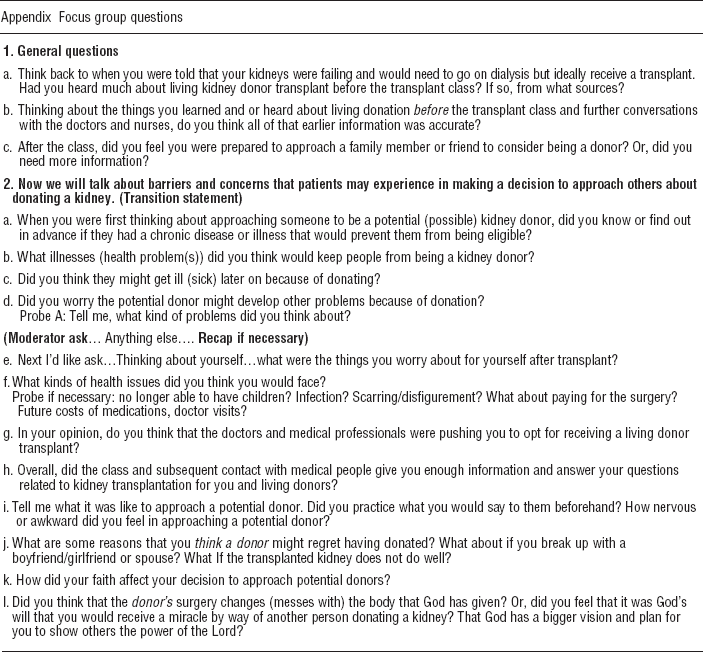
A 46-item questionnaire was used that was based on a literature review and opinions from LDKT recipients, deceased donor recipients, and transplant team members of barriers, myths, and misperceptions associated with LDKT. The new questionnaire included items from 2 previously validated questionnaires that examined current knowledge and concerns about living donations.19,33 The consolidated criteria for reporting qualitative research checklist was used to enhance the quality of reporting the results. 34
Recruitment and Protocol
A convenience sample from the center's list of African American kidney transplant recipients was contacted and scheduled by an African American transplant coordinator from the only transplant center in South Carolina, located at the Medical University of South Carolina. The transplant coordinator described the study in an effort to gauge the recipients' interest and ability to attend. Seventy-seven recipients residing in South Carolina were contacted by phone and invited to participate in the focus groups; 33 (43%) agreed to participate. For those who declined, only 1 person expressed a lack of interest in participating. The barrier cited by the overwhelming majority of nonparticipating recipients was the geographical distance and/or lack of transportation. To address potential literacy issues, purposeful sampling was used in the recruitment to include recipients with various educational levels. Four focus groups (5-9 per group, 2 with deceased and 2 with living donor recipients) were conducted in private conference rooms on the campus of the transplant center. We used equal numbers of focus groups for deceased and living donor recipients to ensure representation that included recipients who were successful as well as those who were not successful in obtaining a living donor. No other exclusion criteria were used. An African American clinical researcher who was a former transplant nurse coordinator, was experienced in focus group interview techniques, and had no prior contact with this sample of participants conducted the interviews.
After consent was obtained, the questionnaire was administered. Next, we conducted the focus group session, which was audio recorded and transcribed verbatim by a transcriptionist. A scribe was present during all focus groups and recorded field notes on verbalized and nonverbal communications during each session. Participants received a $50 gift card at the conclusion of the sessions. The questionnaire took 15 to 20 minutes and was self-administered by most participants, except those who preferred to have it read to them. The focus groups lasted between 67 and 92 minutes. All research activities were reviewed and approved by the institutional review board at Medical University of South Carolina.
Participants
All 27 kidney transplant participants, 13 of whom were men, reported African American race. Mean age was 48.6 (SD 14.6) years; 52% reported having a disability, and 44% were married. Fifty-two percent of the participants had a trade-school education or higher. The mean amount of time since transplant was 4.4 (SD 3.5) years, and the mean amount of years spent on dialysis was 2.8 (SD 2.4) years.
Qualitative and Quantitative Analytic Methods
Focus group transcripts were imported into NVivo 10.0 (QSR International, Pty) for qualitative analyses. A hybrid analysis was used including inductive and deductive methods to develop taxonomy and themes useful to the development of the educational intervention. 35 Each transcript was independently read by 2 of the authors (J.C.S., L.S.N.), who were experienced qualitative researchers. Using constant comparison methods, we read each of the focus group transcripts in a line-by-line fashion to code meaningful clusters of text inductively. Open, axial, and selective coding were conducted in iterative cycles to first identify recurring categories found in the transcripts and then to refine the analyses by relating the concepts. 36 First, an inductive process of open coding was conducted by using the focus group questions to classify, compare, and categorize the responses. Second, axial coding involved reviewing all of the codes found and searching for relationships among codes to organize a set of themes. Third, a selective coding process entailed deductively searching for evidence of alignment with the constructs of self-efficacy and intrinsic motivation. We refined the analyses from a broad set of categories to a reductive set of themes, through the use of immersion and crystallization 37 by 2 of the authors (J.C.S., L.S.N.) using field notes, and nonverbal observations from the focus groups to determine focus group agreement or disagreement on topic areas.
The themes were presented in a focus group format to a group of 10 members of the transplant service (transplant surgeons, nephrologists, and transplant coordinators). Using specific probes and questions for the transplant team members' feedback, we obtained another source of expert experience to assist in the analysis and validate the themes that we had found. Our process of analysis included the creation of an audit trail of findings in NVivo, analysis of all focus group data by 2 independent researchers (J.C.S., L.S.N.), and presentation of the results to a group of clinicians who frequently interact with this population regarding the final themes; we believe that doing so added confirmability and credibility to our understanding of the perceptions of African American kidney transplant recipients related to the process of LDKT.
The internal consistency of the basic psychometric properties of the 2 questionnaires (LDKT Knowledge Questionnaire and LDKT Concerns Questionnaire19,33) was assessed by using the Kuder Richardson Formula 20. The questionnaires were evaluated by first calculating percentages, and χ2 tests were used to compare the responses (yes/no) of deceased donor and living donor recipients. The questionnaires' topics of knowledge of LDKT and concerns about potential donors were analyzed as a whole and stratified by recipient groups.
The mixed-method approach of a convergent parallel design was used to triangulate data sources to produce more accurate interpretations. Convergent parallel designs collect data at the same time and evaluate the qualitative and quantitative data separately and then merge the results to evaluate their congruence. 30 By merging these data and comparing the results of qualitative themes and survey data for areas of agreement and divergence, a more complete understanding of participants' knowledge about the process for kidney donation and donors' perceptions related to LDKT was achieved.
Results
A total of 27 kidney transplant recipients participated in 4 focus groups (5-9 recipients each) from January through March 2013: 2 groups with live donor recipients (n = 11), and 2 groups of deceased donor recipients (n = 16). Six recipients failed to attend the sessions, owing to lack of transportation or schedule conflicts. Comparisons between the deceased and living donor groups did not reveal any significant differences in any descriptive characteristics (Table 1). Theoretical saturation was met in the qualitative analysis. The analysis revealed 4 central themes: concerns; knowledge and learning; expectations of support; and communication. The themes and exemplar quotes are presented in Table 2.
Demographics
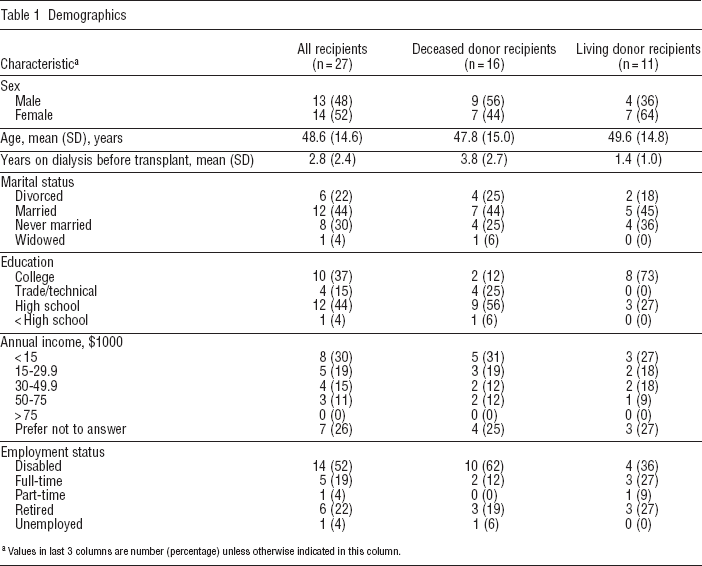
Values in last 3 columns are number (percentage) unless otherwise indicated in this column.
Qualitative themes and exemplar quotes
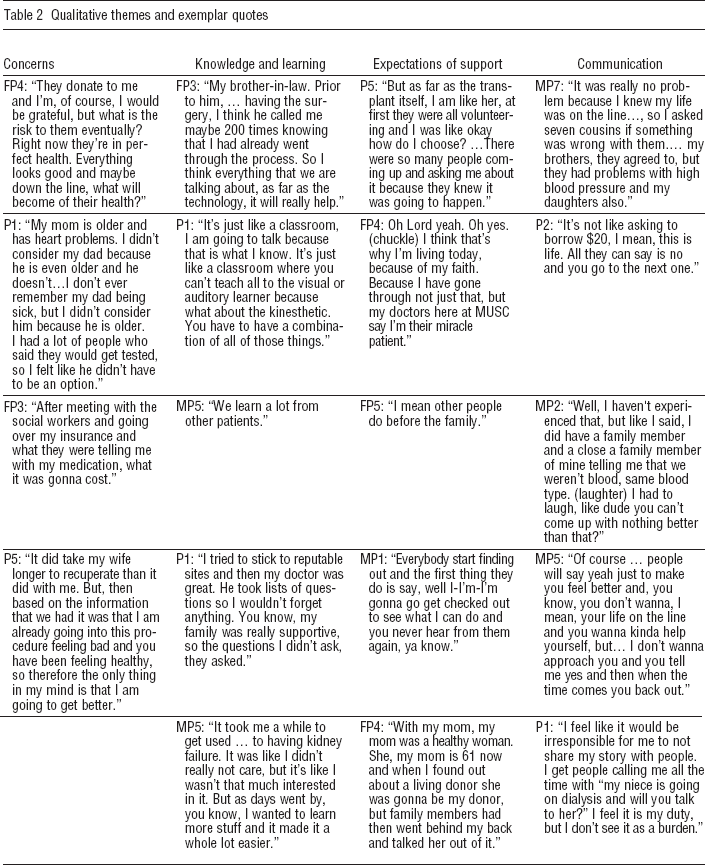
Concerns About Living Donors
The theme “concerns about living donors” was most prevalent within the 4 focus groups. We had probed recipients regarding their concerns related to their own experiences and those experienced by the donor. Recipients expressed concerns regarding their own financial losses and those sustained by the donor related to their time off from work for the surgery and recovery, future health concerns, physical hardships and the scar from the surgery, and the perceived burden if the donor ever needed a transplant. Some were concerned that there might be regret on the part of the donor if the relationship between donor and recipient changed (eg, divorce, no longer friends). Concerns about asking potential donors with 1 or more chronic health conditions often prevented requests or discussions with immediate family members; such concerns were more commonly reported among the deceased donor recipient group. Religious concerns or feeling not in control of one's personal destiny, general anxiety, and fear of the donor dying or being at high risk for development of kidney disease were among other concerns noted. Although many voiced concerns for the donor, there was a general sense of appreciation of being able to get a kidney from the donor and a desire to protect the donor from any potential harms such as missing work, experiencing financial burdens, and health problems resulting from the donation.
Knowledge and Learning
Recipients obtained information and gained knowledge regarding the process of organ donation in a variety of ways: discussions with other people such as patients in the dialysis clinic; meetings with providers, social workers, and financial representatives; and their own Internet searches. Many had little knowledge about organ donation before their experience, and if they were to undergo the process again, they were quite open to learning about the LDKT process in new ways. Methods of learning included use of mobile computer tablets, taking time to learn in a more interactive way with content delivery and interactive video conferencing, and traditional 1-on-1 and group settings. Participants expressed awareness of the progression of their disease, of the complexity of the medication regimens that were needed postoperatively, and of the possibility of rejection, indicating that learning about their disease and self-care was important and continuous as they progressed through the process of transplant and beyond.
Expectations of Support
The recipients discussed many examples of how they felt that their support systems were helpful during the time they awaited a kidney transplant. Three subthemes were found that exemplified their expectations from family (and sometimes lack of follow-through): faith, general support systems, and their appreciation of support. Recipients shared both disappointments with the lack of follow-through from some of the important individuals in their circles of influence and gratitude regarding the support they received and how it met or failed to meet their expectations. Faith seemed to play a pivotal role for most of the recipients. Much of the hope of someone entering in their life to become a donor was seen through their faith. Whether it resulted in complacency with their situation or motivation to ask a potential living donor was mixed.
Communication
The theme of communication provided insight into the need these individuals had to talk with others about their need for a kidney donation. Four subthemes were important: making the request, a duty to educate, benefits of talking with recipients, and health care professionals promoting LDKT. Various levels of comfort with approaching others to consider making the request were discussed. Reports of not feeling skilled or sufficiently knowledgeable to approach others about donation were most commonly voiced among the deceased donor group. For those who experienced a successful living donor transplant, approximately 25% of these participants now felt a personal responsibility to help others awaiting a kidney transplant become more comfortable voicing this subject with family members or friends. Those with a positive experience before their transplant attested to the benefits of learning about this process from other living donor transplant recipients. Overall, recipients discussed being very comfortable talking with members of their health care team, who helped them understand the benefits of receiving a LDKT.
Questionnaire Results
The assessment of internal consistency was conducted on the 2 questionnaires (LDKT Knowledge and LDKT Concerns Questionnaires19,33) by using Kuder Richardson Formula 20. The 23-item LDKT Concerns Questionnaire had an α coefficient of 0.85 comparable to the KR-20's score of 0.79 observed by Rodrigue et al 19 with a sample of 132 patients. The 15-item LDKT Knowledge Questionnaire had a much lower score of 0.29.
Percentages of correct responses to knowledge questions were compared between the deceased donor and LDKT groups (Table 3). Recipients of organs from deceased donors were more likely to believe that only healthy adults may be living donors (100% vs 64%, P = .01). Several nonsignificant trends were notable, including deceased donor recipients believing that living donors: (1) were likely to stay in the hospital after surgery for more than 1 to 3 days (27% vs 0%, P = .06), (2) had increased risk for future kidney disease (25% vs 0%, P = .07), (3) would be negatively affected in their ability to have children (20% vs 0%, P = .12), (4) were likely to have problems functioning at work (38% vs 9%, P = .10), and (5) were likely to require too much time to return to presurgical levels of functioning (38% vs 9%, P = .10).
Recipients' knowledge about living kidney donation and perceptions of donors
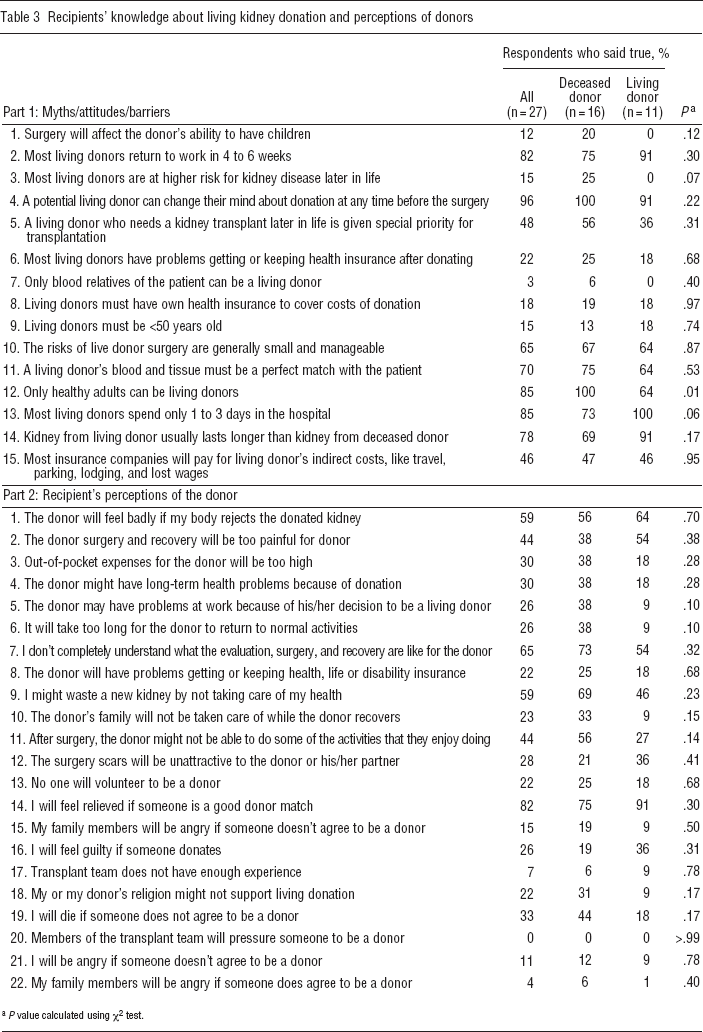
P value calculated using χ2 test.
Results from the 2 scales showed that irrespective of recipient type, there was a significant degree of misunderstanding of the LDKT process and attitudes affecting likelihood of approaching others for a future kidney donation. Participants responded that they did not completely understand the donor process (65%), had misconceptions about what insurance companies would pay (46%), and believed that donors would not be able to do everything they have done before (44%). Only about half of the kidney transplant recipients (48%) understood that living donors who later need a kidney transplant would receive special priority for transplant in South Carolina. They also believed that the risks for donor surgery were not small and manageable (35%), that surgery would be too painful for the donor (44%), and that the donor would feel badly if the recipient's body rejected the kidney (59%).
When triangulating the results, it was noted that compared with the focus groups, the LDKT Knowledge Questionnaire showed agreement with the knowledge and learning themes related to recipients' general lack of understanding of the LDKT selection and evaluation process. Misunderstandings on financial costs incurred by donors following surgery also were found. The LDKT Concerns Questionnaire highlighted other topics that may have not been identified during the qualitative analyses such as concerns about the donor's risks during surgery and the donor's continuing health and functional capacity after surgery.
Discussion
Findings from this study suggest that African American kidney transplant recipients experience many of the same patient-level barriers in the living donation process as other ethnic groups. 15 That is, our 4 qualitative themes (knowledge and learning, concerns, expectations of support, and communication) indicated that African American kidney transplant recipients were reluctant to engage in the LDKT process. This reluctance was especially the case for the step of approaching others, owing to misguided concerns as a result of lack of understanding of donor eligibility and the likely physical and/or financial repercussions donors typically encounter. Another significant barrier, especially among deceased donor recipients, was the lack of confidence or know-how in approaching others to discuss donation consideration, especially persons who are not family members. Lack of follow-through by members of their immediate social network for support and assistance when diagnosed with ESRD also contributed to lowering the desire to approach individuals as potential donors. These barriers significantly contributed to patients' inability to secure a living donor.
The triangulation of the questionnaire findings with the qualitative data resulted in corroborative support of the themes derived from the focus groups and gave context to specific barriers that must be addressed for future programs. Most of the African American transplant recipients, particularly the recipients of organs from deceased donors, had several areas in which their LDKT knowledge was lacking. These areas included eligibility criteria, issues that donors will face such as typical duration of hospital stay, time to return to presurgical functioning, effect on ability to have children, likelihood of increasing future risk of kidney or other chronic diseases, and financial constraints. This comparison was unique to this study in part because of the use of the mixed-methods design. Also, having both deceased and living donor recipients, we were able to better identify the issues that were more apparent for those who did not find a living kidney donor. This finding suggests that increased attention needs to be placed upon educating and confirming that patients eligible for kidney transplant understand the LDKT process, especially with regard to donor eligibility criteria and experiences they are likely to encounter.
LDKT Knowledge and Suggested Educational Approaches
Although recipients exhibited basic knowledge of the living organ donation process, it appears that a more comprehensive approach than what is now provided would be beneficial to transplant-eligible patients. As noted earlier, more comprehensive understanding about donor eligibility criteria is needed, including topics such as age, blood-type and immunological compatibility and chronic comorbid diseases allowed, including obesity. A pervasive lack of understanding of the paired exchange program was also found among both LDKT and deceased donor recipients. Further, both types of transplant recipients also seemed to have limited who they asked because of preconceived ideas of donor exclusion criteria. This misunderstanding was also evidenced during the clinician focus group, which suggested that one of the principal messages to be conveyed is that potential recipients should not eliminate potential candidates because of their perceptions of chronic disease, age, and other factors and should allow the transplant medical team to make the decision.
Educational strategies have varied in previous studies aimed at increasing LDKT. Among a group of patients who received an educational video and booklet about LDKT, one group also had social workers conduct several home visits to assist the patient and family members in identifying LDKT barriers. This group exhibited further increases in their subsequent discussions and pursuit of LDKT in the subsequent 6 months. 38 Rodrigue and colleagues compared the standard brief clinic education approach to health educators discussing the LDKT process with patients and their support network (ie, family members, friends) at the clinic versus patients' homes. They reported that, compared with the standard clinic approach, those who engaged in the home visit education session, especially African Americans, made more living donor inquiries, had more subsequent donor screening evaluations, and completed more LDKTs.33,39,40
Despite these successful approaches, mistrust of medical professionals has been seen as an underlying barrier for accepting information on the LDKT process. This barrier was evident in our study, where recipients had issues with what sources of material to trust. Other research has also shown higher levels of mistrust of medical research and medical care among African Americans than among members of other racial groups,15,41,42 Yet, McDonald et al 42 noted finding a strong relationship between trust in the medical system and LDKT for African Americans. Having trained nonmedical personnel deliver education and skill-building materials may be more likely to be perceived as trustworthy because the messaging would be reinforced by both the community and the medical team. In the instance of LDKT education, other African American LDKT recipients or other nonmedical staff with personal experience with LDKT could be the primary proponent to relay education materials to patients. Doing so would imply using a culturally tailored emphasis, which is an important educational strategy, as noted in a recent review by Waterman et al 15 and by others.14,25,33
Misguided Concerns About Donors
Misguided concerns centered on donors was another major theme (eg, burden on the donor, financial costs, future health problems, physical hardships, age, being outside the family), which prevented deceased donor recipients from approaching others and limited LDKT recipients in the numbers they approached. These areas agreed with prior research where African American recipients' barriers included concerns of potential physical harm resulting to the donor, inconveniencing the donor, or worry about how the donor may feel resentful if the donor kidney failed.16,18,23,24 Pradel et al reported that recipients' and potential recipients' 2 biggest barriers to accepting a living donor kidney included concern that the donor would experience financial burden and that the donor could experience kidney function problems in the future. We found similar concerns in the focus groups, showing that these concerns are largely the concerns expressed 11 years ago and are topics to focus upon strongly in future LDKT programs. 24
The expectation of support also played into the recipients' perceptions where lack of follow-through or support negatively affected future opportunities whether to bring up the topic of living donation in the first place. Our findings reinforced that a mismatch in perceptions between recipients and potential donors most likely exists and was worse for recipients of organs from deceased donors. To dispel these concerns, communication skills may need to be bolstered through education efforts to address inquiry into potential donors' perceptions of the process and personal feelings. Further, inclusion of living donor testimonials in brief video clips used as educational materials could dispel some fears that potential recipients may have about donors' attitudes toward LDKT such as how the donor-recipient relationship and the donor's health may be negatively affected. 43
Lack of Communication Skills
The act of initiating a conversation with someone to consider donation was a particularly difficult issue even among the subgroup of LDKT recipients. Other studies have had similar results, with only about half of ESRD patients seeming to be willing to approach others about their need.17,19,22 This reluctance was especially apparent for deceased donor recipients on topics about how to assess who is healthy enough to donate and the general anxiety associated with skill deficiencies on how to initiate and engage in a conversation, including feeling confident in their ability to discuss donors' potential questions.
Also, fear of being rejected played a role for many in terms of the potential donor's negative response and/or the donor candidate feeling guilty for not being receptive, having an effect on their relationship, and other negative outcomes. These feelings may be more pronounced in African Americans, as whites are 3 times more likely, compared with African Americans, to talk to others about living donation. 19 Even among our focus group participants who recognized the benefits of receiving a LDKT, 68% lacked the motivation to ask others.
Collectively, both LDKT recipients and recipients of organs from deceased donors lacked the confidence needed to approach others outside of their immediate family. Previous findings have shown that whites had a higher incidence of obtaining unrelated living kidney donors than African Americans do. 44 This disparity highlights that the differences among races in approaching others beyond first- or second-degree family members may be rectified by careful attention toward developing culturally sensitive and tailored education efforts for African American transplant-eligible ESRD patients to learn how to share their need and also answer concerns of potential donors. Participants noted that they would have been helped by specific skills training with respect to the mental preparation and/or actual practice at approaching others as a way of gaining confidence. Although some ESRD patients may grasp how to do this quite readily, many need to learn how to initiate the topic and market their need for a kidney. If not supplied with these skills, patients eligible for kidney transplant may prefer to wait for volunteers to approach them than to ask anyone directly.16,45
From the findings, we find that it is vital to gauge success of educational programs via evaluation of knowledge and of self-efficacy in being able to approach others for donation screening after the program. Such information will help facilitate rapid refinement of deficiencies in patients' knowledge or skills and possibly tailor the education materials where help is needed most. One approach to identify specific needs is through an initial evaluation by using valid scales to assess LDKT knowledge, underlying concerns, and self-efficacy toward approaching potential donors. The intent of such an assessment would be to identify those who need training in understanding the LDKT process and the communication skills to approach and effectively discuss the LDKT process with potential donors.
Although these findings corroborate results of many of the studies that involved other ethnic groups, several limitations should be taken into account when interpreting the findings. The focus groups comprised successful African American recipients of deceased donor organs or LDKT recipients from South Carolina. These findings may not generalize to other African American transplant recipients, much less ESRD transplant-eligible patients in South Carolina or in other parts of the United States. However, the participants were from a mix of urban and rural areas and included both sexes. Another limitation is that the participants may have reacted to questions with an expectancy bias and given more positive responses because of the medical center setting. It is also possible that those who self-selected to participate in the focus groups had more positive attitudes about living donation than others. Finally, it is unclear whether the participants were truly reflecting upon their knowledge base and the attitudes that they had during the transplant waiting period.
Conclusion
The derived themes and barriers to engaging in the living donation process generally support prior studies' involving ethnic groups other than African Americans. Even though African American LDKT recipients had a better understanding about the process than did African American recipients of deceased donor organs, both groups, as well as transplant-eligible African American patients with ESRD, would benefit from receiving LDKT-specific education materials and skill building on how to approach others for donation. Importantly, use of trained African American LDKT recipients as navigators/educators may increase acceptability of the programs. Finally, inclusion of knowledge and self-efficacy evaluations after the program, as well as access to an African American navigator for continued support and assistance may prove beneficial in increasing the rate of LDKT among African Americans.
Footnotes
Acknowledgments
The authors thank Brenda Brunner-Jackson for program management support and the Medical University of South Carolina Transplant Center coordinators, Sara Stello and Phyllis Connor-Richey.
This publication was supported with funding from National Institutes of Health (NIH) grant DK 098777 and the South Carolina Clinical and Translational Research Institute, with an academic home at the Medical University of South Carolina, Clinical and Translational Science Award NIH/National Center for Advancing Translational Sciences (NCATS), grant UL1RR029882. The content does not represent the official views of the NIH or the NCATS.