






Abstract
Context—
Very few patient-centered, theory-guided programs for medication adherence and blood pressure control have been conducted in kidney transplant recipients.
Objective—
To evaluate preliminary indications of sustainability of improved blood pressure in kidney transplant recipients 12 months after completion of a 3-month randomized controlled trial of a mobile health pilot program to improve blood pressure and medication adherence.
Participants and Design—
A total of 18 of the 19 trial participants were contacted and all consented to inclusion in the retrospective analysis of their medical records showing their clinic-recorded systolic blood pressures at 3, 6, and 12 months following participation in the 3-month trial of a medical regimen self-management intervention.
Results—
A significant group difference in systolic blood pressure was observed longitudinally, indicating that the intervention group, as compared with the standard-care group, exhibited lower clinic-measured systolic blood pressures at the 12-month posttrial follow-up visit (P = .01). At 12-month follow-up, success in establishing and sustaining control of systolic blood pressure (<131 mm Hg) was greater in the intervention group (50%) than in the control group (11%).
Conclusion—
Patients in the intervention group continued to exhibit lower systolic blood pressure than did patients in the control group 12 months after the trial ended, suggesting that the intervention may have a durable impact on blood pressure control that most likely reflects sustained medication adherence. These findings will aid in the development of an adequately powered randomized controlled trial to address the sustainable impact of the intervention program on medication adherence and blood pressure control.
Kidney transplant is the reference-standard treatment for end-stage renal disease, with multiple studies establishing its association with superior quality of life, improved life expectancy, and better psychosocial functioning, all at substantially lower cost than maintenance dialysis.1,2 Unfortunately, long-term graft survival rates after kidney transplant have remained largely unchanged despite numerous advances in the medical and surgical care of kidney transplant recipients. At present, the 3-year graft survival rate is 81%, 2 and graft half-life is approximately 9 years. 3 Medication nonadherence and poor control of comorbid medical conditions are major contributors to graft rejection, graft loss, and death.45–6 A meta-analysis 7 of 147 solid-organ transplant studies revealed that kidney transplant recipients experienced the highest rate of medication nonadherence at 35.6%. When dose timing is taken into consideration, our findings and those of others indicate that rates of medication nonadherence are even higher.8–10
Hypertension is the most commonly diagnosed chronic illness in the United States, is the leading cause of end-stage renal disease, and affects approximately 90% of kidney transplant recipients.11,12 Hypertension is most often only poorly controlled, with ambulatory blood pressure monitoring showing only 5% of kidney transplant recipients to be normotensive.13–19 Poor control of hypertension following transplant has been closely associated with graft dysfunction, graft loss, and death. However, reductions in systolic blood pressure to less than 140 mm Hg in kidney transplant recipients, even after several years of uncontrolled hypertension, have been associated with significantly improved long-term survival of grafts and patients. 20 Although sustained adherence to antihypertensive medications can control hypertension, 21 medication nonadherence remains the leading modifiable barrier to blood pressure control.22,23
Our team recently identified pretransplant hypertension in 89% of our kidney transplant recipients and found that only 36% met the guidelines of Kidney Disease: Improving Global Outcomes (KDIGO) for hypertension control at a mean follow-up of 7.3 (SD, 4.5) years after transplant. 24 In a recent review 25 of publications on management of hypertension in kidney transplant recipients, our group concluded that posttransplant hypertension is prevalent (70%–90%), multifactorial, and rarely controlled (∼33%).
Although medication nonadherence is critical for optimal kidney transplant outcomes, little research has been focused on interventions directed at improving medication adherence. A recent review 26 of studies of medication nonadherence in kidney transplant recipients yielded 12 studies (8 randomized controlled trials [RCTs]) that ranged from 3 to 12 months in duration. Intervention approaches included education of patients or primary care providers and changing patients' motivational, behavioral, or psychological/affective state. In fewer than half of the studies was a significant improvement in adherence to even a single medication observed. Multidimensional programs were most effective, especially the few that included pill administration devices and self-monitoring. The review included our feasibility pilot RCT.
Importantly, none of the trials, aside from our pilot trial, included self-monitoring or evaluation of change in a physiological parameter (eg, blood pressure) that would be expected with altered medication-taking behavior. Only one study 27 addressed the sustainability of adherence following trial cessation, but those researchers found no statistically significant differences between the groups either during the trial or at follow-up.
The high prevalence of uncontrolled hypertension has led others to examine the efficacy of intervention programs directed at improving control of blood pressure. In 3 meta-analytic reviews28–30 of 133 RCTs, the collective conclusion was that self-monitoring of blood pressure (measurements typically brought, mailed, or phoned into clinic), medication reminder tactics (live or automated phone calls), and education/counseling, individually or in combination, often improve adherence, reduce therapeutic inertia, and result in small but significant improvements in blood pressure. However, typically only 40% to 50% of patients reach their blood pressure goals, and the improvements often deteriorate once the trial is over.
Development of a Medical Regimen Self-Management Program for Kidney Transplant Recipients
Given the lack of an established effective program for ensuring medication adherence and blood pressure control for kidney transplant recipients, we examined the possibilities of capitalizing on recent advancements in health technology. More specifically, researchers in recent studies31–35 have suggested that remote monitoring using mobile health (mHealth) technology is an effective and sustainable strategy for facilitating communication between patients and providers, improving health outcomes, increasing adherence to medical regimens, and reducing costs in some chronic illnesses. Chandak and Joshi 36 recently reviewed 12 technology-enabled self-management programs for controlling hypertension that included mHealth wireless and wired monitoring of blood pressure, Internet and telephone-based monitoring and education, videoconferencing, and use of an automated modem device. Their findings were promising and suggested that these technology-based approaches could successfully improve blood pressure control in 3- to 12-month periods, but the sustainability of those improvements after trial completion was not evaluated.
Mobile phone–based monitoring is a particularly attractive option because of the ubiquity, connectivity, computational power, portability, and relatively low cost of mobile phones.32,34 For those reasons, our team elected to develop a smartphone-enabled self-management system for medication adherence and blood pressure control by using a patient- and provider-centered iterative design.9,10,37 The development framework used self-determination theory with iterative stages that were guided and refined on the basis of feedback and suggestions from kidney transplant recipients and their health care teams, including transplant surgeons, nephrologists, and transplant coordinators.
Initially, key informant interviews were conducted and information was obtained with regard to barriers (eg, forgetfulness, poor planning, lack of transportation to pharmacy, side effects, costs) to and facilitators (eg, use of reminder techniques, pill box, home blood pressure monitor) of adherence to the medical regimen. We also gathered information on key informants' understanding of, and attitudes toward, potential uses of mHealth technology. They provided feedback on several Bluetooth-enabled medical devices and suggestions regarding the content and timing of electronically delivered medication and blood pressure reminder alerts, motivational and reinforcement messages for adherence, and the auditory and visual feedback of blood pressure control and medication adherence. That information was used to develop the Smartphone Medication Adherence Saves Kidneys (SMASK) prototype mHealth system. We then undertook the administration of a formal survey that assessed kidney transplant recipients' use of cellular technology, understanding of mHealth, and thoughts on the acceptability of the SMASK prototype. 37
The survey findings and the recommendations of the participants were used to make further refinements to the SMASK system. We then conducted a 3-month feasibility pilot RCT in 19 hypertensive kidney transplant recipients previously identified as nonadherent to their medication regimen via a month-long screening that used an electronic medication tray.9,10 Details of the study design, implementation, medication adherence criteria, and results are presented elsewhere.9,10 The purpose of the pilot trial was to assess acceptability and usability and to obtain preliminary indicators of treatment efficacy (ie, blood pressure control) as necessary input for the design of a future efficacy RCT. The results, in brief, indicated that the SMASK system was highly acceptable to the participants and was usable, and the improvements seen in medication adherence and blood pressure control were promising. Signals of outcome efficacy were observed, with the SMASK group exhibiting statistically significant improvements in electronically monitored medication adherence scores with a mean of 0.92 versus 0.56 across the trial and the percentage reaching KDIGO guidelines for control of systolic blood pressure during the trial (90% vs 10%) as compared with the control group that received standard care.9,10
As noted earlier, the mHealth approach to chronic disease self-management is still in its infancy, and little is known regarding the sustainability of behavior change after the formal trial phase has ended.38,39 The purpose of this exploratory pilot study was to obtain estimates of variability for clinic-based measurements of systolic blood pressure in the 12 months following trial completion as preliminary indicators of treatment sustainability. Variability estimates will also be used as input for the design of a future efficacy RCT.
Materials and Methods
Study Participants
The present study builds on the 3-month pilot feasibility RCT briefly outlined in the preceding section. That RCT was conducted in Charleston, South Carolina at the Medical University of South Carolina and involved 19 hypertensive kidney transplant recipients with documented medication nonadherence.9,10 Briefly, potentially eligible patients were identified through weekly data extractions from the appointment database. Inclusion criteria were (1) first-time recipient of a functioning solitary kidney transplant performed 3 months earlier, (2) prescribed a total of at least 3 medications for immunosuppression and hypertension, and (3) transplant physician's assent that patient was able to participate. Exclusion criteria included (1) inability to self-administer medications, (2) inability to measure own blood pressure, (3) inability to use a mobile phone, (4) history of psychiatric illness or substance abuse, (5) pregnant, lactating, or intending to become pregnant during the trial, (6) participant in another study, (7) inability to speak, hear, or understand English, and (8) poor cellular coverage at their home.
Recruitment Into Follow-up Pilot Study
One year after the conclusion of the RCT, we were able to contact 18 of the 19 participants who had completed the 3-month RCT.9,10 All participants who we contacted agreed to allow data from their electronic medical record to be used in this follow-up study. We performed a retrospective chart and electronic medical record review examining the clinic-recorded blood pressures for each patient and extracted their systolic blood pressure measurements obtained at the clinic 3, 6, and 12 months after completion of the RCT. The institutional review board approved the study.
Statistical Analyses
We used a generalized linear mixed model (GLMM) approach (PROC MIXED, SAS 9.3) to examine the effect of the mHealth intervention on systolic blood pressure measured during clinic visits over time. GLMM was used to account for correlation of measurement within participants, as well as for missing data. Three patients were each missing 1 measurement of systolic blood pressure from the 3 posttrial clinic visits during the 1-year follow-up period. The model included systolic blood pressure as the dependent variable and time, intervention, and a time-by-intervention interaction term as fixed effects. Correlations between measurements were assumed to decrease with increasing distance in time; therefore an autoregressive covariance structure was used. Fisher exact tests were conducted to evaluate differences in percentages of participants by group classification who exhibited control of systolic blood pressure that met the KDIGO guideline (<131 mm Hg) at each evaluation.
Results
Demographic and transplant-related clinical characteristics of the 2 groups of study participants are presented in Table 1. Although patients had been randomly assigned to treatment condition, a Wilcoxon rank sum test revealed that those in the control group (standard care) were significantly older than those in the intervention group (P = .01). Participants did not differ significantly on months since transplant (P = .50) or number of prescribed medications (P = .60). Unadjusted and least-square means for systolic blood pressures measured in the clinic are presented in Table 2 for the baseline and the 12-month follow-up visits along with mean differences between the 2 groups at each time point. The GLMM analysis revealed that the effect of the SMASK mHealth intervention on systolic blood pressure was statistically significant (F = 9.6, df = 1, P = .006). Although the time-by-intervention group interaction term was not statistically significant (P = .54), examination of Table 2 demonstrates that patients in the SMASK group had a statistically significantly lower systolic blood pressure at the 12-month postintervention follow-up (P = .01) with a Cohen d of 1.86. Although age was significantly different between the groups, when entered into the model, it did not have a statistically significant effect on systolic blood pressure.
Descriptive characteristics of sample
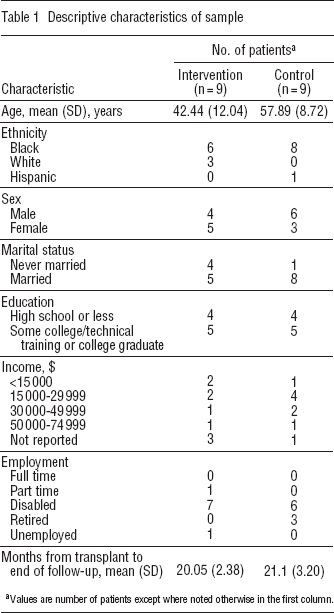
Values are number of patients except where noted otherwise in the first column.
Unadjusted and least-square means (derived from generalized linear mixed model) and differences in means between groups for systolic blood pressure (in millimeters mercury) obtained at baseline and at 12-month follow-up clinic visit
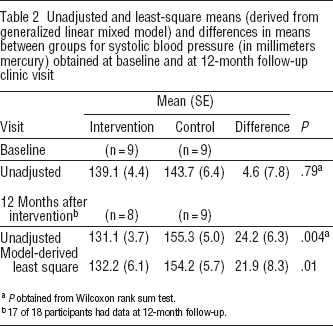
P obtained from Wilcoxon rank sum test.
17 of 18 participants had data at 12-month follow-up.
Either χ2 or Fisher exact tests were conducted to compare each group's percentage of participants who met the KDIGO guideline criterion for control of systolic blood pressure (<131 mm Hg) before the intervention and at the 12-month follow-up clinic visit. Although no statistically significant difference was observed, a greater fraction of SMASK participants had achieved control of systolic blood pressure at the 12 month follow-up visit than in the control group (50% vs 11%; Table 3). At the 12-month follow-up clinic visit, systolic blood pressure ranged from 125 to 178 mm Hg in the control group, whereas blood pressure in the intervention group ranged from 110 to 144 mm Hg.
Percentages of patients attaining blood pressure control according to Kidney Disease: Improving Global Outcomes guidelines (systolic blood pressure <131 mm Hg) by treatment arm
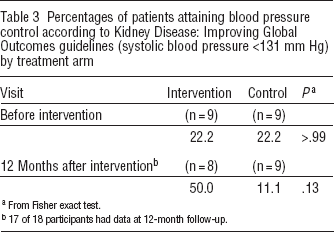
From Fisher exact test.
17 of 18 participants had data at 12-month follow-up.
Discussion
The development of effective, efficient, and acceptable approaches to aid kidney transplant recipients' self-management of their medical regimen is critical to optimizing medication adherence and graft survival, particularly as limited health care provider resources are increasingly taxed by growing demand. Smartphone-based management is an attractive option thanks to the ubiquity, connectivity, computational power, portability, and relatively low cost of smartphones.32,34,40,41 Recent studies have supported remote monitoring via mHealth technology as an effective and sustainable strategy for facilitating communication between patients and providers, increasing adherence to medical regimens, optimizing control of medical conditions, improving health outcomes, and reducing costs in some chronic illnesses.31–35,39,41–45 As penetrance of smartphone technology increases, it seems likely that the demand from consumers for this type of health care delivery will increase. Although the evidence for the acute effectiveness of the mHealth approach is mounting, little remains known about the sustainability of the results after the acute intervention has ceased.
Our initial 3-month feasibility RCT employed a relatively simple mHealth prototype system designed to encourage medication adherence and better control of blood pressure. Blood pressure served as a meaningful physiological indicator of the impact of improved medication adherence. We observed statistically significant and clinically relevant reductions in systolic blood pressure measured in the clinic and significant improvements in medication adherence in the SMASK cohort compared with the standard-care control group.9,10
Although the results of the short-term pilot trial were promising, we were interested in examining estimates of sustainability of those improvements in blood pressure and so undertook the present pilot study. Our findings indicated a statistically significant difference between the SMASK and standard-care groups in systolic blood pressure at the 1-year postintervention clinic visit. These findings suggest that medication adherence in the SMASK cohort continued to be superior to that in the control cohort. It further suggests that our mHealth intervention instilled in patients the increased competence, self-efficacy, and intrinsic motivation necessary to sustain their medication adherence in the absence of the formal reminder tactics, feedback information on blood pressure levels, and motivational/reinforcement messages.
Multiple factors most likely account for the increasing systolic blood pressure observed in the control group at the 12-month follow-up period. As the kidney transplant recipients transition out of the high-acuity care management model typical of the immediate postoperative period, their health care management changes from the more centralized care of the transplant center to the more collaborative and decentralized care of the referring nephrologists and primary care providers. At the same time, the frequency of clinic visits decreases and there is a concomitant diminishment of the emphasis on adherence to the medical regimen and fewer opportunities to engage the patient on the subject or to identify medication nonadherence. In this setting, kidney transplant recipients who have not established an internalized motivational drive to sustain appropriate medication-taking behavior are more likely to have significant medication nonadherence with a resultant worsening of their blood pressure control.
These findings must be evaluated within the context of several limitations of the study. First, the lack of hard medication adherence data (eg, MedMinders, medication possession ratios) raises the possibility that a factor aside from medication adherence may account for the differences in systolic blood pressure. When the RCT ended, all participants returned their MedMinders and the SMASK patients returned the Bluetoothed blood pressure devices and smartphones. Gathering accurate and reliable data on the participants' medication possession ratio once the trial ended proved untenable because of the large number of providers, pharmacy sources, and dose adjustments. Based on patients' self-report, comparable percentages of kidney transplant recipients by previous group classification (SMASK vs standard-care control) owned devices for monitoring blood pressure and standard plastic pill trays. More former SMASK participants than standard-care participants (80% vs 60%) reported using various methods to assist them in adhering to the dosage time schedules (eg, mobile phone reminder alerts, establishment of routine behavior patterns). It seems reasonable to conclude that sustained medication-taking behavior established during the RCT is the most likely explanation for the persistent difference in systolic blood pressure between the 2 groups. That the transplant clinic nurses did not adhere to a rigid protocol for measuring blood pressure is a second limitation. It should be noted, though, that during the 3-month RCT and all of the follow-up evaluations, the blood pressure measurements were taken by nurses or coordinators blinded to the subject's cohort assignment. Given that, it seems reasonable to conclude that variability of the blood pressure measurements due to technique were most likely balanced across the 2 cohorts.
Conclusions
To our knowledge, this study is the first to evaluate the long-term impact of an acute mHealth medication adherence intervention on blood pressure control among patients with uncontrolled hypertension, let alone among kidney transplant recipients. These data provide promising evidence that an mHealth self-management program, which was developed by using an iterative design process and a patient and provider-centered approach and was guided by behavioral change theory and technology acceptability models, can have a lasting impact on patients' self-management of chronic medical illnesses.
Although these data are encouraging, the sample size was small and further empirical evaluations in other groups of kidney transplant recipients are needed. These data provide us with much-needed estimates of variability in systolic blood pressure 12 months following trial completion for purposes of designing an adequately powered efficacy RCT in the future. The expected next steps will include a large-scale efficacy RCT that will include posttrial key informant interviews with health care providers and focus groups with SMASK participants to gather suggestions and guidance for further refinement of the SMASK program. Following that, a large-scale multi-site effectiveness RCT will be conducted, again with longer follow-up evaluations (ie, 12–24 months). The longer follow-up periods will enable us to evaluate the impact of the mHealth program on graft fibrosis, rates of rejection, and graft survival.
Footnotes
This paper was supported in part by funding from the National Institutes of Health (NIH) grant DK 103839 and the South Carolina Clinical and Translational Research Institute, with an academic home at the Medical University of South Carolina, Clinical Translational Science Award NIH/National Center for Research Resources (NCRR), Grant No. UL1RR029882. The content does not represent the official views of the NIH or NCRR.