Editorial
Select search scope: search across all journals or within the current journal

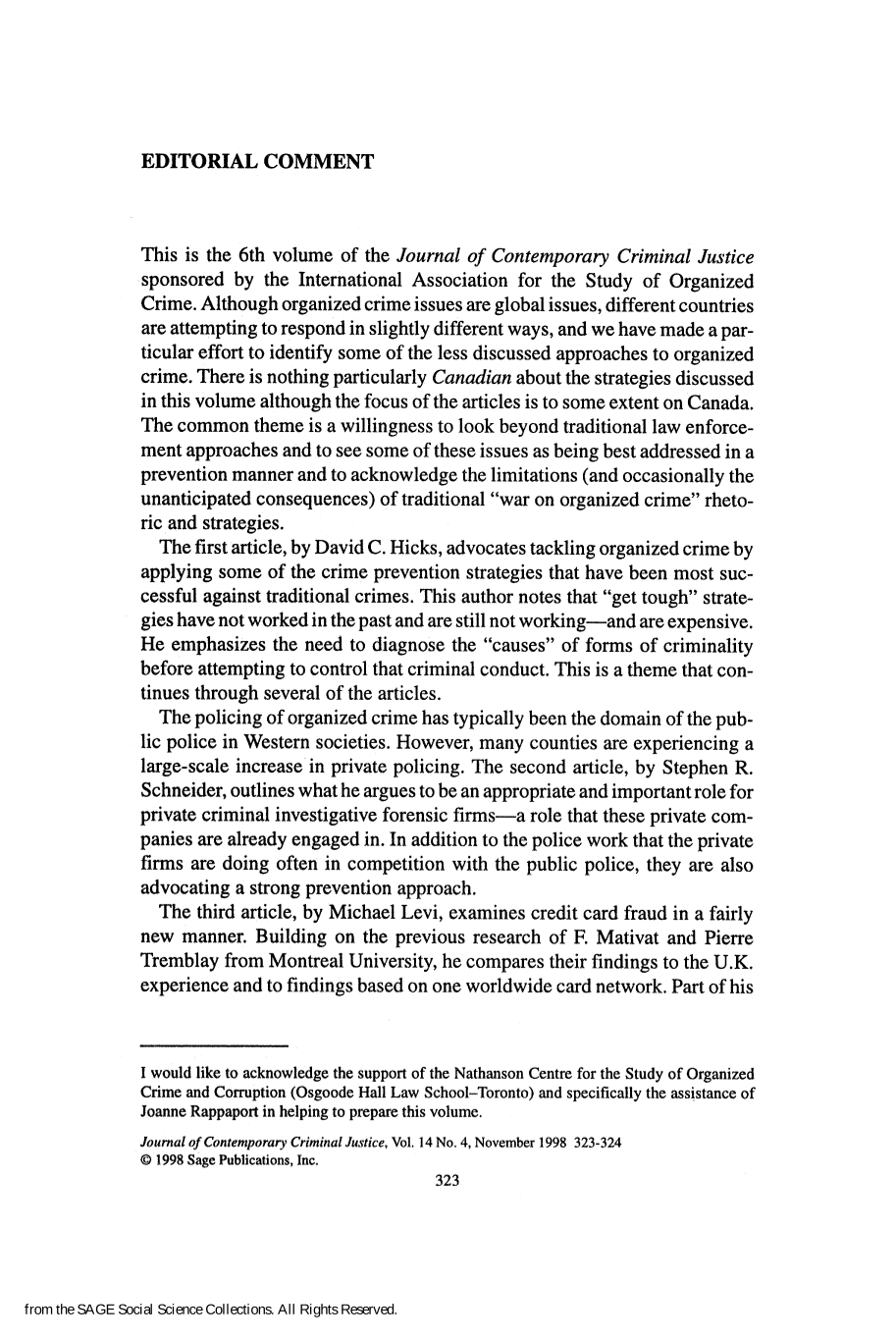
Crime fighting heroics associated with “get tough” approaches to traditional organized crime policing are not working. Aggressive enforcement measures aimed at detection, seizure, and confiscation of assets, and prosecution of offenders are not substantially hurting organized criminal enterprises or diminishing the overall threat of organized crime. This article discusses this lack of effectiveness and locates it within the context of global economic integration. It then explores selected facets of the interdependence between organized and traditional crime, and the potential of crime prevention to more effectively tackle organized crime. The article concludes with steps toward an effective and sustainable program of organized crime prevention.
This article explores the role of the forensic investigative firm in combating the involvement of organized crime in Canada's private sector. Although the onus for organized crime enforcement has fallen exclusively on the shoulders of the state, there is a potentially meaningful role for the largest of these firms to play. This role is based on the resources and expertise of the forensic investigative industry, including former police investigators, professional researchers, forensic accountants, intelligence analysts, industry experts, a national and international structure, and an ongoing auditing and consulting relationship with industries vulnerable to organized crime. The optimal role of the forensic investigative firm is a preventive one. This includes working with industries to determine the nature and scope of the problem and helping them develop preventive polices and programs. This preventive role would complement the largely reactive role of public police in organized crime enforcement in this country.
Tremblay and colleagues have advanced some important insights into the nature of credit card fraud, especially counterfeit card, markets in Canada. This study examines the international applicability of these findings and presents some data about the nature of credit card fraud in contemporary North America and the United Kingdom, showing how card issuers, merchant acquirers, and retailers seek to cope with the levels and organization of offending. Frauds can be committed by a continuum of organizational forms, from lone thieves who use the cards they have stolen to global organized crime syndicates. Barriers to entry for offenders will increase as technologically driven fraud prevention is enhanced, and involvement will depend on the availability of capital investment and technological skills (e.g., high-quality counterfeiting) and the attractiveness of such frauds compared with other criminal and noncriminal opportunities for any given individual or group.
This article illustrates how issues of sovereignty, jurisdiction, and criminal justice traditions preclude the possibility for international law enforcement homogenization in the near future. It does so by taking as an example some of the cultural-legal difficulties that arise when two countries such as Canada and Colombia attempt to engage in large-scale transnational law enforcement. In addition to the more philosophical issues of sovereignty are the numerous legal and cultural differences that make collaborative law enforcement extremely difficult. Many terms that North Americans take for granted prove to be problematic. For example, even the term
This article identifies three structural, procedural and policy decisions that relate to organized crime law enforcement: the structure of the investigative agencies dedicated to containing organized crime, the relationship between the police and the prosecutorial authority, and the use of forfeiture laws and decisions as to who should benefit from these illicit proceeds. Within a frame-work of globalization, we recognize the need for a degree of uniformity in law enforcement across jurisdictions in order to attempt to target transnational criminals. Pressures are put on countries to meet new international standards and to put into force legislation that is compatible with the laws and procedures in place in other jurisdictions. In an explorative manner, we compare and contrast the U.S.-style of investigating organized crime to that of Canada and examine the possible “Americanization” of Canadian policing. The objective of this article is not to recommend what ought to be the response in terms of organized crime enforcement, but rather, bearing in mind traditions, to identify some of the key fundamental differences between our two approaches and to acknowledge the weaknesses and strengths inherent in the various strategies.

