Editorial
Select search scope: search across all journals or within the current journal


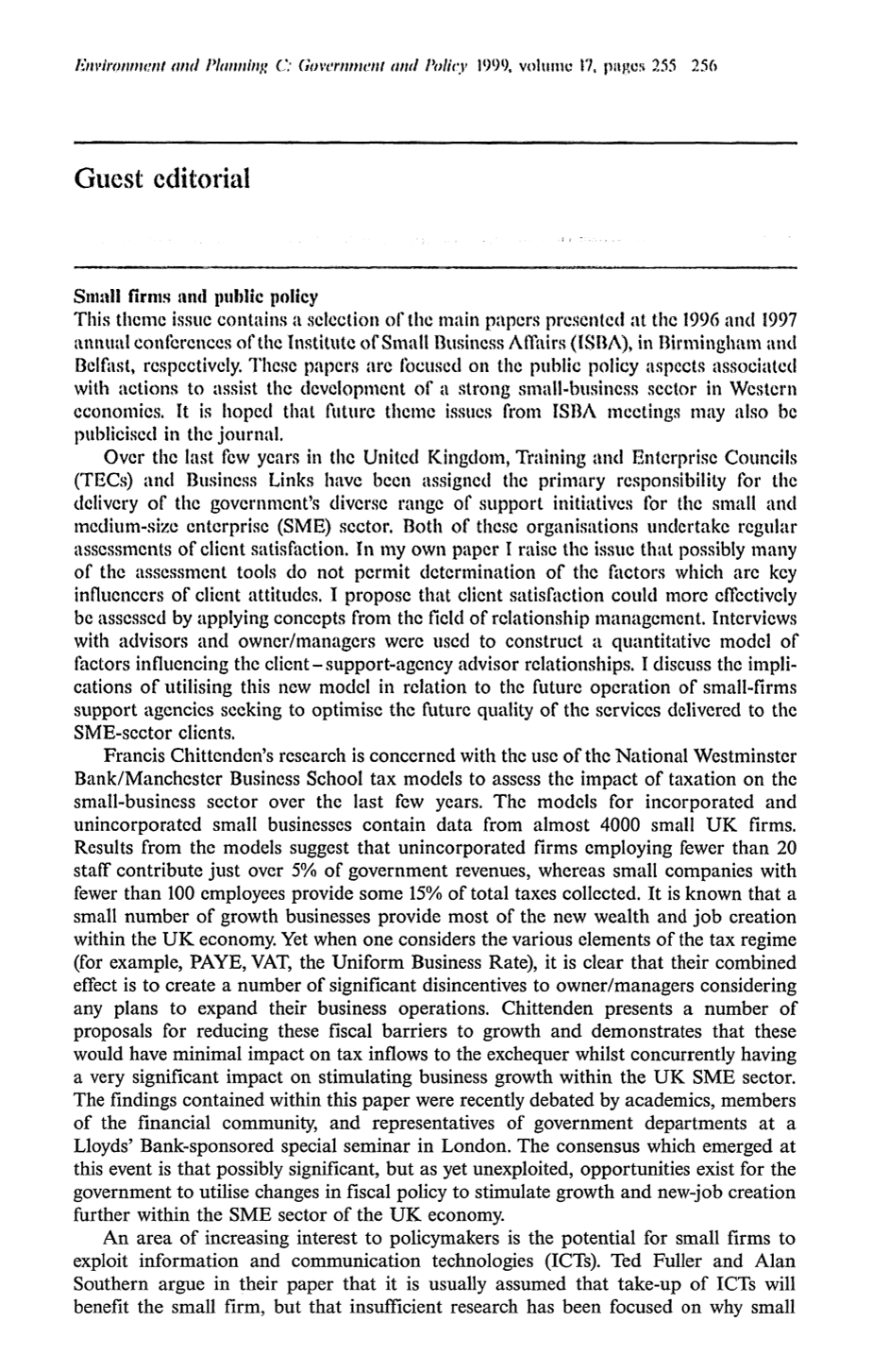
Over the last few years, the UK government has sought to assist more effectively small and medium-sized enterprise (SME)-sector firms through the creation of Training and Enterprise Councils and Business Links. These organisations undertake assessment of client satisfaction. Most of their measurement tools, however, do not permit determination of the factors which are key influences of client attitudes. Research on customer behaviour both in industrial markets and in service environments has caused some academics to posit that, in many situations, the application of traditional transactional-market-research tools is often ineffective. Accordingly, they propose that satisfaction measurement should encompass the influence of a relationship-management orientation because the processes designed to build long-term customer loyalty may be a more appropriate philosophy through which to gain understanding of SME-sector attitudes to services delivered by suppliers. The aim, therefore, is to examine the relevance of applying a relationship-management research tool to assess client satisfaction in small-business-advisory scenarios. Interviews with advisors and owner/managers have been used to construct a qualitative model of factors influencing the client-advisor relationship. The implications of the study are discussed in relation to the future operation of not-for-profit support agencies seeking to optimise the effectiveness of service provision. Proposals are made concerning the need for further research.
In this paper we examine, using the NatWest/Manchester Business School (MBS) tax models, the impact of taxation on the small business sector over the last few years. Because it is known that a small number of growth businesses provide most of the new wealth and additional employment created by the small firms sector, consideration is given to the combined effect of the different elements of the tax regime on small firms, with particular reference to the tax implications of business growth. The NatWest/MBS tax models, for incorporated and unincorporated small businesses, contain accounting data for a stratified random sample of almost 4000 small UK firms. These data are employed to estimate the total tax burden borne by small firms in the United Kingdom, including the total value of taxes collected from this sector by the Exchequer and the aggregate value of compliance costs borne by small businesses. Unincorporated firms employing fewer than 20 staff contribute just 5% of government revenues, and small limited companies with fewer than 100 employees provide 15% of total taxes collected. These figures of total tax revenues together with estimates of the compliance costs borne by small firms are assembled into tax indices for incorporated and unincorporated firms, set at 100 in 1994/95. Changes to the total tax burden are traced from 1994/95 (the base year in the models) up to 1996/97 in the light of the changes introduced in successive budgets. Although the index for small companies falls by 2.5 points across this period the position of unincorporated firms remains virtually unchanged. The reasons for these differential effects are considered and explained. We identify three important areas in which the growth and development of small business is restrained by the tax regulations currently in force: sales growth, employment generation, and investment for the future, We conclude that the fiscal barriers in these areas could be reduced by raising the VAT registration limit (initially to £100 000), by compensating small businesses for the cost of collecting tax on behalf of government and by reducing the level of taxation on profits reinvested in small businesses.
An area of increasing attention for policymakers is the potential for growth as small businesses take up new information and communication technologies (ICTs), This interest has added to the broad discussion on small firms which use information technology (IT) and the take-up of IT by small firms, Often it is an implicit assumption that benefits for the business will accrue as new information-processing technologies are adopted and, accordingly, there has been a flurry of concern over the take-up of ICTs by small firms. Much less attention has been paid within small-firms research to the policy mechanisms and programmes which are enabling take-up, and the reasons why small firms should use ICTs. It is not our intention in this paper to question the rights or wrongs of policy of this nature; rather we seek to make three main points. The first is that there is a scattered and piecemeal approach to this area, consistent with many other small-firm policy issues. We indicate the type of ICT programmes taking place, initiated by UK and European governments, and suggest that an important rationale to this rests with the notion of increasing economic competitiveness. A second point is that there is a clear distinction between the aims and ideals of ICT programmes and the perspectives of owner/managers in small firms. We suggest that policy has not been grounded in the experience of the small firm. The third is that there needs to be further work by small-firm researchers to develop a more rigorous conceptual base for small firms and ICTs. This needs to go beyond notions of use and towards thinking about the ways in which small firms do business in an informational economy. We draw on our previous and current work on small firms, local economic policy, and ICTs and the raison d’être for this paper is that there is a place on the policy agenda for further discussion on the way small firms are being encouraged to use ICTs.
For a number of decades considerable resources have been devoted to supporting Irish industrial policies. There has, however, been a distinct lack of evaluation of these policies. This is particularly pertinent to the Irish small and medium-sized enterprise (SME) sector given its employment potential and importance to the domestic economy. The Small Business Task Force reports that 98% of businesses in Ireland employ fewer than 50 persons and that these provide around half of the total employment in the private sector. There has, however, been a distinct lack of research into the additional impact of SME policy, and particularly the measurement of the twin concepts of deadweight and displacement. To help bridge this gap in Irish SME policy research, the author evaluates grants awarded to indigenous firms (91% of which are SMEs) by a regional development agency in the Shannon region of Ireland. Two components of additionality—deadweight and displacement—are used to aid this evaluation process. The prime methodological approach is that of the self-assessment approach, involving in-depth face-to-face interviews with the managing directors of 77 firms that received grants from the regional development agency in 1995. Data emanating from interviews are then used to obtain estimates of deadweight and displacement in the Shannon region of Ireland.
The authors compare the Canadian and the US approaches to developing exports in the wood-products sector. They focus specifically on exports of sawn lumber and added-value wood products from the Pacific Northwest region (PNW), comprising the Canadian province of British Columbia (BC), and the US states of Washington and Oregon. Conceptually, a ‘get tough—get smart’ dichotomy for evaluating export-stimulation policies is outlined and elaborated on in the context of the PNW wood-products trade with Japan. The authors show that Canada and BC favored predominantly ‘get-smart’ strategies in the wood-products trade with Japan whereas the United States and Washington/Oregon preferred mainly ‘get-tough’ strategics. However, the authors conclude by pointing to the need for both styles in order to be successful in the difficult Japanese market. These two approaches are not mutually exclusive and both generate external economy effects that cannot be limited to one national or regional territory. Nevertheless, the ‘get-tough-get-smart’ continuum is an effective starting point for classifying US and Canadian positions, respectively, and for raising policy and research questions about their relative roles and the underlying bargaining and learning processes which are involved.
The author presents a critical early appraisal of the British Labour Government's ‘New Deal’ welfare-to-work programme for 18–24 year-olds. A key element in the Government's strategy for tackling social exclusion, the New Deal represents a major financial and political commitment, yet perhaps more fundamentally it reflects a change in Labour's thinking about the underlying causes of, and appropriate remedies for, unemployment. Drawing on a behaviourist, supply-side, explanation of ‘welfare dependency’, the aim of the programme is not to create jobs (as it was for ‘Old Labour’) but to (re)create a