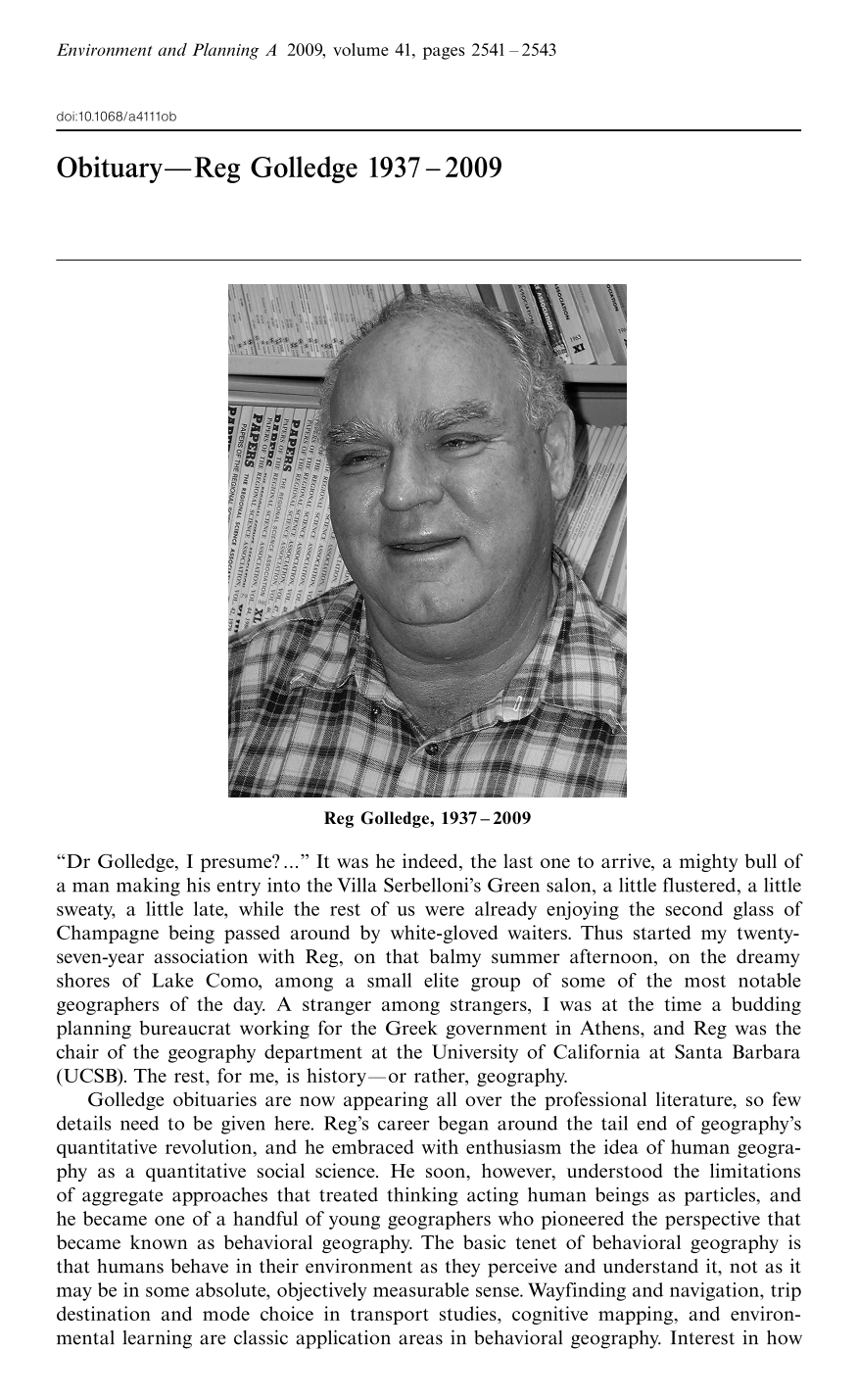
Obituary
Select search scope: search across all journals or within the current journal


In this paper I engage with how we attend to sound in terms of musical performance, but also more generally. Whilst recent work in geography has begun to approach the significance of practices of listening, particularly in terms of its performance, its interpretative role, and its cultural politics, I want to approach the act of listening itself and sound itself. In doing this I take inspiration from the recent work of Nancy and particularly his rethinking of ontology as being-with. More specifically, I will focus on three themes central to his general philosophical project, namely sense, the subject, the body, and, further, his conceptions of sonorous presence, resonance, rhythm, and timbre which relate more specifically to his work on listening. The discussion decentres the role of interpretation, or as Nancy suggests ‘hearing’, in academic and geographic accounts of listening and calls for a greater understanding of the resonance produced when sound impacts upon the body when we ‘listen’. In turn, this contributes to the development of a postphenomenology through its critique of the intentional subject in understanding the subject as resonant, always still to come, folding and unfolded, echoing in its being-with sound. This also develops understandings of the nonrepresentational in its affirmation of a finite thinking of the singular-plural. I take as a lens into this discussion a recent experiment undertaken by the Washington Post where the world-renowned, virtuoso violinist Joshua Bell busked at a Washington Underground station, and, apparently, fell on a thousand pairs of ‘deaf ears’.
In this paper we analyze the making of Liberty Village as a creative hub in inner-city Toronto. We focus on the role of property developers and the Liberty Village Business Improvement Association in fostering the area's internal economic geography. Drawing on the literature on governmentality, we dissect how the production of a place identity requires both the production of new subjectivities and the exclusion of alternative actors and understandings of organization within the district.
This paper discusses a new blend of methods developed to answer the question of where creativity is in the city. Experimentation with new methods was required because of empirical shortcomings with existing creative city research techniques; but also to respond to increasingly important questions of where nascent economic activities occur outside the formal sector, and governmental spheres of planning and economic development policy. In response we discuss here how qualitative methods can be used to address such concerns, based on experiences from an empirical project charged with the task of documenting creative activity in Darwin—a small city in Australia's tropical north. Diverse creative practitioners were interviewed about their interactions with the city—and hard-copy maps were used as anchoring devices around spatially orientated interview questions. Results from this interview-mapping process were accumulated and analysed in a geographical information system (GIS). Digital maps produced by this method revealed patterns of concentration and imagined ‘epicentres’ of creativity in Darwin, and showed how types of sites and spaces of the city are imagined as ‘creative’ in different ways. Qualitative mapping of creativity enabled the teasing out of contradictory and divergent stories of the location of creativity in the urban landscape. The opportunities which such methods present for researchers interested in how economic activities are ‘lived’ by workers, situated in social networks, and reproduced in everyday, material, spaces of the city are described.
Dynamic modes of political economic regulation impact provision for the parks system in Milwaukee, Wisconsin. Green spaces during Milwaukee's first liberal era consisted mostly of private properties accessible only to the city's elite and/or to those willing to pay a fee to drink in its boisterous
In this paper I explore how one particular segment of the informal waste-recovery trade, waste intermediaries, is impacted by Hanoi's rapid urban economic and spatial change. Using survey and interview data I demonstrate: (1) waste intermediaries simultaneously gain and lose as a result of Hanoi's urban transition; and (2) the underlying forces of urban spatial change in different areas of the city are quite distinct, which will have a unique impact on the future of informal waste-recovery in Hanoi.
While urban disamenities and pollution sources have received considerable attention in environmental justice research, few studies have examined sociospatial inequities associated with the distribution of desirable land uses. In this paper we focus on addressing this limitation by investigating the environmental equity implications of street trees—an important publicly financed amenity that provides several direct and indirect benefits to urban residents. The specific objective was to determine if the spatial distribution of public right-of-way trees is equitable with respect to race and ethnicity, income, and housing tenure in the city of Tampa, Florida, USA. We seek to extend research on equity analysis of urban amenities through several methodological innovations, including: (a) accounting for the heterogeneity of urban land use; (b) utilizing high-resolution remote sensing techniques to quantify parcel-specific tree cover; and (c) using multivariate regression models that control for spatial dependence within the data. The results support the inequity hypothesis by indicating a significantly lower proportion of tree cover on public right-of-way in neighborhoods containing a higher proportion of African-Americans, low-income residents, and renters. These findings have important implications for local public investment and policy strategies.
The current, dominating strategy of nature conservation within urban landscapes is to formally protect remaining patches of unexploited nature in nature reserves. However, integration of nature conservation frameworks into urban planning requires reconsideration of key issues, such as why, where, and how to protect nature in a purposeful way. As part of that process I statistically evaluate current nature conservation in 209 municipalities in southern Sweden by analysing the number, size, age, and land cover patterns of 1869 nature reserves in relation to the degree of urbanisation. The analyses reveal that in urban municipalities the nature reserves are fewer, but larger, and have a higher diversity of land covers. Having large nature reserves may be especially important in urban landscapes, since it is often highly fragmented. The land cover compositions show no differences between urban and rural nature reserves. However, urban nature reserves differ more from their surroundings compared with rural nature reserves, according to the identified changes in representation of land cover types with an increasing degree of urbanisation. The most urgent future challenge identified is to develop urban nature conservation strategies that are integrated into the urban context including other green areas and built-up areas, the land-use history, and the requirements for local ecosystem services across the landscape.
The notion of ‘government failure’ is central to theories of neoliberal normativity. Rather than focusing on ‘market failures’ and their correctives, neoliberalism aims to demonstrate ways that government ‘incompetence’, ‘inefficiency’, and ‘graft’ pollute or completely block the provision of adequate public services. Little work has been done, however, to determine the extent to which this notion has been accepted within the political mainstream, or the ways in which examples have been deployed to highlight or solve ‘government failure’. This study considers the way that one such example, the organization Habitat for Humanity, has been deployed as a challenge to interventionist government and, as such, as an alternative to ‘government failure’. A qualitative and quantitative content analysis of 1427 news articles that included ‘Habitat for Humanity’ from six North American newspapers was conducted to determine the extent to which the organization has become normalized as a viable alternative to state-delivered housing in particular, and Keynesian welfarism in general. The paper adds to the argument that neoliberal assumptions, once the purview of a small cadre of right-wing political economists, have permeated mainstream assumptions about the role of government in the provision of public goods.
This study examines changes in enforcement styles among environmental enforcement officials in the context of China's rapidly changing institutional environments, using panel data collected in Guangzhou in 2000 and 2006. Altogether, five enforcement style elements were examined—accommodation, prioritization, educational, formalism, and coercion. It was found that in 2006 respondents reported greater reliance on education, formalism, and coercion than in 2000. During the same period 2000–06, no significant changes were found for the enforcement styles of accommodation and prioritization or in the respondents' perceptions of their organization's enforcement effectiveness. From regression models in which enforcement styles were used to predict perceived organizational enforcement effectiveness, it was observed that the coefficient for formalism had changed substantially over this period, from being significantly negative to significantly positive, which may be evidence of a general shift from ‘rule by man’ to ‘rule by law’ in China. This study has benefited from the concept of regulatory enforcement style elements, as it allows for an empirical understanding of regulatory enforcement beyond the common and normative dichotomy of deterrence versus cooperation.
The commercial property market is transforming from a locally embedded industry to an international one. In the neverending search for opportunities, an increasing number of investors are turning their attention to new, distant, and opaque property markets. Still largely unknown to the investors, such markets generate much uncertainty for decision making. Investors seek to overcome this by adopting new decision-making strategies based on economic models promising transparent optimum solutions. Using global office investors as an example, we show that these actors attempt to generate know-how systematically, to take better ‘rational’ decisions rooted in neoclassical economy and based on key performance indicators. However, we also highlight that the process of rational decision making contains some cracks in its edifice, thus providing space for path dependencies to intrude.
By joining ideas from the spatial interaction and excess commuting literatures, we integrate and organize three related aspects of commuting statistics: trip length, distance decay, and entropy. We use concepts and calculations from the excess commuting literature to improve interpretation of trip length parameters in a doubly constrained trip distribution model. We derive a direct mathematical relationship between trip length and entropy, thereby providing an analytical model to calculate the ease with which trip lengths might be reduced. The new analysis not only ties these statistics together in a mathematically useful way, but also allows for a new entropy metric—relative entropy—that determines the organization (or lack thereof) of aggregate work trips. As a result, we disentangle the entropy component from the distance component and offer new perspectives on aggregate commuting in a comparative framework. Twenty-five cities are classified in an interesting and useful way that includes the average trip length and the degree of organization in each city.
Most of the existing literature on residential location choice is cross-sectional and assumes no history effect in people's residential location preferences. However, human beings are constantly adjusting themselves to the local environment and thus it seems reasonable to assume that preferences are formed over time. We hypothesize a historical deposition effect, which states that people's location preferences are likely to be a function of the attributes of where they lived before. Furthermore, this historical deposition influence can interact with lifecycle, such that it can become less important or insignificant during a life stage, like parenthood. Our study tests the existence of the historical deposition effect and analyzes its interaction with lifecycle. The study results support the historical deposition influence. Furthermore, we show that the historical deposition effect can be subdued by parenthood. The study also makes a methodological contribution by developing a distance-based GEV (generalized extreme value) model to account for spatial correlation. Spatial correlation is rarely treated in existing studies. The few existing studies typically assume a constant spatial correlation coefficient for adjacent zones. The distance-based GEV model relaxes the constant coefficient assumption and allows a distance-based correlation between nonadjacent zones. The results confirm this distance-based spatial correlation.
Museums may serve as important amenities for inhabitants and act as magnets for attracting visitors to a city. For city planners it is important to understand what different types of museums there are in terms of attraction power, and how their attractiveness may depend on the presence of other museums. To this end, we propose a gravity model for all museums allowing for spatial dependence between museums to account for local competition or synergy effects. To address the likely heterogeneity in our sample of museums, we first adopt a spatial error component model. Thereafter, we model the variation between museums explicitly by segmenting the museums using a finite mixture approach. The application of this model uses a unique transaction database of the visiting behaviour of 80 821 persons to 108 Dutch museums. The results stress the large variation both in the spatial reach of museums and in their spatial context.