
Other
Select search scope: search across all journals or within the current journal

The reaction of ((di-iso-propyl)amino)(chloro)phosphenium cation [i-Pr2N-P-Cl]+ (1) with phenyl cyclopropane afforded cis- and trans-l-diisopropylamino-2-phenyl-phosphetane-1-oxide (3a-cis and 3a-trans), and -1-thion (4), respectively. The cis-1-diisopropylamino-2-(p-substituted-phenyl)-3-methyl-phosphetane-1-oxides (3b – 3d) were obtained in excellent yields unexpectedly from the similar reactions of trans-2-methyl-1-(p-substituted-phenyl)-cyclopropane. The six new compounds have been characterized on the basis of elemental analysis, IR, 1H, 31P NMR and MS. The configurations of 3a-cis, 3a-trans and 3c were elucidated by 2D NOESY. Molecular structure of 2-p-methylphenyl-3-methyl-phosphetane-1-oxide (3c) has been established by X-ray crystallography: in 3c, 1-diisopropylamino group is cis to 2-p-methylphenyl group as well as the dihedral angle between the planes C(l)-P-C(3) and C(1)-C(2)-C(3) is 15.09°, which is the least in the found values. A carbocation mechanism including the attack of P+ on less hindered carbon on cyclopropane ring and the cation-π interaction between the positive P+-N of 1 and benzene ring portion of 2 is proposed. The single-crystal data: primitive orthorhombic, space group Pbca(#61), a = 20.053(2), b = 13.955(2), c = 12.526(4), V = 3505(1) Å3, Z = 8, DC = 1.09 g cm−3, F(000) = 1280.00, λ(Mo-Kα) = 0.71069 Å, μ(Mo-Kα) = 1.50 cm−1. Refinement with 182 parameters and 1138 independent reflections with I > 3.00 σ (I) in the range 2° < θ < 25.0° gave R = 0.051 and RW = 0.055.
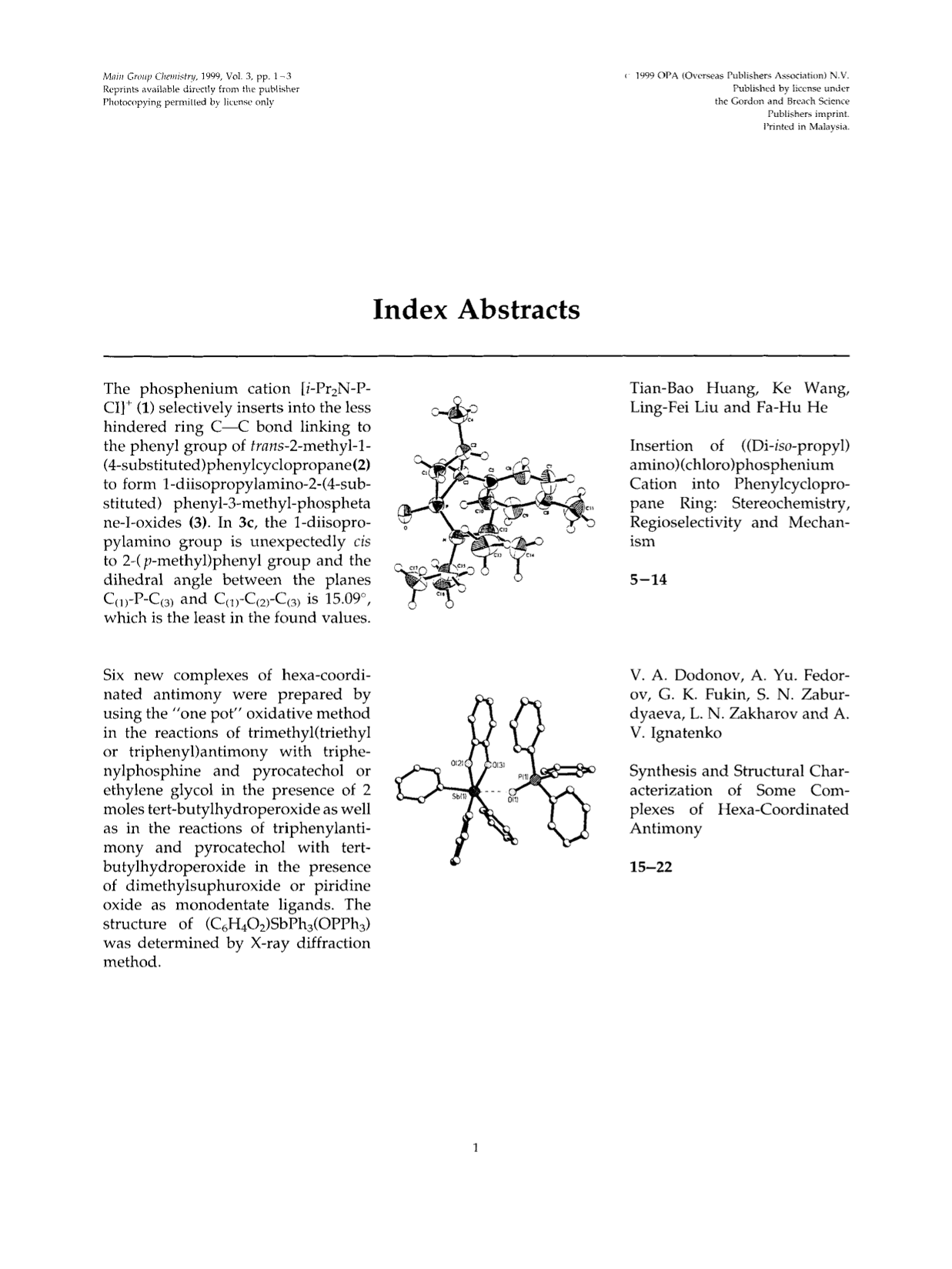
The oxidation of triphenylantimony and triphenylphosphine by tert-butylhdroperoxide in the presence of catechol gives a new complex of a hexa-coordinated antimony, (C6H4O2)SbPh3(OPPh3).7 In this complex triphenylphosphine oxide plays the role of the sixth ligand in a coordination sphere of an antimony atom of triphenylantimony o-phenylenedioxide. The compound was characterized by IR, 1H NMR, 13C NMR, 31P NMR and X-ray single-crystal diffraction method. Crystal data for 7 at T = 293 K: a = 21.111(1) Å, b = 13.910(4) Å, c = 25.052(8) Å, β = 96.48(3)°, V = 73104(4) Å3, Z = 8, Dcalc = 1.380 g/cm3, μ = 0.839 mm−1, space group C2/c. The geometry of the antimony atom in the synthesized complex is a distorted octahedron. Sixth coordination Sb-O(P) – 2.33 Å – is comparable with the sum of covalent radii of antimony and oxygen atoms, 2.20 Å. Five analogous complexes containing trimethyl(triethy1)antimony o-phenylenedioxide or 2.2.2-triphenyl-1.3.2-dioxas-tibolane and triphenylphosphine oxide or triphenylantimony o-phenylenedioxide and dimethylsulfoxide or pyridine oxide as a monodentate ligand were synthesized in the same manner. These compounds were also characterized by IR, 1H 13C and 31P NMR.
Crystal structures are reported for 2,4-(O2N)2C6H3X (2: X = NMe2; 3: X = C6H4NO2-2) and Ph3MSC6H4NO2-2 (4: M = Ge; 5; M = Sn; 6: M = Pb). Compound 2 is triclinic, Pbar1, a = 7.931(5), b = 8.159(7), c = 9.090(7) Å, a = 100.35(6), β = 81.00(6), γ = 110.74(6)°, Dx = 1.500 Mg.m−3, Z = 2, observed reflections = 834, R = 0.066 (Rw = 0.049). Compound 3 is orthorhombic, P212121, a = 11.1424(18), b = 11.8067(18), c = 20.363(3) Å, Dx = 1.593 Mg.m−3, Z = 8, observed reflections = 925, R = 0.061 (Rw = 0.074). Compound 4 is monoclinic, P21/a, a = 14.73(4), b = 10.091(5), c = 15.526(4) Å, β = 107.43(7), Dx = 1.382 Mg.m−3, Z = 4, observed reflections = 2034, R1 = 0.0426 (wR2 = 0.0834). Compound 5 is orthorhombic, Pbca, a = 15.489(10), b = 15.701(5), c = 17.558(7) Å, Dx = 1.569 Mg.m−3, Z = 8, observed reflections = 2537,R1 = 0.0327 (wR2 = 0.0700). Compound 6 is orthorhombic, Pbca, a = 15.569(5), b = 15.702(3), c = 17.651(6) Å, Dx = 1.825 Mg.m−3, Z = 8, observed reflections = 2536, R1 = 0.0323 (wR2 = 0.0737). There are short non-bonded S—O interactions and near linear O—S—X angles in both 2 and 3; values are 2.166(6) Å and 177.1(3)° for 2; 2.582(14) Å and 177.1(8)°, and 2.609(13) Å and 177.9(6) (in two independent molecules) for 3. The S—O interaction in 3 involves the ortho nitro group of the dinitrophenyl ring. Intramolecular S—O interactions are absent in 4 – 6; however there are weak intermolecular M—O bonding in 5 and 6, which results in molecules being linked into chains; the geometries at the metal centres in 5 and 6 are distorted trigonal bipyramidal with Sn—O and Pb—O bond lengths of 3.337(3) and 3.180(5) Å, respectively, and Saxial—M—Oaxial angles of 173.19(5) and 173.96(9)°, respectively. Compound 4 is essentially tetrahedral.
Reaction of [(iBu)2AlH]2 with l-ephedrine yields [(iBu)2A1{μ-OC(H)(Ph)CH(Me)N(H)Me}]2 (1). Reaction of Al(tBu)3 with (2S,3R)-(+)-4-(dimethylamino)-l,2-diphenyl-3-methyl-2-butanol (Chirald®) yields (tBu)2Al[OC(CH2Ph)(Ph)CH(Me)CH2NMe2] (2). The molecular structures of compounds 1 and 2 have been determined by X-ray crystallography. Compound 2 is monomeric with a six membered chelate heterocyclic ring. In contrast, compound 1 exists as a bridged dimer. The formation of monomeric chelate species for compound 2, rather than the alkoxide bridged dimer as is found for 1 is found to be due to the steric bulk of the aluminum alkyl and substitution at the ligand’s α-carbon. Crystal data: (1) orthorhombic, P212121, a=10.987(2), b=18.795(4), c =19.270(4) Å, V=3979(1) Å3, Z=4, R=0.1056, Rw=0.2454. (2) tetragonal, 14, a=22.236(3), c=10.784(1) Å, V=5332.0(5) Å3, Z=8, R=0.0485, Rw=0.0537.
Hydroalumination of H2C==CHCH2SMe with [(tBu)2Al(μ-H)]3 yields the monomeric thioether compound (tBu)2Al(CH2CH2CH2SMe). The molecular structure of (tBu)2 Al(CH2CH2CH2SMe) consists of discreet monomers in which the thioether-alkyl ligand acts as a chelate ligand with an Al-S interaction [2.511(2) Å] that is significantly shorter than observed for other intra-molecular coordination compounds, 2.78–2.95 Å. The coordination about aluminum is highly distorted from tetrahedral and is therefore best described as capped trigonal planar or trigonal bipyramidal with a vacant coordination site. Crystal data: monoclinic, P21/n (No. 14), a = 6.6357(5), b = 13.630(1), c = 16.959(1) Å, β = 95.416(6)°. V = 1527.0(2) Å3, Z = 4, R = 0.0412, Rw = 0.0503.
The possibility for the existence of the tellurium-containing chalcogen ring molecules has been explored by use of ab initio molecular orbital techniques. The full geometry optimization has been carried out for all isomers in the series TexS8–x(x=l,2) and TexSeyS8–(x+y) (x=l;y=1,2) at HF/3-21G* level of theory. Each molecule is a crown-shaped eight-membered ring like S8. All calculated bond parameters indicate single bonds and agree with experimental parameters where available. The relative stabilities of the different isomers have been calculated by taking the effects of electron correlation into account involving the second-order Møller-Plessett perturbation theory. The most stable species are TeS7, 1,2,-Te2S6, 1,2-TeSeS6, and 1,2,8-TeSe2S5. The calculations are consistent with the observation that 1,2-Te2S6 and 1,2-TeSeS6, are initially formed when [Ti(MeC5H4)2(Te2)2-Ti(MeC5H4)2] or [Ti(MeC5H4)2(TexE2-x)2Ti(MeC5H4)2] (E=S,Se) are treated with chalcogen chlorides. When (Me3Si)2Te is treated with ClSeS5SeCl, 1,2,8-TeSe2S5 is formed. All these products decompose on standing with the formation of TeS7 and some insoluble material.

