Research article
Select search scope: search across all journals or within the current journal

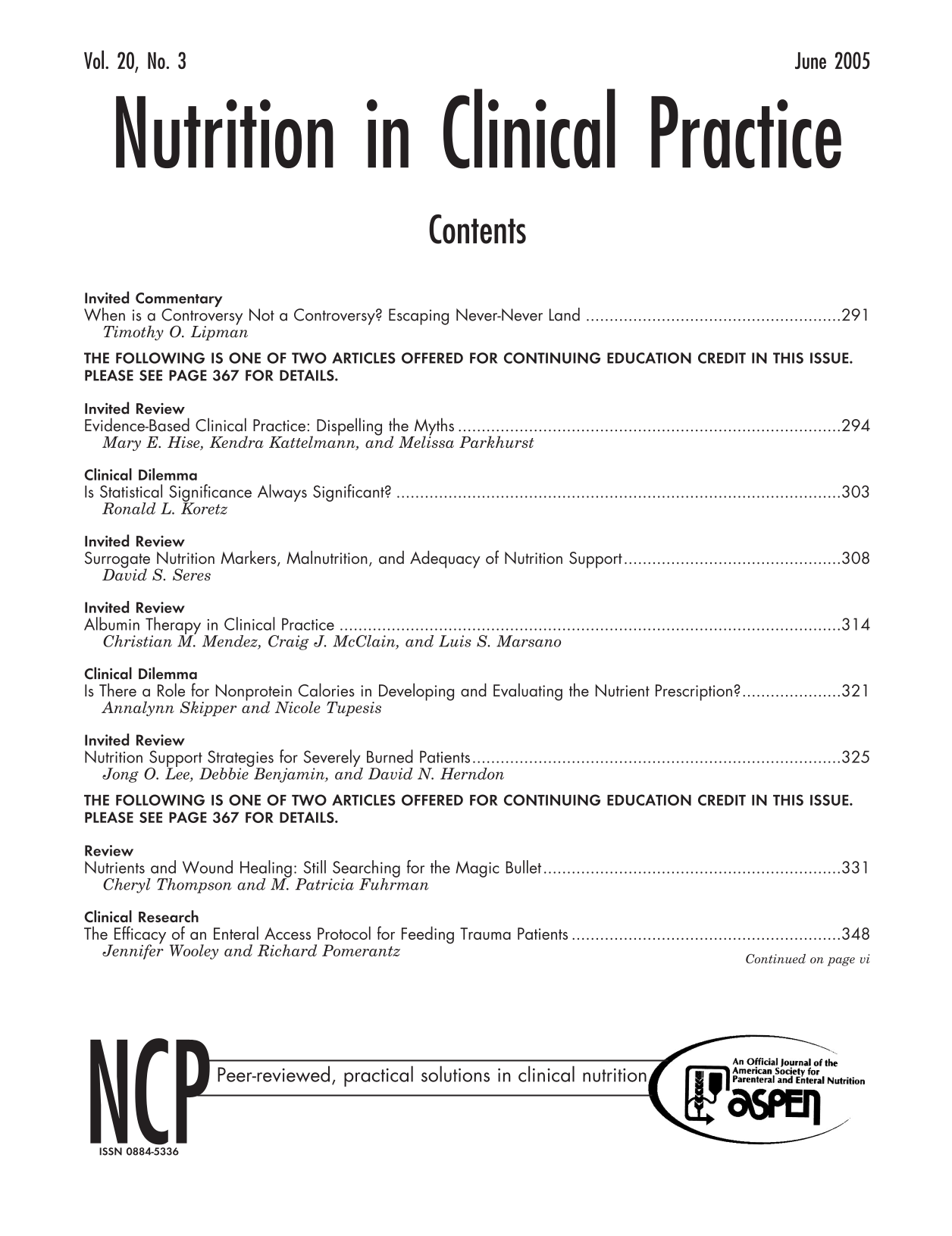
Evidence-based practice merges the best and most relevant clinical research data with clinician experience, pathophysiology of disease state, and the specifics of individual patient care. Currently, there is a significant gap between the best research evidence in healthcare and application of this evidence to clinician practices. Consistent with this finding, nutrition support is not always applied effectively or consistently, despite available scientific evidence that could be used to enhance a given treatment protocol. Cited obstacles that prevent the incorporation of research evidence into daily practice include lack of time, inadequate research skills, and information overload. Identification and application of the most valid primary research and evidence summaries (clinical guides to practice and meta-analyses) should, however, be an integral part of appropriate nutrition care. Consequently, it is important that clinicians develop and improve upon the basic skills required to allow efficient and accurate searches and evaluations of the literature. This review describes the basic and practical components of evidence-based medicine and provides tools to determine whether current nutrition practices are based upon an analysis of valid clinical evidence or anecdotal nutrition traditions and myths.
One way in which we learn new information is to read the medical
literature. Whether or not we do primary research, it is important to be able
to read literature in a critical fashion. A seemingly simple concept in
reading is to interpret
Surrogate nutrition markers are used to assess adequacy of nourishment and to define malnutrition despite evidence that fails to link nourishment, surrogate markers, and outcomes. Markers such as serum levels of albumin, prealbumin, transferrin, and IGF-1 and delayed hypersensitivity and total lymphocyte count may be valid to help stratify risk. However, it is not appropriate to consider these as markers of adequacy of nourishment in the sick patient.
Albumin is the predominant product of hepatic protein synthesis and one of the more abundant plasma proteins. Among its multiple physiologic roles, it plays an essential part in the generation of colloid-oncotic pressure. In the United States, the indications for which albumin therapy are considered include hypovolemia or shock, burns, hypoalbuminemia, surgery or trauma, cardiopulmonary bypass, acute respiratory distress syndrome, hemodialysis, and sequestration of protein-rich fluids. The use of this relatively expensive therapy accounts for up to 30% of the total pharmacy budget in certain hospitals. The use of albumin therapy in different clinical situations and its influence in morbidity and mortality have been reviewed in multiple randomized controlled trials and meta-analyses. Despite frequent reviews, the use of albumin remains controversial in several clinical situations. At the same time, these valuable reviews seem to have documented the advantages of albumin therapy in the management of ascites and clarified the use of albumin in volume resuscitation. More studies have been recommended to investigate the use of albumin in different doses and its role in hypoalbuminemia. This article will provide an overview of albumin metabolism, use of albumin for volume expansion, the potential therapeutic role of albumin in liver disease, and the role of albumin therapy in nutrition.
The concept of nonprotein calories has been used in a variety of ways by nutrition support clinicians. Nonprotein calories may refer to the combined energy from lipid and carbohydrate but are also used to describe the balance between energy and protein in the form of the nonprotein calorie-to-nitrogen ratio. Nonprotein calories have been used as the basis for calculating nutrient needs, but this practice is no longer recommended as it may result in overfeeding. The purpose of this paper is to examine the nonprotein calorie concept using a clinical scenario and review of the literature.
Significant weight loss is a common complication of a major burn injury. Before the modern era of early enteral nutrition support, such a complication contributed significantly to impaired wound healing, raised risk of infectious morbidity, and ultimately increased mortality. Nutrition management of the burn patient is designed to promote wound healing while minimizing loss of lean body mass. The burn patient characteristically demonstrates an increase in energy expenditure after the initial injury and period of resuscitation. Studies have demonstrated that early institution of enteral feeding can attenuate the stress response, abate hypermetabolism, and improve patient outcome.
Clinicians in nearly all practice areas are confronted with the challenges associated with delayed and impaired wound healing. Although nutrition plays a critical role in the healing process, controversy exists regarding the optimal nutrition regimen. This article reviews literature related to nutrition interventions that facilitate wound healing. The limitations of the research that forms the scientific basis of many nutrition recommendations are also examined. The limited availability of rigorously performed clinical studies to develop evidence-based guidelines for nutrition support in wound care emphasizes the need for further research and underscores the importance of individualizing the nutrition care plan for each patient.
Previous data clearly showed profound differences in nursing practices and
techniques within the state of Texas regarding the administration of
medications through enteral feeding catheters (EFCs) between long-term care
(LTC) facilities that predominantly serve a rural
We investigated whether intervention with antioxidant vitamins C and E in
enteral feeding influenced oxidative stress and clinical outcome in critically
ill patients. Two-hundred sixteen patients expected to require at least 10
days of enteral feeding completed the study. One-hundred five patients
received enteral feeding supplemented with antioxidants, and 111 control
patients received an isocaloric formula. Plasma lipoperoxidation (by
thiobarbituric acid reactive substances [TBARS] and prostaglandin
F2α isoprostane levels), low-density lipoprotein (LDL)
oxidizability, and LDL tocopherol content were determined at baseline and at
the end of the 10-day period. The clinical 28-day outcome was also assessed.
Plasma TBARS and isoprostanes were 5.33 ± 1.26 nM/mL and 312 ±
68 pg/mL, respectively, before treatment and 2.42 ± 0.61 nM/mL and 198±
42 pg/mL after intervention (