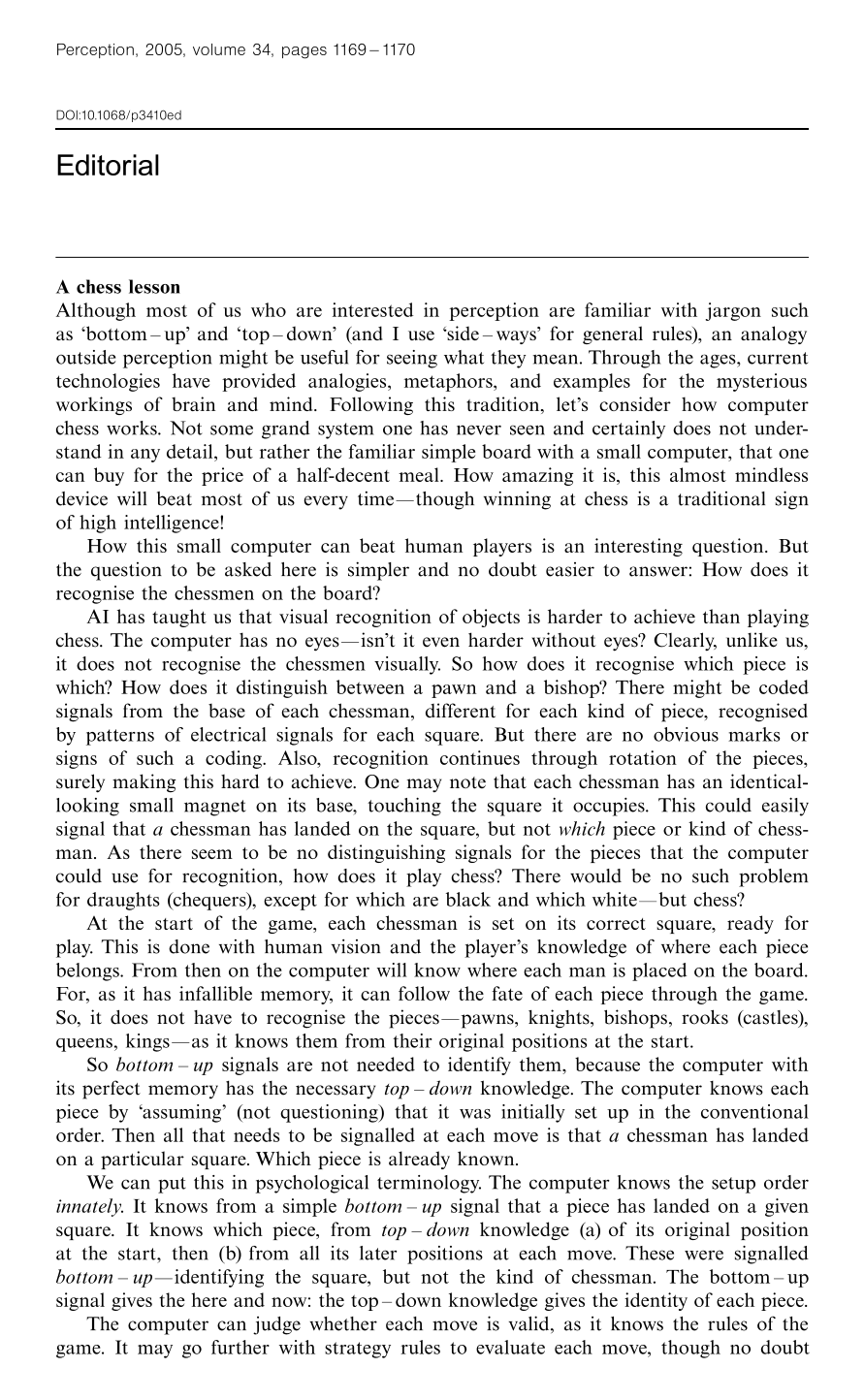
Editorial
Select search scope: search across all journals or within the current journal

We examined whether it is possible to identify the emotional content of behaviour from point-light displays where pairs of actors are engaged in interpersonal communication. These actors displayed a series of emotions, which included sadness, anger, joy, disgust, fear, and romantic love. In experiment 1, subjects viewed brief clips of these point-light displays presented the right way up and upside down. In experiment 2, the importance of the interaction between the two figures in the recognition of emotion was examined. Subjects were shown upright versions of (i) the original pairs (dyads), (ii) a single actor (monad), and (iii) a dyad comprising a single actor and his/her mirror image (reflected dyad). In each experiment, the subjects rated the emotional content of the displays by moving a slider along a horizontal scale. All of the emotions received a rating for every clip. In experiment 1, when the displays were upright, the correct emotions were identified in each case except disgust; but, when the displays were inverted, performance was significantly diminished for some emotions. In experiment 2, the recognition of love and joy was impaired by the absence of the acting partner, and the recognition of sadness, joy, and fear was impaired in the non-veridical (mirror image) displays. These findings both support and extend previous research by showing that biological motion is sufficient for the perception of emotion, although inversion affects performance. Moreover, emotion perception from biological motion can be affected by the veridical or non-veridical social context within the displays.
In order to include the monocular areas from the left and the right eye in the cyclopean view, the visual system displaces the occluded elements which would result in a horizontal elongation of the shape but does not occur thanks to a correction mechanism which preserves the shape. We hypothesised that this mechanism causes Kanizsa's a modal shrinkage illusion (the apparent elongation of a partially occluded square) when it is incorrectly applied by the visual system to a two-dimensional stimulus. Four experiments tested this hypothesis: (i) one-eyed observers were less susceptible to the illusion than people with normal binocular vision because, for them, the correction for shape is unnecessary; (ii) the illusion was stronger with binocular than with monocular vision since binocularity induces the visual system to correct for the shape distortion; (iii) the illusion diminished when the stimulus was rotated 90° given that displacement and compression are not required for vertical occlusion; (iv) the magnitude of the illusion was a function of the width of the occluder because, as previous research has shown, the edges of a partially occluded square are less displaced the farther they are from the edges of the occluder. The data from the four experiments support our hypothesis even though no condition was able to eliminate the illusion; other possible causes are discussed.
We measured how different cues are combined in motion-segregation processes by using motion stimuli where randomly distributed target dots were organised in global revolving motion while the remaining noise dots performed random motion. Target dots were cued with a different colour, polarity, disparity depth, or texture orientation than the noise dots, or they were the same as the noise dots. The stimuli were presented with a prolonged static cue preview which provided position cues to target dots or, briefly with static pre-target and post-target noise frames, which provided false position cues (no preview). All cues efficiently facilitated global motion segregation in cued-preview conditions. Colour completely failed to facilitate global motion segregation in no-preview conditions. Polarity and disparity facilitated segregation in no-preview conditions, although sensitivities were lower than in the preview conditions. Remarkably, texture orientation largely facilitated motion segregation by the same amount in both cued-preview and no-preview conditions. So, colour provides only position cues to the motion-segregation task whereas texture orientation, disparity, and to a lesser extent polarity are integrated with the segregation process.
In studies of the temporal flexibility of the stereoscopic system, it has been suggested that two different processes of binocular depth perception could be responsible for the flexibility: tolerance for interocular delays and temporal integration of correlation. None has investigated the relationship between tolerance for delays and temporal integration mechanisms and none has revealed which mechanism is responsible for depth perception in dynamic random-dot stereograms. We address these questions in the present study. Across five experiments, we investigated the temporal properties of stereopsis by varying interocular correlation as a function of time in controlled ways. We presented different types of dynamic random-dot stereograms, each consisting of two pairs of alternating random-dot patterns. Our experimental results demonstrate that (i) disparities from simultaneous monocular inputs dominate those from interocular delayed inputs; (ii) stereopsis is limited by temporal properties of monocular luminance mechanisms; and (iii) depth perception in dynamic random-dot stereograms results from cross-correlation-like operation on two simultaneous monocular inputs that represent the retinal images after having been subjected to a process of monocular temporal integration of luminance.
It has been argued that visual-search tasks provide a valid model for foraging behaviour. However, Gilchrist et al (2001
Spatial navigation within a real 3-D maze was investigated to study space perception on the sole basis of tactile information transmitted by means of a ‘tactile vision substitution system' (TVSS) allowing the conversion of optical images—collected by a micro camera—into ‘tactile images’ via a matrix in contact with the skin. The development of such a device is based on concepts of cerebral and functional plasticity, enabling subjective reproduction of visual images from tactile data processing. Blindfolded sighted subjects had to remotely control the movements of a robot on which the TVSS camera was mounted. Once familiarised with the cues in the maze, the subjects were given two exploration sessions. Performance was analysed according to an objective point of view (exploration time, discrimination capacity), as well as a subjective one (speech). The task was successfully carried out from the very first session. As the subjects took a different path during each navigation, a gradual improvement in performance (discrimination and exploration time) was noted, generating a phenomenon of learning. Moreover, subjective analysis revealed an evolution of the spatialisation process towards distal attribution. Finally, some emotional expressions seemed to reflect the genesis of ‘qualia’ (emotional qualities of stimulation).
We report a series of three experiments designed to examine the effect of posture on tactile temporal processing. Observers reported which of two tactile stimuli, presented to the left and right index fingers (experiments 1 – 3; or thumb, experiment 3), was perceived first while adopting one of two postures—hands-close (adjacent, but not touching) or hands-far (1 m apart)—in the dark. Just-noticeable differences were significantly smaller in the hands-far posture across all three experiments. In the first two experiments we compared hand versus foot responses and found equivalent advantages for the hands-far posture. In the final experiment the stimuli were presented to either the same or different digit on each hand (index finger or thumb) and we found that only when the same digit on each hand was stimulated was there an advantage for the hands-far posture. The finding that temporal precision was better with greater distance contradicts predictions based on attention-switching models of temporal-order judgments, and also contrasts with results from similar experimental manipulations in other modalities (eg vision). These results provide support for a rapid and automatic process that transforms the representation of a tactile stimulus from a skin-centred reference frame to a more external (eg body-centred or allocentric) one.
Motion parallax was described as a cue to depth over 300 years ago and as producing apparent motion over 150 years ago. In recent years, experimental interest in motion parallax has increased, following the rediscovery of the idea that stimulus motion can be yoked to head movement. We compare the historical descriptions with some contemporary research, which indicates how depth and motion perception are dependent on the conditions of stimulation.
The impact that the analysis of sound waves has made on theories of light is well known, and is touched upon here. However, the acoustic figures described initially by Robert Hooke in 1665 and in more detail by Ernst Chladni in 1787 (often referred to as Chladni figures) were instrumental in vision in two specific respects. First, their representation by Tyndall [1867