Other
Select search scope: search across all journals or within the current journal

The past 40 years have seen a movement in the profession of pharmacy to modify the strictures on professional judgment and professional service to patients emanating from antisubstitution laws, both statutes and regulations, at the state level of government. The shift of responsibility for preparing final dosage forms more and more from the community pharmacist to the pharmaceutical industry led the brand name pharmaceutical manufacturers to form an organization to seek enactment of restrictions on the ability of pharmacists to select the brand of medication to be dispensed. Beginning in 1970, the American Pharmaceutical Association sought to change these laws, and through that decade, coalitions were formed with a variety of groups to effect the modifications. A variety of public policy issues were presented for consideration as part of this movement, with the states adopting a variety of approaches, with all jurisdictions eventually restoring to pharmacists the ability to make professional judgments in the area of drug product selection. This initiative within the profession was a highlight of the past century and may have built the confidence of pharmacists to seek other modifications in public policy related to the legal and regulatory framework within which they practice.
This article was adapted from a presentation before the American Society for Pharmacy Law 31st/American Pharmaceutical Association 153rd Annual Meeting, San Francisco, CA, March 18, 2006.
Guidelines from the Seventh American College of Chest Physicians (ACCP) Conference on Antithrombotic and Thrombolytic Therapy provide specific recommendations for the management of patients with supratherapeutic international normalized ratios (INRs).
To assess the appropriateness of vitamin K administration in inpatients with excessive anticoagulation, according to existing guidelines.
A retrospective chart review was performed for randomly selected patients on warfarin therapy who received vitamin K during hospitalization. Data were collected on patient demographics, vitamin K dose and route of administration, warfarin dose, alternative therapies, and INR values before and after vitamin K administration. The appropriateness of vitamin K use was evaluated based on indication, route, and dose.
A total of 136 patient charts were reviewed. The majority (71%, n = 97) of patients had a baseline INR of less than 5, with a mean INR of 4.4 ± 2.9 SD. Seventy-five patients had documented bleeding events on admission, 49% of which were considered major. Average time to repeat INR was 9.7 ± 6.8 SD hours. Seventy-one percent of patients had a documented appropriate indication for vitamin K, 42% received an appropriate dose, and 27% received vitamin K via the appropriate route of administration. Only 21% of patients received vitamin K for an appropriate indication, at an appropriate dose, via an appropriate route.
At our institution, the current use of vitamin K for excessive anticoagulation is inconsistent and suboptimal with regard to route, dose, and monitoring parameters. Education of both medical and pharmacy staff is essential to improving compliance with ACCP recommendations.
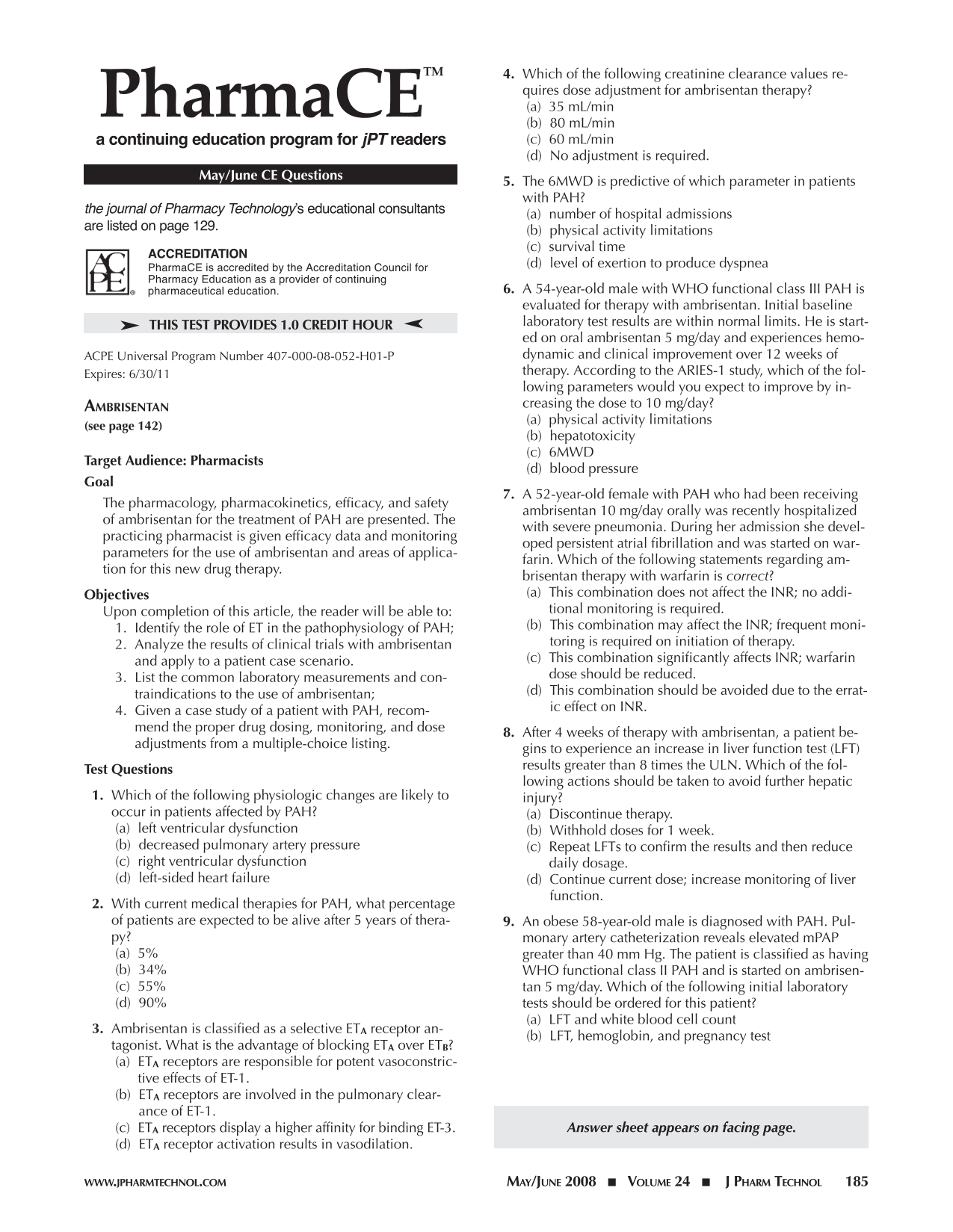
To review the pharmacology, pharmacokinetics, efficacy, and safety of ambrisentan, a selective endothelin type A (ETA) receptor antagonist, for the treatment of pulmonary arterial hypertension (PAH).
Articles were identified through a search of the MEDLINE (1950–November 2007) database for English-language articles containing the key words ambrisentan, pulmonary arterial hypertension, pulmonary hypertension, endothelin antagonist, and endothelin type A receptor. References from publications identified in this search were reviewed for relevant information. Unpublished data received from the manufacturer were also included in this review.
All articles identified from the data search were reviewed for relevant information. Applicable information was included in this review.
Ambrisentan is the first oral nonsulfonamide ETA receptor antagonist approved by the FDA for use in patients with PAH who have World Health Organization class II or III symptoms. To date, the use of ambrisentan in the treatment of PAH has been evaluated by only 1 published Phase 2 clinical trial and 3 unpublished Phase 3 clinical trials. Ambrisentan therapy during clinical trials resulted in a significant improvement in exercise capacity and hemodynamic parameters. Metabolism occurs by hepatic glucuronidation, with elimination primarily through nonrenal pathways. A half-life of 15 hours allows for once-daily dosing. The most common adverse effect reported during clinical trials was peripheral edema. Hepatotoxicity occurred very infrequently, with affected patients requiring only a dose reduction to resolve an episode of elevated aminotransferases.
Ambrisentan appears to be a promising treatment option for patients affected by PAH, given its improved drug–drug interaction and hepatotoxicity profile compared with other endothelin antagonists. Future studies are needed to determine the role of ambrisentan in the treatment of PAH and the selection of optimal endothelin antagonism.
To report 2 cases that examine the use of oxcarbazepine as treatment for individuals with posttraumatic stress disorder (PTSD) and comorbid alcohol dependence.
A 59-year-old male with a past psychiatric history significant for PTSD and alcohol dependence underwent alcohol detoxification and was subsequently prescribed oxcarbazepine 300 mg twice daily, which was titrated to 600 mg twice daily prior to discharge. He experienced significant reduction in PTSD symptoms including anxiety, nightmares, flashbacks, racing thoughts, and avoidance behaviors. Over time, he also experienced a reduction in alcohol cravings and decreased daily alcohol intake. A 62-year-old male with a past psychiatric history of PTSD and alcohol dependence was treated in the outpatient clinic. He experienced almost complete resolution of PTSD symptoms and any craving for alcohol within 4 months of starting oxcarbazepine treatment, which was initiated at 150 mg twice daily and increased to 600 mg/day during that time.
Both patients appeared to receive excellent symptomatic relief from their PTSD symptoms. Recurring symptoms, including nightmares and flashbacks, seemed to be particularly responsive to the treatment. Additionally, in both cases, it is possible that oxcarbazepine had a secondary beneficial effect by decreasing alcohol cravings, although this was not formally measured.
Our experience with these patients suggests that oxcarbazepine could be an effective treatment for the symptoms of PTSD and may decrease alcohol cravings and consumption in patients with co-occurring alcohol dependence. Controlled studies examining the effectiveness of oxcarbazepine for treatment of patients with PTSD, including those with complicating alcohol dependence, are warranted.
To report a case of the venous obstructive condition known as phlegmasia cerulea dolens (PCD) in the presence of heparin-induced thrombocytopenia (HIT).
A 50-year-old white female presented to the emergency department with a 2-day history of a bluish discoloration of her toes and hands accompanied by chest pain and shortness of breath. The evident edema, tenderness on palpation, and cyanosis of the extremities were suggestive of PCD. She had been hospitalized approximately one month previously due to a fibular fracture and again within the past 2 weeks for intractable abdominal pain and nausea. During her current hospital stay, she was diagnosed with multiple venous thromboembolisms (VTEs); at the time of admission, an unfractionated heparin (UFH) drip was initiated to treat her VTEs. Due to a decreased platelet count on admission, a platelet factor 4 (PF4) antibody assay was performed and found to be positive. After discontinuation of UFH, her platelet count slowly returned to normal range.
The pathogenesis of HIT is due to formation of antibodies against the complex of heparin and PF4. HIT is characterized by a reduction in the platelet count approximately 4–14 days after the initiation of heparin therapy plus a paradoxical prothrombotic state. The typical diagnostic clues are a drop in platelet count of 50% from baseline with the initiation of heparin and a positive assay for heparin-PF4-immunoglobulin G. This condition may result in PCD, which presents as the triad of pain, edema, and cyanosis. This condition often results in venous or arterial thrombus formation. The treatment for PCD includes immediate discontinuation of heparin products and anticoagulation with a direct thrombin inhibitor.
Thromboembolic complications such as PCD are often observed as a presenting feature of HIT. To avoid these potentially limb- and life-threatening complications, clinicians must be vigilant in their monitoring of platelets and clinical signs and symptoms of HIT while patients are on heparin therapy.