







Abstract
The present study investigates how the construct intellect, according to the Theoretical Intellect Framework (TIF), predicts creativity. The TIF is a theoretical model describing the structure of the construct intellect, a sub–dimension of the Big Five domain openness to experience. People (N = 2709) from two sub–samples (undergraduate students and Amazon MTurkers) completed one of three creativity tasks (self–reported, remote associates, or rated photo caption) and the Intellect Scale. The results support hypotheses derived from the TIF, as the operation Create, rather than the operations Think or Learn, significantly and in some cases uniquely predicted the self–reported creativity indicators. Creativity indicators with a strong cognitive load (remote associates test and rated photo caption), however, were predicted by the operation Think. Results are discussed with regards to the nomological net of the operation Create and the construct validity of the creativity assessments. We provide implications for applied purposes and call for further examination of the TIF with additional creativity measures. Copyright © 2015 European Association of Personality Psychology
Outstanding creative solutions, like the development of the light bulb, the combustion engine, or the smartphone, allow for cultural, societal, technological, and economic achievements with ongoing influence. Besides these rather rare occurrences, creative achievements also play an important role in daily private and occupational settings, like improving a product or process, drawing a picture, or cooking a dish (Gilson & Madjar, 2011; Kaufman & Beghetto, 2009). From the perspective of personality psychology, an important research question concerns the identification of personality constructs that explain and predict creative achievements. The present investigation takes a facet perspective, thereby investigating hypotheses derived from the Theoretical Intellect Framework (TIF; Mussel, 2013a) regarding the prediction of different measures of creativity.
There has long been a consensus for a basic definition of creativity, which is the process of developing novel and useful ideas appropriate to a task (Kaufman, 2009; Sawyer, 2012). However, the approaches to studying creativity are quite varied, often following the four Ps (Rhodes, 1961): (i) Process (how does creativity occur?), (ii) Product (what is the final output?), (iii) Press (how can the environment enhance or suppress creativity?), and (iv) Person (what are the characteristics of someone who is creative?). With regard to Person, there has been some debate about whether creativity is domain general or domain specific. If creativity is domain general, then a person who is creative in one domain (e.g. math) should be able to use the same processes to be creative in a different domain (e.g. art). If creativity is domain specific, then there would not necessarily be any relationship between a person's creative process across different domains (Kaufman & Baer, 2002; Kaufman, Beghetto, Baer, & Ivcevic, 2010; Silvia, Kaufman, & Pretz, 2009).
The Amusement Park Theoretical model (Baer & Kaufman, 2005; Kaufman & Baer, 2004, 2005) outlines a few broad requirements that a person must possess in order to be creative (intelligence, motivation, an appropriate environment) and then suggests general areas and specific domains and microdomains that are part of the structure of creativity. One personality trait related to domain general and domain specific creativity is the trait openness to experience (Digman, 1990), which is positively related to scores on divergent thinking tasks, peer ratings of creativity, and between–group differences of creative and non–creative scientists (Batey & Furnham, 2006; Feist, 1998, 2010). Because of the breadth and heterogeneity of openness to experience, however, it is not surprising that facets of openness to experience differentially predict creativity (e.g. Dollinger & Clancy, 1993; Gelade, 1997, McCrae, 1987).
Using the specific openness/intellect split outlined by DeYoung, Quilty, and Peterson (2007), Nusbaum and Silvia (2011) found that scores from a measure of openness/intellect differentially predicted performance on tests of divergent thinking and fluid intelligence. Openness was positively related to scores on a divergent thinking test, whereas intellect was positively related to scores on a fluid intelligence test. Kaufman (2013), using multiple measures of openness/intellect and the Creative Achievement Questionnaire, found that measures reflecting openness positively predicted scores in artistic domains, whereas intellect positively predicted scores in science domains. In the present study, we investigate three operations from the TIF (Mussel, 2013a), a theoretical model specifying the internal structure of the construct intellect, from which specific hypotheses regarding their relevance for predicting creativity can be deduced.
Intellect, an aspect or sub–dimension of the Big Five domain intellect/openness (DeYoung et al., 2007), can be defined as a dispositional individual difference variable involving behaviour, intentions, affect, attitudes, and mental processes related to intellectual performance, such as problem–solving, thinking, information search, learning, or creativity (Berlyne, 1978; Litman, 2005; Mussel, 2013a). Adjectives describing individuals with high scores on intellect include ‘intellectual,’ ‘intelligent,’ ‘clever,’ ‘imaginative,’ ‘curious,’ and ‘philosophical.’ The kinds of behaviour and mental processes that define the construct space of intellect can be described as epistemic (Berlyne, 1960), as they are directed toward, correlated with, and predictive of intellectual performance, such as solving complex problems or performing well on an exam (e.g. Mussel, 2013b). An important feature of intellect is that it refers to individual differences in behaviour in situations that are characterized by novelty, complexity, ambiguity, or uncertainty, which are labelled as collative variables (Berlyne, 1978) and heuristics are not available for these situations. Compared to intelligence, intellect refers to the personality and motivational aspects, that is, the “will do” or “typically do” aspect, whereas intelligence refers to ability, that is, the “can do” aspect of performance in such situations (Cronbach, 1960).
The TIF posits two dimensions: Process and Operation. Process refers to the motivational components of the construct which are labelled as seek and conquer. Seek refers to affective aspects and a general openness that accompanies approaching situations that are intellectually challenging. Conquer refers to motivational tendencies once such situations have been encountered and includes aspects such as effort, diligence, persistence, and working hard to resolve incongruities and master intellectual challenges. The label Process refers to the temporal characteristic of these two orientations, focusing on different stages in the course of an action.
The second dimension, Operation, builds upon theories of cognitive ability. The TIF posits three operations that correspond to preferences in thinking, learning, and creating, which are grounded in theories of cognitive abilities. The first operation, Think, mirrors concepts of fluid intelligence (Cattell, 1963, 1987). Fluid intelligence includes inductive reasoning, the capacity to think logically, to identify patterns and relations, and to analyse and solve problems in novel situations. The operation Think of the TIF relates to behaviour such as reasoning, drawing conclusions from premises, recognizing relations between elements, and dealing with complexity. The second operation, Learn, corresponds to crystallized intelligence (Cattell, 1963, 1987; Hebb, 1942; Horn & Cattell, 1966). Crystallized intelligence is the product of educational and cultural experience and is indicated by a person's depth and breadth of general knowledge, vocabulary, or the ability to use skills and knowledge and to reason using words and numbers. The operation Learn from the TIF refers to motivational processes that are associated with acquiring crystallized intelligence. Corresponding behaviour includes obtaining information, asking questions or testing hypotheses to gain knowledge, filling knowledge gaps and, generally, learning. Last, the operation Create corresponds to the ability component of creativity, as included in several structural models of cognitive abilities (Carroll, 1993; Guilford, 1956; Jäger, 1967) and refers to a persons‘ ability to produce creative outcomes (i.e. products that are novel and useful; Feist, 2010; Hoff, Carlsson, & Smith, 2012). Create refers to the personality component of contributing toward creative intellectual achievements. Corresponding behaviours include developing new ideas, concepts, strategies, and products.
Recent empirical evidence supported the two–dimensional structure of the TIF (Mussel, 2013a). Studies investigating the internal structure of the model found improved fit for models assuming two dimensions, compared to one dimension or one general factor. There is also evidence that the operations of the TIF predict theoretically related external criteria, and that the correspondingly explained variance is specific for these operations. For example, school grades in math were specifically predicted by the theoretically related operation Think, whereas grades in English as a foreign language, a criterion that requires learning of vocabulary and grammar, was specifically predicted by the operation Learn.
There is less evidence, however, regarding the prediction of corresponding criteria for the operation Create. As briefly noted above, this operation is grounded in theoretical models of creativity and reflects the motivational counterpart of the ability component of creativity, as included in several structural models of cognitive abilities (Carroll, 1993; Guilford, 1956; Jäger, 1967). By definition, individuals with high levels on Create have preferences for developing new ideas, concepts, strategies, and products (Mussel, 2013a). They like to search for novel and unusual solutions for problems and improve processes and products. By contrast, individuals with low levels on Create more likely apply existing and known procedures, products, and processes. Thus, this scale should be positively related to performance on measures of creativity.
The Aim of the Present Study
The present research investigates the prediction of various indicators of creativity by the personality trait intellect, thereby taking a facet perspective for the construct intellect according to the three TIF operations. Facets, compared to broad traits, might predict specific variance proportions of a criterion that might cancel out on a broader level. Additionally, knowledge about differential effects on the facet level is prerequisite for interventions, which require more detailed information on relations such as those investigated in the present research. According to the rational provided above, we formulate our hypothesis as follows: When predicting indicators of creativity by the three operations of the TIF, we expect that the operation Create, rather than Think or Learn, will account for the variance explained in the respective creativity indicators.
Regarding the criterion, we decided to investigate various indicators of creativity, including general and domain–specific self–reported creativity, creative ideation, and a peer–rated creativity task. This choice acknowledges the breadth of the construct creativity, and allows estimating whether the proposed relations generalize across domains and assessment methods of this construct.
Method
Participants
Participants (N = 2709; Mage = 28.84, SDage = 10.54; age ranged between 18 and 75 years; 1634 females, 857 males, 218 missing) were from two different samples: undergraduate students at a public university in Southern California (n = 1024) and people from Amazon's MTurk website (n = 1685). The student sample was drawn from a student body that is predominantly Hispanic American compared to other ethnic groups; these students are often the first in their family to attend college (for statistics of both claims see http://ir.csusb.edu/students/). They were compensated with course extra credit based on a preset scale (two points). For the MTurk Sample, individuals could participate as long as they were signed up on Amazon MTurk. They were compensated with $2 for their time, which is a rate fitting to the amount of time needed to complete the study (Mason & Suri, 2012). Demographic data for the two samples for all participants who took part in the study as well as for the sub–sample of participants who were included in the final analyses (see below) can be found in Table 1.
Demographic data, separately for the two sub–samples (MTurk, students) and for participants who were identified as attentive, compared to the whole sample
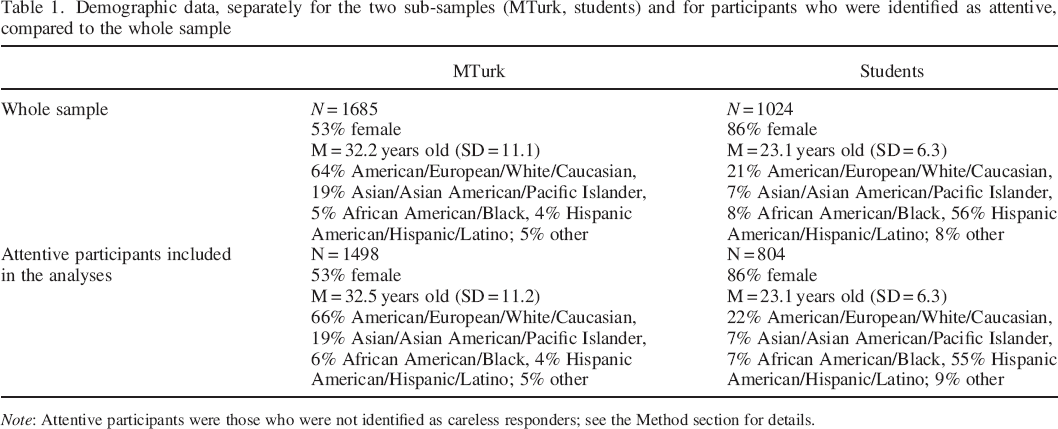
Note: Attentive participants were those who were not identified as careless responders; see the Method section for details.
Procedure
First, participants accessed the survey online from either the university's SONA management website or Amazon's MTurk HIT dashboard and were then redirected to complete the survey on Qualtrics. After accessing the survey, they were randomly assigned to complete one of the three creativity measures that are described below. They completed either self–reported creativity measures (general and domain–specific self–reported creativity scale), a remote associates test, or a photo caption task. Upon completion of the creativity task, they completed a number of personality measures including the Intellect Scale; the presentation order of the measures and items within each measure was randomized. Both samples completed the creativity and personality measures in English. Within the personality measures there were measures to detect careless responders (Meade & Craig, 2012). People then filled out the demographics form, a self–report effort item, and were then debriefed and thanked for their participation.
Materials
Creativity measures
Participants were randomly assigned to complete one of three creativity measures: two self–reported creativity measures, a remote associates test, or a photo caption task.
Self–reported creativity (n = 874)
There were two measures of self–reported creativity used in this study. One of the measures was a general self–reported creativity scale and the other was a domain–specific measure of creativity.
General self–reported creativity
A five–item scale adapted from Kaufman and Baer (2004) was used. People rated the items on a 5–point Likert scale (strongly disagree–strongly agree). Samples items are ‘I consider myself to be creative’ and ‘I am good at coming up with new and different ideas.’ Past research has indicated that this brief measure is correlated both with other self–report creativity measures (Wigert, Reiter–Palmon, Kaufman, & Silvia, 2012) and actual creative performance (Kaufman, Pumaccahua, & Holt, 2013; Wigert et al., 2012).
Kaufman domains of creativity scale (K–DOCS)
We used Kaufman's (2012) domain–specific self–reported creativity measure. The K–DOCS is a 50–item measure that includes five creativity domains: (i) self/everyday, (ii) scholarly, (iii) performance, (iv) mechanical/science, and (v) artistic. People rated the items on a 5–point Likert scale (much less creative–much more creative). Sample items include: ‘Writing a nonfiction article for a newspaper, newsletter, or magazine’ (scholarly) and ‘Making a sculpture or piece of pottery’ (artistic).
Compound remote associates test (CRAT; n = 961)
We used 20 CRAT items from Bowden and Jung–Beeman's (2003) normative list to measure creative insight. For the CRAT, people are given three words and are instructed to come up with a fourth word that, when combined with each of the other three words, forms a compound word or phrase. For example, if people are given ‘river, note, and account,’ the correct response would be ‘bank.’ This would form the words ‘riverbank,’ ‘banknote,’ and ‘bank account.’ People were told in the instructions that each CRAT item would appear one at a time on the screen for 15 s, and they would need to type the answer into a text box provided on the screen. 1 People were given one sample CRAT, which was presented exactly how it would appear on the following screens. A correct answer was scored as 1 and a wrong answer was scored as 0. The CRAT score was the sum of the 20 items.
Photo caption task (n = 874)
People were instructed to write a caption based on an ambiguous photograph. In the photograph, a person wearing a dark blue jacket is standing in front of a chain–link fence looking to the other side of the fence where a large construction vehicle is parked. Amabile's (1982, 1996) Consensual Assessment Technique (CAT) was used for scoring. The CAT utilizes a procedure in which knowledgeable raters come to an independent agreement on what is creative. Although the CAT traditionally calls for experts, the quasi–expert rater, with notable experience but not the traditional 10 years of expertise, has been shown to correlate strongly with experts (e.g. Kaufman & Baer, 2012; Kaufman, Baer, Cropley, Reiter–Palmon, & Sinnett, 2013; Kaufman, Gentile, & Baer, 2005). In the current study, three quasi–experts with a background in creativity studies (which has been shown to be a suitable form of expertise, see Baer, Kaufman, & Gentile, 2004; Baer, Kaufman, & Riggs, 2009) evaluated the captions based on their personal definitions of creativity. They provided ratings on a 6–point scale with 1 meaning that they did not think the caption was creative at all and 6 meaning that they thought the caption was very creative. They did not discuss their ratings with one another. Kaufman, Lee, Baer, and Lee (2007) found the photo caption task to be a reliable measure of creativity and found that raters consistently agreed across captions written by a participant.
Intellect
Mussel's (2013a) intellect scale was used. The intellect scale has 24 items broken up into two processes (Seek and Conquer) or into three operations (Think, Learn, and Create). People rated the items on a 7–point Likert scale (strongly disagree–strongly agree). A sample item from the process Seek and operation Think is ‘I enjoy occupying myself with theories that are new to me’ and from the process Conquer and operation Create is ‘I persevere with the development of new products until they are ready.’ As mentioned, additional personality measures were administered, but were not included in the present study.
Careless responding measures
In order to improve the quality of our survey data, we included three measures in a Latent Class Analysis (LCA) to identify careless responders. First, seven items were mixed randomly within the personality measures. The items read, ‘Select
Second, Chapman and Chapman's (1983) unpublished infrequency scale was used. The scale includes 13 items that are rated as true or false. People typically respond to each of these items in a consistent manner, and deviations from these consistent responses would indicate careless responding. This measure is typically scored if people respond to two or more items inconsistently. A sample item is ‘Driving from New York to San Francisco is generally faster than flying between these cities’ and a response of true to this item would reflect careless responding (i.e. it is faster to fly from New York to San Francisco than it would be to drive).
Last, one self–report item from Meade and Craig (2012) was included at the end of the survey. Participants indicated on a 5–point scale how much effort they devoted to the study, anchored with 1 = ‘almost no’; ‘very little’; ‘some’; ‘quite a bit’; and 5 = ‘a lot of’.
We also conducted an LCA with the three measures included to identify careless responders (Meade & Craig, 2012). We a priori decided to use two classes of responders: attentive responders and careless responders (see Meade & Craig, 2012; Maniaci & Rogge, 2014). Overall, there was high classification accuracy (entropy = .988). There were 2356 people (87.0% of the sample) classified as attentive responders and 225 people (8.3%) classified as careless responders. We excluded the 225 careless responders from all future analyses. There were another 122 (4.5%) participants who did not complete any of the three careless responding measures and were excluded. Finally, 60 participants were excluded due to missing data on all of our study variables. Therefore, all analyses conducted include the 2302 attentive responders.
Results
Reliabilities and correlations for all study variables can be found in Table 2. Cronbach's alphas were high (α > .80) for all variables. The internal consistency for the photo caption task reflects interrater consistency among the three raters.
Correlations and Cronbach's alpha's for the scales used
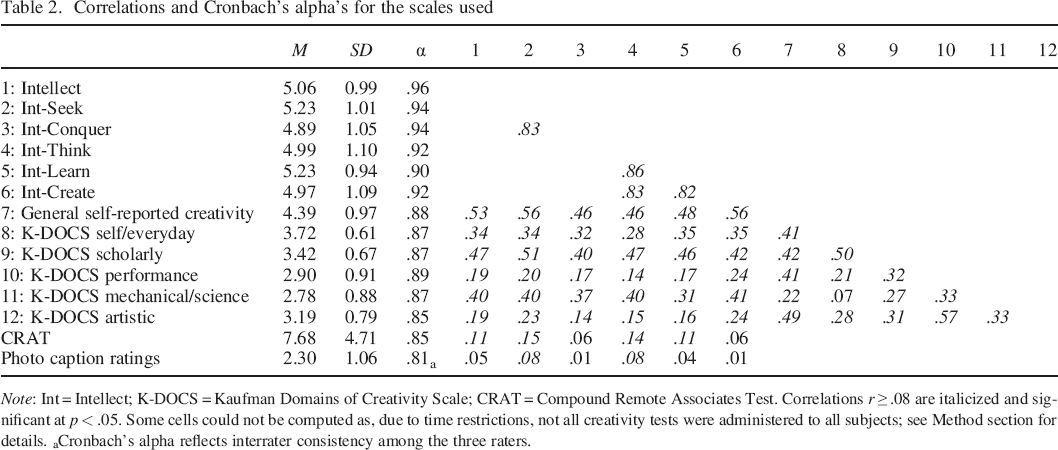
Note: Int = Intellect; K–DOCS = Kaufman Domains of Creativity Scale; CRAT = Compound Remote Associates Test. Correlations r ≥ .08 are italicized and significant at p < .05. Some cells could not be computed as, due to time restrictions, not all creativity tests were administered to all subjects; see Method section for details. aCronbach's alpha reflects interrater consistency among the three raters.
Before testing our hypotheses, we used confirmatory factor analysis to compare the fit of the proposed two–dimensional model with simpler one–dimensional models and a general factor solution. The proposed two–dimensional model (M1) included correlated latent variables for the three operations Think, Learn, and Create and the two processes Seek and Conquer, analogous to multitrait–multimethod models (Marsh, 1989). Table 3 displays results of model fit using the maximum likelihood estimation method. The proposed two–dimensional model M1 had an acceptable fit, and latent variables explained 64% of the variance in the indicator variables. The correlation between the latent variables Seek and Conquer was .90 2 ; latent correlations between Think and Create; Think and Learn; and Learn and Create were .72, .78, and .67, respectively. Next, the theoretically expected and tested model was compared to a model with correlated latent variables for operations (Think, Learn, Create; M2), a model with correlated latent variables for processes (Seek, Conquer; M3), and a one–factor model (M4). Model fit indices in Table 3 show that each of these models has inferior fit when compared to the two–dimensional model M1. A chi–square test of differences in hierarchical models indicated that the difference was significant for all three comparisons (Δχ2 > 2983; dfdiff ≥ 25; p < .001).
Results from confirmatory factor analyses of the intellect structure model
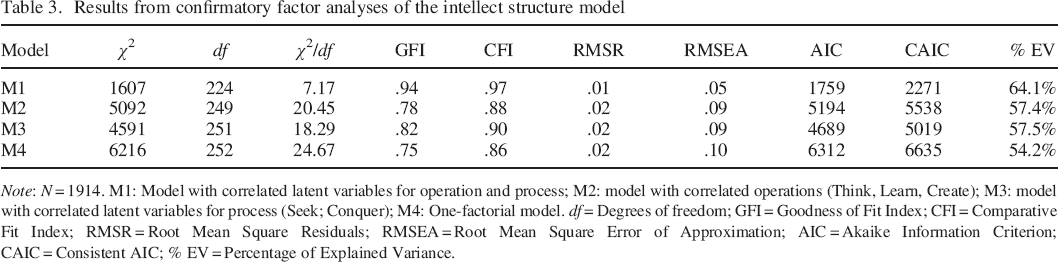
Note: N = 1914. M1: Model with correlated latent variables for operation and process; M2: model with correlated operations (Think, Learn, Create); M3: model with correlated latent variables for process (Seek; Conquer); M4: One–factorial model. df = Degrees of freedom; GFI = Goodness of Fit Index; CFI = Comparative Fit Index; RMSR = Root Mean Square Residuals; RMSEA = Root Mean Square Error of Approximation; AIC = Akaike Information Criterion; CAIC = Consistent AIC; % EV = Percentage of Explained Variance.
As can be seen in Table 2, the creativity indicators were all significantly predicted by the overall intellect score, by one of the intellect processes or one of the intellect operations. However, there were large differences between the creativity indicators regarding the explained variance. The correlation with self–reported creativity was high (around .50). The correlations between intellect and the K–DOCS ranged between .19 and .47. The relationship was strongest for scholar and scientific creativity, and weakest for performance and artistic creativity. Finally, the correlation between the intellect overall score and the CRAT was weak, and the caption ratings was only significantly predicted by the operation Think.
Our hypothesis regarding the significant prediction of creativity from the TIF operation Create was confirmed for six of the eight creativity indicators administered in the present study. Specifically, Create significantly predicted the general self–reported creativity measure and all five domains in the K–DOCS. Contrary, correlations between Create and the CRAT and Create and the Caption Rating task were nonsignificant.
We used latent regression analysis to test whether the variance explained by Intellect in the creativity measures was specific to the operation Create. We ran separate analyses for each of the eight creativity dimensions (see Table 4). For each model, one latent variable was modelled to reflect the respective creativity dimension. For self–reported creativity, the five items of this measure were used as indicators. For each of the domains of the K–DOCS, three indicator variables were used, each of which was computed by randomly assigning the nine to eleven items of each scale to one of the indicators. Similarly, three parcels were computed from the twenty RAT–items and subsequently used as indicator variables. For the Caption Rating Task, the three ratings of the independent raters were used as indicator variables.
Results from latent regression analyses, regressing the creativity measures on a general intellect factor and the intellect operations (think, learn, and create)
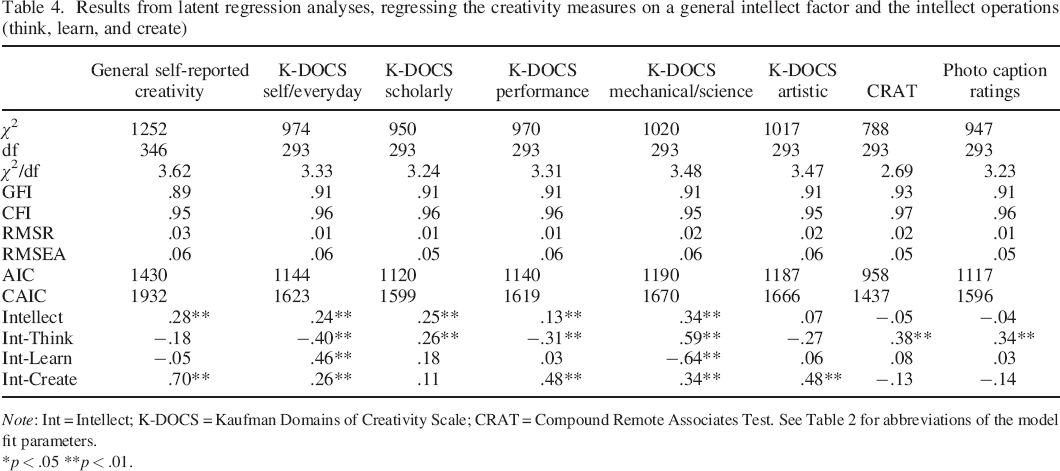
Note: Int = Intellect; K–DOCS = Kaufman Domains of Creativity Scale; CRAT = Compound Remote Associates Test. See Table 2 for abbreviations of the model fit parameters.
p < .0.
p < .01.
The measurement model for intellect was similar to model M2 (as described above, see also Table 3); that is, three latent variables for the operations Think, Learn, and Create were modelled, each of which was indicated by their respective items. Latent regression paths were included to predict the respective latent creativity variable by each of the three latent operations. Additionally, we included a latent variable for general intellect, which was indicated by all 24 items of the Intellect Scale and also predicted the latent creativity variable. We included this variable to control for the variance that is explained in each creativity dimension by overall intellect, rather than by one of the operations.
As can be seen from the results depicted in Table 4, all models showed acceptable model fit. Across the eight analyses, all creativity indicators were significantly predicted by the intellect operations. For self–reported creativity, latent regression coefficients indicate that our hypothesis was fully confirmed. In the context of all three operations and controlling for overall intellect the variance explained in the general self–reported creativity scale was due entirely to the operation Create. Regarding the K–DOCS, significant beta weights for Create were found for self/everyday, performance, mechanical/science, and artistic creativity, indicating that Create significantly predicts these domains in the context of the other operations and controlling for general intellect. Notably, Create was the only operation with significant beta–weight for the domains performance and artistic. For self/everyday creativity, an additional significant beta–weight was found for Learn, and Think had an additional significant beta–weight for the domain mechanical/science. Contrary to expectations, the domain scholarly creativity, the CRAT as well as the caption was only predicted by Think. Because of the positive bivariate correlations between the intellect operations and the creativity indicators, we refrain from interpreting the negative path coefficients from the regression analyses. These negative coefficients are likely to be the result of complex suppression effects, which often cannot be replicated across studies.
Discussion
We tested predictions derived from the Theoretical Intellect Framework (TIF; Mussel, 2013a) with regards to the prediction of four different creativity measures. The TIF is a theoretical model positing that the internal structure of the construct intellect is characterized by a two–dimensional structure, consisting of two processes and three operations. Using a large sample consisting of sub–samples of students and nonstudents, we found confirming evidence regarding the two–dimensional structure. Specifically, results from confirmatory factor analyses showed improved fit for a two–dimensional model, compared to one–dimensional models with either process or the operation factors, or a one–factorial model positing that variance in intellect can be sufficiently explained by one latent variable. In this regard, it is worth mentioning that the present study is the first to investigate the TIF outside of Germany. Therefore, these results confirm that the TIF can generalize to another culture and language (i.e. English).
The TIF posits three operations: Think, Learn, and Create. These operations are theoretically grounded in theories of intelligence, mirroring fluid intelligence, crystallized intelligence, and creativity, respectively. From the model, specific predictions regarding relations between intellect operations and external criteria can be deduced. For example, the operation Think has been found to significantly and uniquely predict grades in math and intellectual–scientific interests, whereas the operation Learn predicted grades in English as a foreign language and educational interests. The operation Create has thus far only been shown to relate to corresponding interests, such as artistically creative vocational interest or interests for art/culture/architecture. Therefore, the purpose of the present study was to investigate whether theoretically related indicators—specifically, various indicators of creative achievements—would be predicted or uniquely predicted by the operation Create.
According to our results, there is confirming evidence that the operation Create, rather than Think or Learn, is related to some of the creativity indicators investigated in the present study. The strongest relationship among the intellect operations and creativity was found for self–reported creativity, and the variance in this criterion was solely explained by the operation Create. As both measures are self–report measures, the absolute level of the correlation might be affected by common method variance. Our main hypothesis, however, relates to the relative variance proportions that can be explained by the intellect operations; as there is no reason to assume that the operations are differentially affected by common–method variance, the results are clearly in favour of our predictions. However, in addition to common method variance, it should be mentioned that overlap in the item content of the respective measures might have inflated the relation between the operation Create and self–reported creativity.
Significant bivariate correlations between the operation Create and the five domains of the K–DOCS suggest that this operation relates to criteria predicted theoretically, and latent regression analyses showed that four of the five domains were significantly predicted in the context of all operations. Additionally, the domains of performance and artistic creativity were uniquely predicted by Create. However, additional variance proportions were explained by the other operations for the domains self/everyday and mechanical/science, and the domain scholarly was uniquely predicted by Think. Interestingly, the non–significant beta–weight for Create with regard to scholarly creativity is seemingly at odds with the results from bivariate correlations—Create and scholarly creativity correlate .42, and none of the other domains has a stronger correlation with Create. However, the correlation between scholarly creativity and the operation Think is even stronger (r = .47); therefore, it seems that the operation Think actually captures all of the variance in scholarly creative achievements (such as researching a topic using many different types of sources or debating a controversial topic). Because the three operations of the TIF predicted different domains of creativity, it is important to further examine sub–facets of openness/intellect in order to understand these constructs and how they relate to creativity.
Our hypothesis was not supported for the CRAT and the photo caption task. First, it should be noted that correlations between intellect and these two measures were generally low (r = .11 and r = .05, respectively). These findings are actually in line with previous research on the correlation between self–assessed creativity and performance–based creativity measures. For example, Kaufman and colleagues (2013), in a large sample study, found a correlation of .10 between self–assessed creativity and the CRAT and a correlation of .19 between openness to experience and the CRAT; Wigert and colleagues (2012) found a correlation of .13 between self–assessed creativity and a caption rating task; and Lee, Huggins, and Therriault (2014) found a correlation of −.02 between scores on the RAT and openness to experience. It seems that, in general, people might not be good at judging their own creativity (see also Realo et al., 2003).
Regarding TIF–operations, we found that the small variance explained in the CRAT and the photo caption task was due to the operation Think, rather than Create. It can be speculated that this result is due to the cognitive component of these two creativity measures. For example, Taft and Rossiter (1966) determined convergent and divergent validity of the Remote Associates test with regards to convergent thinking (including verbal and quantitative IQs on indicators such as Raven's Progressive Matrices, the A.C.E.R. Speed and Accuracy test or the Number Series subtest from the Army Alpha), and divergent thinking (including measures of Ideational Fluency, Word Fluency, Consequences, Unusual Uses, and a Figure Completion test). The authors found the Remote Associates test to primarily load on a convergent thinking. Lee and Therriault (2013; Lee et al., 2014) also found that the CRAT was more highly related with measures of convergent thinking. Examples of fluid abilities which are beneficial to such tasks include verbal knowledge to carefully think through possible responses for the best response. Broadly, reasons for this pattern might be that both the CRAT and the photo caption task are designed to allow only one solution, which is typical for convergent test. It is possible that such properties of the two performance–based creativity tasks accounted for the results found, specifically stronger correspondence to the facet Think (which is theoretically grounded in theories of fluid intelligence, including convergent thinking) compared to Create. These results also add to our knowledge regarding the construct validity of the TIF. Specifically, the facet Create, as defined in the TIF and operationalized in the Intellect Scale, does not readily correspond to such performance–based indicators of creativity. Additionally, our results suggest that future research on creativity would benefit from a more systematic differentiation between cognitive or performance–related aspects of creativity on one hand and trait–related aspects on the other.
In sum, results of the present study refine our understanding of the operation Create from the TIF. Results from bivariate correlations as well as from multiple regression analyses, investigating the operation Create in the context of the two other operations Think and Learn, showed that Create predicts theoretically related criteria. Indeed, from a battery of four tests with eight creativity indicators, six of the creativity measures were significantly and in three cases uniquely predicted by Create. However, creativity indicators that require higher working memory capacity and have a strong cognitive load, like scholarly self–reported creativity or performance on the CRAT and photo caption task, are more strongly or uniquely predicted by the operation Think, which at least in part mirrors the cognitive nature of such indicators (Lee et al., 2014). Therefore, in applied contexts where creative achievement is to be predicted or improved through interventions, the cognitive motivation should at least be equally considered, next to the motivation to create, for establishing an optimal set of determinants of such outcomes.
Footnotes
Acknowledgements
The authors would like to thank Garo P. Green for his generous support of this research.