







Abstract
Research has shown that two individual difference dimensions, Right–Wing authoritarianism (RWA) and Social Dominance Orientation (SDO), consistently predict prejudice. Traditionally it has been assumed that RWA and SDO both index generalized dispositions to dislike outgroups and those who differ, and therefore predict prejudice similarly. An alternative approach suggests that RWA and SDO express different motivational bases for prejudice that differentially interact with intergroup conditions to predict prejudice. This was tested by investigating students’ reactions to varying descriptions of a bogus immigrant group. As hypothesized, the degree to which RWA and SDO predicted opposition to the immigrants was differentially contingent on the degree to which the immigrants were described as economically competitive, socially threatening (deviant) and socio–economically disadvantaged. Copyright © 2010 John Wiley & Sons, Ltd.
Introduction
Two approaches have dominated social psychological inquiry into the causes of outgroup dislike or prejudice. One approach has explained prejudice in terms of group or intergroup processes that generate prejudices that are widely shared within social groups and target specific outgroups (Sherif, 1967; Tajfel & Turner, 1979). The second approach has explained prejudice in terms of systematic individual differences in peoples’ propensity to hold generally prejudiced attitudes as individuals (Adorno, Frenkel–Brunswick, Levinson, & Sanford, 1950; Altemeyer, 1998).
Intergroup theories have focussed primarily of three kinds of intergroup processes or relations that generate outgroup dislike. These are intergroup threat (e.g. Greenberg, Solomon, & Pyszczynski, 1997; Neuberg & Cottrell, 2002; Riek, Mania, & Gaertner, 2006; Stephan & Stephan, 2000), intergroup competition (e.g. Esses, Jackson, Dovidio, & Hodson, 2005; Sherif, 1967; Tajfel & Turner, 1979) and intergroup inequality or dominance (e.g. Jost & Banaji, 1994; Pratto, Sidanius, & Levin, 2006; Sidanius & Pratto, 1999).
The individual difference approach derived originally from the empirical finding that prejudice or tolerance in individuals tends to be generalized over targets. This was demonstrated by positive correlations, usually in the moderate to strong range, between individuals’ attitudes to quite different outgroups (Adorno et al., 1950; Allport, 1954; Altemeyer, 1998; Ekehammar & Akrami, 2007). This suggested that some stable characteristic of individuals, such as personality or basic values, was influencing them to be generally prejudiced or tolerant towards outgroups and minorities. Adorno et al. (1950) first attempted to measure this individual difference component of prejudice proneness using their famous F–scale measure of Authoritarian Personality. A great deal of research over the following six decades has identified two relatively stable individual difference dimensions, Right–Wing Authoritarianism (RWA) and Social Dominance Orientation (SDO) that powerfully predict prejudice in individuals (Altemeyer, 1998; Duriez & Van Hiel, 2002; Ekehammar, Akrami, Gylje, & Zakrision, 2004; Heaven & Bucci, 2001; McFarland, 1998; Van Hiel & Mervielde, 2002).
The RWA scale was developed by Altemeyer (1981) to rectify the psychometric deficiencies of Adorno et al.'s (1950) original F–scale (i.e. its lack of unidimensionality, failure to control acquiescence and low reliability when its items were balanced). The RWA scale achieved this by narrowing its item content to just three of the original nine content clusters (conceptualized as ‘traits’) incorporated in the original F–scale, that is, conventionalism, authoritarian submission and authoritarian aggression. Thus, RWA items express beliefs in coercive social control, in obedience and respect for existing authorities and in conforming to traditional moral and religious norms and values.
The SDO scale was developed later by Pratto, Sidanius, Stallworth, and Malle (1994) to measure a ‘general attitudinal orientation towards intergroup relations, reflecting whether one generally prefers such relations to be equal, versus hierarchical’ (p. 742). This scale seemed to measure a different set of social attitudinal clusters of Adorno et al.'s (1950) original 9–item ‘trait’ clusters, such as those pertaining to power and toughness, destructiveness and cynicism, and anti–intraception.
Research on RWA and SDO has indicated that they seem to be relatively independent dimensions, with the correlation between them typically being positive but weak, although it can vary from strong positive to weak negative (Duriez, Van Hiel, & Kossowska, 2005; Roccato & Ricolfi, 2005). Both RWA and SDO have been shown to predict prejudice against outgroups independently of each other with their effects relatively unaltered by controlling for other psychological individual difference variables but typically eliminating or substantially reducing significant effects of other psychological variables (Altemeyer, 1998; Ekehammar et al., 2004; McFarland, 1998; Sibley & Duckitt, 2008).
The issue of why and how RWA and SDO predict prejudice has attracted less attention. The dominant assumption in the research literature, stemming originally from Adorno et al. (1950) and continued by Altemeyer (1998), has been that RWA and SDO both seem to involve a need for prejudice, that is, a basic disposition to generally dislike outgroups and those who are different. This implies that RWA and SDO will both predict dislike or prejudice towards all or most outgroups in much the same kind of way. This seems to have been supported by the research showing that both RWA and SDO have independently and powerfully predicted prejudice against many different kinds of outgroups (e.g. Altemeyer, 1981, 1996; Ekehammar et al., 2004; Pratto et al., 1994; Van Hiel & Mervielde, 2002, 2005). As a result, researchers have often simply aggregated attitudes to different kinds of outgroups into indices of generalized prejudice and shown that RWA and SDO powerfully predict these generalized prejudice indices (e.g. Altemeyer, 1998; Ekehammar, & Akrami, 2003; McFarland, in press; Zick, Wolf, Küpper, Davidov, Schmidt, & Heitmeyer, 2008).
An alternative dual process motivational (DPM) approach sees RWA and SDO as expressing different sets of basic social values or motivational goals and therefore has somewhat different implications (Duckitt, 2001; Duckitt & Sibley, 2009). This approach sees RWA as expressing collective security motivational values (i.e. at the high–RWA extreme, values of social order, stability, cohesion, control and tradition as opposed to at the low–RWA extreme, values of personal liberty, individual autonomy, social diversity and openness to change) and SDO expressing enhancement or assertion motivational values (i.e. values of power, dominance, superiority over others and self or group aggrandizement at the high–SDO extreme and values of equality, universalism, and altruistic social concern at the low–SDO extreme). This view is supported by independent research showing that these values do differentially predict SDO and RWA as expected by the Dual Process Model (Duriez et al., 2005; Van Hiel, Pandelaere & Duriez, 2004).
The DPM approach proposes that RWA and SDO should have different psychological bases or causes, and that they should therefore exert their effects on prejudice in different ways and through different mechanisms. The first proposition has been supported by research showing that different personality trait dimensions and different schema–based, socialized beliefs about the nature of the social world underlie RWA and SDO (e.g. Duckitt, 2001; Duckitt, Wagner, du Plessis, & Birum, 2002; Duriez & Soenens, 2006; Sibley & Duckitt, 2008; Sibley, Wilson, & Duckitt, 2007a; see also Ekehammar et al., 2004). Thus, RWA seems to be determined by the socialized belief that the social world is a dangerous and threatening place, and by the personality construct of social conformity (or Big Five low Openness and high Conscientiousness). SDO seems to be determined by a Social Darwinist view of the social world as a ruthlessly competitive jungle, and by the personality construct of toughnindedness (or big–five low Agreeablness).
Second, the model proposes that RWA and SDO generate prejudiced outgroup attitudes for different reasons. Specifically, since RWA expresses the motivational goal or value of collective security (that is, of controlling social or value–based threat and uncertainty by maintaining societal order, cohesion, stability and tradition), persons high in RWA should be particularly negative towards outgroups that seem to threaten collective security in some way. Since SDO expresses the competitive motivational goal or value of group dominance and superiority, persons high in SDO should be particularly negative towards lower status outgroups, in order to justify and maintain existing ingroup superiority, and towards outgroups competing over relative group dominance and superiority.
In contrast to the traditional approach, which has tended to assume that RWA and SDO influence prejudice against all or most outgroups in broadly similar fashion, the DPM approach suggests that because RWA and SDO express quite different motivationally based values, they should have important differential effects on outgroup attitudes. This suggested three specific hypotheses. First, RWA and SDO should predict outgroup prejudice differentially with RWA predicting prejudice against outgroups threatening collective security, while SDO should predict prejudice against low status groups or competing groups (differential prediction hypothesis). Second, the effects of RWA and SDO on outgroup prejudice should be differentially mediated psychologically with the effects of RWA mediated by the degree of perceived threat from outgroups and the effects of SDO by feelings of competitiveness over relative status or dominance to outgroups (differential mediation hypothesis). And, third, particular social and intergroup conditions or processes, that is, intergroup threat in the case of RWA, and intergroup competition or inequality in the case of SDO, should differentially activate the different motivational values underlying RWA and SDO to direct prejudice against particular outgroups or minorities (differential moderation hypothesis).
The differential prediction and differential mediation hypotheses have been directly tested and supported in prior research. Thus, RWA and SDO differentially predicted dislike of particular kinds of outgroups, and different kinds of prejudice, consistent with their hypothesized motivationally based values (Bizumic, Duckitt, Popadic, & Krauss, 2009; Duckitt, 2006; Duckitt & Sibley, 2007; Sibley, Wilson, & Duckitt, 2007b; Asbrock, Sibley, & Duckitt, in press). The effects of RWA and SDO on outgroup dislike have also been shown to be differentially mediated, with RWA mediated by perceived threat and SDO mediated by felt competitiveness (Duckitt, 2006). Research by McFarland (2005) also showed that the effects of RWA and SDO on support for the Iraqi war were differentially mediated in similar fashion.
The differential moderation hypothesis, however, has not yet been comprehensively and directly tested. According to this hypothesis, when people high in RWA and SDO categorize themselves as members of a social group, they will be particularly reactive to intergroup relationships or processes that activate their underlying motivational goals or values. Thus, awareness of outgroup threat to ingroup collective security, should result in persons high in RWA, who value collective security, becoming correspondingly hostile to that outgroup. Awareness of intergroup differences in status and power should result in persons high in SDO, who value group dominance and superiority, becoming correspondingly negative to outgroups lower in status and power in order to justify their group's relative superiority. And third, an awareness of outgroup competition over status, prestige or over real resources and power should result in persons high in SDO becoming corresponding negative to competing outgroups. Moreover, because intergroup competition will typically also threaten ingroup collective security, competing outgroups should also elicit negativity from persons high in RWA.
Although research has not yet tested this differential moderation hypothesis directly, findings have been reported that seem consistent with it. Some studies have shown expected moderation effects for either RWA (or similar measures of authoritarian attitudes or values) (Cohrs, Kielmann, Maes, & Moschner, 2005; Cohrs & Ibler, 2009; Feldman, 2003; Feldman & Stenner, 1997; Rickert, 1998; Stenner, 2005) or SDO (Eibach & Keegan, 2006) separately, and so could not show if the effects were differential. Other studies have shown differential effects for RWA and SDO using moderators (either manipulated or measured) that seem reasonably consistent with the DPM hypotheses. For example, a cross–national meta–analysis by Cohrs and Stelzl (in press) found that RWA correlated particularly strongly with anti–immigrant attitudes in countries where immigrants were perceived as increasing the crime rate (e.g. Germany, Italy), whereas SDO correlated particularly strongly with anti–immigrant attitudes in countries with a higher relative unemployment rate of immigrants (e.g. Belgium, Sweden, Switzerland). An experimental study by Dru (2007) manipulated the motivational orientations presumed to underlie RWA and SDO and found that when an ingroup norm preservation orientation was primed, RWA was a significant predictor of anti–immigrant (Arabs, Blacks, Asians) attitudes among French students while SDO was not. When group competitiveness was primed, SDO significantly predicted anti–immigrant attitudes, while RWA did not.
Several other experimental studies have tested differential moderation by manipulating the description of a minority group to make either intergroup threat or intergroup competition over relative dominance highly salient or not salient, with mixed results. Thomsen, Green, and Sidanius (2008) found that RWA and not SDO predicted aggression towards immigrants who would not assimilate (interpreted as likely to threaten collective security and cohesion), whereas SDO and not RWA predicted aggression to immigrants who were assimilating (interpreted as likely to blur the status boundary and power differential between immigrants and the dominant majority).
Cohrs and Asbrock (2009) found that describing Turks as socially threatening significantly increased the degree to which RWA, and not SDO, predicted anti–Turkish attitudes among German students. However, their study also found that depicting Turks as competitive did not produce expected moderating effects of SDO on anti–Turkish attitudes. In another recent study also focusing on Turkish immigrants, Meeus, Duriez, Vanbeselaere, Phalet, and Kuppens (2009, Study 2) primed levels of perceived symbolic and realistic threat to Flemish (ingroup) culture resulting from Turkish immigration. They reported that SDO and RWA did not interact with the threat manipulation, and instead retained direct (main) effects on attitudes towards Turkish immigration that were invariant across conditions. Apparently non–supportive findings were also obtained by Esses, Jackson, and Armstrong (1998) who found no difference in the degree to which SDO predicted anti–immigrant attitudes under competition (information making competition from immigrants for jobs salient) and no competition conditions (general information about immigrants).
These apparently non–supportive findings could, however, be due to differences in the way the expected moderators were conceptualized or measured. For example, the study by Cohrs and Asbrock (2009) did not manipulate intergroup competition from Turks. Instead Turkish individuals were described as personally industrious, achievement oriented and competitive, which persons high in SDO might tend to admire. These apparently non–supportive findings could also be due to studies trying to manipulate the awareness of real outgroups and group relations where knowledge and beliefs about these groups were already powerfully entrenched. This was evidently the case in the Esses et al. (1998) study in which SDO was already a strong predictor of anti–immigrant attitudes in the ‘no competition’ condition, and the degree of subjectively perceived competition was a powerful mediator of the relationship between SDO and anti–immigrant attitudes in both competition and non–competition conditions. The study by Meeus et al. (2009, Study 2) may have failed to detect significant interactions for a similar reason, namely that RWA and SDO were significant predictors of opposition to Turkish immigration even in the non–threatening control condition, making it all the more difficult to detect interaction effects given a high baseline level of presumably heavily anchored attitudes about the threat posed by Turks.
Finally, some research has been cited as not supporting moderation that did not manipulate or compare real differences in awareness of actual outgroup threat or competition (where moderation would be expected), but tested interactions with the degree to which threat or competition was subjectively perceived or assessed (e.g. Sidanius, Haley, Molina, & Pratto, 2007), which should mediate effects of RWA and SDO on outgroup attitudes, but not necessarily moderate them (see, e.g. Cohrs & Ibler, 2009).
Overall, therefore, a number of studies have reported findings broadly consistent with the DPM proposition that the degree to which RWA and SDO will predict prejudice against particular outgroups will be differentially contingent on concerns over collective security; and over competitiveness over relative dominance and superiority, respectively. There have also been some apparently non–supportive findings, but there have generally been plausible methodological factors, or differences in conceptualization of the moderators, that could account for these findings. No study has yet set out to directly and comprehensively test the DPM differential moderation hypothesis by manipulating the three specific intergroup conditions expected to differentially influence the degree to which RWA and SDO would predict anti–outgroup attitudes towards a group that are not already anchored by pre–existing knowledge and beliefs about the outgroup.
The current research therefore set out to test this by manipulating descriptions of a bogus new immigrant outgroup as either competing with the ingroup, disadvantaged or low status relative to the ingroup, socially deviant and so threatening ingroup norms, traditions, and values, or, in a control condition, as neither competing, disadvantaged or socially threatening. The DPM approach would predict that both RWA and SDO would significantly predict opposition towards competing immigrants, only SDO would predict opposition towards disadvantaged immigrants, only RWA would predict opposition towards socially threatening immigrants, and neither RWA nor SDO would predict opposition towards immigrants described as not competing, not disadvantaged and not socially threatening.
These predictions can be contrasted to those that would be generated by the more traditional view which has tended to assume that both RWA and SDO involve generalized negativity to all, or most, outgroups independently of intergroup context or intergroup relations (Adorno et al., 1950; Allport, 1954; Altemeyer, 1998). This perspective would expect both RWA and SDO to predict opposition to immigrants more or less equivalently in all these conditions.
Method
Participants
The participants were 191 undergraduate introductory psychology students in their first semester at university in 2008. In order to ensure that all participants were native New Zealanders only those who were born in and had lived in New Zealand for all or most of their lives and who classified their ethnicity as Pakeha/European New Zealander or Maori were included. The mean age of the sample was 19.0 years (SD = 2.26), 68.1% were female and 92.7% were of Pakeha/European ethnicity.
Experimental manipulations
Participants completed a questionnaire that described a bogus immigrant group, Sandrians (adapted from Esses et al., 1998) and were asked to visualize a situation in which large numbers of Sandrians would be immigrating to New Zealand in the near future. This was followed by one of four descriptions of Sandrians, with participants randomly assigned to one of these four questionnaire versions:
Direct economic competition (n = 50): These Sandrian immigrants are culturally quite similar to New Zealanders in values and lifestyle and in educational level and level of skills. However, their numbers and skills make it inevitable that they will be taking away jobs from native New Zealanders and competing with them for resources. As their numbers and influence in New Zealand increase, they will reduce the influence, importance and role of New Zealanders like you in New Zealand society. Disadvantaged (n = 46): These Sandrian immigrants are quite similar to New Zealanders in culture and lifestyle and are very unlikely to compete with New Zealanders over jobs, resources and influence. However, they do come from a very disadvantaged background. Although respectable and law abiding, their history of poverty and lack of education and training means many might need educational support and assistance in order to become economically self–sufficient in New Zealand. Social threat (n = 47): These Sandrian immigrants are very similar in education and standard of living to native New Zealanders, and very unlikely to take away jobs from native New Zealanders or disadvantage them in any way. Sandrian culture, however, differs from that of more conventional New Zealanders. They are highly unconventional, hedonistic and bohemian in outlook and behaviour and totally reject conventional family or religious values and morality. For example, their lifestyle is characterized by high levels of extra– and pre–marital sexual activity, hedonistic drug and alcohol use, and much youth delinquency. Control (n = 48): These Sandrian immigrants do not differ from New Zealanders in any important ways. Their life style, values and cultural background are very similar to those of New Zealanders. They are also similar in educational level and standard of living, and it seems very unlikely that they will take away jobs from native New Zealanders or disadvantage native New Zealanders in any way.
Measures
Participants first completed a shortened 10–item balanced version of the RWA scale (Altemeyer, 1996) and a shortened 8–item balanced version of the SDO scale (Pratto et al., 1994). The αs for these scales were .76 and .73, respectively and the correlation between them was r(189) = −.03, p = .68. Participants then read one of the four experimental manipulations describing Sandrian immigrants.
After reading the description of Sandrians, participants completed a 6–item balanced Likert scale assessing opposition to Sandrian immigration. This scale was adapted from the generalized intergroup attitude scale used previously by Duckitt, Callaghan, and Wagner (2005). Specimen items are: ‘I would be completely opposed to Sandrians migrating to NZ’ and ‘I would have a very positive attitude to Sandrians migrating to NZ’ (reverse scored). One of these items had a relatively weak item–total correlation was therefore discarded. The remaining 5–item scale had an α coefficient of .87. In addition, a single item assessed how generally unfavourable or favourable participants would feel about the migration of Sandrians to New Zealand. This rating correlated .73 with the opposition to Sandrian migration scale and was therefore simply added to that scale. This expanded 6–item opposition to Sandrian migration scale had an α of .89.
Manipulation check measures
Participants also completed three 2–item scales, which were used to assess if the experimental manipulations had been successful in depicting Sandrians as direct economic competitors, as disadvantaged, or as socially threatening, relative to the control group.
Direct economic competition manipulation check items:
Sandrians will compete with New Zealanders for jobs and resources. As their numbers increase Sandrians are likely to reduce the influence, importance and role of New Zealanders like you in NZ society.
These 2 items had an α of .62.
Disadvantaged condition manipulation check items:
Sandrians come from very disadvantaged backgrounds. Sandrians will probably need support and assistance to become economically self–sufficient in NZ.
These 2 items had an α of .86.
Social threat manipulation check items:
Sandrians’ are highly unconventional and will tend to undermine traditional family and religious values. In their behaviour and outlook, Sandrians reject and do not adhere to conventional moral and religious values.
These 2 items had an α of .87.
All items were rated on scales ranging from −4 (strongly disagree) to 4 (strongly agree), and items were averaged to create overall scale scores in which a higher score represented a higher value on the construct in question.
Results
Expectation maximization (Schafer, 1997) was used to estimate isolated missing values so that the full data set could be used for analysis.
Effect of experimental manipulations on attitudes towards Sandrian immigration
Opposition to Sandrian immigration was higher in the three experimental conditions (Economic Competition, M = −.72, SD = 1.39; Disadvantaged, M = −.66, SD = 1.66; social threat, M = .29, SD = 1.52) than in the control condition (M = −1.77, SD = 1.37). A one–way ANOVA was significant (F(3, 187) = 15.20, p < .001, partial η 2 = .20) and multiple comparison analyses revealed that the means for the three experimental conditions were all significantly higher than the mean for the control condition (p < .001). These effects were all powerful with the difference in each case close to or exceeding one standard deviation.
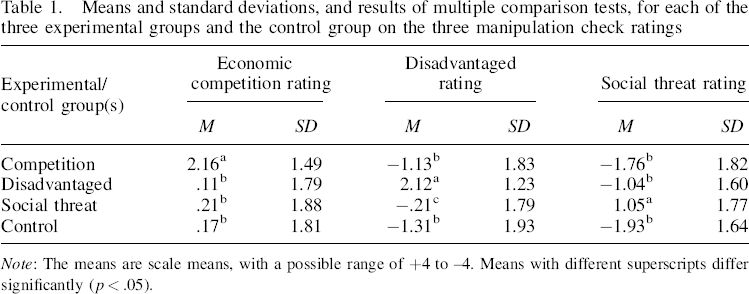
The effect of the experimental manipulations on the three manipulation check measures was assessed using one–way ANOVA followed by multiple comparisons to assess if the mean scores on the three experimental manipulation check scales differed as expected between the four experimental conditions. The means on these three scales for each of the four experimental conditions are shown in Table 1, with differing superscripts indicating which means differed from each other.
Means and standard deviations, and results of multiple comparison tests, for each of the three experimental groups and the control group on the three manipulation check ratings
Note: The means are scale means, with a possible range of +4 to –4. Means with different superscripts differ significantly (p < .05).
Economic competition manipulation check
An ANOVA comparing economic competition ratings for the four manipulation condition groups was significant (F(3, 187) = 16.10, p < .001, partial η 2 = 21). Multiple comparison tests between the four means showed that, as expected, participants in the economic competition manipulation condition had the highest mean economic competition rating, and their mean was significantly higher than the means for participants in the disadvantaged, social threat and control manipulation conditions.
Disadvantaged condition manipulation check
An ANOVA comparing the mean disadvantaged ratings for the four manipulation condition groups was significant (F(3, 187) = 39.34, p < .001, partial η 2 = 39). Multiple comparison tests between the four means indicated that, as expected, and as shown in Table 2, the mean disadvantaged rating was highest in the disadvantaged manipulation condition, and significantly higher than the means for all three the other manipulation conditions.
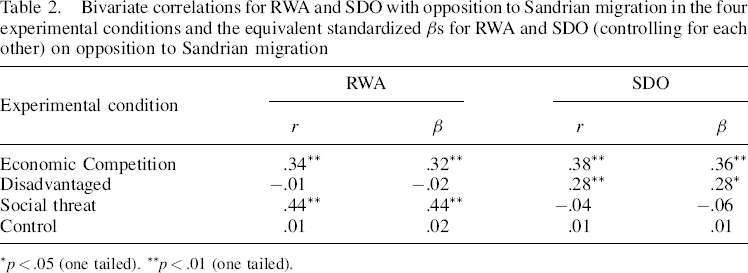
Bivariate correlations for RWA and SDO with opposition to Sandrian migration in the four experimental conditions and the equivalent standardized βs for RWA and SDO (controlling for each other) on opposition to Sandrian migration
p < .05 (one tailed).
p < .01 (one tailed).
Social threat manipulation check
As expected, the mean for the social threat rating was highest for the social threat manipulation condition, and much lower in the other three conditions. The ANOVA was significant (F(3, 187) = 30.40, p < .001, partial η 2 = 33), and multiple comparison tests showed that the social threat rating mean was significantly higher than all three the other means.
Overall, therefore, the findings from the manipulation check rating scales indicate that the manipulations had their expected effects. Relative to participants in the control condition, participants in the economic competition condition rated Sandrians as economic competitors, participants in the social threat condition rated Sandrians as socially threatening, and participants in the disadvantaged condition rated Sandrians as disadvantaged.
Testing the differential moderation hypotheses
It had been hypothesized that RWA would be a stronger predictor of opposition to Sandrian migrants in the competition and social threat conditions (as opposed to disadvantaged and control conditions), whereas SDO would be a stronger predictor in the competition and disadvantaged conditions (as opposed to the threat and control conditions). In order to test this using moderated multiple regression, we created two corresponding contrast coded variables combining the conditions that should differentially elicit prejudice from high versus low RWA and SDO persons. For RWA this was Threat and Competition (both coded .50) versus disadvantaged and control (both coded −.50), whereas for SDO this was Disadvantaged and Competition (both coded .50) versus threat and control (both coded −.50). We entered both of these contrast codes, one reflecting the main effect of competitive and threat versus disadvantaged and control, and the other reflecting the main effect of competitive and disadvantage versus threat and control simultaneously, and thus controlled for possible shared variance in these condition combinations in the analysis.
To test for the proposed differential moderated effect, we next created centred SDO and RWA scores, and entered these into the regression analysis along with category condition × SDO and RWA product terms. We therefore created four product or interaction terms, which reflected the interactions of RWA (and SDO) with the competitive and threat versus disadvantaged and control, and the interactions of SDO (and RWA) with competitive and disadvantage versus threat and control. Significant interaction terms found using this method of analysis would indicate that the combined combinations of categories evoked prejudice differentially for high versus low SDO and RWA individuals. This approach has the strength of controlling for differences across conditions that are shared by the collapsed contrast codes, thus the inclusion of these two sets of contrasting category codes and the interaction terms, controlled for shared variance across conditions. 1
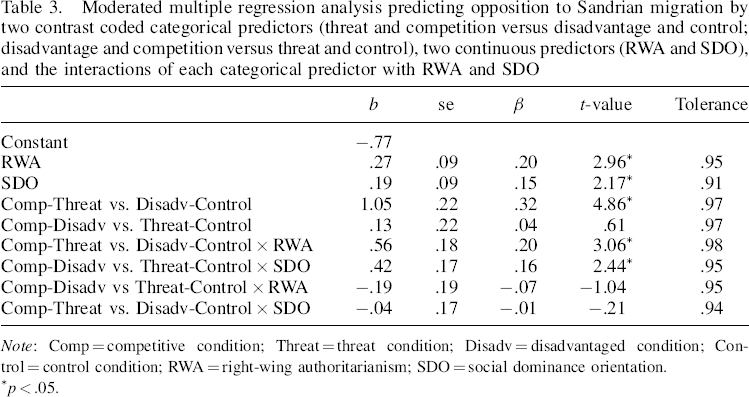
The results from this analysis are presented in Table 3. As shown, SDO (β = .15) and RWA (β = .20), were both uniquely associated with increased prejudice across conditions (main effects). There was also a main effect for condition, such that prejudice tended to be higher in mean level in the combined competitive and threat conditions relative to the disadvantaged and control conditions (β = .32). The hypothesized interactions were also significant. The combined competition and threat conditions (versus the disadvantaged and control conditions) moderated the association between RWA and prejudice (β = .20), but also consistent with predictions, the combined competition and disadvantage conditions (versus the threat and control conditions) did not moderate this RWA association. As expected, SDO showed the opposite pattern of results. The combined competition and disadvantage conditions (versus the threat and control conditions) moderated the association between SDO and prejudice (β = .16), and also consistent with predictions, the combined competition and threat conditions (versus the disadvantage and control conditions) did not moderate this SDO association. Finally, Table 3 also reported multicollinearity tolerance statistics, which indicated acceptable levels of tolerance in all cases.
Moderated multiple regression analysis predicting opposition to Sandrian migration by two contrast coded categorical predictors (threat and competition versus disadvantage and control; disadvantage and competition versus threat and control), two continuous predictors (RWA and SDO), and the interactions of each categorical predictor with RWA and SDO
Note: Comp = competitive condition; Threat = threat condition; Disadv = disadvantaged condition; Control = control condition; RWA = right–wing authoritarianism; SDO = social dominance orientation.
p < .05.
We explored the nature of these interactions in further detail by solving the simple slopes for the effects of low (−1 SD) versus high (+1 SD) SDO and RWA across the different combinations of conditions (contrast coded −.50, .50) using the procedures outlined by Aiken and West (1991). As predicted, the interaction with RWA occurred because RWA significantly predicted prejudice towards the hypothetical immigrant group Sandrians when that group was described as competitive or threatening (simple slope = .55, t = 4.28, p < .01) but not when the group was described as competitive or in the control condition (simple slope = −.01, t = −.04, p = .96). As predicted, SDO in contrast, significantly predicted prejudice towards the hypothetical immigrant group Sandrians when that group was described as competitive or disadvantaged (simple slope = .40, t = 3.58, p < .01) but not when the group was described as threatening or in the control condition (simple slope = −.02, t = −.15, p = .88). These slopes are presented in Figures 1 and 2, respectively. Importantly these simple slopes were calculated controlling for all effects, i.e. the multiple interaction terms presented in the regression output in Table 3.
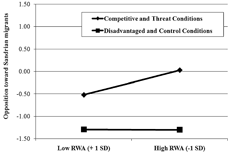
Slopes for the association between RWA and opposition to Sandrian migration across threat (social threat and competitive) and non–threat (disadvantaged and control) conditions.
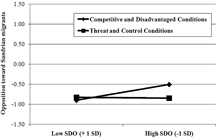
Slopes for the association between SDO and opposition to Sandrian migration across competition (competitive and disadvantaged) and non–competition (social threat and control) conditions.
Because the effects analysed in this way did represent combined effects aggregated across discrete experimental conditions, there was a possibility that the effects might have varied between the conditions being aggregated. In order to check that these effects were indeed as hypothesized for the conditions separately, we also computed standardized regression coefficients assessing the associations of RWA and SDO (controlling for each other) with attitudes towards Sandrian immigration for each of the four experimental conditions separately, as well as the zero–order correlations of RWA and SDO with opposition to Sandrian migration in each condition. These correlations and βs are shown in Table 2. They indicate that, as hypothesized, opposition to Sandrian migration was significantly positively predicted by RWA in both the threat and competition conditions but not in the disadvantaged and control conditions. Moreover, SDO significantly predicted opposition to Sandrian migration in both the disadvantaged and competition conditions, but not in the threat and control conditions. Moreover, and again as expected, the differences between the correlations of RWA and SDO with opposition to Sandrian migration were significant or marginally significant in the Disadvantaged (t = −1.39, p= .085) and social threat (t= 2.54, p = .007) conditions, but not in the competition (t= −.20, non–significant) and control (t = .00, p > .90) conditions.
As expected, therefore, both RWA and SDO significantly predicted opposition to Sandrian migration in the competition condition, only SDO significantly predicted opposition towards disadvantaged immigrants, only RWA significantly predicted opposition to socially threatening immigrants, and in the control condition neither RWA nor SDO significantly predicted opposition towards immigrants described as not competing, not disadvantaged, and not socially threatening.
Discussion and Conclusions
As expected, the experimental manipulation of the description of the intergroup relationship between Sandrian immigrants and host New Zealanders had strong effects on participants’ opposition towards Sandrian immigration. Describing Sandrians as economically competitive with New Zealanders, as disadvantaged (low in status, education and skills), and as threatening conventional New Zealand culture, lifestyle norms and values resulted in markedly greater opposition towards Sandrian immigration than was the case when Sandrian migrants were described as non–competitive, not disadvantaged and not threatening conventional social values. The manipulation check ratings confirmed that the participants in these three experimental conditions did indeed perceive Sandrian immigrants as economic competitors, or as disadvantaged, or as threatening conventional values.
The relatively favourable attitudes to Sandrian immigrants in the control group in this study (relative to the three experimental groups) provides an analogue for an important real world distinction that is relevant for understanding why attitudes to different kinds of immigrants can sometimes be very different. Certain countries and regions, such as North America, Australia and New Zealand, have historically drawn two quite different kinds of immigrants, at least as viewed by the dominant majorities in these countries. One kind of immigrant is very similar to that described in the control group in this study. These have been immigrants coming from United Kingdom and Western Europe, who been seen as culturally and ethnically similar to the dominant majorities in these countries, as well as generally similar in skill and educational level, and have generally not been seen as economic competitors.
The other kind of immigrants, which for Australia and New Zealand today have been primarily from Asian countries, tend to be seen as culturally very different to the majority in the host country, as typically of lower skill and educational level, and as prepared to work harder for lower wages, and therefore as economic competitors (i.e. as described in this study's three experimental groups). Government policies in New Zealand and Australia in the past have favoured culturally and ethnically similar immigrants such as those from Western Europe and the United Kingdom (e.g. the ‘White Australia’ policy), and while these discriminatory policies have now been abandoned, very different attitudes to these two kinds of immigrant groups still persist. For example, a New Zealand study that compared attitudes to Asian and European immigrants measured on exactly the same items found generally favourable attitudes to the European immigrants and generally unfavourable attitudes to Asian immigrants with the difference greater than one standard deviation (Zavareh, 1997). More recent unpublished data has also shown that RWA and SDO did not predict attitudes to European immigrants in New Zealand but did predict negative attitudes to Asian immigrants. 2 The current findings therefore suggest that the three kinds of intergroup relationships operationalised through outgroup descriptions in this research all seem to contribute independently to explaining these profound attitudinal differences towards these different kinds of immigrants.
The findings showing substantial differences between opposition to Sandrian immigrants in the control group and the three experimental groups are also consistent with a great deal of prior research showing that intergroup threat, competition and inequality were powerfully associated with intergroup dislike and prejudice, and with a number of theoretical perspectives that view intergroup relations of this kind as highly conducive to prejudice (e.g. Esses et al., 2005; Greenberg et al., 1997; Jost & Banaji, 1994; Schaller, Park, & Faulkner, 2003; Sherif, 1967; Sidanius & Pratto, 1999; Stephan & Stephan, 2000; Tajfel & Turner, 1979). They are also consistent with a DPM approach to explaining individual differences in prejudice, because this approach proposes that it is precisely these three kinds of intergroup conditions that will most directly activate the motivational goals and values (expressed in RWA and SDO) that generate outgroup dislike in individuals.
The primary objective of the research was to investigate the differential moderation hypothesis generated from the DPM that the degree to which RWA and SDO predicted outgroup dislike would be directly contingent on these particular intergroup relationships. More specifically, it was predicted that outgroup social threat would interact with RWA to influence prejudice, outgroup low status or disadvantage would interact with SDO to influence prejudice, and outgroup competition would interact with both RWA and SDO to influence prejudice. The findings were consistent with this. When outgroup threat was manipulated by describing Sandrian immigrants as likely to threaten conventional norms and values, RWA predicted opposition to Sandrian migration while SDO did not. When intergroup inequality was manipulated by describing Sandrians as low status and disadvantaged, SDO predicted opposition to Sandrian migration while RWA did not. When intergroup competition was manipulated by describing Sandrians as economically competitive, both RWA and SDO predicted opposition towards Sandrian migration. And, in the control condition where Sandrians were described as non–competitive, non–disadvantaged, and not socially threatening, neither RWA nor SDO predicted opposition to Sandrian migration. 3
These findings are therefore not consistent with the widely held, though often implicit, assumption in the traditional research literature on RWA and SDO that these two individual difference variables involve a basic disposition to dislike outgroups generally that would be relatively invariant across intergroup context (e.g. Adorno et al., 1950; Altemeyer, 1998). This assumption would expect significant effects for both RWA and SDO on opposition towards Sandrian immigrants across all conditions. This was only the case for the economically competitive Sandrians. The findings for the disadvantaged and socially threatening conditions, where opposition towards Sandrian immigration was predicted only by SDO or RWA respectively, and for the control condition, where neither RWA nor SDO predicted opposition to Sandrian migration, clearly contradicted this expectation.
Prior research had already shown that RWA and SDO predicted prejudice against different outgroups, with RWA predicting prejudice against apparently dangerous and socially threatening (deviating from existing norms and values) social groups, and SDO predicting prejudice against groups apparently low in status and power, or deviant groups that challenged existing social inequalities (Duckitt, 2006; Duckitt & Sibley, 2007). However, this research was purely correlational and the nature of the groups differentially predicted was merely inferred from what seemed to be their common characteristics. The current experimental research extends these findings in several important was. First, it showed that manipulating highly specific outgroup characteristics (social threat, low status or disadvantage, economic competition) derived from theory directly altered the degree to which RWA and SDO predicted opposition to particular immigrants. Thus, instead of merely inferring that differential prediction might be due to certain outgroup characteristics, it showed that differential prediction was indeed directly related to change in these characteristics. Second, the experimental research design demonstrated causality, that is, that manipulating the description of outgroup social threat, outgroup low status or disadvantage, and outgroup economic competition directly caused increases in opposition to immigrants, with the degree to which this occurred varying with participants’ levels of RWA and SDO. This therefore implies that RWA and SDO were interacting with the causal impacts of outgroup threat, disadvantage and economic competition to predict prejudice.
The current findings are consistent with prior findings showing similar interaction effects for RWA and SDO. However, as noted previously, these earlier findings typically investigated RWA and outgroup threat or SDO and outgroup low status separately and so could not show that these effects were indeed differential. Other studies did investigate both types of effects simultaneously but did not measure or manipulate the hypothesized indicators of outgroup threat, low status, or competition comprehensively or directly. Some studies used real outgroups or minorities, where attitudes would tend to reflect well established beliefs about intergroup relations and manipulating the salience of these relations would tend to produce relatively weak effects that might not show differential moderation effects clearly (e.g. Cohrs & Asbrock, 2009; Esses et al., 1998).
In contrast to these earlier studies, the current study provided a much better test of the DPM differential moderation hypothesis. First, it used a bogus immigrant group so that pre–existing outgroup beliefs would be unlikely to obscure effects. Second, it provided a more comprehensive test of the theory by simultaneously manipulating all three the intergroup conditions expected to moderate the effects of RWA and SDO on prejudice. And third, it provided information about the outgroup that manipulated these three intergroup conditions directly as opposed to earlier studies which merely inferred change in these intergroup conditions from overtly different manipulations (e.g. an immigrant who was assimilating or not assimilating; Thomsen et al., 2008). Overall, therefore, these findings together with the number of prior studies that have reported broadly consistent effects, support the DPM hypotheses that particular intergroup relationships or conditions will moderate the effects of RWA and SDO on outgroup dislike or prejudice.
However, these findings do not exclude the possibility that the precise way in which this interaction occurs, or indeed if it occurred at all, might also be contingent on other factors, such as the kind of intergroup threat, competition, or inequality (see, e.g. Akrami, Ekehammar, Bergh, Dahlstrand, & Malmsten, 2009). If so, this might have contributed to the inconsistent findings noted in the prior research. For example, Cohrs and Ibler (2009) have suggested that the degree to which intergroup threat and RWA will interact in determining outgroup dislike may depend on the nature and possibly the strength of outgroup threat. They suggest that it may be when intergroup threats are ambiguous (and relatively weak) that they should elicit stronger reactions from persons higher in RWA, because high RWAs believe the social world is dangerous and threatening while lows do not. High RWAs should therefore maximize weak or ambiguous threats, while low RWAs would minimize or ignore them, so there would be significant moderation. On the other hand, when outgroup threat was completely unambiguous (and relatively strong), it might elicit as strong a reaction from persons low in RWA (who might then not be able to deny or minimize the threat) as from persons high in RWA, and there would be no moderation. A closely related possibility is that symbolic threats to collective norms and values from an outgroup, as manipulated in this study, might elicit moderation effects (with high RWAs reacting more strongly than lows), while real threats to group resources or power might not elicit moderation (with low RWAs reacting as strongly as highs). Assessing possibilities such as this would require research that systematically varied factors such as the ambiguity, strength, or nature of threat (e.g. real or symbolic), competition (e.g. real or social) or inequality (e.g. status or power).
Irrespective of these possibilities, however, an important implication of the present findings is that they do support a broad perspective that individual differences and intergroup processes related to prejudice do not necessarily operate in isolation, but may often operate together in a complementary and interactive fashion to determine outgroup dislike. RWA indexes the importance of the motivational goals and value of collective security for individuals, and therefore how reactive individuals will be to threats to collective security. Persons high in RWA will therefore not be prejudiced against all outgroups or under all circumstances. It should be primarily when persons high in RWA categorize themselves as members of a group whose collective security, stability and cohesion seems to be threatened in some way by outgroups that they should generally react with greater hostility towards those outgroups than persons low in RWA. In similar fashion SDO indexes how important the motivational goal or value of power, superiority and dominance is for individuals. Persons high in SDO should therefore not be particularly hostile towards all outgroups, or under all circumstances. However, when persons high in SDO categorize themselves as members of a group which is higher in status and power than outgroups, or competing over dominance or superiority with outgroups, they should generally tend to dislike and devalue those outgroups in order to establish or justify their relative superiority over them.
Overall, therefore, there is empirical support for the broad nature of the motivational goals and values that underlie RWA and SDO and how they may be activated and directed by intergroup conditions. However, the exact nature of these complementarities and how these interactive processes may play out or not play out in varying conditions may be more complex than envisaged by current theory, and may need more systematic research to be fully clarified.