







Abstract
We tested the hypothesis that a pictorial attitude variant of the Implicit Association Test (PA–IAT) is a valid measure of implicit motives. The PA–IAT aims to capture attitudes towards pictures that are related to implicit motives. In the first two studies, we showed that the pictorial attitude Implicit Association Test (IAT) correlated more highly with non–IAT measures of implicit motives than other IAT variants. In the third study, we established the validity of the PA–IAT experimentally and showed that the pictorial attitude IAT correlated with non–declarative behavioural measures only if implicit motives were aroused. Copyright © 2010 John Wiley & Sons, Ltd.
Introduction
Implicit motives are motivational dispositions that are assumed to operate outside a person's consciousness. A good understanding of one's implicit motives is of great importance because research over the past 50 years clearly shows that these motives influence many economic, societal and political phenomena independent from motivational dispositions that people attribute explicitly to themselves at a conscious level (see McClelland, Koestner, & Weinberger, 1989, for a review). Implicit and explicit motives differ in that the former are acquired during early childhood on the basis of non–verbal, affective experiences while the latter are cognitively more elaborated constructs that are acquired after the development of language and influenced by explicit instructions of the social and cultural environment (Kasser, Koestner, & Lekes, 2002; McClelland & Pilon, 1983). Given their pre–verbal nature, it is more likely that non–verbal cues arouse implicit motives (Schultheiss & Brunstein, 2002; Woike, Bender, & Besner, 2009). Schultheiss and Brunstein (2002), for instance, demonstrated that participants’ implicit power motives become active only after they have the opportunity to translate the verbal instructions of power related goals into experiential formats by means of an imaginary exercise.
Implicit and explicit motives differ also in their impact on behaviour. More specifically, implicit and explicit motives correlate with different aspects of behaviour. In general, implicit motives are more likely to predict general behavioural trends over time as well as non–declarative behaviour, whereas explicit motives are more likely to predict immediate and specific declarative responses to specific subjective situations or choice behaviour (McClelland, 1985; Schultheiss & Pang, 2007). Traditional implicit motive researchers referred to these behavioural distinctions as operant versus respondent behaviour. Whereas operant behaviours involve automatic actions in the absence of stringent situational concerns, respondent behaviours stem from conscious reactions to specific stimuli (McClelland et al., 1989; Perugini & Leone, 2009). Measures of implicit power motive, for instance, have been shown to predict managerial or political success over time (i.e. operant or non–declarative behaviour) (McClelland et al., 1989; Winter, 1991). Explicit power motive measures, on the other hand, have been shown to predict declarative or respondent behaviours such as prophesy task enjoyment and subjective well–being. Research consistently confirms this difference between implicit and explicit motives (McClelland et al., 1989; Schultheiss & Pang, 2007).
The Measurement Of Implicit Motives
Because implicit motives differ fundamentally from explicit ones, their assessment requires different measurement instruments (Schultheiss, Yankova, Dirlikov, & Schad, 2009). Explicit motives can easily be assessed explicitly with questionnaires, unequivocally asking participants to what extent a certain motive is relevant for them (e.g. PRF: the Personality Research Form, Jackson, 1984). Implicit motives, on the other hand, are traditionally assessed indirectly by means of projective tests such as the Picture–Story Exercise (PSE) and the Thematic Apperception Test (TAT). A typical PSE or TAT consists of 4–6 pictures depicting people in a variety of social settings. For each picture, participants have to write an imaginative story. Because these tests use non–verbal cues, it is assumed that they arouse implicit motives (Schultheiss & Brunstein, 2002; Woike et al., 2009). Afterwards, one can analyse these stories by means of motivational content coding schemes, derived from motivational arousal studies. Researchers can use the obtained score as a measure of the individual's implicit motives (McClelland et al., 1989; Schultheiss & Pang, 2007).
Since the development and first applications of projective techniques, there has been an intense debate on the validity and usability of projective measures (e.g. Hibbard, 2003; Raven, 1988). Even though recent work confirms the good psychometric qualities of projective measures, (e.g. Langan–Fox & Grant, 2006; Vargas, von Hippel, & Petty, 2004), doubts about the validity of projective measures continued to exist. Consequently, when new response latency based indirect measures were developed in the 1990s, many researchers abandoned projective techniques and started using response latency techniques to assess implicit processes (Vargas et al., 2004). The Implicit Association Test (IAT) is probably the most well known response latency measure (IAT: Greenwald, McGhee, & Schwartz, 1998). The IAT is a computerized response latency task that is assumed to measure the relative strengths of associations amongst two pairs of contrasted concepts (e.g. ‘positive–negative’ and ‘sunshine–rain’). Many researchers consider the IAT to be the most reliable and valid response latency based measure that is currently available (e.g. De Houwer & De Bruycker, 2007; Nosek, Greenwald, & Banaji, 2007).
The IAT, initially developed to assess implicit attitudes and stereotypes (Greenwald, et al., 2002), has recently been applied also to assess implicit motives (Brunstein & Schmitt, 2004; Sheldon, King, Houser–Marko, Osbaldiston, & Gunz, 2007). Brunstein and Schmitt (2004) were the first to measure achievement motivation by means of both the IAT (implicit measure) and explicit ratings (explicit measure). After completion of the IAT task and explicit measures of achievement, participants completed a mental concentration task. Half of them received achievement related feedback. Brunstein and Schmitt (2004) found that implicit and explicit measures of achievement orientation were uncorrelated. Further, when participants received feedback, the IAT uniquely predicted participants’ behaviour (i.e. task performance) but failed to foresee subjective outcomes (i.e. task enjoyment). Explicit achievement, on the contrary, predicted only the subjective outcomes but not behavioural outcomes. When participants did not receive feedback, both the IAT and explicit measures were unrelated to the outcome variables. In fact, these results were similar to the findings of Biernat (1989) who assessed achievement motive with projective as well as explicit measures. She also concluded that projective measures did not correlate with explicit ones, and that the projective measure predicted behavioural outcomes instead of subjective outcomes. Brunstein and Schmitt's (2004) study is of great significance because they were the first to show that the IAT can be used to measure implicit motives. Yet, convergent validity of the IAT with projective measures was not established.
Sheldon et al. (2007) were the first to assess implicit motives with both the IAT and a projective measure, the TAT. Their results showed that both implicit measures uniquely predicted behavioural outcomes (e.g. motivation related choices) but not subjective outcomes (e.g. well–being and life satisfaction). However, they could not establish convergent validity in that the correlation between the IAT and TAT was rather small (r = 0.17; p < 0.05) and both techniques predicted different behavioural outcome variables. They argued that the IAT predicted competitive behavioural choices (i.e. social dilemma with a choice between exploitation versus conservation of natural resources) whereas the TAT predicted general behavioural trends (i.e. academic job opportunities in a distant future). However, the conclusion that the IAT and the TAT captured different behavioural outcomes of implicit motives is rather pre–mature because they applied only one particular instantiation of the IAT. Moreover, there were important differences between their version of the IAT and the TAT. First, both tasks differed in how implicit motives were measured, that is, in the type of stimuli that were used. Whereas verbal stimuli were used in the IAT, the TAT made use of pictorial stimuli. Pictorial and verbal stimuli of the same concept are not fully interchangeable and may assess different sets of associations (Foroni & Bel–Bahar, 2010). Second, the IAT and the TAT also differed in what they measured. The IAT measured the strength of the relationship between the self and need for power whereas the TAT assessed need for power by means of affective thoughts and feelings evoked by pictures (Bilsky & Schwartz, 2008). Lastly, the IAT that Sheldon et al. used resulted in a relative measure while the TAT resulted in an absolute one. These three differences could have been responsible for the fact that the IAT predicted different types of behaviour than the TAT and the fact the IAT correlated only weakly with the TAT. In sum, the question remained whether it is possible to adapt the IAT in such a way that it serves as an alternative to projective measures for the assessment of implicit motives. This is an important question because the IAT could offer a better way of assessing implicit motives. First, unlike measures such as the TAT, it does not require extensive scoring and interpretation of responses. Second, the split–half and test–retest reliability of IAT effects are relatively high in comparison with other implicit measurement procedures (Schnabel, Asendorpf, & Greenwald, 2008). Third, it is likely that the IAT is less controllable than projective measures because it relies on response latencies whereas projective measures rely on the content of what participants say. Consequently, projective measures are more prone to intentional manipulations (Teige–Mocigemba & Klauer, 2008).
We therefore set out to develop an IAT measure of implicit motives that differed in two important ways from the variant used by Sheldon et al. (2007). Because implicit motives are based on early, non–verbal experiences, not accessible via introspection, we assumed that IATs that make use of pictorial stimuli will be able to capture the same aspects of implicit motives as projective measures. Moreover, compared to verbal stimuli, pictorial stimuli enclose more concept–relevant information which make them more appropriate to capture stable traits such as motives (Gschwendner, Hofmann, & Schmitt, 2008). Furthermore, we altered the target categories. Instead of target categories representing the self–concept, we applied affective target categories because projective measures primarily assess the affective aspects of motivational domains (Bilsky & Schwartz, 2008; McClelland, 1985; McClelland et al., 1989). In sum, we hypothesized that pictorial IATs with affective target categories would show greater convergence with projective tests.
In the first two studies, we assessed one implicit motive, need for power, with different versions of the IAT. More precisely, we manipulated how the IAT was constructed (pictorial versus verbal stimuli) and what it measured (associations with the concept ‘self’ versus affective evaluation of pictures). As such, the aim of the first two studies was to test whether a pictorial IAT with affective target categories was, as hypothesized, the best candidate IAT measure of implicit motives. Validity of the IAT variants was tested using a correlational approach: Correlations with (semi–) projective and explicit measures of implicit motives were included to test convergent validity. Moreover, correlations with operant and respondent conceptualizations of environmentalism served as behavioural criterion correlates of implicit power motivation. The primary objective of the third and final study was to further examine the validity of the pictorial IAT with affective target categories. Therefore, validity was tested also experimentally, an approach that is strongly recommended for the development of new measures (Borsboom, Mellenbergh, & van Heerden, 2004; De Houwer, Teige–Mocigemba, Spruyt, & Moors, 2009). More specifically, we examined whether the IAT measure was sensitive to the degree to which implicit motives were aroused.
Study 1
Design and participants
In Study 1, we conducted a between–subjects comparison of a verbal self (VS)– IAT and pictorial attitude (PA)– IAT to assess implicit motives. In the VS–IAT, verbal motive exemplars (e.g. prestigious) and verbal–concept exemplars (e.g. me) were presented. The PA–IAT, on the other hand, was designed to achieve a maximal conceptual correspondence with classic measures of implicit motives such as the TAT. This means that pictorial stimuli were used in combination with affective target categories. In addition to the IAT, participants completed a projective test and an explicit measure of implicit motives (within–subjects). Afterwards, respondents answered a number of questions about environmentalism.
In total, we recruited 160 undergraduate university students for participation in our experiment. Students participated for partial fulfilment of additional course requirements. Participants were tested in groups of up to five participants at a time. They were seated in cubicles isolating them from outside views and noises. After controlling for fast responses in the IAT (Greenwald, Nosek, & Banaji, 2003) and missing data, 145 participants were included in our final sample. By taking part in the study, participants had the chance to win a restaurant voucher of €5. Mean age was 20.8 (SD = 3.5) and 25 participants were men (17.2%). Sixty–five participants completed the VS–IAT and 80 completed the PA–IAT.
Measures and materials
Need for power: Implicit Association Test
We created two IATs: a VS–IAT and a PA–IAT. Brunstein and Schmitt's (2004) IAT study formed the basis for the VS–IAT. We used (Dutch translations of) the labels ‘me’ (ik) versus ‘other’ (ander) for the target categories, and the labels ‘power’ (macht) versus ‘non–power’ (geen macht) as labels for the attribute categories. Shultheisses’ definition and description of need for power (i.e. the capacity to derive pleasure from having impact on others, but not from being aggressive or irresponsible; Schultheiss, in press) formed the inspiration for the stimuli representing the attribute categories. The stimuli were ‘prestigious’ (prestigieus), ‘influential’ (invloedrijk), ‘impressive’ (indrukwekkend), ‘important’ (belangrijk), ‘all–knowing’ (alwetend) and ‘authoritative’ (gezaghebbend) for the category ‘power’, and ‘ordinary’ (alledaags), ‘docile’ (volgzaam), ‘submissive’ (onderdanig), ‘humble’ (nederig), ‘resigned’ (gelaten) and ‘modest’ (bescheiden) for the category ‘non–power’. Furthermore, stimuli representing the target category ‘me’ (ik) were ‘I’ (ik), ‘mine’ (mijn), ‘own’ (eigen) and ‘self’ (zelf) while the exemplars of the target category ‘other’ (ander) were ‘them’ (hen), ‘they’ (zij), ‘their’ (hun) and ‘others’ (anderen).
In order to increase the conceptual correspondence with projective measures such as the TAT (Hofmann, Gawronski, Gschwendner, Le, & Schmitt, 2005), we created a PA–IAT that differed from the VS–IAT in two important ways. First, we used affective target categories (‘attractive’ versus ‘not attractive’). Stimuli representing the target categories were ‘nice’ (leuk), ‘friendly’ (aardig), ‘pleasant’ (plezant), ‘great’ (fijn), ‘lovely’ (prettig) and ‘decent’ (tof) for ‘attractive’ (aantrekkelijk), and ‘creepy’ (akelig), ‘unpleasant’ (onprettig), ‘nasty’ (lastig), ‘unfavourable’ (ongunstig), ‘annoying’ (ambetant) and ‘undesired’ (ongewenst) for ‘not attractive’ (onaantrekkelijk). Secondly, we utilized pictures as stimuli of the attribute categories. These pictures were all pre–tested. Forty–five undergraduate university students participated in this pre–test. Each participant evaluated a series of 45 pictures that three experts selected on their potential to represent a situation where need for power was either an important motive or not at all. For each picture, respondents indicated the fit with the following description of need for power (Schultheiss, in press): ‘This picture fits with someone who: “likes to influence other people,” “wants to elicit prestige,” “likes to show to other people that he/she holds an important position” and “is able to manipulate people.”’ Participants rated the pictures on a 7–point likert scale with the following anchor points: 1 = ‘Fits very well with the description’, through 7 = ‘Fits not at all with the description’. The pictorial IATs in this study used the seven pictures with the highest mean scores (range of means: 5.7–6.5) and the seven pictures with the lowest mean scores (range of means: 2.1–2.8) as exemplars of the attribute categories ‘power’ and ‘non–power’.
The VS–IAT consisted of seven blocks of trials in which participants were instructed to categorize words as quickly as possible into different categories by pressing a left (D) or right (K) key on an AZERTY keyboard. Each item was presented equally often and in a random order. In Block 1 (24 trials) participants had to sort self and other related items into the ‘Me’ and ‘Other’ categories. Half of the respondents started with the ‘Me’ category on the left side and the ‘Other’ category on the right side. The other part of the participants started with the categories in reversed position. Block 2 (24 trials), required participants to distinguish items representing power or non–power. The ‘Power’ category was assigned to the left key and the ‘Non–power’ category to the right key for all participants. Block 3 (24 trials) and Block 4 (40 trials) combined the ‘Me–Other’ categories and the ‘Power–Non–power’ categories. The position of the categories and their assignment to response keys were identical to those in Blocks 1 and 2. Block 5 (24 trials) was identical to Block 2, except that the positions of the ‘Power’ and ‘Non–power’ categories and their corresponding response keys were reversed. Finally, Block 6 (24 trials) and Block 7 (40 trials) were identical to Blocks 3 and 4 except for the reversed position of the ‘Power’ and ‘Non–power’ categories and their assignment to the response keys. In the four combined tasks (Blocks 3, 4, 6 and 7), target and attribute related exemplars alternated from trial to trial.
Stimuli were presented in the centre of the screen. Target and attribute labels were displayed on the upper right and left corner of the white screen. Interstimulus interval was 200 ms. False responses were followed by an error message that disappeared only after participants pressed the correct response.
The procedure of the PA–IAT was identical to the procedure of the VS–IAT. For the PA–IAT, the ‘Me–Other’ categories and their corresponding exemplars were replaced by the ‘Attractive–Not Attractive’ categories and their representing exemplars. Furthermore, we used pictures instead of words as exemplars of the ‘Power–Non–power’ categories.
IAT effects were calculated using the recommended D600 scoring algorithm of Greenwald et al. (2003) based on the data collected in Blocks 3, 4, 6 and 7.
We estimated internal consistency of the IATs by dividing each combined block into two sub–blocks of equal length. The first block comprised the even trials and the second the odd trials. Next, we calculated the IAT effects for each sub–block. The Spearman–Brown coefficients revealed a good split–half reliability for both IATs (VS–IAT: r = .67; PA–IAT: r = .87). The IAT was programmed and administered with the INQUISIT Milliseconds software package (2008).
Need for power: Explicit measure
Explicit Need for Power was assessed with a constant sum scale. Participants were asked to distribute exactly 100 points among the three foundational human motivations: need for Power, need for Affiliation and need for Achievement. Each motivation was briefly described by the experimenter. The definitions and descriptions of Schultheiss (in press) formed the foundation for these descriptions. Respondents indicated to what extent each motivation fitted them by means of allocating a portion of 100 points to these motivations. More points indicated a better fit. In this way, we obtained a relative measure that should improve the conceptual correspondence with both the IAT as well as the projective measure (Hofmann et al., 2005).
Need for power: Projective test
In the first study, we used a projective measure that could serve as an initial, easily applicable criterion to test the validity of the two versions of the IAT. Therefore, we used a quantitative alternative to the TAT as projective measure. We preferred a quantitative projective measure to cancel out subjectivity of the coding of the story as source of method variance. The projective measure that we used was based on Schmalt's Power Motive Grid (Schmalt, 1987). Instead of writing a story of the situation depicted on the picture, participants indicated on a 7–point likert scale to which extent the picture made them feel good or bad. To complete the test, each participant evaluated seven pictures that aroused the implicit motive of need for power and seven pictures that aroused other implicit motives (need for affiliation and need for achievement). The pictures were the same as those used in the PA–IAT. The projective measure was calculated as the difference between the mean score of the power motive pictures and the mean score of the other motive pictures. As such, like the IATs, the obtained measure has to be interpreted as a relative measure.
Dependent variables: Environmentalism
In order to assess predictive validity, we introduced environmentalism as a dependent variable. Research suggested that people scoring high on need for power are significantly less concerned with the environment (e.g. Schultz et al., 2005; Sheldon et al., 2007). Because previous research indicated that the implicit (IAT and projective measures) and explicit measures predicted different aspects of behaviour (cf. supra), we also measured environmentalism on two different dimensions. First, we estimated one's general level of environmentalism because previous research suggested that measures of implicit motives predominantly correlated with general behavioural trends. Furthermore, because general environmentalism was formulated in general terms and did not comprise any personal nor any specific situational cue, it could be interpreted as an indicator of operant behaviours. Second, we assessed subjective environmentalism. Because this concept was formulated in a personal way and involves reactions to specific stimuli, subjective environmentalism could be interpreted as an indicator of respondent behaviour. Following, for instance, Sheldon et al. (2007), we assumed that measures of implicit motives would correlate with general environmentalism (operant behaviours) whereas measures of explicit motives would correlate with subjective environmentalism (respondent behaviours). We will now describe both measures of environmentalism.
General behavioural trends, or general environmentalism, were assessed by means of statements about how individuals thought the educational system or society should deal with environmental issues. Behavioural changes resulting from the actions or issues formulated in these statements had an impact only in the long run and on the society as a whole. An exemplar item is ‘courses in economics should pay more attention to the consequences of economic growth on the environment’. Subjective environmentalism was examined with items adopted from Schuhwerk and Lefkoffhagius’ (1995) scale. This scale measured someone's personal concern for the environment as well as his or her individual willingness to work towards its protection. A sample item of the scale was ‘I am concerned about the environment’. Both the general and subjective environmentalism scale consisted of four 5–point Likert–type items with the anchors 1 = ‘strongly disagree’, through 5 = ‘strongly agree’. We calculated the individual measures as the mean score of the scale items. Internal consistency of these scales was satisfactory (general environmentalism: M = 3.90; SD = .57; α = .68; subjective environmentalism: M = 3.51; SD = .62; α = .81). For both, the general and subjective measure, high scores indicated positive behavioural intentions towards the environment.
Procedure
We presented all measures in a fixed order because our analysis focused on the correlations between the different measurement procedures. Randomizing or counterbalancing might introduce error variance per respondent and thus deflate correlations (Gawronski, 2002). We first presented the projective technique, followed by the IAT, then the explicit need for power and, finally, the behavioural questions on environmentalism.
Results
Relations between the different measures of need for power measures
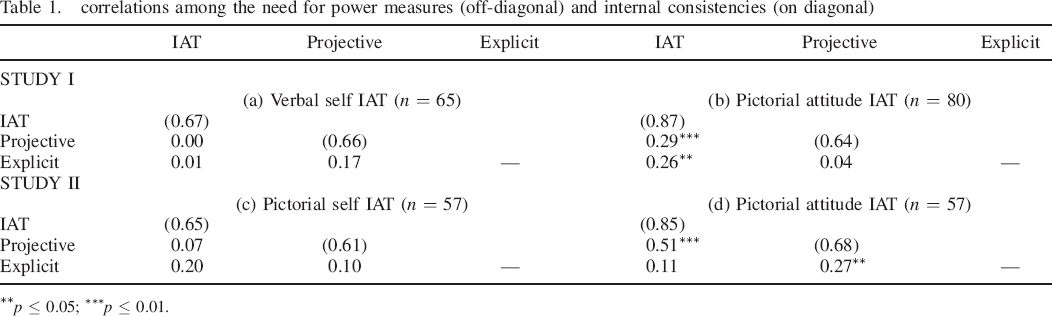
Correlations between the IAT, the explicit measure of need for power, and the projective measure of need for power were calculated for the two conditions separately. The non–significant correlations between the three measures of need for power in the VS–IAT condition, reported in Table 1(a), suggested that the three measures of need for power (VS–IAT, projective and self–attributions) did not capture the same constructs.
correlations among the need for power measures (off–diagonal) and internal consistencies (on diagonal)
p ≤ 0.05;
p ≤ 0.01.
A different result emerged in the condition in which participants completed the PA–IAT. The PA–IAT did correlate with both the projective measure and the explicit measure whereas the projective measure only correlated with the PA–IAT (see Table 1b). When we compared the two conditions with each other, we noticed that only the correlation between the IAT and projective measure was marginally significant different (rVS–IAT–projective = .00, rPA–IAT–projective = .29, z = 1.78, p < .10). Summarizing the results in terms of our expectations, we found a first indication that the PA–IAT is a valid measure of implicit motives and that it outperforms the VS–IAT in assessing implicit motives. Conceptual correspondence between the IAT and the projective measure does seem to increase correlations between both.
Relations between measures of need for power and measures of environmentalism
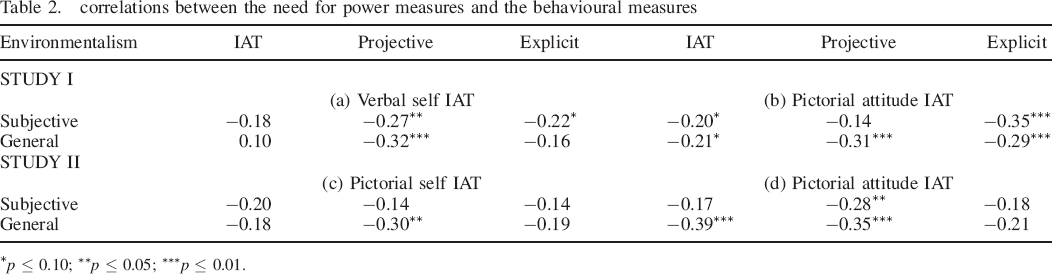
Table 2(a and b) shows the zero–order correlations between the need for power measures and the indices of environmentalism, split by the type of IAT (VS–IAT or PA–IAT). As represented in Table 2(a), the VS–IAT did not correlate with any of the environmentalism variables. Conversely, correlations of the PA–IAT with the indices of general and subjective environmentalism were marginally significant (see Table 2b). Furthermore, a Fisher's Z transformation revealed that the difference between the VS–IAT and PA–IAT was marginally significant for general environmentalism (z = 1.84, p < .10). Next, the projective measure clearly correlated with general environmentalism in both conditions. Finally, correlations with the explicit measure were not consistent. As reported in Table 2(b), the explicit measure was significantly correlated with both indices of environmentalism in the PA–IAT condition whereas in the VS–IAT condition, the explicit measure was marginally correlated only with subjective environmentalism (see Table 2a).
correlations between the need for power measures and the behavioural measures
p ≤ 0.10;
p ≤ 0.05;
p ≤ 0.01.
Even though the results were in line with our expectations, the correlational results might have been biased by the fact that the PA–IAT was somewhat more reliable (r = .87) than the VS–IAT (r = .67). To further examine this issue, we corrected the correlations between the IATs and the environmentalism variables for attenuation due to unreliability. Results, however, showed that correlations involving the VS–IAT condition versus the PA–IAT condition still varied substantially. The corrected correlations with subjective environmentalism were −.24 for the VS–IAT condition and −.23 for the PA–IAT condition. For general environmentalism, the corrected correlations were .10 (VS–IAT condition) and –.21 (PA–IAT condition). Differences between Fisher's r–to–z transformations did not reveal any discrepancy with the uncorrected correlations. (i.e. PA–IAT correlated higher with general environmentalism). These additional analyses indicated that differences in reliability did not fully account for the predictive advantage of the PA–IAT.
Discussion
Study 1 provided initial evidence for the hypothesis that the PA–IAT is a valid measure of implicit motives and is a better measure of implicit motives than the VS–IAT. Compared to the VS–IAT, the correlation between the PA–IAT and the projective measure was not only higher, but its predictive utility for behaviour was also greater. The association patterns further revealed that the PA–IAT leaned closer towards the projective measure than the VS–IAT did. Even though differences in correlations were only marginally significant, the results did confirm the validity of the PA–IAT whereas no evidence was found for the validity of the VS–IAT. However, the design of the first study did not enable us to reveal why only the PA–IAT turned out to be valid. The VS–IAT differed from the PA–IAT not only in the type of stimuli that were used (words or pictures) but also in the type of associations that were measures (associations with the concept ‘self’ or associations with the concept ‘attractive’). To determine which difference was crucial, we replicated the first study, but instead of a VS–IAT, we used a pictorial IAT for measuring associations with the self.
Study 2
Design and participants
The design of the second study mirrored that of the first one. This means that we compared two versions of the IAT using a between–subjects design. Each participant also completed the projective test and explicit measures of implicit motives. Finally, participants completed the same questions on environmentalism as in Study 1. The only difference was that we now compared a PA–IAT with a pictorial self (PS)–IAT.
One–hundred fourteen male (n = 36) and female (n = 78) undergraduate university students participated for partial fulfilment of additional course requirements. Mean age was 20.7 (SD = 1.9). Half of the participants completed the PS–IAT while the other half were given the PA–IAT.
Measures, materials and procedure
The PA–IAT was exactly the same as in Study 1. The PS–IAT employed the same pictures as the PA–IAT and used identical attribute exemplars and attribute category labels as the VS–IAT of our first study. The IAT procedure mirrored the procedure applied in Study 1.
We estimated internal consistency of the IATs in the same way as in Study 1. The Spearman–Brown coefficients revealed a good split–half reliability for both IATs (PS–IAT: r = .65; PA–IAT: r = .85). Internal consistency of all other measures was also satisfactory (projective test: α = .66; subjective environmentalism: α = .86; general environmentalism: α = .74).
We first presented the projective technique, followed by the IAT, then the explicit need for power and finally the behavioural questions on environmentalism.
Results
Relations between the different measures of need for power
In line with the first study, we first analysed correlations between the IAT, explicit, and projective measure of need for power in each of the two conditions. The PS–IAT correlated neither with the explicit nor with the projective measure of need for power, indicating that these measures did not capture similar constructs (see Table 1c).
Comparable with the first study, the PA–IAT did correlate significantly with the projective measure, thus supporting the validity of the PA–IAT. The correlation matrix reported in Table 1(d) did reveal some differences between the two measures in that the correlation of the PA–IAT with the explicit measure was not significant whereas the correlation between the projective and explicit need for power measure was significant. However, these small differences could have been due to sampling error. Comparing the correlations of the PS–IAT and the PA–IAT with the explicit and projective measures, we observed a significant difference in correlation with the projective measure (z = 2.56; p < .05) but not with the explicit measure. Clearly, the PA–IAT but not the PS–IAT shared a substantial amount of variance with the projective measure.
Associations of the need for power measures with environmentalism
On the whole, Study 2 confirmed the findings of Study 1. The zero–order correlations, reported in Table 3(c and d), show that the projective measure was predictive for general environmentalism in both conditions. Taking into account both experimental conditions in the two studies, general environmentalism was the only behavioural variable that consistently correlated with the projective measure. Furthermore, Fisher's Z transformations did not reveal any difference between studies or between conditions for the projective measure, p > .05.
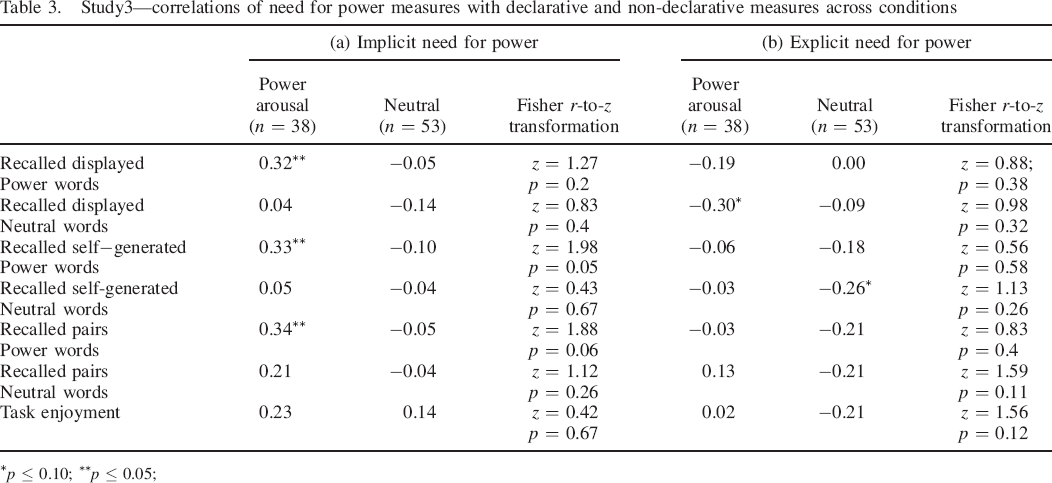
Study3—correlations of need for power measures with declarative and non–declarative measures across conditions
p ≤ 0.10;
p ≤ 0.05;
The results of the PA–IAT were also largely consistent across conditions and across studies. In Study 2, its correlation with general environmentalism was even significant whereas in Study 1, it was only marginally significant. The PS–IAT did not correlate with any of the environmentalism variables, neither general not subjective environmentalism. Nonetheless, comparing the correlations of the PA–IAT and the PS–IAT using Z values of Fisher's r–to–z transformations, we did not find evidence for differences between the two IATs in their relation to measures of environmentalism, p > .10. Finally and contrary to Study 1, the explicit measure was not correlated with the indices of subjective or general environmentalism.
Discussion
The main finding of the two studies can be summarized easily: We consistently obtained evidence for the validity of the PA–IAT but not for the validity of the other (VS– and PS–) IATs as a measure of the implicit power motive. This conclusion is based on the fact that (a) only the PA–IAT was related to the projective measure of the implicit power motive and (b) only the PA–IAT predicted general or operant behavioural trends that are assumed to be determined by implicit motives (i.e. general environmentalism). Confirming the divergent validity of the PA–IAT, it was not related to responses in specific or personal situations (i.e. subjective environmentalism). Similar evidence did not emerge for the VS– and PS– variants of the IAT. Nevertheless, some limitations should be acknowledged. First, the status of motive–grids as projective measures of implicit motives is questionable (Schultheiss et al., 2009). On the one hand, motive–grid authors such as Schmalt (1987) claim that motive–grids are valid measurement instrument of implicit motives, but on the other hand firm validity tests are still lacking. Kehr (2004) and Brunstein and Heckhausen (2008) for instance, failed to report significant correlations between motive–grids and projective measures such as the TAT. Second, in the first two studies we used a correlational approach to validate the PS–IAT as measurement instrument of implicit motives where as traditional motive measures were validated experimentally (e.g. Smith, 1992 for an overview).
Third, in the first two studies, we used self–report measures of attitudes towards the environment as a criterion–validity correlate of implicit power motivation. Even though we made a clear distinction between operant and respondent behaviour, any self–report question, regardless whether they are indicators of operant or respondent behaviours, might not be optimal for the validation of implicit motive measures. Schultheiss (2008) for instance, mentioned that self–report measures frequently fail to correlate with traditional implicit motive measures such as the TAT and PSE. We therefore conducted a third study to address these limitations and thereby provide additional evidence of the validity of the PS–IAT as measure of implicit power motive.
Study 3
In this final study, we addressed these issues in the following ways. First, rather than assessing the validity of the PA–IAT by correlating it with a motive–grid measure, we used an experimental design to test the validity of the PA–IAT. More specifically, we varied the degree to which the need for power motive was aroused and examined whether the PA–IAT score was influenced by this manipulation. Second, rather than correlating the PA–IAT with self–reports of environmentalism, we correlated it with an actual (non–declarative) behaviour. We will now discuss both of these changes in more detail.
We opted for an experimental approach because, as pointed out by Borsboom et al. (2004, p. 1061) and recently emphasized by De Houwer et al. (2009), ‘a test is valid for measuring an attribute if and only if … variations in the attribute causally produce variations in the outcomes of the measurement procedure’. Because validity implies causality, we thus need evidence that variations in implicit need for power indeed cause variation in the PA–IAT measure of implicit power motive. For this, we created two experimental conditions, one in which need for power was aroused and one in which it was not aroused. This experimental approach fits very well with the traditional motive—incentive—behaviour model of motivation (McClelland et al., 1989) and the gatekeeper model (Perugini & Prestwich, 2007). In brief, the motive—incentive—behaviour model postulates that motives become aroused and affect operant or non–declarative behaviour only in the presence of tasks or incentives that are inherently rewarding for individuals high in a given motive. The gatekeeper model implies that implicit measures of a certain concept (e.g. need for power) will be related more strongly to behaviour when that concept is aroused by an experimental manipulation. Translating these models to our experimental approach, arousing the need for power motive should result in (a) overall larger PA–IAT effects and (b) an increase in the extent to which the PA–IAT measure is more sensitive to variances in motive relevant behaviour. The first hypothesis was tested by comparing the size of the PA–IAT effect in the two conditions. The second hypothesis was examined by comparing the relation between the PA–IAT and the (non–declarative) criterion behaviour in the two conditions. If the overall PA–IAT effect is larger and the PA–IAT correlates more strongly with the criterion behaviour when implicit need for power is aroused, this would provide further evidence for the validity of the PA–IAT as a measure of implicit need for power. Note that the experimental approach is in fact also the approach that motive researchers have used consistently for the development of the traditional content coding measures for the past 50 years (see Smith, 1992, for an overview).
Our choice of the non–declarative criterion behaviour was based on a study by Woike et al. (2009). In that study, participants were asked to recall three different types of words: (a) previously presented words from a predefined list of neutral and motive–related words, (b) words that were generated by the participants in response to each of the presented words and (c) the exact pairs of the displayed and self–generated words. In line with Woike et al. (2009), we assumed that, in the condition in which the need for power was aroused, the number of recalled power–related words would be positively related to the strength of the power motivation. Because need for power was not aroused in the control condition, no such relationship was expected in this condition. To test the divergent validity of the PA–IAT, we also obtained a measure of declarative behaviour by asking participants to report the extent to which they enjoyed the task. Given that need for power is assumed to influence primarily non–declarative behaviour, we did not expect a relationship between the PA–IAT and task enjoyment.
Design and participants
The design of the third study consisted of three parts: (a) the experimental manipulation in which need for power was aroused for half of the participants, (b) the measurement of motives and (c) the measurement of non–declarative and declarative behaviours.
The whole procedure was programmed and administered online using INQUISIT Milliseconds software (2008). Only participants who spent more than 5 minutes on the experimental manipulation were included in the study. Given that tasks designed to arouse implicit motives tend to last about 10 minutes (e.g. Schultheiss and Brunstein, 1999; Woike et al., 2009), a task engagement of 5 minutes can be considered as close to the minimal time necessary for the arousal of implicit motives. Note that selecting a cut–off point of 5 minutes rather than the more standard 10 minutes could, if anything, reduce the chance of finding an effect of our manipulation. We nevertheless used this conservative cut–off point in order retain a sufficient number of participants in our study. From the 331 students who visited our website from which the study could be launched, 208 students started our study and one hundred students spent at least 5 minutes to the experimental manipulation. All of the remaining participants were between the age of 18 and 25. Fifty three were assigned to the control condition and 47 to the power condition.
Measures, materials and procedure
For the experimental manipulation, we used autobiographical narratives. Narrative studies have consistently shown relations between specific implicit motives and the content of the autobiographical narratives (e.g. McAdams, 1982; Woike et al., 2009) and were regularly used to arouse specific motivations (e.g. Woike, 2008; Woike et al., 2009). Participants were randomly assigned to either a control condition or a power–arousing condition. In the control condition, participants were asked to write down a common, everyday experience, that is, the routine events of a typical day. In the power–arousal condition, participants had to describe as vividly and as detailed as possible a memory of a significant event where they dominated the situation and had control over others.
Afterwards, need for power was measured by the PA–IAT (implicit measure) and by a constant sum scale (explicit measure). The procedures and materials used for the PA–IAT and the explicit measure were identical to those of the previous two studies. Internal consistency of the IATs was estimated in the same way as in Studies 1 and 2. The Spearman–Brown coefficients revealed a good split–half reliability for the PA–IATs in both condition (power arousal condition: r = .88; control condition: r = .85).
The procedure, that served as an input for the non–declarative measure, was a memory recall task that was borrowed from Woike et al. (2009, Study 1). For this task, participants first received a randomized list of 14 pre–tested neutral words and 14 power–related words. For each given word, they were instructed to write down the first word they spontaneously associated with the displayed word. When this was finished, participants were first asked to recall the displayed words, then the self–generated words, and finally the pairs of displayed and self–generated words. Participants could enter their answers one at a time on a computer. Finally, task enjoyment was assessed. Participants had to rate the different parts of the memory recall task on how enjoyable they found each part, that is, (1) generating words, (2) recalling the displayed words, (3) the self–generated words and (4) the pairs of displayed and self–generated words. Answers were administered on 7–point Likert–scales with the anchors 1 = ‘Not enjoyable at all’, through 7 = ‘Very enjoyable’. We calculated the individual measures as the mean score of the four scales. Internal consistency of these scales was satisfactory (M = 4.72; SD = 1.12; α = .88).
Results
For the analysis, the recalled words were summed to make three kinds of dependent variables: number of correctly recalled (a) displayed words, (b) self–generated word and (c) pairs of displayed and self–generated words. Scores were calculated separately for power and neutral displayed words. Two research assistants who were blind to the manipulation independently categorized the self–generated words as power or neutral words. They agreed in 93% of all cases. Disagreement was solved by means of discussion.
Next, as a manipulation check, the stories of the participants were content analysed for neutral versus power themes by two trained coders who were also blind to the manipulation. Nine participants in the power condition were removed from analysis because their stories provided memories deviant from the power motive. After exclusion of these participants, the sample consisted of 91 respondents: 38 in the power–arousal condition and 58 in control condition.
Effects of the experimental manipulation on the PA–IAT
We conducted a t–test with the PA–IAT measure as dependent variable and experimental condition (power–arousing versus control condition) as grouping variable. The results showed that the IAT effect was larger in power–arousal condition than in the control condition, t(89) = 2.10, p < .05. Arousing the implicit power motive clearly made the allocation of pictorial and attitudinal stimuli easier when the positive target category was assigned to the same key as the power attribute category. To ascertain that we only aroused implicit power motives, we further conducted t–tests with explicit need for power and task enjoyment as dependent variables. As expected, neither explicit need for power, nor task enjoyment differed significantly between the power–arousing and control condition (explicit need for power: t(89) = 1.38, p > .05; task enjoyment: t(89) = .93, p > .05).
Correlations with declarative and non–declarative measures
Next, correlations were computed between implicit and explicit need for power scores and the declarative (i.e. task enjoyment) and non–declarative variables (i.e. number of recalled displayed, self–generated and word pairs; see Table 3). In the power–arousal condition, the PA–IAT scores correlated significantly with the number of recalled power–related displayed words, the self–generated words and pairs of self–generated and displayed words. None of these correlations were significant in the control condition. Fisher's Z transformations revealed that the correlations were significantly higher in the power–arousal condition than in the control condition for the self generated words and marginally significantly higher for the pairs of self–generated and displayed power words. In sum, we largely confirmed Woike et al.'s (2009) findings that arousing implicit motives facilitates the elaboration of recently acquired information related to the motive, and that this information is retained in memory better than other types of information. In contrast to Woike et al., however, we used the PA–IAT scores as a measure of need for power, thus confirming the validity of this measure. Our results are also in line with the gatekeeper model (Perugini & Prestwich, 2007). Implicit need for power was only correlated with the number of recalled power related words when the power motive was experimentally aroused. Also in line with our expectations, correlations between the declarative variable, task enjoyment and implicit power motive were in neither condition significant. However, contrary to our expectations, the correlation between explicit need for power and task enjoyment was not significant either. A possible explanation for this might be that participants were not able to compare their task performance (i.e. the number of recalled word) with the performance of others. This condition might have been necessary to find a significant correlation between explicit need for power and task enjoyment (e.g. Schultheiss & Brunstein, 1999).
Finally, the fact that it was impossible for participants to compare their task performance with that of others, might also explain why participants with a high explicit need for power showed a tendency to underperform on the recall tasks (Table 3: see the negative, but not significant correlations between explicit need for power and task performance). The lack of social comparisons might have made people with a high explicit need for power less motivated to perform well.
General Discussion
Our results support the hypothesis that the PA–IAT is a valid measure of implicit motives, more specifically, need for power. In the first two studies, we showed that the PA–IAT is superior to the VS– and PS–variants of the IAT as a measure of implicit need for power. The data from these studies also provided the first indications that the PA–IAT predicts the kind of general behavioural trends or operant behaviours that are assumed to be determined by implicit motives (i.e. general environmentalism). Confirming the divergent validity of the PA–IAT, it was not related to responses in specific situations or respondent behaviours (i.e. situational environmentalism). Similar evidence did not emerge for the VS– and PS– variants of the IAT. In the third study, the validity of the PA–IAT was further established, by both an experimental and correlational approach. Variations in implicit need for power caused differences in the magnitude of the PA–IAT score. In addition, PA–IAT scores correlated in the predicted manner with memory for power–related words. Therefore, we can conclude that the PA–IAT is a valid measure of implicit need for power.
There are several possible reasons why the PA–IAT is particularly successful as a measure of implicit motives. First, it employs pictorial rather than verbal stimuli. It is generally assumed that implicit motives are based on nonverbal experiences (e.g. McClelland et al., 1989). Because of this, nonverbal (e.g. pictorial) stimuli that relate to implicit motives might be particularly suitable for capturing those motives. Although our results do not refute this hypothesis, the results of Study 2 do show that the use of suitable pictorial stimuli is not sufficient to ensure the measurement of implicit motives. Even though pictorial stimuli were presented in both the PS–IAT and the PA–IAT, only the PA–IAT was related to the (semi–) projective test and general environmentalism. These findings confirm the idea that, in order to capture implicit motives, it is important to assess the affective responses to motivationally relevant stimuli. Standard projective tests are directed at registering such affective responses (Bilsky & Schwartz, 2008; McClelland, 1985; McClelland et al., 1989). Our results suggest that variants of the IAT that are designed to capture affective reactions to motivationally relevant (pictorial) stimuli, can provide a valid measure of these motives. Note that our findings are also in line with the general idea that conceptual correspondence is an important determinant of the relation between different measures: Whether different measures correlate and predict the same variables depends on whether they are designed to capture the same attribute (for the relation between projective and explicit measures, see: Bilsky & Schwartz, 2008; for the relation between the IAT and explicit measures, see Hofmann et al., 2005).
Our findings go beyond the results of previous studies in which the IAT was used as a measure of implicit motives. Whereas Sheldon et al. (2007) concluded that implicit motive IATs are useful to predict dilemma outcomes, our findings clearly show that at least some variants of the IATs also successfully predict general behavioural trends (Study 1 and 2) and non–declarative measures (Study 3). This is important because implicit motives are assumed to be related primarily to the latter classes of behaviours. Sheldon et al. (2007) probably failed to successfully predict general behavioural trends because the properties of their variant of the IAT were not optimal to assess implicit motives. If they had applied a PA version of the IAT, they might have been able to predict general behavioural variables as well. Our results also extend Brunstein and Schmitt's (2004). In their study, they measured implicit need for achievement with a traditional IAT (i.e. a verbal self variant). Their results might have been even more convincing if they had applied a pictorial variant of the IAT.
Our studies also have some limitations. First, we assessed only the implicit motive for power. It still needs to be examined whether the PA–IAT could be a useful measurement instrument for studying other motives or other constructs, such as personality traits, that are also acquired during early childhood on the basis of nonverbal, affective experiences (e.g. Mahler, 1963). Second, in Study 1 and 2, we used only a quantitative projective technique as the criteria to test the validity of our IAT effects. Future research should test whether the PA–IAT is related also to purely qualitative projective measures. Especially its correspondence with the TAT or PSE would be interesting. Third, the specific benefits of pictorial stimuli in IAT measures of implicit motives need to be examined further. More specifically, we did not yet examine the possibility that an IAT directed at assessing affective reactions to motivationally relevant words might also be a valid measure of implicit motives. Fourth, because the findings of the third study are based on relatively small sample sizes, further replication studies with bigger samples are warranted.
To conclude, the studies reported in this paper elucidate the conditions under which IAT effects can provide a valid measure of implicit motives. They also demonstrate that IAT measures can be optimized by increasing the conceptual correspondence with more traditional measures such as exiting projective tests. This illustrates that current research on implicit measures can benefit from recycling fruitful insights gained during early times.