







Abstract
This paper uses national data on eighth grade female students and their English, math and science teachers to examine teacher perceptions of student behavior, such as attentiveness and disruptiveness. Particular attention is paid to differences in perception by student race and socioeconomic status. I find that black female students are perceived as less attentive and more disruptive than their white, Hispanic, and Asian counterparts. Controlling for academic performance and socioeconomic status mitigates the differences in perceptions of attentiveness but not disruptiveness. Further, the perceptions of attentiveness are significantly related to the probability that a teacher recommends a student for honors courses. I discuss the implications of these findings for the educational outcomes of black female students.
Keywords
Introduction
In Margaret Simms and Julianne Malveaux's influential volume Slipping through the Cracks, Margaret Wilkerson (1986), Lynn Burbridge (1986) and Harriett Harper (1986) sounded the alarm with regard to continuing disparities in black women's educational attainment and on-the-job training. Twenty-five years later, there is still cause for concern. Diette (this issue) demonstrates that black female students still are less likely to take advanced math courses than their white counterparts and Campbell (this issue) sheds light on the mechanisms behind the differences in advanced course taking by exploring the relationship between the characteristics and behaviors of black female students and the probability of their being recommended for advanced courses. This paper complements the work of Diette and Campbell by examining the ways in which teacher perceptions of student behavior relate to their likelihood of recommending students for advanced courses.
Teachers often make subjective judgments about student behavior, and these behavior perceptions may influence their decisions to recommend those students to advanced or remedial courses or instructional ability groups (Condron 2007; Hughes et al. 2005). There is evidence that being placed in a low-level instructional group can have negative repercussions for student academic performance not only in a student's current grade, but throughout the remainder of their academic trajectory as students who start in low level groups are less likely to take the advanced courses required for admission in to selective universities (Darity and Jolla 2009; Dauber et al. 1996; Eder 1981; Lieras and Rangel 2009; Oakes 2005). For this reason, it is important to have a better understanding of the degree to which teacher perceptions of student behavior vary across student racial background categories.
In this paper I pay specific attention to teacher perceptions of black female students by using a nationally representative sample of eighth grade students and their teachers to compare the perceptions that teachers hold for black females with the perceptions that teachers hold for female students from other racial backgrounds in the areas of attentiveness and disruptiveness. I control for a host of other variables that might influence teacher perceptions such as student socioeconomic status, student test scores, classroom racial composition, and school racial and socioeconomic composition. I extend the analysis by estimating the relationship between teacher subjective perceptions and the likelihood of that teacher recommending a student for honors classes.
I find that black female students are perceived as less attentive and more disruptive than their white, Hispanic, and Asian counterparts. The differences in perceptions of attentiveness but not disruptiveness are mitigated after controlling for academic performance and socioeconomic status. Further, perceptions of attentiveness are significantly related to the probability that a teacher recommends a student for honors courses. This can have important implications for the academic trajectory of black girls.
Data and Methodology
I use data from the Early Childhood Longitudinal Study, Kindergarten Class of 1998/1999 (ECLS-K) to estimate an ordered probit model through maximum likelihood estimation (MLE) in order to estimate the relationship between student racial background and teacher perceptions of attentiveness and disruptiveness in class. I then extend the evaluation by relating a teacher's behavioral perception of a student to the likelihood of the teacher recommending that student for honors classes, also paying attention to differences by race.
Data
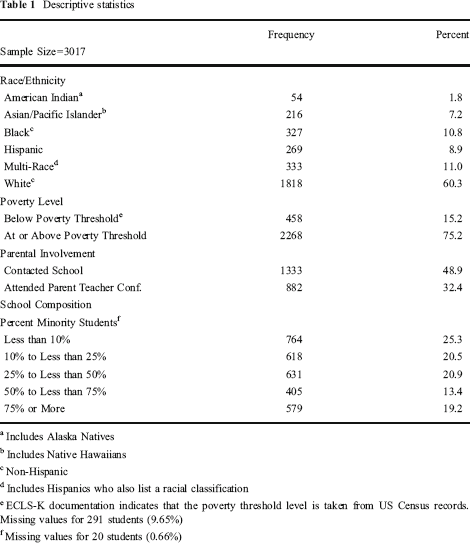
The ECLS-K collected administrative data from student records and survey data from parents, teachers and students for a national sample of children at seven time points between their kindergarten year in 1998/1999 and their eighth grade year in 2006/2007. I limit the sample to students in the eighth grade when teachers filled out survey assessments for each student. I further limit the sample to female students which leaves a sample size of 3,017. Descriptive statistics are presented in Table 1 and Table 2 for the categorical variables and the continuous variables, respectfully.
Descriptive Statistics
Includes Alaska Natives
Includes Native Hawaiians
Non-Hispanic
Includes Hispanics who also list a racial classification
ECLS-K documentation indicates that the poverty threshold level is taken from US Census records. Missing values for 291 students (9.65%)
Missing values for 20 students (0.66%)
Descriptive Statistics Continued
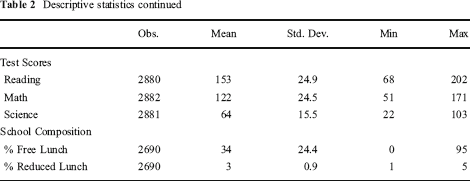
The majority of students (60.3%) are white, followed by multi-racial students (11.0%) and black students (10.8%). Hispanic students make up 8.9% of the sample, while Asian/Pacific Islanders and American Indians comprise 7.2% and 1.8% of the sample, respectfully. About 15% of students have parents whose income is below the poverty level as defined by the US Census Bureau. Approximately half of all students had parents who contacted the school at least once during the school year, while only a third of students had parents who attended a parent-teacher conference during the year. School racial composition is fairly evenly split across five categories ranging from minorities comprising less than 10% of the school to more than 75% of the school.
Students were tested in reading, math and science as part of the data collection effort. Since eighth grade test scores may be influenced by teacher perceptions I use fifth grade test scores in order to mitigate any bias due to this potential endogeneity. Table 2 presents mean test scores in each of the subject areas. There is substantial variation in the test scores. Table 2 also presents a second set of school composition variables based on socioeconomic status. In the average school, 34% of students are eligible for the federal government's free lunch program with a range from 0–95%. Only 3% of students in the average school are eligible for the reduced lunch program, with a range of 1–5%.
Figure 1 presents descriptive information on the sample distribution of the prevalence of black students in each of three types of classes–English, math and science. Most students were taught in classrooms with fewer than 5% black students. The next largest group was taught in a classroom with 25% or more black students. The pattern is similar for the prevalence of Hispanic students in the classroom.
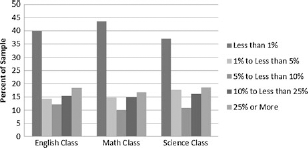
Prevalence of black students in class by class type
In the eighth grade, each student was evaluated in a survey by two of their teachers–an English teacher, and either a math or a science teacher. As part of the survey, teachers were asked the questions: “How often is this student attentive in your class?” and “How often is this student disruptive in your class?” They were given the answer choices: “Never,” “Rarely,” “Some of the time,” “Most of the time,” and “All of the time.” Figure 2 presents the distributions of the disruptiveness measure and the attentiveness measure by class type. Teachers were more likely to describe students as never disruptive and mostly attentive. Figure 2 also shows that there is significant variation in teacher perceptions. The ordered ranking of these disruptiveness and attentiveness measures will serve as the dependent variables in the first part of the analysis.
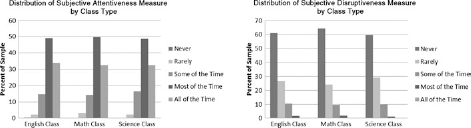
Distribution of teacher behavioral perceptions by class type
In the same teacher survey, teachers were also asked whether or not they would recommend the student for honors classes. In the sample, English teachers said they would recommend 34% of students for honors classes on average, math and science teachers would each recommend about 31% of students on average. Whether or not a student is recommended for honors classes will serve as the dependent variable in the second part of the analysis.
Methodology
Given the categorical nature of the teacher perception variables, I estimate the relationship between race and subjective teacher perceptions using an ordered probit functional form to carry out maximum likelihood estimation. I estimate a baseline model in which the only explanatory variables are five dichotomous variables that indicate student race/ethnicity–White, Asian, Hispanic, AmericanIndian, and Multi. The omitted category is black students to ease comparison of black students with the other five categories. I also estimate a full model which includes controls for test scores, school and classroom racial composition, school socioeconomic composition, parental involvement and whether the student lived in a household with an income level below the poverty threshold. 1 There are two observations for each student, since each student was rated by two teachers. I report standard errors that are clustered at the individual student level throughout the analysis.
Ideally, I would also like to include controls for teacher characteristics such as race, gender and experience, but these variables are only available in the restricted use version of the ECLS-K.

In this specification, Y represents the two outcome variables-attentiveness and disruptiveness, and k indexes the categorical levels of the outcome variables, ranging from zero to three. Race is a vector of the five racial indicator variables, X is a vector of control variables, and ε is a student level error term that is assumed to be normally distributed.
In the second part of the analysis I estimate a standard probit model predicting the likelihood that a student is recommended for honors classes by her teacher. The baseline model, again, includes only the five race/ethnicity indicator variables, and the full model now includes test scores, the poverty measure, and the teacher perception measures-disruptiveness and attentiveness.

In this specification Y is an indicator for whether the student is recommended for honors by her teacher, Perceptions is a vector containing the teacher perceptions of the student's attentiveness and disruptiveness, and the other variables are as in Eq. 1.
Results
For ease of presentation, I present the results of the ordered probit model as marginal effects graphs (Figure 3). The full estimation results are available upon request. There are three important points to take away from the results presented in Figure 3. First, in the baseline models, black girls are viewed significantly less favorably than all other ethnic groups (except American Indian girls in attentiveness). For example, on the disruptiveness scale, they are less likely to be seen as “never” disruptive and more likely to be seen as disruptive “some of the time.” They are also less likely to be seen as attentive “all of the time,” and more likely to be seen as attentive only “some of the time.”
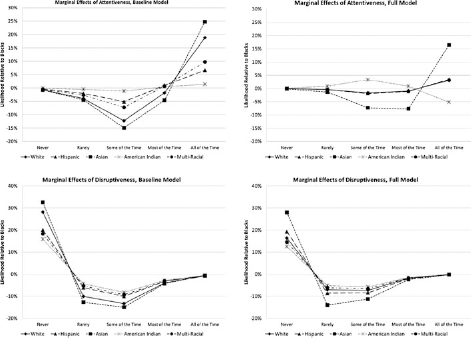
Marinal effects of race from ordered probit models of attentiveness and disruptiveness
Second, the differences in teacher perceptions of black girls’ attentiveness relative to almost all other groups become insignificant in the full model. This is largely driven by test scores. Teachers rate students with higher test scores as more attentive and black girls have lower test scores on average than girls from the other racial/ethnic backgrounds. However, even after controlling for test scores, school composition, classroom composition, parent involvement and poverty level, black girls are still viewed significantly less favorably than Asian girls with regard to attentiveness.
Third, unlike the results for attentiveness, the results for perceptions of disruptiveness indicate that black girls are still viewed as significantly more disruptive than all other groups even after controlling for the regressors included in the full model. Test scores seem to be associated with whether a teacher thinks a child is attentive, but do not appear to have a similar association with whether a teacher thinks a child is disruptive. It is important to understand how these differences in perception are associated with the likelihood of students being recommended for placement in honors classes.
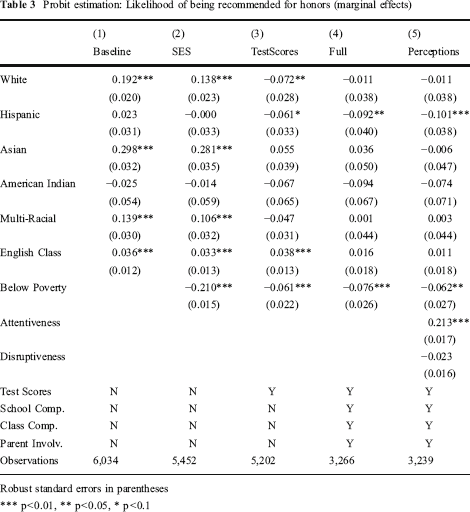
Results for the likelihood of being recommended by a teacher for honors placement are presented in Table 3 as marginal effects evaluated at the sample means. 2 The baseline model indicates that white female students are 19% more likely to be recommended for honors than black female students. Asians are 30% more likely, multi-racial students are 14% more likely, and there is not a significant difference between the likelihood that Hispanic or American Indian students and black students are recommended for honors. In Model (2), which incorporates poverty level the difference in likelihoods decreases slightly due to the observation that poor children are less likely to be recommended for honors courses, and black students in this sample are more likely to be poor.
Including more controls in the model leads to smaller sample sizes due to missing values. I ran the analysis using a sample that was balanced in observations across all models and the results were consistent.
Probit estimation: Likelihood of being recommended for honors (marginal effects)
Robust standard errors in parentheses
p<0.01
p<0.05
p<0.1
Including test scores in the model (column 3) reverses the relationships previously observed. Black girls with the same test scores are equally or more likely to be recommended for honors than their female classmates. This again, reflects the observation in the data that black girls have lower test scores on average, and lower test scores decrease the likelihood of being recommended for honors. Finally, model (5) incorporates teacher perceptions. Perceived disruptive behavior does not seem to have a significant relationship to being recommended for honors. Perceived attentiveness, on the other hand, is associated with a 21% higher likelihood of being recommended for honors. It is not surprising, then, that once teacher perceptions are controlled for, black girls have an even higher likelihood of being recommended for honors than their similar peers. In a sub-analysis (results not shown) I partitioned the sample by poverty status. Notably, among poor students, being perceived as more attentive is associated with only a 9% increase of being recommended for honors while for students who are not poor, being perceived as more attentive is associated with a 23% increase. The patterns in the racial differences in being recommended for honors are similar between poor and nonpoor students; however, the magnitudes are slightly larger among nonpoor students. For example, in the baseline model, poor black students are 9% less likely to be recommended for honors than poor white students, but black students who are not poor are 14% less likely to be recommended for honors than their white counterparts.
Discussion
The findings of this paper indicate that black girls are viewed less favorably than girls from other racial and ethnic backgrounds with regards to disruptive behavior, even after controlling for other factors that might influence teacher perceptions. The same is not true for perceptions of attentive behavior. Once test scores are controlled for differences between black girls and other girls become insignificant for all groups but Asian girls. Asian girls with similar test scores are still perceived as more attentive than black girls.
Differential teacher perceptions of black girls’ disruptiveness cannot necessarily be interpreted as bias on the part of teachers because the data do not allow me to determine whether the actual behavior of black female students is more disruptive on average, as the teachers perceive it to be, whether teachers are unfairly judging black female students, or whether both are occurring. Cultural mismatch theory hypothesizes that when viewed through the lens of the dominant school culture of individualism and competitiveness, common black cultural traits like communal problem solving–which might be valued in the labor market-are seen as disruptive and disobedient in the classroom (Boykin et al. 2005; Tyler et al. 2006; Tyler et al. 2008). Thus it is possible that teachers are misperceiving black girls’ behavior as disruptive.
Researchers have attempted to distinguish between teacher bias and actual student behavior by demonstrating that teachers tend to hold more favorable views of students who share their same race or gender (Dee 2005; Downey and Pribesh 2004; Ehrenberg et al. 1995; Mullola et al. 2011). This literature, however, has at least two limitations. First, students may actually behave better when they have a teacher who is similar to them in race or gender, leading to an overstatement of teacher bias. Alternatively, taking the same-race estimates as an example, black teachers may also be biased against black students (Ferguson 2000), and comparing the perceptions that black teachers hold towards black students with the perceptions that white teachers hold against black students may actually understate the amount of bias faced by black students.
Even if the behavioral perception differences documented in this paper are not the result of teacher bias, the finding that black female students are perceived as worse behaved is important. The results indicate that black girls may be able to overcome the deficit in attentive perceptions with good academic performance, but performance is less of a boost when it comes to perceptions of disruptiveness. The good news is that teachers don't appear to factor their perceptions of disruptiveness into the decision to recommend a student for honors. These perceptions of disruptiveness may, however, impact black girls in other ways. They may spend more time being sanctioned or punished than other children, taking away valuable learning time which could influence their grades and test scores (Ferguson 2000). Given the potential importance of teacher perceptions for the academic outcomes of black girls, further research is needed into the mechanisms influencing these perceptions.
Footnotes
Acknowledgments
I would like to thank Patrick Mason, Shanyce Campbell, Timothy Diette, William Darity, Jr., Rhonda Sharpe and the participants at The Invisible Woman Conference for their helpful suggestions and comments