







Abstract
This study explored the relation between adolescent reports of parental religious socialization (i.e., cultural socialization, promotion of mistrust, and pluralism) and their religious out-group evaluations, externalizing and internalizing behaviors. Crosssectional data were obtained from 730 12- to 15-year old Belgian adolescents through questionnaires. Results from multilevel and ordinary linear regression analyses indicated that pluralism was associated with higher religious out-group evaluations whereas promotion of mistrust was associated with lower religious out-group evaluations and higher externalizing and internalizing behaviors. Cultural socialization interacted with the importance adolescents give to religion to influence youth externalizing behaviors. Despite its limitations, this study presents a complex picture of the association between religious socialization practices and adolescent outcomes and offers an alternative pathway to understand parental religious socialization.
Keywords
Introduction
As societies have increasingly witnessed multiple changes in their religious composition, a growing body of research has started to address the issue of religious socialization. However, very little is known about how different messages parents give to their children about the meaning of their religious group membership can contribute to their children's psychosocial functioning. This is unfortunate because research on youth development stress the importance of parents and suggest that adolescents’ attitudes and behaviors may be influenced by those of their parents (Bebiroglu et al. 2013; Flanagan and Tucker 1999). Accordingly, the present study focuses on Belgian early adolescents’ religious out-group evaluations and internalizing and externalizing behaviors and seeks to bring data to bear on the association between parental religious socialization practices and these outcomes.
Parental Religious Socialization
We define parental religious socialization (PRS) as a process by which parents exchange their knowledge, behaviors, values, customs, norms and beliefs about religion with their children (Hughes and Johnson 2001; Hughes et al. 2006, 2009). Three models may describe parental socialization in the religion literature: unidirectional, bidirectional, and channelling models. According to the unidirectional model children are passive recipients of socialization messages of their parents. Studies of this model that have focused on how parents transmit their religious beliefs and behaviors to their children have indicated that there was indeed a correspondence between adolescents’ and parents’ religiosity. For instance, parents who model religious behaviors, such as church attendance or encourage their children to be more religiously active have children who are more likely to report such behaviors (Krause 2012; Myers 1996; Schwartz 2006). This model has been challenged by the bidirectional model of socialization that highlights the active role that adolescents play and suggests that parents and children mutually influence each other. Evidence for the bidirectional model mostly comes from studies that look at religious communications between parents and children. These studies have generally demonstrated that parent-adolescent conversations about religion are common and that adolescents actively initiate discussions and exchange questions and comments related to religion with their parents (Boyatzis and Janicki 2003; Dollahite and Thatcher 2008; Layton et al. 2011). Importantly, youth perceive such conversations as more positive if the focus is on their needs and interests rather than those of their parents (Dollahite and Thatcher 2008). Studies that look at factors that increase the success of religious transmission from parents to their children provide additional support. For instance, adolescents who report to have warm relationships with their parents and perceive their parents as more accepting are more likely to follow their parents’ religious beliefs and behaviors (Bao et al. 1999; Granqvist 2002; Ozorak 1989). The channelling model of religious socialization expands the socialization agents beyond parents to include peers, religious mentors and schools (Himmelfarb 1980; Martin et al. 2003; Regnerus et al. 2004). According to this model, parents channel their children into social institutions and settings that reinforce or help maintain their religious commitments. Indeed, studies that investigated this model by including measures of peer religiosity or school-level religiosity have found that family influence on adolescent religiosity is mediated by peer groups or the school context (Martin et al. 2003; Regnerus et al. 2004; Schwartz 2006).
These ideas provide important insights into multiple factors that shape religiosity in adolescents. In contrast, very little is known whether the influence of parents extends further into other domains of adolescent development such as out-group evaluations, internalizing or externalizing behaviors. In addition, what we know about religion related messages youth hear at home mostly comes from qualitative studies. These studies enrich our understanding of the content, structure and frequency of religious conversations but typically have the following limitations: small sample size and an exclusive focus on highly religious parents and adolescents. Furthermore, they provide little information about parent-adolescent discussions on religious out-groups.
Accordingly, in this study, we focus on a religiously diverse group of adolescents and investigate different types of parental socialization messages and how these messages are associated with adolescents’ out-group evaluations, internalizing and externalizing behaviors. Hughes et al. (2006, 2009) formulated and validated one of the most widely used frameworks of parental socialization for the ethnic-racial socialization literature. Following Hughes and Chen (1997), we divide parental socialization messages into three main dimensions: cultural socialization, giving knowledge about religious heritage, history and cultural traditions, promotion of mistrust, emphasizing the need for wariness and distrust in interreligious interactions, and egalitarianism/pluralism, stressing the importance diversity. Studies that have examined parental ethnic-racial socialization by using these dimensions suggest that not all dimensions are uniformly beneficial for development. For instance, cultural socialization and pluralism have been associated with favorable outcomes, including fewer externalizing behaviors (Caughy et al. 2002), higher self-esteem and ethnic identity (Bebiroglu and Pinderhughes 2012; Gartner et al. 2013; Rivas-Drake et al. 2009), higher problem solving skills (Caughy et al. 2011), and motivation (Huynh and Fuligni 2008). Whereas other research has revealed evidence of negative effects of promotion of mistrust on adolescents, including higher externalizing and internalizing behaviors (Caughy et al. 2011) and lower social competence (Tran and Lee 2010).
Especially during adolescence, discussions with parents about religion can be a key element that provides an opportunity for youth to construct their own understanding of religion, religiosity, and religious out-groups (King et al. 2002). Therefore, we believe that it is important to explore religious socialization practices by using the dimensions of cultural socialization, promotion of mistrust and pluralism in order to better understand their nuanced relations with distinct youth outcomes. We chose to examine the outcome variables of religious out-group evaluations, externalizing, and internalizing behaviors because, first, previous studies on ethnic-racial socialization have demonstrated clear links between these outcomes and socialization messages. Second, they represent both adolescents’ behaviors as well as their attitudes, therefore covering key areas of adolescent functioning. And finally, they provide information on positive as well as negative outcomes in adolescents, thus giving the opportunity to differentiate and examine adolescents who do better or more poorly from a wider perspective. In the following section, we describe some of the literature illustrating the connection between religious socialization practices and religious group evaluations, and externalizing and internalizing behaviors.
Religious Out-Group Evaluations
Religious out-group evaluations are feelings and attitudes toward individuals who are considered in one's out-group. Studies on socialization and out-group evaluations suggest that although adolescents do not simply model parental attitudes, they can absorb parental messages about out-groups. For instance, in one study, Dutch adolescents’ out-group attitude towards Islam and Muslims was largely related to their parents’ and adolescents evaluated Muslims less positively if they perceived their parents to be less positive about them (Van der Noll and Dekker 2010). Although to our knowledge, there are no other studies that look at parental socialization and adolescent religious out-group evaluations, a rich body of research on ethnic attitudes and parental socialization provides support for this study. For instance, children as young as 9 years are less likely to be biased if their parents perceive the members of the out-group as heterogeneous and expect individual diversity (Aboud and Doyle 1996). Similarly, children of 10–12 years evaluate their ethnic out-groups less positively if they perceive their parents to be less positive (Verkuyten 2002).
Externalizing Behaviors
Previous studies that have examined the relationships between parental religious participation and youth externalizing behaviors have generally found links between them. For instance, Seol and Lee (2012) have attempted to specifically investigate the association between PRS (i.e., a composite of faith modeling, dialogue and control) and psychosocial functioning among 12–19 year-old Korean Americans adolescents. The authors found that PRS was positively associated with adolescents’ religious identity. In addition, adolescents’ religious identity interacted with religious socialization in predicting externalizing behaviors such that youth with higher religious identity showed fewer externalizing behavior problems when they reported more PRS. Similarly, Pearce and Haynie (2004) who used a nationally representative sample of adolescents reported that if mothers and children differed religiously, children were more likely to be delinquent than children who shared religious beliefs and practices with their mothers. Interestingly, a study on intergenerational transmission of Buddhist beliefs and practices among early adolescents in Thailand reported that the link between parental religiousness and externalizing behaviors depended on the seriousness of delinquency. Results showed that higher parental spiritual beliefs and practices were directly linked to lower youth serious delinquency (e.g., being arrested). However, for minor delinquency (e.g., skipping school), the link was indirect in that parental spiritual beliefs influenced youth beliefs and practices, which was then linked to decreases in their minor delinquency (Chamratrithirong et al. 2013). Based on these studies, it appears that PRS, measured by religious beliefs and practices, is important in influencing youth externalizing behaviors and that adolescents’ own religiosity can act as a moderator between PRS and externalizing behaviors.
Internalizing Behaviors
Findings from studies that have examined the relationships between PRS and youth internalizing behaviors have been mixed. Carothers et al. (2005) who looked at the relationship between parental religiosity, operationalized as church attendance, and children's internalizing behaviors found that maternal adjustment mediated this relationship. That is, children with more religious mothers had fewer internalizing behaviors if their mothers were more adjusted. More recently, in Bert (2011) children's depression was unrelated to maternal religiosity, whereas Schottenbauer et al. (2007) found a direct relationship between family religious service attendance and youth internalizing behaviors. Thus, relationships, to date, are unclear.
The results of these studies are difficult to compare because of conceptual and methodological differences between them. Nonetheless all these studies highlight the importance of further differentiating the specific roles of different PRS domains. Understanding the distinct domains in which parental influences are most evident may help explain the inconsistencies across studies.
Accordingly, the goal of the present paper is to provide a better understanding of the relation between PRS practices and adolescent religious out-group evaluations, externalizing and internalizing behaviors. We investigate this goal in the context of a specific European country, Belgium. Although traditionally a Roman Catholic country, due to the decreasing rates of religiosity among native Belgians and increasing rates of immigration (Krysinska et al. 2014), in the last three decades, Belgium has become more religiously diverse where 64.2 % of the population identify themselves as Christian, 5.9 % as Muslim, and 29 % as unaffiliated (Pew Research Center 2014). Immigrants constitute about 10 % of Belgian population and most important non-European Union immigration comes from Morocco and Turkey, comprising 8.5 and 4.5 % of all immigrants, respectively (European Migration Network 2012).
Specifically, we address the following research question: Are PRS messages associated with youth religious out-group evaluations, internalizing and externalizing behaviors, after controlling for key covariates (i.e., demographic variables, importance of religion, and school religious heterogeneity)? Based on prior theory and research we expect that cultural socialization and pluralism will be associated with higher out-group evaluations and lower externalizing behaviors wheras promotion of mistrust will be associated with lower out-group evaluations and higher externalizing behaviors. Given that the links between internalizing behaviors and PRS remain speculative, testing these differences remained exploratory.
Method
Participants
Participants were 730 adolescents (51.9 % female) from 7 regular secondary schools in Wallonia, the French-speaking region of Belgium, and Brussels, the capital. They were 12 (mean age = 12.75, SD = .04), 13 (mean age = 13.77, SD = .05) and 14 years-old (mean age = 14.58, SD = .05) during data collection. The majority (84.1 %) were Belgian citizens. 43.8 % of parents in our sample had a university degree, 26.7 % had some college degree or vocational training, 26.8 % had a high school diploma and 2.6 % had an elementary school diploma. Data collection was conducted in classrooms by trained research assistants. Participants completed a short paper-and-pencil questionnaire exploring demographic information, psychological and social adjustment. Participation was voluntary. In the present analyses, since we wanted to focus on the three major religious groups in Belgium, we included only participants who identified themselves as either Catholic (n = 304), Muslim (n = 171), or nonreligious (n = 250). Most adolescents who identified themselves as Muslim were Belgian born (n = 112). Most important Muslim groups who were not born in Belgium came from Morocco, Turkey and Sub-Saharan countries such as Congo or Guinea, comprising 30, 16 and 14 % of non-Belgian born Muslim adolescents, respectively.
All participating schools were publicly funded. In Belgium, public schools can be secular or Catholic, with the latter having a better academic reputation. Although the Belgian education system grants freedom of school choice, since choosing the right school requires considerable knowledge of the education system, Catholic schools have a larger-than-proportional share of non-immigrant and middle-class students (Fleischmann et al. 2012). In this study, 63.3 % of adolescents were enrolled in Catholic schools. The majority of students who identified themselves as Catholic came from Catholic schools (n = 255), and the majority of students who identified themselves as Muslim came from secular schools (n = 171).
Measures
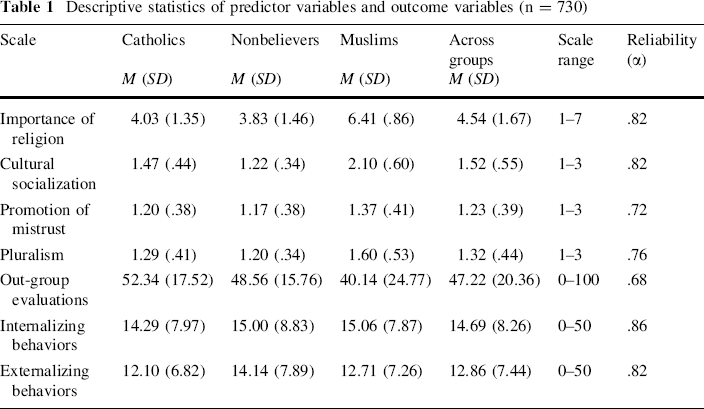
Descriptive statistics of predictor variables and outcome variables (n = 730)
Control Variables
Religious Group Membership
We assessed students’ religious group membership by means of self-identification. To examine the differences between each religious group, we created two dummy variables: Muslims (Muslims = 1 and Catholics = 0) and Nonbelievers (Nonbelievers = 1 and Catholics = 0), therefore choosing Catholics as the reference group.
Importance of Religion
We assessed the importance of religion by a three-item scale completed by adolescents measuring how important religion is in their lives. The items making up this scale were used in previous studies and showed good psychometric characteristics (e.g. Verkuyten 2007; Verkuyten and Yildiz 2007). Adolescents responded how true the items were for them, on a 7-point scale from 1 = not at all true to 7 = certainly true, with seven indicating a higher importance of religion. A sample item is, “my religion is important for me.” Participants who identified themselves as nonbelievers answered the same set of questions but “my religion” was replaced by “being a nonbeliever”. A sample item is, “being a nonbeliever is important for me”.
School Heterogeneity
We computed each school's religious heterogeneity by the heterogeneity index (Moody 2001; Rowe et al. 1999). Using data from all of the participating adolescents, we first calculated the percentage of Catholics, nonbelievers and Muslims in each school and then used the following equation:

As opposed to measures that only focus on the percentage of majority or minority, this index has the advantage to take into account all religious groups’ relative representation in each school. Most schools in this study had intermediate levels of heterogeneity, ranging from 52.21 to 63.93 %, with the exception of two schools with lower levels of heterogeneity (less than 25 %). In our sample, Catholic and secular schools had similar levels of religious heterogeneity, 53.88 and 59.89 %, respectively.
Independent Variables
Parental Religious Socialization
Factor analysis and frequency for items measuring PRS dimensions
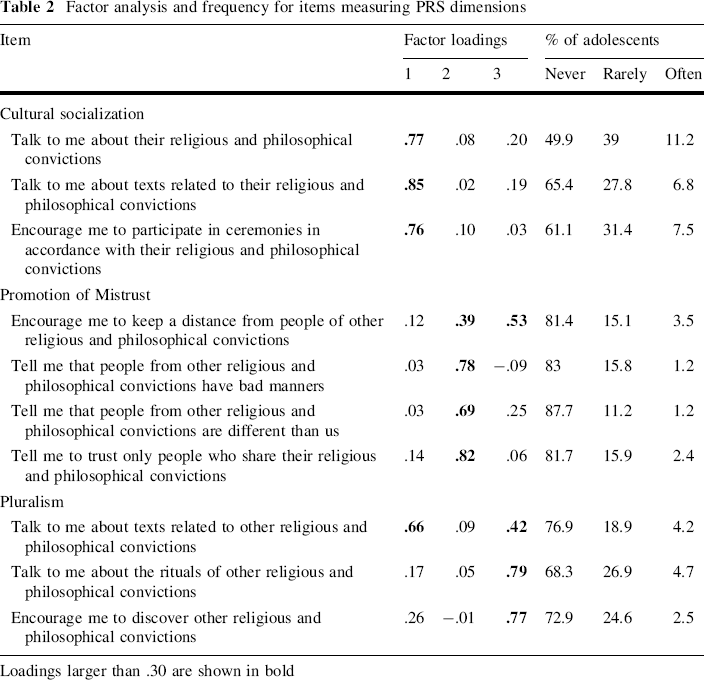
Loadings larger than .30 are shown in bold
Therefore, cultural socialization was measured by a three item indicator assessing parental teaching about own group's religious culture and heritage. A sample item was “My parents talk to me about texts related to their religious and philosophical convictions”. Promotion of mistrust was measured by four items emphasizing the need for wariness and distrust in interreligious interactions. A sample item was “My parents encourage me to keep a distance from people of other religious and philosophical convictions”). And pluralism was measured by a three-item indicator assessing how much parents emphasize diversity. A sample item was “My parents encourage me to discover other religious and philosophical convictions”. For each item, adolescents indicated on a 3-point rating scale how often their parents did or said things reflecting each dimension of religious socialization ranging from 1 = never to 3 = often. The mean score of each three dimension was calculated separately; higher scores indicating higher levels of socialization. The factor analysis and the reliabilities of this scale for the present study are presented in Tables 1 and 2.
Dependent Variables
Religious Out-Group Evaluation
We used the ‘feeling thermometer’ as a global measure of in-group and out-group feelings. This measure has been successfully used in previous studies (e.g. Verkuyten 2007). On a scale of 0–100, adolescents were asked to indicate to what extent they had positive or negative feelings about different religious groups, 50 representing neutral feelings. 6 religious groups were listed in the following order: Buddhists, Catholics, Protestants, Muslims, non-believers and Jews. Participants received a mean score based on their feelings towards their religious out-groups, with 100 indicating higher out-group evaluations.
Externalizing and Internalizing Behaviors
In the Youth Self-Report (YSR) of the Child Behavior Check List (CBCL) adolescents answer 112 items assessing the emotional, behavioral and social aspects of their lives, each rated on a 3 point Likert scale from 0 = not true to 2 = very true (Achenbach and Rescorla 2001). Validity and reliability of the YSR have been documented across different age groups (Achenbach and Rescorla 2001) and diverse societies (Ivanova et al. 2007). In this study we used Internalizing (i.e., anxious-depressed, withdrawn-depressed, and somatic complaints) and Externalizing (i.e., rule-breaking behavior and aggressive behaviors) scales in their raw score form. Consistent with the literature, the two factors were positively correlated, r = .36, p < .01.
Results
Preliminary Data Analyses
Table 2 shows adolescents’ report of the frequency that their parents engaged in cultural socialization, promotion of mistrust and pluralism. The majority of adolescents reported low levels of religion related communications, with percentages for “never” running from 49.9 to 65.4 % for cultural socialization, from 81.4 to 87.7 % for promotion of mistrust, and from 68.3 to 76.9 % for pluralism.
Table 1 shows the means, standard deviations, actual range, and the reliability estimates of survey scales. Youth reported having moderate levels of cultural socialization and pluralism and lower levels of promotion of mistrust. A one-way between-subjects ANOVA suggested that the means of cultural socialization, promotion of mistrust, and pluralism changed across religious groups, F(2, 689) = 182.44, p < .001; F(2, 688) = 44.29, p < .001; F(2, 693) = 14.05, p < .001, respectively. Post hoc comparisons using the Tukey HSD test indicated that Muslims reported significantly higher levels of cultural socialization (M = 2.10, SD = .60), pluralism (M = 1.60, SD = .53) and promotion of mistrust (M = 1.37, SD = .41) compared to both Catholics and nonbelievers. Catholics reported higher levels of cultural socialization (M = 1.47, SD = .44) compared to nonbelievers (M = 1.22, SD = .34).
Correlations between predictor variables and outcome variables
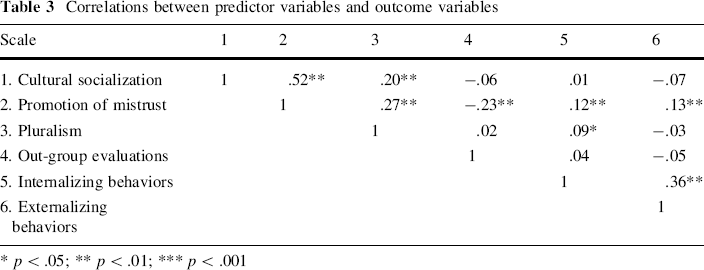
* p < .05; ** p < .01; *** p < .001
Regression Models
To examine how PRS dimensions relate to religious out-group evaluations externalizing and internalizing behaviors three two-level multilevel regression models were tested with religious out-group evaluations, externalizing behaviors and internalizing behaviors and as the respective outcomes. The Level 1 (student-level) predictors included religious group 1 (nonbelievers vs. Catholic), religious group 2 (Muslim vs. Catholic), age, gender, nationality, (Belgian vs. other), parental education, importance of religion, cultural socialization, promotion of mistrust and pluralism. Level 2 (school-level) predictor was school religious heterogeneity.
The Link between PRS and Religious Out-Group Evaluations
Multilevel models displaying the fitted relationship between adolescents’ religious out-group evaluations and student-level and school-level factors
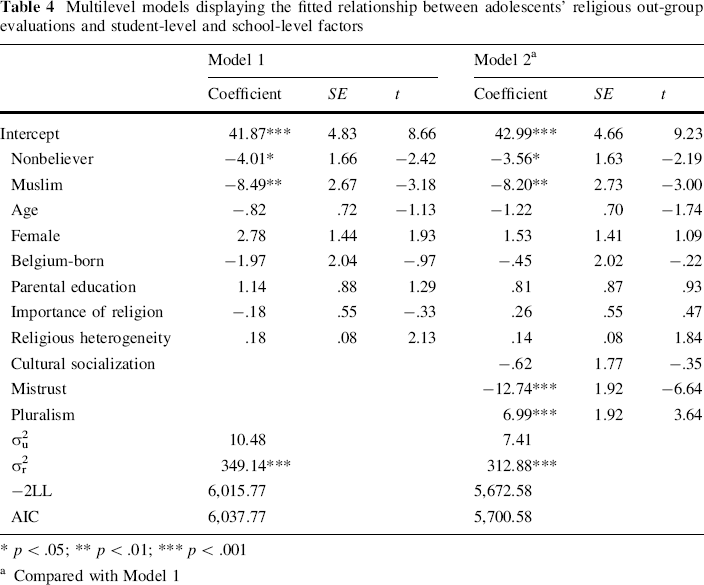
* p < .05; ** p < .01; *** p < .001
aCompared with Model 1
In the first step, we entered adolescent-based variables of religious group, age, gender, nationality, parental educational and importance of religion along with school religious heterogeneity. As can be seen in Table 4, religious group and sex were significantly related to religious out-group evaluations. All other associations were not significant. Adding PRS variables accounted for a significant additional proportion of the variance in explaining religious out-group evaluations in comparison to Model 1 (Δ-2LL [3] = 343.19, p < .001). Promotion of mistrust was significantly and negatively associated with religious out-group evaluations (t = −6.64, p < .001) whereas pluralism was positively associated (t = 3.64, p < .001). A final model was fit with the interactions between religious group and PRS variables but this model did not account for a significant additional increase in the variance of religious out-group evaluations thus was not retained.
The Link between PRS and Externalizing Behaviors
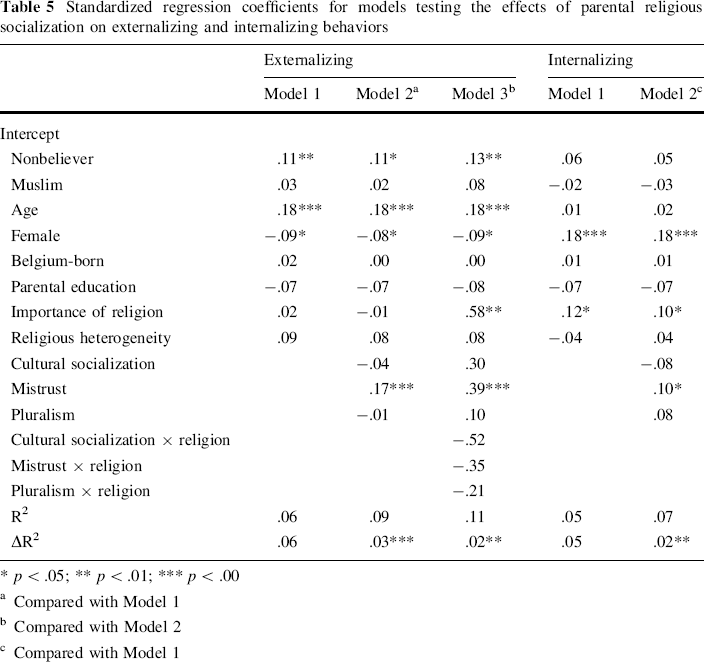
Standardized regression coefficients for models testing the effects of parental religious socialization on externalizing and internalizing behaviors
* p < .05; ** p < .01; *** p < .00
aCompared with Model 1
bCompared with Model 2
cCompared with Model 1
In Step 1, we entered the demographic variables, importance of religion and school heterogeneity in the model, with a significant contribution to the prediction of externalizing behaviors. Nonbelievers (compared to Catholics), males, and older adolescents reported higher externalizing scores. In Step 2, we added PRS variables into the model, which accounted for a small yet significant unique amount of variance in externalizing behaviors in comparison to Model 1 (ΔR2 = .03, R2 = .09, F(11, 648) = 5.85, p < .001). Promotion of mistrust was positively related to externalizing behaviors (b = .17, p < .001). Finally, in order to test the interaction between importance of religion and PRS, a final model was fit with the interaction terms and accounted for an additional 2 % of the variance in externalizing behaviors (ΔR2 = .02, R2 = .11, F(14, 645) = 5.57, p < .001). We generated a prototypical plot to show the cultural socialization and importance of religion interaction, albeit only marginally significant (p = .06). As shown in Fig. 1, if other predictors were held constant, as cultural socialization increased, externalizing behaviors decreased only for adolescents who reported higher rates of importance of religion. However, for those who reported lower rates of importance of religion, the relation was reverse: as cultural socialization increased their externalizing scores increased. Prototypical plot of the interaction between cultural socialization and the importance of religion in relation to externalizing behaviors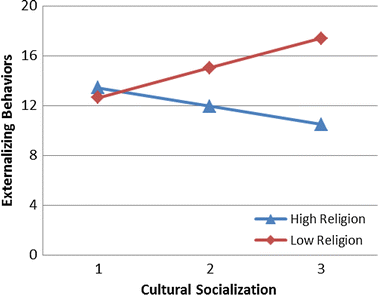
The Link between PRS and Internalizing Behaviors
The fully-unconditional two-level model with no predictors indicated no clustering at the school-level for internalizing behaviors. The intraclass correlation was lower than 1 %, indicating that it was not necessary to use a two-level model. Therefore, we used ordinary linear regressions and neither the predictor variables nor the interaction terms were mean centered. Results of ordinary linear regression analyses examining the effects of predictors on internalizing behaviors are presented in Table 5.
In Step 1, we entered the demographic variables, importance of religion and school heterogeneity in the model, with a significant contribution to the prediction of internalizing behaviors. Females reported higher internalizing behaviors than did males. Higher importance of religion was related to higher levels of internalizing symptoms. In Step 2, PRS variables were added into the model and accounted for an additional 2 % of the variance in comparison to Model 1 (ΔR2 = .02, R2 = .07, F(11, 648) = 4.36, p < .001). Promotion of mistrust was positively related to internalizing behaviors (b = .10, p < .01). A final model was fit with the interaction between importance of religion and PRS variables however, was not significant and was not retained.
Discussion
The main goal of this study was to examine the association between PRS messages and adolescents’ religious out-group evaluations, externalizing and internalizing behaviors. On the basis of previous research and theory we expected cultural socialization and pluralism to be associated with higher out-group evaluations and lower externalizing behaviors whereas promotion of mistrust to be associated with lower out-group evaluations and higher externalizing behaviors. Given the paucity of research on PRS and internalizing behaviors, no a priori hypotheses on internalizing behaviors were formed.
Before discussing the links between PRS and youth outcomes, a note on the frequency of discussions is warranted here. The majority of adolescents in our study reported low levels of cultural socialization, promotion of mistrust and pluralism. These results are in contrast with those reported in previous research (e.g., Boyatzis and Janicki 2003; Dollahite and Thatcher 2008), where parent–child discussions on religion or religion-related topics are frequent. Could it be that religion is not an important topic of discussion among families, especially in Western-European societies where a large proportion of the population have less favorable public attitude about religion? Or is religion simply an uncomfortable topic for parents to discuss with their children? Would parents of late adolescents talk more about religion than parents of early adolescents? These questions remain to be answered by future studies.
Despite the low frequencies of PRS reported by adolescents, the results of this study present a complex picture of the association between PRS practices and adolescent outcomes. These results affirm that significant amounts of added information can be provided by including PRS practices over demographic factors and importance of religion. The fact that not all dimensions of socialization practices are related to outcome variables with the same magnitude and in the same direction additionally highlight the importance to disaggregate these domains and separately examine them. The following paragraphs summarize the results related to each type of PRS dimension studied.
The only significant association we found for cultural socialization was its interaction with importance of religion when predicting externalizing behaviors. Although small in magnitude, this pattern is similar to the one found by Seol and Lee (2012) and Pearce and Haynie (2004). These results suggest that adolescents whose parents do not engage in cultural socialization and who give lower levels of importance to religion are at lower risk of engaging in externalizing behaviors than when their religiosity is at odds with their parents in either direction. These findings add to the mounting evidence revealing that when it comes to externalizing behaviors religion may be both protective and divisive depending on whether it is shared among family members. Such complex associations within family dynamics highlight the necessity to consider more integrative, fused and relational theories such as relational developmental systems theories (Lerner and Schmid Callina 2013) or dialectics models of socialization (Kuczynski and De Mol 2015) where children and parents are viewed to constantly interpret and construct meanings, and resist, negotiate and accommodate each other's perspectives. The conceptually challenging feature of this argument is that it requires that we study religion within the family context and incorporate religious dynamics between parents and children.
Interestingly, contrary to our expectations, cultural socialization was not linked to religious out-group evaluations. Studies on intergroup attitudes suggest that in-group preference cannot be equated to out-group acceptance and that these two aspects of intergroup behaviors may have different origins (Cameron et al. 2001). Since the focus of cultural socialization is on one's own in-group, it may be that cultural socialization is not linked to out-group evaluations but linked to in-group preference instead. Future studies are needed to evaluate this possibility.
In line with our expectations, across all religious groups promotion of mistrust was related to decreases in religious out-group evaluations and increases in internalizing and externalizing behaviors. It is possible that adolescents who receive messages about caution and wariness anticipate negative inter-group interactions and interpret these interactions in ways to confirm these expectations. Such notions may impede the development of healthy relationships not only with peers of diverse cultures but also with the social world in general, and thus result in lower out-group evaluations and higher externalizing and internalizing behaviors (see Hughes et al. 2006 for discussion). This interpretation is consistent with past research demonstrating the negative effects of promotion of mistrust among adolescents in ethnic and racial socialization studies, and may extend these results to the domain of religion. Another possible explanation, however, is that adolescents who have low levels of out-group evaluations initiate or encourage promotion of mistrust discussions with parents or over-report the likelihood of such discussions. Given the research design, the directionality of effects cannot be inferred.
As expected, pluralism was related to increases in religious out-group evaluations. Pluralism messages may lay the foundation for children to actively think about other cultures and instill an understanding and appreciation of others. Alternatively, adolescents who already have higher levels of out-group evaluations may initiate more discussions related to pluralism with their parents and thus report more pluralism messages. Pluralism was not linked to internalizing nor externalizing behaviors. Internalizing and externalizing behaviors are likely to be distal outcomes to pluralism, relative to its immediate goals of increasing appreciation of intergroup affiliations (Tran and Lee 2010). Given the evidence for a link between pluralism and outcomes such as self-esteem (Gartner et al. 2013), future research should strive to increase knowledge on pluralism by examining possible pathways to internalizing and externalizing behaviors via these variables.
Importantly, the analyses suggested that adolescents who gave higher importance to religion reported higher internalizing problems. This finding was unexpected given that the majority of research among adolescents and early adults has shown an association between measures of religiosity and a decreased prevalence of internalizing behaviors (e.g., Saroglou and Munoz-Garcia 2008; Wright et al. 1993). There are several explanations of why importance of religion was positively linked to internalizing behaviors. Adolescents’ psychological well-being is more strongly associated with their social experience and interactions than with their private or public religious participation (Pearce et al. 2003). In a given context, when religious participation and religiosity is not the norm, being religious may attract more criticism and lead to more negative social interactions, resulting in mental health disadvantage. For instance, in one study conducted in Scotland, adolescents who had affiliations with the Church of Scotland were more likely to be teased and bullied (Abbotts et al. 2004). Such findings suggest that when it comes to internalizing behaviors the protective effect of religion may be more context-dependent than previously thought. Alternatively, withdrawn adolescents may be more likely to be attracted to religion in order to find help. Future studies are needed to explore the nature of this relationship and replicate these findings.
School heterogeneity did not relate to youth outcomes. According to contact theory, intergroup contact does not necessarily lead to positive outcomes such as higher out-group evaluations, lower prejudice and intergroup tension (Amir 1969). In fact, research suggests that schools with levels of heterogeneity between 30 to 65 % may experience highest friendship segregation (Moody 2001). As mentioned previously, in our study most schools had intermediate levels of religious heterogeneity. Therefore, it may be that adolescents’ social relations were restricted to members of their own group. An interesting direction for future research would be to assess the link between adolescents’ out-group evaluations and their cross-religion friendship nominations.
There are limitations present in the current research. First, the patterns of covariation that we report are descriptive. As previously noted, neither causality nor direction of effects (i.e., unidirectional or bidirectional) can be inferred from these data. Therefore, we cannot answer whether and how much adolescents and parents influence each other. Common source variance is another limitation of the present research. All scores were derived from youth self-report, and prone to social desirability and response bias. In addition, all data came from one European country, Belgium. Although the religious landscape of Belgium shows multiple similarities to other European countries (Voyé and Dobbelaere 2001), it is unclear whether the findings reported here can be generalized to other countries. It is also important to note we did not assess adolescents’ interest in parental messages on religion. Therefore, additional research is needed to replicate our results with longitudinal data, additional methods (e.g., observations) and sources (e.g., teachers, peers), more specific measures of adolescents’ agency (e.g., acceptance- rejection of messages or interest), and larger sample sizes. In addition, future research should investigate the extent to which these findings can be generalized to other countries and cultures.
Despite its limitations, the present study extends previous work by showing that PRS messages (at least insofar as perceptions of them by their adolescent children are concerned) are significant contributors to youth outcomes. Although previous research has examined PRS, very few studies have looked into the link between different parental socialization messages and youth outcomes. Our focus on PRS by using three dimensions, as opposed to parental religious beliefs and practices, is to encourage other researchers in the field to do some additional thinking about religious socialization. Taken together, our data suggest that the process underlying PRS may be more complex, layered and contextually grounded than previously thought. Moreover, a sharp distinction between religion as a protective factor and religion as a risk factor for adolescent development may be overly simplistic. The full potential of PRS messages has not been fully exploited and the present study provides some evidence that research on religious socialization would benefit from using these three dimensions. Understanding parents’ religion-related discussions with youth can serve as a window into adolescents’ development. Future research on youth outcomes and PRS should consider replicating the present findings in light of the methodological recommendations we have made.
Footnotes
Acknowledgments
This research was in part supported by a grant from the Marie Curie Actions of the European Commission and the UCL awarded to the first author.