







Abstract
This article addresses the demand for global content knowledge that the process of internationalization has placed on the preparation of social studies teachers. Drawing on scholarship about global perspectives in teacher education, this study examined what one cohort of preservice teachers learned about globalization during participation in a three-week, web-based, international relations simulation. The unit was part of a methods course designed to prepare preservice teachers to teach global issues and internationalize the curriculum. International simulations have long been touted as a means for learning challenging knowledge about global issues yet are rarely studied in teacher education. This qualitative study drew on concept maps and written responses completed before and after the simulation to document the preservice teachers’ learning. The analysis generated two findings: (1) preservice teachers acquired a shared, conceptual vocabulary for globalization that included the events and actors represented in the simulation; and (2) they also demonstrated a more systematic and critical understanding of the ways that power and conflict shaped the events and actors. The study contributes to the question of what teachers need to know to teach with global perspectives and how efforts to internationalize teacher education programs can foster such knowledge.
Keywords
Introduction
The rapid increase in efforts to internationalize teacher education, driven largely as a response to the conditions of globalization (Paine, Aydarova, & Syahril, 2017), remains an ongoing process with many unresolved questions (Baildon & Alviar-Martin, 2018; Goodwin, 2010; Yemini et al., 2017). Internationalization in higher education broadly refers to the creation of learning opportunities involving “relationships between and among nations, cultures, or countries,” particularly that are intercultural and global in scope (Knight, 2004, p. 11). In a globalizing world, teachers need to be prepared to work with an international student body and to teach global issues in order to prepare students to be global citizens (Myers, 2016; Yemini, Tibbitts, & Goren, 2019). Because teachers may lack the knowledge and skills for teaching about complex global issues, teacher education programs across the world have begun to consider how to integrate global knowledge and skills for teachers (UNESCO, 2018). Pioneering efforts to achieve these goals include international student teaching, intercultural training, information and communications technology (ICTs), credentialing in global education, and curriculum reform.
Less attention has been paid to the knowledge demands that these internationalization practices have placed on teacher education programs for the preparation of subject area teachers. Successful teaching depends significantly on teachers’ mastery of content knowledge (Tatto, Richmond, & Carter Andrews, 2016) yet most teacher preparation programs, including in social studies education, lack global content knowledge (Poole & Russell III, 2015). Nor has there been sustained debate over what global knowledge is worth knowing and how this knowledge fits together as a curriculum (White & Myers, 2016). Furthermore, preparing teachers for internalization includes “not only broadening the knowledge base of teachers but also sensitizing them to different perspectives on issues” (Olmedo & Harbon, 2010, p. 77). Scholars maintain that a critical understanding of globalization is fundamental for teachers committed to addressing issues of justice in the world as well as to counteract the role of neoliberal reforms on the teaching profession (Hytten & Bettez, 2008). A critical perspective goes beyond mainstream appreciation of global issues and diverse cultures to understand the ways that “globalization from below” recognizes the impact of global forces and economic changes on diverse peoples and their efforts to democratize market-driven globalization based on principles of justice (Steger, 2008).
This study examined what one cohort of preservice teachers (PSTs) in a social studies teacher education program learned about globalization during participation in a three-week, web-based, international relations simulation. The simulation was selected to present a case study of the dynamics of globalization in a non-Western context in both creating oppression and inequalities as well as the ways that local groups can resist these outcomes. The teaching unit was part of a methods course designed to prepare PSTs to teach global issues and internationalize the social studies curriculum. The goal of the study was to challenge PSTs’ prior conceptions of a significant but frequently misunderstood global issue by situating their learning in a real-world context.
Global perspectives in social studies teacher education
Preparing candidates in teacher education programs to teach global perspectives and issues has traditionally received less scholarly attention than other reform efforts (Merryfield, 2000; Zhao, 2010). As internationalization has continued to gain momentum, a range of efforts have been undertaken in social studies teacher education programs that provide cross-cultural experiences, such as study abroad and international student teaching (e.g., Cunningham, 2019; Doppen, An, & Diki, 2016) as well as a focus on global content knowledge and critical thinking skills. Cross-cultural experiences develop broad attitudes and skills for global competence, such as valuing diversity, cultural awareness, and inquiry skills (Parkhouse, Tichnor-Wagner, Cain, & Glazier, 2016). Other efforts include integrating experiential learning, cross-cultural communication, and critical thinking skills into teacher education coursework (Kopish, Shahri, & Amira, 2019). Less attention has been paid to the systematic development of global knowledge for PSTs or teachers. One of the few studies on PSTs’ global knowledge showed that participants were found to be empathetic toward diverse cultures but largely misinformed about other cultures (Varadharajan & Buchanan, 2017). This scholarship collectively suggests that knowledge for teaching global issues has not addressed the misconceptions and inaccuracies in mainstream knowledge to include what Young (2013) refers to as powerful, or theoretical, knowledge “nearer to truth about the world we live in and to what it is to be human” (p. 107).
Critical global teacher education aims for teachers to develop sociocultural consciousness to understand “the ways in which their social location and worldviews shape the manner in which they approach global education” (O'Connor & Zeichner, 2011, p. 525). Sociocultural consciousness helps teachers to see how global issues impact others around the world by making them aware of the ways their worldviews may privilege Western perspectives. A critical approach to global teacher education should also include the “recognition, understanding, and critical analysis of the causes and manifestations of power and oppression on a global scale” (O'Connor & Zeichner, 2011, pp. 531–532). Understanding the impact of global issues such as globalization from others’ perspectives, especially from less privileged settings, and recognizing the way that power works in fostering exploitation and suffering are key understandings for teachers in global education.
Despite decades of efforts to internationalize U.S. schools, there has been little consensus on the global concepts that form the basis of global content knowledge for teachers. Most attempts have settled on categories of contemporary global issues that cut across national borders and that rest on the process of globalization as the defining content. For example, UNESCO refers to global citizenship education (GCE) as an ethos that includes knowledge of “global, regional, national and local issues and the interconnectedness and interdependency of different countries and populations” (UNESCO, 2018, p. 2). Oxfam's Education for Global Citizenship curriculum proposes seven broad thematic topics: (a) social justice and equity, (b) identity and diversity, (c) globalization and interdependence, (d) sustainable development, (e) peace and conflict, (f) human rights, and (g) power and governance (Oxfam, 2015). Much of the debate has revolved around which thematic topics are most important, such as human rights or development (see also, Davy, 2011, pp. 8–9; Sant, Davies, Pashby, & Shultz, 2018). While important to academic discussions of GCE, these thematic topics stop short of specifying and developing the conceptual knowledge for GCE that form the basis of a curriculum (Rata, 2012).
In this study we focus on preparing social studies PSTs to teach a single global issue: globalization. Scholars consider globalization a “master concept” for understanding the world today (Steger, 2013, p. 771). However, ever since entering mainstream discourse, myths about globalization have become common, which suggests the need to be unraveled and examined as both an historical and contemporary phenomenon (Hebron & Stack, 2016). The body of knowledge on globalization has grown exponentially since the 1990s and is increasingly relevant in the school curriculum. Social studies teachers in particular are responsible for teaching the concept yet may not have sufficient content knowledge to address these concerns.
Since the 1970s, globalization has been increasingly mentioned in international-focused social studies and history textbooks across the world, particularly economic aspects, although this trend does not show the depth of coverage devoted to the topic (Buckner & Russell, 2013). Global processes have challenged and re-shaped the national narratives in textbooks although with greater impact in Europe than in the U.S. (Schissler & Soysal, 2005). In the U.S., the portrayal of globalization in textbooks emphasizes economic aspects from a human capital perspective (Beltramo & Duncheon, 2013). Further, state standards and textbooks lack a comprehensive treatment of the topic (Myers, 2010; Rapoport, 2009). In world history, when the term globalization is included in the curriculum it is often treated as a homogenous concept focused on historical events prior to the modern period (Stearns, 2007). While globalization is occasionally portrayed critically in textbooks, it is more often presented as a benevolent force that “blends internationalization with a sense of global interconnectedness” (Buckner & Russell, 2013, p. 748).
Preparing social studies PSTs to understand the complexities of globalization requires critical knowledge that goes beyond superficial, popular treatments of the topics. Because globalization is now a prominent buzzword that has become part of mainstream vocabulary for the economy, people often learn about the concept through the media and online. These sources can provide limited and often inaccurate accounts. Scholarship suggests the need to understand globalization from multiple geopolitical perspectives, which has been described as “decentering” globalization (Mittelman, 2004, p. 224). This critical approach to globalization requires “an active recognition of the dynamics of power, rather than just a casual statement of solidarity or empathy with humankind …” (O'Byrne & Hensby, 2011, p. 22). This perspective fosters an understanding of the ways that power and conflict shape inequality in the world and avoids privileging Eurocentric views.
Simulations for global education
International simulations have long been touted as strategies to teach challenging global knowledge about the contemporary world (Ioannou, Brown, Hannafin, & Boyer, 2009). Typically, international simulations have students take on real-world roles as diplomats and other actors to resolve a significant international crisis or problem. Taylor (2013) identified two primary classes of international simulations that are commonly available for instructors: (1) Model United Nations (MUN) and (2) in-class simulations of real-world problems. Both of these models teach students about real-world issues by negotiating solutions to pressing global issues. Differences include that MUN is typically an extra-curricular activity that occurs outside of school hours, often as a city-wide or regional event. In-class simulations can take a variety of forms, including fully online and face-to-face.
The use of international simulations in social studies teacher education emphasizes content learning of global issues and the workings of the United Nations, international relations theory, and disciplinary skills (Kirkwood-Tucker, 2004; Myers & Rivero, 2019). Scholars suggest that simulations are effective at fostering a deep understanding of content knowledge by providing an opportunity to exercise and apply that knowledge to explore the dynamics and complex nature of a real-world situation (e.g., Bachen, Hernández-Ramos, & Raphael, 2012). In this respect, simulations “can be a valuable tool to help students finally grasp abstract theoretical concepts and recognize fundamental challenges in conducting global politics” (Taylor, 2013, p. 134). International simulations support this type of learning by requiring students to consider other points of view when examining a global issue (Zappile, Beers, & Raymond, 2016). However, the multiple demands of learning content knowledge, pedagogical strategies, and curriculum design also present a range of challenges for PSTs (Walker, Pettit, Albert, & Rychly, 2018).
Method
The purpose of this study is to explore how an international relations simulation can help PSTs develop a more sophisticated understanding of globalization. Two research questions guided our inquiry on PSTs’ global content knowledge during an instructional unit: What do preservice student teachers learn about the topic of globalization during participation in an international relations, web-based simulation? To what extent do preservice student teachers adopt critical perspectives on economic globalization during the simulation?
Participants and setting
This qualitative case study of a teacher preparation course examined the quality and depth of PSTs’ acquisition of content knowledge while participating in an international relations simulation about the impact of globalization in an African nation. The study took place at a university in the Southeast region of the U.S. during a three-week unit in an undergraduate social studies methods course focused on strategies for teaching global competencies. The unit was centered on learning to design and teach simulations for world history. As part of the unit, PSTs took on both the role of students during modeling of the simulation and as teachers when designing a simulation for world history.
All 29 students in the course were invited to participate in the study. From this initial group, 24 provided informed consent and completed all requirements for the study. Two students elected not to participate in the study and three students were excluded due to not completing all of the unit requirements. Nine of the participating PSTs are female and 15 are male. Prior to enrolling in the course, all PSTs had completed their content area prerequisites, which consisted of a range of courses in history, economics, political science, and geography. None of these courses deal at length with the topic of globalization.
The study took place during a 3-week unit in a face-to-face, undergraduate teacher education course. The course, which met once per week for 2 hours and 40 min, addresses curriculum and pedagogical practices in global education. The first class involved studying the educational purposes of simulations, with a focus on international approaches, and preparing for the PSTs’ participation in the simulation. Students learned procedures for the simulation, including the messaging system, stages of the simulation, and available actions, reading background information on the scenario, and preparing strategies in project groups. The simulation was completed during the second class. The third class focused on debriefing their experience during the simulation as a starting point for studying debriefing practices for simulations.
The simulation, titled “Globalization and Nigerian Oil,” draws on the case of real-world international conflict over oil in Nigeria during the 1990s. Created by the International Communication and Negotiation Simulations Project (ICONS) (www.icons.umd.edu), the topic highlights the way that globalization has created a new set of challenges as global trade and the involvement of international actors has intensified conflict over the distribution of wealth, control of resources, and protection of human rights. ICONS is an online, international relations simulation developed and maintained by the University of Maryland that aims to teach participants about controversial national and global issues. The ICONS approach places participants in group roles as diplomats, government officials, financial institutions, international organizations, and community leaders to negotiate solutions global problems. Negotiations take place in a custom online messaging system that allows for either synchronous or asynchronous communication. For this study, all messaging occurred during class time while PSTs collaborated in groups to send proposals, make deals, and seek allies.
The scenario for the simulation is a fictitious United Nations-sponsored conference to negotiate a memorandum of understanding on the future of the petroleum industry in Nigeria. The conflict centers around four broad issues: (1) security, (2) investment, (3) human rights, and (4) political participation. The negotiations address these issues in terms of the specific concerns in the Niger Delta region, including employment opportunities, quality of life for its people, security for foreign investment, the role of the Nigerian military, and environmental concerns like pollution. This simulation includes eight groups: (1) the Nigerian military, (2) the Nigerian government, (3) Shell Oil, (4) the International Monetary Fund (IMF), (5) the Ogoni people, (6) the Coalition of Women's Groups, (7) Human Rights Watch, and (8) Greenpeace. Groups review detailed histories of their role, role sheets that describe their objectives in the negotiations, and detailed background on conflict over oil in Nigeria. For example, the key negotiation goals for the Ogoni people group are (a) the removal of the Nigerian military from the region, (b) financial support from oil profits for local infrastructure and employment, and (c) talks about self-governance in the region. These groups take part in a diplomatic negotiation session to resolve the main issues culminating in the submission of final proposals requiring support from other groups.
Data collection
This study uses two primary data sources: (1) concept maps and (2) written reflections. PSTs completed concept maps before and after the simulation to record changes in the information they could communicate about globalization. A concept map is a tool that graphically represents the knowledge and its structure of the person creating the map. Maps are frequently used as instructional tools to stimulate thinking and organize knowledge. They are well-established as a research tool for documenting change in conceptual knowledge, especially the interrelationships between concepts. Concept maps are also powerful tools for revealing students’ misconceptions about social science topics (Richter, 2009). PSTs were asked to create a concept map about economic globalization responding to the prompt: What is economic globalization and who is involved in it? The instructions called for the inclusion of any ideas, events, or individuals associated with the global economy and linking phrases to illustrate relationships.
Second, PSTs completed a written, free response to a prompt on what they knew about Africa's role in the global economy before and after the simulation. The reflections were designed to capture readily available knowledge. The reflections also allowed PSTs to explain their thinking in a familiar way that is not possible with the abstract nature of concept maps. This exercise was completed during class without access to a computer or phone. Instructions asked for writing a maximum of three paragraphs during a 15-minute period by brainstorming whatever came to mind about the topic.
Coding and analysis
Our analysis of the concept maps focused on change in the amount and quality of information about economic globalization. The simulation scenario allows for conflict and cooperation between self-interested actors over the oil trade. We analyzed three elements of the concept maps: the concepts (or nodes), the organization of the concepts, and the linking phrases indicating the relationships between concepts (Novak & Cañas, 2008). To understand change in the PSTs’ conceptual knowledge, we first counted the number of concepts in the maps before and after the simulation. As prior research has shown, the number of concepts added to a concept map is associated with knowledge and comprehension of a given topic (Chichekian & Shore, 2013). We then qualitatively coded the content of the maps, paying special attention to any contradictory data. We drew on current GS scholarship on the ways that economic globalization is conceptualized, including critical perspectives, that focused on the categories of (a) actors (e.g., multinational corporations), (b) processes or events (e.g., trade), and (c) objects or entities (e.g., imports).
Next, as an indication of quality we coded all maps for the specificity of the concepts. Specificity shows deeper understanding of a topic and grasp of how the real-world works. Concepts were determined to be specific if they included the name of a person, group, or organization; a place name; or a particular entity, object, or event. For example, the term “multinational corporation” is coded as a non-specific actor while Shell Oil is a specific example. Specificity was determined by the number of concepts of a particular example or entity. We labeled each map as low, medium, or high to describe the degree of specificity (see Table 1).
Coding for specificity of concept maps.

We employed thematic coding to analyze the written responses for conceptions of globalization. First, we created initial codes by reading both sets of responses, focusing on the aspects of globalization that were included in each. Next, we compared this list of codes with the major theories and conceptualizations for globalization in the existing scholarship (O'Byrne & Hensby, 2011). This process produced a final set of codes that were used for both sets of written responses. In order to increase the reliability of the analysis, we conducted inter-rater reliability sessions to determine the accuracy of our coding. These scores were discussed until there was consensus.
Results
PSTs’ knowledge of globalization
Our analysis found that substantial information on globalization was added to the PSTs’ concept maps following the Nigerian oil simulation although there was considerably variation from student to student. Fig. 1 shows the change in the number of concepts for each student. The number of concepts on the maps increased from before to after the simulation for a majority of the students. In some cases, the increase was up to four times the number of concepts. Adding concepts to a map indicates that the author has a deeper understanding of the topic and more readily available information (Hay & Kinchin, 2006). However, four students’ maps (represented with single points) showed no change in the number of concepts (noted with ‘0’ change in Fig. 1) and two students’ maps decreased in total number (students 17 and 10).
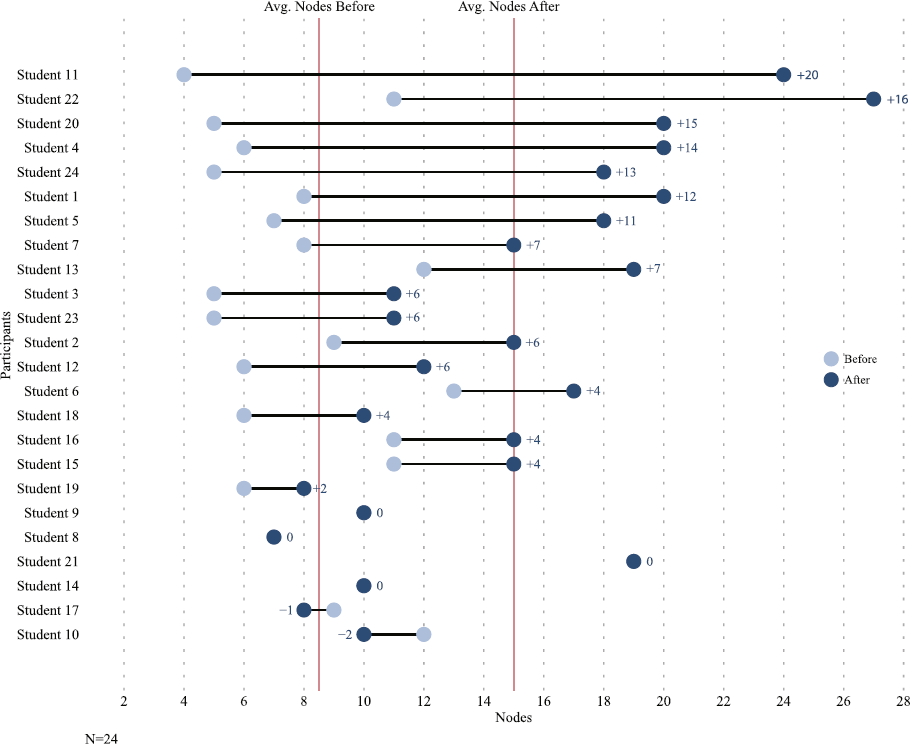
Number of concepts by PST, pre and post.
The concept maps completed before the simulation typically use vague or generic economic concepts that do not express unique features of economic globalization, such as trade, money, or markets. Paired concepts were also frequently used on the initial concept maps, especially imports and exports, private and public, or products and consumers. The predominant characterization of economic globalization in these maps is focused on markets and free trade. Although these terms should certainly be part of an explanation of economic globalization, they lacked a deep understanding of the actors involved or the impact on groups and society.
Specialized economic terms, such as gross domestic product (GDP), were added to several of the initial concept maps. These terms were typically add-ons that did not further understanding of globalization. For example, the concept comparative advantage was used in one map as a link from the “resources” concept and paired with other generic economic terms. Because comparative advantage deals with the ability to produce a good more efficiently and at lower cost, which does not necessarily depend on resources, it might fit for the concept to be introduced as a link from the preceding “trading” concept or in relation to how comparative advantage supports low-income countries. The concept “multinational corporations” was the most common specialized term that potentially has meaning for explaining globalization. However, it was not always used accurately. For example, one map used it to explain international relations, stating that it “consists of” multinational corporations. Other maps linked the term directly to the starting concept, economic globalization, but without specifying a relationship or developing their thinking with additional information. Overall, these characteristics of the initial concept maps indicate that PSTs had some familiarity with economics and some general features of the global economy, such as multinational corporations and free markets, yet they struggled to put them together coherently.
Although some maps completed after the simulation also contained vague uses of concepts, these maps included a greater range of actors, events, and processes of economic globalization as portrayed in the simulation. New concepts were included in these later maps, such as non-governmental organizations (NGOs), power, and conflict, which align with critical views of globalization. In particular, there is a deeper understanding of the actors involved in economic globalization, the role of conflict and negotiation, and the impact on society. Beginning to see the ways that globalization affects different social groups is a key goal of the simulation, an outcome that humanizes the otherwise abstract concept.
The processes of power and conflict were also present in the maps completed after the simulation. In total, ten maps recorded the concept of power and nine included conflict compared to two and zero in the initial maps. This finding suggests that the PSTs were beginning to understand the way that interdependence and conflict function in economic globalization as a dynamic system in contrast to the largely static portrayal in the initial maps. Lastly, the concepts of environment, human rights, and poverty are now included in some concept maps as areas in which economic globalization affects civil society, which also align with the non-state, group roles of Greenpeace, Human Rights Watch, the Ogoni people, and the Coalition of Women's Groups.
To illustrate these findings, Figs. 2 and 3 present the change in information for one PST's concept maps. The total amount of information increased from 7 concepts to 18 and there was a greater variety of information types. In Fig. 2, the initial map includes two concepts that are processes: trade and comparative advantage. The remaining five are objects or entities: markets, tariffs, products, goods, and currency. There is not a single actor included. In a complete reversal, Fig. 3 shows that the map after the simulation was dominated by 11 actors representing a broad range of groups involved in and affected by globalization. These actors align closely with the role groups in the Nigerian oil simulation. Furthermore, while the two processes included in initial map are traditional economic terms (trade and comparative advantage) that miss unique aspects of globalization, the post-map includes a central process that is key to the understanding of economic globalization supported in the simulation: “competing for control and power.”
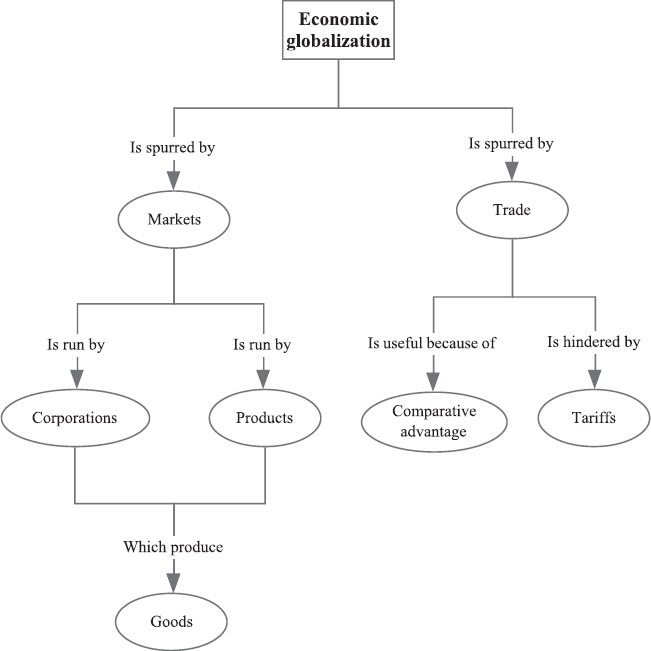
Concept map before simulation.
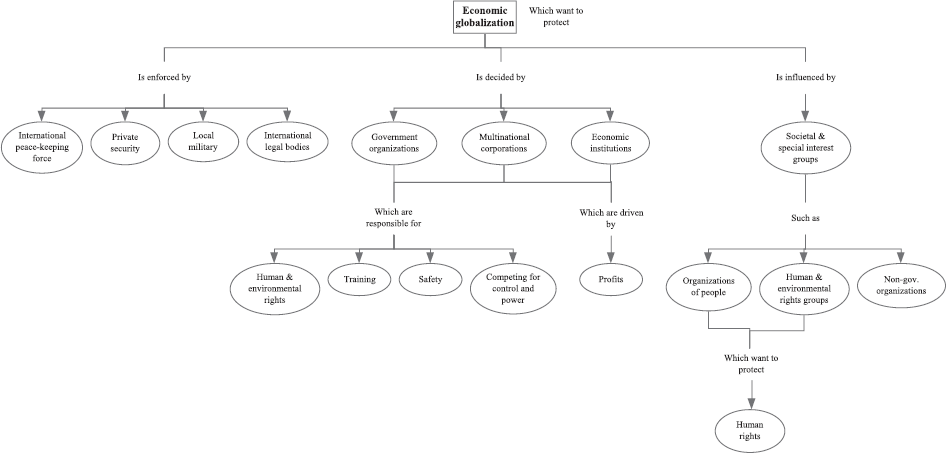
Concept map after simulation.
In addition to more information, the post concept map in Fig. 3 displays a more complex structural organization of the information (for a more detailed analysis, see Myers & Rivero, 2019). In the initial map, concepts are organized into two branches, starting with markets and trade. The post-map is organized in three thematic categories based on the role and purposes of actors in economic globalization and clarified with linking phrases: (1) influences on globalization, (2) decision-makers, and (3) enforcers. Each of these three areas are arranged as spokes (see Hay & Kinchin, 2006) that are developed with at least four linked explanatory or example concepts. This organization is driven by dynamic linking phrases that describe the ways that the concepts affect each other: is influenced by, is decided by, or which are driven by. Dynamic linking phrases also exist in the initial map but they are less directed. For example, the phrase is spurred by to connect economic globalization with markets and trade is broader and less specific than phrases used in the post-map.
Although most concept maps after the simulation contained more information than the initial maps, there was some variation in this pattern. Some maps either had the same number of concepts after the simulation as before or decreased in the amount of information. The maps in Figs. 4 and 5 are an example of a decrease in the amount of total information. In this example, although the amount of information decreased, the maps completed after simulation showed a more complex and deeper understanding of economic globalization. This PST's maps decreased from 9 to 8 concepts the map completed after the simulation and from 4 to 3 concept levels (steps from the starting concept), which does not fit the pattern of increasing information seen in the other maps. However, compared to the initial map, the map completed after the simulation is markedly more advanced in the quality and depth of its representation of economic globalization. First, the initial map contains mainly general economic terms that are not unique to the global economy, such as producers of goods and services, national governments, and markets. The only exceptions that reference the global economy are the terms multinational corporations and, perhaps, global population, which is connected to the “consumers” concept. The initial map lacks any specific reference to a person, event, process, or place. It also lacks the linking phrases that were part of the assignment, possibly because the student was rushing or because it was difficult to articulate the relationships. In general, the initial map contained economic terms but was missing specific detail and an accurate understanding of economic globalization.
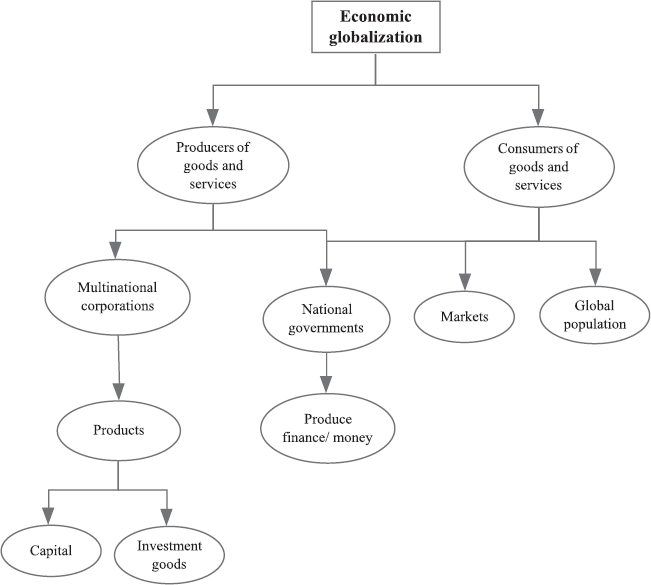
Decreasing concept map, before simulation.
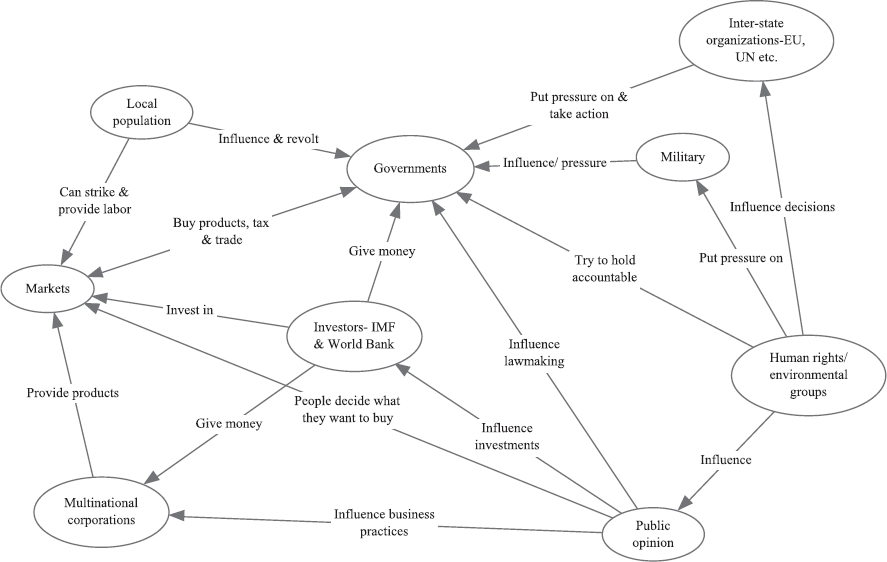
Decreasing concept map, after simulation.
Although smaller, the concept map completed after the simulation revealed a more complex understanding of globalization. This map includes information relevant to the conceptualization of globalization, including the involvement of a broader range of actors (e.g., interstate organizations, human rights/environmental groups, and investors) as well as naming specific actors (the European Union (EU), the United Nations (UN), the International Monetary Fund (IMF), and the World Bank). This map also adds the dimension of potential conflict that was not present in the initial map. Completely absent in the initial map, social actors are now included. Local population and human rights/environmental groups are identified as influences on the government that “try to hold [the government] accountable” (linking phrase). Two actions, strike and revolt, are listed as linking phrases explaining how these groups can act. Two concepts, interstate organizations and the military, are also conceived of in this map as sources of influence and potential conflict. Interstate organizations in this map “put pressure on/take action” against governments at the same time that they are being influenced by human rights and environmental groups. The military too is described as acting to “influence/pressure” governments.
In a major change, this map includes detailed linking phrases that provide greater meaning and orientation to the relationships between concepts. For example, in the initial map, the concept of multinational corporations was squeezed in between producers of goods and services and products. We might interpret this chain to mean that producers in a global economy include multinational corporations, which create products. In his second map, multinational corporations are in the midst of a web of relationships. A network map structure is the most complex and an indicator of deep conceptual learning (Hay & Kinchin, 2006). Investors such as the IMF and the World Bank are linked with the phrase “give money” to these corporations, pointing to a particular relationship between specific actors. Also, the concept “public opinion” is linked to multinational corporations with the phrase “influence business practices”, which highlights a completely different group of actors who influence corporations. Together, a more accurate view of economic globalization is presented as a dynamic and interdependent web of relationships among a range of political, economic, and social groups.
In addition to the amount and nature of the information, we examined all concept maps for the specificity of information as an indicator or quality. Table 2 shows that a majority of the concept maps increased in specificity from before to after participation in ICONS. This change was especially pronounced in the High Specificity category, which only included one map before the simulation and increased to half of all maps after the simulation. There was also change in the Low category, which markedly decreased. Furthermore, none of the maps decreased in specificity of information although seven maps stayed at the same level.
Specificity of concept maps.

Figs. 6 and 7 present a set of concept maps illustrating changes in the specificity of one PSTs’ conceptual knowledge. These maps were selected to illustrate a large increase in specificity as well as the use of specific concepts both from the simulation and from the PST's prior knowledge. Fig. 6 shows the initial concept map, which only includes a total of four concepts connecting from the start point of economic globalization. The information in this map is organized in three levels but with only two linking phrases. The first phrase states that economic globalization “deals with” economic interdependence and the second declares that products “depend on” resources. All four concepts are economic terms for general processes or entities. Because no concepts refer to an example or particular entity or object, it is coded as low specificity. In contrast, the map completed after the simulation is more complete in all respects, showing greater depth of understanding and more specific knowledge. In total, this map includes six specific concepts. It also contains six-times more information with 24 concepts, which are organized in four levels. The map is structured around three main branches: (a) the composition of economic globalization, (b) a definition for the concept, and (c) its outcomes. Each of these three branches includes several specific examples of groups, entities, or objects that demonstrate a clearer understanding of globalization.
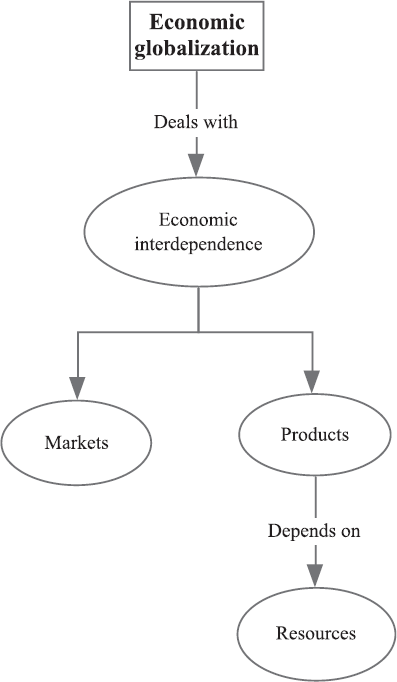
Specificity in concept map, before simulation.
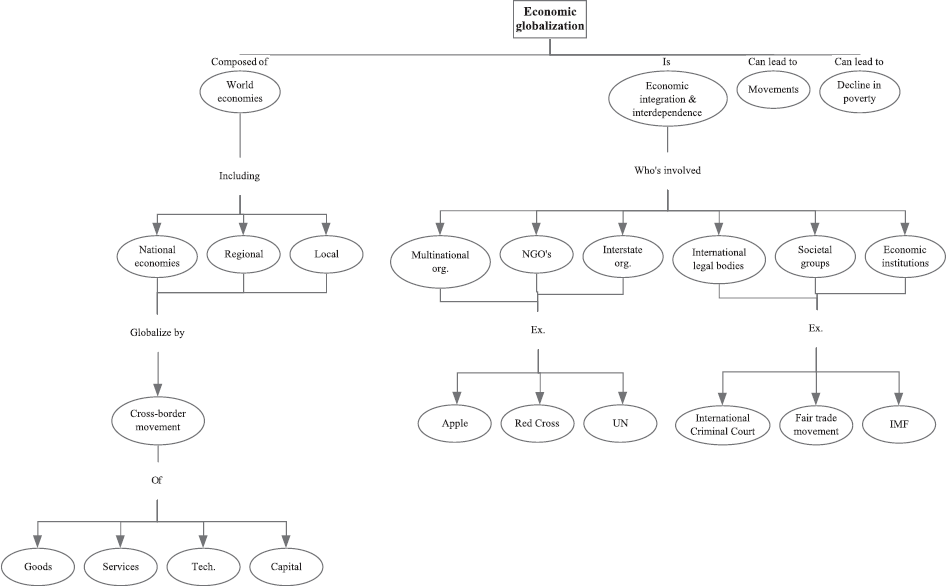
Specificity in concept map, after simulation.
Creating a concept map requires conceptual thinking about the relations between actors and events, which demonstrate the reorganization of prior knowledge into new and more complex patterns (Novak & Cañas, 2008). Maps that combined specific concepts from the simulation and from the map author's prior knowledge provide concrete examples of this process. The prompt used for the concept maps was designed in alignment with the focus of the simulation on the topic of globalization in order to capture what they learned. For example, in Fig. 7 the concept of “economic integration and interdependence” is connected by the linking phrase “Who's involved” to six types of actors: multinational organizations, NGO's, interstate organizations, international legal bodies, societal groups, and economic institutions. Each general type of actor is given an example, which were coded as specific concepts. These examples are a mix of actors: two from the simulation (e.g. the IMF) and 4 from the author's prior knowledge (e.g. fair trade movement). This example demonstrates the integration of knowledge gained from the simulation with prior knowledge of the topic within the conceptual framework of the map, which points to a more advanced comprehension of the complex workings of globalization.
PSTs’ knowledge of Africa's role in the global economy
Our findings show that the written responses completed after the simulation, like the concept maps, increased in total information and specific details on a broader range of actors and events. The responses also displayed a pattern of more complex and diverse explanations for economic globalization that reflect existing scholarship on the topic. In particular, multiple responses emphasized the role of conflict between actors and the exercise of power by local and international actors to exploit low-income countries for natural resources. These responses went beyond simple assertions of exploitation to understanding it in relation to conflict in which local organizations both opposed and supported the economic involvement of multinational corporations. This explanation recognizes that African groups have agency as well as diverse interests, and are not simply acted on by others. For the PSTs to be able to explain the human side of economic globalization as a political process of negotiation and conflict over economic agreements among groups with diverse interests is a powerful take-away with the potential for contributing to teaching the topic in a classroom.
In addition to increasing the length of the written responses after the simulation, the responses also increased in specific information. In the responses completed before the simulation, the majority of the PSTs wrote that they knew little about Africa or its role in the global economy. One student summed up that “Africa's role in the global economy is somewhat of a mystery to me.” The initial responses often included common but clichéd images of Africa as depending on “lots of international aid” and as “producers of raw materials” (see also Myers, 2008, 2012). About half of the PSTs’ writing focused on African countries’ provision of raw materials to the global economy. For example, one student stated about Africa's role:
For as large of a continent that it is, we never hear about their contributions to the global economy. Sure, some of the countries in Africa are more developed than others but for the most part these countries are developing.
The reflections written before the simulation discussed the global economy and African countries in limited terms. This writing rarely extended beyond their status as developing countries and the trade of raw materials that, as another student presciently described before the simulation, “various countries and corporations want a part of.”
Following the simulation, written responses contained more overall knowledge of Africa and the global economy. For example, a student who admittedly did “not know much about Africa” altered his thinking and even began to theorize the role corporations have in the African economy, suggesting that “during the simulation it seemed that big corporations could easily push what they wanted.” He also contemplated historical precursors that have led to the situation, asking whether “this could be a result of colonization” and designating it as a factor for his view that “independence seems to never truly come for African nations.”
After participating in the simulation, PSTs also had a more complete understanding of its role in the global economy. Prior to the simulation, PSTs typically viewed Africa's role in the global economy from a historical perspective centered on the trans-Atlantic slave trade or as a source of raw materials, such as diamonds. For example, prior to the simulation one student wrote about Africa's role in the global economy in general terms that seem right out of a textbook: “Africa is involved in trade globally, interconnected during many periods with monsoon empires. They were a landing point for trade ships with convenient port towns on the coast.” Following the simulation, they were not only able to discuss the process of how a valuable resource like oil is acquired by multinational corporations but also how oil is a major source of political turmoil. Following the simulation, the same student was able to describe Nigeria's role in the global economy:
Africa is a large source of one of the most important resources in the world—oil. This leads to issues concerning outside countries’ economic interests in Nigeria. Locals may not like the exploitation of their resources and land, but huge international corporations (like Shell) work tighter with the Nigerian government and military to work to capitalize on these resources.
Participation in the Nigerian Oil simulation also provided PSTs’ within a more complex and realistic understanding of the role of domestic politics in the global economy. Prior to the simulation, PSTs who mentioned politics typically used worn-out generalizations, such as widespread “political unrest” and that “Africa as a whole has remained politically unstable” due to “politics that deal with issues that face them.” Such statements, while based in some truth, lack explanatory power or evidence that could demonstrate an understanding of political unrest in a particular place and context. Following the simulation, the students were able to discuss in more detail why and what lead to the civil unrest. Many students pointed to competing objectives from different groups—foreign investors, local governments, and local military groups—that lead to the unrest. One PST's responses embodied this change when he altered his view of politics and political unrest in Africa from a vague description of Africa as “a place that is politically important” in the global economy, to an understanding of how political unrest is a result of “Governments and militaries in a constant struggle for power and money.” This finding suggests that the simulation was able to provide students with a more detailed understanding of one cause of political and civil unrest.
In contrast to the broad statements that were typical of the writing before the simulation, the PSTs’ writing displayed a more complex and critical view of economic globalization. A critical perspective considers how power is exercised to create inequalities that benefit some and disadvantage other groups in society. Collectively, 64% (14) disclosed a recognition of the ways that multinational corporations, such as Shell Oil in the simulation, have exploited African countries such as Nigeria for valuable resources. They also showed an understanding that multinational corporations viewed countries, and their resources, as an investment opportunity above any humanitarian motive. Following the simulation PSTs began to describe in more specific terms how, what, and who was exploiting Africans for their resources. One student commented following the simulation: “Multinational corporations like Shell can get whatever they want… NGO's and societal groups must then be active in order to ensure the land and the people are not being taken advantage of.” Echoing this sentiment, another student stated:
Environmental and human rights issues pop up wherever a resource does leading to foreign intervention. However, this can also hurt more than help. In the simulation, Shell had oil rights in the region but they were exploiting the Nigerian people.
These statements reflect informed analyses based on understandings of the way that power and influence are used to gain economic and political advantages. One PST explained in greater detail:
What I learned about Africa's role in the global economy and politics is that more powerful countries and corporations take advantage of the people of Africa. These powerful countries and corporations see dollar signs because of all the available resources in that part of the world. Since Africa isn't powerful like these other countries and corporations, they aren't respected and since they don't have the ability to enforce any regulations on their land, they get steamrolled.
Although these statements are critical of multinationals, the PSTs’ writing after the simulation typically portrayed the scenario is a result of the competing interests of several actors, including the role of the national government and military as sometimes partners and beneficiaries of these economic deals. PSTs also began to see the ways that negotiations with multinationals and governments could be mutually beneficial for human rights groups by including financial and policy concessions. Rather than a simple good vs. bad formula, economic globalization as portrayed in the ICONS simulations is a complex scenario without predetermined winners and losers.
Discussion and conclusion
As efforts to include global knowledge and learning opportunities in schools grow, teachers will increasingly require specialized content knowledge that is missing from teacher preparation. We argue that advances in preparing teachers for global citizenship education are necessary for the field to acquire the academic and institutional standing to become a more central component of the school curriculum (Myers, 2016). This study contributes to discussions about what social studies teachers need to know to teach for global citizenship and how efforts to internationalize teacher education programs can support these goals. Selectively including global content knowledge also provides an initial move toward a more organized and explicit core curricular knowledge that supports internationalization (Larsen, 2016). Ultimately, this approach aims to equip PSTs with the kind of global content knowledge that allows them to be curriculum makers who utilize specialized knowledge to prepare students for a globalizing world (Goodwin, 2010).
This study showed that PSTs started with very limited knowledge of globalization. They all had some idea of what the concept means but they did not have the specialized knowledge that attends to its complexity or the range of perspectives that diverse students bring to classrooms about global issues (Myers & Zaman, 2009; Yemini & Furstenburg, 2018). In many cases, the PSTs struggled to communicate a basic working definition of the concept. However, the challenge of articulating an understanding of globalization trained the PSTs’ attention on their own gaps in content knowledge about a topic that they recognized as important to their future teaching. Most significantly, our findings showed that participation in the simulation provided PSTs with a shared, conceptual vocabulary for globalization. This vocabulary included the events and actors represented in the simulation as well as a more systematic understanding of the ways that actors exercised power and created conflict in pursuit of their economic aims (O'Byrne & Hensby, 2011).
There is some evidence that the PSTs gained a more critical perspective on the dangers and risks associated with globalization for lower income countries. By a critical perspective, we mean to consider whether the simulation helps PSTs to see that the exercise of power during conflicts over natural resources leads to winners and losers and that the protection of human rights is precarious in this situation. Our findings documented a growing understanding of the ways that multinational corporations and governments used their political and economic power for financial gain, which also suppressed the human rights concerns of local peoples. The concept map data, in particular, suggested that some PSTs began to see the scenario as an economic system or structure that involved trade-offs and negotiation rather than as a struggle of good versus evil. Thus, the simulation was effective at providing a critical perspective on the dangers of globalization as a real-world case. The simulation also provided insight into the power relations of global events and actors with local peoples as well as the possibilities for action by civil society groups.
This study addresses the need in teacher education for “the potential to develop a critique of, and challenge, Eurocentric perspectives” by learning about less developed regions of the world often marginalized in the official curriculum, such as Africa (Mwebi & Brigham, 2009, p. 418). Our findings suggest that simulations can be an effective approach in teacher education to provide an understanding of diverse perspectives in cross-cultural contexts, especially when international teaching experiences are not a viable option (Olmedo & Harbon, 2010). This focus is similar to other uses of simulations in teacher education to provide experience with diverse perspectives (Shapira-Lishchinsky, 2013).
If global citizenship is going to have a long-term footprint in classrooms, teacher education programs need to more comprehensively integrate global knowledge and skills fundamental to this goal. Our work confronts this problem by developing learning experiences combining pedagogy with global content knowledge and documenting what social studies PSTs learn in practice. Our approach to this problem aimed for conveying deeper knowledge that goes beyond a collection of facts as mechanical knowledge to involve understanding multiple perspectives and critical knowledge of the ways that power, conflict and resistance operate within globalization. However, further work is needed to internationalize social studies teacher education by articulating what PSTs need to know about the world and the practices to teach it effectively. Without this kind of careful attention to content knowledge, education for global citizenship is unlikely to have the long-term impact in classrooms that its proponents hope for.