







Abstract
A series of equiatomic and non-equiatomic Fex(NiCrCo)100−x (at.-%, x = 25, 45, 55, 65, 75 and 85) multicomponent alloys were prepared and studied. With the increase in x, the phase structure of the alloys evolves from a single FCC phase (x = 25, 45 and 55), to a mixture of FCC and BCC phases (x = 55) and finally to a single BCC phase (x = 65 and 75). As a result, the BCC-structured alloys have much higher strength and hardness than the FCC-structured alloys. The existing VEC criteria are unable to predict the FCC-BCC phase transition in these alloys.
Introduction
Over the past decade, high-entropy alloys (HEAs) have attracted great attention due to their unique structures, excellent properties and many potential applications [1–5]. In the development of HEAs, a common strategy is to design equiatomic or near-equiatomic compositions in order to benefit from phase stabilisation through entropy maximisation [1,5]. Only recently it was demonstrated that, despite the reduced mixing entropy, some non-equiatomic HEAs can also form solid solution structures [6–11]. For instance, the Fe40Mn27Ni26Co5Cr2[6], Fe40Mn40Cr10Co10[7], Fe40Mn28Ni28Cr4[8] and Cr x Mn x Fe x Co x Ni100−4x [9] alloys exhibited a single-phase FCC structure, while the non-equiatomic Fe50Mn30Co10Cr10 showed FCC plus HCP structures [10]. These previous studies have evoked a renewed interest in the study of non-equiatomic HEAs [11]. However, few work has so far been performed to systematically compare the structure and properties of equiatomic and non-equiatomic alloys. In this work, we designed a series of Fe x (CrCoNi)100−x alloys based on the FCC-structured FeCrCoNi alloy [7,12–14]. The Cr, Co and Ni elements in each alloy had an equiatomic concentration. With the increase of x, a phase transition from the FCC phase to BCC phase was observed in these alloys. A significant improvement of both strength and hardness was achieved owing to the FCC-BCC phase transition.
Experimental
The Fe x (CrCoNi)100−x (at.-%, x = 25, 45, 55, 65, 75 and 85) alloys were produced using an arc melting furnace under argon protection. The raw metals are small pieces with a purity greater than 99.9 wt-%. The total mass of each alloy was 60 g. The alloys were remelted five times to homogenise its composition, and then solidified naturally in the furnace. The approximate cooling rate of the alloys was about 100° s−1. After the melting process, the actual compositions of the alloys were very close to their nominal compositions (see Table 1S in Supplementary materials). X-ray diffractometer (XRD, Empyrean) patterns were detected to reveal the phase structure of the alloys. Cu-Kα radiation was used at a wavelength of λ = 0.154 nm. The scan range 2θ was from 20° to 100° using a scanning step size of 0.026° and time per step of 40 s. Scanning electron microscopy (SEM, Quanta-200FEG) images were taken to characterise the microstructure of the alloys. Compression tests were conducted on a universal electronic compression testing machine (Instron-5500R) with a strain rate of 1.67 × 10⁻³ s−1 at room temperature. The sizes of cylindrical samples for testing are about Φ 3 mm × 5 mm. Hardness measurements were performed using a Vickers hardness detector (MICRO-586) with a load of 10 N for 20 s. Ten points were measured in order to obtain the average hardness for each alloy.
Results and discussion
Figure 1 shows the XRD patterns of the Fe
x
(CrCoNi)100−x
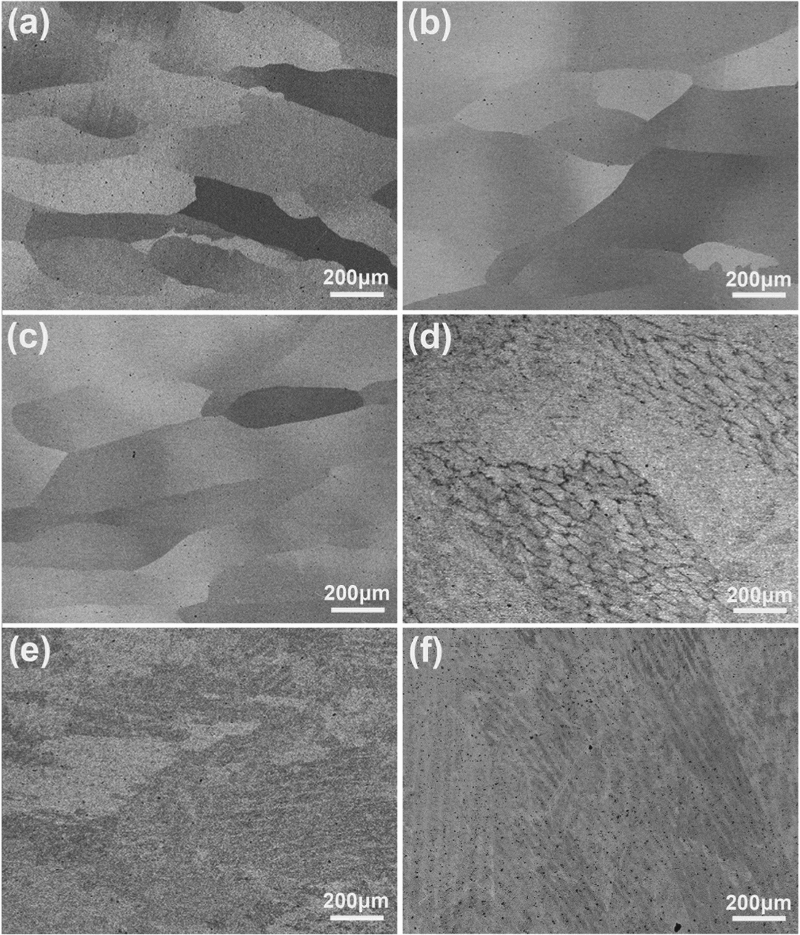
alloys. In the equiatomic alloy, x = 25, a single FCC solid solution phase was detected. As x increases to 45 or 55, the alloy still has a single FCC solid solution phase. When x reaches 65, the alloy forms a mixture of FCC and BCC solid solution phases. With a higher Fe concentration, x = 75 or 85, the phase structure of the alloy changes into a single BCC solid solution phase. Figure 2 shows the SEM back scattered electron images of the Fe
x
(CrCoNi)100−x
alloys. In the FCC-structured alloys, large elongated grains were observed as shown in Figure 2(a–c). Distinct microstructural transition occurred when x becomes larger than 55, which confirms the results of XRD analysis. At x = 65, the alloy contains large grains and small cell structures, as shown in Figure 2(d). A small amount of FCC phase exists around the cell structures. For the BCC-structured alloys, large grains and spindly strip structures can be observed, as shown in Figure 2(e–f). XRD patterns of the Fe
x
(CrCoNi)100−
x
alloys. SEM back scattered electron images of the Fe
x
(CrCoNi)100−
x
alloys. (a) x = 25, (b) x = 45, (c) x = 55, (d) x = 65, (e) x = 75, and (f) x = 85.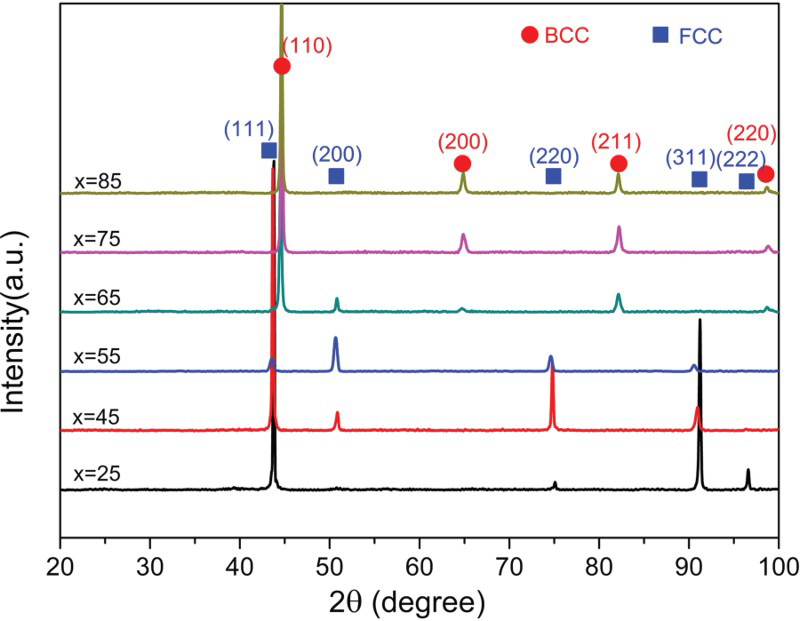
Calculated parameters of ΔSmix , ΔHmix , Ω, δ, and VEC for the Fe x (CrNiAl)100−x alloys.
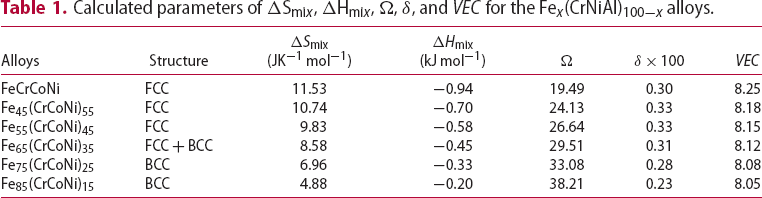
As for the FCC-BCC phase transition, Guo et al. [16] proposed that the BCC phase was stable when VEC < 6.87, while the FCC phase was stable when VEC > 8. In many Al-containing HEAs such as Al x CrCoFeNi and Al x CrCoFeNiCu alloys, FCC-BCC phase transition behaviours were often observed [16]. The reason for the FCC-BCC phase transition in these alloys was usually due to the low VEC value of the Al element. In this study, the values of VEC calculated for the Fe x (CrCoNi)100−x alloys range from 8.25 to 8.05. Obviously, the existing VEC criteria are unable to predict the FCC-BCC phase transition in the present study. A reasonable explanation for the FCC-BCC phase transition in the Fe x (CrCoNi)100−x alloys is that the Fe has a BCC structure at room temperature. Therefore, the alloys can retain Fe-rich BCC solid solutions when low concentrations of Cr, Co and Ni are added.
Figure 3 shows the stress–strain curves of the Fe
x
(CrCoNi)100−x
alloys. All the alloys have a good plasticity and no fracture occurs under compression. The yield strengths of these alloys are 131.5, 112.3, 104.4, 623.1, 733.6 and 621.4 MPa for x = 25, 45, 55, 65, 75 and 85, respectively. The hardness values of these alloys are 123 ± 4, 118 ± 3, 116 ± 4, 261 ± 8, 280 ± 11 and 259 ± 7, respectively. The measured hardness values and yield strength of the FeCrCoNi alloy is consistent with the results in the literatures [22,23]. It can be clearly seen that the BCC-structured alloys have much higher strength and hardness than the FCC-structured alloys. The yield strength of the alloy increases by about 6 times owing to the FCC-BCC phase transition. This can be mainly explained by the fact that the slip deformation is generally easier in FCC systems than in BCC systems due to the lower intrinsic lattice strength [24]. Moreover, the small cell structures and spindly strip structures in the large grains of the BCC-structured alloys may also attribute to their higher strengths. The hardness of the BCC-structured alloys is about 1.5 times higher than that of the FCC-structured alloys. In general, the values of Vickers hardness are usually about 0.3 times of the yield strengths of alloys [3]. Here, the BCC-structured alloys follow this relationship, but the FCC-structured alloys do not. This unusual phenomenon may be due to that the FCC-structured alloys in this study have too low yield strengths but prominent work hardening. These results suggest that such a strengthening effect arising from FCC-BCC phase transition may be applied in strengthening many other solid solution multicomponent alloys. To achieve a similar FCC-BCC phase transition, non-equiatomic compositions may be more promising than equiatomic compositions [11,22]. Compression stress–strain curves of the Fe
x
(CrCoNi)100−
x
alloys at room temperature.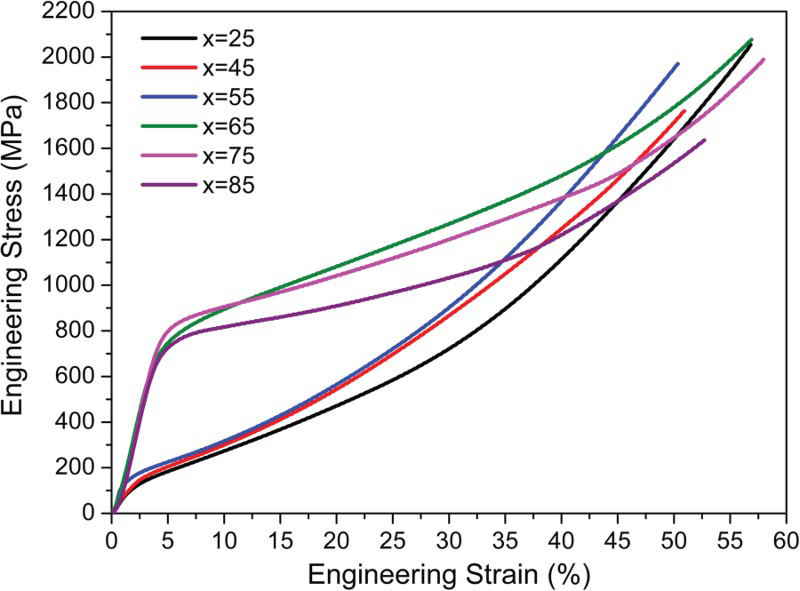
Conclusions
In summary, a series of Fe x (NiCrCo)100−x (at.-%, x = 25, 45, 55, 65, 75 and 85) alloys were prepared and studied in order to systematically compare the structure and properties of equiatomic and non-equiatomic multicomponent alloys. With the increase in Fe concentration, an FCC-BCC phase transition was observed in these alloys. Such FCC-BCC phase transition cannot be predicted by the existing VEC criteria. Compared with the FCC-structured alloys, the BCC-structured alloys can have much higher strength and hardness. These results show that entropy maximisation is not a must to stabilise solid solutions. The validity of existing VEC criteria for predicting FCC-BCC phase transition in multicomponent alloys is still under debate. Our findings may help to design other FCC/BCC dual-phase solid solution alloys in the future.
Footnotes
Disclosure statement
No potential conflict of interest was reported by the authors.