






Abstract
Rapid and homogeneous precipitation of nano-sized Si particles with high density was achieved in Al–1%Si alloy by electric pulses treatment (EPT) in a liquid nitrogen bath (∼77 K). In contrast, when processed by EPT in air or by high-temperature (527–720 K) salt bath treatment, the precipitate density decreases dramatically. The homogeneous precipitation of Si could be facilitated by both the low-temperature environment and the non-thermal effects of EPT. The low-temperature environment provides a high driving force for nucleation, and retains the quenched-in vacancies serving as potential nucleation sites. The non-thermal effects of EPT can significantly promote local migration of solutes and vacancies at such low temperatures.
Introduction
Al–Si alloy is among the most widely used aluminium alloys owing to its high specific strength, low density and high electric conductivity. The microstructure characteristics, including size and distribution of the second-phase precipitations, play a crucial role in controlling the properties of Al–Si alloys [1,2]. Therefore, it is of great significance to explore efficient techniques to develop homogeneously distributed precipitates with small size and high density. To improve the properties of the Al–Si alloy by tailoring Si precipitation, one common approach is conducting the standard aging treatment at low temperatures (373–573 K) for a long period [3,4]. To further refine Si precipitate or to increase its density, constant efforts have been made, such as modifying the alloying composition, or tailoring the microstructure using techniques like high strain pre-deformation before aging. The first approach has been explored by adding other alloy elements [5,6] or by increasing the solubility of Si in Al matrix under high pressures [7]. For example, the precipitate density in the ternary alloy (Al–0.5Si–0.5Ge) was at least one order of magnitude higher than that in the binary alloy (Al–1Si) after an identical aging treatment [5], though they have the same concentrations of total alloying atoms. When the solubility of Si in Al was greatly increased by applying ultra-high pressures during the solid solution treatment, homogeneous distribution of Si clusters can be formed immediately after quenching, which are the preferred nucleation sites [7] for the subsequent precipitation. The second approach involves severe plastic deformations before aging to introduce defects. It has been reported that the dispersion of fine Si particles could be obtained in heavily cold-rolled Al–1Si alloys, in which large amounts of dislocations and lamellar boundaries were served as nucleation sites [8,9]. All these researches imply that, if more nucleation sites could be produced and maintained, it would be more likely to achieve densely-distributed nano-sized precipitates. However, for the dilute Al–Si alloy (<1.65wt-%Si) when pre-deformation is not allowed, if it requires a much higher density of precipitates than those obtained by heavy cold-rolling [10], other techniques need to be developed.
Recently, electric pulses treatment (EPT) has been utilised in various conventional thermal treatments to accelerate aging kinetics or to modify the microstructures for its unique physical effects associated with the high-energy input [11,12]. High-current density electric pulsing can dramatically promote the long-range diffusion and enhance the nucleation rate for some phase transformations, such as in steel [13] and Cu–Zn alloy [14], thus producing randomly distributed nano-sized new phases. The acceleration effect of EPT can be explained by the combination of its thermal and non-thermal effects. The non-thermal ones include electron wind force [15,16] and electric/magnetic field [17], etc., which have a positive correlation with the current density. The thermal effect, or the joule heating effect, can rapidly increase the specimen temperature but may also cause undesired rapid growth or coarsening of the precipitates in a very short time, especially when insufficient cooling techniques were provided. These two effects stimulate us to speculate that, if the thermal effect could be somewhat weakened to suppress the precipitate coarsening, then the non-thermal effects could be utilised to higher extents to promote much finer precipitation.
Therefore, in this work, EPT with ultra-low-temperature environments has been applied to Al–1Si alloy to evaluate its potential to enhance the precipitation behaviour. The ultra-low-temperature environments were intentionally designed to weaken the rapid heating associated with the high-current density. Two more experiments, EPT in air and salt bath treatment (SBT) of Al–1Si were conducted to comprehensively investigate the non-thermal effects of EPT on the precipitation, by comparatively studying the morphology and distribution of the precipitates yielded by the three treatments.
Experiments
The starting material is the Al–1Si (wt-%) alloy cast from 99.999% purity Al and high purity Si. Thin foils with dimensions of 150 (length) × 24 (width) × 0.5 (thickness) mm3 were cut from the ingot. The foils were held at 843 K for 12 h as the solid solution treatment and quenched to 243 K by ethanol. The EPT with a short period (<10 s) was applied to the quenched Al–1Si foils bathed in liquid nitrogen (LN, ∼77 K) and in the air (∼300 K), respectively. An electric pulse generator applies electric pulses of varying peak current densities (1000–2650 A mm−2) to different samples. The details of the EPT setup and experimental process are depicted in Supplementary material and our previous work [18]. For comparison, the quenched foils with the same sample sizes were also subjected to SBT at temperatures ranging from 633 to 728 K for similar durations and then quenched into water at room temperature.
The microstructures before and after EPT and SBT are characterised using Transmission Electron Microscopy (TEM). The TEM specimens of the foils were first mechanically polished to remove the oxide surface layers, and then electrochemically polished by twin-jetting with an electrolyte of 30% nitric acid and 70% methanol at 248 K. TEM characterisations were carried out in a JEOL JEM-2100F microscope operating at 200 kV. The multiple beam condition (e.g.  or
or  ) was chosen to better observe the morphology of the precipitates. The Si precipitate size and density were averaged from 100 to 200 particles using ImageJ analysis software [19].
Results
Homogeneous precipitation of dense nano-sized Si particles was obtained in Al–1Si after EPT in LN for just 10 s, and the average size of precipitates increases with the peak current density of EPT. Figure 1 shows the typical microstructures of the Al–1Si alloy with increasing applied current density. When the peak current density was relatively low (1500 A mm−2, Figure 1(a,b)), there was no visible Si precipitates. As the peak current density increased from 1650 to 1900 A mm−2, fine Si precipitates started to appear (Figure 1(c,d)), and their average diameter increased from 2.1 to 3.0 nm. Meanwhile, the particle density increased from 2.0×10¹⁶/cm3 to 4.7×10¹⁶/cm3. With the current density increased to 2650 A mm−2, the average size of the precipitates significantly increased to 12.5 nm with the density decreased to 1.5×10¹⁵/cm3. The Si precipitates (<12.5 nm) obtained by EPT in LN in this work are much finer than those observed in Al–1Si alloys processed by conventional thermal treatments (15–60 nm) [20-22] or heavily cold-rolling (20–50 nm) [9,10]. More importantly, the density of these Si particles in this work is orders of magnitude higher (up to 4.7×10¹⁶/cm3) than the counterparts in other works (1012∼1015/cm3) [9,10,20-22].
TEM images of Al–1Si alloy processed by EPT with the current density of (a,b) 1500 A mm−2, (c,d) 1650 A mm−2, (e,f) 1900 A mm−2 and (g,h) 2650 A mm−2 performed in liquid nitrogen bath. The Si precipitates are indicated by arrows in (d,f,h), and some quenched-in dislocations or loops by arrows in (a,c,e).
To understand how the homogeneous precipitation of nano-sized Si particles was facilitated by EPT in LN, the impacts of the low-temperature environment and the non-thermal effects of EPT were investigated. Here, the non-thermal effects mainly refer to selective heating on defect regions with lattice distortion. We measured the temperatures of the treated samples (labelled in Figure 1), to examine the influence of the surrounding environment and the joule heating effects on the sample temperature. We found the temperature rises for all the samples are less than 5 K, suggesting that the joule heating effect can be effectively suppressed by the surrounding cooling environment. Such limited temperature rise agrees with previous study [18], which reported a temperature rise of less than 35 K for pure Al processed by EPT (current density >3000 A mm−2) at a cryogenic alcohol bath (253 K). In the present work, much lower current density (<2650 A mm−2) and lower environmental temperature (∼77 K) were applied. Besides, the electric resistivity of Al–1Si at 77 K (3.3 × 10⁻¹⁰ Ω·m) was also much lower than that of pure Al at 253 K (2.65 × 10⁻⁹ Ω·m) [23]. Hence, the temperature rises of Al–1Si samples caused by EPT in LN should be rather limited.
These results lead us to speculate that the rapid homogeneous precipitation of Si observed after EPT in LN treatment is the coupled contribution of the ultra-low-temperature environment and the non-thermal effects of EPT. To validate this speculation, we first studied the Si precipitation after EPT with same parameters but in the air, which should experience the same (at least similar) non-thermal effects of EPT as in LN, but experience much higher temperature rise resulted from the joule heating of EPT in the air than in LN. Second, we studied the Si precipitation after SBT, which involves merely the thermal effect (high temperatures) but excludes the non-thermal effects of EPT. The heating rates of SBT were similar to those of EPT in the air such that we can estimate the temperature required for rapid Si precipitation when using conventional heating treatments only.
Figure 2 shows EPT in the air can also produce rapid homogeneous precipitation of Si particles, but with relatively larger size and lower density, compared to EPT in LN. Similar to EPT in LN, the precipitation yielded by EPT in air also show increased precipitate size and decreased density with the applied current density. After EPT in the air for 6 s, the average size of precipitates increased from 13.3 nm to about 50 nm, and the density decreased from 1.05×10¹⁵/cm3 to 6.42×10¹³/cm3, when the current density increased from 1250 A mm−2 to 1580 A mm−2. On the other hand, compared to EPT in LN, the average precipitate size produced by EPT in air is larger, although the applied current densities are lower and processing time is shorter. Additionally, the precipitate density decreases more rapidly with the current density of EPT in air.
TEM images of Al–1Si alloy processed by EPT with current density of (a,b) 1250 A mm−2, (c,d) 1455 A mm−2, and (e,f) 1580 A mm−2 for 3 s or 6 s in the air.
The apparent difference between the precipitation obtained by EPT in two environments is considered to be caused by their different temperatures (or the thermal effects of EPT), since the current densities (and the associated non-thermal effects) are quite similar. From the measured temperatures of the samples during EPT in air, we can see the temperature rise ranges from 115 to 366 K within 6 s. Considering the much less temperature rise (< 5 K) by EPT in LN within 10 s, it can be reasonably inferred that high temperatures during EPT in air can somewhat promote the rapid precipitation of Si, but at the sacrifice of the Si precipitates with larger size and lower density.
The SBT results indicated that the effect of high temperature could accelerate the precipitation kinetics but sacrifice the small size and dense distribution of precipitates. Figure 3 displayed the precipitation morphology after SBT at different temperatures. Within a short period of time (3–10 s), precipitation can only occur at temperatures between 633 and 728 K, which are obviously much higher than those of EPT samples (77–82 K for EPT in LN, 361–666 K for EPT in the air). For SBT at temperature below 633 K for 10 s, which has similar heating rates with EPT in the air (120–200 K s−1), no Si precipitation behaviour was observed at all. This indicates a certain high temperature above 633 K is required for conventional heating treatment such as SBT to promote rapid Si precipitation within seconds. As the temperature of SBT increased, the Si precipitates grew very quickly, and meanwhile, the precipitate concentration decreased drastically. Compared to the results of EPT in LN or in the air, the size of the precipitates in SBT samples is larger, and the density is lower (Figure 4). From the data in Figure 4, the volume fraction of precipitates can be roughly estimated by multiplying the cube of the average size and the density of precipitate together. The estimated volume fraction is 0.293%, 0.230%, 0.246% for EPT in LN, EPT in air and SBT, respectively. It can be seen that the volume fraction of the precipitates by EPT in LN is the highest. This suggested that, in the absence of EPT, or without its non-thermal effects in other words, the high temperature or the thermal effect itself can merely accelerate the growth rate of precipitates, but have a negative influence on the homogeneous nucleation and the possible fine size.
Si precipitation by salt bath treatment at different temperatures for 3 s or 10 s. Comparison of (a) the number density and (b) size distribution of Si precipitates produced by the previous air furnace treatments [21-23] and the experimental results in this work. The dashed line in (a) represents the temperature-dependent nucleation rate, as discussed in the Supplemental material.
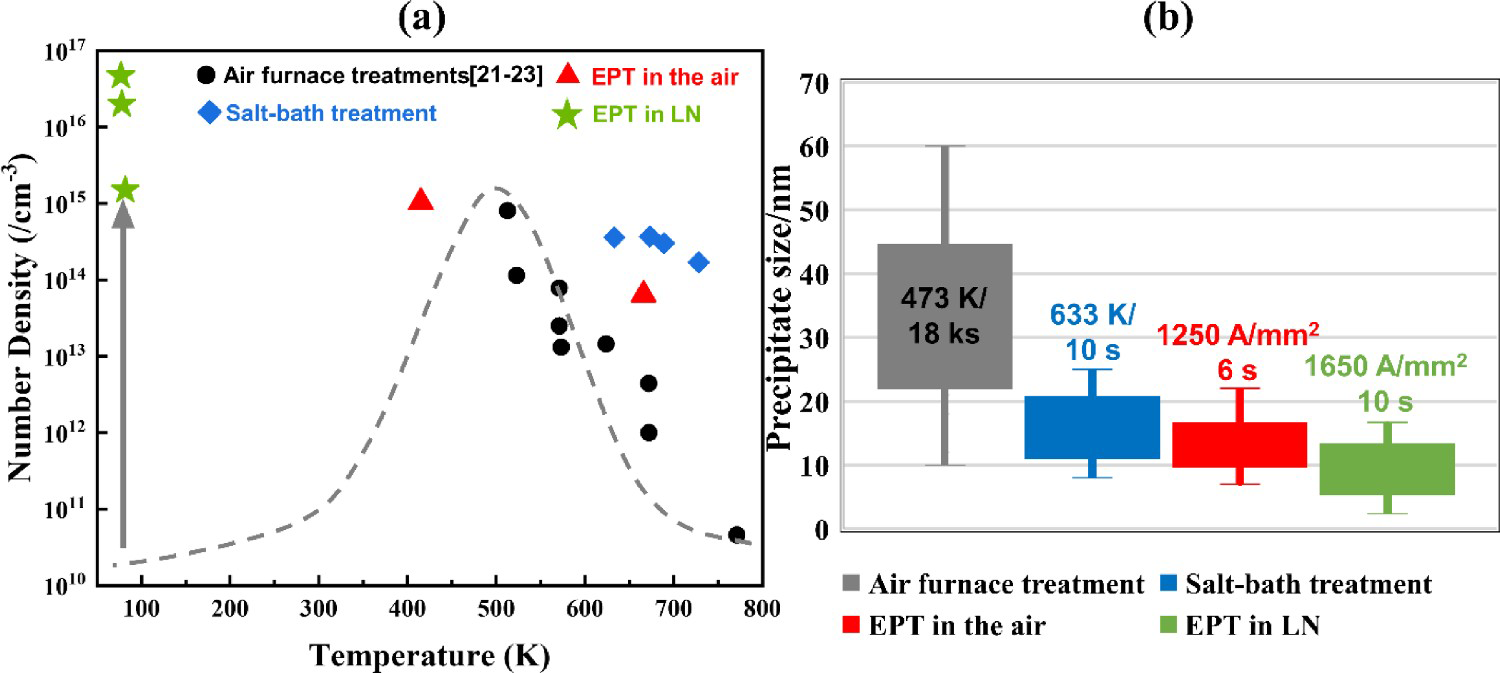
To control the precipitate size, conventional air furnace treatments with a relatively lower temperature at 473 K were frequently used [20,21,24], but a much longer treatment time (tens of hours) was needed. Figure 4 shows the lower density and larger fluctuations in size distribution of Si precipitates produced by the previous air furnace treatments [20,21,24], compared with the three treatments in this work. These results were not surprising, considering the low heating rate of air furnace treatment which could substantially reduce the quenched-in vacancy. In this regard, the high heating rate associated with EPT or SBT also contributes to the rapid precipitation in this work.
Discussion
The results above suggest that the ultra-low temperature is important for the dense distribution and fine size of the Si precipitates (EPT in LN vs. EPT in air/SBT), and that the non-thermal effect of EPT plays a crucial role in accelerating the precipitation process (EPT in air vs. SBT).
The contribution of the cryogenic environment to the dense distribution of the precipitates arises primarily from the preservation of quenched-in vacancies. According to the Arrhenius relation [25,26], the more than 10-min LN bath processing before applying EPT can maximally reserve the quenched-in excess vacancies produced during the rapid quenching due to inhibited diffusion at low temperature. The individual vacancies can increase the diffusion rate of Si precipitates, and small vacancy clusters can form and further may collapse into dislocation loops, which can provide potential heterogeneous nucleation sites [2]. Thereby the quenched-in vacancies significantly increase the density of Si precipitates [21,27,28]. However, only indirect evidence for the role of vacancies as heterogeneous nucleation sites was available [2] for limited resolution of individual vacancies or small clusters in experiments.
In addition, the increased stability of Si cluster in low-temperature environment also contributes to the dense distribution of fine Si precipitates. At a certain temperature, there exists a critical size of Si nuclei, below which the nuclei are very unstable (or even dissolve into the matrix) [3]. As the critical size generally decreases with decreasing temperature, more Si precipitates with small size and sufficient stability can be obtained. More importantly, the low temperature around 77 K maintained by the LN environment can significantly increase the driving force for nucleation, as discussed in Supplemental material.
When the quenched samples are bathed in LN, the low temperature can, on one hand, provide high nucleation driving force, but on the other hand, may extremely restrict the diffusion of vacancy and solute. For instance, no precipitation would occur at temperatures below room temperature [17] within short processing time such as several minutes. The optimised typical aging temperature for Al–1Si alloy is around 450–550 K (Figure 4(a)) [29], which is well above the LN temperature. Figure 1(a) also confirms that, if the current density of the applied EPT was not high enough in LN, no Si precipitation can be observed. Only when EPT was applied with higher current density, Figure 1(c–f) shows homogeneous nucleation of Si precipitation in the same LN environment. These results imply that the non-thermal effect of EPT must have played an indispensable role in overcoming the migration energy barrier.
The non-thermal effect of EPT can be understood from the selective heating effect [30]. Previous experiments [18,31] demonstrated that EPT at low temperatures can greatly promote the dislocation mobility in pure Al by selectively heating dislocation core [30] for its higher local electrical resistance [32,33]. Owing to the similar lattice distortion thereby higher electric resistivity around solutes, vacancies and their clusters [30,34], it is reasonable to infer that the EPT could similarly selectively heating Si solutes and vacancies. The measured negligible global temperature rise (<5 K) was indirect evidence for the selective heating effects that can promote the local vibration of the atoms around the solutes or vacancies. This non-thermal effects of EPT on vacancies or solutes can facilitate overcoming the atomic migration energy barrier, thus promoting local atomic migration and precipitate nucleation [2,17], which explains the higher density of precipitates observed in electric pulses-treated samples (Figure 4(a)).
The promoted local atomic migration at low temperature by the EPT's selective heating effects is as important as the high nucleation driving force provided by large undercooling. Because when nucleation free energy barrier was significantly reduced by undercooling, the nucleation rate at low temperature is dominated by the diffusion of vacancy and solute [2]. This explains no observed precipitation in Al–1Si alloy aged at room temperature (or below) [35] or processed by EPT with low current density (Figure 1(a)). But precipitation occurs in the same LN environment when processed by EPT with relatively higher current density (Figure 1(c–g)). These speculations were supported by the estimated nucleation rate and growth rate of Si precipitates (see Table S1 in supplementary material).
Admittedly, it is still difficult to apply the EPT technique in this work to ‘thicker’ bulk specimen, because the two requirements (the high-current density of EPT and the limited temperature rise) for the dense distribution and fine size of precipitate cannot be satisfied by the present electric generator and cooling techniques.
Conclusions
EPT at cryogenic temperatures (LN) was demonstrated to be efficient to obtain rapid and homogeneous precipitation of nano-sized Si particles in Al–1%Si alloy. By comparing the precipitation behaviours under EPT without cooling environment or high-temperature SBT, the primary mechanism for the homogeneous nano-precipitation was concluded to be the non-thermal effects of EPT with high-current density. The non-thermal effects of EPT greatly accelerate the diffusion kinetics, which was quantitatively estimated from the kinetics of precipitates growth and explained by the selective heating effect of EPT on vacancies and solutes. Meanwhile, the low-temperature environment significantly increases the precipitate density by providing a high driving force for nucleation and maximally reserving the quenched-in excess vacancies serve as potential nucleation sites. The combined non-thermal effects of EPT and low-temperature environment explain the rapid homogeneous precipitation of nano-sized Si particles. These results suggest that EPT at low temperatures can be used as an effective approach to tailor the precipitation behaviours in aluminium alloys, which can be hardly achieved by other conventional treatments or the EPT-assisted thermal treatments.
Footnotes
Acknowledgements
This work is supported by the National Science Foundation of China (NSFC) under Project No. 51671132 and 51801122, and the Science Challenge Project No.TZ2018001.
Disclosure statement
No potential conflict of interest was reported by the author(s).