






Abstract
In this study, the Mo–Si–B alloys containing 10–30 wt% Ti were prepared by spark plasma sintering. The dry sliding tribological properties against Al2O3 ceramic and AISI 52100 steel were thoroughly investigated, and the corresponding wear mechanism was explored. The results indicate that the tribological properties of the MoSiBTi alloys are highly dependent on the Ti content and property of counterpart materials. The dominant wear mechanism of the MoSiBTi alloys sliding against Al2O3 ceramic is severe abrasive and adhesive wear and it transforms to mild abrasive and adhesive wear when coupled with AISI 52100 steel. It confirms that the MoSiBTi/AISI 52100 steel friction pairs show more preferable wear resistance, which is more suitable for room temperature tribological applications.
Introduction
The design and preparation of new materials with excellent comprehensive properties (high strength, hardness, ductility, toughness, corrosion, oxidation, creep and wear resistance, etc.) is a long-existing concern for materials science and engineering [1–3]. Increasing requirements have motivated researchers to develop innovative materials with favourable performance [4]. In the search for new alloys, multiphase Mo–Si–B (α-Mo–Mo3Si–Mo5SiB2) alloys exhibit high strength, good toughness and excellent high-temperature oxidation resistance; thus, they are intended to replace Ni alloys [5–7]. In this alloy system, the Mo3Si and Mo5SiB2 intermetallic with high strength and high stability determine their high-temperature strength and oxidation resistance, and the α-Mo matrix guarantees its fracture toughness and ductility. Therefore, Mo–Si–B alloys display bright prospects for high-temperature structural applications and have attracted considerable research interest [8].
During the past decades, considerable efforts have been made to optimise the chemical compositions of Mo–Si–B alloys, and the results indicate that Mo–12Si–8.5B (at.%) alloys possess excellent mechanical properties [9–11]. Moreover, significant improvements have been further achieved mainly by reduction in impurity concentration and grain sizes [12] through micro/macro alloying of Ti [13], Zr [14] and Fe [15] and introduction of second phases such as TiC [16], SiC [17], ZrB2 [18] and rare earth oxide [19]. Their effects on the phase and microstructure evolution, mechanical properties and high-temperature oxidation resistance have been systematically investigated.
However, the anti-wear properties of Mo–Si–B alloys have seldom been considered, and studies on their friction and wear behaviour are quite scarce. The studies [20–22] show that Mo–Si–B alloys exhibit good tribological properties in the temperature range of 600–1000°C due to the self-lubricated MoO3 films. However, they show a much higher friction coefficient and wear rate below 600°C. Li et al. [21] compared the friction and wear properties of Mo–Si–B-based alloys with different chemical compositions under an applied load of 1.96–10.78 N at room temperature. The results indicate that all the Mo–Si–B-based alloys show a high friction coefficient and poor wear resistance. The friction coefficient is as high as 0.75–2.12, and the wear rate of these alloys reaches (2.5–20) × 10−4 mm3 N−1 m−1. It is well known that for engineering applications, the friction and wear of structural components under certain working conditions is inevitable, and excellent anti-wear properties are needed [23]. In this regard, the study of the tribological performance and wear mechanism of Mo–Si–B alloys is essential for further optimisation of their compositions and extending their industrial application. In addition, one drawback still existing in Mo–Si–B alloys is their higher density than Ni-based superalloys [24]. As proven by previous studies, the addition of a high level of Ti not only reduces the density since the density of pure Ti (4.51 g cm−³) is just 44% of pure Mo (10.22 g cm−³), but also enhance the oxidation resistance at intermediate temperatures and fracture toughness of Mo–Si–B alloys by solid strengthening in both Mo and silicide phases [25–27]. And the effects of Ti contents on the evolution of microstructure, high-temperature oxidation and creep behaviour are systemically studied. Nevertheless, the effects of Ti contents on the tribological behaviour of the Mo–Si–B alloy have not been well studied.
Therefore, Mo–4.2Si–1.2B (wt%) alloys containing 10–30 wt% Ti were fabricated by spark plasma sintering (SPS), dry sliding tribological performance of the alloys with varied Ti contents were investigated, and the wear mechanism was deeply explored.
Experimental procedures
Material preparation and microstructural characterisation
The Mo–4.2Si–1.2B (wt%) alloy powder was firstly weighted from Mo (300 mesh), Si (200 mesh) and B (300 mesh) elemental powders, and 1 wt% CeO2 was also added. Then the powder mixture was ball milled by a Fritsch Pulverisette 5 type high-energy planetary ball mill. The mechanical alloying was conducted at a ball-to-powder weight ratio of 3:1 for 16 h under argon atmosphere. After that, the Ti powder (300 mesh) with different weight percent (10%, 20% and 30%) was weighted and mixed with the mechanical-alloyed Mo–4.2Si–1.2B alloy powder by a low-energy ball mill. The selected ball-to-powder weight ratio was 1:1 and the milling time was 8 h. Finally, the Mo–4.2Si–1.2B–xTi (x = 10 wt %, 20 wt % and 30 wt %) alloy (denoted as 10Ti, 20Ti and 30Ti, respectively) was fabricated by spark plasma sintering process. The selected sintering temperature was 1450–1500°C with a heating rate of 110–130°C min−1, the applied sintering stress was 30 MPa, and the duration time was 5 min. The fabrication details are presented in [28]. After the sintering process, the sintered samples were cut to the desired sizes and then ground and polished for subsequent tests. The phases of the sintered alloys were identified by an X-ray diffractometer (XRD, Panalytical X'pert PRO) with Cu Kα radiation in the 2θ range between 20° and 90°. The polished alloys and that etched with Murakami's reagent (an aqueous solution with 10% K3[Fe(CN)6] and 5% NaOH) were analysed by a scanning electron microscope (SEM, JSM5600LV) equipped with a backscattered electron detector. And the chemical compositions were analysed by an energy-dispersive spectroscopy (EDS).
Mechanical properties measurement
The density of the polished samples was measured by Archimedes principle. The hardness of the prepared samples was tested by a Vickers hardness tester at 10 N for 5 s. At least five measurements were conducted and the mean hardness was given. The mechanical properties of compressive strength, flexural strength and fracture toughness were assessed on a WDW-200 universal material testing machine. The tests were conducted according to ASTM E9, ASTM E290 and ASTM E399 standard, respectively. Samples with dimensions of Φ3 × 6 mm3 were subjected to compression tests at a cross-head speed of 0.1 mm min−1. The samples with a dimension of 3 × 3 × 30 mm3 and 3 × 4 × 30 mm3 (with an edge notch at the centre of the specimen in a width of 0.2 mm and a depth of 2 mm) was measured by three-point bending tests with a span of 20 mm at a cross-head speed of 0.05 mm min−1. The fracture toughness (KQ, MPam1/2) was calculated by the following formula:
Friction and wear analysis
Dry sliding tribological properties were assessed by a rotational ball-on-disk tribometer (HT-1000) with a normal load of 5 N, a rotating speed of 360 r min−1, a rotating diameter of 10 mm, and a duration time of 30 min. Commercially available Al2O3 ceramic and AISI 52100 steel balls were used as matched ball specimens. The AISI 52100 steel ball was chosen because that it is widely used as counterpart for metals and metal matrix composites. The Al2O3 ceramic ball was selected for that it has a high hardness and chemical stability and thus it can avoid ball wear when mated metals. The diameter of the matched ball was 6.0 mm, and the hardness of the Al2O3 ceramic and AISI 52100 steel was 16.5 GPa and 63 HRC, respectively. The friction coefficient was measured and reported by the software. The wear rate was determined by the wear volume divided by the sliding distance and applied load. The wear volume was measured by a MicroXAM-800 surface profiler. The values of the friction coefficient and wear rate were given by three repeated tests. After the sliding test, the morphologies, elemental mappings and corresponding chemical contents of the worn scars of the alloys and counterpart balls were characterised and analysed by SEM equipped with EDS. The hardness of the tribolayer on the worn surface was measured with a load of 300 g and a dwell time of 5 s.
Results and discussion
Phase and microstructure
The XRD patterns of the MoSiBTi alloys with different contents of Ti are shown in Figure 1. Figure 1(a) shows that the MoSiBTi alloys are mainly composed of α-Mo, Mo3Si, Mo5SiB2 and Ti phases. Different from that produced by arc melting, Ti5Si3 phase is not formed during spark plasma sintering process and Ti phase is existed in the alloys [25–27]. Moreover, it has been proven that Ti has a high solubility in the α-Mo, Mo3Si and Mo5SiB2 phases [13,25,29]; thus, the position deflection in these diffraction peaks can be easily found in the XRD patterns shown in Figure 1. This can be further observed by the magnified XRD patterns from 30 to 50 degrees shown in Figure 1(b). It is clear that the positions of the strongest diffraction peaks of α-Mo move to a lower angle, which indicates the diffusion of Ti into the α-Mo solid solution, thus leading to an increase in the lattice parameter. This phenomenon can also be found in the Mo3Si phase and Mo5SiB2 phase.
XRD patterns of the MoSiBTi alloys.
The backscattered SEM images of the MoSiBTi alloys are shown in Figure 2. As can be seen from Figure 2(a–c) that dark Ti phase particles are uniformly dispersed in the Mo–Si–B alloy matrix, where the Ti phase is confirmed by the EDS result shown in Figure 2(e). Moreover, it is clear that the addition of Ti can affect the morphology of Ti phase. As the Ti content increases from 10 to 30 wt%, the microstructure of the Ti phase changes from polygonal grains to elongated structures. Additionally, the size of the Ti phase becomes increasingly finer with a high content of Ti. This is due to that Ti has a much lower melting point (1668°C) than that of MoSiB alloys, and thereby the addition of Ti can significantly reduce the melting point of MoSiBTi alloys. For this reason, the selected sintering temperature for MoSiBTi alloys is in the range of 1450–1500°C and the sintering temperature decreases with the increasing Ti content. Thus, the grain size refining is mainly ascribed to the decreasing sintering temperature inhabits the growth rate of Ti phase. At the meantime, more content of Ti content also contributes to more nucleation sites, and results in a decrease in the grain sizes. In addition, the microstructure of the etched Ti10 alloy was characterised and presented in Figure 2(d). Corresponding to the previous reference, the bright, light grey and dark grey areas are α-Mo, Mo3Si and Mo5SiB2 phases, respectively [30]. And dark areas are confirmed to be Ti phase, which are clearly marked in the SEM image.
Backscattered SEM images of the MoSiBTi alloys: (a) polished Ti10, (b) polished Ti20, (c) polished Ti30, (d) etched Ti10 and (e) EDS result of Ti phase.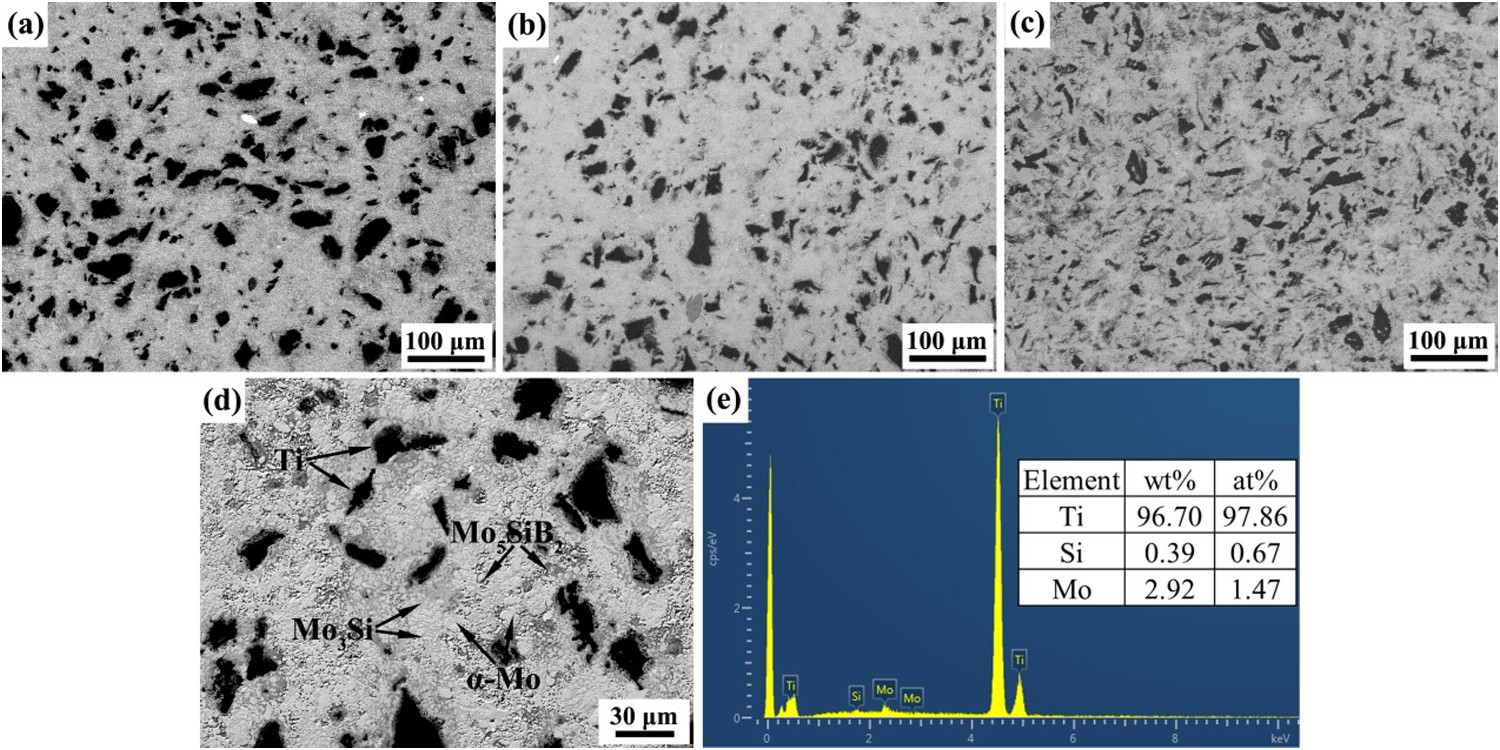
Mechanical properties
Figure 3 illustrates the mechanical properties of the MoSiBTi alloys with different contents of Ti. The density for Ti10, Ti20 and Ti30 alloy is 8.48, 7.81 and 7.25 g cm−3, respectively. This proves that Ti addition is efficient in reducing the density due to its much lower density (4.51 g cm−3). Meanwhile, the addition of Ti is detrimental to the hardness, compressive strength, flexural strength and fracture toughness of the MoSiBTi alloys, and the values drops gradually with an increase in Ti content. Moreover, according to the compressive stress–strain curves and flexural stress-deflection curves depicted in Figure 3(c,d), the MoSiBTi alloys show a typical brittle fracture, and increasing Ti content leads to a decrease both in the strength and plasticity. The reduction in hardness, strength, plasticity and fracture toughness in the MoSiBTi alloys can be explained as follows: Ti possesses a lower hardness and strength than Mo, and the addition of Ti leads to a decreased amount of ductile α-Mo phase and a non-uniform dispersion in the α-Mo matrix; at the same time, the macroalloying of Ti causes a high solubility in the Mo-containing phases of α-Mo, Mo3Si and Mo5SiB2; thus, these effects constrain the deformation ability of the α-Mo matrix and result in the deterioration of the strength and toughness [31]. However, it should be pointed out that the flexural strength of the prepared MoSiBTi alloys in the current work is slightly higher than that of the Mo–12Si–8.5B alloy (376–412 MPa) [10] and Mo–14Si–10B alloy (404 MPa) [31] produced by the powder metallurgical technique. Moreover, their fracture toughness is comparable to that of Mo–14Si–10B–xAl (x = 0, 3, 7.3) alloys (5.0–6.6 MPam1/2) [31].
(a) Density, (b) hardness, (c) compressive stress-strain curves, (d) flexural stress-deflection curves, (e) compressive strength and specific compressive strength and (f) flexural strength and fracture toughness of the MoSiBTi alloys with different contents of Ti.
The fracture micrographs of the MoSiBTi alloys after the flexural tests are shown in Figure 4. The fracture micrographs indicate that the MoSiBTi alloys show a mixed-mode fracture of transgranular fracture and intergranular failure. In these alloys, owing to the high content and intrinsic brittleness of the Mo3Si and Mo5SiB2 phases, intergranular failure occurs in these intermetallics, which exhibits a typical characteristic of cleavage fracture with featureless facets. However, the α-Mo matrix acts as a ductile phase and shows a typical feature of transgranular fracture in α-Mo grains, which is characterised by cleavage planes on the surface. Meanwhile, some α-Mo grains are pulled out during the deformation process, leaving a rough fracture surface [12,32]. As the addition of Ti leads to a decreasing content of ductile α-Mo, the MoSiBTi alloys show a higher occurrence of intergranular fracture, which is responsible for the deterioration of the strength and toughness.
Fracture micrographs of the MoSiBTi alloys: (a) Ti10, (b) Ti20 and (c) Ti30.
Friction and wear behaviour
The profiles of the frictional curves and friction coefficient of the MoSiBTi alloys sliding against different counterparts are depicted in Figures 5 and 6. After a short duration of running-in time, the MoSiBTi alloys show a relatively stable friction coefficient with sliding time. And it is visible that the average friction coefficient shows a downward trend with increased Ti content for both counterparts, while it shows a slightly higher friction coefficient against the steel counterpart in comparison with that against Al2O3 ceramic. The main reason is that, when mated Al2O3 ball, the ball wear is not occurred, and the adhesion wear is in the form of MoSiBTi alloys adhering to the counterpart balls. Meanwhile, when coupled with AISI 52100 steel, cold welding is taken place between the counterpart surfaces, and the material transfer is occurred both on the MoSiBTi alloys and AISI 52100 steel, thus the higher tearing force lead to a higher friction coefficient. As it can be observed, with increasing Ti content, the friction coefficient decreases from 1.03 to 0.67 when coupled with Al2O3 ceramic, which is 1.11–0.77 for the AISI 52100 steel counterpart.
Typical profiles of frictional curves of the MoSiBTi alloys sliding against different counterparts. Friction coefficient of the MoSiBTi alloys sliding against different counterparts.

Figure 7 shows the wear rate of the MoSiBTi alloys sliding against different counterparts. When coupled with Al2O3 ceramic, the wear rate of the MoSiBTi alloys shows a remarkable increment with the increase in Ti content, which is 3.67 × 10⁻⁵ mm3 N−1 m−1, 1.12 × 10⁻⁴ mm3 N−1 m−1 and 1.19 × 10⁻³ mm3 N−1m−1 for Ti10, Ti20 and Ti30 alloy, respectively. And that for MoSiB alloy is 2.40 × 10⁻⁵ mm3 N−1 m−1, suggesting that a lower content of Ti addition does not obviously damage the wear rate, while it drops markedly with more addition. This is mainly due to that Ti addition decreases the hardness, strength and plasticity of the MoSiBTi alloys, and thus more severe damage is occurred on the MoSiBTi alloys during dry sliding process. However, the wear rate exhibits a completely opposite trend against AISI 52100 steel, which decreases gradually in the magnitude of 10−7–10−6 mm3 N−1 m−1. The wear rates for the Ti10, Ti20 and Ti30 alloys are 1.08 × 10⁻⁶ mm3 N−1 m−1, 8.47 × 10⁻⁷ mm3 N−1 m−1 and 7.11 × 10⁻⁷ mm3 N−1m−1, respectively. The results indicate that the MoSiBTi/AISI 52100 steel friction pairs display better tribological properties than the MoSiBTi/Al2O3 ceramic friction pairs, and the wear resistance of MoSiBTi alloys is greater when sliding against AISI 52100 steel than that against Al2O3 ceramic. This can be ascribed to hardness of the MoSiBTi alloys is comparable to that of the AISI 52100 steel, and the plowing damage and severe plastic deformation is much slighter than that coupled with Al2O3 ceramic, thus the alloys shows a better wear resistance. Moreover, it is found that wear rate of MoSiB alloy is 9.17 × 10⁻⁷ mm3 N−1 m−1, indicating that there is no obvious change in the wear rate when sliding against AISI 52100 steel, which will be discussed later.
Wear rate of the MoSiBTi alloys sliding against different counterparts.
Figure 8 shows SEM images and EDS mappings of the MoSiBTi alloys after sliding against Al2O3 ceramic. The corresponding counterparts are shown in Figure 9. From the macroscopic SEM images of the wear scars (Figure 8(a1–c1)), the width and depth of the MoSiBTi alloys increase substantially with increasing Ti content. This phenomenon is in good agreement with the morphologies of the coupled Al2O3 counterparts (Figure 9(a1–c1)), which is closely correlated to the decreased hardness and strength of the MoSiBTi alloys with increasing Ti content. Moreover, it can also be observed that the MoSiBTi alloys experience severe plastic deformation, and the worn surface shows large and continuous plowing grooves along the sliding direction, which is a typical characteristic produced by two-body abrasion wear. This is because the Al2O3 ceramic has a much higher hardness than the MoSiBTi alloys; once the hard abrasive particles intrude into the ductile metal matrix, severe plastic deformation and plowing are inevitable [33]. The decreased hardness and strength of MoSiBTi alloys leads to more severe plastic deformation and plowing on the wear tracks, and thus results in an increased wear loss. Observing the worn surfaces shown in Figure 8(a2–c2), there is a high amount of wear debris scattered on the surfaces. By analysing the results of the elemental mappings shown in Figure 9(a3–c3) and the chemical compositions of the worn surfaces given in Table 1, it can be identified that a high level of oxygen exists on the worn surfaces; this confirms that the tribo-oxidation process occurs during the sliding process [34]. And the hardness of the tribolayer on the MoSiBTi alloys after sliding test was conducted and depicted in Figure 10. Compared with the MoSiBTi alloys, the tribolayer shows a much higher hardness, which can provide a supporting role on the counterfaces and reduce the real contact between the counterparts, and thus it results in a decrease in the wear rate [35]. In accordance with the hardness of the MoSiBTi alloys, the hardness of the tribolayer is also decreased with increasing Ti content. To further explore its wear mechanism, the SEM image of the collected wear debris of Ti30 alloy after sliding against Al2O3 ceramic is given in Figure 11. It was found that the wear debris is a few microns, which is consistent with the wear debris morphology shown in Figure 8(c2). This result suggests that the fine wear debris is mainly produced by severe plastic deformation and tribo-oxidation [36]. In addition, by observing the worn surfaces of the Al2O3 ceramic, as shown in Figure 9, it can be seen that the surface is covered by relative sense tribolayer. And by the EDS analysis, the main element is Mo, Ti and O, indicating that the MoSiBTi alloys is grinded, oxidised, mixed and adhered to the counterpart balls, which proves the bulk metal transfer occurred by adhesion wear during the sliding process. Therefore, severe abrasive and adhesive wear dominates when sliding against Al2O3 ceramic.
SEM images and EDS mappings of the MoSiBTi alloys after sliding against Al2O3 ceramic: (a) Ti10, (b) Ti20 and (c) Ti30. SEM images and EDS mappings of the Al2O3 counterpart after sliding against (a) Ti10, (b) Ti20 and (c) Ti30. Hardness of the worn surface the MoSiBTi alloys after sliding against different counterparts. SEM image and EDS mappings of the wear debris of Ti30 alloy when sliding against Al2O3 ceramic. EDS results (at%) of the worn surfaces of the MoSiBTi alloys after sliding against different counterparts.


The SEM images and EDS mappings of the MoSiBTi alloys after sliding against AISI 52100 steel are shown in Figure 12, and the corresponding steel counterparts are shown in Figure 13. Compared with MoSiBTi/Al2O3 ceramic friction pairs, the MoSiBTi alloys show a much slighter wear when coupled with AISI 52100 steel. The significantly reduced damage on the worn surface results in a remarkable decline in the wear rate. Observing the wear scars at low magnification (Figure 12(a1–c1)), plastic deformation cannot be detected on the worn surfaces, and the widths of the MoSiBTi alloys decrease slightly with increasing Ti content; thus, the wear rate slightly decreases gradually. By observing the worn surfaces shown in Figure 12(a2–c2), no wear debris can be found on the worn surfaces compared to that sliding against the Al2O3 ceramic. The presence of Fe is proven by the elemental mappings shown in Figure 12(a3–c3) and the chemical compositions of the worn surfaces given in Table 1, indicating that part of the AISI 52100 steel adhered to the surfaces of the MoSiBTi alloys. This is because the hardness of the MoSiBTi alloys is comparable to that of the AISI 52100 steel, and no severe plowing and plastic deformation take place. According to the hardness of tribolayer shown in Figure 10, the hardness is slighter higher than that after sliding against Al2O3 ceramic, thus it enhance the supporting role and contribute to the decreased wear rate. As the MoSiBTi alloys/AISI 52100 steel friction pairs have higher chemical compatibility, the transfer of metal elements is commonly recognised to occur during the sliding process, which can be proven by the wear scars of steel balls shown in Figure 13(a1–c1). The mated balls are ground off and leave obvious planes on the surfaces. Further analysis of the worn surfaces and the corresponding elemental mappings are shown in Figure 13(a2–c2) and Figure 13(a3–c3). Some of the MoSiBTi alloys adhered to the AISI 52100 steel balls. Thus, the main wear mechanism of the MoSiBTi/AISI 52100 steel friction pairs is mild abrasive and adhesive wear. Although adhesive wear is existed both on the MoSiBTi/AISI 52100 steel and MoSiBTi/Al2O3 ceramic friction pairs, while it has quite different characteristics. When sliding against Al2O3 ceramic, the ball wear is not occurred on the mated Al2O3 ball, and the adhesion wear is in the form of MoSiBTi alloys adhered to the counterpart balls. However, when sliding against AISI 52100 steel, the cold welding is taken place between the MoSiBTi alloys and AISI 52100 steel, and the material transfer is appeared both on the MoSiBTi alloys and AISI 52100 steel, and thus the friction coefficient caused by adhesive wear is much higher than that sliding against Al2O3 ceramic.
SEM images and EDS mappings of the MoSiBTi alloys after sliding against AISI 52100 steel: (a) Ti10, (b) Ti20 and (c) Ti30. SEM images and EDS mappings of the AISI 52100 steel counterpart after sliding against (a) Ti10, (b) Ti20 and (c) Ti30.

In summary, the tribological behaviour of the MoSiBTi alloys is highly dependent on the Ti content and mated balls, which is closely correlated to the mechanical properties of the MoSiBTi alloys, property of counterpart balls and the difference in the wear mechanism. According to the results conducted on the mechanical properties of the MoSiBTi alloys shown in Figure 3, the mechanical properties such as hardness, strength, fracture and plasticity toughness decreases with an increase in Ti content, which greatly influences the wear resistance of MoSiBTi alloys. Additionally, the property of counterpart balls also has a significant impact on the friction and wear behaviour of MoSiBTi alloys. The Al2O3 ceramic shows a high hardness of 16.5 GPa (equals to 1683 HV), which plays a vital role on the plowing effect and meantime leads to severe plastic deformation during the sliding process, while it can avoid ball wear when mated with the MoSiBTi alloys. However, owing to lower hardness of AISI 52100 steel (63 HRC, equals to 795 HV), the plowing is much slighter and severe plastic deformation and ball wear are inevitable, and meantime cold welding can occur due to the higher chemical compatibility between the counterparts. Therefore, in the current test conditions, as Al2O3 ceramic has a much higher hardness than the MoSiBTi alloys, severe plastic deformation and plowing take place on the MoSiBTi alloys, and the resistance is closely related to the hardness and strength of the MoSiBTi alloys. And the decreased fracture toughness further increases the degree of brittle fracture that act on the wear loss, thus the wear rate is mainly determined by the mechanical properties of the MoSiBTi alloys. In this condition, it can be found that the wear loss (V) of MoSiBTi alloys shows negative proportion to the hardness (H), which is in concordance with Archard's equation (V = KLP/H, where L is the sliding distance, P is the applied load), and the decrease in hardness increases the wear loss and wear rate [37]. Therefore, a lower hardness results in a lower resistance to abrasive wear, and Ti addition deteriorates the anti-wear resistance of the MoSiBTi alloys. As for the friction coefficient, it is also mainly caused by the abrasive wear and thereby it decreases with decrement in hardness. When sliding against AISI 52100 steel, as the hardness of the MoSiBTi alloys is comparable to that of the steel, much milder abrasive and adhesive wear occurs, and no severe plowing and plastic deformation take place, and thus adhesive wear plays a dominant role on the friction and wear behaviour. However, there is an obvious difference in the form of adhesive wear for the MoSiBTi/AISI 52100 steel and MoSiBTi/Al2O3 ceramic friction pairs, which plays a vital role on the friction coefficient and wear rate. When sliding against Al2O3 ceramic, the adhesion wear occurs in the form of MoSiBTi alloys adhering to the counterpart balls. However, the cold welding is taken place on the counterfaces when mated AISI 52100 steel and the material transfer is appeared both on the MoSiBTi alloys and AISI 52100 steel, thus the friction coefficient caused by adhesive wear is much higher than that sliding against Al2O3 ceramic. In this case, the deterioration of mechanical properties of the MoSiBTi alloys on the wear rate is not as significant as that mated with Al2O3 ceramic. Owing to the occurrence of tribo-oxidation during the sliding process and formation of hard tribolayer on the worn surface, there is an obvious supporting role in reducing the wear rate. As shown in Figure 10, the tribolayer hardness is slighter higher than the MoSiBTi alloys and that after sliding against Al2O3 ceramic, thus it enhance the strengthening role and contribute to the decreased wear rate. Consequently, the much slighter wear and formation of hard tribolayer contribute to a much lower wear rate than that sliding against Al2O3 ceramic. However, there is no obvious difference in the wear rate with increasing Ti content. The decrease in the wear rate may be ascribed to the decreased difference in the hardness between the MoSiBTi alloys and AISI 52100 steel decreases. And the decreased friction coefficient can be ascribed to the weakened degree of adhesion that is related to the decrement in the hardness of tribolayer. Based on the above results, the MoSiBTi/AISI 52100 steel friction pairs display better tribological properties than the MoSiBTi/Al2O3 ceramic friction pairs, and the wear resistance of MoSiBTi alloys is more preferable against AISI 52100 steel than against Al2O3 ceramic.
Conclusions
MoSiBTi alloys with different amounts of Ti addition (10, 20 and 30 wt%) were prepared, the effects of Ti contents and counterpart materials on the friction and wear properties were systematically studied, and the corresponding mechanism was revealed. The conclusions are given as follows:
The MoSiBTi alloys are composed of α-Mo, Mo3Si, Mo5SiB2 and Ti phases. Macro-alloying of Ti results in a solid solution of Ti in these Mo-containing phases, while the excessive Ti particles are uniformly dispersed in the α-Mo matrix. With an increase in Ti content, the microstructure of Ti particles transforms from large polygonal grains to a fine elongated structure. The friction and wear properties of the MoSiBTi alloys are greatly influenced by the Ti content and counterparts. With the increase in Ti content, the friction coefficient decreases for both counterparts, and the wear resistance increases gradually for MoSiBTi/AISI 52100 steel, while it decreases substantially when coupled with Al2O3 ceramic. The MoSiBTi alloys show a higher friction coefficient while a much slighter wear rate (10−7–10−6mm3 N−1 m−1) when sliding against AISI 52100 steel than that against Al2O3 ceramic. The slighter higher friction coefficient is mainly ascribed to the cold welding between the MoSiBTi alloys and AISI 52100 steel. And the higher wear resistance is related to the much slighter wear and formation of hard tribolayer. The dominant wear mechanism of the MoSiBTi alloys is severe abrasive and adhesive wear when sliding against Al2O3 ceramic, and it transforms to mild abrasive and adhesive wear when coupled with AISI 52100 steel. Under the current test conditions, the MoSiBTi/AISI 52100 steel friction pairs are more suitable for tribological applications due to its preferable wear resistance.
Footnotes
Disclosure statement
No potential conflict of interest was reported by the author(s).