







Abstract
Theoretical aspects of kinetics and transport phenomena during the hillocks formation and growth in thin Al films are discussed. Following the suggested methodology, the conceptual relationship of step by step linear and/or parabolic law for hillock volume changes ΔV with time t:

Finally, using the experimental measurements from S. J. Hwang, Y. D. Lee, Y. B. Park, J. H. Lee, C. O. Jeong, and Y. C. Joo: Scripta Mater., 2006, 54, 1841–1846, illustrative calculation results of the proposed concept are presented.
Introduction
Aluminium films, mainly deposited by physical vapour deposition process, are frequently used in the semiconductor industry as interconnection layers. 1
Formation of hillocks in Al-based films is one of the major problems in manufacturing multilevel networks in silicon integrated circuit technologies. Hillock is an extrusion of film material extracted out of grains or grain boundaries in a process of relieving the compressive stress resulting from a mismatch in thermal expansion coefficients between A1 and the substrate. Hillocks can penetrate through the interconnections of LCDs, see e.g. 2 leading to electrical shorts and potential failure mechanism.
It is generally accepted that hillock growth is related to diffusion and plastic flow.3-9 Chaudhari, 3 Iwamura et al. 4 and Kim et al. 5 have demonstrated that hillocking is controlled by interface diffusion, grain boundary diffusion and creep-controlled diffusion, respectively. Hwang et al.7,8 have provided strong influence of plastic deformation in the thin Al film. In that sense, a model for plastic deformation – power law creep – controlled hillock growth was developed by Berla et al.9
Much effort was expended into the understanding of the mechanism of the hillock nucleation and growth. A number of different hillock height and/or volume versus time relationships have been observed experimentally for hillock growth. In spite of the lot of experimental work and various models, which have been applied, the understanding of hillock nucleation and growth is still far from satisfactory. Although it is possible to derive one or more time laws on the basis of any of suggested mechanisms, the question of which one applies in a particular case is still wide open. Owing to these reasons, two main theoretical approaches are presented and discussed. The first one, a microstructural approach, is based on grain kinetics, while the second, a transport phenomenon approach, follows diffusional and/or plastic flow descriptions.
However, the purpose of this paper is not to develop a completely new routine, but rather to highlight the information that lies in the variation of the slope of the hillock volume changes coupled with time.
Microstructural approach
Generally, the microstructural approach to the kinetics of formation (nucleation) and growth has been the subject of much interest for years.10-15 The earliest efforts to model the isothermal nucleation and growth processes by Fraenkel and Goez, Goler and Sachs, Tarnman, Austin and Rickett had a big disadvantage. They did not take into account the impingements of the new growing contiguous grains. It was the work of Kolmogorov, Johnson and Mehl, and especially Avrami (KJMA)12-14 that led to the development of the first kinetic theory where the impingement factor was taken into account. The method was based on an abstraction called the extended volume concept. This concept was important because, if the grains of the new phase (here potential hillocks) are distributed randomly throughout the volume in a statistical manner, then there is a simple mathematical relationship between real volume fraction transformed and the extended volume fraction transformed. The extended volume concept was discussed and applied extensively by Avrami, who examined several different transformation models. The suggested general expression is known as the Avrami equation, usually referred as the KJMA equation.
The experimental data are not always described by the KJMA equation because of physically unrealistic values of the time exponent (n), equation (1). With time, this has led to the development of new modelling techniques based on discrete lattice Monte Carlo computations or cellular automata schemes. 15 Also, extensions of the KJMA approach were algorithms that treat impingement using Wigner–Seitz cells. These simulation models directly compared the experiment and the microstructural path methodology (MPM). Each of the modelling approaches noted above has strengths and weaknesses. 15
In this light, it is useful to consider the work 16 that presents a modified curvature method for residual thermal stress estimation in coating/substrate.
Hillocks formation and growth can be imagined as some kind of ‘recrystallization’ or reconstruction of grain structure during annealing of deformed metals. Generation and motion of high-angle grain boundaries concurrently removes the deformed microstructures (i.e. see in Gottstein 11 SIBM: grain-induced grain boundary motion). Some considerations of hillock growth dynamics via coupled localised Coble creep, grain boundary sliding, and shear induced grain boundary migration are given in.17-19
In that sense, starting from KJMA equation and MPM,
15
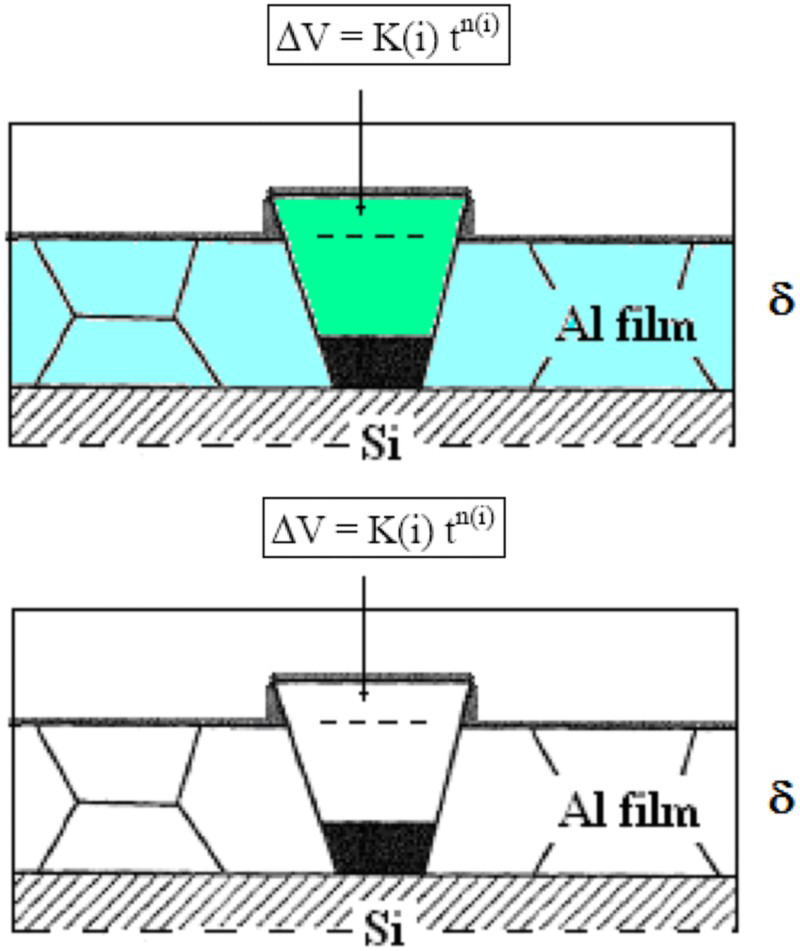
the following equation for hillock volume changes ΔV in time t (see Fig. 1) is suggested:
Microstructural approach of the hillock formation and growth; ΔV hillock volume changes, t time, δ thickness of the Al film, K(i) and n(i) constants for appropriate time sequence (i).
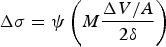
From optical and SEM micrographs of the Al surface, the magnitude of the stress relief by hillock formation can be estimated using
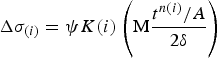
From equations (1) and (2) it is obtained:
The time exponent, n, is a useful parameter, which provides a semiquantitative description of the isothermal transformation kinetics. This parameter is independent of temperature, provided the reaction mechanism does not change over the range of conditions encountered. The n values have been used to predict conditions and morphologies of particular phase changes.
Transport phenomena of hillock growth
Hillock formation (nucleation) and growth is the complex phenomena involving:
Internal transport
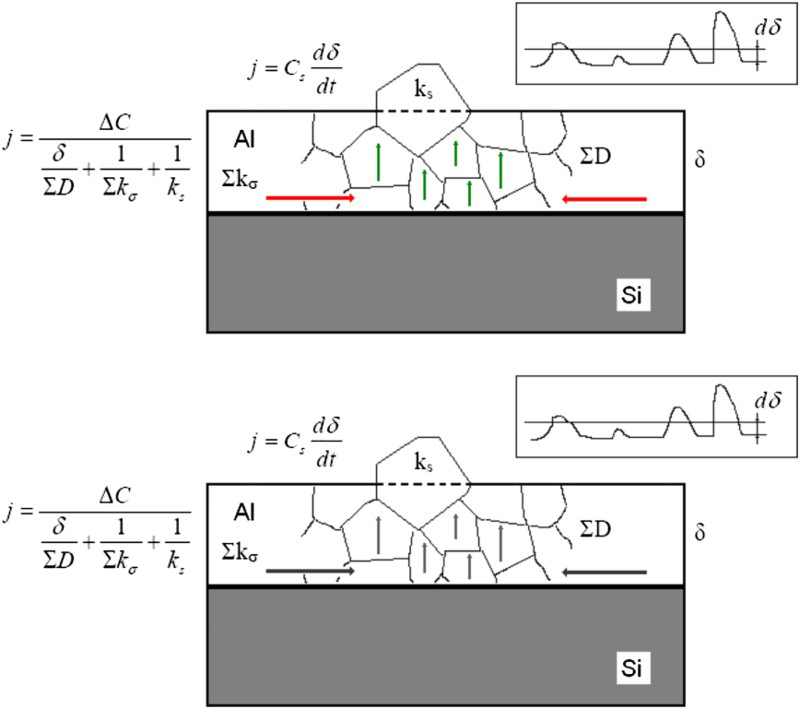
In order to illustrate the role of the internal transport phenomena during hillock forming, a relative simple situation will be considered, with the self-diffusion of Al atoms through the Al film, internal stress rate and surface permeability (Fig. 2). In other words, it is a typical steady state process of uniform mass flux from the bulk to the surface
20
with the overall potential ΔC = (Cs − Cb):
Transport phenomena of the hillock formation and growth: general overview. Uniform mass flux j from the bulk to the surface (↑) with the overall potential ΔC = (Cs − Cb), Cs surface concentration on the Al film; Cb bulk concentration in the Al film, δ film thickness, ΣD overall diffusion coefficient of Al in the Al film, ∑kσ
overall plasticity rate constant of the Al film, and ks
surface permeability rate constant.
External transport
On the other hand, the mass flux of adding atoms of Al from the film surface into the hillock is:

Finally there is:
Diffusion-controlled hillock growth
ΣD = ƒ(lattice diffusion, grain boundary diffusion, interface diffusion) and
Plasticity controlled hillock growth
Σkσ
= ƒ(dislocation glide, dislocation climb, diffusional creep, Harper–Dorn creep, twinning and grain boundary sliding) and
Film surface permeability controlled hillock growth
ks
is the surface permeability rate constant, and


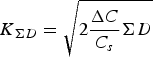

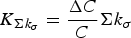

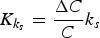
Note: Unfortunately, all mixed combinations are possible.
Hillock growth as unsteady state laminar phenomena
The mathematical model of the hillock formation and growth as unsteady state transport phenomena is based on the simplified laminar boundary layer approach (unsteady state non flow situation).21,22 The boundary layer approach is used in order to obtain information about the behaviour in the neighbourhood of the Al film surface (Fig. 3). Here, there are only two phenomena involving: diffusion via the overall diffusion flux gradient FGΣ
D
and plasticity via the overall plasticity flux gradient FGΣσ.
Hillock growth as unsteady state laminar phenomena. Mass balances for the control volume: Q is the total mass amount; FGΣ
D
the overall diffusion flux gradient; FGΣσ the overall plasticity flux gradient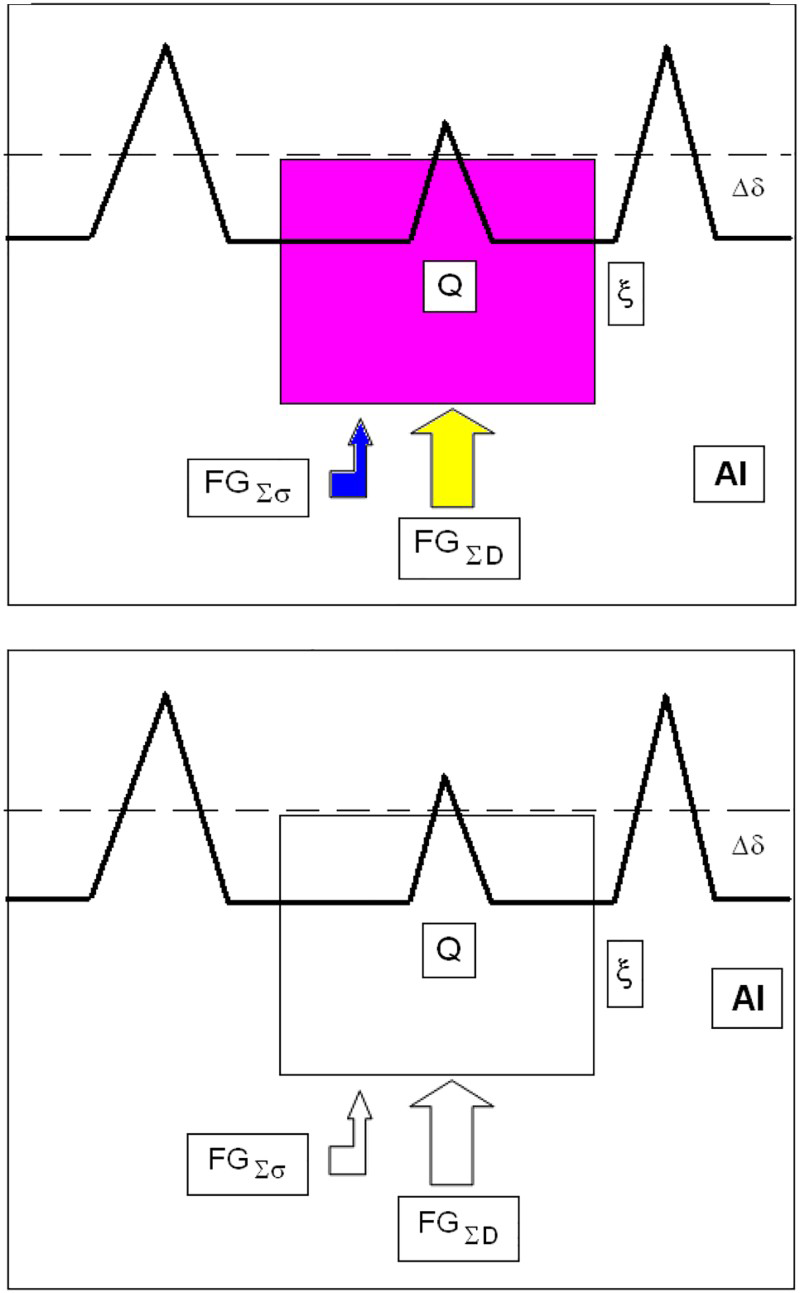
The modelling procedure is reduced to the constitution of the balance of FG's occurring within a system. Mass flow is the ‘promoter’ of the whole mass transport. By its concentration distribution from bulk to surface it produces the FGΣ D which induces the FGΣσ that embarrasses the mass transport process.
So, the integral method, based on setting the mass balances for the control volume, gives:

 is the total mass amount; ξ = y/δ(t) dimensionless distance; dδ the average change in hillock height in time dt;
 the overall diffusion flux gradient;
 the overall plasticity flux gradient; Θ dimensionless concentration ratio of total mass transport; ΘΣD dimensionless concentration ratio of overall diffusion, ΘΣσ dimensionless concentration ratio of overall plasticity
Integration of equation (10) gives:



The overall plasticity (via FGΣσ) participates in the mass transport process and its inflection is evident after some time t*, i.e. t*(1) or t*(2), Fig. 4.
Increase of average hillock volume or stress change through the stages (i, ii or iii) as time or square root of the time: principle relationship.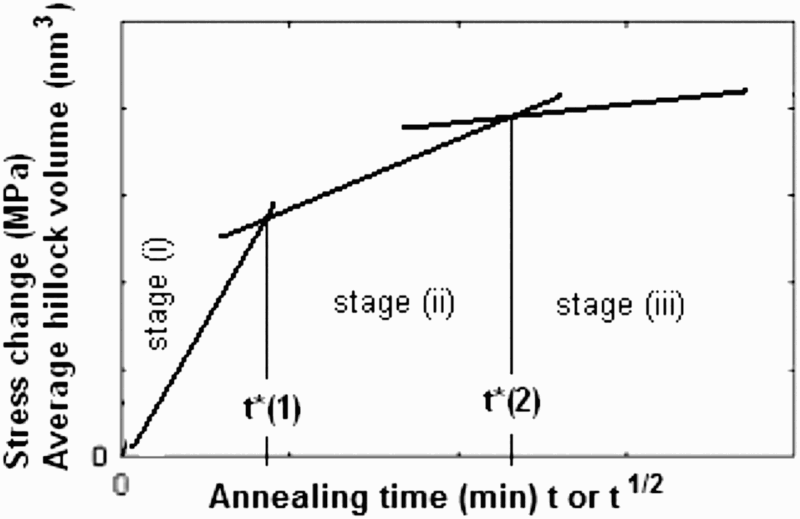
Also, in ‘critical time’ t* one obtains the ratio:

that indicates the ‘power’ change of the whole mass transport influenced by overall plasticity.
Elements of the concept
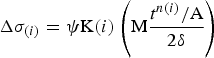
The mathematical form of the general equation (1) is identical i.e. equivalent to the corresponding equations (7)–(9) and (12). Therefore, the conceptual relationship of step by step linear and/or parabolic law for hillock volume changes ΔV in time t (see Fig. 4):

On the other hand, the magnitude of the stress relief by hillock formation can be estimated using equation (3):
Illustrative examples
Similarly to
8
the experimental measurements reported by Hwang et al.
6
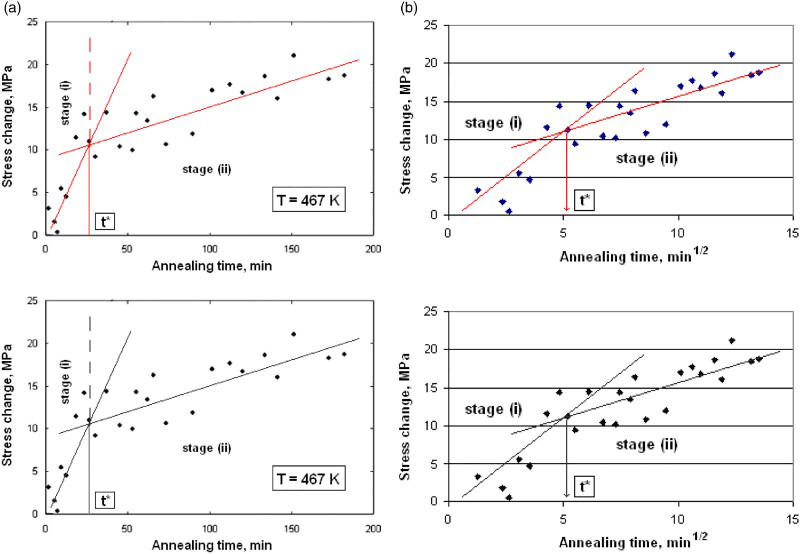
can be used to generate the plots in Fig. 5
a and b. The considered temperature is T = 467 K.
Discussion
It is evident, from Fig. 5 a and b, that some changes in the hillocks growing mechanism might be detected around 26 minutes. Linear dependence, Fig. 5 a, only shows the existence of two stages, where the line of the stage (i) is very close to results of Chaudhari's model applied on same experiment, 9 so the interface diffusion can be assumed. On the other hand, it seems that the stage (ii) follows the plasticity controlled hillock growth, defined by equation (8).
But, according to the simplified laminar boundary layer approach, Fig. 5 b, the hillocks are formed by ‘pure’ diffusion up to time t* i.e. by the mechanisms of diffusion of Al atoms through the bulk of Al, stage (i). In this stage the mechanisms of plasticity are very low, FGΣσ stage(i) ∼ 0. However, starting from time t*, the influence of the present mechanisms of plasticity becomes evident and the stage (ii) begins, so the rate of hillock growth decrease. Accordingly, equation (13), for the ratio (FGΣ D + FGΣσ)stage(ii)/(FGΣ D )stage(i) gives the value of 0,83 that presents the ‘power’ change of the whole mass transport influenced by overall plasticity. In other words, the overall plasticity in Al thin film decreases the overall diffusion as well as hillock growth for about 17%.
After this illustrative presentation, it must be noted once again that all mixed combinations of mechanisms of diffusion and plasticity are possible.
Conclusion
A simple model for the kinetics of the hillock growth described by the conceptual relationship or step by step linear and/or parabolic law for hillock volume changes in time has been formulated. This relationship would be valid for both diffusive and plastic hillock growth.
This approach is very useful for processing and exploitation of deposited Al films. With appropriate adjustment of process parameters it is possible to reduce the occurrence and growth of hillocks, especially in microwave processing of deposited materials. 23
Finally, the principal purpose of this article is to point out that there is information contained in the change of the hillocks volume coupled with elapsing time at holding temperature. This information is potentially useful for understanding of the growing mechanism. It is felt that the internal coherence of the model and all the qualitative conclusions to be reached, the higher-quality measurements should be retained.
Footnotes
Acknowledgements
This work was financially supported by the Ministry of Education, Science and Technological Development of the Republic of Serbia.