







Abstract
In this study, we fabricated a super-hydrophilic (θ < 5°) hierarchical reticular porous structure on the surface of Ti–24Nb–4Zr–8Sn (Ti2448) by combining sandblasting, dual acid-etching, and alkali thermal treatment. The super-hydrophilic hierarchical structure on the surface contained fine well-distributed nanopores with random microscale structures, leading to extremely high surface hydrophilicity. The sand blasting and dual acid-etching processes (SLA) and alkaline treatment (AT) resulted in the formation of microscale structures and nanopores, respectively. The formation mechanism of the hierarchical reticular porous structures was also examined. The average size of the nanopores on the surface of the SLA + AT Ti2448 sample was 86.3 nm, and the hierarchical structure contained several biocompatible components, including TiO2, Ti2ZrO, ZrTiO4, Nb2O5, Ti2O3, and ZrO2. Because of their super-hydrophilic and chemically biocompatible characteristics, hierarchical Ti2448 structural candidates are expected to be more suitable as implants for successful osseointegration.
Keywords
Introduction
Recently, titanium and titanium-based alloys have been widely used as medical materials in hip implants, joint prosthetics, and dental implants and for cranioplasty and oral and mandibular repair because of their high strength, long-term durability, high corrosion resistance, excellent biocompatibility, and ability to integrate with the adjacent bone during healing.[1,2] However, in the last few decades, the application of commercially pure titanium (CP-Ti) implants in long-term weight-bearing conditions, such as spinal intervertebral fusion and dental implantation, has been hindered by their insufficient mechanical properties.[3] These properties include mismatched elastic moduli, which cause stress shielding over a long period of healing, and bone absorption through decreased mechanical strain, which causes prospective implantation failure.[4] The mechanical and osseointegration properties of titanium-based implants have been improved by alloying and surface-modification techniques.[5] Other elements that are suitable for use in the human body (such as Nb, Zr, Sn, Mn, Mo, and Ta) have been added to titanium alloys to improve their mechanical properties and biocompatibility for bone implantation.[6,7] A novel quaternary Ti–24Nb–4Zr–8Sn (Ti2448,wt-%) alloy with high strength (approximately 850 MPa) and an ultralow elastic modulus (approximately 45 GPa, similar to that of human bone (30 GPa)) was developed that combines ideal biomechanical performance with appropriate biological properties to improve stress-matching and biocompatibility, with great potential for future successful osseointegration.[8]
Surface modification is a key method for improving the osseointegration properties of titanium alloy implants, enabling more rapid integration of implants with adjacent bone and thereby improving the success rate of osseointegration.[9] In terms of biocompatibility, the surface chemistry and morphology of an implant are critical factors affecting the cellular response capacity, which includes cellular adhesion, proliferation, and differentiation.[10] In recent decades, the addition of a porous structure to the surfaces of Ti-based implants has been demonstrated to improve the stability of primary osseointegration, bone formation, and gene expression during healing.[11,12] Unlike smooth surfaces, porous surfaces form biocompatible chemical environments which also introducing a larger surface area and rougher surface morphology, thereby increasing the hydrophilicity of the implant and improving the adhesion, proliferation, and differentiation of osteoblasts.[13,14] Many surface-modification techniques, such as anodisation, dealloying, and alkali treatment, have been employed to introduce micro- or nanostructures to the surfaces of Ti-based biomaterials, which accelerate integration between implants and newly formed bone tissues.[15-17] Permeable micro/nanoscale structures with open, connected features are beneficial for the transportation of substances, such as water and nutrients, between implants and bone tissues, which could promote osteogenic growth during healing.[18] The introduction of biomimetic micro/nano-hierarchical structures on the surface of Ti could enhance both cell differentiation and proliferation, including the attachment, spread, adhesion, proliferation, and differentiation of osteoblasts.[19] Combining microscale structures with nanostructures on the surface of Ti-based implants could result in a compound effect on cell proliferation and differentiation because it mimics the hierarchical complexity of bone.[20]
In this study, we innovatively introduced a hierarchical reticular porous structure with combined microscale structures and nanopores on the Ti2448 surface by combining sandblasting, dual acid-etching, and alkali thermal treatment. Compared with the Ti substrates, the as-formed surface structures were characterised by more homogeneous and finer nanopores, a higher roughness, and more biocompatible surface compounds. Furthermore, after the multiple treatments, the surface of the Ti2448 alloy became super-hydrophilic, which is evidence of the improved adhesion of biological tissues. This super-hydrophilicity is expected to improve the properties of the surface for osteocyte adhesion, proliferation, and differentiation.[21] Furthermore, we discuss the chemical and microstructural mechanisms for the super-hydrophilicity of the Ti2448 surface, which could be beneficial for designing super-hydrophilic surfaces for titanium alloys and exploring the underlying mechanisms.
Materials and methods
Experimental design
The multi-process technology designed for the surface modification of Ti2448 involved successive sand blasting and dual acid-etching (SLA) and alkali thermal (AT) treatment (Figure 1). The SLA treatment introduced micron-sized structures to the surfaces of smooth samples, and the AT process was used to fabricate nanopores on the surfaces roughened by SLA. As a result, the multi-process technique formed both microscale structures and nanostructures on the surfaces of the substrates. The valence bond schematic for the AT process is shown in Figure 1. The multi-process technology used here is stable, repeatable, and controllable, and has been used for treating Ti surfaces.[22] In addition to introducing a hierarchical and reticular porous structure to the surfaces, this process can also improve the roughness, wettability, and chemical condition of the surface.
Flow diagram and valence bond schematic diagram during AT treatment.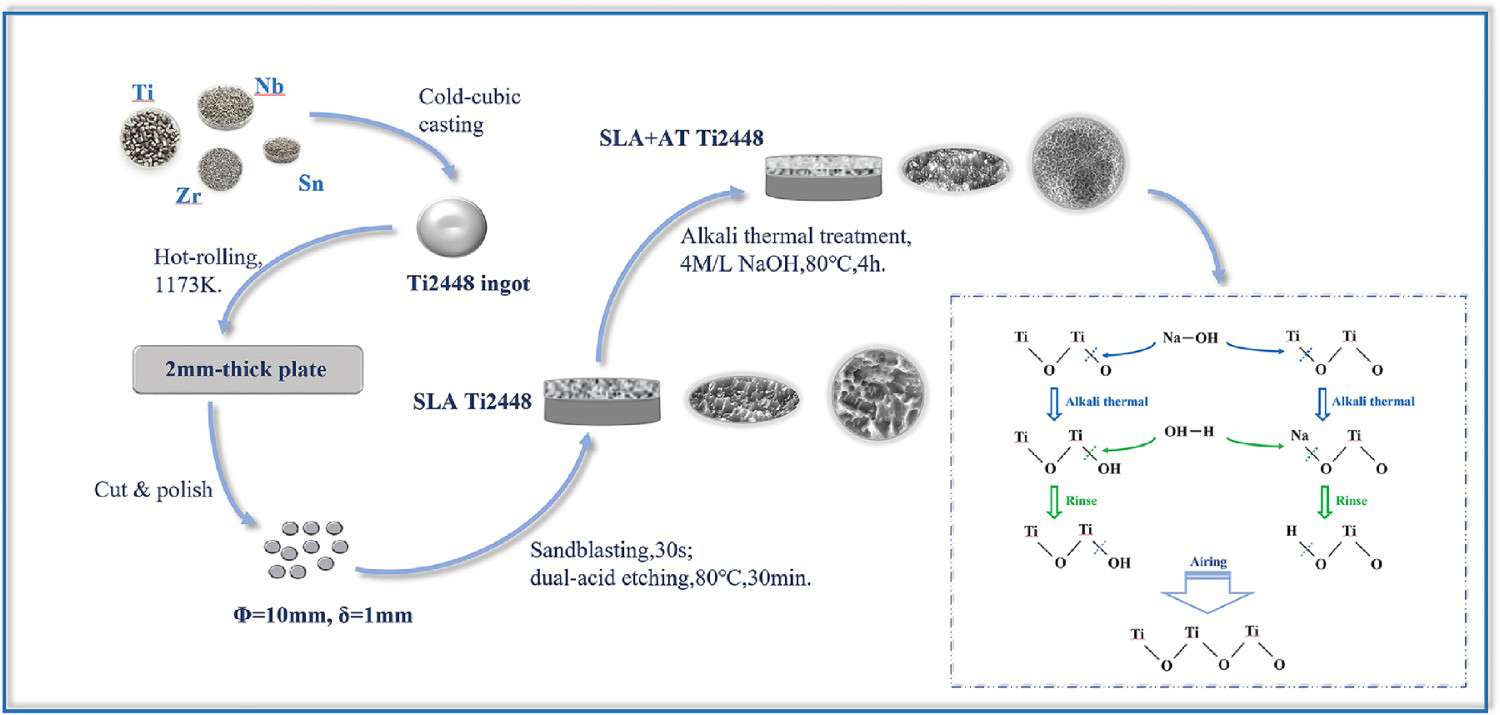
Sample preparation
A Ti–24Nb–4Zr–8Sn (Ti2448, wt-%) ingot was produced by cold-crucible casting using titanium (Ti, ≥99.9%), niobium (Nb, ≥99.9%), zirconium (Zr, ≥99.9%), and tin (Sn, ≥99.9%) as raw materials. The ingot was then hot-rolled into a thin plate and solution treated in an evacuated quartz tube, followed by water quenching in air. Rounded discs with a diameter of 10 mm and thickness of 1 mm were cut from the Ti2448 plate using an electrical spark, and Ti discs were prepared as a control group. The discs were mechanically burnished, ultrasonically cleaned, and dried in air. Smooth discs were prepared and denoted as smooth Ti2448 and smooth Ti. All the raw materials were provided by Zhongnuo Advanced Material Technology (Beijing).
Surface treatment
For the SLA process, the smooth Ti2448 and Ti discs were sandblasted with SiO2 particles. The discs were then immersed in dual-acid liquor consisting of hydrochloric acid (HCl, 6.10 mol/L, 20 mL) and sulphuric acid (H2SO4, 8.86 mol/L, 20 mL), and etched for 30 min at 80 °C. The discs were then ultrasonically cleaned and dried in air. The acids used to prepare the dual-acid liquor were provided by Sinopharm Chemical Reagent (Shanghai, HCl 36.0 wt-%, H2SO4 98.0 wt-%).
For the AT treatment, the SLA Ti2448 and Ti discs were treated under an alkali thermal reaction with a sodium hydroxide solution (NaOH, 4 mol/L, 40 mL), which proceeded for 4 h in a JRY electric-heated thermostatic water bath at 80 °C. Following the reaction, the discs were rinsed repeatedly with deionised water and dried in air and were denoted as SLA + AT Ti2448 and SLA + AT Ti, respectively. The solution used for the alkali thermal reaction was prepared from analytical-grade solid sodium hydroxide provided by Sinopharm Chemical Reagent (Shanghai, NaOH, wt-% ≥ 99.5%).
Surface analysis
The surface morphology was examined using scanning electron microscopy (SEM, JEOL JSM-7800F Prime, Japan) under a voltage of 5.0 kV. The surface roughness was assessed based on the arithmetic average roughness (Ra), which was calculated using a roughness profilometer (Mitutoyo SJ-201, Japan). X-ray photoelectron spectroscopy (XPS, AXIS UltraDLD, Japan) and X-ray diffraction (XRD, ADVANCE Da Vinci, Germany) were employed to determine the surface chemical composition. To determine the surface hydrophilicity, a contact angle analyser (DSA 100, Germany) was used with 5-μL droplets of deionised water. The contact angle values, element contents, and surface roughness values reported in this study are the averages of triplicate measurements.
Results
Surface structures and dimensions
As observed in the SEM images in Figure 2, analogous hierarchical reticular porous morphologies were formed on the surfaces of both the SLA + AT Ti2448 and SLA + AT Ti samples (Figure 2(a,b)). A well-distributed micron-sized undulating structure was observed on the surfaces of both SLA + AT samples, which was introduced by the sand blasting and dual acid-etching treatments. At a higher magnification, nanopores produced by the subsequent AT treatment can be observed. We also measured the dimensions of the micron-sized and nanoporous structures (as shown in Figure 2(c–f)), and the two surfaces both exhibited bimodal structures.[23] Over 100 measurements were conducted foreach nano-sized image.
SEM images and dimensions of the surface structures of Ti2448 (a,c,e) and Ti (b,d,f) after SLA and AT treatment.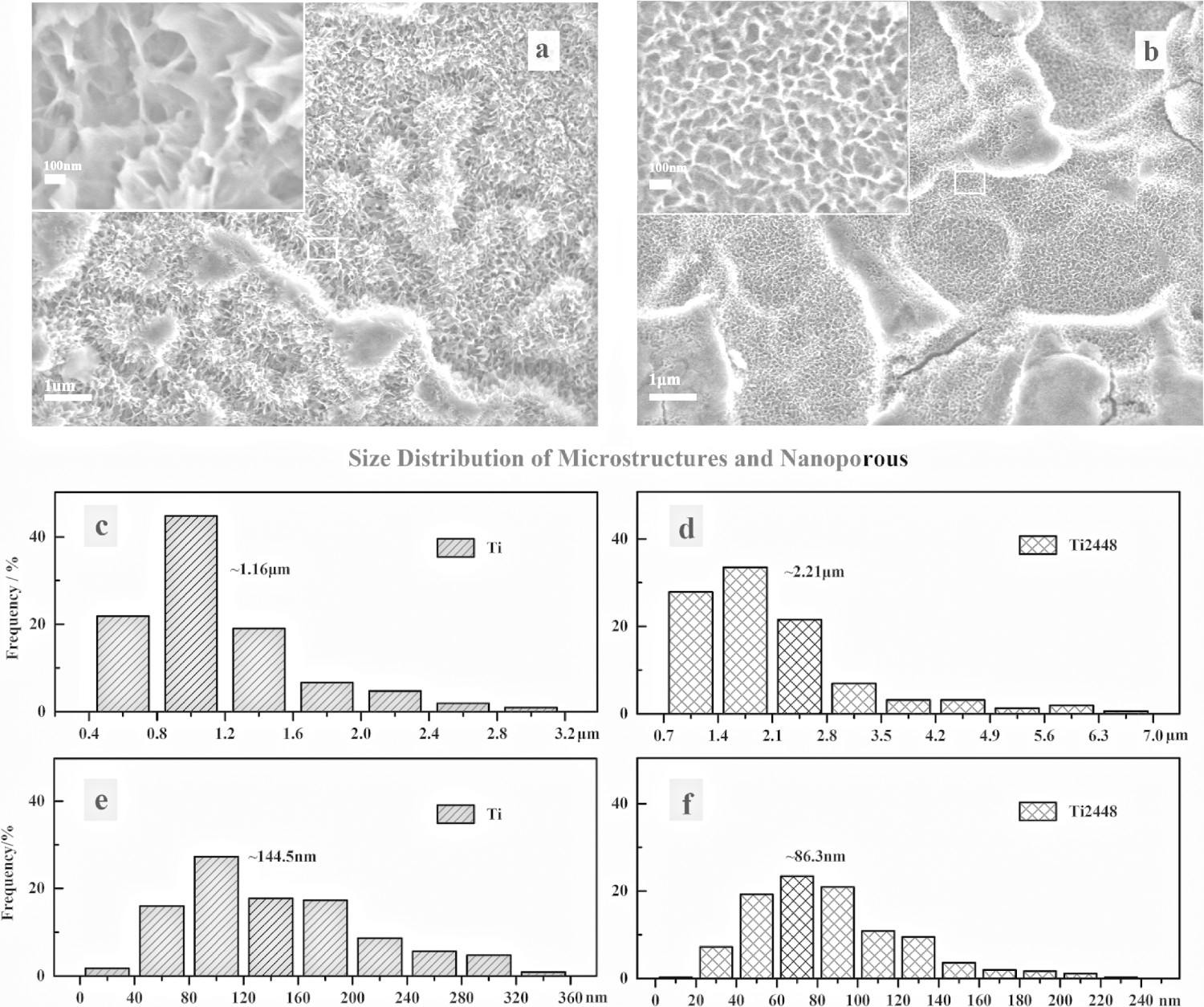
The surface of SLA + AT Ti2448 exhibited a random, micron-sized structure with a width of approximately 0.91–3.46 μm; nanopores were distributed throughout the structure varying from 17.55–221.73 nm in diameter (Figure 2(b,d,f)). Homoplastically, the surface of SLA + AT Ti exhibited a micron-sized structure with a width of approximately 0.45–3.09 μm, with nanopores varying from approximately 22.73–337.43 nm in diameter (Figure 2(a,c,e)).As shown in the nano-measurements presented in Figure 2(c–f), the average microscale diameter of the micron-sized structure on the surface of SLA + AT Ti2448 was 2.21 μm (Figure 2(d)), which was larger than that of the SLA + AT Ti sample (1.16 μm; Figure 2(c)). However, the average nanoscale diameter of the pores on the surface of SLA + AT Ti2448 was 86.3 nm (Figure 2(f)), which was smaller than that of SLA + AT Ti (144.5 nm; Figure 2(e)). The dimensions on the surface of SLA + AT Ti2448 were more homogeneous than those of the SLA + AT Ti sample at both the micro- and nanoscale. Most of the micron-sized structures and nanopores on SLA + AT Ti2448 were 0.7–2.8 μm and 40–100 nm in diameter, respectively (Figure 2(d,f)), whereas those on SLA + AT Ti were 0.8–1.2 μm and 40–200 nm in diameter, respectively (Figure 2(c,e)).
The elements in the Ti2448 surface behaved differently during the AT process; several oxides responded less to the heated alkaline solution, whereas other oxides readily dissolved or engaged in the bond-replacement reactions. Therefore, as a result of the stable oxides formed on the surface of Ti2448 that prevented the sample from dissolving further, more homogeneous and finer nanopores were formed on the surface of Ti2448 than on Ti. The different responses of the elements in the Ti2448 surface during the multiple processes will be discussed later. Similar to human bone, which also contains fine nanopores distributed throughout its substantial loose netlike scaffold, the biomimetic hierarchical porous reticular structure on the surface of the SLA + AT sample provided a large surface area that was beneficial for osteoblast adhesion; this structure also provides a biocompatible structure for the storage of fluids and nutrients.[24]
Surface roughness
Figure 3 shows that at the microscale, the structures on the surfaces of the SLA + AT samples were undulating. The thicknesses of the rough layer and width of the macro-wave crest were also measured. The thicknesses of the SLA + AT Ti2448 and SLA + AT Ti samples were 3.29 and 3.01 μm, respectively. The widths of the macro-wave crests were 230 and 190 μm, respectively, whereas these values were quite low and flat for the smooth samples. After the multi-process treatment (sand blasting, dual acid-etching, and alkaline thermal treatment), the SLA + AT samples exhibited higher surface roughness than the smooth samples (Table 1). According to Table 1, the surface of the SLA + AT Ti2448 sample was rougher than that of the SLA + AT Ti sample, with Ra values of 2.41 and 1.70 μm, respectively. This finding indicates that the multi-process surface-modification method is more effective for increasing the roughness of the surface of Ti2448 (Table 1) than that of Ti.
Surface roughness and undulations of Ti (a) and Ti2448 (b). Parameters of the surface structures. Roughness of the sample surfaces, thickness of the biomimetic hierarchical porous reticular formations, and widths of the micron-sized structures.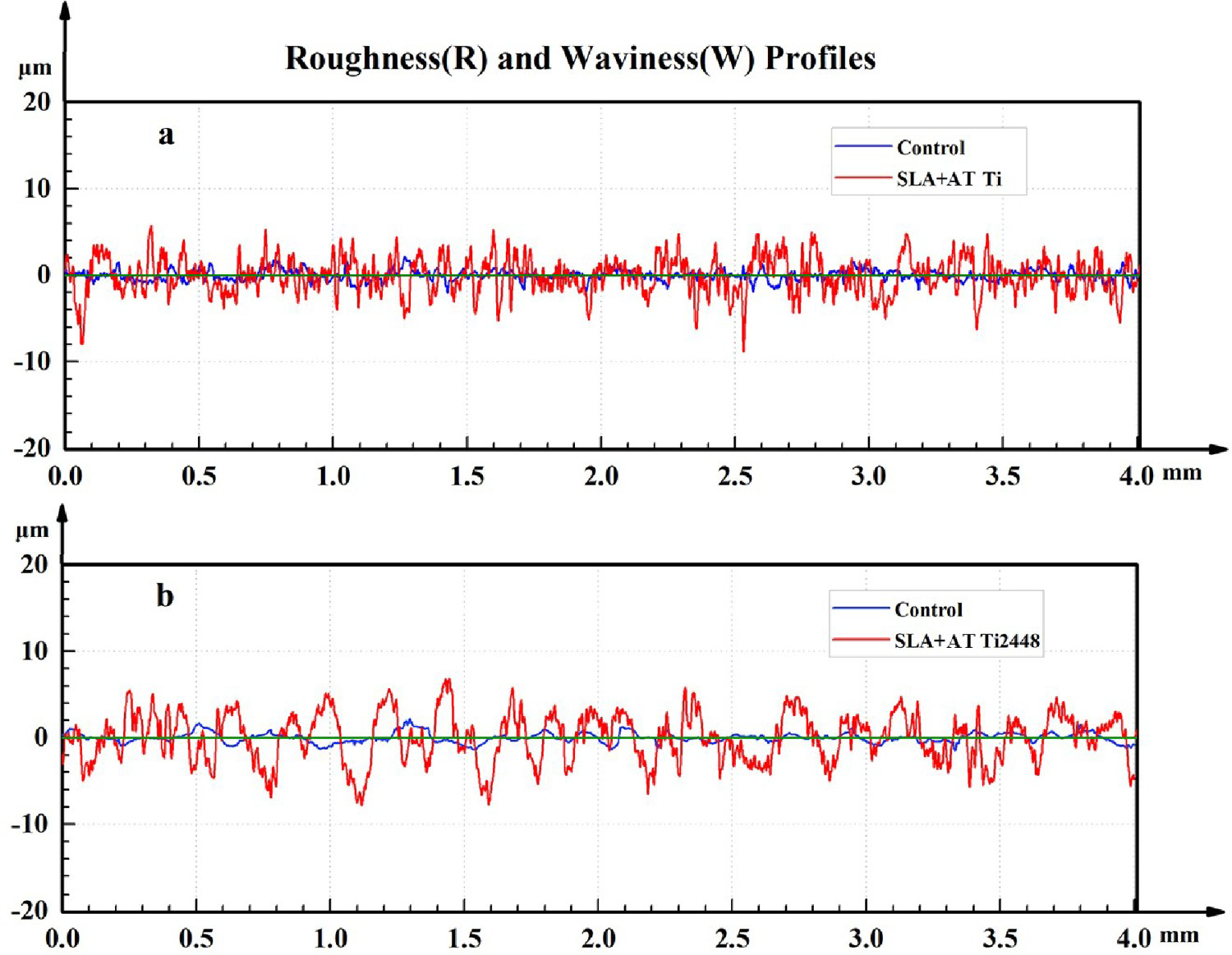
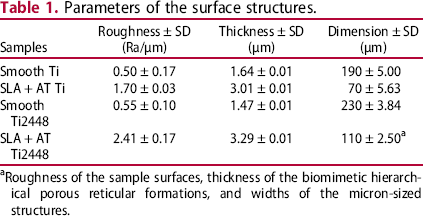
The microscale undulations on the surface of Ti2448 were wider and of higher amplitude than those on the surface of Ti (Figure 3). This is because during sandblasting, when the SiO2 particles strike the surfaces and mechanically form craters (micron-sized structures), the more ductile material (i.e. Ti2448) is more susceptible to stress, as its elastic modulus (approximately 45 GPa) is lower than that of Ti (approximately 110 GPa). The surface of SLA + AT Ti2448 exhibited a more fluctuating micron structure as well as numerous finer nanopores (Figure 2), resulting in a higher roughness and thicker rough layer with wider undulations. As the contact between the bone and implant increases with increasing surface roughness of the implant, it is expected that the SLA + AT Ti2448 surface would be more biocompatible.[25]
Surface chemical compounds
XPS and XRD analyses were conducted to determine the chemical states and phases of the scabrous porous surfaces, and the results are presented in Figures 4 and 5, respectively. The presence of metal oxides was primarily determined by XPS analysis. As observed in Figure 4(a,e), the Ti 2p region contained Ti 2p3/2 and Ti 2p1/2 peaks at 458.5 and 464.19 eV, respectively. According to the NIST XPS Database, these values are consistent with those of TiO2. Homoplastically, the Nb 3d peaks included Nb 3d5/2 at 207.0 eV and Nb 3d3/2 at 209.9 eV (Figure 4(b,f)), indicating the presence of Nb2O5; the Zr 3d peaks included Zr 3d5/2 at 182.3 eV and Zr 3d3/2 at 184.5 eV (Figure 4(c,g)), indicating the presence of ZrO2; and the Sn 3d peaks included Sn 3d5/2 at 486.2 eV and Sn 3d3/2 at 495.37 eV (Figure 4(d)), indicating the presence of SnO2. According to the XPS spectrum in Figure 4(A), the chemical components of the surfaces of the SLA sample included TiO2, Nb2O5, ZrO2, and SnO2. The SLA + AT sample contained the same components as the SLA sample except for SnO2 (Figure 4(B)), indicating that SnO2 was dissolved during the AT process.
XPS spectra of the rough surfaces of (A) SLA Ti2448 and (B) SLA + AT Ti2448. XRD pattern of the Control, SLA, and SLA + AT Ti2448 surface.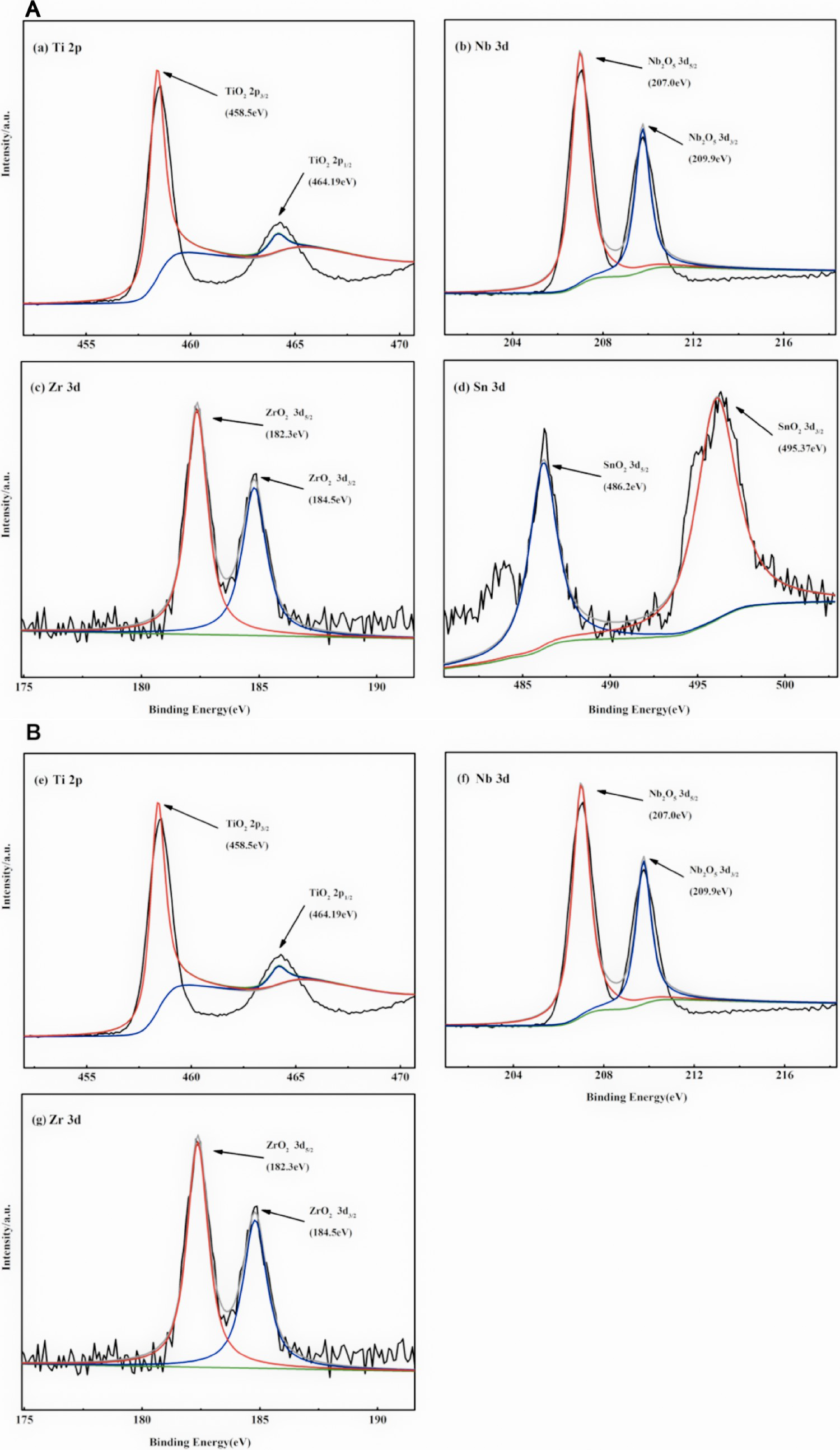
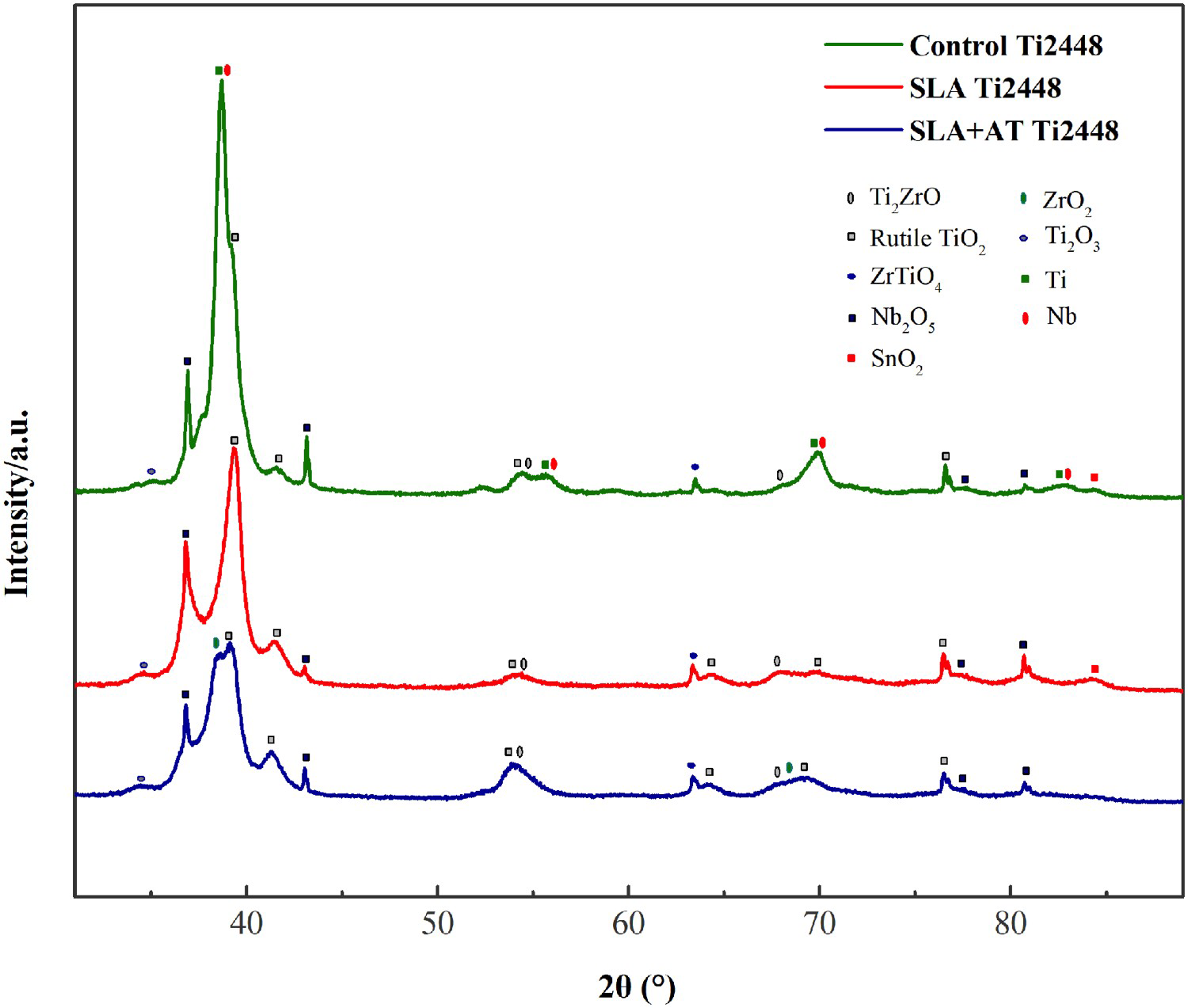
The phase condition of the mixed-oxide layer was confirmed by XRD analysis. The phases were matched against the JCPDS/ICDD. We will focus on discussing the medium and high 2θ patterns because no peaks were present in the low 2θ pattern. As shown in Figure 5, TiO2 was determined to contained the rutile phase after the multi-process treatment. A porous surface containing rutile TiO2 is believed to be biocompatible for cell adhesion.[26,27] Before the dual acid-etching treatment, the components on the surface were mainly Ti, Nb, rutile TiO2, Ti2ZrO, ZrTiO4, Nb2O5, Ti2O3, and SnO2 (Figure 5 (Control Ti2448)). After the SLA treatment, the components on the surface were mainly rutile TiO2, Ti2ZrO, ZrTiO4, Nb2O5, Ti2O3, and SnO2 (Figure 5 (SLA Ti2448)). After the AT treatment, the components on the surface were mainly rutile TiO2, Ti2ZrO, ZrTiO4, Nb2O5, Ti2O3, and ZrO2 (Figure 5 (SLA + AT Ti2448)). After the SLA treatment, Ti and Nb disappeared; after the AT treatment, ZrO2 appeared and SnO2 disappeared while the chemical states of the other oxides remained the same.
The combined XPS and XRD results improve our understanding of the different responses on the Ti2448 surface during the SLA and AT process: Ti and Nb are oxidised during the SLA treatment, SnO2 dissolves during the AT process, Zr-containing components partially change from Ti2ZrO or ZrTiO4 to ZrO2, Nb2O5 remains corrosion resistant, and the AT does not induce phase transformation of TiO2. The different responses of the elements in the Ti2448 surface during multiple processes will be discussed later. The presence of Nb and rutile TiO2 on the surface was beneficial for cell adhesion and ECM formation, which enhances the surface bioactivity.[28] However, the biological role of Zr-containing components is not understood and requires further research.
Surface wettability
Surface wettability plays a key role in surface biocompatibility; higher hydrophilicity results in better protein and cellular adhesion, which would improve cellular proliferation and differentiation.[29] The evolution of the hydrophilic properties of the smooth and modified surfaces of the Ti2448 and Ti samples is shown in Figure 6. The static water contact angles decreased from 108° to 10° for the Ti sample and from 90° to <5°for the Ti2448 sample. This result indicates that the samples transformed from hydrophobic to hydrophilic as a result of the multi-process treatment. The contact angle of SLA + AT Ti2448 was below 5°, which is super-hydrophilic, indicating that a water droplet on the surface of the sample could spread out and be completely absorbed into the surface. This property is superior to that of similar Ti-based materials.
Static contact angles of Ti and Ti2448 samples.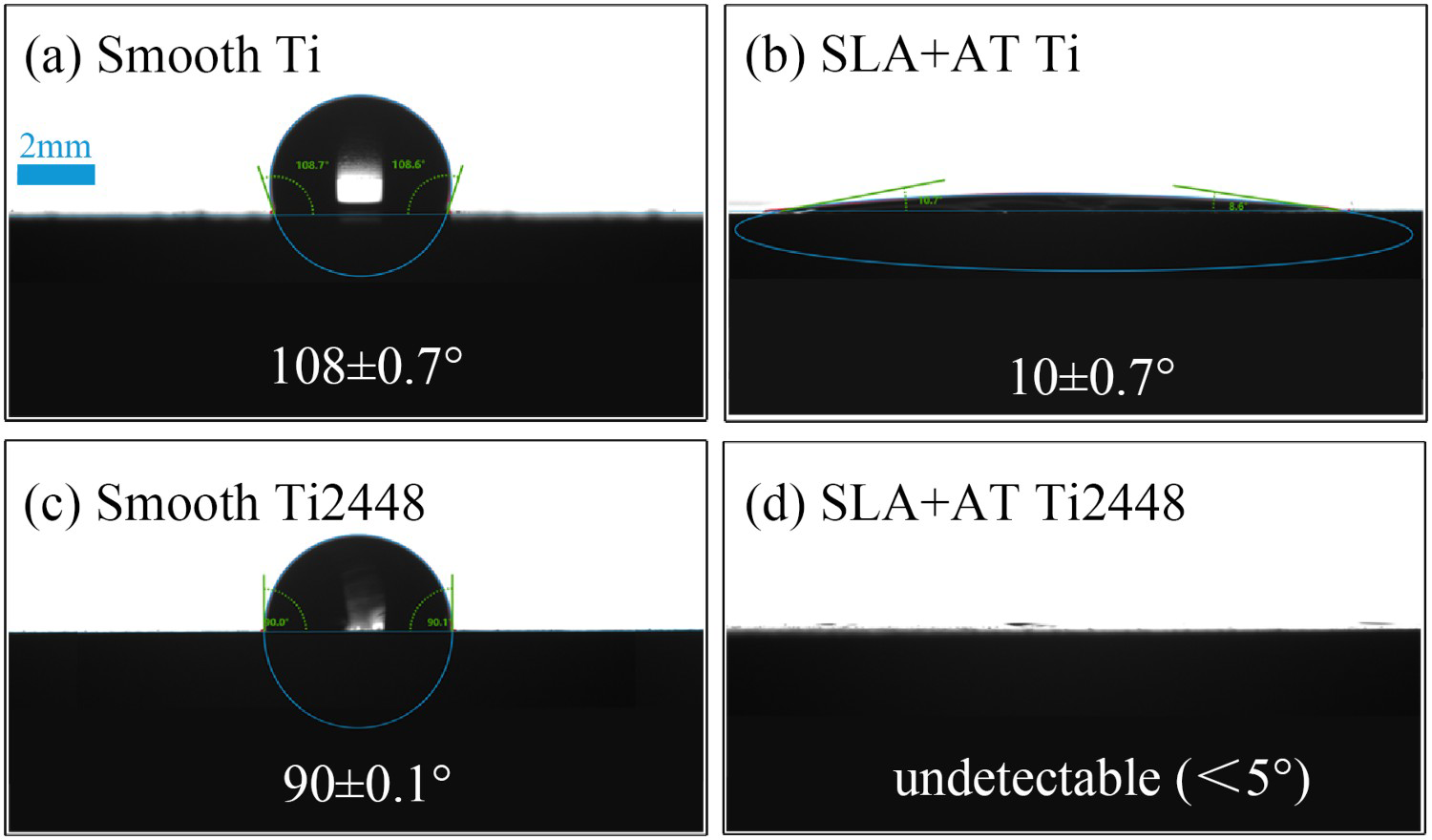
According to the SEM results, for a large number of fine nanopores on the SLA + AT Ti2448 surface, capillarity is an important factor for determining its super-hydrophilicity. A highly roughened surface might also be a factor determining its super-hydrophilicity, while alloying also has a positive effect on the improvement of wettability. The detailed factors that govern the surface wettability will be discussed later. Better hydrophilicity of implant devices is crucial for cell adhesion, proliferation, and differentiation. Liu demonstrated that the hydrophilic surface created by the multi-process can improve the biocompatibility of Ti implants in an in vitro study. The wettability of our Ti2448 samples is consistent with the results reported by Sun,[30] who treated Ti using a process similar to that used; and their treated Ti exhibited better hydrophilicity than nanotube-covered samples treated by anodisation by Li. This finding suggests that the hybrid process comprising sand blasting, dual acid-etching, and AT treatment is a more suitable surface-modification method, and the modified Ti2448 could be more suitable for bone implantation.
Discussion
Generation of hierarchical reticular porous structure
Recently, sand blasting, acid-etching, and AT treatment have been applied to form polymorphic structures on the surfaces of Ti-based substrates. Combining these processes and using the optimal parameters reported by Liu resulted in Ti2448 and Ti samples with hierarchical reticular porous structures consisting of random micron-sized structures with abundant, widely distributed nanopores. A process diagram for this study and valence bond schematic diagram for alkali treatment are presented in Figure 1.
The formation of wide and deep micron-sized structures on the surface of Ti2448 benefits from the combination of two treatments, i.e. sand blasting and acid-etching. During sand blasting, the smooth, low-modulus Ti2448 surface is exposed to high-speed SiO2 particles. Ti2448 exhibits an unstable β-type phase and severe cracks and undulations can be formed on its surface (Figure 3) that are deeper and wider than those on Ti. The as-formed Ti2448 sample was subsequently treated with a mixed solution of HCl and H2SO4, which consolidated and deepened the micron-sized structures. Chemically, when the sandblasted Ti2448 substrate was exposed to air, it was partially oxidised, resulting in the presence of TiO2, Ti2O3, Nb2O5, SnO2, Ti2ZrO, ZrTiO4, Ti, and Nb on the Control Ti2448 surface (Figure 5). When the Control Ti2448 substrate was immersed in the mixed acid liquor, dissolution of the oxides and oxidation of the metal occurred. The microscale topography was consolidated and deepened through the following steps[31]: (i) partial oxidation of metal on sandblasted surfaces; (ii) dissolution of metallic oxides and oxidation of metal in the mixed heated dense acid liquor; and (iii) oxidation of metal on the acid-etched surfaces.
During the acid-etching process, H+ ions were present throughout the mixed acid liquor, particularly around the interfaces of the solution and substrates. Titanium and tin oxides would be dissolved quickly[32]:





When bubbles appeared and the solution gradually changed from colourless to purple, H2 and TiCl3 were formed. Because titanium and tin are the two most active elements of the four elements, they would be oxidised rapidly when the inside metal substrate was exposed to the concentrated dual-acid solution[33,34]:




As shown in Figure 5, Nb2O5 remained on the SLA surface and Nb disappeared, indicating that Nb was oxidised during the acid-etching process:

The AT treatment resulted in the production of numerous well-distributed nanopores on the surface of Ti2448. Valence bond replacement occurred when the acid-etched sample was immersed in the heated alkali solution, when the alkali-treated sample was rinsed with deionised water, and when the cleaned sample was dried in air [35] (Figure 1). As shown in Figure 5, after AT treatment, SnO2 disappeared and ZrO2 appeared. This result means that SnO2 dissolved in the NaOH solution, and the hybrid ZrTiO4 clusters were partially disintegrated[36]. Consequently, the formation of nanopores in the polymorphic topography is expected to occur as follows: (iv) valence bond replacement between TiO2 and NaOH, dissolution of SnO2, and disintegration of ZrTiO4 in the heated alkaline solution; (v) valence bond replacement between sodium titanium oxide and deionised water; and (vi) dehydration of titanium hydroxides in air. The valence bond-replacement responses in steps (iv), (v), and (vi) are displayed as follows:



Reactions (11), (12), and (13) occur on the surfaces of both the Ti2448 and Ti samples. The reactions for SnO2 and ZrTiO4 are as follows:


The reactions for Nb2O5 are quite slow because Nb2O5 is thermodynamically stable and resistant to corrosion.[37,38] The different chemical activities of the four metallic oxides, as well as lattice deformation due to metal doping, results in the production of finer nanopores on the surface of Ti2448 than on the surface of Ti (Figure 2). However, whether Ti2ZrO oxidises into TiO2 and ZrO2 in the heated alkaline solution requires further exploration.
Hydrophilicity of the hierarchical reticular porous structure
The fabrication of hierarchical trabecular bone-like structures combining micron-sized structures with nanopores has attracted researcher attention for the modification of Ti-based implants.[39] Hierarchical reticular porous structures on the surface of Ti2448 created by SLA and AT (Figure 1) exhibit several biologically beneficial characteristics, such as hierarchical structures with homogeneous nanopores, high roughness, chemical biocompatibility, and high hydrophilicity. The chemical composition, surface roughness, and surface topography studied herein are the main factors governing the surface wettability, and the surface hydrophilicity directly affects the biological function of biomaterials.[40,41]
The mixed chemical composition of the Ti2448 sample is one factor that could contribute to surface wettability. As shown in Figure 6, the smooth Ti2448 sample exhibited higher hydrophilicity than the smooth Ti sample, suggesting that the alloying elements improved the hydrophilicity. The polarity of metal–oxygen bonds may also play a key role in the super-hydrophilicity of the SLA + HT Ti2448 sample. For instance, the Ti-O bond of the surface TiO2 is polar, which aids in the dissociation of surface-absorbed H2O to form a super-hydrophilic –OH bond. The presence of Ti2ZrO, ZrTiO4, Nb2O5, Ti2O3, and ZrO2 (Figure 5) would also aid in intensification of the polarity of the Ti2448 surface, as their presence may facilitate easier H2O molecule adhesion and dissociation. This characteristic substantially improved the surface energy and surface wettability of the Ti2448 mixed-oxide substrate, and these properties play a significant role in osseointegration.[42] However, the contribution of the polarisation properties of oxides to super-hydrophilicity requires further detailed research.
The surface roughness of the SLA + AT Ti2448 (Figure 3) was higher than that of the smooth Ti2448, and the SLA + AT Ti2448 possessed optimised hierarchical structures (Figure 2) that increased its specific surface area. Without any additional treatment, the specific surface area of the smooth sample was the smallest, whereas that of the SLA-treated surfaces was larger and that of the SLA + AT-treated surface was the largest. The high specific surface area is likely to have contributed to the super-hydrophilic surface (Figure 6), as it increased the water contact area. The SLA + AT surface provides a larger specific surface area than the AT surface, as micro/nanoscale hierarchical structures are more hydrophilic than nanopores fabricated by AT treatment alone.
The presence of finer nanopores will increase the capillary effect, as smaller nanostructures correspond to greater cell response, regardless of whether the surfaces contain oxides other than TiO2. The capillary effect is expressed by the following formula:

The bimodal porous structures may play a key role in the storage of nutrients and fluids. The combined micron-sized structures and nanopores act as reservoirs for storing nutrients, which improves the structural permeability to allow for the storage of fluids and nutrients. Therefore, the hydrophilic surface provided by the hierarchical structures on the surface of the SLA + AT Ti2448 increases the likelihood of the substrate coming into contact with water-based cell-anchoring proteins, resulting in the adhesion of cells to the substrate. The SLA + AT Ti2448 surface was rough with irregular undulations in all directions, contributing to its high surface free energy, as high surface free energy is associated with high surface hydrophilicity.[44] Several studies have demonstrated that higher surface roughness can induce a more severe cell response, and implants with rough surfaces exhibit better cell adhesion and proliferation and expression of osteogenic markers than smooth surfaces.[45] Additionally, contact between the bone and implant increases with increasing surface roughness and thickness, indicating that a higher surface roughness and thicker rough layer result in a more severe cell response.[46] By employing multi-process technology, we fabricated a super-hydrophilic micro/nanostructure on an originally low-modulus Ti2448 surface and discussed the fabrication mechanism and the causes of the super-hydrophilic structure. Multi-process technology has great potential for long-term implantation, and the biocompatibility of implants produced in this manner should be investigated in the future.
Conclusions
We fabricated a hierarchical reticular porous structure with combined micron-sized structures and nanopores using sand blasting, dual acid-etching, and alkali thermal treatment. The as-formed surface structures greatly affected the surface properties, resulting in hierarchical morphology, an increase in roughness, a more biocompatible chemical composition, and surface super-hydrophilicity. In the hierarchical morphology, the average size of the nanopores on the surface of the SLA + AT Ti2448 sample was 86.3 nm, whereas the average size of the micron-sized structure was 2.21 μm. The SLA + AT Ti2448 sample exhibited an arithmetic average roughness of 2.41 μm, and the average thickness of the rough layer was 3.29 μm. As the surface topography transformed to combine numerous well-distributed and fine nanopores with random micron-sized structures, the surface roughness increased and the surface wettability improved. During the SLA and AT processes, a series of reactions occurred on the surfaces of Ti2448, resulting in the production of TiO2, Ti2ZrO, ZrTiO4, Nb2O5, Ti2O3, and ZrO2, which are biocompatible oxides. As the mixed-oxide layer formed, the wettability of the surface improved. Owing to these super-hydrophilic and chemically biocompatible characteristics, SLA + AT Ti2448 could be used to create suitable implants with excellent biocompatibility and healing capability for successful osseointegration.
Footnotes
Acknowledgments
All authors were contributed to the manuscript. This work was co-supported by the [the National Natural Science Foundation of China #1] under Grant [number 51201100, 51821001, 8190030324]; and [the Cultivation (Transformation) of the Interdisciplinary Program of Shanghai Jiao Tong University, China #2] under Grant [number ZH2018QNA04].
Disclosure statement
No potential conflict of interest was reported by the author(s).