







Abstract
In conversation with the biographer and author Barry Miles, the artist and poet Liliane Lijn talks about her early influences as a young American artist living and working in Paris, Athens and New York and the development of her practice between 1959 and 1970. She recalls her encounters with prominent surrealists, poets and artists of the Beat generation: André Breton, William Burroughs, Gregory Corso, and her enduring friendship with Greek sculptor Takis. Inspired by the experimental nature of their works, Lijn explains how her own work focused on research and invention. She describes her Poem Machines as ‘seeing sound’ and explains her growing interest in science and, in particular, light. Lijn details the long and complex gestation of Liquid Reflections, her most well-known cosmic work of the late 1960s, and how working with industry and technology allowed her to increase both the scale and complexity of her oeuvre.
Keywords
I first met Liliane Lijn at the time of her solo show on the 9th of March 1967 at the Indica Gallery, started by myself, Peter Asher and John Dunbar along with the Indica Bookshop in Mason's Yard, off Duke Street St. James's. In the artist's statement printed on the invitation card she described her Liquid Reflections: ‘Water trapped in transparent disk condenses, forms perfect spherical lenses of many sizes alive and changing with temperature and movement. Pressure of heavy ball on thin Perspex surface makes contact with water leaving a trail.’ Visitors to the gallery were mesmerized and stood, watching the balls move for many minutes at a time. I kept track of Liliane over the decades. She exhibited at Riflemaker Becomes Indica, the 40th anniversary re-creation of Indica staged at the Riflemaker Gallery in Beak Street, Soho in November 2006 and, when the show travelled to New York the following year, I introduced her talk. Though we both live in London, this interview was conducted over the Internet as she was in New York this summer and I was in SW France. This gave us time to correct details and edit her replies and for me to add new questions. For me, it has been a delight to revisit these works and see them afresh with the new-to-me knowledge of how they were created (Figure 1). Who, or what, were your early influences and how do you think they shaped you? I began my first year in Paris in 1959 studying archaeology and art history at the Sorbonne and the Ecole du Louvre. Although my studies were to be incomplete, their influence on my later works were profound. My childhood friend, Nina, whose mother, Manina, was a Surrealist painter married to the poet Alain Jouffroy, had also come to live in Paris and together we often went to meetings at the Surrealist Café, where André Breton presided over those who still remained in the Surrealist group. Nina gave me André Breton's Entretiens (Discussions, 1952), The Surrealist Manifesto (1955) and L'Amour Fou (Mad love, 1937). I was fascinated by Surrealism, in particular, their interest in dreams and the subconscious. I immediately experimented with ‘automatic writing’
1
and drawing. Introduced to Indian and Japanese Zen Buddhism, I merged the reclusive purity and meditative direction of Buddhism with the inclusive multiplicity and liberal sexuality of Surrealism. They were both equally important for me and receiving the teachings of both may have allowed me to accept the extreme contradictions I felt within myself. Antonin Artaud's writings impressed me deeply and awoke in me a belief in the urgent necessity for awareness that has remained a central aspect of both my art and my life.
2
Liliane Lijn at her exhibition at Indica Gallery, London, February 1967.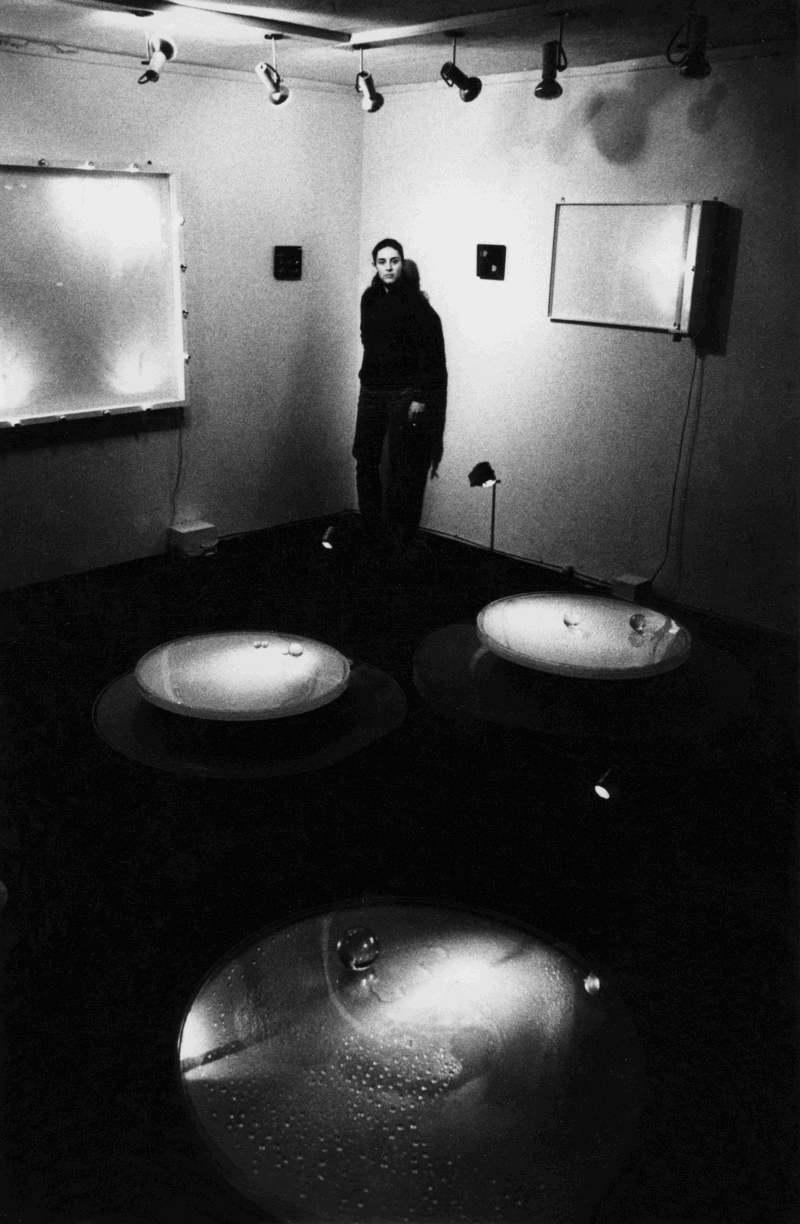
In the summer of 1959, I visited Madrid and spent a week in the Prado. My favourite work there was the Hieronymus Bosch, The Garden of Earthly Delights (1490–1510). I loved his wild and prophetic imagination; his translucent globes and strange fruit fountains. I spent days analysing its composition. I thought Bosch had arranged all the elements in the triptych into triangulated segments, each segment related to the others, in a magical connective web.
The beginning of my interest in geometry stems from imagining a web of interconnected triangles in The Garden of Earthly Delights and was a way of abstracting and ordering, thus emptying of emotion, the myriad of mad and fantastic forms and creatures that teem in Bosch's masterpiece. Had you not met Takis at such an early stage of your career, do you think you would have still been a sculptor or would you have concentrated on painting and drawing? I don't think I became a sculptor in the classical sense. Soon after I met Takis in 1959, he came to visit me in my small apartment in rue Chanoinesse, where I had started to paint on jigsaw puzzles. I would take the puzzle apart and then paint each piece, as if it was separate and unconnected to the other pieces of the puzzle and then, once they were all painted, I would try to put the puzzle together. Takis saw my first attempt and he was very impressed. He said I was attempting to do the impossible. He suggested I try something similar in three dimensions and taught me his technique of lost wax. But, although I made a three-dimensional puzzle in wax and Takis had it cast for me in bronze, I never completely finished it. Perhaps it was too solid, too sculptural. Instead I focused on a particular technique of drawing that had been suggested to me by the Italian painter, Gianni Bertini, on seeing my early drawings. This technique involved rubbing Crayola wax crayons over paper and then applying a wash of gouache. The Crayola acted as a luminous resist revealing landscapes and clouds transforming into strange floating creatures. I had seen an exhibition of horizontal Chinese scrolls depicting huge landscapes in which people and their palaces were not drawn as central to the picture but seen as a small part of the natural environment. I liked their way of viewing the world and the horizontal format but I was more interested in the sky and called my works, Skyscrolls. In both these instances, I began to work as I would continue, exploring new techniques to find my own vision.
This was the beginning of our friendship, in the spring of my first year in Paris. Takis was 15 years older than I was and vastly more experienced. He and I began living together in the autumn of 1959. He was making Signals in a blacksmith's shop, while I worked in the apartment we shared with his assistant, Raymondos, who played the piano in the dark and carved black wooden angels. In the summer of that same year, I spent some time alone in Greece. Because I intended to work there, I took a few of these scrolls with me. In Paris and in Italy, where we spent the summer, with a select group of artists and poets, at Caresse Crosby's 3 Castello di Roccasinibalda, they had seemed quite luminous but in the very bright, clear light of Greece, they appeared less vibrant and quite flat. I began to think that was why the Greeks favoured sculpture. When I returned to Paris in the autumn of 1960, I knew that I would need to find a new way of working.
I was drawn to light, fascinated by luminous reflections and shadows. I began to explore new materials and technologies in a conscious effort to ‘work with the source of light’ and started reading books on optics and physics. I particularly liked the diagrams and photographs in the monthly journal Scientific American. Two issues of that journal stand out even now: an entire issue devoted to Light and another to Material Science or solid state physics. I was fascinated by the discovery that light was both wave and particle and that those particles were called photons. I dreamt of capturing photons.
Soon after I went to New York, where I decided to spend a few months living and working on my own to get out from under Takis’ shadow. His influence on my development as an artist and as a human being was important but daunting. Although he tried to encourage me, he was also jealous of my early successes. I concluded that the most important thing I could learn from him and from his work was to aim for invention rather than expression. You met members of the Beat generation through Takis. Gregory Corso came to visit and looked carefully at my numerous Sky Scrolls that Takis had hung on all the walls. Gregory gave me a copy of Bomb and Sinclair Beiles gave me Minutes to Go, my first encounter with cut-ups. Iris Owens, an American novelist, who penned the infamous Harriet Daimler series for Olympia Press, introduced me to William Burroughs. When I had my first exhibition in 1963 at Gaït Frogé's La Librairie Anglaise on rue de Seine, Brion Gysin was exhibiting his calligraphic paintings at Galerie Stadler just across the street. Burroughs came into the bookshop and told Gaït to ask me to come and visit him at the Beat Hotel. Having read André Breton's Entretiens, I had already been introduced to ‘automatic writing’ and the Beats’ cut-ups were an update on it, a new tool facilitating chance apertures to new paths of thought. My Poem Machines, first made in 1962, behave like automated cut-ups, allowing a reading of the text freed from its syntax, when their speed of rotation was slow enough so that the words could be deciphered. On seeing them, William Burroughs told me that he wanted to get his words off the page and asked me to try. How did your involvement with the Beats affect you? I am sure that my contact with the Beats was one of the liberating experiences in my early years, although I came from a very open and uninhibited family. My parents, both Russian and Polish Jews, did not keep their feelings or their thoughts to themselves. It was not until I went to school that I found out that other people were not quite as direct and voluble as I was. So my education was inhibiting. In fact, I think that, when I first found myself in Paris, the intellectual excitement and the overwhelming and contradictory feelings I experienced led me to shy away from expressing feelings through my work and focus on materials and energies in their purist form. This was taking very much an opposite direction to the Beats, although I felt attracted and inspired by the ease with which they passed from one discipline to another. They moved from painting to poetry to film and used them interchangeably. Their interests, much like the Surrealists, were broad and included all areas of science, economics, medicine, new and ancient cults and religious or philosophical beliefs. To be simply a painter, a sculptor, a poet, to keep within narrow frontiers seemed then to me to be limiting and stultifying. Tell me about your experiments with industrial material. Early in 1960, I came down with a nasty kidney infection and stayed in Geneva with my father to recuperate. Once recovered, it was thought that mountain air would help me regain my strength. I spent a couple of weeks in Val d'Isere, in the French Alps, where I met and became friendly with one of the skiers of the French Olympic Ski team. He used what was then a new proprietary polymer-based ski-wax ‘Tefon-Stift’ and observing him wax his skis, I thought this might be an interesting material to experiment with. Burning these like candles, I dripped and spattered the molten wax-like material on to paper and realized that by vibrating the stick I could extrude fine filaments, thus drawing in the air with molten material that I then deposited firstly on paper, then wood and finally on clear Perspex sheets. I could embed the plastic fibres by melting them into the Perspex sheet, using a small torch that Takis had given me as a present, and they would cast shadows through the clear Perspex onto the wall. The shadows multiplied the lines I created. The doubled lines moved when I did and their motion brought interaction to the work. It was thus that I first became a kinetic artist. My interest in becoming actively involved, when observing the results of my work, led to my involving the viewer in precisely that kind of active looking. I called the first works on paper Starspace (1959–60) and the works on Perspex that followed Firelines (1960) (Figure 2). Fire Lines (detail), 1960. Teflestuck on Plexiglas.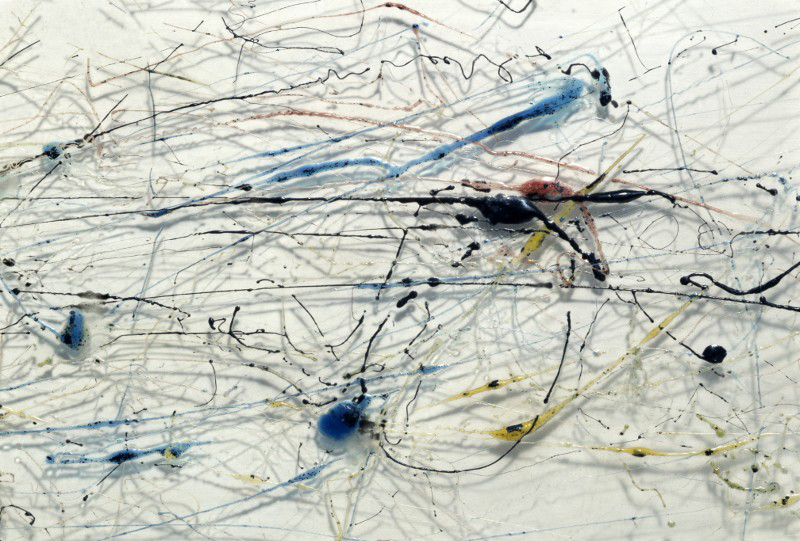
From 1960 to 1962, when I gave birth to my son Thanos, I moved in between Paris and New York. On Canal Street, I discovered Industrial Plastics: a whole building selling all kinds of plastics, Perspex both in sheet and block form, as well as all sorts of recycled nylon tubes and polythene bottles, boxes full of brightly coloured plastic bits and pieces. I became friends with the owner, Max Landau, who on hearing that I could not find a studio, offered me a space in his warehouse and carte blanche use of all his machinery and plastic materials. I began by burning and melting different kinds of plastic to see how they reacted when molten but soon realized that the ‘Tefon-Stift’ that I could buy in many colours was more interesting because I could draw with it in the air. This was a turning point in the way I worked. I began to actively research materials, to explore how they behaved under different conditions and to find out what I could do with them. In the six months I spent there, I began my series of Drillings and Cuttings, using a circular saw to slice into sheets of Perspex, drilling holes into Perspex blocks and discovering that cavities made in a transparent material appear as solids, thus reversing the way we perceive reality. Working with larger blocks, I stressed the material by injecting acetic acid into the holes I had drilled and attacking them using a screwdriver and hammer. This produced haloes and tiny air bubbles inside the blocks. I used repetitive elements or actions (drilling) to generate an energetic vibration in the material. I was interested in the shadows cast by the empty holes, which transformed the negative spaces of the drilled holes into positive forms, creating the illusion of solids. I felt I had created an architecture of the void.
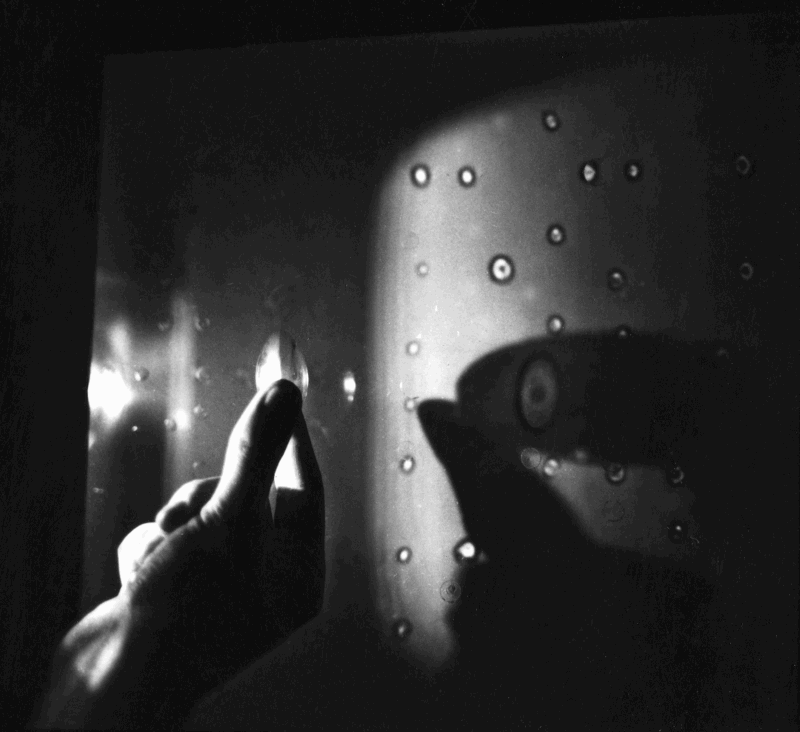
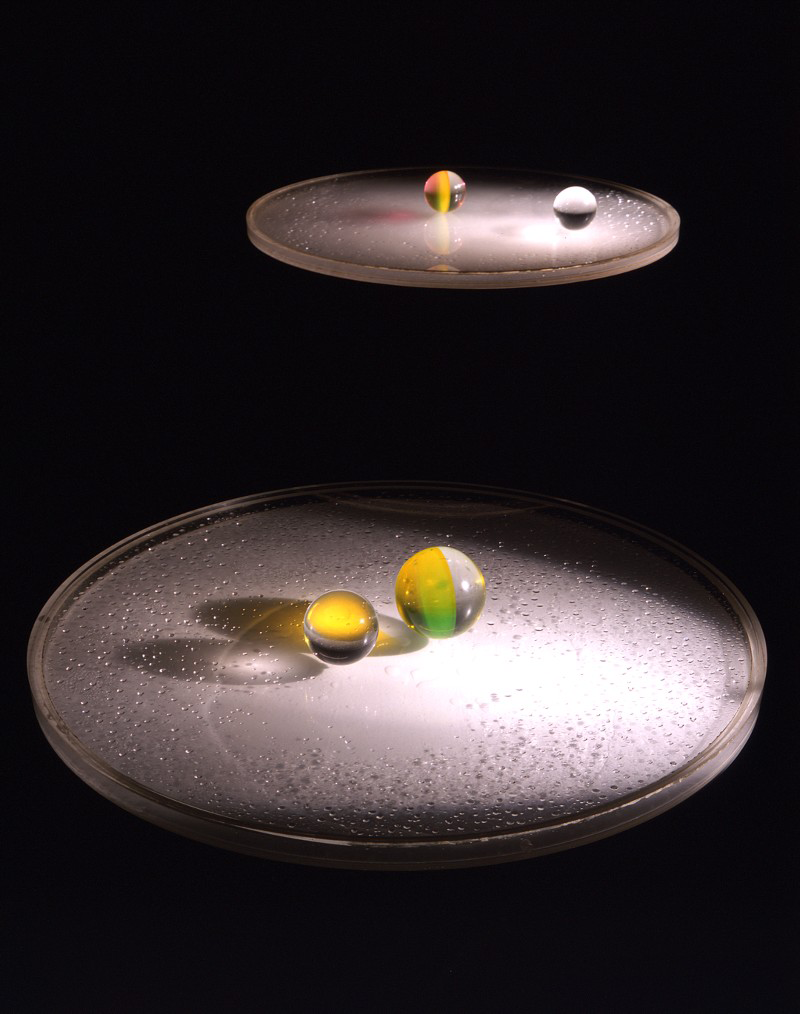
Experiencing headaches from the ‘Tefon-Stift’ fumes, I went to the leading US Perspex manufacturer, Rohm & Haas, and bought liquid polymer in bulk. With this clear acrylate polymer, I created surfaces that projected luminous reflections similar to cellular life forms. I wanted to see coloured reflections without using coloured pigments, to create what I called invisible colour but the solution involved such complexity of means I decided, instead, to move away from the informal organic reflections to more geometric forms by making my own clear lenses. Leaving New York in 1963 to live again in Paris, I continued working with nine centimetres thick blocks of Perspex on the surface of which I made perfect lenses, using a hypodermic needle filled with clear polymer (Figure 3). I designed a light projector with a revolving glass lens that, when illuminating the lens patterns I had made on the Perspex blocks, caused them to appear to move and double or split themselves. I called these Echo-Lights and their effect was a vision of particles of light, photons made visible. I felt I had captured the essence of light. They were shown, with Cuttings, Le Vibrograph and Poem Machines, in my first solo exhibition in November 1963 at La Librairie Anglaise. All these ideas were brought together in Liquid Reflections, one of which is in Tate Britain. It is described in the Tate catalogue as a Perspex drum filled with water and liquid paraffin; the condensing water vapour creates a profusion of droplets, which are picked out by a beam of light as the turntable revolves. The earliest were without balls and you only began to place Perspex balls on the rotating surfaces towards the end of I966, starting with ones, which were clear and colourless. Your first piece using balls was exhibited in the Salon Comparaisons in Paris in February 1967 and was bought by the Musée d'Art Moderne de La Ville de Paris. Over the two years I967–8, you made a number of works of this type of varying sizes with one, two or three balls, but only began in 1968 to use balls that were partly coloured. You intended the ingenious inclusion of a fluorescent plane of colour within the balls, primarily, to call attention to the rotation of the balls, but it also introduced a note of colour. This is the work that most people know you by. Can you tell me about the making of this series of works? It was only on coming to London in the autumn of 1966 that I really began to develop the diverse strands with which I had been experimenting in Paris, New York and Athens. London was still a city where small engineering and manufacturing companies could be easily located. It was in London that I was able to make the first Liquid Reflections (1966–68), in which I not only explored light in the form of reflections and shadows, but also gravity and forces similar to those that govern the cosmos. (Figure 4) Liquid Reflections was the final development in experimental works that began five years earlier with my experiments with liquid polymers. 1n 1962, I wrote in a notebook: Echolights, 1963. Perspex block, acrylic polymer, projector with rotating lens. Liquid Reflections Series 2, 1968. Perspex drum containing water and liquid paraffin, acrylic balls, spotlight, motor. Photo: Liliane Lijn.
‘Instead of plastic lenses on the outer surface there are other alternatives. ‘1. In a transparent cavity already fabricated inside the Plexiglas or oil or both … '
4
It was at this point that my method of working changed quite radically, because up until then I had always made all my pieces by myself but I was not equipped to fabricate the shallow Perspex drum that I now needed. The step I took then to draw up what I wanted and approach a small factory was the beginning of a new way of working, which would prove to be important as it opened up possibilities of working in many different mediums at once and liberated me from the most elementary technical problems, allowing me to concentrate on developing my ideas.
This first drum containing water was in fact the prelude to Liquid Reflections. I exhibited it at Kunsthalle in Berne in the summer of 1966 in the White on White exhibition curated by Harald Szeemann. Later that summer, while conversing with friends in the sunshine, I happened to play with some large clear marbles. I was fascinated by the pure beam of white light they threw as they moved across the table, the intense focal point that refracted through them and I decided to experiment with similar balls on a rotating white surface. On my return to Athens, where I was then living, I found I only had the work that had been shown at Berne Kunsthalle, still containing the water paraffin mixture. When I placed two clear Perspex balls, bought on Canal Street five years earlier, on the surface of the spinning drum, it was as if a new world was revealed as the balls slid across its dewy surface, magnifying the changing reflections and shadows created by the water inside the drum. In the autumn I moved to London, where I found a Perspex fabricator and a small engineering workshop to complete Liquid Reflections and subsequently, in February 1967, exhibited them at Indica Gallery. Did that exhibition also include your Poem Machines? Can you tell me more about how they were developed. No, for some reason, it didn't. At Indica I showed an installation of five Liquid Reflections in the centre of the space, Cosmic Flares and my first works with prisms on the walls and the first cylinder works that were, in part, objets trouvés.
While living in Paris in 1963, I visited Le Palais de La Découverte.
5
I was also reading about optics, physics and astronomy and was particularly interested in early experiments made by the French physicist, Augustin-Jean Fresnel. There was one experiment with light interference that I wanted to try to make myself. Using two cylinders on which I had painted three columns of parallel black lines, I made them revolve at the same time at a constant speed. I was amazed to see the lines vibrate in spectral colours. I called this work Vibrograph and it was one of the works in my first exhibition at La Librairie Anglaise (Figure 5).
Liliane Lijn at Librairie Anglaise, 1963. Installation view with the artist at her one woman show in the Librairie Anglaise Gallery, Paris 1963. Photographed with Vibrograph and Young Universe. Photo: Jean Loup Charmet.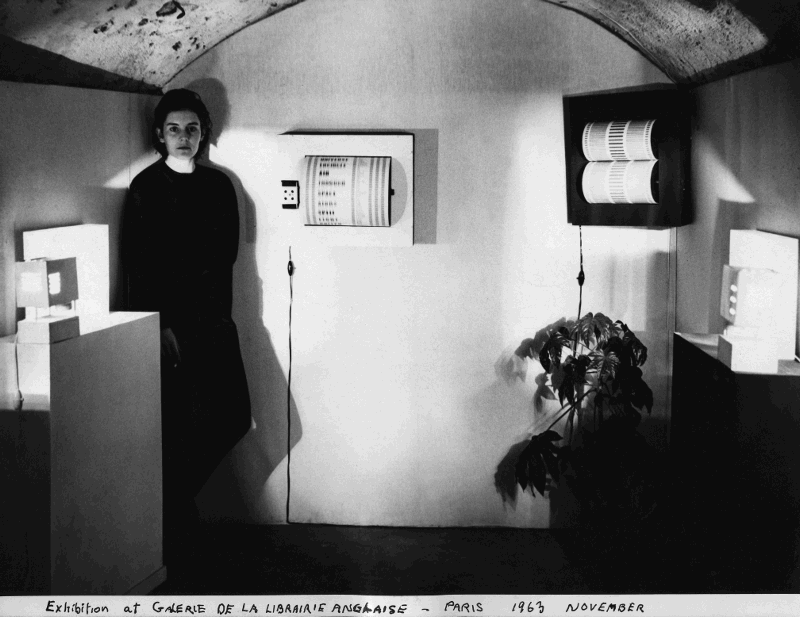
Since letters were also made from lines, I wondered what kind of vibrations spinning words couId make. I started with the alphabet and then thought of using random texts culled from newspapers. Nazli Nour, a British poet friend, suggested that I use her poems, since she wanted them to move. I wondered how, since her poems were literally pages long. Nazli casually encouraged me to cut them up and choose sections of her poems as material for my Poem Machines, which were later much admired in Concrete Poetry circles (Figure 6). John Ashbury, then the Paris art critic for the New York Herald Tribune, wrote: “Her Vibrographs are wheels revolving too fast for you to read the words printed on them, but perhaps they influence you unconsciously like subliminal advertising.” I believe Nazli Nour was distressed at the way the rotating drums made the words impossible to read directly but that you re assured her that “they would communicate subliminally.” What disturbed Nazli was that her spinning poems were illegible but my reaction was that this might make people more curious to read her poems. My intention was to transform the written word into the energy of sound. The Poem Machines began as cylinders but quickly evolved into cones. In Paris and in Greece, where I went to live in 1963, technology was not easily available. In Athens, I could not find a source of Perspex and made the mistake of trying to reuse many of the Firelines works. Hunting for materials in a town where distinct neighborhoods were dedicated to selling particular goods, I came across a street selling everything for cars and trucks. I loved the cylindrical oil filters on display in shop windows and thought I might be able to use these to make Poem Machines. I also found used and battered filters in Monastiraki.
6
I left one on a small turntable in the sun. It was wound with silver wire and had a dent on its surface. When it revolved, the sunlight formed a line across the silver windings and the dent appeared as a wobble of light. I saw light dancing on that cylinder and thought I could develop that. Get Rid of Government Time Poem Machine, 1962. Letraset on painted metal drum, plastic, painted metal, motor. Words from a poem by Nazli Nour. Collection Stephen Weiss.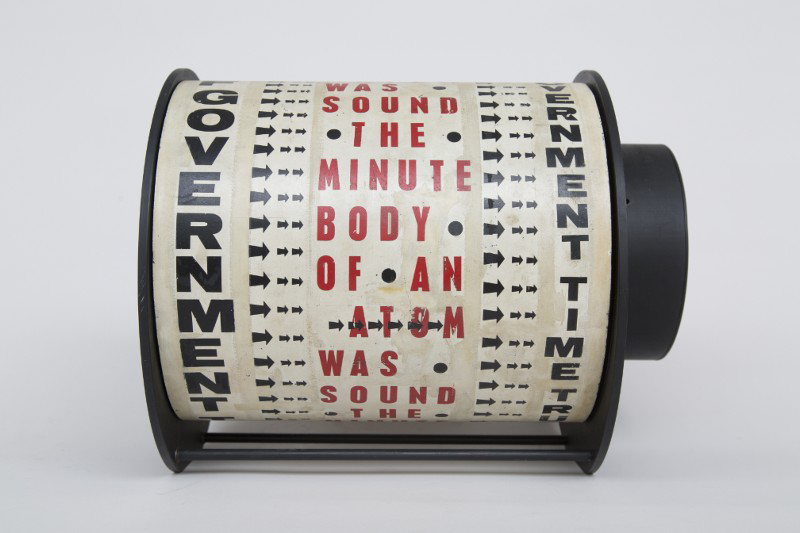
In Athens, I also found small woodworking shops, where I could get cones turned out of solid wood. I had realized that if I printed words onto cones instead of drums or cylinders, the changing diameter of the cone would alter the apparent velocity of the word, meaning that the Letraset words appeared to move at different speeds on the same cone. When I returned to Paris in 1965, I began to use cork cones. I started again with the alphabet, rubbing white letters in no apparent order on a painted black background, ABC Cone (1965), and then decided to use a poem by a young American poet I had met in Athens, Leonard D. Marshall, whose beautiful, unpublished poems were so short, I had been able to memorize them. When spoken, they had a very musical sound, a rhythm that I wanted to emphasize on the Poemcon. In order to do that, I decided to use repetition and spacing. The result was Sky Never Stops (1965) now in the collection of the National Art Library at the Victoria and Albert Museum (Figure 7).
Sky Never Stops Poemcon, 1965. Letraset on painted truncated cork cone, motorized turntable. Poem by Leonard D. Marshall. Collection National Art Library, V&A Museum.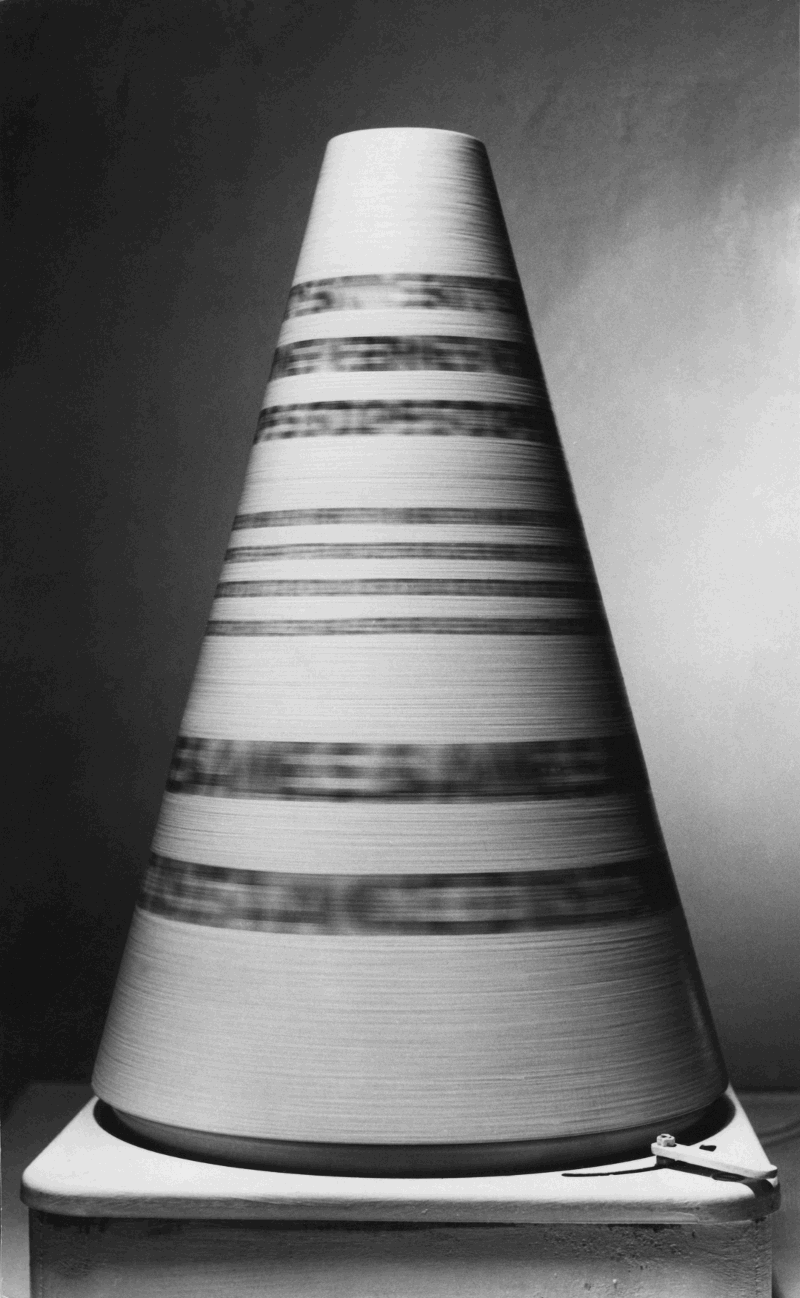
When a Poemcon spins, words printed around the circumference of the cone disintegrate into a blur of colour. At high speed they become a band of colour. A wave band. Colours are narrow bands of reflected light and all materials communicate through the media of spectral bands. Deciding that colours communicated like words, I painted bands of colour on cork cones similar to those I had used for words. When these revolved, the colour pulsated with energy. I called these works Hiway Cones (1965) because they were inspired by the striped cones lining the roads. I would put a cork cone on a turntable and make it spin. Then, using a brush, I laid colours on the spinning surface. The colour stripes were a memory of motion. I made a red and white striped cone and a yellow and white striped cone. Both referred to signal cones on roads. Then I also made some multi-coloured striped cones. The numerous bands of colour reminded me of the rings of Saturn. The cone is an astronomical form. It is the form taken by all emission. Both light and sound radiate along a conical path.
Colour and words became interchangeable for me. I saw colours as language. That was, incidentally, also when I discovered the importance of prisms. I had found a shop on the Boulevard Beaumarchais that sold second hand optical equipment and initially went there to buy lenses for the projectors I had designed for Echo-Lights. The first time I went there, I was dazzled from across the boulevard by a pure blue brilliance that made me stop and cry out. As I moved, the light filling my sight became green and then yellow, orange, red. The change of mood I felt was instantaneous. In the window of the second hand optical store, displayed along with model locomotives and loose camera lenses, were trays of optical glass prisms of varied shapes and sizes. I knew then that I had to work with prisms and sunlight but I did not know how to control the sun. That came much later during my ACE, NASA, Leonardo Network artist residency at the Space Sciences Laboratory at the University of California, Berkeley in 2005.
In 1968, I came across a boat builder in Plymouth, who worked with glass-reinforced polyester. I used fibreglass to make hollow cones, that were cut into elliptical sections and then sandwiched with various thickness sheets of fluorescent Perspex. A great deal of study went into deciding on the relationship between the Perspex planes, which appeared as lines on the finished white cones. These were lit from inside and motorized to spin at a precise and constant speed that allowed the viewer to focus on the luminous lines. The lines appear to move through the cone while the spinning cone appears immobile. The viewer, immersed in a dance of form, no longer perceives the cone as a material volume. Since the cone turns and the viewer remains in the same position, the luminous lines dissecting the cone give the viewer information about form and surface in a continuous flow, unlike an object around which the viewer has to walk, and where the viewer's perceptions are discontinuous. I called these sculptures Koans: Anti-Gravity Koan, Space Displace Koan, Exit Matter Koan (Figure 8). Their titles give you the gist of the ideas I wished to convey through them. The word ‘koan’ is Japanese and describes a riddle without a solution. Koans were given as meditation exercises to Zen monks. The Koans were first shown in London in 1970 in my solo show at the Hanover Gallery.
Anti-Gravity Koan, 1969. Perspex, fibre glass, turntable, fluorescent light, motorized turntable. Collection Mme Boissonas, Flaines Cultural Centre.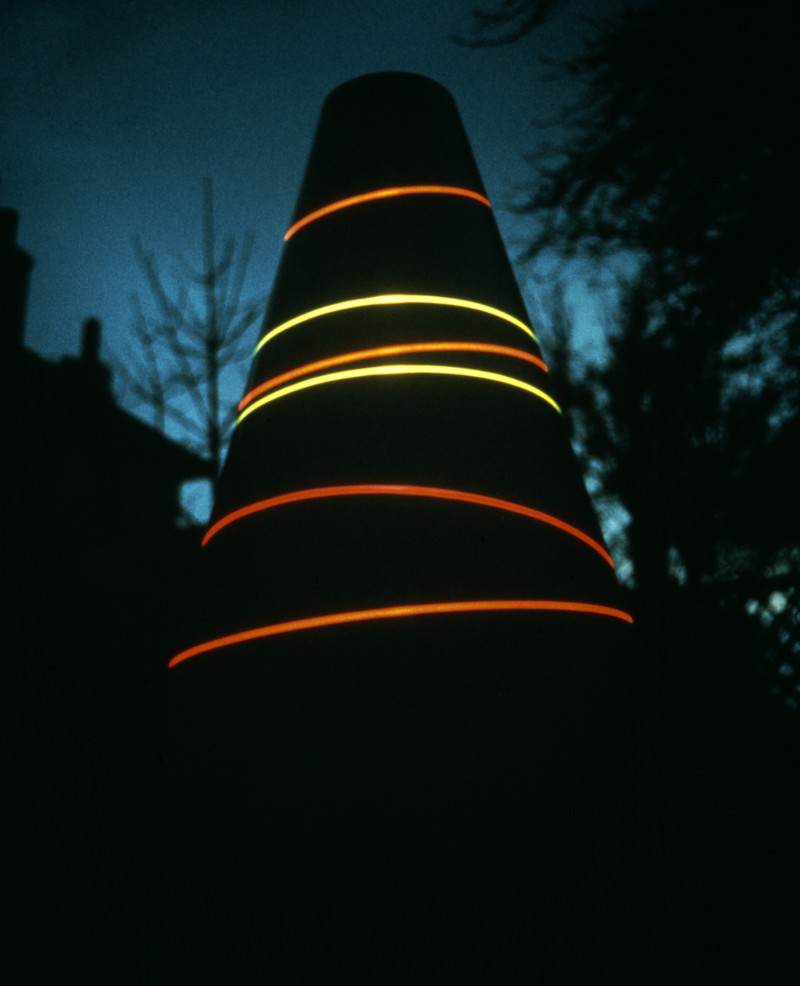
Footnotes
Disclosure statement
No potential conflict of interest was reported by the authors.
Notes on contributors
1
First Automatic Writing was possibly in: Soupault and Breton ([1920]  ).
).
3
Caresse Crosby was the most inspiring woman I have known. I first met her in 1960, when she was 70 and I was 20. She had invited Takis and I to stay the summer in her castle north of Rome, the huge Castello di Roccasinibalda, where she held court over a changing group of artists, poets and guests from the world of fashion. She had met Takis in Greece, some years earlier, and helped him to leave Athens and live in Paris. Hers was a long history of patronage to the arts. She was a free spirit born into an aristocratic American family. She invented the brassiere in 1913 when she was just 21 and sold the patent, she told me, to Warner Brothers. In the 1920s, she and her husband, Harry Crosby, founded the Black Sun Press, publishing the early work of authors including T.S. Elliot, James Joyce, Henry Miller and Anaïs Nin.
4
Notebook marked N63 017.
5
Le Palais de La Découverte is the science museum in Paris.
6
The Athens flea market.