







Abstract
Addressing complex future challenges requires transdisciplinary practices. However, existing approaches for transdisciplinary collaboration tend to be limited to science-expert directions. Successful collaboration across disciplines and diverse contexts requires community agency, blurring disciplinary boundaries, and combining sciences and arts. We argue that traditional and emergent design practices provide a powerful mindset to support productive transdisciplinary collaborations for addressing complex societal problems such as climate change and social justice. Designers, historically, have struggled to translate the practices of arts and sciences into professional practice; and design can be understood as a third way of knowing that is unique from arts and sciences. Designers may use evidence, but they also generate proposals that are about preferred possibilities. We propose components of a design mindset (synthesis, modelling, speculation, facilitation, and implementation) for transdisciplinary teams to enhance future-oriented collaboration outcomes. These guidelines expand research-oriented approaches and can be used for co-designing futures in collaborative work.
Introduction
In 2021, the lead author engaged with two colleagues with health expertise in a project called ‘designing the primary care of the future,’ and we brought this challenge to a course with students from different creative fields. Health experts usually follow an analytical approach, using evidence-based sources (e.g., existing public health research or data) to design for the complex problems of the future. In this transdisciplinary team, we discussed that evidence alone would not support the goal of imagining desirable primary care futures. We used what we call a design mindset to leverage multiple disciplinary tools such as analytical thinking, evidence, creativity, intuition, speculation, and others. Health experts further came to understand in the process that evidence-based analytical thinking alone would not get them where they wanted to be. Later, they were eager to intuitively explore ideas while bringing evidence to the process to prototype and evaluate ideas. The team embraced a design mindset to address the complex challenge of imagining the future of primary care.
In the above vignette, we provide an example of a transdisciplinary collaboration – a collaborative approach to addressing complex challenges or innovation endeavours that span disciplines, involving varied types of disciplinary experts. Disciplines are divisions of knowledge metaphorically referred to as tree branches (Malina, Strohecker, and LaFayette 2013) departments within academic institutions (Wallerstein 2004), institutions seeking to establish the foundation of truth (Foucault 2005), or cultures with their own foundational texts, languages, symbols, values, and ecosystems (Leach 2005). In the 1970s, interests in educational reform sought to challenge the divisions in academia and spurred discussions of transdisciplinarity. A robust interest in the application of transdisciplinary thinking to complex problems inside and outside academia started in the 1990s (Bernstein 2015). Transdisciplinary work is not a simple collection of practitioners from different disciplines, but a relational synthesis of the participating disciplines (Max-Neef 2005) where collaborators create integrative conceptual frameworks. Given the increasing interest in transdisciplinary collaborations for addressing futures and future-orientated problems, it is imperative to consider mindsets that can support such connections across disciplinary boundaries.
Transdisciplinarity has been mostly considered in research activities. However, transdisciplinary work not only crosses disciplinary boundaries but also sectors of society (Lang et al. 2012). Transdisciplinarity may be approached with close or distant disciplines, or similar or disparate language structures and expectations (Mejía et al. 2020). For example, two different arts (dance and theatre) or two sciences (biology and physics) collaborating will have different relationship challenges as compared to a collaboration between artists, scientists, and others. Within this context of disciplinary diversity, design arises as its own unique discipline, with its own affordances of practice, because it is associated with both arts and sciences and focused on practical action in context. In this article, we propose that core design components – skills, competencies, approaches to practice – constitute a powerful mindset that may enhance successful, collaborative, transdisciplinary future making.
Design is a broad and expansive field of practice and research. Kimbell (2011) noted that traditional definitions associate design with either a form-making activity using physical objects as outcomes or a future-orientated/situation-improving activity developed from Herbert Simon's work on The Sciences of Artificial (1969). However, the design field keeps changing. There is an exchange between design disciplines (Dykes, Rodgers, and Smyth 2009), outside of design disciplines (Dorst 2018), and beyond the professional design action from the studio to social practices (Kimbell 2012). The expansive atypical areas of design application include, among others, designers working in public sector innovation (Björklund et al. 2019), helping educators overcome bounded framings to address their problems (Henriksen, Richardson, and Mehta 2017), using design as intellectual capital for organizations (Gallego, Mejía, and Calderon 2020), and many others.
Other disciplines have also utilized the term design and related terms to reframe their practices. Notably, applied behavioural scientists have positioned terms such as choice architecture (Thaler and Sunstein 2009) or behavioural design (Datta and Mullainathan 2014) to argue that behaviours can be designed to address complex problems in policy by applying behavioural insights in interventions that nudge people towards preferable behaviours. While behavioural design has captured excitement in many disciplines, this practice works only in narrow and discrete problems and conflicts with the systemic nature of practices in the design field (Mejía 2021). Marres, Guggenheim, and Wilkie (2018) criticized the idea of ‘designability of social life’ in fields like applied behavioural science because it deems society as a passive object that experts can optimize. They proposed the concept of inventive social research to use participatory creative explorations – sometimes informed by art and design – to make visible social phenomena or activate latent social processes. Both behavioural design and inventive social research incorporate components of design practices; however, their purpose and approach preserve aims, methodologies, or mindsets of natural or social sciences.
We argue that design is a powerful mindset, different from science or art mindsets, that collaborators from disparate disciplines can use to address complex challenges of the future. While design is a dynamic and changing field, professional designers and humans practicing design develop distinctive core attitudes and ways of thinking and making that are neither science nor art. Design has fundamental knowledge and ways of being and working that are increasingly used by and with other subject experts and fields (Dykes, Rodgers, and Smyth 2009). We argue that some foundational aspects of design practices, skills, and attitudes form a unique design mindset, which can transfer to non-professional designers and support transdisciplinary teamwork around complex future-oriented problems.
In describing and discussing this mindset, we emphasize the qualitative principle of ‘transferability’ of an idea. Transferability speaks to the degree to which proposed ideas or findings might transfer (not generalize) to other contexts or settings. Since the responsibility for transferability is upon the consumer of research to determine how ideas connect to other settings and could or should be adapted in their own setting (Lincoln and Guba 1985) – we have tried to support such transfer through thoroughness in describing and elaborating on the components of each mindset (albeit in broad terms, as drawn from a range of design literature) and the theoretical foundations central to this work. Transferability suggests that there are no absolute formulas or common solutions to most situations. Rather, here, we suggest that each team or transdisciplinary group may interpret the utility and application of design mindsets to contextually determine their best practices. Thus, in transferring results or ideas from such research, there are opportunities to combine ideas, and refine, develop and alter these practices (Lincoln and Guba 1985). To this point, following our discussion of design mindset, we exemplify these ideas in an example of a transdisciplinary project on air pollution (in section 4), to ground our ideas in a context, while also acknowledging that these mindsets might play out differently across a range of contexts. As Miles, Huberman, and Saldana (2014) note,
the events and processes in one setting are not wholly idiosyncratic. At a deeper level, the purpose is to see processes and outcomes – to understand how local conditions qualify them, and thus to develop more sophisticated descriptions and powerful explanations. (101)
We are a group of six co-authors that represent diversity at many levels including race, gender, country of origin, native language, and academic disciplines – from design to education, film, astrophysics, and sustainability. We have worked as part of interdisciplinary projects in areas including health and sustainability which we use as the basis for this paper.
In this article, we first briefly review the disciplinary characteristics of sciences and arts as a basis to understand differences in disciplines. Following this, we review the discipline of design with a particular emphasis on how designers work – design components. Then, we discuss the current general concepts of transdisciplinarity and major principles and approaches. Finally, we propose the design mindset for transdisciplinary collaboration practices.
Sciences and arts
In examining disciplinary foundations, what constitutes the arts and sciences and how do these differ from design? In ancient Greece, some scholars studied episteme and some techne; scientific disciplines originate from episteme (understanding) and artistic disciplines from techne (making). Since their formal institutionalization in both industry and higher education during the eighteenth and nineteenth centuries, the disciplines have been recognized not only as branches from the same ‘tree’ of knowledge (Malina, Strohecker, and LaFayette 2013), but also as communities of practice with their own rules, practices, and claims to membership (Wenger 1999). These disciplines then can evolve into professional identities and cultures with ingrained beliefs, values, rituals, customs, languages, symbols, and foundational texts which can generate a worldview (Frodeman 2014; 2017).

Scholars and practitioners from other broad disciplines have defended their discrete cultural identities. Examples of this include engineering as distinct from science (Downey and Lucena 2004), education, and teaching as a way of experiencing the world (Dewey 1923). Awareness of lens, values, and methods can be useful for synthesis across domains of knowledge, teams, and work. This is particularly useful in transdisciplinary collaborations in which a design mindset can enhance the results and ameliorate the challenges that emerge when priorities, interests, and practices collide within and among a collaborative group.
Design has always been a future-oriented discipline – artefacts are designed in the present and enacted in the future. Notably, Simon's (1969, 130) definition of design describes its purpose as ‘changing existing situations into preferred ones.’ This carries an inherent futuristic sensibility, as a forward move from something that exists, to something that does not yet (but should). Design scholars have shown a focus on long-term futures in design practices (e.g. Irwin 2015), sometimes seen in the expansive scope of design challenges and the interest of other professional disciplines in design methods to address complex challenges. To understand why and how design mindsets are valuable to transdisciplinary approaches in projects that address the complex challenges of the future, it helps to understand design as a method and way of being, as well as its own transdisciplinary nature. Design is neither purely a fine art nor a pure science – it sits in its own territory. While design is highly context-sensitive, it often blends the arts/humanities and sciences to develop its own ways of knowing (Cross 2006). It is not fine art because designers must not only consider aesthetics but also practical goals, such as utility, influence, communication, or social significance (Frascara 1988). Design is not a science because the aim in design is to work on ultimate particulars or unique proposals for every project and the specific needs of the context (Stolterman 2008), as opposed to general knowledge. Design can be understood as an integrative discipline. Buchanan (1992) argues that designers select and integrate relevant knowledge from both the arts and sciences. When designers address a problem, they select relevant knowledge from different fields or seek expert support to make decisions in the design process. For example, when designing a health product/system, designers integrate knowledge from public health, user experience, information systems, or other areas to make design proposals. Because of this integrative characteristic, Buchanan considers the discipline of design as the ‘new liberal arts of technological culture.’
Cross (2006) argues that design is a third way of knowing, different from (a) science and (b) art/humanities. Cross’ work popularized the term ‘designerly ways of knowing.’ This term denotes how design has particular ways of knowing, thinking, doing, and being that are unique to professional designers and foci that set design apart from science or the arts. In Cross’ work, design is about appropriate conception and modelling in the artificial world (anything that falls outside of the natural world – i.e. anything created by and through human artifice and design), which are not the aims of science or arts/humanities. The term designerly ways of knowing speaks to attributes, epistemologies, and ontologies that define the domain of design. It also characterizes the quintessential ways of working and thinking of designers. The term ‘design thinking’ is also used to characterize aspects of how designers operate, but it is commonly used in reference to cognitive skills and thinking processes associated with design work (Kimbell 2011; 2012). Although the term design thinking has become widely-known because of current popular models for design processes (i.e. the Stanford d.School model or others), it is also used broadly to describe how designers think and problem solve (e.g. Dorst 2011). These different terms, while unique in their own ways, share some overlap and are in certain contexts used interchangeably. We assert that knowledge of design mindsets is a valuable tool for all disciplinary experts and communities in transdisciplinary collaborations.
Mindset, as a concept and a term, is used across academic and popular literature. While there is not absolute coherence across the literature on a singular definition of mindset, there is some synchronicity between most common definitions. Mindset as a common term of language is often used to denote ‘a person's way of thinking’ (Cambridge, n.d.). Thus, as a general rule, it is a term that speaks to a person's worldview, and often, their capabilities, capacities, skills, and methods for or orientation to thinking and working. In scholarly literature, qualifiers are often added to this common construct, to denote specific forms of mindset (e.g. growth mindset, entrepreneurial mindset, etc.) (Ng 2018). Similarly, in decision theory or general systems theory, it refers to a set of assumptions, methods, or notions held by one or more people or groups of people (Savary et al. 2015). Specific types of mindset have been termed in certain disciplinary foci in the literature – e.g. an entrepreneurial mindset often refers to an orientation and ability to sense, act, and mobilize under uncertain conditions within entrepreneurial settings (Haynie et al. 2010). Our focus on the design mindset speaks to ways of thinking, working, and acting with a set of skills and capabilities of designers, which support the processes and practices of professional design. It can also be developed by any individual that hones design practices.
We use the term design mindset, instead of design thinking, to avoid the association with a step-by-step process. The design mindset is a particular mental attitude to address situations grounded on existing and contemporary research about how designers think and make. We hope that the design mindset is not about becoming design experts but adopting a particular attitude to address transdisciplinary work. While different design disciplines have distinctive social practices, our design theory references throughout are mostly based on the disciplines of interaction design, industrial design, communication design, architecture and service design. Other design disciplines share theoretical foundations, but they also develop other specific skills and ways of work that escape this review. Further, most references are situated in West Europe and North America, leaving out relevant work in other geographical areas and references in languages other than English.
The components of a design mindset
As follows, we identify the main components of design practices – or the main skills or competencies that professional designers use in the activity of designing. We then identify the salient practices, skills, and competencies in influential and contemporary literature.
Importantly, we must recognize that these components may not be universally applicable (or some more or less applicable depending on the context), because design is so variable across settings/contexts, and design practices are rapidly evolving, such that other components that are relevant to specialized design disciplines might not be included. It is impossible for us, in the scope of this article, to sort through or identify the range of different settings, situations, variables, and contexts that design might apply to (the range of possibilities for design work are nearly limitless). Further, we cannot begin to conceive of the entire range or scope of work that transdisciplinarity might touch upon. Since we cannot exemplify, qualify, or ground each of our mindset components in contexts that reveal the variety of ways they might play out – we acknowledge that each mindset is abstract from existing design literature and norms, and must be considered and adapted by different teams for the different problems, settings, disciplines or variables they are working with.
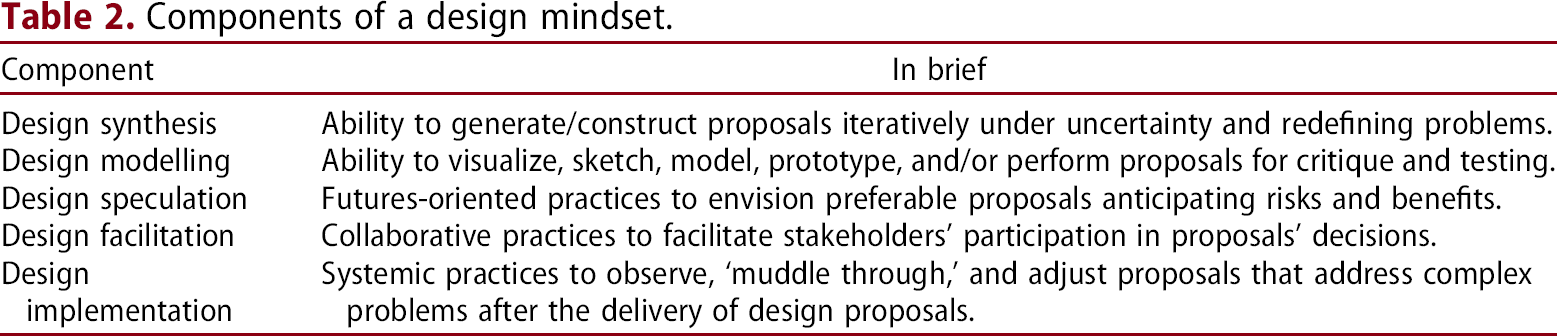
Components of a design mindset.
Components of a design mindset.
The high-level goal of designing is to generate something that did not exist or perform well before. Designers are expected to generate normalcy out of chaos. They engage in the process of finding appropriate, creative, and satisfactory solutions to problems or challenging situations. These solutions may take the form of tangible artefacts/products or intangible objects, services, processes, strategies, or systems. Synthesis is the major component related to design practice, as a cognitive style of professional designers. Cross (2006) contended that the ability to propose practical solutions using constructive/abductive reasoning is a key design skill. Dorst (2015) has expanded on the idea of design abduction. He proposed the concept of frame creation to explain the ability of designers to continuously reframe/redefine problems. Dorst's ideas of abduction and reframing may be associated with creativity; however, analytical thinking is also part of design synthesis because designers iteratively analyse, create, and reframe multiple times during the design process. Dorst and Cross (2001) theorized the concept of coevolution to explain that the problem and the solution coevolve in the design process, which shows that designers use both analytical and abductive reasoning in the process of design synthesis. A recent trend in prescribing design methods has created some confusion; for example, design thinking literature has highlighted ‘empathy’ as an analytical first step (Dam and Siang 2021). Although designers do empathize, empathy is integrated in the coevolution of problem and solution/proposal.
Since designers are open to emergent solutions or proposals in this coevolution, they become comfortable with the uncertainty of design synthesis. Ball, Onarheim, and Christensen (2010) describe how uncertainty motivates designers toward resolution through action, and it has been identified as a mediator between design requirements and the deployment of particular design strategies. This uncertainty is also present in Schön's (1983) description of design. Schön's work denotes design as part of human-centred professions that demand an epistemology of practice that designers must bring to situations of ‘uncertainty, instability, uniqueness and value conflict’ (1983, 49). Situations that require a mindset for creativity, flexibility, and a tolerance for ambiguity allow designers to engage with uncertainty while working with multiple possibilities for framing problems and prototyping solutions that will live in the future (Henriksen, Richardson, and Mehta 2017; Rylander 2009); in using these mindsets designers engage in Simon's (1969) fundamental view of design as moving from existing situations to a preferred future. Design synthesis is a component that describes the way designers approach situations using abductive reasoning to deal with uncertainty and reveal hidden meanings (Kolko 2010), while still allowing for practical proposals (see Figure 1).
Design synthesis. This graphic is adapted from Newman's (n.d.), who proposed it in the early 2000s.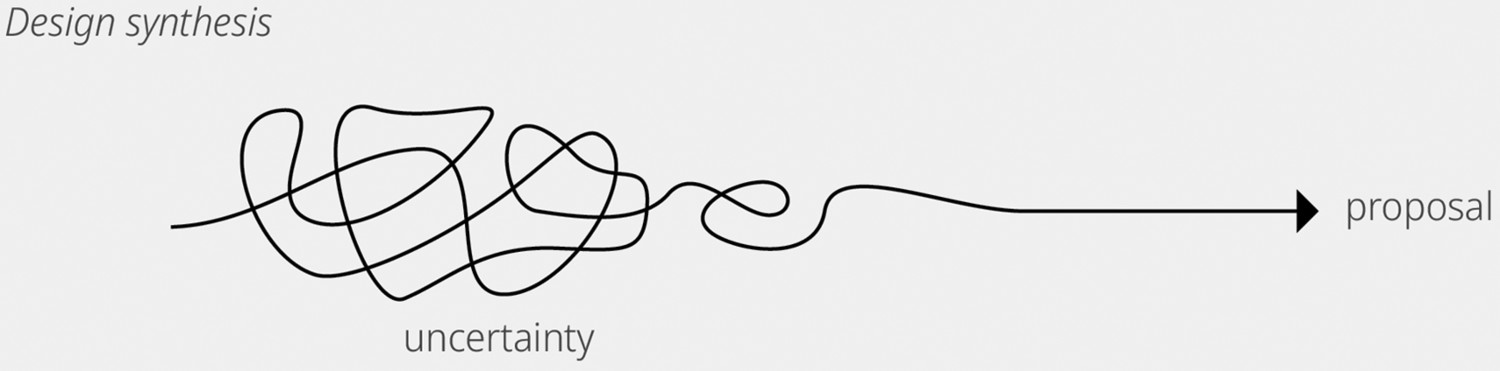
We do not suggest that the skill of synthesis (or any of these mindset components) is only used in design work. Rather, we note that it is a one of a series of skills/capacities that make up a profile of design mindsets and are fundamental to what designers do. We do not seek to stake-out synthesis as exclusively belonging to design processes; synthesis is, however, critical to design and is one of a set of factors that create a mindset profile of design practices (and is part of approach that is characteristic of design work) that speaks to transdisciplinary work. Root-Bernstein and Root-Bernstein (2013) describe synthesis as a core skill for transdisciplinary creativity – and because design practice focuses on creating or creative problem-solving across disciplines (solutions, ideas, artefacts) synthesis has strong prevalence/resonance within the design process, which is essential to transdisciplinary teamwork.
Designing is an embodied activity that depends on expressive gestures of drawing, sculpting, and enacting ideas. Designers think in sketch-like forms to make the abstract concrete (Cross 2006, 25). The concrete expressive artefacts produced in the design process are fundamental for design critique. Critique is a pedagogical and professional activity where designers and stakeholders discuss, assess, and negotiate interests and implementation. A disciplined designer uses sketching as a rigorous approach to exploration and iteration to connect design requirements (Stolterman 2008, 61). Some authors use the concept of prototyping to refer to this core component of design practices (e.g. Brown 2009). Design modelling shows the designers’ process of exploration and making designing concrete for stakeholders; models (sketches, visualizations, maps, prototypes) become tools for reflection, critique, testing, and coevolution (see Figure 2). Even when designers work on intangible outcomes, such as service design, they visualize and prototype using design models, such as service blueprints, journey maps, or role-plays, to make their ideas concrete for critique, testing and iterating.
Design modelling.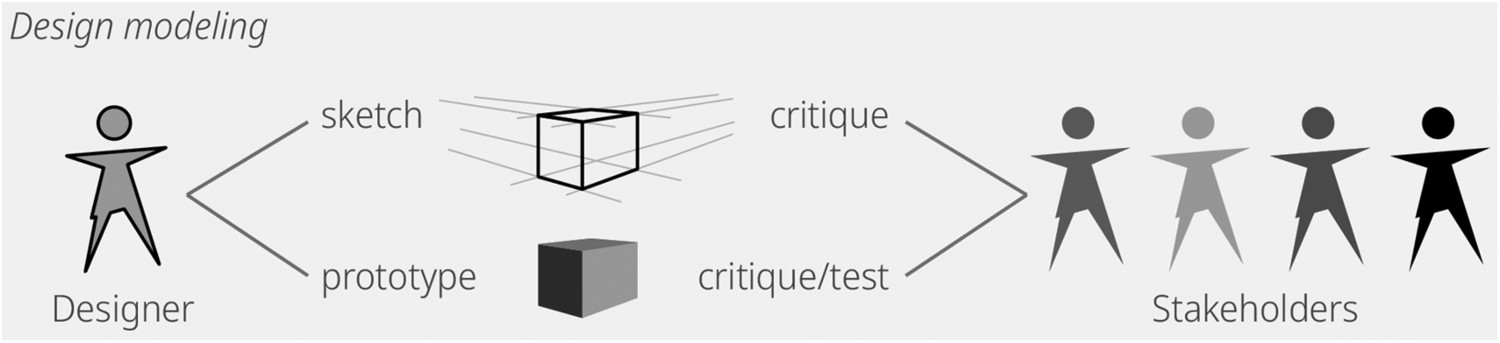
Stakeholders are also participating in design modelling in some co-design practices and are applied in diverse ways. For example, designers engage communities to map values in systemic diagrams and experiential prototypes to explore design futures and anticipate unintended consequences (De la Rosa, Ruecker, and Nohora 2021). Also, strategic designers engage health care providers with service prototyping to catalyse organizational change (Coughlan, Suri, and Canales 2007).
Design practices have always been concerned with and for the future. In 1951, industrial designer Raymond Loewy proposed the MAYA principle – most advanced, yet acceptable. This principle explains that designers should propose novelty while also using familiar elements to ensure people accept new products in the marketplace. Beyond novelty, design artefacts are designed in the present but will be used and enacted in the future. In the last two decades, future-oriented critical practices, such as speculative design and design fiction, have gained attention. These practices aim to take the form of provocation to question norms (e.g. Dunne and Raby 2013; Sterling 2009). More recently, connections between future studies and design have been developed with interesting potential applications for complex challenges (De la Rosa and Ruecker 2020; De la Rosa, Ruecker, and Nohora 2021). Future visioning is an activity that is similar to the design process (Evans 2014). There are benefits for futurists using design approaches and for designers using future approaches: Futurists can expand their typical narrative scenarios to design experiential prototypes and designers are able to describe long-term contexts and scenarios (Candy and Dunagan 2017; Selin et al. 2015). Futures methods can help service designers with inspirational insights and centring on future states of the service (Løgager, Simeone, and Mejía 2021).
The particular approach to speculation in design practices is related to imagining possibilities and world building. Designers do not respond to what humans do, instead designers create variation and ‘possibilities [that] relate to what humans can do’ (Krippendorff 2007, 73). In other words, designers do not rely solely on research for future making, they also imagine what is possible and actively make decisions to create futures. Further, design speculation is also different from anticipation. In anticipation, a model of the future is used to inform design decisions in the present; ‘the future is causing a present state’ (Brassett and O'Reilly 2021, 4–5). Similarly, in some future practices such as scenario planning, anticipation (rather than speculation) is based on research and the aim is to recommend strategies to preserve the status quo, exploit possible opportunities, and reduce risks in the future. In design speculation, the future is not something that is foreseen to make decisions in the present, the future is made according to the imagination of the designer and stakeholders participating in design decisions. Designers and stakeholders, rather than adapting to or predicting the future, can explore and prototype intentions and values by overlapping a series of images of the future to depict complex preferred futures (De la Rosa and Ruecker 2020). Further, anticipation becomes important as an evaluative process to foresee potential implications of a design proposal (De la Rosa, Ruecker, and Nohora 2021; Mejía 2022). Design speculation is a component of design that allows designers to imagine preferred proposals with a critical perspective, while also anticipating risks and benefits (see Figure 3).
Design speculation. The futures cone was popularized by Voros (2003). In this figure, we include the concept of design speculation as an action that seeks preferable futures. It is worth noting that speculative design focuses more on using possible futures for critique rather than creating preferable futures (Dunne and Raby 2013).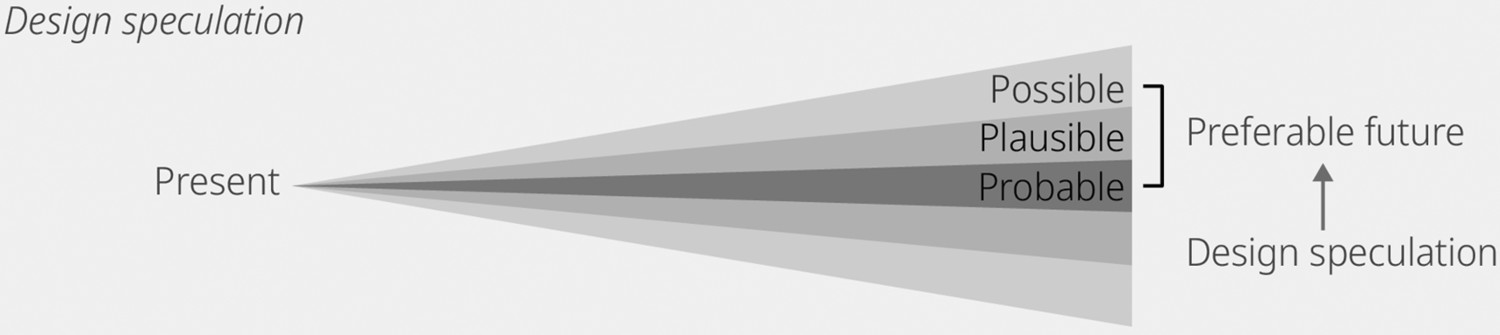
Designing requires facilitating the participation of stakeholders including experts and community members. Design is at the core of human-centred work, in developing solutions, products, and processes for people. Thus, design requires communication with stakeholders and developing empathy to see and frame a problem from others’ perspectives (Lawson 2006). For Krippendorff (2007), designers must communicate with stakeholders and use design discourse to make compelling proposals to realize them successfully. Designers traditionally assume an expert role collecting insights to understand needs and testing ideas to design for people. However, an evolution of this approach is the idea of designing in groups and with (not just for) people.
Collaborative or collective design approaches are often termed as co-design or participatory design. Sanders and Stappers (2008) distinguished between the ‘expert’ and ‘participatory’ perspectives of involvement of people in the design process. In the expert view, people are invited as users for testing or interviews. In participatory design, people take an active part in the design process. A similar distinction in transdisciplinary research is defined as consulting (expert-driven) and participatory (social actors participate in knowledge production) transdisciplinarity (Mobjörk 2010). The challenges for facilitating design practice or transdisciplinary research are similar; however, a design mindset would be informed by the current emergent research in collaborative and participatory design. For example, designers are trained and adapted to utilize their visual or graphic skills such as sketches, illustrations, diagrams, prototypes, or other physical models in collaborative design to facilitate co-creation/design activities with others (Lundberg and Arvola 2007). Designers are able to talk and draw in parallel to explore conceivable futures (Schön 1987). Therefore, compared with regular facilitators, ‘design facilitators’ have rapid and spontaneous modelling skills to suggest alternatives and possible consequences (Crane 1993; Lundberg and Arvola 2007), as a result, they can help materialize stakeholders’ knowledge and catalyse emergent co-creation (Aguirre, Agudelo, and Romm 2017) to focus on making futures.
Participatory and plural perspectives imply a fundamental transformation in design practices because designers share agency and power when making futures as artefacts, services and artificial worlds. Facilitation is identified as a critical ability of designers to address participatory and systemic change processes (Aguirre, Agudelo, and Romm 2017). Sanders and Stappers (2008) argued that traditional design skills will be needed in the future, along with emergent skills from a participatory perspective. Recent research has shown that the design industry has not been well prepared for embracing participatory design (Xie, Mejía, and Zheng 2021), but it has been critical in the public sector and a critical expected shift in the whole field. Further, for working respectfully eliminating misunderstanding and gaining more empathy within indigenous cultures and plural worldviews, designers should be committed to genuine and situated partnerships in which community members share the agency in the design process (Xie et al. 2020; Sosa, Mejía, and Adamson 2021). Design facilitation is an emergent but increasingly fundamental component of design practices in which designers work within communities to make sure the benefits of design outcomes are participative, just, and sustainable for them and the planet (see Figure 4).
Design facilitation.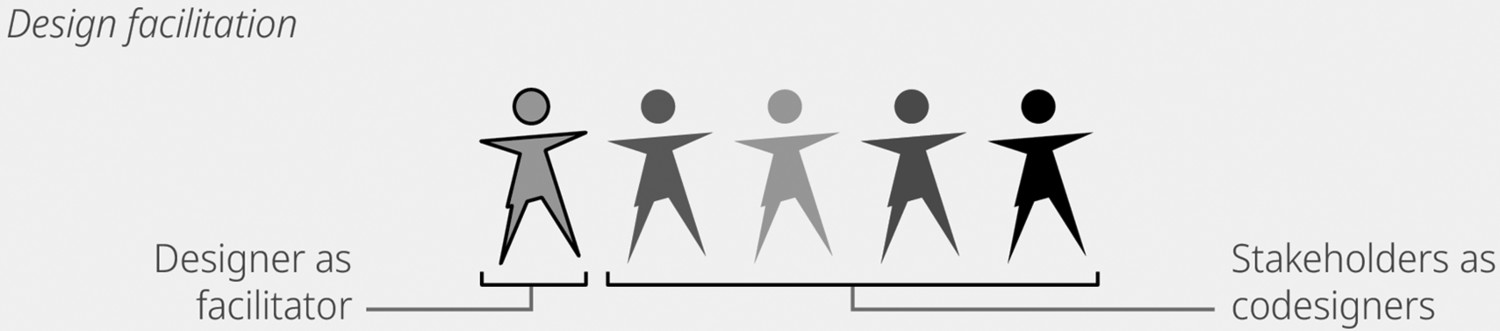
As designers work within more complex situations, the design process does not end in the delivery of a proposal that technicians can produce. Design implementation is an emergent component in design practices, with nascent literature, but we argue that design implementation would be critical in a design mindset for the complex challenges of transdisciplinary future making. Norman and Stappers (2015) contend that designers need to engage in the implementation phase. In this phase, psychological, social, political, economic, and technical issues become the major challenges (86). Design in this order, they added, is about designing modules, rather than the whole system. For example, when redesigning a health emergency room service, designers can address a module related to communication between health professionals instead of changing all medical, financial, and cultural components of the system at once. Then, designers ‘muddle through’ the situation to propose modular and incremental strategies (93). Irwin (2018) proposes a similar approach associated with sustainability, arguing that designers changing complex systems must work on proposals in multiple scales and timeframes – often with future-orientated vision. Designers should observe how their work unfolds in the long-term future, before making new proposals (983). Design implementation is a specific design component in the context of design for changing complex systems. In this area, designers adopt a long-term commitment to work continuously within the system and community (see Figure 5).
Design implementation.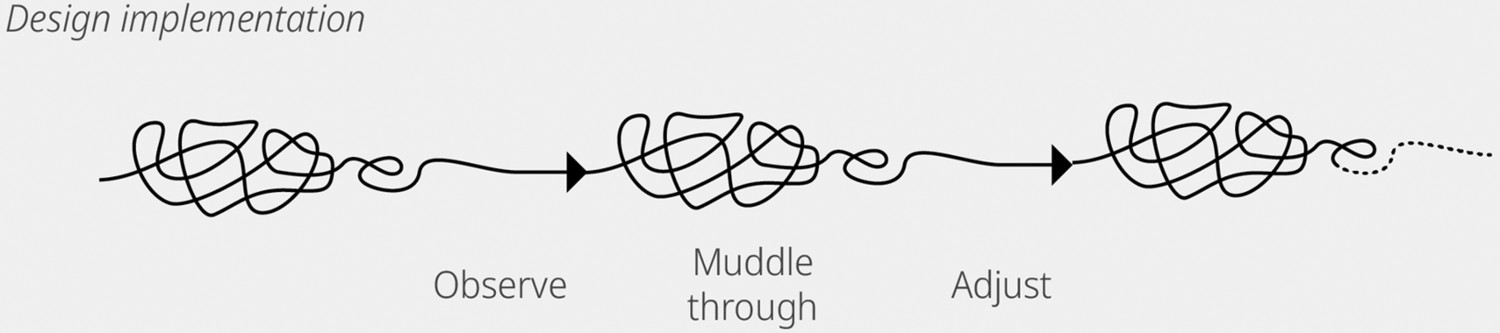
We reiterate that these five design components in section 3.1 do not cover all practices, skills, and competencies of designers, but these are particularly salient and applicable across transdisciplinary approaches and problems. Before proposing how these components are a potential mindset for transdisciplinary collaboration, we briefly review concepts of collaboration, transdisciplinarity, and their major practices and approaches.
An air pollution project: A group of researchers and professionals gather to work on exploring solutions for the growing challenges of air pollution in large cities. The multidisciplinary team includes researchers and professionals in geography, public health, media arts, sociology, and engineering. They are able to get a seed grant to investigate potential solutions expecting to leverage the increasing interest in current issues, such as artificial intelligence and digital arts, to influence citizen behaviors. The project is organized in two phases. In the first phase, the group collects quantitative and qualitative evidence aiming to identify existing successful strategies to change transportation behaviors. Participants include commuters and key informants in a major city. In a second phase, the group organizes workshops with participants to ideate solutions and propose a potential intervention. The aim of the project is to generate a strong intervention and write an external grant proposal that a major agency would fund.
The vignette above offers an illustrative example of a group of researchers and professionals across multiple disciplines, that gather to work collaboratively in a complex problem. In our modern world, disciplines have developed into sophisticated areas of knowledge. Disciplinary exchanges offer the opportunity to integrate knowledge and practices. Jantsch (1972) proposed a disciplinary exchange hierarchy framework, according to the complexity of group work across disciplines: multidisciplinary/pluridisciplinary, cross-disciplinary, interdisciplinary, and transdisciplinary. He depicted transdisciplinarity as the coordination of multiple disciplines based on universal principles and an ‘emerging epistemological pattern.’ Transdisciplinary collaboration seeks a novel unified whole – even a completely new discipline consisting of homogenized disciplinary theories and viewpoints, wherein each contributing field has no clear boundaries in the work (Klein 2000). Russell, Wickson, and Carew (2008) note that transdisciplinarity is not a new practice. However, in recent university and industry settings, there have been increasing drivers of transdisciplinary approaches, such as creative activity happening at the margins of disciplines, frustration with traditional disciplinary inertia, new problems, or industries that prompt unions of disparate disciplines, and collaborations based on newly developed equipment and techniques. Those new problems are increasingly interdependent, complex, and unpredictable. Klein (2015) notes that the ascendance of transdisciplinarity in recent decades signalled a need for new syntheses at a time of growing fragmentation of knowledge and culture. Van Baalen, De Groot, and Noordegraaf-Eelens (2021) suggested that transdisciplinarity in its different forms, has gained traction in higher education as a means of dealing with complex societal problems through productive border-crossing between different knowledge domains and practice communities. They also suggested that transdisciplinary efforts are attuned to co-creation, producing a richer conception of knowledge, and an awareness for ‘more-than-rational’ aspects of challenges.
Klein (2004) claimed that interdisciplinarity doesn't always need a deep degree of collaboration, it could be understood by two metaphors: bridge building and restructuring, while Klein (2004) stated transdisciplinarity requires deconstruction with more paradoxes and conflicts. Regarding existing knowledge, interdisciplinarity presents characteristics including integrating, interacting, linking, while transdisciplinarity presents transcending, transgressing, and transforming. Transdisciplinarity moves beyond interdisciplinarity (Klein 2004) and works as articulated conceptual frameworks, which transcend the limited scope of disciplinary worldviews (Miller 1982). Transdisciplinairty is inevitable to deal with the most challenging level of collaboration and synthesis (Klein 2004). Different from disciplinarity, transdisciplinarity uncovers bridges between different fields of knowledge and embraces multidimensional realities (Nicolescu 2002). Max-Neef (2005) argued that transdisciplinary practice requires the integration of four disciplinary levels: empirical (e.g. mathematics, geology, sociology), pragmatic (e.g. engineering, agriculture, commerce), normative (e.g. design, politics, law), and value-level (i.e. ethics, philosophy, and theology). He explained that the empirical level in particular, and even pragmatic and normative levels, have elevated rational thinking over relational and intuitive thinking between and across disciplines (10). He recognized two types of transdisciplinarity: ‘weak’ and ‘strong’. Max-Neef suggests that a ‘systematic’ research-driven approach to collaboration may be weak because there is a focus on linearity and the empirical level. On the other hand, strong transdisciplinarity takes a less linear and more quantum approach in that it does not assume a single reality (e.g. across disciplinary knowledge and practices there are multiple truths, which may be in tension but must also coexist).
In a more practical perspective, transdisciplinary collaboration aims to integrate societal and expert stakeholders to address real-world problems. Lang et al. (2012) illustrated an ideal model synthesizing previous work of Jahn (2008) and others that have sought to integrate everyday social problems and scientific practices. Lang et al described three iterative phases: research framing, co-producing interventions with the community, and integration of knowledge and implementation of strategies. They also made recommendations in each phase in the form of ‘design principles’. For example, in the first phase, two recommendations include building a collaborative research team and defining the research scope collaboratively. This model, while including community participation, appears to prioritize the scientific framing given in the first phase and the researchers’ control role in the process. Research-driven transdisciplinary work is also problematic, because what the community wants to do and how the community wants to do it is superseded by what researchers want to know (see: Max-Neef 2005). Pohl (2005) argued that compared with natural/social researchers, programme management perceived collaboration as a necessity in transdisciplinary work; thus, it has a higher level of understanding of transdisciplinary collaboration. Though the definition of transdisciplinarity is still contested, scholars have some consensus on the limited number of features of transdisciplinary research: (a) focused on practical problems with social context; (b) transcending and integrating discipline boundaries; (c) conducting participatory research; (d) creating usable knowledge by integrating disparate knowledge (Carew and Wickson 2010; Pohl 2011).
Common practices for transdisciplinary collaboration
Transdisciplinarity practices are present in multiple fields, such as sustainability, medicine, and design. Russell, Wickson, and Carew (2008) emphasize that transdisciplinarity is a practice, rather than a static process, which needs flexibility and adaptability. They suggest that organizations should focus more energy not on the products or commodification of transdisciplinary practices, but on building up intellectual capacity for transdisciplinary collaborations within the institution. Klein (2010) noted the necessity of collaboration between academic researchers and industry sectors; and the involvement of stakeholders for developing product/technology in the transdisciplinary problem-solving process. Pohl (2005) suggested scientists should be identified as detached specialists or engaged problem solvers, rather than simply natural and social scientists because in reality these different disciplines met difficulties when collaborating. He noted that mutual respect is the precondition of transdisciplinary collaboration, and the collaboration could be aroused by reducing the pressure to produce usable results. Fischer, Tobi, and Ronteltap (2011) further proposed four areas need to be focused to support collaboration between natural and social sciences: (a) different between paradigms in natural and social sciences; (b) skills/competences of the researchers/scientists; (c) insufficient institutions sympathetic to collaboration; (d) organization (internal) of collaborative projects.
One set of practices is related to the skills of the collaborators. Transdisciplinary collaboration benefits from appropriate levels of knowledge. Stein (2007) argued that collaborators should demonstrate competencies in more than one domain and communicate with others from a variety of disciplines in a ‘synoptic manner’ (99). For this, Priaulx and Weinel (2018) suggested a rudimentary form of facts and information about other fields. They argued that incorporating a range of example problem domains and approaches that populate different fields and disciplines can build ‘about knowledge’ and create awareness of potential connections. Boon, Chappin, and Perenboom (2014) stated that a moderate amount of expertise diversity within the team is beneficial to the satisfaction and effectiveness of transdisciplinary projects because too much overlapping expertise may result in unnecessary conflicts. Diversity can be defined in terms of separation (e.g. disagreement on the value of research), variety (e.g. disciplinary expertise, age, gender), and disparity (e.g. tenure, rank, or authority). This in itself constitutes both a risk for conflict and failure and an opportunity for creativity and breakthrough insights in transdisciplinary collaboration (Harrison and Klein 2007). In addition, collaborative research demands certain levels of trust and ‘personal chemistry’ among the team members. This connection then allows for the openness, motivation, and intellectual exchange that lead to successful collaboration by multiple experts, from outside and beyond their silos (Harris and Lyon 2013; Groth et al. 2020).
The second set of practices is related to the configuration or set-up of the collaboration. Transdisciplinary collaboration demands a workflow that balances divergent and convergent epistemic contribution cycles (Boon, Chappin, and Perenboom 2014), which is more likely when the team is diverse. These cycles foster the development of transdisciplinary connections. Mejía, Malina, and Roldán (2017) share practices from behavioural sciences and health for transdisciplinary collaboration related to team dynamics. This work includes practices of identifying interests, assigning specific roles, setting up rules to overcome power interactions, or rewarding team performance. Russell, Wickson, and Carew (2008) suggested ensuring all stakeholders possess equal power and the same interests in the transdisciplinary collaboration process. Hall et al. (2008) suggested that multiple factors, such as contextual-environmental (e.g. institutional resources), influence and interact with both intrapersonal personalities and interpersonal factors in transdisciplinary collaboration teamwork. They also mention that contextual-environmental conditions play the primary role because sufficient institutional resources could lessen competition and facilitate greater trust and cohesion among collaborators. Transdisciplinarity is an open, flexible, adjustable, and problem- and context-driven practice (Wickson, Carew, and Russell 2006; Russell, Wickson, and Carew 2008). Therefore, Tötzer, Sedlacek, and Knoflacher (2011) noted that transdisciplinarity requires combinations of diverse new approaches and tailored methods because processes cannot be planned strictly.
These practices related to skills or collaboration configuration may be useful for transdisciplinary collaboration – however, they are challenging to implement because teams usually do not have the sufficient ability, time, or knowledge to recruit ideal collaborators or follow nuanced recommended practices. Group formation and collaboration setup may also represent a burden for the leadership and management of the collaboration (McGregor and Donnelly 2014). Barriers abound form the many factors involved in transdisciplinary collaboration (see, e.g.: Morse et al. 2007), ranging from institutional misalignment and poor leadership (e.g. too rigid and parochial when adaptability is a must) to mismatched time considerations (e.g. a project would need three years to come together but the expected deadline by/for the team is 12 months), conflicting communication styles, and insufficient trust or committment. Therefore, it may be feasible to focus on approaches that build up the mindsets and similar capacities or practices within individuals and teams to engage in collaborative transdisciplinary efforts.
Design mindset as a transdisciplinary collaboration approach
Design practices provide an alternative, powerful ‘mindset’ for transdisciplinary collaboration because it brings together arts and sciences, empirical and practical activities, and experts and the community. Designers recognize that collaboration means to transcend the existing task and motivate conversations with the public (Feast 2012). Max-Neef (2005) argued for ‘strong transdisciplinarity’ established on three pillars that Nicolescu (2002) proposed – levels of reality, principle of the included middle, and complexity. Design could be seen as the ‘included middle’ in transdisciplinarity, because transdisciplinary collaboration engages ‘multiple non-academic participants’ (Stock and Burton 2011). Boyd Davis, Vane, and Kräutli (2021) suggested that other disciplines can benefit from including design practice in interdisciplinary work because design is an interrogative rather than decorative practice, and designers are adept at discovering and engaging with problems. Notably, this proposal is not the popularized managerial ‘design thinking’ approach that prescribes a particular method (e.g. Stanford's d.school design thinking method or the Design Council's double diamond). We understand design and design thinking as a broader category that not only includes thinking, but also knowing and doing. While many design methods are available elsewhere, designers are not ‘guided in’ action but ‘prepared for’ action (Stolterman 2008, 61). This means that for every project, designers have to immerse themselves in the situation and adopt specific knowledge and methodologies. We propose the design mindset for transdisciplinary collaboration as an approach that the participant collaborators can adopt, master, and use to be better ‘prepared for’ transdisciplinary actions.
The components of the design mindset in transdisciplinary collaboration
The mindset may be seen as a set of mental dispositions and style of work that design and non-design experts can use to improve transdisciplinary outcomes. The following is a presentation of how the components of the design mindset can be applied.
Design synthesis for transdisciplinary collaboration
Most disciplines tend to favour reductionism, where problems are divided, processed, and solved. Design synthesis works differently because proposals incorporate the whole, rather than divided parts. For example, while designing a building, the designers cannot only focus on energy efficiency, they must address many issues at the same time such as functionality, social interaction and impact, aesthetics, construction, human behaviour changes, or costs. Further, as designers analyse components and make sense of the problems and iterate, the definition of the problem co-evolves with the solution (Dorst and Cross 2001). Thus, designers embrace uncertainty and ambiguity to make proposals toward improved futures, and learn from outcomes. For example, service designers may know that customers are dissatisfied with a financial service. They would engage in design research to make sense of and set the problem. They would pilot new service ideas to continue the sensemaking and learn how customers respond. These activities are repeated multiple times, performed in parallel and in different orders. Pink et al. (2020) reflect the requisite role of uncertainty in designers’ work. Grounded in design anthropology, the authors note that trust and sharing are critical to dealing with the enduring anthropological concerns relating to uncertainty and reciprocity in designing for the future. Pink, Akama, and Sumartojo (2018) emphasize that design ethnography workshops actually create and harness circumstances of uncertainty, to successfully disrupt assumptions and produce new future visions. During this process, designers (and stakeholders) live in uncertainty while the problem and solution coevolve into improved future outcomes. Design synthesis is an alternative to research-driven approaches to achieve Max-Neef's (2005) strong transdisciplinarity, which, he argued, must permeate different realities combining rationality and intuition. Thus, design synthesis provides the flexibility between rational and intuitive thinking needed to achieve strong transdisciplinarity.
What can collaborators do to integrate the design synthesis component? Collaborators may seek to embrace the ambiguous and uncertain nature of transdisciplinary problems to learn from and about the problem. They should resist a fixed definition of the problem, which is often common practice in research and empirical fields. Research and problem-solving should not be done in response to a fixed question. Instead, collaborators should explore alternatives that will influence how the problem is set or evolved/developed, and test them in tandem or iteratively, while also being open to different possibilities that are not set out at the beginning of the project. Scientific research should not drive transdisciplinary practice. Research can be used to inform collaborators, not to limit themselves to a linear path.
Design modelling for transdisciplinary collaboration
While concrete and constructive thinking have been diminished in some disciplines, they are foundational in design (Cross 2006, 28). Design modelling involves making ideas concrete, which is essential for designers to demonstrate and test their ideas. Diverse knowledge and communication are commonly suggested practices for transdisciplinary collaboration (e.g. Stein 2007; Priaulx and Weinel 2018). Modelling offers a concrete/constructive alternative to abstract thinking to support communication challenges in transdisciplinary collaboration. Visualizations, sketches, diagrams, maps, prototypes, models, performances, and other modelling artefacts make knowledge concrete and accessible for critique among collaborators – this is an important divergence from existing transdisciplinary practices which tend to report verbally between collaborators. When collaborators visualize proposals, they integrate their knowledge to create something new. This component also responds to the constructive integration of knowledge that Lang et al. (2012) posited as an argument for the need of transdisciplinarity.
What can collaborators do to integrate the design modelling component? Design modelling is not about the beauty or aesthetic quality of the representation. Instead, collaborators might consider how to focus on expressing ideas, fostering conversations, visualizing information, and materializing thinking. One approach is to use participatory design toolkits. These are visual sets like Legos, small objects, stickers, and gallery images that participants can use to visualize proposals. When using these toolkits in multicultural groups, special awareness is needed to avoid colonizing ways of making. Particular visualization approaches such as cognitive redirective mapping (a method helps collaborators discover unimagined connections based on previous information and realities) (Schultz 2018), future narratives (series of short narratives where stakeholders imagine preferred futures) (De la Rosa, Ruecker, and Nohora 2021), and playful triggers (an ethnomethodological tool utilizing daily objects to facilitate communication and co-creation) (Akama and Ivanka 2010) are an alternative to respectfully visualize knowledge and prototype ideas when designing with other cultures such as local or indigenous communities. Another valid alternative is to bring a visual recorder or sketch note-takers to team sessions. Visual recorders are illustrators or graphic artists that visualize verbal inputs like conversations, lectures, or discussions.
Design speculation for transdisciplinary collaboration
Speculation into the future is a potent way to integrate intuition in transdisciplinary collaboration. When disciplines and stakeholders focus on evidence and current needs, decisions will be made based on insights that become obsolete in changing and evolving futures. Also, when the future is anticipated as something to prepare for, interventions become attached to the past or present. Design speculation can help in reframing the actions of transdisciplinary collaboration towards desirable futures, while also considering risks and benefits. Design speculation provides agency over the future. This forethought helps collaborators deal with unintended consequences of rational problem-solving, where the world is stable and focused on the present. Speculation and imagination are a dramatic shift in transdisciplinary collaboration, where previously, empirical researchers have often dominated. Theory and evidence should inform design (and transdisciplinary) practices, not drive the process or determine all decisions (see Mejía 2021). For example, when addressing food waste, behavioural or social theory could inform and inspire ideas, but speculation allows imagining and reframing possibilities beyond what theory or information about the problem can provide. While empirical evidence and theory are important inputs, imagination – design speculation – is a critical tool to reposition stakeholders’ agency in determining and envisioning their own futures.
What can collaborators do to integrate the design speculation component? Collaborators might shift from evidence-driven action to a balance between evidence and imagination. In research and practice settings, such as non-profits, industry, and the government, the ‘measurable’ becomes the only standard to assess effectiveness. Evaluation becomes the framing for action. We suggest that not merely evidence but also speculation should inform transdisciplinary collaboration. For example, the effectiveness of a recycling programme is measured by metric tons or number of households participating in a programme. These metrics frame problems and solutions. Designers can also speculate about new lifestyles that change how households consume products and come up with alternatives to purchasing and recycling such as renting, repairing, buying second hand, and so on. Speculation and imagination might appear too ambiguous for some research or evaluation-oriented collaborators. Yet, patience tends to reveal how ambiguity pays off with more innovative and wider possibilities. Further, imagination is a tool that non-experts and community stakeholders can use to preserve their agency and power in the collaboration. Imagination can also be a stakeholder tool to anticipate risks and benefits by exploring unintended consequences (De la Rosa, Ruecker, and Nohora 2021). Evidence is not as useful for this because non-expert collaborators have challenges questioning it or the authority of experts.
Part of the problem-exploration phase of the transdisciplinary collaboration should address envisioning an intended future – be that a future solution to a present issue or a future improvement to an existing system (Mitchell, Cordell, and Fam 2015), and then ‘backcast’ the changes, transitions, steps, and overall pathway (Ely et al. 2020) that could lead from that ambitious future to the present context. For example, a vision of a world without landfills could be developed with urban food production and circular consumer products. Backcasting from that vision would help to develop milestones and propose present strategies towards that vision.
Design facilitation for transdisciplinary collaboration
The integration of stakeholders in transdisciplinary collaboration is seen as a way to increase legitimacy and ownership of the solutions (Lang et al. 2012, 26). Designers often seek to integrate stakeholders in human-centred or participatory design approaches. Human-centred designers focus on human needs collecting insights from people using methods such as observation or interviews. Participatory designers bring the people themselves into each phase of the design process and have them ideate, prototype, assess design proposals. Design facilitation is a more specific skill that originated in a participatory approach where the goal is to facilitate collective production processes beyond just validating or legitimizing preconceived work. In design facilitation, the goal is to work within the community to increase the agency and engagement of the stakeholders. This requires a commitment to counter power relations, switching from an expert patriarchal approach to a decolonized learning attitude (Sosa, Mejía, and Adamson 2021).
What can collaborators do to integrate the design facilitation component? One approach involves collaborators designating a broker or translator, whose role is to bridge the gaps in understanding that occur between groups of stakeholders. Those gaps can be complex, such as misunderstandings regarding the political intricacies of a particular community, or as simple as language differences between groups of stakeholders. Ideally, brokers either have direct ‘insider’ experience of the different groups (e.g. bilingual translators), or have previous experience acting as ‘outsider’ brokers for such situations. Another alternative may be to change the expert collaborators’ mindset from a knowledge-authority role to learners of local knowledge. Depending on specific situations, facilitation might have a more instrumental goal of inclusion. The most desirable goal of facilitation would be having open, flexible, and learning attitudes that counter privilege biases and distribute agency equally among collaborators.
The inherently collaborative nature of design can also result in a frequent need to negotiate differences in understanding, suggestions, wants, needs, and knowledge bases that people bring to the process. Thus, existing design research and practices about negotiating conflicts or frictions that can emerge in collaborations may also be beneficial to the transdisciplinary team process. For instance, Björgvinsson, Ehn, and Hillgren (2010) suggest that collaborative and/or participatory design processes benefit from applying an ‘agonistic’ approach. They define an agonistic frame wherein ‘agonistic struggle’ is central to a vibrant democracy. In applying such a frame to collaborative design (or transdisciplinary teamwork) the goal is to avoid presupposing the possibility of consensus and rational conflict resolution – but rather to begin by embracing a polyphony of voices and mutually vigorous and tolerant disputes. In this view, shared spaces are always plural and different projects must confront each other with respect and tolerance, and an agreement to accept other views as legitimate, even in conflict. Starting from the idea of an agonistic approach, as opposed to an antagonistic one, provides a thoughtful frame of reference for facilitating the work of transdisciplinary collaboration. Design facilitation typically relies on the development of specific processes for handling conflict or disagreement at the outset of a collaboration (as opposed to waiting for conflict to arise and then mediating it) (Xie et al. 2020).
Many design negotiation processes vary and are determined by the needs of the group in their context (Lloyd and Oak 2018). Adelson (1999) suggests a theory-based framework of negotiated collaboration, which is useful for addressing goal conflict, role conflicts, or challenges emerging from limited resources. Her frame involves: (a) allowing all individuals/groups to state the problem as they see it and privately create their description of the impasse, then (b) state the solution they have in mind as the best approach to the impasse. All parties seek to find shared interests and resources, and refer to their initial solutions to draw up a list of design considerations or interests which need to be included, as well as offering objective criteria for stated interests (for more detail refer to Adelson 1999). McDonnell (2009) reveals how even in non-participatory design, designers make careful moves to facilitate negotiation. Studies of design exchanges reveal how architects often take different conversational turns in which each contributes from their own territory of expertise the responds to others’ conversational invitations supply information, occasionally invoking the position or knowledge of the other to propose or justify a design decision (provoking, in turn, an expert response) (McDonnell 2009; Oak 2009; Luck and McDonnell 2006). They provide us with a way of grasping concretely some of the subtleties of how shared ownership of a design work is established within design settings (Day and Parnell 2003); and how transdisciplinary teams, working in situations of different expertise and backgrounds, might move in negotiation through differences.
Design implementation for transdisciplinary collaboration
The idealized imaginary of projects is proposing breakthrough solutions. However, the complex problems of transdisciplinary initiatives for the future require active work through implementation, observation, and adjustment. Design implementation is an emergent competency of designers, but is critical for the new category of complex problems that those who are interested in designing want to address. Certainly, designers have focused on creation and delivery without follow up and they are still learning and theorizing how design implementation works; nonetheless, design implementation becomes critical in transdisciplinary future making that is clearly associated with long-term work.
What can collaborators do to integrate the design implementation component? Perhaps in this component area, there are existing practices and approaches in other disciplines that are already robust. Yet, design implementation developments show practices that are compatible with the design mindset. Preliminary pointers in design implementation show that practitioners should understand that proposals are oriented towards modules because a whole system will not be designed at one point in time. Transdisciplinary collaborators should follow-up with their proposals and adjust them as they muddle through complex situations. Special attention to forthcoming development in areas of transition design and systemic design would inform this component.
An air pollution project with the design mindset
In this subsection, we return to the vignette (an air pollution project) presented at the beginning of section 4 to discuss an example of how the components would influence transdisciplinary collaboration. The agenda of the researchers and the grant funders determine the problem. Even when there are collaborators from media arts that are open to generative work, how the problem is defined frames the transdisciplinary work. Further, the goal of creating an intervention to seek funding limits the possibilities to find alternatives in cyclical iterations. The further improvement after funding is available or committed to a particular framing could be problematic. Adopting design synthesis for transdisciplinary collaboration would imply that the problem and the solution would evolve during the project. The project's approach would change from evaluating predefined solutions into emergent practices that allow levels of uncertainty. Also, in an air pollution project, researchers would usually communicate and produce outputs based on verbal communication. When visualizations or models are included, they are defined by technical maps or graphics. Collaborators using design modelling would engage in clearer and faster communication between disciplines. For example, sociologists participating in sketching or prototyping of ideas could contribute to the transdisciplinary outcomes. Design modelling would make everyone's knowledge more accessible and support the combination of knowledge for strong transdisciplinarity.
The air pollution project is conceived to generate evidence to make decisions in the process (e.g. traffic statistics or transportation preferences survey data). Adopting design speculation would require a significant change in process. For instance, evidence would not be the major initial source for making decisions. Instead, it may be a speculative imagination of possible futures. Evidence might limit creativity and prime collaborators to generate ideas solely based on what research data show. Second, as speculation offers agency to non-expert stakeholders in the decisions, community members would have a more critical role. In typical projects, stakeholders in the community are participants for data collection or idea-generation workshops, but their role is insufficient to collaborate in decision-making. Thus, design facilitation would help the collaborators to not only legitimize their preconceived solutions for air pollution, but also to share agency with the community. Then, members of the community that have agency in a cleaner transportation model could be more committed to embrace it. Lastly, design implementation would reframe the time scope of the project. In this case, the grants timelines would not fit adequately, as most limit support to two or three years. Government or other institutional partnerships could offer continued support for longer term observation and adjustment of proposals.
Limitations
We acknowledge limitations in this collaborative approach. The design mindset approach to transdisciplinary collaboration is at present (while built on scholarship that is both theoretical and empirical), largely theoretical, and in part, based on the transdisciplinary collaboration experiences of the authors. More empirical research is needed to examine how such a design mindset can affect the collaborative work of transdisciplinary teams. For example, a research study could explore how training team members in the components of the design mindset would yield better collaboration processes and outcomes. Our aim in advancing these ideas is that such work can be undertaken in future studies.
The design mindset proposal in this article is also a relatively new way of thinking and working, in bringing ideas from the arena of design practices into teams where people cannot exist in traditional silos. Thus, potential issues can emerge, some of which we have raised. For example, roles are often fluid and less bounded in transdisciplinary team collaborations than they may be in traditional teamwork. Therefore, such teams may encounter challenges if they are not prepared to shift where participants take on new roles in collaborative design processes. The role of the ‘expert’ in design may be different than it has been in traditional disciplinary framings. Thus, collaborators in these shifting roles may need an ability to unlearn their discipline to some extent to be able to contribute. Otherwise, they may risk getting stuck or stymied by their existing disciplinary schemas. Again, this can be helped by the development of a design mindset, as designers must be prepared to confront topics in social problem-solving where they may not have content expertise (allowing a certain amount of vulnerability and uncertainty into their mindset).
Another limitation may be that while we advance this conception of design for transdisciplinary teams, design skills, and mindsets can take time to develop. Designers spend years developing a mastery of their craft (Dorst and Cross 2001). Further, the social practices embedded into professional design situations and structures create a barrier for non-professional designers to adopt design thinking (Kimbell 2012). While we do not suggest that non-design members of transdisciplinary teams require expertise or professional mastery of design skills – there would still be a need to put time, resources, and effort into training non-designers to develop some foundational skills and habits of mind. Furthermore, the design discipline must be embedded in a sense of ethics, in order to avoid teams failing to account for adverse ethical outcomes of solutions they design (Verbeek 2006). Again, this requires that design-minded teams be given ethical training, opportunities, and encouragement to use ethical foresight in their solution-building efforts.
We also note that this design mindset approach to transdisciplinarity may be less applicable to the work of teams driven by practical, material, or functional outcomes. Such an approach may be more aligned with collaborations happening along big-picture or conceptual lines, as transdisciplinary problems and collaborations tend to involve the conceptual. Further, transdisciplinary team members not only play the role of researchers or practitioners of their discipline knowledge, but engage in the role of process management (Lieven and Maasen 2007). While our research mainly elaborated on the former role, future research should explore more about the latter aspect of the design mindset for transdisciplinary collaboration. These further inquiries could draw from design management theories to explore strategic planning and management for transdisciplinary teams applying a design mindset.
Transdisciplinary collaboration in this article
In writing this article, the co-authors have applied and embodied most of the recommendations, aiming to make it an exemplar of transdisciplinary collaboration. For synthesis, the co-authors made sure to revisit and iterate the outline of the article, editing it according to the discussion and learning that occurred during co-authors’ meetings. At the same time, the group intentionally represented diversity in several dimensions: professional expertise (including: education, sustainability, astrophysics, filmmaking, and design), cultural backgrounds (Latinos, White, Asian), personal identity (gender, age [31–70]), disparate ranks (tenured professors at varied points in careers, and graduate students), and different research preferences (qualitative vs. quantitative). To facilitate the collaboration, the co-authors rotated the leadership among group members from session to session, and each acted as a broker of the recommendations in relation to their field of expertise. Similarly, in terms of speculation, the co-authors actively imagined who and how future audiences (mainly non-designer transdisciplinary collaborators) would read and benefit from the article, and crafted its language, illustrations, and examples to be as broadly relevant as possible. To aid with visualization, the article's tables and illustrations were derived from the co-authors’ discussions and intra-group attempts to communicate concepts and metaphors related to both design practices and collaboration. Finally, as part of the overall implementation, the co-authors kept shared reflection logs throughout the process, as well as a shared annotated bibliography for the references, while also making sure that all co-authors provided input and feedback for each section of the article at each revision until a final draft was finished in agreement. We see this as an ongoing effort in collaborative transdisciplinary academic work that brings this concept of ‘design mindset’ into our own real-world practices, which will continue to emerge in our current and future research and design practices.
Recent insights for an evolving design mindset
Design practices are in continuous transformation and recent studies and future developments are likely to influence changes in how professionals and communities design products, services, and complex systems. For instance, work in brain and behavioural sciences may influence how design is practiced and studied. First, there is a growing understanding of the modes of human cognition. Nobel prize winner Daniel Kahneman, one of the founders of the theory of behavioural economics, explained that individuals have two thinking modes based on intuition and rationality (Kahneman 2003). The automatic system based on readily applied heuristics when information is incomplete allows us to perform skilled tasks but also leads to cognitive biases such as the loss aversion bias, the endowment effect, or the optimism bias. While designers’ thinking has been associated with intuition (Schön 1983; Dorst 2015), little has been done about the cognitive biases in design activity.
Scholars of science and technology studies – STS are increasingly discussing the relevance of design in their field. Efforts to represent social life also ‘make’ social life (Marres, Guggenheim, and Wilkie 2018, 21). Further, design scholars are studying reorienting design practices to acknowledge the role of social theory and political implications of design practices (e.g. Mazé 2019; Nardi 2019). These exchanges between design and social science would transform and enrich the understanding of design practices as a mindset. Moreover, any transdisciplinary team approaching problems with a design mindset, will enact their unique and nuanced transdisciplinary collaboration. This is why a mindset works as an attitude rather than a recipe to successful work.
Other developments related to social justice are influencing design practices. Design scholars are already discussing issues and challenges of participation and decolonization; for example, stakeholder participation in the design process should evolve from inviting people to propose ideas within mainstream innovation discourses to position designers as participants that need to unlearn their colonizing worldviews (Sosa, Mejía, and Adamson 2021). In this article, we have presented the component of design facilitation that incorporates the participatory approach; however, we expect that development of issues of decolonization, social justice, and multispecies participation will influence design studies as well. Also, it is necessary to rethink the ‘local’ with the growing importance of online research communities, which of course include transdisciplinary collaborations. The author group for this publication has collaborated totally online, although some of us had met before. We adopted group behaviours and customs as we designed the collaboration for this paper. The explosion of online communities provoked by the pandemic provides unique opportunities to understand how community design is accomplished, when the local community is online.
One other salient development is the concept of computational design and its connection to artificial intelligence. AI systems are beginning to develop cognitive and performative functions where they could be viewed as primitive ‘collaborators’ in some transdisciplinary projects (e.g. Savage 2019). In projects that involve AI, one must analyse the implicit and explicit biases of the AI ‘beings’ and their use of cognitive modes that may not be used by humans. One could imagine the role of a ‘computational designer’ that is able to use AI to learn from design failures or roadblocks.
Conclusion
In this article, we argue that a design mindset to approach transdisciplinary collaboration can yield positive transdisciplinary outcomes addressing the complex problems of the future such as climate change, health, food security, democratic participation, and social justice. We offer guidelines for teams working with and without designers to adopt this approach, to expand from research-oriented approaches to offer an alternative to codesign preferred futures.
While professional designers have sophisticated competencies, anyone can practice a design mindset. In particular, we focus on highlighting five components of design practices that can factor into innovative transdisciplinary practices including: synthesis, modelling, speculation, facilitation, and implementation. We delve into these five components in turn, as broad-minded approaches to design that apply to designerly ways of knowing and doing in transdisciplinary teams. Further, we have sought to unpack the language of transdisciplinarity to understand what transdisciplinary practices entail, as well as the two core elements of the skills of the team members (e.g. ability to demonstrate competencies in multiple domains, and to communicate with others from varied disciplines synoptically), also the set-up or configuration of the team (e.g. diversity of expertise, and the development of rules, identification of interests, and other behavioural science methods).
In the conflation of these, we have developed five categories of design practices for transdisciplinarity, aiming to demonstrate what these components of synthesis, modelling, speculation, facilitation, and implementation would appear in transdisciplinary collaborations. We emphasize that we see designing within this frame as a mindset, given that non-designers could reasonably adopt the mindset features of the discipline, without having to unreasonably develop the knowledge/expertise/skills of expert designers. Further, since the activity of designing is also a human ability in everyday life (e.g. designing how to serve a meal on a plate or creating a slide presentation layout), collaborators from multiple disciplines have a natural potential to adopt and practice the design mindset. Likewise, we see transdisciplinarity as a practice (or a collection of practices), not a set process or skill. Thus, our approach is to suggest a design mindset for good transdisciplinary practices. This can support future-oriented innovation and problem-solving among teams dealing with complex issues related to change and improvement of future outcomes across disciplines.
Future implications
Given the relatively unexplored territory in seeking to build these practices for problem-solving and realization of new futures for problem-solving, teamwork, and collaboration, further work is needed to evaluate this approach and its outcomes. At present, most of the extant literature takes academic points of view. Our work suggests that it is important to co-design design methods. In a small sense, we did this for this project, but all of the authors of this piece are housed in academic settings. A key next step would be to bring non-academics into co-designing our next project. It is also critical that the field of futures studies seeks more work that draws on action research, design-based, or participatory approaches to such scholarship, drawing in the expertise and real-world experiences of designers and teams in this area. For example, further research may be needed on the design skills that non-professional designers use in transdisciplinary collaborations. Also, a major issue facing transdisciplinary work is the organizational structure of institutions of learning (universities, in the case of the authors). Therefore, research on non-institution-based transdisciplinary learning and research would be valuable and warranted.
As we have noted, using this mindset does not mean that collaborators need to (or could) become professional designers. Designers hone their skills with education and experience. Further, specialized professional designers might not be prepared for transdisciplinary collaboration. Professional designers could be invited to facilitate processes; however, the best way to develop design skills is within the action of designing. In looking to a better-designed future, where complex social problems are addressed by stakeholders from across disciplines, our goal is to offer a design-minded lens for transdisciplinarity, to facilitate the future of designerly social change.
Footnotes
Disclosure statement
No potential conflict of interest was reported by the author(s).