







Abstract
Owing to the ever-growing demand and supply problems, rare earth elements (REEs) are now considered to be some of the most critical elements. This has focused attention towards their recovery from end-of-life products and industrial waste streams. A hydrometallurgical approach was carried out to assess the recycling potential of REEs from fluorescent lamp waste. In comparison to other efforts in this field, these investigations were carried out using real waste samples originating from a discarded lamp processing facility. Leaching of metals from the waste was studied using nitric, hydrochloric, sulphuric and methane sulphonic acid solutions. Separation of REEs from nitric acid media was investigated using solvent extraction. Batch extraction experiments were carried out using Cyanex 923, a commercial mix of trialkylphosphine oxides. Separation of heavier REEs (terbium, europium and gadolinium) and yttrium from lighter REEs (cerium and lanthanum) is possible due to larger separation factors. Selective stripping of REEs from the co-extractable species (iron and mercury ions) was easily achieved using 4 M hydrochloric acid. Further recovery of the extracted iron and mercury, with either oxalic acid or nitric acid solutions, allows for the subsequent re-use of the organic phase in the process.
Introduction
The rare earth elements (REEs) are presently regarded as one of the most critical groups of elements in the periodic table (European Commission 2014). Among the reasons are the monopoly held by China – the largest producer of REEs with over 90% market share; the low availability and high demand; as well as the large variety of applications that these elements have. REEs have many uses, from common ones, e.g. catalysts and polishing agents, to future sustainable ones, e.g. phosphors in low-energy lighting applications and permanent magnets for green energy sources (wind turbines) (USGS 2002). The recent concerns regarding the future availability of REEs have focused the attention towards their recovery from various waste streams and end-of life products (Binnemans et al. 2013). Fluorescent lamps are one of the main targets. Cerium, europium, gadolinium, lanthanum, terbium and yttrium are the six REEs found in the phosphors of tri-band fluorescent lamps (Ronda, Justel and Nikol 1998). Their potential recovery from lamp phosphors has been investigated using hydrometallurgical approaches. Leaching, followed by precipitation of REEs using oxalic acid (De Michelis, Ferella, Varelli and Vegliò 2011) as well as their recovery using solvent extraction have been the target of recent studies (Shimizu, Sawada, Enokida and Yamamoto 2005; Nakamura, Nishihama and Yoshizuka 2007; Rabah 2008; Mei, Rao, Matsuda and Fujita 2009; Yang et al. 2012). However, despite this research, large-scale applications for the recovery of REEs from end-of-life lamps are scarce (Meyer and Bras 2011). Recycling rates of less than 1% have been reported for all REEs in 2011 (UN Environment Programme 2011). When it comes to fluorescent lamps, the low recovery is due to the nature of the stream: the chemical complexity of the material and the presence of mercury, a vital constituent in all fluorescent lamps (Raposo, Windmoller and Durao 2003). Moreover, some of the proposed processes for the recovery of REEs have not been optimised for real and contaminated waste streams. Parts of the published investigations were carried out using pure phosphors, clean material and even artificial mixtures.
The work presented in this paper aims at assessing the recycling potential of REEs from fluorescent lamp waste. A hydrometallurgical approach was carried out: leaching of metals from the waste using acidic solutions, followed by separation of REEs using solvent extraction. The advantages and disadvantages of using a commercial mix of trialkylphosphine oxides (Cyanex 923) for the extraction of REEs from nitric acid-based leachates were investigated, in the view of scaling-up an industrial separation process. One of the differences from some of the other efforts in the field is the use of real, contaminated, fluorescent lamp waste samples and a commercially available extractant.
Experimental
Waste samples, chemicals and analysis
Genuine fluorescent lamp waste collected from a discarded lamp processing facility was investigated throughout the experiments. Various batches of spent fluorescent lamps were processed industrially using crushing under controlled conditions, followed by separation of macro-fractions (glass, aluminium end caps, etc.). A coarse fraction containing phosphors was sampled on-site. Owing to the nature of the industrial process, this fraction contained large amounts of impurities generated during crushing – mainly glass. Prior to the experiments, the material was homogenised (grinding and mixing). The acids used in the leaching process were of analytical grade. The solvents used in the solvent extraction experiments were used as supplied by the manufacturer, with no additional purification. The solutions obtained were analysed using inductively coupled plasma-optical emission spectroscopy (iCAP 6500, Thermo Fischer). All the investigations were carried out in triplicate tests. All dilutions were done using a 1 M supra-pure nitric acid solution.
Total metal content in the waste and leaching of REEs
To estimate the soluble metal content in the waste, dissolution experiments were carried out using aqua regia at 90 ± 3°C, for 2 h, with a solid to liquid ratio of 10% w/v. The leaching of REEs was investigated using nitric, hydrochloric and sulphuric acid solutions of various concentrations (0.5, 1, 2 and 4 M), at 20 ± 1°C, for 168 h, with a solid to liquid ratio of 10% w/v. Methane sulphonic acid solutions (1 and 4 M) were also tested under similar conditions. The undissolved residues collected after leaching were washed with pure water, dried, weighted and treated with aqua regia in a similar manner as described above. This was done in order to estimate the efficiency of the leachants.
Solvent extraction of REEs
Solvent extraction of REEs from nitric acid-based leachates was investigated using a 30% v/v Cyanex 923 solution in kerosene. Batch extraction experiments were carried out in a thermo-stated shaking machine set at 23°C and 1750 vibrations per minute (vpm), with a phase ratio of 1. Stripping of the extracted metals was studied using 4 M nitric and hydrochloric acid solutions and a 0.5 M oxalic acid solution. The aqueous phases were sampled for analysis before and after extraction/stripping in order to calculate the corresponding distribution ratios e.g. the ratios between the concentration of a metal in the organic phase and its concentration in the aqueous phase.
Results and discussions
Total metal content in the waste and leaching of REEs
The soluble content of several metals in the waste, calculated after digestion of the material in aqua regia at 90 ± 3°C, for 2 h.
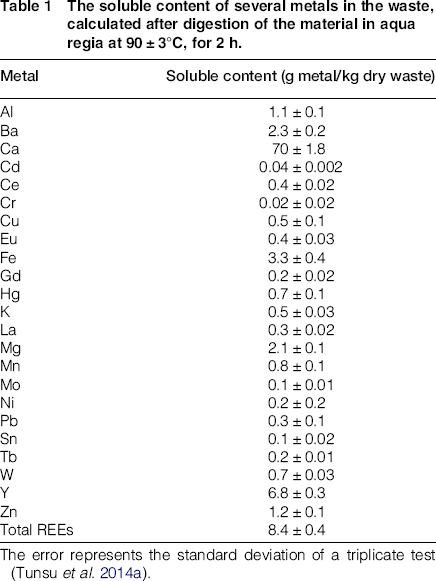
The error represents the standard deviation of a triplicate test (Tunsu et al. 2014a).
Leaching of REEs from fluorescent lamp waste samples using various acidic solutions (20 ± 1°C, 168 h, solid to liquid ratio of 10% w/v, magnetic stirring)
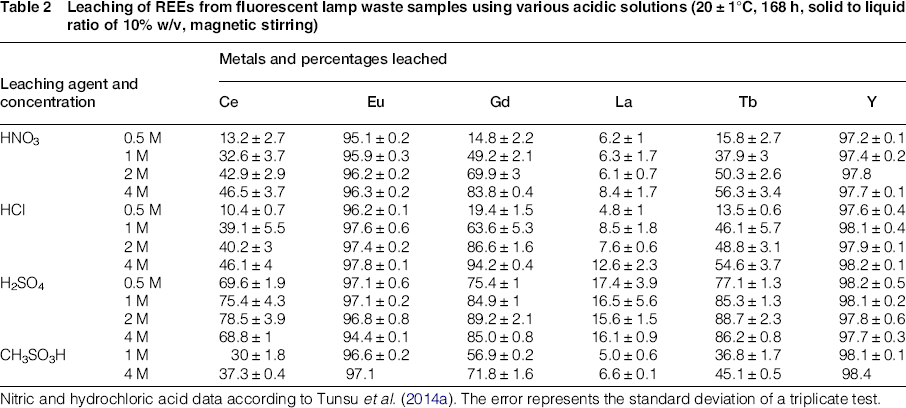
Nitric and hydrochloric acid data according to Tunsu et al. (2014a). The error represents the standard deviation of a triplicate test.
Based on these observations, a partial separation of the REEs contained in the material is possible in the leaching process. Europium and yttrium can be leached using less concentrated acidic solutions, leaving the majority of the other REEs in the solid material. It was also noted that, when using nitric acid solutions, the amounts of cerium, lanthanum, gadolinium and terbium leached from the waste can be minimised by using a shorter leaching time (under 24 h) and performing the leaching at room temperature (Tunsu et al. 2014a). The leaching kinetics for these are much slower compared to those of yttrium and europium (more than 168 vs. 24 h, respectively).
Solvent extraction of REEs
Distribution ratios of REEs, iron and mercury with 30% v/v Cyanex 923 in kerosene (Tunsu et al. 2014b)
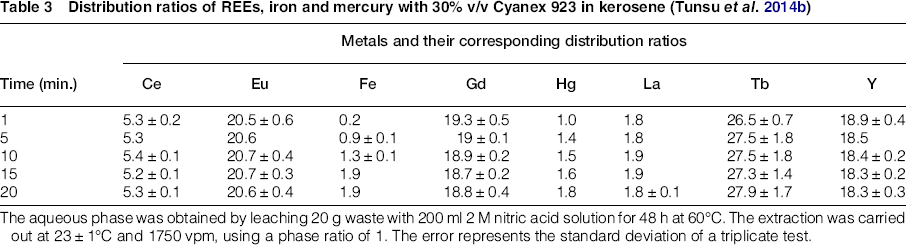
The aqueous phase was obtained by leaching 20 g waste with 200 ml 2 M nitric acid solution for 48 h at 60°C. The extraction was carried out at 23 ± 1°C and 1750 vpm, using a phase ratio of 1. The error represents the standard deviation of a triplicate test.
As expected, the distribution ratios of lanthanum and the investigated lanthanoids were found to increase with a decrease in ionic radius, a consequence of the lanthanide contraction. Yttrium showed behaviour similar to that of the middle lanthanoids. Heavier REEs (terbium, europium and gadolinium) and yttrium can be separated from lighter REEs (cerium and lanthanum) due to larger separation factors. Individual separation of europium, gadolinium and yttrium is problematic due to similarities between distribution ratios. Multiple extraction stages are required for their efficient separation. A group recovery, followed by further processing using more selective extractants such HDEHP and EHEHPA (Bautista 1995), or by using chromatographic techniques, is recommended for their individual recovery.
Extraction of REEs from various fluorescent lamp leachates with 30% v/v Cyanex 923 in kerosene (Tunsu et al. 2014b)
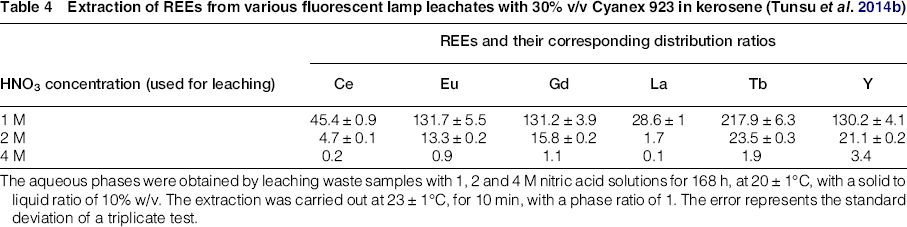
The aqueous phases were obtained by leaching waste samples with 1, 2 and 4 M nitric acid solutions for 168 h, at 20 ± 1°C, with a solid to liquid ratio of 10% w/v. The extraction was carried out at 23 ± 1°C, for 10 min, with a phase ratio of 1. The error represents the standard deviation of a triplicate test.
A decrease in distribution ratios with an increase in acidity was observed for all six REEs. This is due to the competition of the protons in the aqueous phase with the REE ions for the extractant (extraction of nitric acid instead of REE nitrate complexes) (Alguacil and Lopez 1996). The differences in distribution ratios for the 2 M acid systems in Tables 3 and 4 are due to different proton concentrations in the aqueous phases (different leaching conditions, as presented in the table captions).
Stripping of REEs, iron and mercury using 4 M hydrochloric and nitric acid solutions (Tunsu et al. 2014b)

The error represents the standard deviation of a triplicate test.
Conclusions
Genuine fluorescent lamp waste samples collected from a discarded lamp processing facility were investigated for the recovery of cerium, europium, gadolinium, lanthanum, terbium and yttrium. A hydrometallurgical approach was studied. Efficient leaching of yttrium and europium was easily achieved at room temperature with diluted nitric, hydrochloric, sulphuric and methane sulphonic acid solutions. The leaching efficiencies for the other REEs increase with an increase in acid concentration. Extraction of REEs from nitric acid-based leachates is possible using Cyanex 923. The extraction efficiency decreases when increasing the amount of acid in the aqueous phase. Because of this, it is recommended to conduct the leaching of REEs with dilute nitric acid solutions. Separation of REE ions from other co-extractable species (iron and mercury) is possible by using a shorter contact time between the aqueous and organic phases or by selectively stripping these metals using 4 M hydrochloric and nitric acid solutions, respectively.
Footnotes
Acknowledgements
Project 211-2010-2266 (Chalmers 21290013) funding granted by Formas and Energimyndigheten, Sweden, is acknowledged for financial support. Nordic Recycling AB (a member of the Hans Andersson Group AB) is acknowledged for supplying guidance and the samples investigated. This paper was originally presented at the 2014 Sustainable Industrial Processing Summit / Shechtman International Symposium and has subsequently been revised and extended before consideration by Mineral Processing and Extractive Metallurgy.