







Abstract
The purpose of this study was to investigate factors associated with substance use among homeless young adults. Multinomial logistic regression analyses examined the influence of social networks and economic factors among a group of homeless young adults with differing levels of alcohol and drug use. In addition, for those with an alcohol use disorder, the role of future time expectancies was examined. A sample (n = 185) of homeless young adults aged 18 to 23 were recruited from a community drop-in center and interviewed utilizing self-report instruments. Findings suggest that social networks, economic factors, and future expectancies are significant predictors of the level of substance use among homeless young adults. Being able to identify those areas that place homeless young adults at risk for substance abuse and dependence has implications for effective intervention.
Introduction
The severity of substance abuse among homeless young adults is well documented. Drug use for homeless young people is higher in comparison to their housed counterparts (1). Previous research has estimated that 39% to 70% of homeless youth abuse drugs or alcohol (2, 3). Substance use in this population has been reported as 2 to 3 times higher than that found among non-homeless young adults. In nationally representative samples, marijuana has been identified as the drug of choice for homeless youth (4, 5). Rates of cocaine use are 4 to 5 times higher and amphetamine use is 3 to 4 times higher among homeless youth compared to their housed counterparts (6). In addition, Kipke and colleagues (19) reported that 71% of their sample of homeless youth met criteria for an alcohol and/or illicit drug use disorder, whereas Mundy and colleagues (7) found that 48% of homeless youth in their study met DSM-IV criteria for alcohol abuse or dependence and 39% met criteria for drug abuse or dependence.
Homeless young adults are defined as individuals between 12 and 24 years of age who are without stable housing and who identify with the culture and economy of living on the street (1, 8, 9, 10). Identification with street culture includes engaging in accepted practices for earning money (such as panhandling), adopting unique slang language, and developing strategies to prevent victimization (11). Using even abusing substances is often viewed as a “normal” practice by those identifying with street culture. Homeless young people report using drugs and alcohol as a coping strategy and often have more favorable attitudes toward drug use than their non-homeless peers (12). Drug use is a common approach to numbing the daily experiences of life on the street and alleviating the stress of street life and the negative emotional effects of traumatic experiences (5). The stress resulting from sleeping outdoors and in public places may be alleviated or eased by using drugs and alcohol to keep warm and suppress hunger (13). Some drugs are used to help these young people stay awake for extended periods, especially at night when the chances of victimization increase (13, 14). Drugs also provide a means of escape from the physical and emotional pain associated with surviving on the street (15).
Although these young people face numerous hardships, they are highly resilient (16, 17). Resiliency is the ability to thrive and adapt despite stressful situations (18). Homeless young adults are remarkably resilient as they are able to identify survival processes that help them manage a variety of stressors, including the lack of housing and food, loss of family or friends, victimization, physical discomfort, and disease (19). Although the stress of homelessness can increase the risk of substance abuse and dependence, some homeless young people overcome this vulnerability. Therefore, identifying factors that influence the severity of substance use among homeless young adults may assist service providers in tailoring treatment and services that maximize the strengths and resources of these young people (19). To understand the factors associated with substance use among homeless young adults, this study examines 3 factors that may influence their level of substance use: social support, economic resources, and future expectations.
Social/Peer Networks
Due to the disruption of family relationships and separation from social institutions (such as schools), homeless peers often become the primary social support network for homeless young adults (20, 21). Homeless young adults draw upon peer relationships to fulfill multiple needs, including love, companionship, and safety (8, 16). These peer relationships often provide an educational function to newly homeless youth regarding street survival (20). The relationships between homeless young adults may provide a supportive function by protecting the individual, especially newly homeless young adults, from the adversity of the street lifestyle. Despite the benefits of homeless peer relationships, young adults often emulate the behavior of their peer group, especially concerning substance misuse (8, 20, 22, 23). Thus, researchers have suggested separating homeless young adults from peers engaged in street culture because substance use patterns are highly influenced by this peer group (8, 20, 22, 23). Bender and colleagues describe peer groups from a strength's perspective where relationships with peers who choose not to abuse substances are encouraged (8). It is clear that social networks are important for homeless young adults, but peer groups may negatively influence increased substance use among these young people.
Economic Resources
Limited research has focused on the relationship between economic resources and the level of substance use behavior of homeless populations. However, Valois and colleagues (42) found evidence that employment increased the risk of substance use for high school youth who worked more than 15 hours a week. For homeless young adults, it remains unclear how financial resources influence substance use. Studies have shown that homeless youth face barriers to employment, such as lack of education and skills, instable housing, stigma in the workplace, mental health problems, substance use problems, and incarceration (24, 25). Although the majority of these young people voice their interest in finding paid employment (25), they often must turn to the street economy. Panhandling is the most common source of income for homeless adolescents (17, 26, 27); however, they also earn income through prostitution, drug distribution, stealing, trading sex for money, and from parents/other family members or friends (17, 25, 26, 27). The need for economic resources is clear, but the level of access to these resources may influence the severity of substance use among homeless young adults.
Future Expectations
Expectations concerning the future have been described as the extent to which the future is perceived as predictable, structured, and controllable (28). An individual's perspective on the future reflects both long-term and immediate experiences, thoughts, and feelings. It includes the tendencies to link present experiences with future events, determine how manageable the future seems, and understand how far into the future one can envision their lives (29). Previous research has shown that individual's expectations for the future predict substance use behavior (30), such that those with more positive expectations are less likely to abuse or be dependent on substances as compared to those with less positive expectations of the future.
Positive health practices, including reduced substance use, have been shown associated with adolescents’ beliefs and expectations of a positive and bright future (31). Evidence suggests that when adolescents perceive a high level of social support, their ability to understand that current actions have an impact on the future increases. This motivates them to engage in positive health practices (32). Rew (50) noted that homeless adolescents who perceived a supportive social environment had more positive views of the future than those individuals who did not perceive a supportive social environment. Similarly, Fingerman and Perlmutter (29) found that a more positive view of the future was related to individuals’ satisfaction with life events, which influenced their beliefs that they could impact their future. Thus, positive future expectations factor into health decisions, including substance use behavior.
Previous research of the 3 factors described suggests that these influence individual's behaviors, including their use of substances. To assess the role social networks, economic factors, and future expectancies play in understanding substance use among homeless young adults, this study posited the following research questions: (1) what are the influences of social network variables, economic resources, and future expectancies on the severity of alcohol use among homeless young adults and (2) what is the influence of social network variables and economic resources on the severity of drug use among these young people?
Methods
Setting
Participants were recruited from among homeless young adults receiving services from a community drop-in center located in Central Texas from September 2006 to May 2007. The drop-in center, typical of others across the country, provides outreach and support services to homeless/runaway youth ranging in age from 16 to 23 years. The center provides a safe environment for young people during the day and offers case management services, hygiene supplies, laundry facilities, food, clothing, education/GED (General Educational Development) preparation, educational groups, transportation services, medical care, immunizations, HIV (human immunodeficiency virus) counseling and testing, and pregnancy testing. As drop-in centers are one of the most common sources of services accessed by street youth (33), this service agency provided the most likely source of homeless young adults assembling in one location.
Sample
Young people recruited for participation in the study included those identified by drop-in center staff as being 18 to 23 years of age and known to use alcohol and/or drugs. Case managers approached young adults who, based on their observations and knowledge of the individual, met inclusion criteria but were not currently “high” or drunk. These staff members approached and described the study to their clients and invited the young person to speak with research assistants. Those who agreed were taken to a private room at the drop-in center where the study was explained and a consent form provided. The explanation included information about who was conducting the study, the voluntary nature of participation, the confidentiality of the data collected, and the option of stopping the interview at any time. Participants were informed that the interview would require approximately 1 hour and they would receive $10 for their involvement. After providing informed consent, participants completed self-report questionnaires that addressed issues of substance use and other high-risk behaviors. Questionnaires were read to each participant to control for literacy problems often found among this population. A total of 185 young adults completed the measures.
Measures
The dependent variable reflected the diagnostic classification for substance use, abuse or dependency by utilizing the Mini International Neuropsychiatric Interview (MINI) (34). The MINI contains 130 questions that allow for the clinical diagnosis of 17 Axis I psychiatric disorders, including substance abuse and dependency (35), The MINI has been shown to have high reliability (kappa = .93) scores in comparison to the Structured Clinical Interview and Patient Edition (SCID-P) and Composite International Diagnostic Interview (CIDI), 2 widely accepted psychiatric interviews (34). This study utilized only the items that measured alcohol (8 items) and drug (10 items) use, abuse, and dependence. Drug use was based on the drug the individual self-identified as the one they used most frequently. The categories of alcohol and drug use were coded as 0 = some use; 1 = abuse; 2 = dependence. Abuse was identified as experiences of users failing to meet obligations, recurrent use in physically hazardous situations, recurrent legal problems, and continued use despite serious social and interpersonal problems. A classification of dependency identified individuals who needed to use more of the drug to achieve the same effect, experienced withdrawal symptoms, spent a great deal of time seeking or using the substance, and continued to use despite health problems related to using the drug. Cronbach's alpha for the alcohol dependency items in this sample was moderately high (alpha = .78), as was the alpha for drug dependency (alpha = .73).
Demographic variables assessed included: age, ethnicity (White/not Latino = 1; Black/not Latino = 2; Latino = 3; American Indian = 4; Other/mixed ethnicity = 5), gender (male = 1; female = 2), and school status (1 = graduated from high school; 2 = quit or dropped out; 3 = enrolled in an educational program).
Social network variables were measured using individually scaled items, including (1) Have friends who did not use alcohol; (2) Have friends who use opiates regularly; (3) Receive primary social support from homeless, street-involved peers; and (4) Live on the street or in a shelter with other homeless young people. All items were coded no = 0; yes = 1.
Economic factors included how the participants were able to get money during the previous 6 months, including selling self-made items, selling blood or plasma, dealing drugs, or prostitution. All items were coded no = 0; yes = 1.
Youths’ expectations regarding the future was measured using the Future Time Perspective (FTP) scale (28). The FTP scale is a 25-item 7-point (1 = agree to 7 = disagree) summated rating scale that defines future expectations as the degree to which an individual views the future as predictable, structured, and controllable. Items include “It is very hard for me to visualize the kind of person I will be ten years from now”; “My future seems dark to me”; “Sometimes I feel that everything is moving on ahead and leaving me behind.”; “I look forward to the future with hope and enthusiasm.” Higher scores indicate a hopeful view of the future with a positive perspective of successful attainment of goals and dreams (28).
Data Analysis
Descriptive statistics were calculated for the entire sample and separately for participants’ who used, abused, or were dependent on alcohol or drugs. Chi-square and analysis of variance (ANOVA) tests were conducted to compare participants across the 3 groups in relation to demographic and independent predictor variables. Multinomial logistic regression (MLR) models were calculated to examine the impact of social networks, economic resources, and future expectancies in relation to youths’ use, abuse, or dependency on alcohol or drugs. Multinomial logistic regression is an extension of binary logistic regression that allows the simultaneous comparison of more than one contrast (36), such as comparisons of street youth in 3 substance use categories (use, abuse, and dependency). Analyses compared multiple groups through a combination of binary logistic regression using maximum-likelihood ratio estimation to predict the likelihood of being in specific categories (use or abuse) relative to the reference group (dependency).
Results
The overall sample was composed primarily of males (67.6%, n = 125) who averaged 20 years of age (mean = 20.8 ± 1.6) and were White (67.6%, n = 125). Approximately half of the respondents had quit or dropped out of school (45.94%, n = 85), primarily lived on the streets, outdoors, or in shelters (61.1%, n = 113), and panhandled as their primary means of income (75.13%, n = 139). Most reported they spent the majority of their time “hanging out” with street friends who used alcohol (93.51%, n = 173) and/or marijuana (92.97%, n = 172). Marijuana was identified most frequently as the drug of choice (71.89%, n = 133), followed by opiates (13.5%, n = 25).
Alcohol Use
Characteristics of the Total Sample and Youth Who Use, Abuse, or Are Dependent on Alcohol
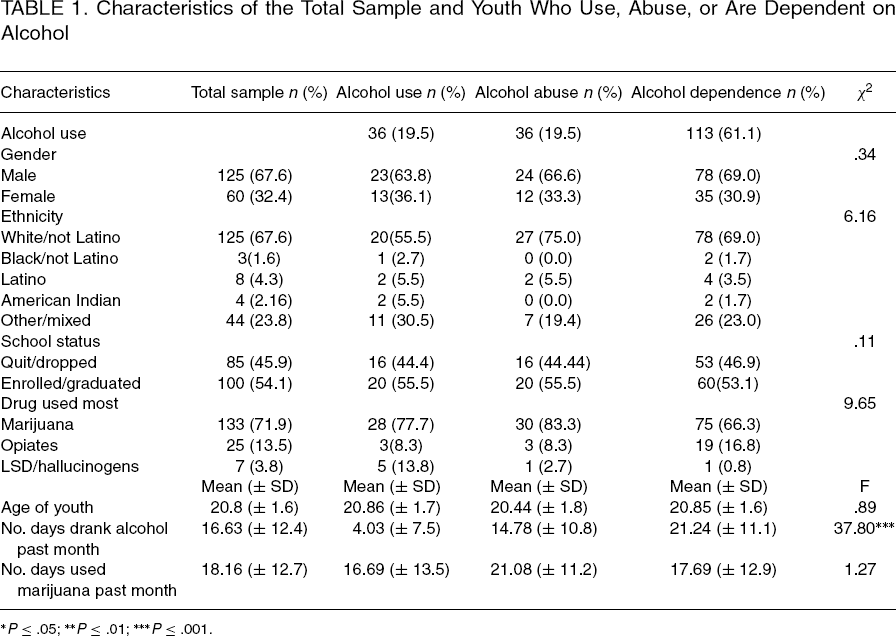
P ≤ .05; ** P ≤ .01;
P ≤ .001.
Multinomial Logistic Regression for Alcohol a
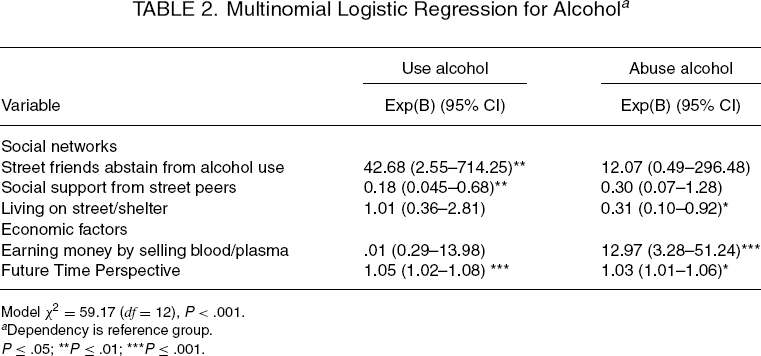
Model χ2 = 59.17 (df = 12), P < .001.
Dependency is reference group.
P ≤ .05;
P ≤ .01;
P ≤ .001.
Of economic resource factors, earning money by selling blood/plasma was only significant among the abuse versus dependent group; specifically, young adults who earned money through selling blood/plasma were nearly 13 times more likely to abuse alcohol than be alcohol dependent (OR = 12.97). Finally, the Future Time Perspective scale significantly differentiated the level of alcohol use. For each 1-unit increase in the scale score, the odds were 5% higher that the young adult used alcohol less frequently (OR = 1.05) and 3% higher that the individual abused alcohol (OR = 1.03) when compared to alcohol dependent youth.
Drug Use
Characteristics of Youth Who Use, Abuse, or Are Dependent on Drugs
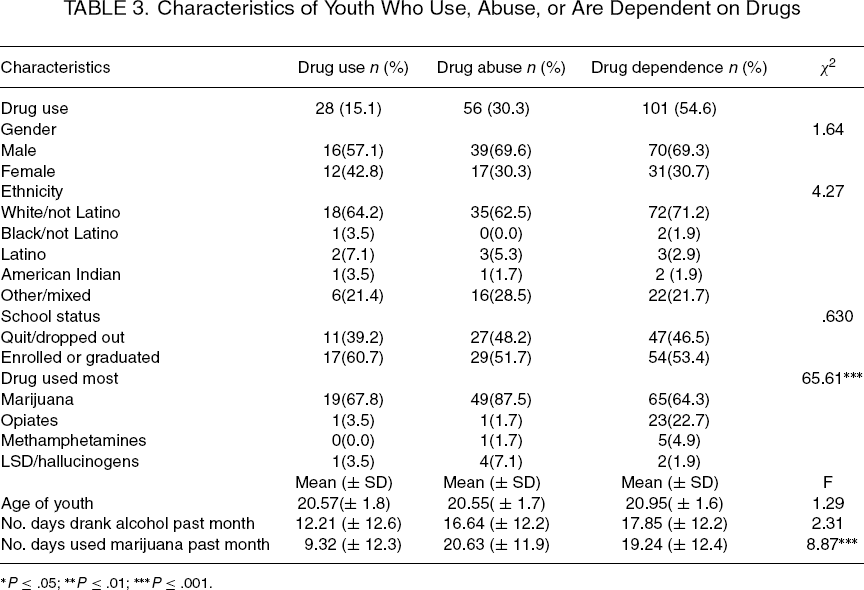
* P ≤ .05; ** P ≤ .01;
P ≤ .001.
Multinomial Logistic Regression for Drugs a
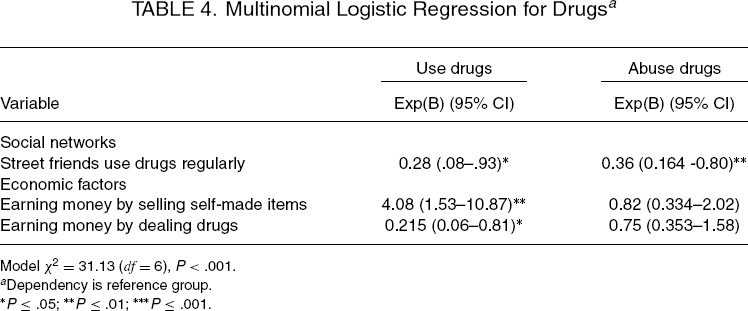
Model χ2 = 31.13 (df = 6), P < .001.
Dependency is reference group.
P ≤ .05
P ≤ .01; *** P ≤ .001.
Economic resources were significant predictors of drug use when comparing those who used to those who were drug dependent. Specifically, youth who earned money by selling self-made items were 4 times more likely to use drugs infrequently (OR = 4.1) compared to drug-dependent youth. In contrast, if participants earned money by dealing drugs, they were less likely to use drugs infrequently (OR = .21).
Discussion
The purpose of this study was to examine the influence of social networks, economic resources, and future expectations on the level of substance use among homeless young adults. In this sample, the vast majority reported high levels of alcohol and drug use, with more than half being identified as dependent. Reflecting the normative nature of substance abuse among this population (37), these young adults most frequently identified marijuana as their drug of choice. Descriptive analyses suggest they also relied on peers as the primary social support network and spent most of their time with street friends while receiving very little parental support in terms of financial or emotional assistance. Given this lack of financial support and the fact that nearly half had not completed high school, the primary means of economic survival was panhandling or selling blood/plasma.
Alcohol Use
The findings from this study provide evidence that there are distinct differences in the factors that influence alcohol use, abuse, and dependency among homeless young adults.
Results suggest that social networks and particularly peer networks influence the level of alcohol use among homeless young adults. Those young people who had street friends who abstained from alcohol use also drank less frequently, whereas those whose peers abused or were dependent on drugs were more also likely to be substance dependent. In addition, young adults who were alcohol dependent were more likely to live on the streets or in shelters than those with less severe levels of use. These findings are consistent with previous research that suggests that peer groups are markedly influential and substance abuse is especially susceptible to peer influences. As peers form “street families” that provide consistent relationship support over extended periods of time and geographic distances (38), they are highly influential. A lack of hope and motivation to leave the streets or perceiving a different way of life also leads homeless youth to form ties with similarly situated others. They develop loose connections aimed at improving their survival strategies (39). Although mutually supportive, these relationships may further entrench them in the street culture (27, 40). Abusing alcohol, then, becomes a common and normative daily activity that provides not only respite from the daily stress of living on the street, but also an activity around which social and emotionally supportive interactions occur.
The findings make an important contribution to the paucity of research on the employment options and sources of income among homeless young adults (20, 41). Although limited, research that has examined the influence of employment on substance use has focused on young adults with stable housing (42). However, the current study found that the source of income was a significant predictor of the level of alcohol use among homeless young adults. Specifically, young adults who sold blood/plasma were less likely to be alcohol dependent. This supports previous research suggesting that those who only use alcohol are more likely to earn their money from selling their blood or plasma, presumably because their blood is “clean” (43).
The final predictor of alcohol misuse was identified as future expectancies. This study confirms previous research findings that positive future expectancies motivate adolescents to engage in positive health practices (32). Among the young adults in this study, having positive expectations for the future was related to lower levels of alcohol use. Thus, an ability to feel hopeful concerning the future and feeling one has control of the future results in more positive health practices such as alcohol misuse.
Drug Use
In comparing homeless young adults who used, abused, or were dependent on drugs, basic demographics are similar; however, peer influences appear to play a major role in youth's immersion in the street environment, which is highly associated with use of illegal drugs (44). Confirming previous studies demonstrating drug use behaviors are highly influenced by peer's use (8, 20, 22, 23), these findings indicated that associating with peers who were using drugs regularly increased the severity of drug use among homeless young adults. These young people often seek out similarly situated peers who provide opportunities and reinforcement for drug-using attitudes and behavior (45), even drawing upon one another for money and other material support. Previous research indicates that the homeless experience itself encourages the use of hard-core, illegal drugs (46, 47). Involvement in the culture of the streets provides opportunities to experiment with various substances, especially as young adults travel from one region of the country to the other and become increasingly isolated from conventional society.
Few studies have evaluated economic factors for homeless young adults or the relationship between economic factors and drug use. In this study, it was found that the source of income was a significant predictor of the level of drug use. For example, young adults who sold self-made items were more likely to use drugs infrequently, whereas those who reported dealing drugs as their primary source of income were more likely to be drug dependent. Previous research has suggested that economically disadvantaged groups who are also socially isolated may experience physical threats and victimization (48). The living conditions of this group, compounded with the need for monetary and material resources, may lead not only to illegal activities such as selling drugs, but to violent actions as well (49). As a drug-dependent lifestyle requires a constant infusion of money, heavy involvement in property crime and drug distribution is common.
Limitations
When interpreting the results, it is important to consider methodological limitations. First, the study included a convenience sample of homeless young adults accessing a community drop-in center in a city with a highly transient homeless population. Although the sample may not be representative of homeless young adults across the United States, the basic demographics of the young people in this study appear similar to other studies of street-involved youth (50, 51). Further research is needed to assess whether this group of young people have comparable substance use patterns to those accessing services in other areas of the country. Caseworkers at the drop-in center also did not collect information on the number of homeless young adults who refused to participate in the study. Although this creates difficulty in assessing selection bias, the caseworkers only sought participation from those they knew used alcohol and/or drugs and were not currently intoxicated or under the influence of drugs. Caseworkers were very familiar with participants due to their frequent utilization of drop-in services and reported that few youth who were approached refused to participate. This level of participation by the young people increases the likelihood that this sample characterizes the youth population sought for this study.
Social desirability may be a concern due to the reliance on self-report measures. As participants were interviewed face to face at the drop-in center where they received services, it is possible they answered questions in a manner they perceived as most desirable to the interviewer. In addition, the possibility of cultural bias may also be a factor, as homeless young people have a unique culture that identifies with a street “language” and expressing themselves counter to traditional authority (38). Interviewers were familiar with homeless culture in the area and attempted to minimize this bias, but the fact that interviewers were “outsiders” may have influenced participant responses. Although these self-reports are uncorroborated by external sources, interviewers found youth willing, even anxious, to describe their drug/alcohol use behaviors and other facets of their lives beyond the quantitative data reported here.
Conclusion
Given the limitations of this study, findings suggest that social networks, economic factors, and future expectancies are significant predictors of the level of substance use among homeless young adults. Being able to identify those areas that place homeless young adults at risk for substance abuse and dependence is important to intervening effectively. This research serves as a preliminary step toward identifying areas where environmental factors can be strengthened to build resiliency in homeless young adults. It also begins to identify those factors that place homeless young adults at greater risk for substance dependence. Agencies providing care to these youth must assess alcohol and drug use and develop referral mechanisms and brief interventions that target alcohol/drug issues. Service providers that identify, understand, and facilitate social processes that reduce harm without judgment or condemnation will likely find greater success in assisting these young people.
Footnotes
Acknowledgements
This research was supported with funding and administration from the Center for Social Work Research at the University of Texas at Austin, School of Social Work and the National Institute on Drug Abuse (5K01-DA015671).