







Abstract
Recent studies on the reading habits of those studying to be teachers have questioned the reading identity of the people who are to become the future mediators of reading in school environments. Within this framework, the current research constitutes an exploratory hermeneutic interpretative study on the reading habits of pre-service teachers, in order to establish a reader profile for this population group, which is the focus of our study. The information is taken from students at Universidad Autónoma de Barcelona. It has been collected through sharing life experiences and has undergone a mixed content statistical analysis. The results reveal a standard profile defined by discontinuous reading habits, precarious intertexts and current practices mainly related to bestsellers.
Frame of reference
Reflecting on the role of the mediator in educating readers, Michèle Petit points out that ‘to pass on a love for reading, in particular for reading literature, one must have experienced it’ (1999, p. 168), thus emphasizing the importance of personal reading habits in terms of conveying an experience which, while being personal and individual, is also intended to be shared. In this sense it has been demonstrated that the mirror effect (Manresa, 2009) created when children observe the reading behaviour (images of readers in other words) of their teachers influences the configuration of their own personal reading habits and can sometimes prove to be decisive. Nevertheless, according to a study carried out with more than 10 Spanish universities (Larrañaga, Yubero, & Cerrillo, 2008), only 7.7% of pre-service teachers are regular readers. In other words, fewer than one in 10 future teachers would be likely to generate this mirror effect in their students.
At the same time, the research indicates that the type of material read by these students is made up of study-related material and best seller novels; a point which would seem to be validated in other contexts. Thus, for example, a study carried out with pre-service teachers in France (Chartier, 2004) shows that reading related to the profession (or to their studies) represents two thirds of these young people’s reading practices. Another example is the choice of reading indicated by pre-service teachers in an Argentine university (Vélez & Rapetti, 2008), whose most-read authors are Jorge Bucay and Paulo Coelho, which is to say best sellers that we could define as self-help books. The reading of literature is thus relegated to second place in the hierarchical selection made by future teachers, as confirmed by other studies such as the one carried out by Tenti Fanfani (in Ferreyro & Stramiello, 2008), this time with in-service teachers in four Latin American countries: the percentage of teachers who regularly read fiction is 16% in Argentina, 14% in Uruguay, 11% in Brazil and 10% in Peru; which is to say, just over one in 10.
It has also been noted that pre-service teachers lack the skills required to analyse literary texts (Díaz Armas, 2008) and have practically no knowledge of children’s literature. Given this context, different proposals have been advanced, such as the need to include specific knowledge on literary education and children’s literature in the training of future teachers, and the need to provide ample and varied reading experiences to combat the inexperience demonstrated by the participants (Silva Díaz, 2001). These and other proposals highlight the need for basic training which, while being fully aware of the reading practices and intertexts drawn on by current university students (Díaz Armas, 2008), is capable of generating new meeting points with the literary system and reflection on it.
As indicated by Dubois (1990): what teachers do depends not solely on what they know, but also on what they are. Accordingly, the teaching practices carried out in relation to the reading of literature will be strongly rooted in personal reading habits and in the identification with a reading identity that, in the best case scenario, is conveyed by teachers to their students.
Objectives and methodology
Our research constitutes an exploratory hermeneutic interpretative study which aims to inquire into the reading habits of those who will go on to become the future reading mediators in schools: pre-service teachers. In this context, our sample is made up of 317 pre-service teachers from the Autonomous University of Barcelona, studying Infant Education (82.3%) and Primary Education (17.7%). The sample is mainly composed of Catalan students in the second year of their degree at the time the information was obtained.
The objectives of the study were: to obtain a description of the participating students in terms of their literary reading habits; to establish a reading profile of the participating students based on an analysis of their reading history.
The data have been collected annually since the academic year 2003/4 up to the year 2010/11, as part of a diagnostic activity within the Literatura infantil 1 (Children’s literature) module. Specifically, this was the initial activity of the first session of the subject, which consisted of writing a text (ranging from one to two sheets, in line with the teacher’s instructions and to be written during class time) responding to the following prompt: ‘Describe your life as a reader from childhood up to the present’.
Life stories were used as a data collection method, which are defined as a ‘description, in narrative form, of a fragment of lived experiences’ (Bertaux, 2005, p. 12). The use of this instrument has provided us with a diachronic perspective of the reading habits of each student from childhood to the present, thus constituting an excellent procedure for constructing the generational reading profile of these students (future Infant and Primary teachers), not focusing merely on their current reading habits — as is the case in most surveys — but also taking account of the possible lines of continuity between their perception of themselves as readers and their reading practices during childhood, adolescence and at present. While being fully aware that the material analysed corresponds to discursive constructions which may not always coincide exactly with reality, we believe that the students’ discourses are nevertheless representations providing relevant information that can help us to explain the construction of their reading habits.
We have used two analysis methods: a statistical analysis which focuses on the number of times the students mention one of the categories constructed in the generational reading profile, and a content analysis process to observe recurrences in the life stories. The analysis units defined were as follows: discourses and practices related to reading, first memories of reading, school reading practices and the corpus of literature.
In relation to these, the first point requires a brief explanation. The exercise of writing their own reading path from childhood to the present leads many students to include an explicit appraisal of their own level as readers. This appraisal was included under a category called the ideal reader (IR), divided into three sub-categories: strong reader (IR1), average reader (IR2) and weak reader (IR3), in line with the categorization procedure most widely used in the sociology questionnaires on reading in French (Hersent, 2000).
We were also aware, however, that the subjects’ declarations on their own reading levels may be influenced by the social value attributed to reading (Chartier, 2004) and in view of this we decided to include a second category based on an observation of the current reading practices mentioned by them. This took the form of a construction compiled by the researcher on the basis of the data collected, providing us with the real reader category (RR), which was also divided into the same sub-categories (RR1, RR2 and RR3). The criteria used to compile the real reader profile were based in the first instance on the frequency of reading for pleasure observed: RR1: Includes the intense practice of reading for pleasure in daily life, regardless of the time of year and/or workload. RR2: Enjoys reading but tends to leave it aside or keep it for specific periods (summer, holidays) due to lack of time and/or excessive workload. RR3: Does not read for pleasure and only reads the compulsory material of their degree course.
When the frequency of reading for pleasure was not mentioned, a second criterion was used which was linked to the corpus of literature stated: RR1: Wide corpus with a predominance of canonical literature (at least two mentions of specific works and/or authors). RR2: Reduced corpus with a predominance of best sellers (at least two mentions of specific works and/or authors). RR3: Corpus restricted to study material and occasional best sellers.
If students made no explicit mention of the two criteria stated above, they were not categorized as real readers.
Results and discussion
The reader: discourses and practices
Among the students who provided an explicit appraisal of their reading level (85% of the sample), most stated that they had a strong reading level (50.5%), followed by average readers (41%) and, considerably below these, weak readers (8.5%), which points to a fairly positive general self-perception in relation to reading. But if we consider the observations made of the real reading practices mentioned, the situation changes notably: The most common type of reader is now the average reader (58.5%), followed by weak readers (25.7%) and finally strong readers (15.8%). In other words, on comparing the categories of ideal reader and real reader, we find a drastic reduction of strong readers and a significant increase in average and weak readers, as shown in Figure 1. Profile of students according to IR and RR.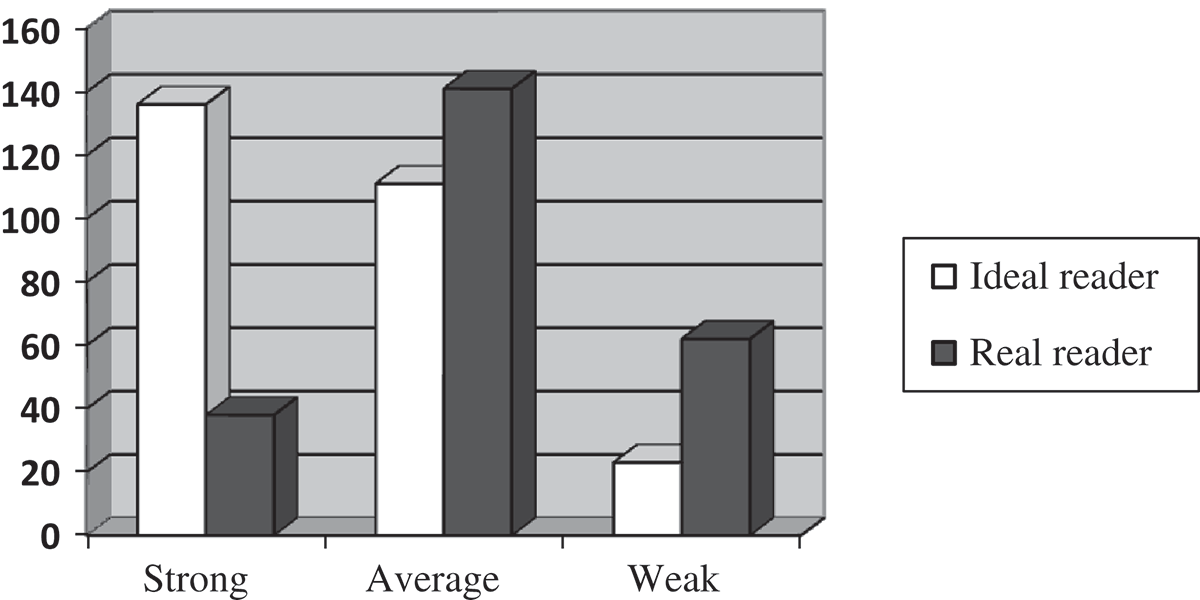
We can therefore say that a phenomenon exists whereby real reading habits are distorted, since the reading level declared is not always in line with the daily practices mentioned in relation to reading. The phenomenon described confirms the weight of the social value given to reading and the influence it has on the students’ statements, in which we can detect abundant signs of a learned official discourse which is present in comments such as: reading is really important or it enriches us in many ways
2
: I don’t read a lot but it’s mainly because of lack of time (…) I know I should read more. Reading is really important, we learn about culture, new vocabulary, use our imagination, think… so I think that as soon as I have more free time I’ll use it to read (Student 252); I don’t see myself as a fan of books or reading, even though I think they enrich us in many ways. I’d like to read more and watch fewer films (E270).
At the same time, the citations indicate unsteady or basic readers who, aware of the social value of reading, show their intention to improve their reading practices. But time also seems to be the most plausible factor that explains the failure to achieve this objective. In this way, the subjects are able to ascribe to accepted social discourse, displacing the reasons behind their scarce reading practices to a circumstantial problem related to time: ‘I read one or two books a year. It’s not that I don’t like reading, but just that I don’t have enough time to enjoy it’ (E301); ‘Unfortunately reading for pleasure is relegated to the summer months’ (E176).
We therefore observe that lack of time is an excellent way of explaining reading habits which the subjects themselves know to be deficient, relegating reading for pleasure to holiday times, but managing nevertheless to build it into their reading itineraries even when, strictly speaking, it is not something they do on a daily basis.
Some students say that time, in terms of a resource, is a factor that explains the absence or precarious nature of their reading habits, thus mitigating the single and explanatory sense it has acquired in generational discourse and opening up other ways of understanding the phenomenon of low reading habits. They thus challenge the causality established in the standard discourse to the extent that lack of time = little/nil reading and explain it in a way which is probably closer to reality by way of questions of motivation or priorities: ‘I always convince myself that I haven’t got time and keep leaving it to one side’ (E203); ‘I haven’t got time to read at the moment, or we could say that it’s not one of my priorities either’ (E173).
If we were to follow the explanatory line opened up by these students, we would have to discard the causality suggested and, by extension, refute the idea shared by current university students concerning their reading habits (see Larrañaga et al., 2008). In other words, we would need to question the most powerful framework of the generational discourse concerning reading practices in their free time and for pleasure, and this would lead us to ask about higher education students’ motivations for maintaining (or constructing) a space for reading for pleasure in their daily lives.
Home: first memories of reading
Among those who carried out an explicit appraisal of their family setting in terms of their initiation into reading (practically half the students), a good majority (79.7%) have a positive memory of this, while only 11.8% and 8.5% remember it as a negative or unexceptional model, respectively.
Positive memories about the home as a place which encouraged the initiation into reading are defined on the basis of three main principles: first, the reading of stories before going to bed; second, the figure of an adult close by as a reading mediator, both in terms of their reading stories before going to bed and in terms of their reading alone which acted as a model for the child; and third, although less frequently, seeing the home as a literacy-rich environment, marked by the possession of books, by reading and, eventually, by conversations on literature.
Perception of family setting according to reader type.
With regard to ideal readers, a clear correlation is found between those who say they are good readers (IR1) and families assessed positively as a reading climate and model (70 mentions). This situation drops to half (36 mentions) in the case of average readers (IR2), and practically disappears in weak readers (IR3), who seem to come from homes which did not play an active role in promoting reading. By contrast, negative perceptions of the home (absence of motivation towards reading, parents who didn’t read) increase in weak readers and drops drastically to only three mentions in strong readers.
We could thus conclude that a close link exists between positive reading experiences in the family setting during early childhood and adults who declare themselves to be good readers, at least in terms of the discourse provided in their self-appraisals. The same relation appears to exist between those who describe themselves as precarious readers and family settings in which no meaningful reading practices, climates or models existed which could be recorded in exercises such as the one carried out.
As regards real readers, on the whole, positive perceptions of the home correlate with average readers (65 mentions), thus following the logic of the aforementioned mass displacement of IR1 to RR2. Nevertheless, strong readers still conserve a high percentage of positive appraisals of their family setting (21 mentions), which falls to its lowest point with weak readers (eight mentions) who, consequently, account for the highest proportion of negative appraisals of the home in their initiation into reading (eight); a figure which decreases in RR2 (5) and practically disappears in good readers (one mention).
The data observed in relation to real readers lead us to draw up two explanatory lines. The first proposes that the family setting may also have been altered during the phenomenon of distorting data in order to claim a more profuse reading path. Consequently, actual perceptions about initiations into reading in the family setting could be situated above the lived reality, with the high proportion of homes considered to be very stimulating in terms of promoting reading practices (79.7%) being, in reality, much lower than that stated.
The second line would infer that a good family reading environment in early childhood does not necessarily lead to strong readers in adulthood, as observed in the high quantity of RR2s who provide positive appraisals of the home. Having analysed the students’ accounts, we can conclude that reading habits are discontinuous: reading practices are not always stable and vary between different stages, with the reasons for these changes in reading habits also varying considerably in line with different factors (personal, academic, social, etc.). Bearing in mind this discontinuity, we cannot simply assume that the power of these early reading experiences will guarantee strong reading habits at the age of 20.
However, we believe that the results of this research confirm the importance of the family setting in the initiation of children into reading and their subsequent development as readers. While this initial experience cannot provide any guarantees, as indicated above, certain tendencies can be observed in the analysis of reading types that are worth noting here. The most relevant are: all good readers (RR1), without exception, come from family settings that brought them close to reading. On the other hand, weak real readers (RR3) are divided interchangeably between those who enjoyed reading homes and those from settings in which no motivation to read was provided, and in which the child had no reading models.
Reading at school
We have collected the students’ appraisals concerning different points related to reading at school, in particular: compulsory reading plans (CR), evaluations of compulsory reading (Ev), the figure of the teacher as a reading mediator (Te), and the school library (SL). It should be noted that while only some of the subjects provided explicit appraisals of these categories (due to the freedom and range of the instruction), we believe that the data obtained shed interesting light on the shared perceptions held of the school period and its influence on personal reading habits, as shown in Figure 2. Appraisal of school reading items.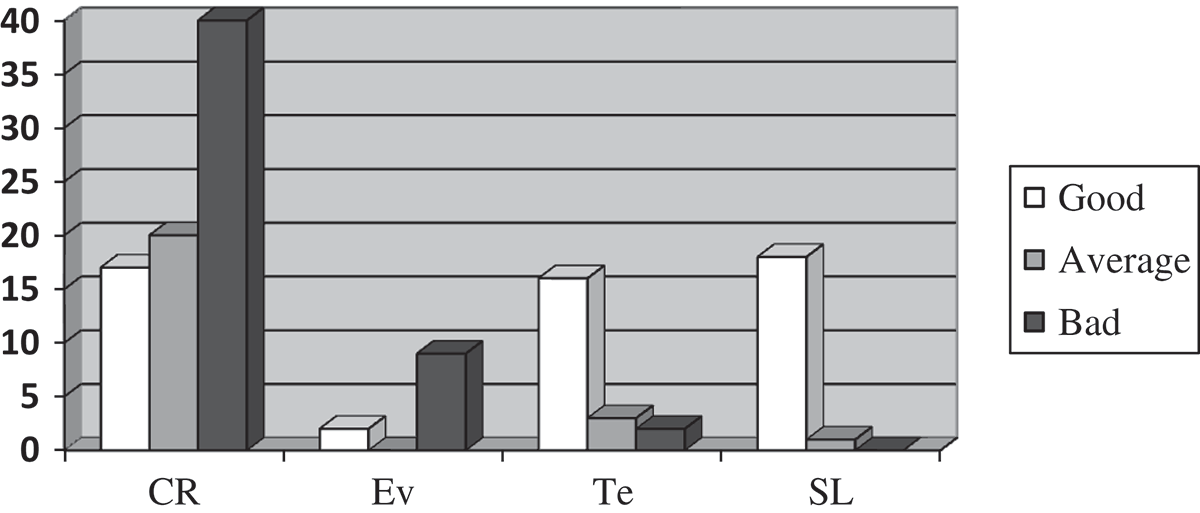
Approximately one in four students of the total sample provided an explicit appraisal of the reading they had to do at school. Out of this group of 77 students, most (51.9%) referred to this compulsory reading negatively, defining it as boring, not at all stimulating and even blaming it for putting them off reading literature: ‘I had always enjoyed reading, but when the school started to impose compulsory books, I lost interest’ (E197).
The tension between free reading and school/compulsory reading means that the negative view of prescribed books is maintained in standard discourse. In this context, 11 students also made explicit their perception of the means of evaluating compulsory reading: nine of them (a significant 81.8% of the group) perceived this negatively and linked it with their progressive lack of motivation towards reading. Given this, the relation that many establish between prescribed reading and a decline in reading for pleasure is only to be expected, as well as the current definition that some of them adopt in order to reaffirm their freedom as readers: ‘That is how I have experienced literature (…) And it is this image that I carry with me from my childhood and adolescence at school: read a book and do your work because “that’s what you have to do” (…) Now I enjoy literature and I read when I want and what I want’ (E227).
The other categories in which data on school reading were collected were the figure of the teacher and the school library, with results that contrast with the negative discourse predominant up to now. As regards the figure of the teacher as reading mediator, approximately three out of every four students who mention this (76.2%) do so by providing a positive appraisal, while only 9.5% of the group (two students out of 21) provided negative appraisals.
The idea that captures students’ memories of their teachers most significantly is related to the ability some teachers had to transmit their own enjoyment of reading. In other words, they incorporated their own affective relation with literature into their teaching practices, which was perceived as a motivating factor by the students who, in their own words, were infected with the enthusiasm shown by the teacher as a literary reader: Fortunately, I had a literature teacher in high school who brought back my interest in reading all kinds of books. She knew how to infect us with her enthusiasm and love of books (E219); maybe it’s thanks to the teacher who taught us Spanish literature that I now love reading even more. That teacher loved reading and enjoyed doing the classes and also made us enjoy literature like her (E123).
The final aspect observed relates to the school library, which was appraised by 19 of the participants. Practically all of these subjects (94.7%) involve positive perceptions: in other words, the school library is remembered as a pleasant meeting point with books and reading. At the same time, it appears in the students’ discourse as a counter to the stamp of the compulsory reading predominant in reading practices in the classroom: many mention it, highlighting the free choice of reading material, reading for pleasure and without subsequent tasks, and relating it with greater motivation towards reading: Once this bad period was over, I started going to the library often, where I was able to choose books that I really wanted to read (E3); I think that being able to choose books to take home increased the enjoyment of reading in the whole class and in me in particular (E115).
Perception of school reading according to real reader types.
On noting the negative appraisals of compulsory reading plans and evaluation tasks related to this reading, which has emerged as one of the particular stamps of the generational discourse provided (when these items are mentioned), clear distinctions appear according to real reader types. On the whole, negative perspectives are found in average and weak readers (RR2 & RR3), and practically disappear in strong readers (RR1), who appeared not to ascribe to the standard discourse on this question. Consequently, positive appraisals of both items, observed together, are concentrated equally between strong and average readers (five mentions for each type) and are low in weak readers (with only two mentions).
This would seem to indicate that the group of good readers (RR1) are not in complete agreement with the negative discourse associated with school reading practices, especially those related to the stamp of compulsory reading. On the contrary, this group show a high percentage of agreement with these practices: 71.4% of strong readers agree with compulsory reading and even the subsequent evaluation tasks related to it; a figure that drops to 21.7% in average readers and to 10% in weak readers. Despite the small number of students (almost 50) that make up this group, we believe that a tendency can be observed here that points to a distinction in ways of perceiving school reading: while precarious and average readers consider it negatively and blame it for putting them off reading, strong readers do not appear to share this discourse with the same intensity.
Another idea reinforced in the table showing real reading types is that the school library does not only belong to good readers, as may have been expected. Contrary to expectations, strong readers do not include it in their appraisals. It is mainly average and, to a lesser extent, weak readers who remember it positively.
Our explanation of this phenomenon relates to the descriptions that the students provide of the library. In a context of tension between free and compulsory reading, it is logical that students who feel uncomfortable and displaced by classroom reading practices find their own space for free reading in the library. In this sense, it is important to note that while the library may represent a space for bringing these students closer to books and reading, this is not necessarily maintained over time, since those who perceive it positively in this study have not gone on to become strong readers today.
The corpus of literature
Current literary corpus.
As we can see, the standard reading profile is by far the reader of best sellers. After this comes reading related to studies, defined as reading which forms part of their professional training. Next, and way below the previous corpuses, come canonical literature: for every one mention of the literary canon, we find approximately four mentions of best sellers. The predominance of the corpus alluded to is confirmed when we review the most mentioned authors in their current reading practices: Paulo Coelho (eight mentions), Carlos Ruiz Zafón (seven), Isabel Allende, Jorge Bucay and Ken Follett (six); followed by Haruki Murakami (five) and Stephen King, Federico Moccia, Noah Gordon, Lucía Etxebarria and Stieg Larsson (three).
It is clear that all these authors, with one exception (Murakami), belong to the corpus known as best sellers. From the international symbols of this genre, such as Ken Follett and Stephen King, to authors such as Isabel Allende who, while being part of the media and commercial network of best sellers, would be considered closer to the literary canon by some. We supplemented this overview of current reading practices with the most referenced titles: The Da Vinci Code, by Dan Brown (15 mentions), The Pillars of the Earth, by Ken Follett (11) and La sombra del viento, by Carlos Ruiz Zafón (11), head a list on which we also find works such as Harry Potter, Angels and Demons, Memoirs of a Geisha and Twilight.
The rigorous predominance of best sellers is thus confirmed as the most significant generational stamp in terms of literacy practices. Given the homogenizing and standardizing of reading that this brings with it, it is not surprising that the three books that are most frequently mentioned in this study are also the three most read books by Spanish university students (Larrañaga et al., 2008); and that the authors read most frequently by students on a Teacher Training Degree in an Argentine University (Vélez & Rapetti, 2008), Coelho and Bucay, are also within the five most read authors by students of a Catalan university, as shown in this study.
Nevertheless, this homogenization of the corpus appears not to be perceived by many average readers — mainly consumers of best sellers — as a discourse is often observed which is defined by an apparent range of readings, but which is actually reduced to the same type of literature: I like many different types of books: romantic, horror, mystery, adventures… but most of all I like fantasy stories, with magic and invented worlds. My favourite books are It by Stephen King, The Lord of the Rings by Tolkien…(E74); I like all kinds of books, such as romantic, horror or mystery (…) I also like classics such as Strangers on a Train and Love Story. At the moment I’m reading Pillars of the Earth by Ken Follett and I’ve already got two books at home for when I finish it: Angels and Demons and The Madman’s Tale (E112).
Leaving aside the worrying definition of classic assumed here, we would like to point out that, in both cases, in terms of their self-perception of themselves as readers, they see themselves as liking a wide range of literature when in fact they refer to a very reduced corpus which is limited to best sellers, children’s literature and possibly detective novels. An important element in understanding this phenomenon lies in the description of the supposed wide corpus that the students claim to be familiar with: the recurrence of the terms romantic, horror, mystery, and adventure, which is nothing other than a description of the kind of novels written by the best selling authors, on the basis of the main thematic and generic components they are made up of.
This creates serious confusion when talking about the corpus, given that the average reader shows no knowledge of literary traditions, or of any points of reference that would help them to position a work within a particular genre. Consequently, they attribute certain concepts related to canonical literature to their reading of best sellers, which leads them to make erroneous comments such as the one made in relation to the classics: I consider myself to be very close to the world of literature (…) It was from the age of 16 that I started to discover my own style in this world: the modern novel, with books like The Pillars of the Earth and Night Over Water by Ken Follett, and the most recent one I’ve read, Angels and Demons by Daw Dreword or something like that (E82).
In this case, the style of the student is based on her attaching herself to a corpus, that of the modern novel, which, erroneously, is seen to exceed the genre of best seller, as we see by the titles given, as if these were canonical examples of the genre. Similar questions emerge with expressions such as the historical novel and the romantic novel, given the wide and simplified use of some of their characteristics by some best selling authors.
These are, then, examples of unfamiliarity with the corpus and with literary traditions, as well as of the limited type of literature preferred by a significant majority of the students in our sample. One of the consequences of this is that best sellers, as the sole or main genre to which they have access, also constructs its own readers, encasing them in a type of reading defined by the vertiginous rhythm of events, an initial sensation in the form of a hook, and by the rapid consumption of a large number of pages: The last one I read was Scusa ma ti chiamo amore by Federico Mocca (…) When I start reading a book I’ve chosen and it’s about adventure and romantic stories, I need to read it quickly. I feel hooked and engrossed in the reading from the beginning right up to the end (E245).
In this context, it is not surprising that students find it difficult to access different literary corpuses from those they are used to reading. Paraphrasing Umberto Eco, each corpus demands certain reading competencies that it also helps to create. And it is clear that the predominance of this kind of literature, characterized by predictability, does not construct reading competences with which students may go on to tackle texts of greater complexity (Colomer, 2005).
Conclusions
What kinds of literary reading habits are demonstrated by the pre-service teachers who are the focus of this study and what is the predominant reading profile within this group? The results show a significant predominance of the average reader type, followed by weak readers, leaving the strong reader as the least visible in the generational reader profile. In other words, the most predominant type of readers are those who either restrict their reading for pleasure to specific and highly circumscribed periods (such as holidays), or simply do not read anything or hardly anything for pleasure. In this context, the corpus that characterizes their literary reading practices is the best seller that, among many of our students, would seem to have formed a model reader; readers who are faithful to certain thematic and genre-specific characteristics. However, despite the homogenizing of reading practices implied by this process of generating loyalty, many university students believe that they navigate a wide literary corpus which, in short, leads to an illusory literary competence that stops them from seeing beyond the limited literary landscape in which they move, and which, in our view, will be of little help in promoting the diversification needed of the school corpus.
Our research confirms the results of other studies already mentioned here (Chartier, 2004; Larrañaga et al., 2008; Vélez & Rapetti, 2008), which have explored the reading profile of the same social universe in relation to the precarious nature of the reading baggage of future teachers, and with regard to the overall tendency towards best sellers which represent the centre of their literary system. The convergence of the results therefore supports the central hypothesis of the ethno-sociological perspective (i.e., that the logic of a social world or meso-cosmos such as students on Education degrees, is equally present in each of the micro-cosmos of which they are a part, such as one university in particular) and would seem to confirm that we are set to see a future generation of teachers with a reduced baggage of literary reading.
In view of this relatively new scenario, it is worth asking what role the university plays in training these teachers. What lines of action should be fostered in the literary education of a group which, up to now, has not been contemplated in terms of their own literary formation, as this would seem to have been taken for granted?
In this respect, it seems to us that the increasing knowledge obtained concerning the reading baggage of future teachers opens new avenues to be explored in initial training which, from our perspective, should be taken forward in at least two lines of action: first, by including reflection and problematization processes based on the students’ own reading experiences (Langlade, 2001), particularly in relation to literary discourse, thus generating spaces in which awareness can be raised of the critical aspects of teaching literature and of the multiple ways of constructing readers; and second, by proposing guided reading paths that allow for the intertexts of future teachers to be widened and diversified, thus working on the construction and consolidation of literary mastery in their own personal baggage. On this point, contact with literature for children and young people from a critical and analytical perspective would seem to be particularly important in terms of the construction of what we could call late reading paths in those who have not yet developed a personal relation with the literary text.
Trayectorias de lectura del profesorado en formación
Marco de referencia
Reflexionando sobre el lugar del mediador en la formación de lectores, Michèle Petit ha señalado que ‘para transmitir el amor a la lectura, y en particular a la lectura literaria, hay que haberlo experimentado’ (1999, p. 168), enfatizando así en la importancia que adquieren los bagajes personales de lectura para vehicular una experiencia propia, individual, que se pretende sea también una experiencia compartida. Pues se ha demostrado que el efecto espejo (Manresa, 2009) que provoca en niños y jóvenes la observación de conductas lectoras (en definitiva, de imágenes de lectores) por parte de sus docentes influye, y en ocasiones puede ser decisivo, en la conformación de sus trayectorias personales de lectura. No obstante, según los datos de un estudio realizado con más de 10 universidades del Estado español (Larrañaga, Yubero, y Cerrillo, 2008), solo un 7,7% de los estudiantes de Magisterio son lectores habituales. Es decir, menos de uno de cada 10 futuros maestros estaría en condiciones de provocar ese efecto espejo en sus alumnos.
A su vez, la misma investigación señala que el corpus de lecturas del alumnado está definido por textos de estudio y novelas tipo best sellers, cuestión que pareciera validarse en otros contextos. Así por ejemplo, un estudio con profesorado en formación en el contexto francés (Chartier, 2004), señala que las lecturas orientadas a lo profesional (o de estudio) representan dos tercios de las prácticas lectoras de estos jóvenes. O las elecciones de lectura libre de estudiantes de Magisterio en una universidad argentina (Vélez y Rapetti, 2008), que señalan como autores más leídos a Jorge Bucay y Paulo Coelho, es decir, best sellers que podríamos definir de autoayuda. La lectura literaria, por tanto, queda relegada a lugares secundarios en la jerarquía de selección de los futuros maestros, situación que confirman otras investigaciones como la desarrollada por Tenti Fanfani (en Ferreyro y Stramiello, 2008), esta vez con profesorado en activo de cuatro países latinoamericanos: los profesores que leen habitualmente literatura de ficción corresponden a un 16% en Argentina, 14% en Uruguay, 11% en Brasil y 10% en Perú. Es decir, poco más de uno sobre 10.
Se ha observado también que el alumnado de Magisterio posee muy escasos elementos para el análisis de textos literarios (Díaz Armas, 2008), y que la literatura infantil les resulta un corpus prácticamente desconocido (Colomer, 2005). En este contexto, la investigación ha formulado propuestas como la necesidad de incluir conocimientos específicos sobre la formación literaria y la literatura infantil en los procesos de formación de los maestros, o proporcionar muchas y variadas experiencias de lectura para suplir la inexperiencia de los participantes (Silva Díaz, 2001). Estas y otras propuestas similares ponen de relieve la necesidad de una formación inicial que, consciente de las características de las prácticas lectoras y de los intertextos del alumnado universitario actual (Díaz Armas, 2008), genere nuevas instancias de encuentro con el sistema literario y de reflexión sobre el mismo.
Pues, tal como señalara Dubois (1990): lo que el maestro haga dependerá no solamente de lo que él sepa, sino también de lo que él sea. En esta lógica, las prácticas didácticas que se realicen en lectura literaria tendrán un fuerte arraigo en el bagaje personal de lecturas, y en la identificación con una identidad lectora que, en el mejor de los casos, se pretende proyectar hacia los estudiantes.
Objetivos y metodología
Nuestra investigación constituye un estudio exploratorio, de tipo hermenéutico- interpretativo, cuyo propósito general es indagar en las trayectorias lectoras de quienes serán los futuros mediadores de lectura en el contexto escolar: los maestros en formación. En ese marco, la muestra la constituyen 317 estudiantes de Magisterio de la Universidad Autónoma de Barcelona, de Educación Infantil (82,3%) y Primaria (17,7%). Esta población corresponde mayoritariamente a estudiantado catalán, que cursaba su 2° año de carrera al momento de la recogida de información.
Los objetivos de investigación han sido los siguientes: Obtener una descripción de los estudiantes participantes en cuanto a su bagaje de lecturas literarias. Establecer un perfil de lector de los estudiantes participantes a partir del análisis de sus historias de lectura.
Los datos han sido recogidos anualmente desde el curso 2003/04 hasta el curso 2010/11, como parte de una actividad de diagnóstico del módulo Literatura infantil 1 . En concreto, se trataba de la actividad inicial de la primera sesión de la asignatura, que consistía en la escritura de un texto (de entre uno y dos folios, solicitado por la profesora del curso y redactado en el aula), a partir de la consigna ‘Describir mi vida lectora desde la infancia hasta la actualidad’.
Como técnica de recogida de datos se utilizó el relato de vida, definido como una ‘descripción, en forma narrativa, de un fragmento de la experiencia vivida’ (Bertaux, 2005, p. 12). La elección de este instrumento nos ha permitido una mirada diacrónica de los recorridos lectores de cada estudiante desde su infancia hasta la actualidad, constituyéndose en un excelente procedimiento para cons- truir un perfil lector generacional de estos alumnos (futuros docentes de Infantil y Primaria), centrado no solamente en sus hábitos lectores actuales, como hacen la mayoría de las encuestas, sino observando también posibles líneas de continuidad entre su percepción como lectores y las prácticas de lectura de la infancia, adolescencia y actualidad. Y si bien asumimos que el material de análisis corresponde a construcciones discursivas, que no siempre coinciden exactamente con la realidad, creemos que los discursos de los estudiantes son representaciones que igualmente entregan información relevante para conjeturar posibles explicaciones acerca de la construcción de su camino lector.
Dos han sido los métodos de análisis utilizados: el análisis estadístico, centrado en la cantidad de menciones para cada una de las categorías construidas en el perfil lector generacional, y el análisis de contenido, para observar las recu- rrencias producidas en los relatos de vida. Las unidades de análisis definidas fueron las siguientes: discursos y prácticas sobre la lectura, los primeros recuerdos de lectura, las prácticas escolares de lectura y el corpus literario.
De estas, la primera requiere una breve explicación. Escribir la trayectoria lectora desde la infancia hasta la actualidad llevó a muchos de los estudiantes a incluir, de manera explícita, una valoración acerca de su propio nivel como lectores. Esta valoración se recogió en una categoría denominada lector ideal (LI), dividida en tres sub-categorías: lector fuerte (LI1), lector mediano (LI2) y lector débil (LI3), atendiendo a la categorización más extendida en las encuestas de la sociología de la lectura francesa (Hersent, 2000).
No obstante, sabíamos que las declaraciones de los sujetos acerca de su nivel lector estarían posiblemente influenciadas por la valoración social de la lectura (Chartier, 2004), lo que nos llevó a incluir una segunda categoría basada en la observación de las prácticas lectoras actuales mencionadas por los estudiantes. En este caso, se trata de una construcción del investigador a partir de los datos recogidos, que da origen a la categoría de lector real (LR), dividida a su vez en las mismas sub-categorías (LR1, LR2 y LR3). Los criterios para la conformación de los perfiles de lector real se basan, en primera instancia, en la frecuencia de lectura fruitiva observada: LR1: Incluye una intensiva práctica lectora por placer en su vida cotidiana, independiente del periodo del año y/o de la carga de trabajo. LR2: Gusta de la lectura, pero por falta de tiempo y/o excesiva carga de trabajo suele dejarla de lado o circunscribirla a periodos determinados (verano, vacaciones). LR3: No lee por placer, y se limita a las lecturas obligatorias de la carrera.
Cuando la frecuencia de lectura fruitiva no se mencionaba se utilizó un segundo criterio, asociado al corpus literario declarado: LR1: Corpus amplio, con predominio de literatura canónica (mínimo dos menciones de obras y/o autores). LR2: Corpus reducido, con predominio de best sellers (mínimo dos menciones de obras y/o autores). LR3: Corpus restringido únicamente a las lecturas de estudio y a best sellers ocasionales.
Si un estudiante no hacía explícito ninguno de los dos criterios anteriores, no categorizaba como lector real.
Resultados y discusión
El lector: discursos y prácticas
Entre los estudiantes que hicieron una valoración explícita de su nivel lector (el 85% de la muestra), la mayoría se declaró en el nivel de lectores fuertes (50,5%), seguido por los lectores medianos (41%) y, muy por debajo de estos, por los lectores débiles (8,5%), lo que nos habla de una autopercepción general bastante positiva en su relación con la lectura. Pero si consideramos la observación de las prácticas lectoras reales mencionadas, la situación cambia notoriamente: el tipo de lector mayoritario se concentra ahora en el lector mediano (58,5%), seguido por el lector débil (25,7%) y, finalmente, por el lector fuerte (15,8%). Es decir, compa- radas las categorías de lector ideal y lector real, encontramos una drástica disminución de lectores fuertes, y un aumento significativo de lectores medianos y débiles, tal como se observa en la Figura 1. Perfil de los estudiantes según LI y LR.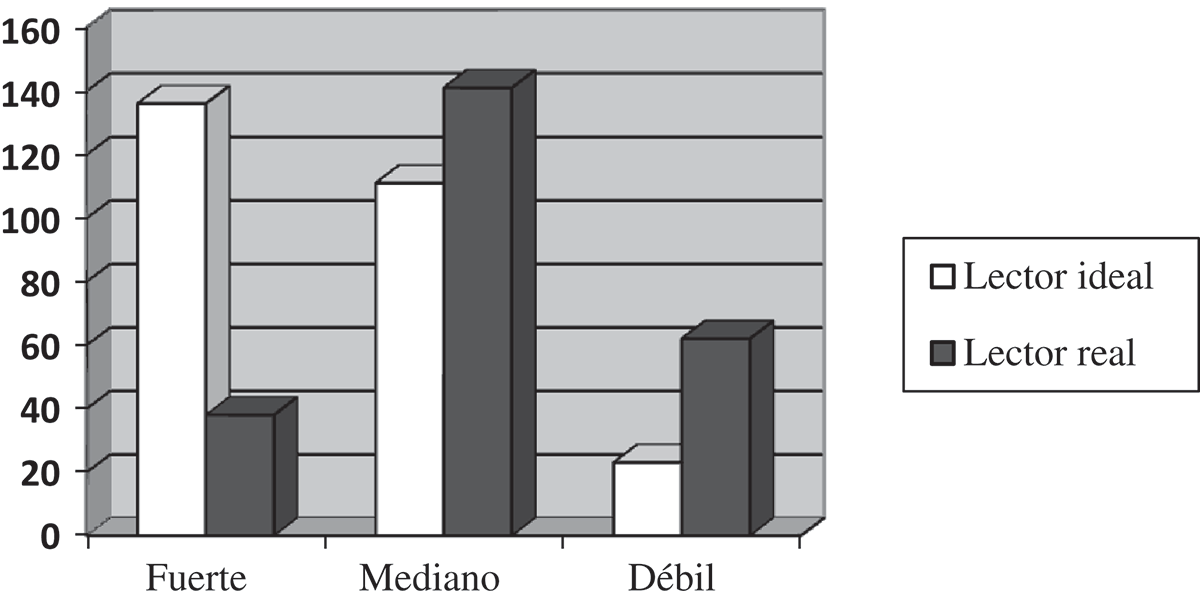
Podríamos decir, por tanto, que existe un fenómeno de distorsionar los hábitos de lectura reales, pues el nivel lector declarado no siempre es coherente con las prácticas cotidianas que mencionan en relación a la lectura. El fenómeno descrito confirma el peso que ostenta el valor social de la lectura y su influencia en las declaraciones de los estudiantes, en las que se observan abundantes huellas de un discurso oficial aprendido, presente en frases como leer es muy importante o te enriquece en muchos sentidos
2
: Leo poco pero es sobre todo por falta de tiempo (…) Sé que he de leer más. Leer es muy importante, nos da mucha cultura, vocabulario, nos hace imaginar, pensar… por tanto, tan pronto tenga tiempo libre aprovecharé para hacerlo (Estudiante 252); No me considero una aficionada a los libros ni a la lectura, aunque considero que te enriquece en muchos sentidos. Me gustaría leer más y ver menos películas (E270).
A su vez, las citas describen a lectores precarios o regulares que, conociendo el valor social de la lectura, señalan tener intenciones de mejorar sus prácticas al respecto. Pero aparece también el factor tiempo como la explicación más plausible en la no consecución de este objetivo. De esta manera, los sujetos pueden adscribir al discurso social aceptado, desplazando las causas de sus escasas prácticas lectoras hacia un problema circunstancial de tiempo: ‘leo uno o dos libros al año, no es una cuestión de que no me guste leer sino que no tengo el tiempo suficiente para leer con gusto’ (E301); ‘La literatura por placer desgraciadamente se ve relegada a los meses de verano’ (E176).
Observamos, por tanto, que la falta de tiempo es una excelente vía para explicar hábitos lectores que los mismos sujetos saben deficitarios, relegando la lectura fruitiva a periodos vacacionales, pero integrándola así a sus itinerarios de lectura aun cuando, en estricto rigor, no sea una práctica que realizan cotidianamente.
Algunos de los estudiantes explicitan el factor tiempo en cuanto recurso que explica la ausencia o precariedad de los hábitos lectores, relativizando así el sentido único y explicativo que ha adquirido en el discurso generacional, y abriendo otras líneas de comprensión para el fenómeno de la baja de lecturas. Desbaratan así la causalidad establecida en el discurso estándar en términos de falta de tiempo = poca/nula lectura y la explican, probablemente más cercanos a la realidad, por cuestiones de motivación o de prioridades: ‘Siempre me autoconvenzo de que no tengo tiempo y la sigo dejando de lado’ (E203); ‘Ahora no tengo tiempo de leer o, podríamos decir, que tampoco es mi prioridad’ (E173).
Seguir el hilo explicativo abierto por estos estudiantes implicaría suprimir la causalidad propuesta y, por extensión, negar la idea más compartida por los actuales universitarios acerca de sus hábitos de lectura (cfr. Larrañaga et al., 2008). Es decir, pondría en entredicho la marca más fuerte del discurso gene- racional acerca de sus prácticas de lectura libre, por placer, y nos llevaría a preguntarnos sobre las motivaciones del estudiantado de educación superior para mantener (o construir) un espacio de lectura fruitiva en su vida cotidiana.
El hogar: los primeros recuerdos de lectura
Entre quienes hicieron una valoración explícita del entorno familiar en cuanto iniciación a la lectura (prácticamente la mitad de los estudiantes), una amplia mayoría (79,7%) tiene un recuerdo positivo de este, mientras solo un 11,8% y un 8,5% lo recuerdan como un modelo negativo o regular, respectivamente.
Los recuerdos positivos sobre el hogar como un entorno favorable para la iniciación lectora están definidos a partir de tres grandes ejes. Primero, la situación de lectura de cuentos antes de dormir. Segundo, la figura de un adulto cercano como mediador de lectura; tanto en su función de lector de cuentos al ir a dormir como en calidad de lector autónomo que actúa como modelo para el niño o niña. Tercero, aunque menos frecuente, la visualización del hogar como un ambiente letrado, marcado por la tenencia de libros, por la actividad lectora y, eventualmente, por el diálogo en torno a la literatura.
Percepción entorno familiar según tipo de lector.
En cuanto a los lectores ideales, se observa una evidente correlación entre quienes se declaran buenos lectores (LI1) y familias valoradas positivamente como ambiente y modelo de lectura (70 menciones), situación que decae a la mitad (36 menciones) en el caso de los lectores medianos (LI2), y que prácticamente desaparece en el lector débil (LI3), que parece no provenir de hogares que jugaran un papel activo en la promoción de la lectura. Por el contrario, la percepción negativa del hogar (ausencia de motivación hacia la lectura, padres no lectores) crece en el lector débil y baja drásticamente, a solo tres menciones, en los lectores fuertes.
Podríamos concluir, entonces, que existe una estrecha relación entre expe- riencias lectoras positivas en el entorno familiar de la primera infancia y adultos que, al menos en el discurso de autovaloración, se declaran buenos lectores. La misma relación parece haber entre quienes se declaran lectores precarios y entornos familiares en los que no existieron prácticas, ambientes ni modelos lectores significativos, recordables en ejercicios como este.
En cuanto al lector real, la percepción positiva del hogar se traslada en forma mayoritaria hacia el lector mediano (65 menciones), siguiendo así la lógica del masivo desplazamiento de LI1 a LR2 que observamos anteriormente. No obstante, el lector fuerte conserva aún un alto porcentaje de valoraciones positivas acerca de su entorno familiar (21 menciones), percepción que cae a su punto más bajo en los lectores débiles (8 menciones) que, consecuentemente, acaparan la mayor cantidad de valoraciones negativas sobre el hogar en su iniciación lectora (8), cantidad que decrece en LR2 (5) y que prácticamente desaparece en los buenos lectores (1 mención).
Los datos observados según lector real nos llevan hacia dos líneas explicativas. La primera supone que el entorno familiar también puede haber sufrido alte- raciones en el fenómeno de distorsionar los datos para declarar una trayectoria lectora más abundante. En consecuencia, las percepciones actuales acerca de la iniciación lectora en el seno familiar podrían estar por encima de la realidad vivida, y esa alta proporción de hogares muy estimulantes hacia la práctica lectora (79,7%), sería en la realidad mucho menor a lo declarado.
La segunda, implicaría que un buen entorno lector familiar en la primera infancia no asegura lectores fuertes en la etapa adulta, como se observa en la alta cantidad de LR2 que hacen una valoración positiva del hogar. Analizados los relatos de los estudiantes, es posible concluir que los recorridos lectores son discontinuos: las prácticas de lectura no son siempre estables, varían entre una etapa y otra, y las causas de esos cambios en las trayectorias de lectura son también muy variadas, y responden a distintos factores (personales, escolares, sociales, etc.). Asumida esta discontinuidad, es difícil otorgarle a esas primeras experiencias de lectura un poder que garantice hábitos lectores fuertes a la edad de 20 años.
No obstante, creemos que los resultados de esta investigación confirman la importancia del entorno familiar en la iniciación lectora de los niños y en su posterior desarrollo como lectores, pues si bien es imposible que esta expe- riencia inicial otorgue ese certificado de garantía al que aludíamos, sí se observan ciertas tendencias en el análisis por tipo de lector que nos parece importante puntualizar acá. La más relevante: todos los buenos lectores reales (LR1), salvo una excepción, provienen de entornos familiares que los acercaban a la lectura. Mientras, los lectores reales débiles (LR3), se dividen indistintamente entre aquellos que gozaron de hogares lectores y aquellos que provienen de un entorno en el que no se motivaba a leer, y en los que el niño o niña no tuvo modelos de lector.
La lectura en la escuela
Hemos recogido las valoraciones de los estudiantes acerca de diversos puntos relacionados con la lectura escolar, particularmente: el plan de lecturas obligato- rias (LO), la evaluación de las lecturas obligatorias (Ev), la figura del profesor como mediador de lectura (Pr) y la biblioteca escolar (BE). Cabe señalar que si bien solo algunos sujetos explicitaron sus valoraciones sobre estas categorías (debido esto a la amplitud y libertad de la consigna), creemos que los datos obtenidos arrojan interesantes luces sobre la percepción compartida que se tiene del periodo escolar y su influencia en los recorridos personales de lectura, tal como muestra la Figura 2. Valoración de los ítems de lectura escolar.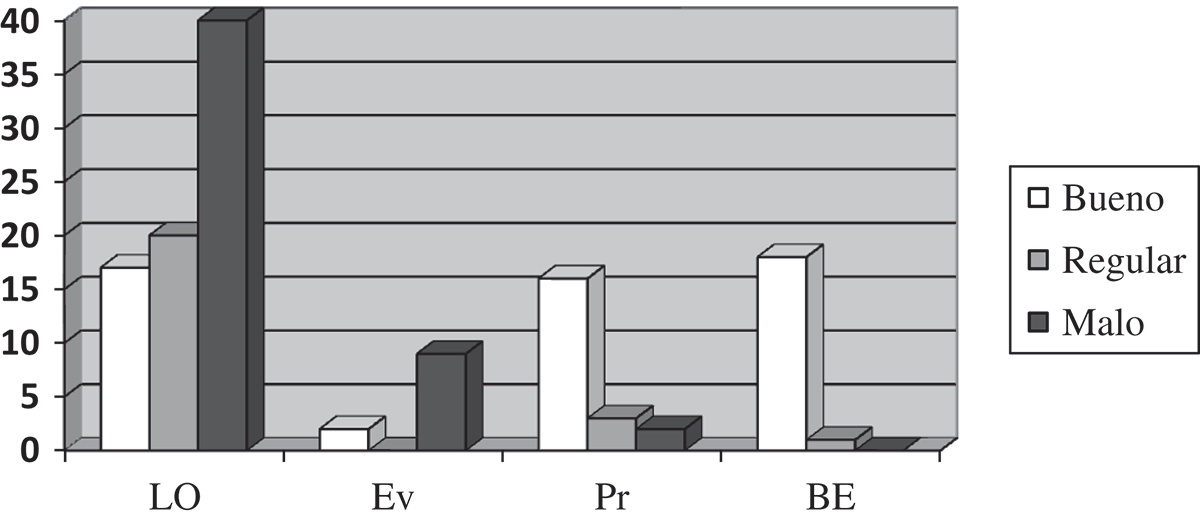
Aproximadamente uno de cada cuatro estudiantes del total de la muestra hizo una valoración explícita sobre las lecturas que debían realizar por prescripción escolar. En este universo de 77 estudiantes, la mayoría (51,9%) se ha referido negativamente a esta, definiéndola como una actividad aburrida, poco estimulante, e incluso señalándola como la culpable de su alejamiento y desmotivación con respecto a la lectura literaria: ‘Siempre había disfrutado, pero cuando la escuela comenzó a imponer libros de lectura obligatoria, perdí el interés’ (E197).
La tensión entre lectura libre y lectura escolar/obligatoria hace que la visión negativa sobre los libros prescritos se mantenga estable en el discurso estándar. En este contexto, 11 estudiantes explicitaron también su percepción acerca de las formas de evaluación de las lecturas obligatorias: nueve de ellos (un amplio 81,8% de este universo) las perciben negativamente, y las relacionan con su progresiva desmotivación hacia la lectura. Dado lo anterior, es esperable la relación que muchos establecen entre la prescripción de lecturas y la pérdida del placer de leer, así como la actual definición que algunos adoptan reafirmando su libertad como lectores: ‘De esta manera he vivido la literatura (…) Y es esta la imagen que llevo de mi infancia y adolescencia en la escuela: leerte un libro y hacer el trabajo porque “tocaba hacerlo” (…) Ahora disfruto de la literatura, y leo cuando quiero y lo que quiero’ (E227).
Las otras categorías en las que se recogieron datos sobre la lectura escolar son la figura del profesor y la biblioteca de centro, con resultados que contrastan con el discurso negativo predominante hasta ahora. En cuanto a la figura del profesor como mediador de lectura, aproximadamente tres de cada cuatro estudiantes que lo mencionan (un 76,2%) lo hacen entregando una valoración positiva, mientras que solo un 9,5% en este universo (2 estudiantes en 21) lo valoran negativamente.
La idea que define más significativamente los recuerdos hacia el profesorado se relaciona con la capacidad que tuvieron determinados docentes para transmitir su propio gusto y placer por la lectura. Es decir, que integraban su propia relación afectiva con la literatura en sus prácticas didácticas, movimiento percibido como motivador para los alumnos que, en sus palabras, se contagiaban con el entusiasmo que demostraba el o la docente como lector literario: Afortunadamente tuve una profesora de literatura en bachillerato que me volvió a despertar aquel interés por la lectura de todo tipo. Supo contagiarnos su entusiasmo e ilusión hacia los libros (E219); Es quizás gracias a la profesora que me impartió clases de literatura castellana que encuentro todavía más placer. Esta profesora amaba la lectura y disfrutaba haciendo clases, y hacía que también disfrutases como ella de la literatura (E123).
El último aspecto observado se refiere a la biblioteca escolar, que tuvo un total de 19 valoraciones. Prácticamente todas (94,7%) implican una percepción positiva: es decir, la biblioteca se recuerda como una atractiva instancia de encuentro con el libro y la lectura. A su vez, aparece en el discurso de las y los estudiantes como contraparte a la impronta de obligatoriedad predominante en las prácticas lectoras de aula: muchos la mencionan resaltando la libre elección de lecturas, el leer por placer y sin trabajos posteriores, y relacionan esto con una mayor motivación por la actividad lectora: Pasada esta mala época me aficioné a asistir a menudo a la biblioteca, donde podía coger libros que realmente me apetecía leer (E3); Pienso que el hecho de poder elegir los libros para llevarnos fomentó el gusto por la lectura en el grupo clase y en mí particularmente (E115).
Percepción de lectura escolar según tipo de lector real.
Al observar las valoraciones negativas sobre el plan de lecturas obligatorias y sobre la evaluación de esas lecturas, que se ha perfilado como una de las marcas del discurso generacional (cuando estos ítems han sido mencionados), surgen evidentes distinciones según el tipo de lector real. La mirada negativa se centra mayoritariamente en los lectores medianos y débiles (LR2 y LR3), y prácticamente desaparece en los lectores fuertes (LR1), que parecieran no adscribir al discurso estándar en esta materia. Consecuentemente, la valoración positiva de ambos ítems, vistos en su conjunto, se concentra por partes iguales en los lectores fuertes y medianos (5 menciones en cada uno) y baja en el lector débil (con solo dos menciones).
Lo anterior parece indicar que el grupo de buenos lectores (LR1) no comparte plenamente el discurso negativo asociado a la práctica lectora escolar, especialmente en lo referido a la impronta obligatoria de la misma. Al contrario, este grupo manifiesta una mayor identificación porcentual con estas prácticas: un 71,4% de lectores fuertes avalan las lecturas obligatorias, e incluso la evaluación posterior de estas, cifra que baja a un 21,7% en el lector mediano, y a un 10% en el lector débil. Creemos que, pese a la escasa cantidad de estudiantes que conforman este universo, cercana a la cincuentena, es posible observar aquí una tendencia que marca una distinción en la forma de percibir la lectura en la escuela: mientras lectores precarios y regulares la valoran negativamente, y le achacan las causas de su alejamiento de la lectura, los lectores fuertes no pare- cieran compartir con la misma intensidad este discurso.
Otra idea reforzada en el cuadro por perfil lector real es la siguiente: la biblioteca escolar no es un patrimonio exclusivo de los buenos lectores, como podría pensarse. Al contrario: el lector fuerte no la incluye en sus valoraciones. Son los lectores medianos, principalmente, y los lectores débiles, en menor medida, quienes la recuerdan de manera positiva.
La tesis explicativa que defendemos para este fenómeno se relaciona con las descripciones que las y los estudiantes hacen sobre la biblioteca. En un contexto de tensión entre lectura libre y obligatoria, cobra sentido que quienes se sienten más incómodos y desplazados por las prácticas lectoras del aula encuentren en la biblioteca su espacio propio de lectura libre. En este sentido, cabría recalcar que si bien la biblioteca, para esos alumnos, representó un espacio de acercamiento al libro y la lectura, este no necesariamente se ha sostenido con el tiempo, pues quienes la valoran positivamente en esta investigación no han devenido lectores fuertes en la actualidad.
El corpus de lectura literaria
Corpus literario de la actualidad.
Como puede observarse, el perfil lector estándar es, con muchísima diferencia, el de un lector de best sellers. Luego aparecen las lecturas de estudio, definidas como aquellas que forman parte de su formación profesional. Posteriormente, y muy por debajo de los corpus anteriores, se sitúa la literatura canónica: por una mención de canon literario, encontramos aproximadamente cuatro de best sellers. La supremacía del corpus aludido se confirma al revisar los autores más mencionados en sus lecturas actuales: Paulo Coelho (8 menciones), Carlos Ruiz Zafón (7), Isabel Allende, Jorge Bucay y Ken Follett (6); seguidos de Haruki Murakami (5) y de Stephen King, Federico Moccia, Noah Gordon, Lucía Etxebarria y Stieg Larsson (3).
Resulta evidente que todos estos autores, salvo una excepción (Murakami), son autores representativos del corpus denominado best sellers. Desde los símbolos internacionales del género, como Ken Follet o Stephen King, hasta autores que, formando parte del entramado mediático y comercial del best sellers, estarían para algunos más cercanos al canon literario, como Isabel Allende. Complementamos el panorama de lecturas actuales con los títulos más referenciados: El código da Vinci, de Dan Brown (15 menciones), Los pilares de la tierra, de Ken Follett (11) y La sombra del viento, de Carlos Ruiz Zafón (11), lideran una lista donde también aparecen obras como Harry Potter, Ángeles y demonios, Memorias de una geisha y Crepúsculo.
Es decir, se confirma el riguroso predominio del best sellers como la gran marca generacional de lecturas literarias. Dado el proceso de homogeneización y estandarización de lecturas que esto trae consigo, no resulta extraño que los tres libros más mencionados en la presente investigación sean también los tres libros más leídos por los universitarios españoles (Larrañaga et al., 2008), o que los autores más leídos por estudiantes de Magisterio de una universidad argentina (Vélez y Rapetti, 2008), Coelho y Bucay, estén también entre los cinco más leídos por estudiantes de una universidad catalana como la del presente estudio.
No obstante, esta homogeneización del corpus parece no ser percibida por muchos de los lectores estándar, principales consumidores del best sellers, pues con frecuencia se observa un discurso definido por la supuesta amplitud de lecturas pero que, en definitiva, se reduce a un mismo tipo de literatura: Me gustan muchos tipos de lecturas: de amor, terror, misterio, aventuras… pero sobre todo las de rol, con magia y mundos que no son reales. Mis libros preferidos son It de Stephen King, El Señor de los Anillos de Tolkien… (E74); Me gustan los libros de todo tipo de género, como de amor, terror o intriga (…) Los clásicos también me gustan mucho, como Extraños en un tren o Love Story. Actualmente estoy leyendo Pilares de la Tierra de Ken Follett, y ya tengo en casa dos libros más para cuando lo acabe, que son Ángeles y demonios e Historia de un loco (E112).
Dejando de lado la preocupante definición de clásico asumida, nos interesa resaltar que la autopercepción como lectores, en ambos casos, considera que gustan de un amplio abanico bibliográfico cuando en verdad se refieren a un corpus muy reducido, restringido al best sellers, a la literatura juvenil y, acaso, a la novela policial. Un elemento importante para entender lo anterior radica en la descripción del pretendidamente amplio corpus que los estudiantes dicen conocer: la recurrencia de los términos amor, terror, misterio, aventuras, que no es sino una descripción de la novela-tipo de los escritores superventas, a partir de sus principales componentes temáticos y genéricos.
Lo anterior genera graves confusiones al hablar del corpus, pues el lector estándar no evidencia conocimientos de las tradiciones literarias, ni marcos de referencia que le ayuden a situar una obra en un género particular. Por consiguiente, atribuye a sus lecturas de best sellers determinados conceptos de la literatura canónica, que lo llevan a planteamientos erróneos como el que se hiciera acerca de los clásicos: Me considero muy cercana al mundo de la literatura (…) Fue a partir de los 16 años cuando comencé a descubrir mi estilo en este mundo: la novela moderna, con libros como Los Pilares de la Tierra y Noche sobre las aguas, de Ken Follett los dos, y como el último que he leído, Ángeles y demonios, de Daw Dreword o algo así (E82).
En este caso, el estilo de la alumna estaría fundado en la adscripción a un corpus, el de novela moderna, que traspasa erróneamente al género best sellers, tal como vemos por los títulos aludidos, como si estos fueran los ejemplos canónicos del término mencionado. Cuestiones similares suceden con expresiones como novela histórica o novela romántica, dado el amplio —y simplificado— uso de algunas de sus características por parte de los autores superventas.
Son, pues, ejemplos del desconocimiento del corpus y de las tradiciones literarias, así como del restringido tipo de literatura que conforma los gustos de una importante mayoría de los estudiantes de la muestra. Una de las consecuencias de esto es que el best sellers, como género único o mayoritario al cual se tiene acceso, construye también su propio lector, encasillándolo en un tipo de lectura definida por el vertiginoso ritmo de los acontecimientos, por una sensación inicial de enganche, y por el rápido consumo de una gran cantidad de páginas: Lo último que leí es Perdona si te digo amor, de Federico Mocca (…) Cuando comienzo a leer un libro que he escogido y que habla de historias de aventuras y románticas necesito leerlo rápido. Me siento enganchada y comprometida con la lectura desde el principio hasta el final (E245).
En ese contexto, no resulta extraño que los estudiantes experimenten dificultades al acceder a corpus literarios diferentes de aquel que leen habitualmente. Pues, parafraseando a Umberto Eco, cada corpus exige unas determinadas competencias de lectura que también ayuda a crear. Y es evidente que el predominio de un tipo de literatura caracterizada por lo predecible, no construye competencias de lectura para enfrentar textos de mayor complejidad (Colomer, 2005).
Conclusiones
¿Qué bagajes de lectura literaria demuestran los estudiantes de Magisterio objeto de nuestro estudio, y qué perfil lector predomina en este grupo? En los resultados se observa un amplio predominio del tipo de lector mediano, seguido del lector débil, dejando así al lector fuerte como el menos visible en el perfil lector generacional. Es decir, predominan los lectores que, o bien circunscriben sus prácticas de lectura fruitiva a periodos determinados y muy acotados (como las vacaciones), o directamente no leen nada o casi nada por placer. En ese contexto, el corpus que caracteriza sus prácticas de lectura literaria es el best sellers, que pareciera haber formado, entre muchos de nuestros estudiantes, a su lector modelo, lector que fideliza con unas determinadas características temáticas y de género. Sin embargo, pese a la homogeneización de lecturas que implica este proceso de fidelización, muchos universitarios creen navegar por corpus literarios amplios que, en definitiva, comportan una competencia literaria ilusoria, que no les permite ver más allá de los restringidos terrenos literarios en los que se mueven y que, creemos, de poco servirá para proponer la necesaria diversificación del corpus escolar.
Nuestro estudio confirma los resultados de otras investigaciones, mencionadas ya en estas páginas (Chartier, 2004; Larrañaga et al., 2008; Vélez y Rapetti, 2008) que han explorado el perfil lector del mismo universo social, acerca de la precariedad de los bagajes lectores del futuro profesorado, y de la orientación mayoritaria hacia el best sellers como centro de su sistema literario. La convergencia de resultados, por tanto, avala la hipótesis central de la perspectiva etnosociológica (esto es, que las lógicas de un mundo social o mesocosmos como el alumnado de Magisterio, se dan igualmente en cada uno de los microcosmos que lo componen, como una universidad en particular) y parecen confirmar que estamos frente a un futuro profesorado caracterizado por reducidos bagajes de lectura literaria.
Frente a este relativamente nuevo escenario, cabe preguntarse por el lugar que ocupa la universidad como formadora de docentes. ¿Qué líneas de actuación propiciar en la educación literaria de un grupo que, hasta ahora, no ha sido contemplado en términos de su propia formación literaria, pues esta parecía darse por sentada?
Al respecto, nos parece que el conocimiento cada vez mayor de los bagajes de lectura de futuros docentes abre nuevas puertas a explorar en la formación inicial, que desde nuestra perspectiva debiese avanzar al menos en dos líneas de actuación. Primero, dar cabida a procesos de reflexión y problematización a partir de las propias experiencias lectoras del estudiante (Langlade, 2001), particularmente en su relación con el discurso literario, generando así espacios de toma de conciencia sobre los nudos críticos de la enseñanza de la literatura y sobre los múltiples caminos de construcción de un lector. Segundo, proponer itinerarios de lectura guiada que permitan ampliar y diversificar los intertextos del futuro profesor, trabajando así en la construcción o consolidación de un dominio literario en sus historias personales. En este punto, el encuentro con la literatura infantil y juvenil desde una perspectiva crítica y analítica parece especialmente fructífero para la construcción de lo que podríamos denominar recorridos lectores tardíos en quienes aún no hayan desarrollado una relación personal con el texto literario.
Footnotes
1.
Due to a change in the Curricular Plan for the speciality in Infant Education, this subject was no longer delivered after 2009, as a result of which the data collected in 2010/11 correspond to students taking the subject Didáctica de la Lengua y la Literatura (Teaching Language and Literature) on the Primary Education speciality. This explains the important difference in the percentages of the sample between one speciality and another.
2.
The language in which the participating students teach is Catalan, and their texts were written in this language. The translation of their texts into Spanish was carried out by the author of this article.
1.
Por un cambio en el Plan Curricular de la especialidad de Educación Infantil, esta asignatura dejó de dictarse como tal en 2009, por lo que la recogida de datos del curso 2010/11 corresponde a estudiantes de la asignatura Didáctica de la Lengua y la Literatura, de la especialidad de Primaria. Esto explica la importante diferencia en los porcentajes de muestra entre una y otra especialidad.
2.
La lengua de enseñanza de los estudiantes participantes es el catalán, y sus textos fueron escritos en esa lengua. La traducción es del autor de este artículo.
To Dr. Teresa Colomer who provided us with the majority of the life stories studied and tutored the research work that led to this article. / A la Dra. Teresa Colomer, quien nos facilitó gran parte de los relatos de vida estudiados y tutorizó el trabajo de investigación que dio origen al presente artículo.