







Abstract
This article examines the different writing practices carried out in Spanish universities and the methodology used to promote and teach the development of writing competences. The data in this study pertain to nine Spanish universities, 280 teachers and 1,044 undergraduate students from these universities. The data also refer to student and faculty perceptions of the importance attached to the writing process, the amount of time spent on it and the dimensions or aspects of the competence they consider the most important. Furthermore, the article examines the writing practices proposed by the teachers as well as the ones identified by and assigned to the students. On some of the variables, the results suggest opposing perceptions between the two groups and at the same time highlight differences depending on the fields of knowledge. This sheds light on different ways to include the writing process in university education.
The acquisition of communicative-linguistic competences as a ‘process of gradually approaching, incorporating and integrating into the community of experts and professionals in the field’ (Ezeiza, 2008, p. 1) to which students belong is regarded as an essential part of university education. For this reason, it should come as no surprise that degree programmes ask for room to deal with writing within the teaching of the disciplines, in an effort to respond to the difficulties students face with the writing practices that they should be capable of producing. The purpose is not to remediate shortcomings in the previous curriculum, and we do not consider writing an elementary competence that can be generalized to any communicative situation (Carlino, 2005).
In other educational settings, discipline-internal writing has been done for many decades. In English-speaking countries, especially the USA and the UK, numerous avenues researching into writing at university have been developed, and different movements to revamp the writing curriculum have been created and spread, as mentioned in the introductory article of this special issue (Bazerman, Little, Bethel, Chavkin, Fouquette, & Garufis, 2005; Kruse, 2013). In the field of writing in Spanish, there have been significant contributions from Latin American universities, especially in Argentina, Chile and Colombia (Benvegnú, Galaburri, Pasquale, & Dorronzoro, 2001; Carlino, 2003, 2004, 2005, 2013; Di Stefano & Pereira, 2004; Marincovich, 2014; Molina-Natera, 2012; Narvaja de Arnoux, 2009).
In these contexts, importance is attached to writing because of its communicative function and as a learning tool, which means that it is present in the different stages of university education. A variety of teaching proposals have been devised and implemented, and an array of resources have been generated to meet students’ needs.
Attention to writing in discipline forces us to consider different kinds of problems associated with the complex nature of this competence. Writing is viewed not only as a code but also as a dialogic communicative practice, a cognitive process and an epistemic tool.
Writing is conceived as a code distinct from oral communication, although related to it, with its own features which situate it at different levels within the language system, such as spelling and punctuation rules, making correct sentences and paragraphs. Students must be capable of producing and controlling these features (Cassany, 1989).
Writing is also a communicative practice situated in a given historical-social context. In this sense, we should highlight the contributions made from the field of discourse studies. The concepts of discourse and discourse genre are crucial. Bajtin (1982) establishes the basic characteristics of the notion of discourse genre and associates the use of the language with the multiple spheres of human activity. Following this reasoning, Camps and Castelló (2013) describe how a single person participates in different spheres of activity and how genres are instruments of participation in this social activity. One learns how to use the language within spheres of activity which have shaped specific language usages. Learning a language means learning how to use it properly in that specific context in which communicative exchanges take place, such as in academia. For this learning to take place, we must consider the situation or kind of social action performed in that field, bearing in mind that situations ‘are not defined only or even primarily by the material conditions of communication but are social constructs stemming from the meaning and interpretation that humans assign to their activities’ (Camps & Castelló, 2013, p. 20).
The term discourse community refers to a human group which shares specific communicative practices and uses specific texts to achieve specific goals (Maingueneau, 2004). In these communities, authors and readers take on predetermined roles and are the heirs to the same way of perceiving reality and transmitting knowledge. All users are capable of recognizing and using the text genres linked to the spheres of activity in which they take place.
From the perspective of cognitive psychology, writing is a complex cognitive process which involves different mental operations until the final version of a text is reached (Flower & Hayes, 1981, 1996). These operations, which are primarily based on planning, writing and revision, are supported by long-term memory and the factors surrounding the communicative situation. These phases are not linear in nature but instead recursive, thanks to the increasing control exerted when writing a text. The writer’s ability to manage information and carry out the different actions or processes entailed in composing a written text are a reflection of their competence at generating a message and constructing knowledge. Bereiter and Scardamalia (1983) describe two different ways of composing: ‘telling knowledge’, when the writing more or less literally reproduces the information on a topic stored in students’ memory; and ‘transforming knowledge’, when the information leads the writer to rethink their ideas as it is adapted to a new contexts, generating new knowledge in consequence. We should stress that certain writing practices do not entail cognitive activity because they are not epistemic tools, that is, semiotic instruments that affect the construction of one’s own knowledge (Bazerman, 2009) and have influence on the learning attained through them (Bangert-Drowns, Hurley, & Wilkinson, 2004).
Based on these theoretical referents, we set out to ascertain what happens in the context of Spanish universities, what importance faculty and students attach to writing, how much time is spent on writing, what aspects are considered the most important in ‘writing well’ and what the characteristics of the practices carried out in the classroom to develop writing skills are.
Within this context, we set the following objectives: To analyse the amount of time spent on writing, how much writing is done and how frequently writing is done in the opinions of both faculty and students. To determine to what extent the status that faculty and students attach to writing changes depending on the characteristics of the participants and their disciplines. To describe writing practices based on: (a) the kind of instructions provided to plan, write or revise texts; (b) the kind of feedback students receive; and (c) the genres that students write the most frequently. To analyse to what extent these representations are shared by both faculty and students. To verify whether there are differences in these representations based on the characteristics of the participants and their fields.
Method
The study was carried out in nine Spanish universities using the faculty and student versions of the European Writing Survey (EUWRIT) (in its Spanish version: Encuesta Europea sobre la Escritura Académica (EEEA), which is described by Castelló and Mateos (2015) in the first article of this special issue.
Participants
Participants were 280 faculty members and 1,044 Bachelor’s students from nine Spanish universities in the degree programmes in the arts and humanities, social and legal sciences, health sciences and engineering and architecture.
Procedure
Presence of writing in the curriculum.
Perceived support from the university in developing writing as reported by students and faculty.
Writing practice in the classroom.
Frequency and kind of feedback received.
Assessment of the feedback received according to students and faculty.
Presence of writing in the curriculum.
For the general description of the responses, we analysed the central tendency (M) and dispersion (SD) measures; to analyse the differences between students and faculty, we used an ANOVA (F and p < .02).
Results
Presence of writing in university education and importance attached to it
To ascertain to what extent writing is present in the everyday activities at universities, we analysed the five items on the Amount of Writing scale which refer to the amount or frequency with which writing is used in academic activity. The five response choices express intervals of percentages in the first three items (none, 0–24%, 25–49%, 50–74% and 75–100%), frequency in the fourth item (never, < 3, < 6, < 9 and 10 or more) and the estimated number of written assignments in the fifth (none, < 5, < 10, < 15 and 20 or more) (see Table 1).
The students believe on average that they have to write texts in 72.75% of their courses, and that this is the tool used to evaluate them in up to 60.25% of the time. However, these figures show considerable dispersion. They also estimate that they spend less than seven hours per week writing, and that the volume of texts they have to produce over the course of their university degree is 17.4 or more. Finally, students claim that on average they write at home for different purposes in 73% of their cases.
The analysis of variance according to variables involved in the survey shows that female students report a significantly higher presence of writing in their day-to-day academic activities than male students (F = 6.145, p < .013). On the other hand, students in the fields of the humanities and social and legal sciences report a significantly higher presence of writing in their day-to-day academic activities than students in health sciences and engineering and architecture (F = 29.449, p < .00). Finally, students with three or four years of university experience state that writing is significantly more frequent in their day-to-day academic activities than students with five years or more at the university (F = 4.033, p < .018).
These results do not dovetail with the faculty perspective (see Figure 1). In the opinion of the latter, the percentage of classes in which they ask students to write texts for evaluation is 59.75% (SD = 1.27). Likewise, they estimate that the amount of writing they assign either in the classroom (43% of classes, SD = 1.18) or outside it (55.5%, SD = 1.25) is lower than what students reported. Along the same lines, the faculty expect students to spend less than five hours per week on writing in their classes, yet they believe that the students have to write an average of 19.35 texts. Mean responses from faculty and students on the Amount of Writing used.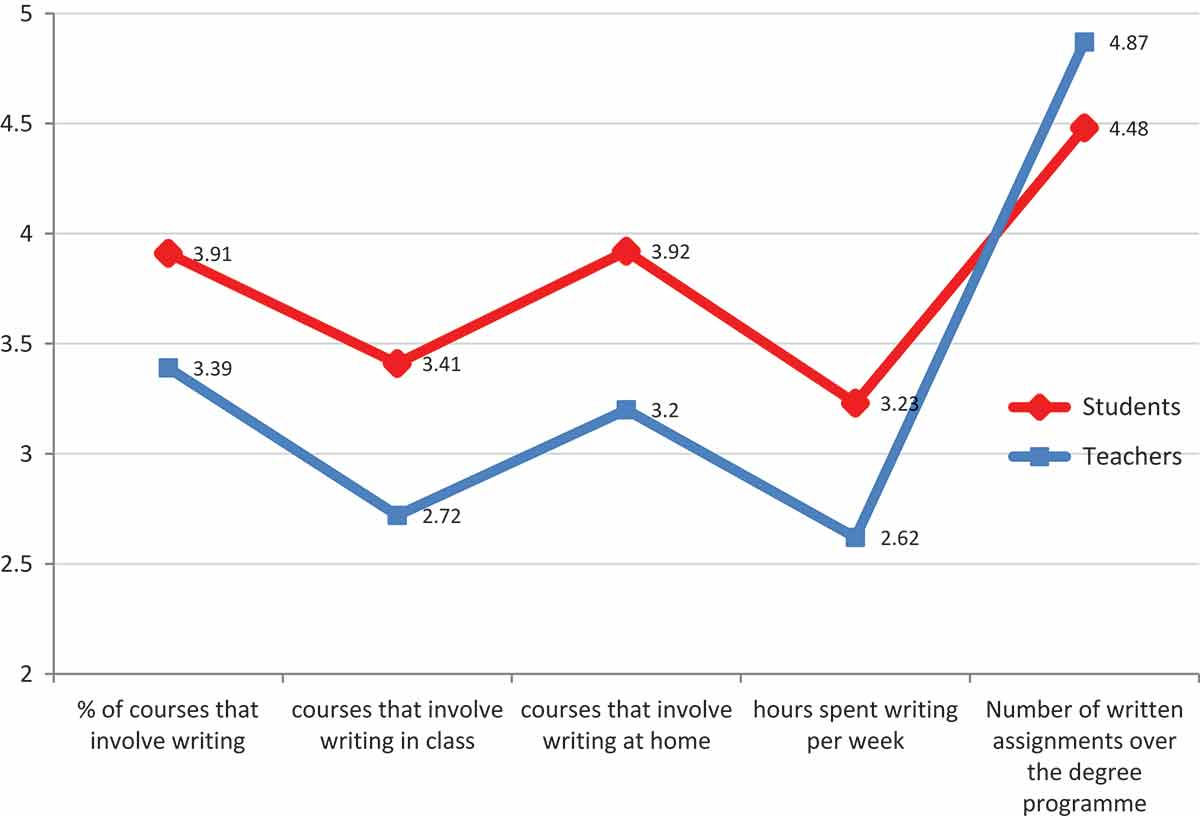
The significant differences found in the faculty sample are related to the fields in which most of them teach. Predictably, given the nature of the fields, the humanities and social sciences faculty state that they assign significantly more writing than the engineering faculty (F = 9.681, p < .000).
We also analysed the perception of support that the university provides so students can develop the skills involved in writing. In this case, the five response options reflect the degree of agreement with the statement: ‘totally disagree’, ‘disagree’, ‘not sure’, ‘agree’ and ‘totally agree’.
The mean results show that students are ‘not sure’ whether they get the right level of support from the university as they learn to write, although they ‘agree’ that writing is quite common. In both cases, the opinions are relatively heterogeneous. The faculty report the same viewpoints on the amount of support given to writing and to the fact that it is considered a topic of interest and discussion, but in both cases with highly dispersed opinions as well.
Instructional attention to the development of writing skills
We analyse the practices used to guide and encourage the development of writing skills as perceived by both faculty and students. We first present aspects related to the instructions given when assigning written texts and the amount of attention spent on the writing produced by students, and secondly we deal with issues related to revising and improving texts as reported by students. Thirdly, we analyse what kinds of writing practices are done the most frequently.
Instructions for writing texts and attention to writing
The scale on Writing Practice in the Classroom (see Table 3) refers to the instructions provided when students write texts and whether writing is the subject of attention in meetings between faculty and students, and among students and faculty with each other. The five response options are ‘never’, ‘rarely’, ‘sometimes’, ‘often’ and ‘always’.
The students declare that they receive oral and written instructions ‘often’, while the faculty believe that they ‘always’ provide oral instructions when they assign students to write a text, and that they ‘often’ provide written instructions. The different perceptions of students and faculty on oral instructions is significant. The students state that they ‘sometimes’ discuss their texts with their instructors and ‘often’ with their peers, while the faculty claim that they ‘often’ discuss students’ writing with them and ‘sometimes’ discuss the characteristics of students’ texts with their colleagues.
The students declare that they ‘sometimes’ participate in debates, forums and wikis at their university, and the faculty say that they ‘sometimes’ use chats, forums and wikis to provide instructions, although both samples show relatively high dispersion in their responses.
The students indicate that faculty have ‘rarely’ asked them to plan before writing in class, while the faculty believe that they ‘sometimes’ ask their students to plan their writing in advance. On the other hand, the students report that they almost always or ‘always’ take notes in class, while the faculty’s perception is that students ‘sometimes’ or ‘often’ take notes.
Regarding whether students are informed about the rules on plagiarism and told how to avoid it (see Figure 2), the faculty claim that they ‘often’ provide information on plagiarism and explanations how to avoid it; however, the students state that they are ‘often’ informed about plagiarism but only ‘sometimes’ told how to avoid it. In both cases, the dispersion in answers is high. Responses from faculty and students on writing practices in the classroom.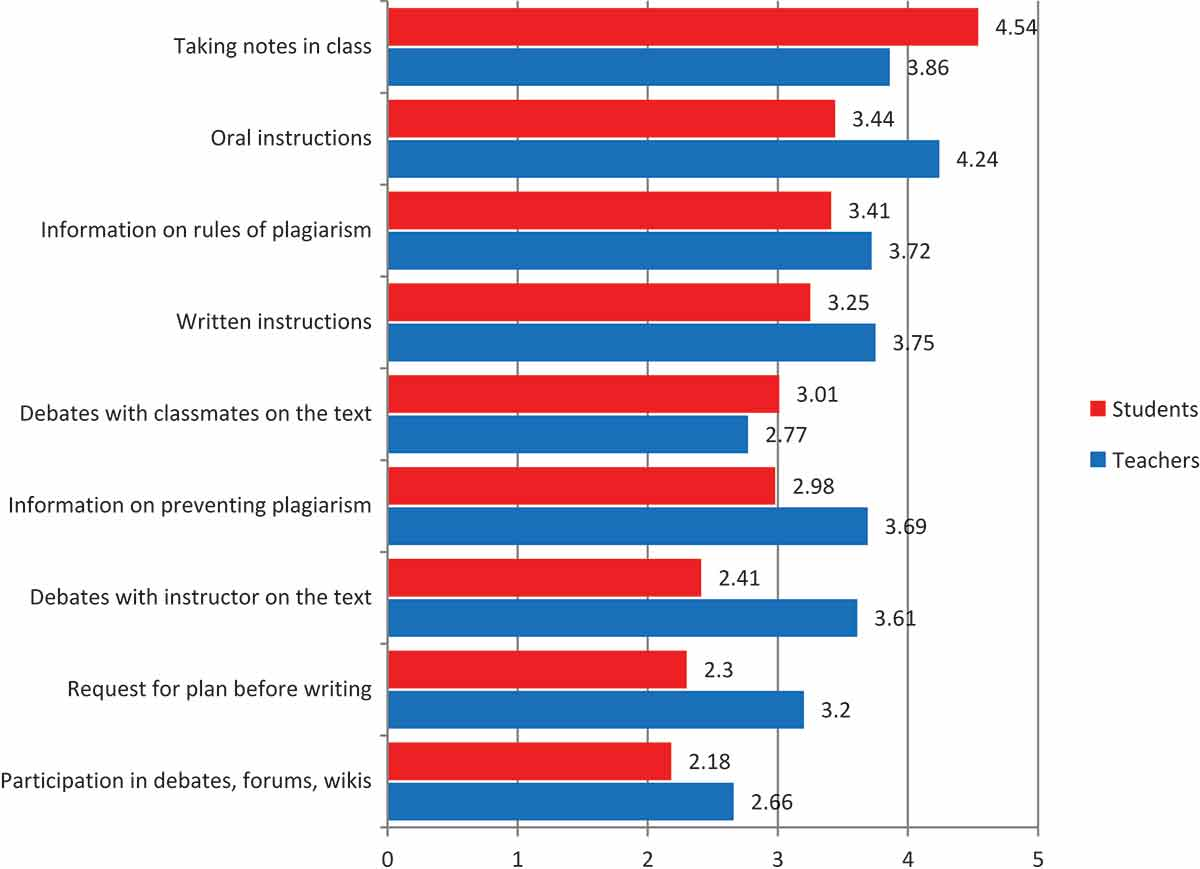
The humanities and social sciences faculty declare that they use writing practices to guide and attend to students significantly more than the engineering faculty (F = 7.532, p < .000).
The students in the humanities and social sciences report a significantly higher frequency of writing practices in the classroom than the students in health and engineering, just as the students in the health sciences report significantly more than their engineering counterparts (F = 10.747, p < .000). Likewise, the number of years that students have been at the university shows significant differences: students who have been there one or two years declare that they do more writing practices than the others, just as students who have been at the university three or four years claim to write more than those who have been there five years or more (F = 21.311, p < .000).
Feedback on writing and usefulness of this feedback
This scale provides information on when and how students receive feedback from their instructors on their writing: (1) ‘never’, (2) ‘rarely’, (3) ‘sometimes’, (4) ‘often’ or (5) ‘always’.
The data (see Table 4) highlight the fact that according to students’ perceptions, the texts that are evaluated ‘often’ only receive a mark, with no feedback on how to improve them. When they do receive feedback, it is ‘often’ on the final version of the text, and only ‘sometimes’ on the initial stages like planning, or intermediate stages like the first draft in the process of writing a text (see Figure 3). Student perception of when they receive feedback.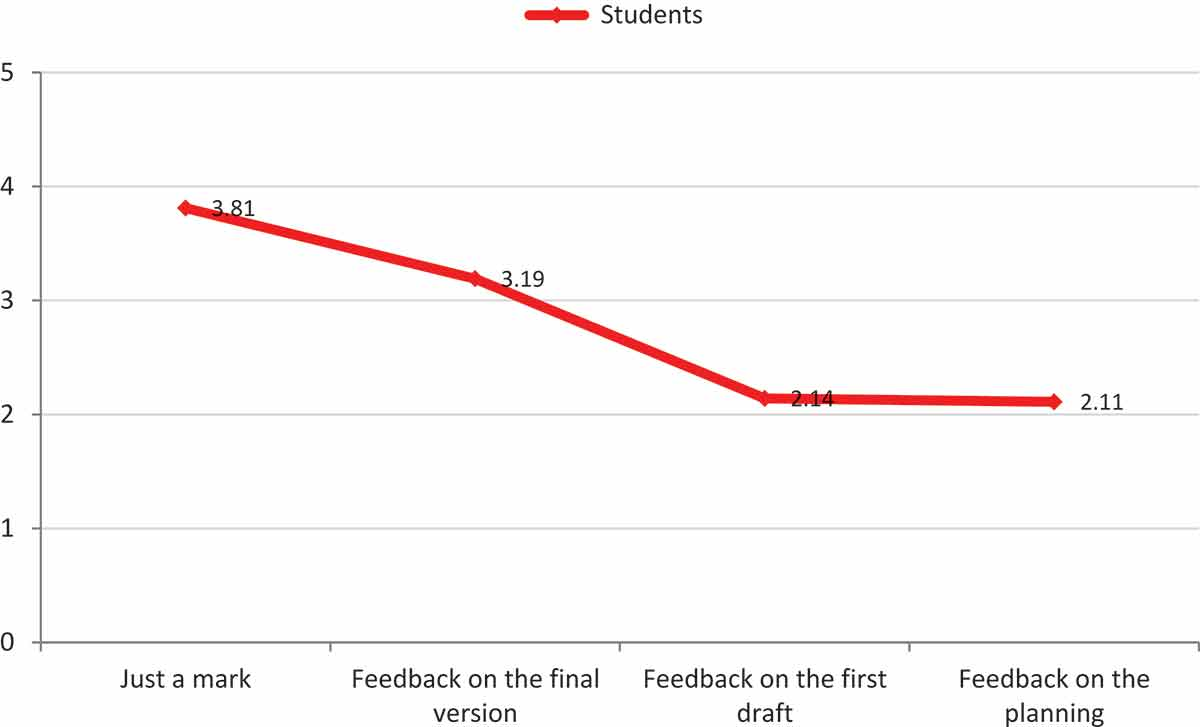
Regarding the way feedback is provided, ‘sometimes’ it is specific written comments in the margins of the text, ‘sometimes’ it is oral comments, and students ‘often’ receive written comments at the end of the text. The standard deviation is similar in these three items, showing a relatively high degree of heterogeneity in the responses. Likewise, students also claim to ‘frequently’ receive feedback through a mark according to a scale that assesses different aspects of the text.
Considerably more feedback is received in the humanities and social sciences than in engineering (F = 12.939, p < .000).). Likewise, it is significantly higher among students who have been at the university one or two years than all the others, and it is higher among those who have been there three or four years than those who have been at the university five years or more (F = 9.543, p < .000).
In order to complete these results, we analysed three items on the usefulness of this feedback from the writing process scale (see Table 5). We asked respondents to express their degree of agreement with the statements according to the scale (1) ‘totally disagree’, (2) ‘disagree’, (3) ‘not sure’, (4) ‘agree’ and (5) ‘totally agree’.
The students indicated that they were ‘not sure’ whether their instructors help them to organize their texts nor whether they receive enough feedback, although they also claimed that instructors’ responses ‘often’ help them to improve their writing.
The faculty ‘totally agrees’ that revision is an essential part of student writing, but the scores assigned to these practices drop with regard to specific actions (enough feedback and comments aimed at improving texts).
Kinds of texts used in classes and courses
Table 6, below, contains the data on the kinds of writing practices students do and the frequency they do them according to student and faculty perceptions. Both groups were asked how often they write certain kinds of texts in class, and the five response options were ‘never’, ‘occasionally’, ‘sometimes’, ‘often’ and ‘very often’.
The students declared that they ‘very often’ take notes and ‘often’ take written exams and write summaries. Furthermore, they ‘sometimes’ write reports on practices, monographic projects and research reports.
Both faculty and students perceive the same writing practices as the most frequent at the university. In all cases, the average frequency that the students attribute to each kind of practice is considerably higher than the frequency attributed by the faculty (see Figure 4). There are differences in terms of the order of frequency with which faculty and students believe these practices are done, as can be seen in the case of monographic projects and summaries. In any event, we can see fairly high deviations on these items. Kinds of writing activities declared by faculty and students.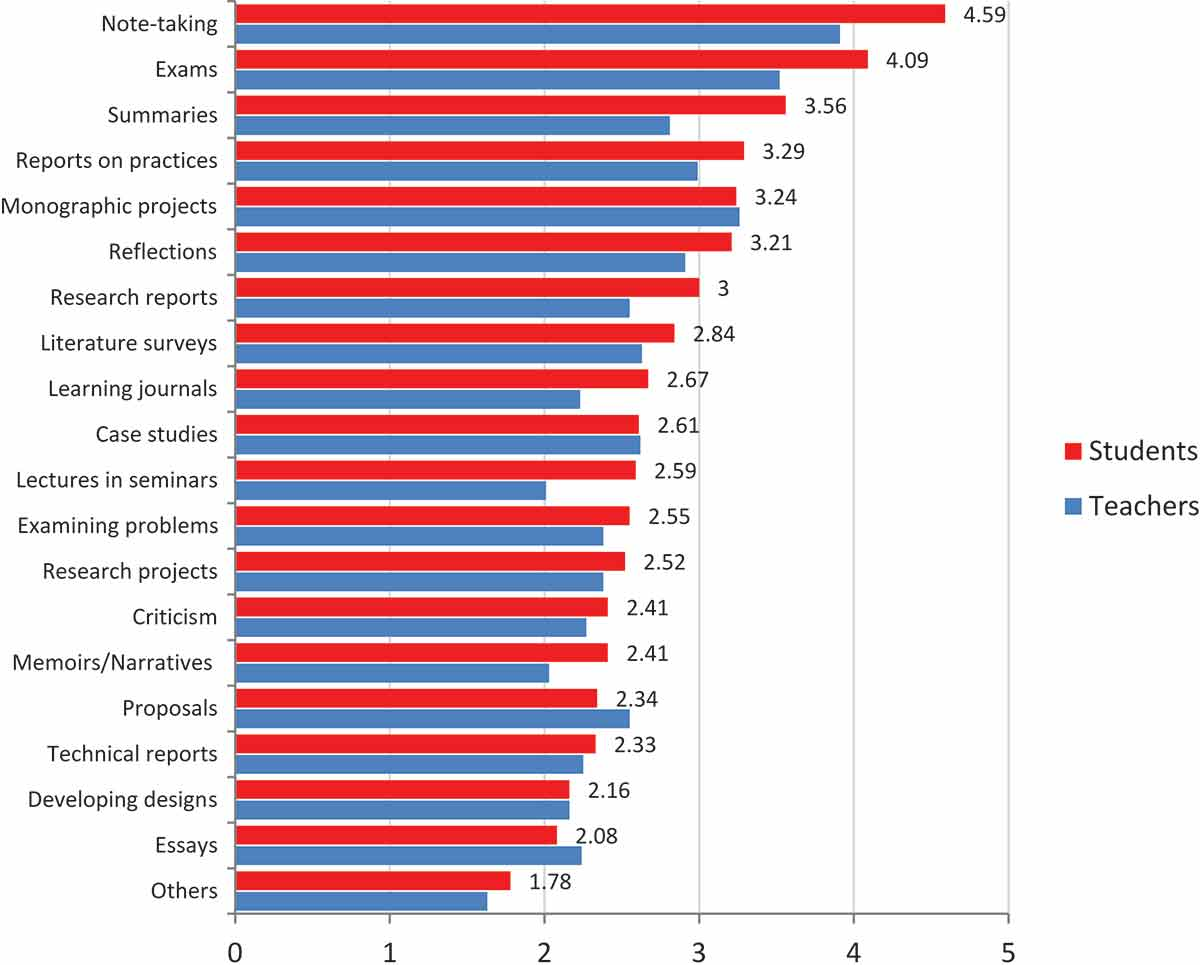
Respondents claimed to ‘occasionally’ write the other kinds of texts, but the rates differed between both groups. They only concurred in their low ratings of the unspecific choice (others). Regarding the rest, we can see how the students reported that the texts they write the least frequently are essays, developing designs, technical reports and finally proposals. The faculty, in turn, claimed that the least common writing practices were lectures in seminars, reports or narratives, developing designs and learning journals.
Predominance of individual or group writing.
Discussion
Regarding the presence of writing in the day-to-day activities of university students and the importance they attach to it, we first noted that students perceive an intense, frequent presence of writing in the day-to-day activities of the disciplines, and that the faculty claims to assign and assess the writing in a large number of texts. Likewise, both believe that writing is very common and of keen interest at the university, although they express some uncertainty regarding the sufficiency of the support received for writing. Therefore, we can state that there is an academic context which is ripe for the formative development of writing and favourable to the acquisition or improvement of communicative competences, as required by the regulations of the current Spanish university curricula.
However, major differences were found in the two groups’ perceptions (see Figure 1). The faculty believe that fewer hours are spent on writing and that students are asked to write or actually do write less frequently outside the classroom for different purposes, while the number of writing projects that students estimate they do throughout their degree programmes is higher than the faculty’s estimates. It would be interesting to analyse the factors that influence these differences, which probably include the effort or interest required by both groups because of the way they could contribute to identifying formative criteria.
This difference disappears when the goal is to estimate the frequency of writing for evaluative purposes, a figure which matches that found in Colombian universities, where it is interpreted that the purpose of these texts is similar to an exam (Gutiérrez-Rodríguez & Flórez-Romero, 2011). This figure opens up several questions on the concept and type of evaluation underlying these practices, and on the use of and approach to writing in them. Is writing used as a mere record of knowledge to evaluate or as a tool that fosters the process of developing new knowledge and communicating it? Is writing evaluated? If so, which elements and using what criteria?
With regard to the fields, the significantly higher presence of writing reported by students in humanities and social sciences compared to students in health and engineering, along with the significantly higher frequency of writing in the classroom in humanities and health than in engineering, seems coherent with the traditional approach to and beliefs about what is common to each field. Similarly, the faculty in the humanities and social sciences claim to use writing significantly more than the engineering faculty. These results suggest an interest in continuing to study the epistemic use of writing in the different fields, along with when and how texts are written and knowledge is constructed. It would also be interesting to develop and validate instructional proposals that also prevent insufficient or weak writing practices in the professional and social realm (Carlino, 2004, 2013).
Regarding our analysis of classroom practices, the faculty report providing instructions for writing tasks more or much more frequently than the students, and the biggest discrepancy comes with regard to oral instructions. It would be interesting to analyse the communicative situations in the classrooms and the faculty’s beliefs about what extent and level of detail instructions should have, as well as how students use these instructions and the relationship between this use and the fact that they may not follow these instructions when writing texts.
The students poorly rate instructors’ actions aimed at improving the writing process, such as asking for a plan before beginning to write, the instructor’s attention to the written text and the frequency with which instructors explain how to avoid plagiarism. These figures spark doubts as to how much attention is paid to writing processes and therefore how these processes are learnt, and on the effect that this has on students, given that the faculty’s perception is notably different, with considerably higher scores on these practices.
When we compare the fields, we find significant differences in the feedback received, as it is higher in humanities and health than in engineering.
Secondly, the scant attention that faculty pay to how students’ texts are written, according to the students’ perceptions, is closely tied to the feedback the latter receive, especially in the final version of the text. Therefore, the proposals for improvement cannot have repercussions on the final mark and cannot affect and improvement in students’ writing skills. And this is related to the students’ claims when they report that they are ‘not sure’ that their ‘instructors help them to organize their texts’.
What students and faculty reveal about teaching actions matches what Carlino, Iglesia, and Laxalt (2013) call ‘working on the ends’ (they are asked to do writing practices, are given instructions and feedback is primarily given on the end product). In their study, they noted that instructors who claim to work on the ends are in the majority. Just as in that study, in ours both students and instructors believe that the university is interested in writing and that it is an important matter, so ‘it does matter how [it is done]’ (p. 128). In Spain, we found similar results in the study recently conducted at the University of Córdoba in which the authors stated ‘[…] many instructors concentrate solely on the final evaluation of the product without taking the process into account’ (Perea, Luque, & Cepedello, 2013, p. 72).
In our case, the fact that writing outside the classroom predominates and that the end product is focused on the most often might be associated with a conception of writing as a tool to ‘tell knowledge’ more than one that allows students to ‘create new knowledge’. In concurrence with what was found at Colombian universities, our study also reveals that writing is generally assumed to be a form of expression that only requires the development of general skills acquired in the initial literacy process but not as an epistemic and specific disciplinary practice (Gutiérrez-Rodríguez & Flórez-Romero, 2011).
The fact that feedback is primarily given through written comments at the end of the text reveals that the support and monitoring provided to students do not cover the multiplicity of aspects that come into play in the process of writing academic texts and the quality of the final texts. In consequence, it should come as no surprise that the perceptions of both groups are that they are ‘not sure’ that students are really given help to improve their writing and that the rate of sufficient feedback is worth examining.
With regard to student and faculty perceptions of the kinds of writing practices that they do the most frequently at the university, we should stress the fact that both concur in the most frequent practices chosen: monographic projects, practice reports, summaries, written exams and note-taking. However, both groups disagree on the kinds of practices done the least frequently. In each case, it is important to stress that the writing practices used the most often according to faculty and students are those which are associated with knowledge and a detailed, up-to-date understanding of the discipline (Corcelles, Oliva, Castelló, & Milian, in this special issue). To the contrary, the least frequent practices are those that require independent reasoning or critical evaluation, as well as research methods that involve conducting independent research (Gardner & Nesi, 2013). Probably ‘the way writing is used is targeted at expressing knowledge and verifying that contents were learned. Writing is prompted by assigning and evaluating written texts more than by teaching students how to write’ (Gutiérrez-Rodríguez & Flórez-Romero, 2011, p. 158). This leads us to think that instructors view writing more as a basic technique that, once acquired, should be used to put any kind of knowledge on paper (Carlino, 2005).
The fact that from the students perceive ‘collaborative writing’ and writing outside the classroom as the most frequent, coupled with instructors’ attention primarily to the end product of that activity, plus, according to both groups, the fact that this activity is used quite frequently to evaluate, leads us to believe that the most common texts (monographic, reports and summaries) are used for the same purpose as exams. This, then, leads us to believe that even though these are more complex discourse practices, the attention they receive does not lead to the teaching of the specific disciplinary practices and the fruitful use of writing as an epistemic tool.
Students believe that the most common kind of writing is collaborative, yet this dynamic requires instructors to adopt a more interactive role with the students because ‘the purpose of the instructor is to organize and guide the construction of meaning that students engage in in a complex environment of activity and discourse, adjusting their assistance and support to the way students are undertaking this construction’ (Colomina, Onrubia, & Rochera, 2001, p. 443).
Feedback aimed at developing writing skills is used more as a form of evaluation than a way to strengthen students’ written production. ‘However, students need an instructor who helps them to develop categories of analysis systematically, and to reread and diagnose the problems in their writing in order to improve it overall’ (Carlino, 2005, p. 33). The goal is for instructors to take on the role of the students’ reader more than evaluator of their texts (Gutiérrez-Rodríguez & Flórez-Romero, 2011).
The fact that the most prominent dimensions or aspects of composition of written texts according to the faculty are associated more with the writing practices used the least frequently is also telling.
In conclusion: There is an academic context ideal for fostering the formative development of writing. This context varies depending on the field of knowledge, in favour of humanities and social sciences over health and engineering. The major differences are regarding the frequency and intensity of writing practices and the amount of feedback received. The fact that the purpose of evaluation and that the most attention to writing is on the end product also leads to the use of writing as a record and literal learning tool. The students’ lower perception of instructions may be related to the fact that they do not use these instructions because they do not affect the end quality. Feedback ‘on the end’ seems to be associated with a conception of writing as an elementary tool with no specialized discursive practice. The association between the most frequent writing practices and the way writing is worked on indicates that these practices fulfil purposes similar to traditional exams. The least frequent writing practices are the ones which are the most closely related to the dimensions of writing that are the most highly valued by the faculty (and also, to a lesser extent, by students).
From the importance attached to writing, its presence at the university and how it transcends classroom work, we can glean a series of ideas linked to a teaching model which focuses on disciplinary content more than on students and encourages somewhat meaningless learning. However, the importance attached to it suggests a potentially positive context for introducing writing practices aimed at developing communicative competence and influencing the epistemic function of this competence, bearing in mind the situation in the different fields.
Las prácticas escritas en la universidad española
La adquisición de las competencias comunicativo-lingüísticas en cuanto ‘proceso de acercamiento, incorporación e integración progresiva en la comunidad de expertos y profesionales del área’ (Ezeiza, 2008, p. 1) a la que pertenecen los estudiantes se considera esencial en la formación universitaria. Por ello, no es de extrañar que en las titulaciones se reclame un espacio para atender a la escritura dentro de la enseñanza de las disciplinas, tratando de responder a las dificultades a las que se enfrentan los estudiantes con las prácticas escritoras que han de ser capaces de producir. La finalidad no es remediar deficiencias curriculares anteriores y no se considera una competencia elemental y generalizable a cualquier situación de comunicación (Carlino, 2005).
En otros contextos educativos esto se viene haciendo desde hace muchas décadas. En los países anglosajones, especialmente en EEUU y Reino Unido, se han desarrollado diversas corrientes de estudio de la escritura en la universidad; y se han creado y propagado distintos movimientos de renovación de su enseñanza tal como se comenta en el artículo introductorio de este monográfico (Bazerman, Little, Bethel, Chavkin, Fouquette, & Garufis, 2005; Kruse, 2013). En el ámbito de la escritura en español son relevantes las aportaciones de diversas universidades latinoamericanas especialmente de Argentina, Chile y Colombia (Benvegnú, Galaburri, Pasquale, & Dorronzoro, 2001; Carlino, 2003, 2004, 2005, 2013; Di Stefano & Pereira, 2004; Marincovich, 2014; Molina-Natera, 2012; Narvaja de Arnoux, 2009).
En dichos contextos, se concede importancia a la escritura por su función comunicativa y como herramienta de aprendizaje por lo que está presente en las diferentes fases de formación en la universidad; se realizan e implementan variadas propuestas didácticas y se generan diversidad de recursos para atender a las necesidades de los estudiantes.
La atención a la escritura en las disciplinas requiere considerar diversos tipos de problemas que están vinculados a la naturaleza compleja de esta competencia. Se mira a la escritura como un código pero también como una práctica comunicativa de carácter dialógico, un proceso cognitivo y una herramienta epistémica.
La escritura se concibe como un código distinto al oral, aunque emparentado con él, con características propias que se sitúan en diferentes niveles del sistema de la lengua: la normativa ortográfica, las normas de puntuación, la elaboración adecuada de la frase y el párrafo, etc., características que es necesario saber producir y controlar (Cassany, 1989).
La escritura también es una práctica comunicativa situada en un contexto histórico-social determinado. En este sentido cabe destacar las contribuciones hechas desde el dominio de los estudios del discurso. Son clave los conceptos mismos de discurso y de género discursivo. Bajtin (1982) establece las características básicas de la noción de género discursivo y vincula el uso de la lengua con las múltiples esferas de la actividad humana. Siguiendo este razonamiento, Camps y Castelló (2013) describen cómo una misma persona participa en diferentes ámbitos de actividad y cómo los géneros son instrumentos de participación en la actividad social. Se aprende a usar la lengua dentro de los ámbitos de actividad que han ido conformando usos verbales específicos. Aprender lengua es aprender a usarla de manera adecuada en aquel ámbito concreto en el que se vayan a producir los intercambios comunicativos, como en el caso del ámbito académico. Para este aprendizaje deberá considerarse la situación o tipo de acción social que se realiza en dicho ámbito, teniendo en cuenta que las situaciones no ‘vienen definidas sólo ni principalmente por las condiciones materiales de la comunicación sino que son constructos sociales resultado del significado y de la interpretación que los humanos dan a sus actividades’ (Camps & Castelló, 2013, p. 20)
El término comunidad discursiva alude al grupo humano que comparte unas prácticas comunicativas concretas y hace uso de textos concretos para alcanzar propósitos específicos (Maingueneau, 2004). En estas comunidades, los autores y lectores asumen unos roles predeterminados y son herederos de una misma manera de percibir la realidad y de transmitir el conocimiento. Todos los usuarios son capaces de reconocer y de usar los géneros textuales ligados a las esferas de actividad en que se desenvuelven.
Desde la perspectiva de la psicología cognitiva la escritura es un proceso cognitivo complejo que conlleva diferentes operaciones mentales hasta llegar a la elaboración final de un texto (Flower & Hayes, 1981, 1996). Estas operaciones, que se basan fundamentalmente en la planificación, textualización y revisión, están apoyadas por la memoria a largo plazo y por los factores que rodean la situación comunicativa. Son, además, fases que no tienen un carácter lineal, sino más bien recursivo, gracias al sucesivo control que se ejerce en la elaboración de lo escrito. La capacidad que tenga el escritor para gestionar la información y para llevar a cabo las diferentes acciones o procesos que conforman la composición de un texto escrito son reflejo de su competencia para generar un mensaje, para construir conocimiento. Bereiter y Scardamalia (1983) describen dos modos diferentes de componer: ‘decir el conocimiento’ cuando el escritor reproduce de forma más o menos literal los datos que sobre el tema tiene almacenados en su memoria; y ‘transformar el conocimiento’, cuando al adecuar la información a un nuevo contexto reelabora sus ideas, generando, en consecuencia, nuevo conocimiento. Interesa insistir en que determinadas prácticas de escritura no conllevan actividad cognitiva por lo que no resultan herramientas epistémicas, es decir, instrumentos semióticos que inciden en la construcción del propio conocimiento (Bazerman, 2009) y afectan de modo diferente los aprendizajes que se logra realizar a partir de ellas (Bangert-Drowns, Hurley, & Wilkinson, 2004).
Desde estas referencias teóricas nos planteamos conocer qué ocurre en el contexto de la universidad española, qué importancia atribuyen profesores y estudiantes a la escritura, qué espacio se le dedica, cuáles son los aspectos que se consideran más relevantes para ‘escribir bien’, y cuáles son las características de las prácticas que se llevan a cabo en el aula para el desarrollo de habilidades escritoras.
En este contexto se plantean los siguientes objetivos: Analizar el tiempo dedicado a la escritura, su cantidad y frecuencia según el parecer de profesores y estudiantes. Valorar hasta qué punto el estatus que unos y otros atribuyen a la escritura varía según las características de los participantes y las disciplinas. Caracterizar la práctica de acuerdo a: a) el tipo de instrucciones que se facilitan para planificar, escribir o revisar; b) el tipo de feedback que reciben los estudiantes, y c) los géneros que con más frecuencia escriben los estudiantes. Analizar hasta qué punto estas representaciones son compartidas por ambos colectivos. Verificar si se producen diferencias en estas representaciones en razón a las características de los participantes y las áreas.
Método
El estudio se llevó a cabo en nueve universidades española, utilizando la versión para profesores y para alumnos del cuestionario Encuesta Europea sobre la Escritura Académica (EEEA) descrito en el primer artículo de este monográfico por Castelló y Mateos (2015).
Participantes
Participaron 280 profesores y 1,044 estudiantes de grado de nueve universidades españolas, pertenecientes a estudios de artes y humanidades, ciencias sociales y jurídicas, ciencias de la salud e ingeniería y arquitectura.
Procedimiento
Presencia de la escritura en el currículo.
Apoyo percibido de la universidad en el desarrollo de la escritura declarado por alumnos y profesores.
Prácticas de escritura en el aula.
Frecuencia y tipo de feedback recibido.
Valoración del feedback recibido según el decir de alumnos y profesores.
Presencia de la escritura en el currículo.
Para la descripción general de las respuestas se han analizado medidas de tendencia central (M) y dispersión (DT); para analizar las diferencias entre estudiantes y entre profesores se han utilizado ANOVA (F y p < .02).
Resultados
Presencia de la escritura en la formación universitaria, importancia que se le concede
Para conocer hasta qué punto está presente la escritura en el quehacer cotidiano de los universitarios, se analizan los cinco ítems de la escala Cantidad de escritura referidos a cantidad o frecuencia con la que se utiliza la escritura en la actividad académica. Las cinco opciones de respuesta expresan intervalos de porcentajes en los tres primeros ítems (ninguna, 0–24%, 25–49%, 50–74% y 75–100%), tiempo en la cuarta (ninguna, < 3, < 6, < 9 y 10 o más) o número de tareas escritoras estimadas (ninguna, < 5, < 10, < 15 y 20 o más) (ver Tabla 1).
Los alumnos consideran como promedio que en un 72.75% de las asignaturas tienen que escribir textos, siendo estos la herramienta empleada para ser evaluados hasta en un 60.25% de los casos. Estos datos, sin embargo, presentan una considerable dispersión. También estiman que dedican menos de siete horas semanales a escribir y que el volumen de textos que han de producir a lo largo de sus estudios universitarios es de 17.4 o más. Por último, los alumnos muestran como promedio que en un 73% de los casos escriben en casa con diferentes finalidades.
El análisis de varianza según variables participantes muestra que las alumnas manifiestan una presencia significativamente mayor de la escritura en su quehacer cotidiano que la percibida por los alumnos (F = 6.145, p < .013). Por otro lado, el alumnado de titulaciones del área de humanidades y sociales manifiestan una significativamente mayor presencia de la escritura en su quehacer cotidiano que los de salud e ingenierías (F = 29.449, p < .00). Por último, estudiantes con tres o cuatro años de experiencia universitaria manifiestan una significativamente mayor presencia de la escritura en su quehacer cotidiano que los de cinco o más (F = 4.033, p < .018).
Estos resultados no concuerdan con la perspectiva de los profesores (ver Figura 1). Para estos el porcentaje de clases en las que solicitan que los estudiantes escriban textos para ser evaluados es del 59.75% (DT = 1.27); asimismo estiman que la cantidad de escritura que solicitan para realizar en el aula (43% de las clases, DT = 1.18) o fuera de ella (55.5%, DT = 1.25) también es inferior a los resultados atribuidos a los estudiantes. En misma esta línea, los profesores esperan que los alumnos dediquen menos de cinco horas semanales a escribir en sus materias. Por el contrario, como promedio consideran que los alumnos tienen que escribir una media de 19.35 textos. Respuestas promedio de profesores y alumnos sobre cantidad de escritura utilizada.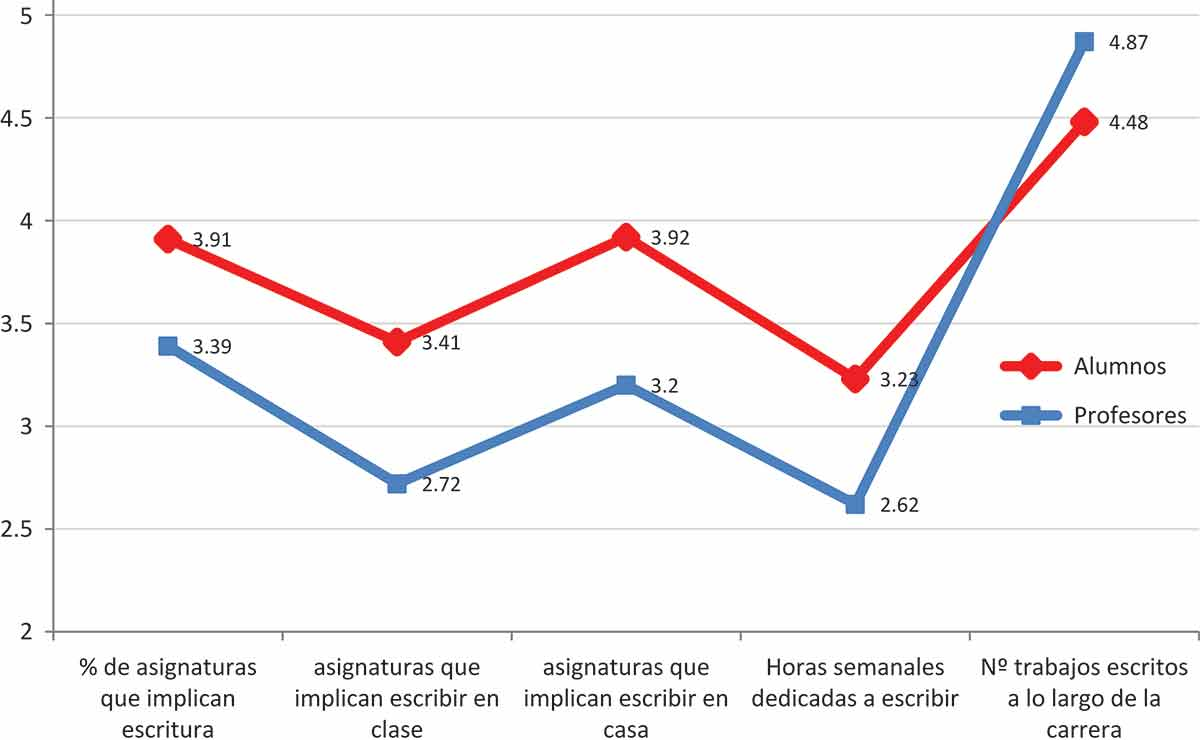
Las diferencias significativas encontradas en la muestra de profesores están relacionadas con las áreas en las que imparten docencia mayoritariamente. Como es previsible dada la naturaleza de las tareas propias, el profesorado de humanidades y ciencias sociales declaran un uso significativamente mayor de escritura que los de ingenierías (F = 9.681, p < .000).
Se analiza también la percepción del apoyo que proporciona la universidad para el desarrollo adecuado de las habilidades implicadas. En este caso las cinco opciones de respuesta corresponden al grado de acuerdo con la afirmación recogida en el ítem, ‘totalmente en desacuerdo’, ‘en desacuerdo’, no ‘estoy seguro’, ‘de acuerdo’ y ‘totalmente de acuerdo’.
Los resultados promedio muestran que los alumnos ‘no están seguros’ sobre la adecuación del apoyo que da la universidad al desarrollo de su escritura, aunque están ‘de acuerdo’ en que la escritura es un asunto muy presente. En ambos casos la opinión recogida tiene una relativamente alta heterogeneidad. Los profesores manifiestan los mismos puntos de vista respecto al apoyo que se dedica al desarrollo de la escritura y a que sea considerado un asunto de interés y discusión; en ambos casos también con una elevada dispersión de opiniones.
Atención didáctica al desarrollo de habilidades escritoras
Se analizan las prácticas que se emplean, declaradas por profesores y estudiantes, para orientar y favorecer el desarrollo de habilidades escritoras. Se presentan en primer lugar aspectos relativos a las instrucciones dadas para la realización de los textos escritos y a la atención que se dedica a la escritura producida por los estudiantes. En segundo lugar se atienden cuestiones referidas a la revisión y mejora de los textos, declaradas por el alumnado. Y en tercer lugar se analiza qué tipo de prácticas escritoras se realizan con mayor frecuencia.
Instrucciones para la realización de los textos escritos y atención a la escritura
La escala sobre prácticas de escritura en el aula (ver Tabla 3), se refiere a las instrucciones que se proporcionan para la realización de los textos escritos y si lo escrito es objeto de atención en los encuentros entre profesores y alumnos, y de alumnos y profesores entre sí. Las cinco opciones de respuesta corresponden a ‘nunca’, ‘raramente’, ‘a veces’, ‘a menudo’ y ‘siempre’.
Los estudiantes declaran recibir instrucciones orales y escritas ‘a menudo’. Mientras que los profesores consideran que ‘siempre’ proporcionan instrucciones orales para la elaboración de los escritos que han de realizar los estudiantes; y que ‘a menudo’ proporciona instrucciones escritas. Destaca la diferente percepción de alumnos y profesores respecto a la emisión de instrucciones orales. Los estudiantes declaran debatir sobre sus escritos, ‘a veces’ con su profesor y ‘a menudo’ con sus compañeros. Mientras que el profesorado declara discutir ‘a menudo’ con los estudiantes sobre sus escritos y ‘a veces’ con otros colegas sobre las características de los textos de los estudiantes.
Los estudiantes declaran que ‘a veces’ participan en debates, foros, wikis, … en su universidad, y los profesores que utilizan ‘a veces’ chats, foros, wikis, … para dar instrucciones, aunque en ambos casos se muestra una dispersión relativamente alta en las respuestas.
Los alumnos indican que ‘raramente’ algún profesor les ha pedido que planifiquen antes de comenzar a escribir en clase, mientras que los profesores consideran que lo hacen ‘a veces’. Por otro lado los alumnos expresan que casi siempre o ‘siempre’ toman apuntes en clase, mientras que la percepción de los profesores es que los alumnos toman apuntes ‘algunas veces’ o ‘a menudo’.
Respecto a si se informa sobre las reglas del plagio y se explica cómo evitarlo (ver Figura 2), los profesores indican que ‘a menudo’ proporcionan información sobre el plagio y explican cómo evitarlo; sin embargo, los alumnos declaran que ‘a menudo’ se informa sobre el plagio, pero solo ‘a veces’ se explica cómo evitarlo. En todos los casos la dispersión de respuestas es alta. Respuestas de profesores y alumnos sobre prácticas escritoras en el aula.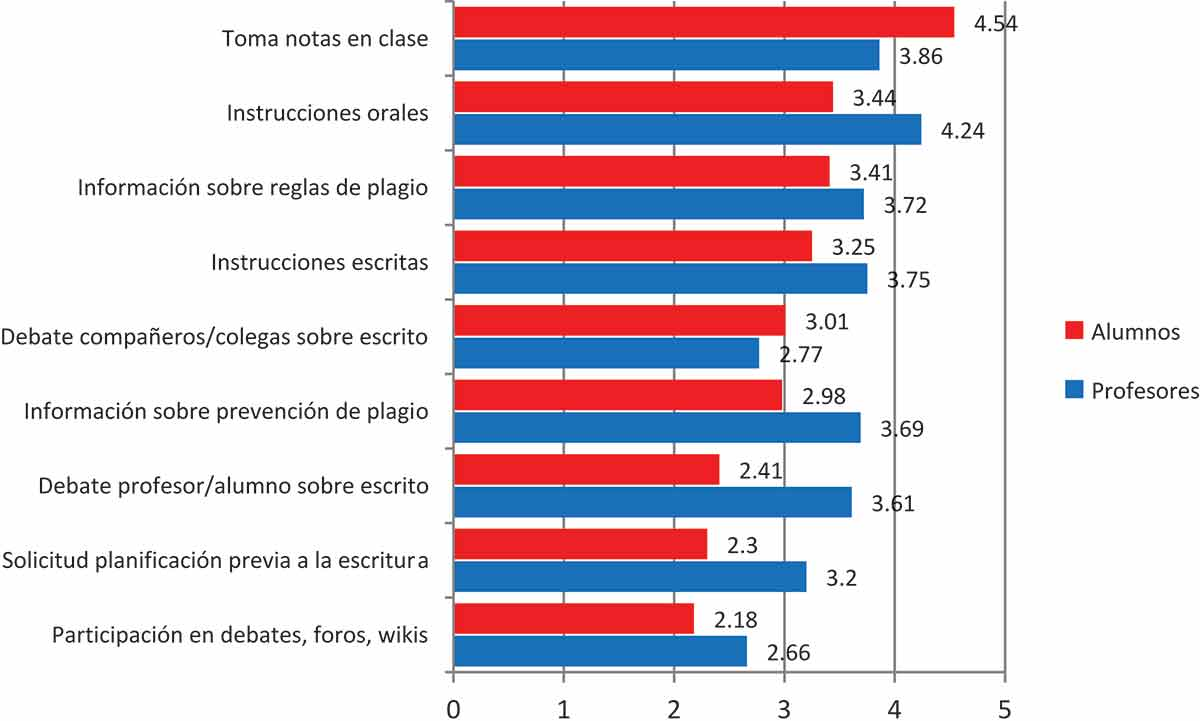
El profesorado de humanidades y sociales declaran prácticas escritoras para orientar y atender a los alumnos significativamente más altas que el profesorado de ingeniería (F = 7.532, p < .000).
Los estudiantes de humanidades y sociales atribuyen una frecuencia de prácticas escritoras en el aula significativamente mayor que los de salud e ingeniería, asimismo los de salud hacen una atribución significativamente mayor que los de ingeniería (F = 10.747, p < .000). Igualmente la permanencia en la universidad de los alumnos arroja diferencias significativas, mostrando que los que llevan uno o dos años declaran más prácticas escritoras que los demás, e igualmente los que llevan tres o cuatro años que los que llevan cinco o más (F = 21.311, p < .000).
Feedback sobre lo escrito y utilidad del mismo
Esta escala ofrece información sobre cuándo y cómo reciben feedback sobre su escritura los alumnos de los profesores: 1 ‘nunca’, 2 ‘raramente’, 3 ‘a veces’, 4 ‘con frecuencia’ o 5 ‘siempre’.
Los datos (ver Tabla 4) ponen de relieve que según la percepción de los estudiantes los escritos que son evaluados ‘con frecuencia’ únicamente reciben una calificación sin feedback para su mejora. Cuando sí reciben feedback, este se realiza ‘con frecuencia’ sobre la versión final del escrito y ‘a veces’ en fases iniciales como la de planificación o intermedias como del primer borrador del proceso de elaboración de los escritos (ver Figura 3). Percepción de los estudiantes sobre cuándo se recibe feedback.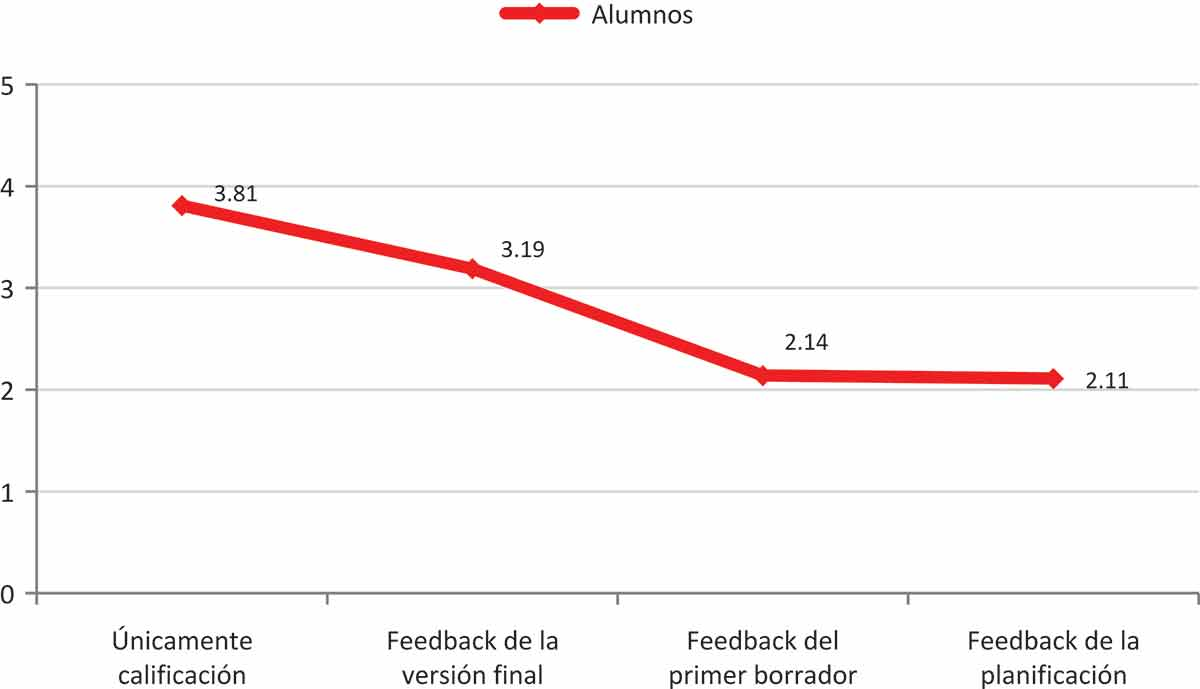
Respecto al modo seguido para proporcionar feedback, ‘a veces’ son comentarios escritos específicos en los márgenes del escrito; ‘a veces’ comentarios orales; y ‘con frecuencia’ reciben comentarios escritos al final del texto. La desviación típica semejante en estos tres ítems, muestra una relativamente alta heterogeneidad de respuestas. Asimismo, se indica que ‘con frecuencia’ reciben feedback a través de una calificación según una escala que valora diferentes aspectos del texto.
El feedback es significativamente mayor en humanidades que en ingeniería y en sociales que en salud e ingeniería (F = 12.939, p < .000). Asimismo es significativamente mayor entre los que llevan uno o dos años y todos los demás, y entre los que llevan tres o cuatro y los que llevan cinco o más (F = 9.543, p < .000).
Con la finalidad de completar estos resultados, se han analizado tres ítems sobre la utilidad de ese feedback pertenecientes a la escala Proceso de escritura (ver Tabla 5). Se pide manifestar el grado de acuerdo con las afirmaciones según la escala 1 ‘totalmente en desacuerdo’, 2 ‘en desacuerdo’, 3 ‘no estoy seguro’, 4 de acuerdo’ y 5 ‘totalmente de acuerdo’.
El alumnado indica ‘no estar seguro’ de si los profesores les ayudan a organizar los textos ni de si reciben suficiente feedback, aunque considera que ‘a menudo’ la respuesta que reciben de estos les ayuda a mejorar la escritura.
El profesorado está ‘totalmente de acuerdo’ con que la revisión es una parte esencial de la escritura de los estudiantes, pero la puntuación atribuida a las prácticas va disminuyendo cuando se refiere a las acciones concretas (suficiencia del feedback y comentarios orientados a la mejora).
Tipos de textos utilizados en las clases y asignaturas
A continuación (ver Tabla 6) se presentan los datos sobre el tipo de prácticas de escritura que realizan los estudiantes y la frecuencia con la que estas se llevan a cabo según la percepción de profesores y estudiantes. Se pregunta sobre cuáles de los siguientes textos se escriben en clase y las cinco opciones de respuesta corresponden a ‘nunca’, ‘ocasionalmente’, ‘a veces’, ‘a menudo’ y ‘muy a menudo’.
El alumnado declara que ‘muy a menudo’ toma apuntes y ‘a menudo’ realiza exámenes escritos y resúmenes; ‘a veces’ escribe informes de prácticas, trabajos monográficos e informes de investigación.
Profesores y estudiantes perciben las mismas prácticas escritoras como las más realizadas en el ámbito universitario. En todos los casos la frecuencia media que el alumnado atribuye a cada tipo de práctica es sensiblemente más alta que la atribuida por el profesorado (ver Figura 4). Se constatan algunas diferencias en cuanto al orden de frecuencias con las que profesores y estudiantes consideran que éstas se practican, como se observa en el caso de los trabajos monográficos y de los resúmenes. Se observa, en cualquier caso, desviaciones bastante elevadas en estos ítems. Tipos de actividades escritoras declaradas por profesores y alumnos.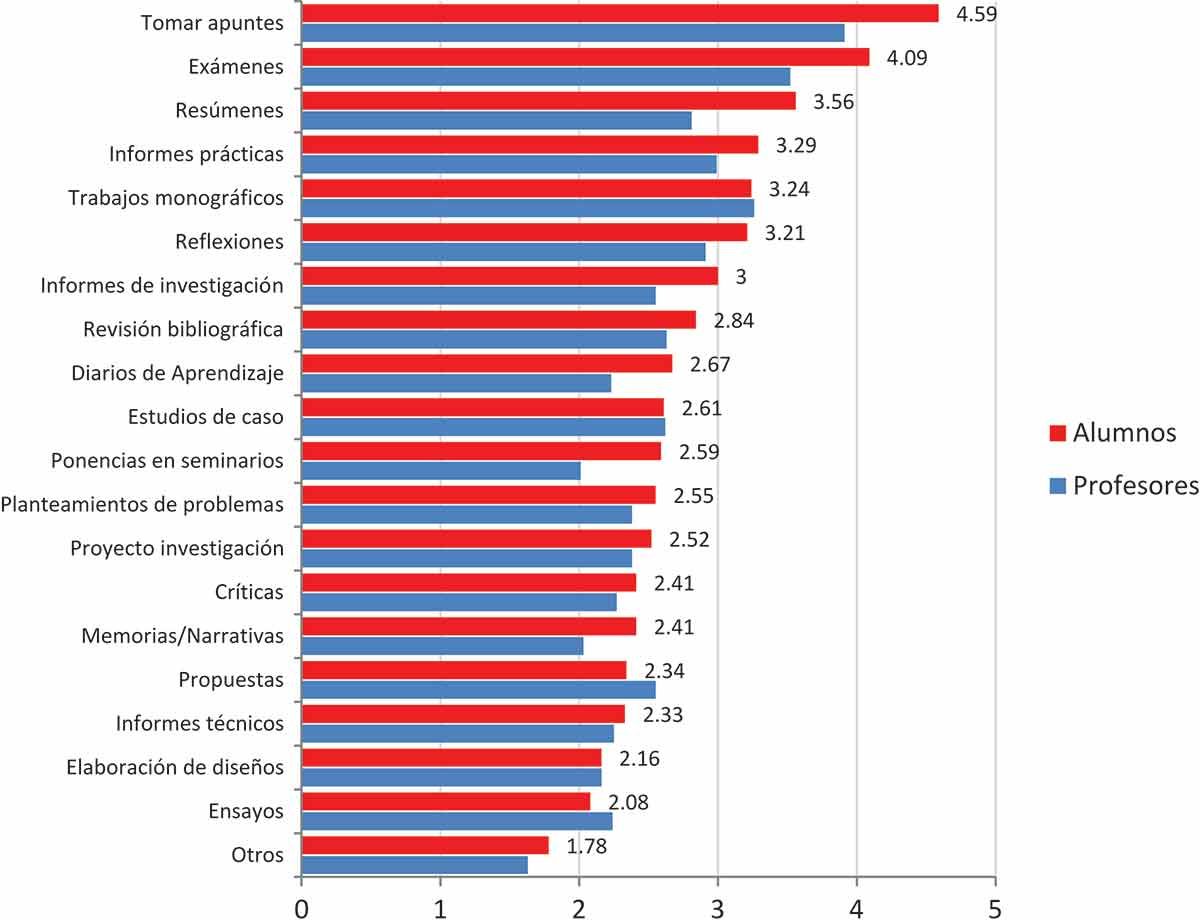
Del resto de textos se declara un uso ‘ocasional’, pero con una consideración diferente en ambas poblaciones. Únicamente coinciden en la valoración más baja a una atribución inespecífica (otros). En cuanto al resto, se aprecia que para los estudiantes, los textos que se ponen en práctica con menor frecuencia son los ensayos, elaboración de diseños, informes técnicos y, por último, propuestas. Los profesores, por su parte, establecen como las prácticas escritoras menos frecuentes las ponencias en seminarios, las memorias o narrativas, la elaboración de diseños y los diarios de aprendizaje.
Predominio de la escritura individual o colectiva.
Discusión
Respecto a la presencia de la escritura en el quehacer cotidiano de los universitarios y qué importancia se le concede, se ha constatado, en primer lugar, que el alumnado percibe una presencia intensa y frecuente de la escritura en el quehacer de las disciplinas, y que el profesorado declara solicitar y valorar que deben escribirse un número importante de textos. Igualmente, ambos consideran que la escritura es un asunto presente y de interés en la universidad si bien manifiestan incertidumbre a la hora de valorar la suficiencia del apoyo que se recibe al respecto. Se puede considerar, por tanto, que hay un contexto académico propicio para fomentar el desarrollo formativo de la escritura, y favorable a la adquisición o mejora de las competencias comunicativas, tal y como se solicita en la regulación de los actuales planes de estudio universitarios españoles.
Sin embargo, se han encontrado algunas diferencias importantes en la percepción de ambos colectivos (ver Figura 1). Para el profesorado siempre es menor esta presencia tanto en el número de horas dedicadas a escribir como en la estimación de la frecuencia con la que se pide o se realizan textos escritos que se tienen que elaborar fuera del aula con diferentes finalidades; y es mayor el número de trabajos que estima que los estudiantes han de realizar a lo largo de sus estudios. Sería interesante analizar los factores que influyen en estas diferencias, probablemente entre otros el esfuerzo e interés que exige de ambos colectivos, por las aportaciones que se pueden obtener para identificar criterios formativos.
Esta diferencia desaparece cuando se trata de estimar la frecuencia de la realización de escritos con finalidad evaluativa, dato coincidente con el contexto de las universidades colombianas donde se interpreta que la función de estos textos es similar a la de un examen (Gutiérrez-Rodríguez & Flórez-Romero, 2011). Este dato abre algunas cuestiones sobre el concepto y tipo de evaluación subyacente a estas prácticas, y sobre el uso y enfoque de la escritura en las mismas. ¿Se usa la escritura como mero registro del conocimiento que se evalúa o como una herramienta que favorece al proceso de elaboración de nuevo conocimiento y posibilita su comunicación? ¿Se evalúa el escrito?, de ser así ¿qué elementos y con qué criterio?
En relación a las áreas, la significativa mayor presencia de la escritura declarada por el alumnado de humanidades y ciencias sociales que en salud e ingenierías, junto a la frecuencia de uso de la escritura en el aula significativamente mayor en humanidades y en salud que en ingenierías parece coherente con el enfoque tradicional y las creencias sobre lo que es propio de la naturaleza de cada área. En la misma dirección el profesorado de humanidades y ciencias sociales declara un uso significativamente mayor de la escritura que los de ingenierías. Estos resultados sugieren el interés de seguir estudiando el uso epistémico de la escritura en las distintas áreas, cuánto y cómo se textualiza y se construye conocimiento, por un lado; y, por otro, desarrollar y validar propuestas didácticas que además prevengan de prácticas escritoras insuficientes o débiles en el ámbito profesional y social (Carlino, 2004, 2013).
A continuación se pasa a analizar la práctica que se lleva a cabo en el aula.
Los profesores declaran proporcionar instrucciones para realizar tareas de escritura con mayor o mucha mayor frecuencia que la que es percibida por los alumnos, obteniéndose la mayor diferencia cuando se refieren a las instrucciones orales. Sería interesante analizar las situaciones comunicativas de las clases y las creencias del profesorado sobre qué nivel de extensión y detalle deben tener las instrucciones, así como qué uso hacen los estudiantes de tales instrucción y la relación que dicho uso pueda tener con el hecho de que no se preste atención a la elaboración del texto.
La valoración de los alumnos es baja cuando se refieren a acciones docentes orientadas a mejorar el proceso escritor, como la solicitud de planificación antes de comenzar a escribir, la atención que presta el profesor al escrito realizado o la frecuencia con la que se explica cómo evitar el plagio. Estos datos suscitan dudas sobre la atención a los procesos de escritura y por tanto al aprendizaje propio de esos procesos; o sobre el efecto que esta tiene en los estudiantes, puesto que la percepción del profesorado se diferencia notablemente con puntuaciones considerablemente mayores en las prácticas mencionadas.
Al comparar las áreas se encuentran diferencias significativas en el feedback recibido, siendo mayor en humanidades que en ingeniería y que en salud e ingeniería.
En segundo lugar, la poca atención que el profesor presta a cómo están escritos los textos de sus alumnos, según la percepción de estos, está estrechamente vinculada a que según ellos mismos reciben feedback, sobre todo, en la versión última del texto. Entonces, las propuestas de mejora no pueden tener repercusiones en la calificación final y no pueden incidir en la mejora de las habilidades escritoras de los estudiantes. Y esto guarda relación con el decir de los estudiantes cuando manifiestan ‘no estar seguros’ de que ‘los profesores les ayuden a organizar sus textos’.
Lo que revelan los estudiantes y los profesores sobre la acción docente coincide con lo que Carlino, Iglesia, y Laxalt (2013) denominan ‘trabajo en los extremos’ (se pide realizar prácticas escritoras, se dan pautas y fundamentalmente se interviene sobre el producto final). En su estudio constatan que predominan los docentes que declaran intervenir periféricamente. Igual que ocurre en dicho estudio, en el nuestro, tanto el colectivo de estudiantes como el de profesores entienden que la universidad se ocupa de la escritura y que es un tema importante, pero ‘no da lo mismo cómo’ (p. 128). En el contexto español se han encontraron resultados semejantes en un estudio llevado a cabo recientemente en la Universidad de Córdoba en el que los autores afirman ‘[…] muchos docentes se concentran solamente en la evaluación final del producto sin tener en cuenta el proceso’ (Perea, Luque, & Cepedello, 2013, p. 72).
En nuestro caso también el hecho de que predomine la escritura realizada fuera del aula y se atienda con mayor frecuencia al producto final podría vincularse con una concepción de la escritura como una herramienta para ‘decir el conocimiento’ más que como una que permita ‘crear nuevo conocimiento. En coincidencia con lo encontrado en las universidades colombianas, nuestro estudio también revela que, en general, la escritura se asume como forma de expresión que sólo requiere el desarrollo de habilidades generales adquiridas en procesos de alfabetización inicial pero no como una práctica epistémica y disciplinar específica (Gutiérrez-Rodríguez & Flórez-Romero, 2011).
El hecho de que el feedback se realice sobre todo con comentarios escritos al final del texto evidencia que, en general, el apoyo y el seguimiento que se le proporciona al estudiante no atiende a la multiplicidad de aspectos que intervienen en el proceso de elaboración de los textos académicos y en la calidad de los escritos finales. Como consecuencia, no parece extrañar que la percepción de un colectivo y otro sea ‘no estar seguros’ de que se ayude realmente a mejorar la escritura de los estudiantes y a situar la cota de la suficiencia del feedback en unos niveles que requieren ser tenidos en cuenta.
En relación a la percepción que unos y otros tienen sobre el tipo de prácticas escritoras que más frecuentemente se realizan en el ámbito académico, cabe destacar el hecho de que ambos coincidan en las cinco prácticas más frecuentes seleccionadas: trabajos monográficos, informes de prácticas, resúmenes, exámenes escritos y toma de apuntes. Sin embargo, ambos colectivos discrepan en los tipos de prácticas que se realizan con menor frecuencia. En uno y otro caso, resulta relevante destacar que las prácticas escritoras más empleadas según profesores y estudiantes son aquellas que están asociadas al conocimiento y a la comprensión disciplinar detallada y actualizada (Corcelles, Oliva, Castelló y Milian, en este monográfico). Por el contrario, las menos frecuentes son aquellas que exigen un razonamiento independiente o una evaluación crítica, así como métodos de investigación que suponen llevar a cabo investigaciones independientes (Gardner & Nesi, 2013). Probablemente ‘el uso que se hace de la escritura se dirige a la expresión del conocimiento y a la verificación del aprendizaje de contenidos. Se fomenta la escritura al exigir y evaluar textos escritos mas no a enseñarlos a escribir’ (Gutiérrez-Rodríguez & Flórez-Romero, 2011, p. 158) Esto hace pensar que para el docente escribir es una técnica básica que una vez adquirida sirve para poner sobre papel cualquier conocimiento (Carlino, 2005).
El que desde la percepción de los estudiantes sea más frecuente la ‘escritura colaborativa’ y la realizada fuera del aula unido a la atención que, de manera prioritaria, concede el profesor al producto final de dicha actividad y que además ésta, según ambos colectivos, se realice en una alta frecuencia para evaluar nos da a entender que los textos más frecuentes (monografías, informes y resúmenes) son empleados con la misma finalidad que los exámenes. Esto lleva a pensar que, aunque se trata de prácticas discursivas más complejas, la atención que reciben no conduce a la enseñanza de prácticas disciplinares específicas y al aprovechamiento del uso de la escritura como una herramienta epistémica.
El estudiante considera que es más frecuente la escritura colaborativa, sin embargo esta dinámica exige al profesor adoptar un rol más interactivo con los estudiantes porque ‘la función del docente es estructurar y guiar la construcción de significados que realizan los estudiantes en un entorno complejo de actividad y discurso, ajustando ayudas y apoyos en función de cómo los estudiantes van realizando esa construcción’ (Colomina, Onrubia, & Rochera, 2001, p. 443).
El feedback para el desarrollo de habilidades escritoras es usado más como una forma de evaluación que de fortalecimiento de la producción escrita del estudiante, ‘sin embargo, los alumnos necesitan un docente que los ayude a desarrollar categorías de análisis, más allá de lo puntual, para releer y diagnosticar los problemas de sus escritos a fin de mejorarlos integralmente’ (Carlino, 2005, p. 33). Se trataría de que el docente adopte el rol de lector de sus estudiantes más que de evaluador de sus textos (Gutiérrez-Rodríguez & Flórez-Romero, 2011).
Resulta revelador también el hecho de que las dimensiones o aspectos más relevantes de la composición de un texto escrito según los profesores estén asimismo más asociados al tipo de prácticas escritoras que se producen con menor frecuencia.
En conclusión: Se da un contexto académico propicio para fomentar el desarrollo formativo de la escritura. Este contexto varía según las áreas de conocimiento, a favor de humanidades y ciencias sociales frente a salud e ingenierías. Las diferencias significativas se refieren a la frecuencia e intensidad de prácticas escritoras, y a la cantidad de feedback recibido. El que predomine la finalidad de evaluar y el que la mayor atención a lo escrito se sitúe en el producto final conduce al uso de la escritura como un registro y a un aprendizaje literal. La menor percepción de instrucciones por parte de los estudiantes puede estar relacionada con el hecho de que no hacen uso de dichas instrucciones ya que no afectan a la calificación final. Un feedback en los extremos parece estar vinculado con una concepción de la escritura como una habilidad elemental sin una práctica discursiva especializada. La vinculación de las prácticas escritoras más frecuentes con la manera cómo se trabaja con la escritura indica que dichas prácticas cumplen funciones similares al examen tradicional. Las prácticas escritoras menos frecuentes son, sin embargo, las que están más relacionadas con los aspectos o dimensiones de la escritura más valorados por los profesores (y también, aunque en menor medida por los estudiantes).
De la importancia otorgada a la escritura, de su presencia en la universidad y de cómo esta transciende al trabajo del aula se desprenden una serie de ideas vinculadas a un modelo de enseñanza centrado en el contenido disciplinar más que en el estudiante y favorecedor de un aprendizaje poco significativo. Sin embargo, la importancia atribuida sugiere un contexto potencialmente positivo para introducir prácticas escritoras orientadas a desarrollar la competencia comunicativa y a incidir en la función epistémica que le es propia, teniendo en cuenta la situación de las diferentes áreas.
Disclosure statement
No potential conflict of interest was reported by the authors. / Los autores no han referido ningún potencial conflicto de interés en relación con este artículo.
Footnotes
The research reported has been partially funded by the Spanish Ministerio de Economía y Competitividad (DGICyT (CSO2013-41108-R) / Este estudio ha sido parcialmente financiado por el Ministerio de Economía y Competitividad español, DGICyT (CSO2013-41108-R).