







Abstract
This article deals with the concept of transmedia learning, which has emerged from Jenkins’ approaches, with an important echo on cultural approaches, research and education. Transmedia educational experiences cause interest in the scientific community; however, it is difficult to find a univocal understanding of transmedia learning. Therefore, this research aims to address the conceptual background of transmedia educational practices through a systematic literature review. The research process starts with the searching of keywords referring to transmedia learning and without time limitation, with 38 documents yielded in the initial search. After following the PRISMA guidelines, the process ends with 24 documents that have been qualitatively analysed in depth using NVivo 12. Among the main results obtained, it is highlighted that transmedia learning, from a narrative, allows us to concretize the pedagogical principles of constructivism or connectivism in proposals that are motivating for students and in a relatively personalized way that is close to their daily lives. However, its integration into teaching-learning processes is complex due to the large number of factors that must be considered.
Beyond the general discourse on the impact of technologies on educational processes, in recent years the literature has gone deeply around what has to do with multimedia (both from a didactic perspective and in relation to the necessary literacies required in these approaches; Gee, 2009; Ito et al., 2013; Jenkins et al., 2009). And, in all of this, the success of the Jenkinsian concept of transmedia is clear, and it has also landed successfully in the educational field, even if it is not the field of education where it arises. In this sense, Jenkins himself (2006, pp. 95–96) defines transmedia storytelling as a ‘story [that] unfolds across multiple media platforms, with each new text making a distinctive and valuable contribution to the whole. In the ideal form of transmedia storytelling, each medium does what it does best — so that a story might be introduced in a film, expanded through television, novels, and comics; its world might be explored through game play or experienced as an amusement park attraction’, a very broad idea, which has yet to take shape in the educational world and which has taken various forms.
However, as commonly happens when a label has experienced such growth, it is difficult to find a shared and univocal understanding and, therefore, a clear common core that brings together the different ramifications that arise from it (in our case, transmedia learning, transmedia literacy, transmedia storytelling, etc.). Nevertheless, there is no doubt on the spreading of transmedia. In a quick search on Google Scholar (searches carried out on 26 February 2021, as an example), we see that from the 36,800 documents returned by the search engine with the reference ‘transmedia’, 4,980 include it in the title, and 3,170 correspond to the last five years. If we focus on the field of education (‘transmedia AND education’), from the 21,700 documents returned by the search engine, 32 include both terms in the title, and 18 of them have been published in the last five years.
However, when we talk about transmedia, it is essential to refer to three fundamental concepts born with Jenkins (2006): media convergence, participatory culture and collective intelligence. Regarding the first, media convergence, we start from the paradigmatic example of the Matrix and the myriad of cultural productions in the most varied media and channels, analogue and digital, and, with it, we arrive at participatory culture, in which these productions, commercial or non-commercial, of recognized or collective authorship, become part of a varied flow of sequential production and consumption. Convergence culture is ‘the flow of content across multiple media platforms, the cooperation between multiple media industries, and the migratory behaviour of media audiences who will go almost anywhere in search of the kinds of entertainment experiences they want’. Convergence is a word that manages to describe technological, industrial, cultural and social changes depending on who’s speaking and what they think they are talking about (Jenkins, 2006, p. 3). And, from it we arrive to participatory culture, which ‘contrasts with older notions of passive media spectatorship. Rather than talking about media producers and consumers as occupying separate roles, we might now see them as participants who interact with each other according to a new set of rules that none of us fully understand. Not all participants are created equal. Corporations — and even individuals within corporate media — still exert greater power than any individual consumer or even the aggregate of consumers. And some consumers have greater abilities to participate in this emerging culture than others’ (Jenkins, 2006, p. 3). We no longer only consume (but produce) and we not only overlap media (but alternate them, combining them also with the analogue, which does not oppose but adds up). The subject goes from consumer to prosumer, with new media literacies that allow the subject to participate, and which place him or her to a central role (Jenkins et al., 2009). Moving on to education, we start from constructivist visions and, under the umbrella of connectivism (as we will see later in detail), we place ourselves more in the sphere of do it together than do it yourself. And this leads us to the third concept, collective intelligence, understood such us ‘an alternative source of media power. We are learning how to use that power through our day-to-day interactions within convergence culture. Right now, we are mostly using this collective power through our recreational life, but soon we will be deploying those skills for more “serious” purposes’ (Jenkins, 2006, p. 4).
In addition, although cautiously, we can assume a certain ageism in an important part of this new reality. Thus, for example, the Transmedia Literacy project (Scolari, 2018) tries to go beyond the classic approaches to media education and investigates from an ethnographic perspective the (trans)media practices of young people in the formal and informal spheres, starting with the idea that transmediate is, in a way, something young people do in a more natural way, and through this, it offers a new taxonomy of components of this transmedia literacy. There are several lessons to be learned from this, and it is perhaps one of the gateways to what interests us, which is the relationship between transmedia and education.
As mentioned before, not only transmedia in general (from a media perspective) has an important echo, but also from an educational perspective. In this sense, a couple of years ago, González-Martínez et al. (2019) analysed the different approaches that the concept could have in the context of learning. They concluded that in the field of education, transmedia could be approached as a media product, as a phenomenon for which the subject requires special literacy, or as a way of dealing with the design of learning experiences. And it is here that we come full circle with Jenkins (2006), understanding participation and production as learning opportunities, which brings us back to Scolari (2018), in his analysis of the formal and informal media practices of adolescents.
Making the leap to participation, as to production, allows for learning. However, can we talk about transmedia learning in the strict sense? Is there transmedia learning as such? And if so, what can we mean by it, what is meant in literature by transmedia learning, and what opportunities and challenges does transmedia learning open up?
Methods and materials
In this context, the aim of this systematic literature review is to address the conceptual background of transmedia educational practices. The aim is to provide an overview of the subject matter, focusing mainly on the definition of transmedia learning (hereafter TL) and its potentials and limitations. Therefore, three research questions (RQs) are formulated for this study: RQ1. What is meant by transmedia learning? RQ2. What opportunities does the integration of transmedia into teaching and learning processes offer? RQ3. What challenges are posed by the integration of transmedia in teaching and learning processes?
In order to locate and analyse the most significant documents in relation to the research questions, the systematic literature review (SLR) method has been used. An SLR is a theory-building process that has as its main purpose the review of relevant sources in a specific area of knowledge based on the exploration of information obtained from searches in different databases (Vangrieken et al., 2017).
Procedure
In order to carry out an optimal, ethical and traceable search, the criteria defined in the PRISMA statement by MacLure (2005) and Urrútia and Bonfill (2010) of inclusion and exclusion, relevance, validity of the studies, elimination of duplicates and application of Boolean operators were taken into account.
The documents under study respond to the search for the keywords ‘transmedia learning’ in Spanish and English without any kind of time frame (the youth of the concept itself, with less than a decade, did not make it necessary). This search was carried out in the two main international multidisciplinary databases, Web of Science and Scopus, in the specific international database for the Educational Resources Information Center (ERIC) and, finally, also in Dialnet, one of the most prestigious Hispanic scientific repositories.
The focus of this review is on transmedia teaching-learning (T-L) processes, from the beginning of the learning process to post-university education. In other words, there is no specific focus of interest as far as the educational stage is concerned, but rather the aim is to understand the concept of transmedia in education from a global perspective. The distinction between formal, non-formal and informal education has not been raised either. However, most of the documents obtained belong to the first group.
Figure 1 presents a flow chart detailing the phases followed in the documentation process, which is characteristic of this type of literature review. In the first phase, the search was carried out based on the descriptors indicated above, and a total of 38 documents were obtained. After detailed filtering considering the exclusion criteria of availability and relevance (strictly texts with explicit or implicit references to the concept of transmedia learning, or developments of it, either from theory or from practice), a sample of 24 documents was obtained. Systematic review flowchart.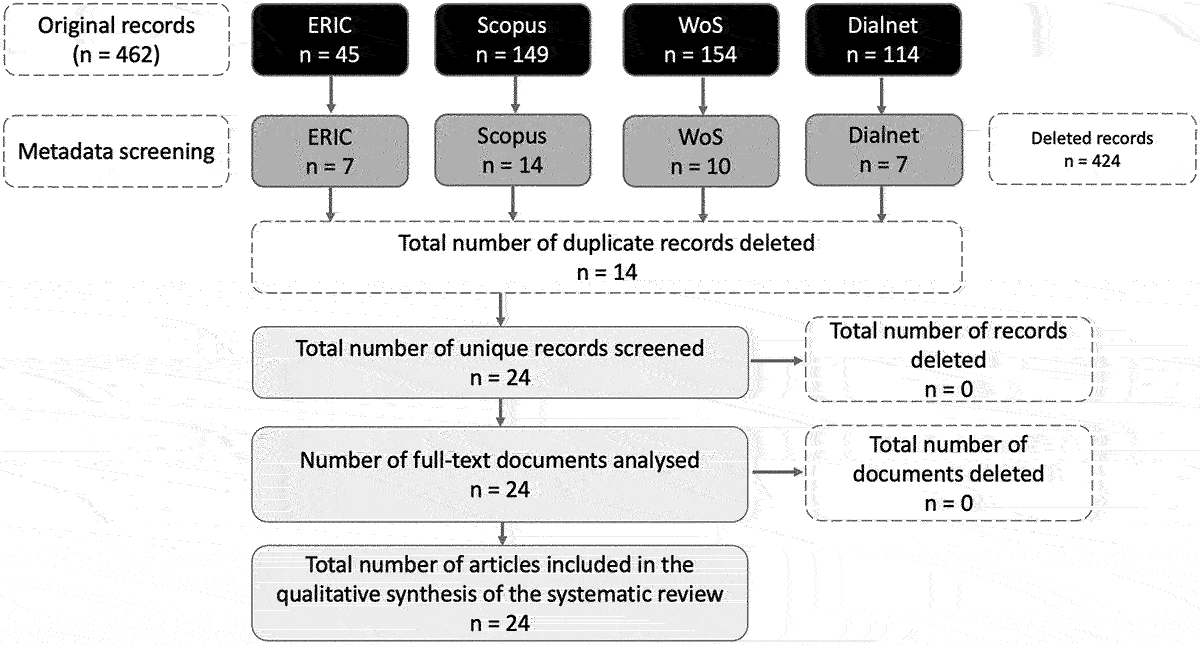
Sample
Analysed sample.
The 24 documents submitted correspond to different educational levels: childhood education (2), primary education (3), secondary education (2), higher education (10) and off-school (7); and different typologies: scientific articles (17), book chapters (1) or contributions to conferences (6); and were produced according to the following time flow (Figure 2). Time distribution of the documents analysed.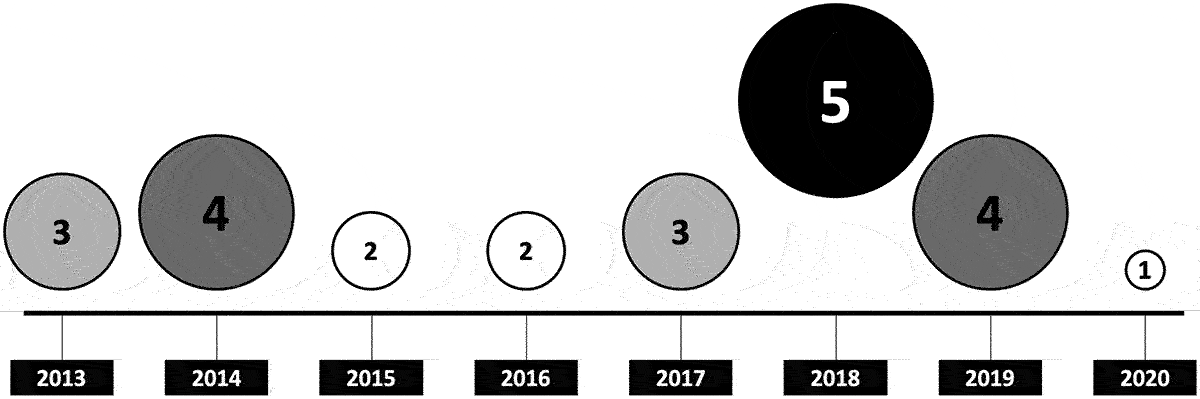
Results
RQ1. What is transmedia learning?
Perhaps one of the ways to begin this analysis is to start from one of the latest reflections on the subject, when Dickinson-Delaporte et al. (2020) assume one of the difficulties of situating transmedia conceptually in the educational field: beyond the recognition of Jenkins’ conceptual framework, with its media convergence and participatory culture, there is such a diversity of ways of understanding transmedia in general and in its educational application. And so, if these authors suggest the existence of multiple transmedia faces (transmedia storytelling, branding, performance, ritual, activism or spectacle), the same would occur in the field of learning. And hence, perhaps, one of the first attempts at conceptualization, Fleming (2013), has laid the foundations for what has been picked up in subsequent literature, but only indirectly. In this sense, this author points out that TL can be defined as: the application of storytelling techniques combined with the use of multiple platforms to create an immersive learning landscape which enables multivarious entry and exit points for learning and teaching. It is the unifying concept of the learning environment that is important since that can become a landscape for learning that has few, if any, boundaries. (Fleming, 2013, p. 371)
As we have said, beyond the occasional quotation and a general recognition of the pillars that the work of this author represents for the young field of knowledge, it is not a definition that has been adopted in a general way, but it does point to some of the elements that we can highlight in any of the later works: the socio-constructivist positioning, the concretization in terms of learning of the ideas of sequential navigation between different media, the leap from the traditional boundaries of formal learning or the importance of a narrative that, when developed, allows the creation of a vast learning landscape (which links more to the concept of ecologies than of learning environments or scenarios; Pereira & Pedro, 2020). Synthesized, this is shown in the following diagram (Figure 3). TL elements.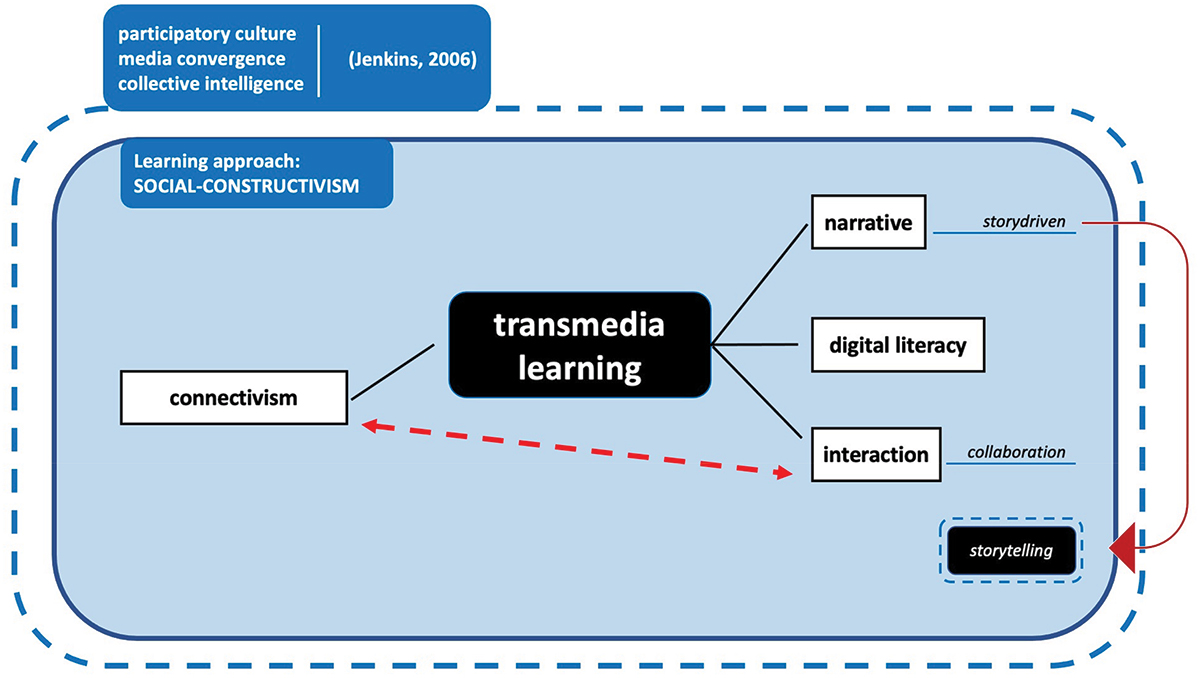
Regarding the learning paradigm, some elements that are pointed out, beyond the initial socio-constructivist positioning and under its umbrella: placing the student as the centre (Amador, 2013; Davis, 2017; Dickinson-Delaporte et al., 2020; Wiklund-Engblom et al., 2013) and calling for using elements of everyday life that not only make learning more meaningful (because of their greater transfer potential and because of their direct connection with previous knowledge) but also link more directly to elements of students’ real lives (Amador, 2013; Rodrigues & Bidarra, 2014), which should have a direct impact in terms of engagement (one of the opportunities commonly suggested when approaching TL; Chung, 2014; Raybourn, 2014).
In this socio-constructivist approach, three elements stand out, according to what we found in the documents consulted: the central role of narrative as a didactic strategy, the technological issue and the collective dimension (interaction and communication, which leads us to collective intelligence and connectivism).
Firstly, the didactic axis from which any transmedia learning experience is always organized is always a narrative, which can be fiction or non-fiction; therefore, projects are always storydriven (Barreneche et al., 2018; Chung, 2014). From a motivational perspective, the power of these narratives (which becomes a challenge) to engage students (if the narrative motivates them, they will naturally feel compelled to develop and share it, and thus learn) is highlighted (Chung, 2014). And it is also common to note that they are flexible from the teacher’s perspective (different paths can be defined initially, to meet different needs) and malleable from the learner’s perspective (they can be developed according to their own interests; Ellis et al., 2018; Fleming, 2013; Gutu, 2019; Raybourn, 2017). It is also promising that narratives can be never-ending a priori, as this offers endless possibilities for development and learning as well (Rodrigues & Bidarra, 2015). Narrative has a key role in the development on every transmedia learning experience: narratives that must be based on elements of everyday life, which allow engagement and a high transfer of everything that has been learned (Chung, 2014; Raybourn, 2014; Rodrigues & Bidarra, 2014).
In terms of technology, it is flexible and liquid. There are no predetermined technologies or media (neither are the resources, nor the order or sequence in which these technologies appear). The narrative can be transmediated with whatever is available in each context; therefore, there is no context in which transmedia cannot happen and learners can transmediate outside the limits of the school as an institution (spatial and temporal limits [Davis, 2017; Ellis et al., 2018; Fleming, 2013; Gutu, 2019]). TL is a direct concretization of the infinite possibilities derived from both the spectacular technological development and the environment of participatory culture/collective intelligence and media convergence. In this sense, it is easy to think that TL is a step further in the discourse on digital literacy and that it drinks directly from it (Barreneche et al., 2018; Pereira & Pedro, 2020), since it offers a cultural and critical context where these skills should be mobilized when everyone tries to act as a citizen (although this is a very major challenge and quite difficult to implement). It also goes beyond the discourse of multimedia insofar as the alternation between the analogue and the digital, as well as the overlap between the differently digital, are natural, and with this, it also becomes natural to go beyond the walls of the school institution in the strict sense (Davis, 2017; Ellis et al., 2018; Fleming, 2013; Gutu, 2019; Raybourn, 2014). This alternation is free, with few limits of time, space, order and channels, ‘if any’, as we have seen in Fleming’s (2013) definition with which we have begun.
In relation to this, transmedia learning forces the mobilization and development of broad-spectrum digital literacies (this is what we pointed out at the beginning when talking about transliteracy, as a step beyond the usual digital competence and media education; Barreneche et al., 2018; Pereira & Pedro, 2020).
Another important element is the collective and collaborative dimension of transmedia learning (we learn in a network, we collaborate), in relation to Jenkins’ (2006) ideas of participatory culture and collective intelligence. The community element, in fact, is highlighted by different authors in connection with the connectivist approach (Campalans, 2015; McCarthy et al., 2018; Valdés et al., 2016). By learning through collaboration and participation, communities of creation (and learning) are born (Raybourn, 2017; Rodrigues & Bidarra, 2015) and authentic community projects are developed. This is where it is relevant to speak, in many cases, of transauthorship (Rodrigues & Bidarra, 2015, 2019).
It is important to highlight that, beyond the direct search for interaction or collaboration, transmedia learning essentially becomes communitarian, so that it revolves around the construction of learning communities, virtual or face to face (Campalans, 2015; Rodrigues & Bidarra, 2015), in such a way that collective intelligence is the main stimulus for learning (Barreneche et al., 2018) and a main agent of dynamization in learning processes also in the formal sphere, especially in the design and management of learning ecosystems and environments (Raybourn, 2017; Raybourn et al., 2018). In this sense, and also as we saw in the initial definition, the links of TL with connectivism are added to the socioconstructivist ones (Campalans, 2015; Rodrigues & Bidarra, 2019) and are embodied in many processes of shared transmediality and transauthorship (Rodrigues & Bidarra, 2015) or shared assumption of alternative identities in the service of learning (Raybourn, 2014, 2017).
Beyond these elements, which are important in themselves, there are two issues that are not so much related to the concept as to the context. The first has to do with the possible leap beyond the walls of the school institution or formal learning. In this sense, in the same way as with the prominence of narrative, we also find a consensus on the potential of transmedia in this regard (Barreneche et al., 2018; Chung, 2014; Rodrigues & Bidarra, 2015). In this sense, we can analyse two of the worlds in which these contributions from the literature are produced as examples of this: on the one hand, Fleming (2013) situates her transmedia play (a way of concretizing transmedia learning) in the sphere of action of school libraries (not in the Spanish sense but more broadly, as libraries that work in a geographical and educational context in which they serve different schools), precisely with the purpose of enabling a transfer between formal learning within the school and informal learning, which responds to the interests of the children; on the other hand, the trigger for the initial work of Raybourn (2014), in the service of the development of serious games for more immersive learning in military training. Even in proposals more closely linked to more formal approaches, there is always a desire to go beyond the classroom (Valdés et al., 2016) by applying the different existing transmedia logics (Dickinson-Delaporte et al., 2020) to overcome the limitations of the institutionalization of formal learning (at all levels).
Finally, the second contextual question that we pointed out has to do with the didactic concreteness of TL, since it is not so much a question here of seeing how learning takes place in contexts of participatory culture (in the pedagogical sense), however interesting it may be, but rather of being able to apply it consciously in the design of learning experiences. In this sense, it is logical to recover storytelling as a didactic strategy. Although we said before that not all TA is storytelling (although it is storydriven), it is logical to deduce that taking learners to develop a story can be a way of approaching the learning situation from a didactic point of view. And all this with the aim of stimulating learners in multiple ways (doing, watching, listening, sharing, collaborating, reflecting, etc.; Wiklund-Engblom et al., 2013), offering them multiple channels that allow them the simultaneous or sequential use of different perspectives (Valdés et al., 2016). In short, a didactic concreteness that is inspired by four principles (McCarthy et al., 2018): (1) a rich and varied narrative; (2) collaborative activities and challenges; (3) elements of gamification; and (4) connections between formal and informal learning.
RQ2. What opportunities does the integration of transmedia storytelling into teaching-learning processes offer?
The integration of transmedia into teaching-learning processes presents opportunities for both students and teachers. From the students’ perspective, transmedia storytelling, if it is well thought out, includes engaging content and integrates the narrative well, and often has a positive impact on students’ motivation (Fleming, 2013; McCarthy et al., 2018). This, as indicated by McCarthy et al. (2018), can ultimately lead to increased student interest in academic content.
Similarly, the ubiquity that intrinsically characterizes such transmedia practices using technology can also have a direct influence on students’ interest in the subject matter (Fleming, 2013). This is partly due to the fact that learning contexts are extended outside the temporal and spatial boundaries of formal education, allowing the teacher to work with students throughout the week in a continuous manner and independently of face-to-face class time (Dickinson-Delaporte et al., 2020).
Going beyond school hours allows students to contribute with additional inputs to those they would make in the classroom; i.e., there is an expansion of the learning ecosystem as a result of taking the T-L process beyond the traditional boundaries of educational institutions (McCarthy et al., 2018; Rodrigues & Bidarra, 2014). As much of the learning process takes place outside the educational institution, it is conducive to sharing experiences close to everyday life that promote greater immersion of learning in students’ daily lives (Rodrigues & Bidarra, 2014). The creation of such connections between curricular content and everyday life leads to greater personal involvement and often provokes emotions in students, which enhances a better assimilation of the content (Dickinson-Delaporte et al., 2020).
On the other hand, combining everyday life with the curriculum through technology also facilitates the integration of learner-centred pedagogies in formal e-learning processes (Rodrigues & Bidarra, 2014). This is partly due to the fact that interactivity mediated by the use of technologies allows personalizing the learning process to respond to both the individual needs of students and the collective needs of the class group (Bernal, 2017). Furthermore, if a transmedia T-L process includes adaptive technologies, more typical of video games, the level can be adjusted according to the needs of the students (McCarthy et al., 2018). This type of technology-enabled learning can enable personalized learning that is based on the data collected (Raybourn et al., 2019).
In order for these more individualized T-L processes to be successful, it is also interesting to offer a wide range of content. Broadening the range of possibilities for student and family participation, as indicated by Paulsen and Rueter (2014), as well as in formats and channels, helps the whole educational community to avoid frustration for students, who receive information in advance and in various formats, and fosters student and family engagement (Dickinson-Delaporte et al., 2020; Paulsen & Rueter, 2014).
It is clear that in order to participate in such a learning process, it is essential to have certain digital skills; however, a specific repertoire of technological skills is not necessary (everyone can find their own transmedia path), nor is the heterogeneity of the group a problem. In this sense, according to Dickinson-Delaporte et al. (2020), those with greater digital competence act as motivating agents for the less experienced, thus promoting collaboration. Moreover, if managed correctly, both with interrelation and personalized content, more efficient T-L contexts can be created (Crespo-Pereira & Legerén-Lago, 2018).
However, in order for beneficial and enriching interactions to take place among students, it is important to ensure that a collective awareness-intelligence is maintained, i.e., to achieve dynamic and participatory relationships that reaffirm the social ties between the participants (Bernal, 2017). Therefore, Raybourn (2014) goes further and points out that, in addition to promoting collaboration and interaction, it is necessary to track the interaction in order to know the data it generates, as they can be useful for the adaptation of content and the learning process throughout the student’s life.
If the more collaborative and technological aspects of transmedia have a key role as means and the focus is on (the development of the) narrative, it becomes clear that these T-L processes contribute to improving students’ communicative skills (not only technological ones). Such improvements are related to the ability to both express and interpret the content of discourse (Bernal, 2017). This is closely linked to the fact that transmedia storytelling often involves sharing and learning about different points of view on the same concept, which implies a higher degree of reflection (Raybourn et al., 2019).
As Fleming (2013) points out, the ultimate goal of transmedia strategies integrated in e-learning processes is to detect students’ interests in order to guide and accompany learners, taking into account their concerns and encouraging them to continue with their learning process. The same author underlines that this type of action has implications not only for the students but also for the teachers, who may feel motivated to go deeper into the contents they teach. In this way, teachers can also be beneficiaries of this type of educational practice.
In line with this idea, Barreneche et al. (2018) consider that transmedia practices have a direct impact on teachers, as they need to focus on aspects that allow them to understand the reality of young people in greater depth, i.e., they involve a constant updating effort. Therefore, the integration of transmedia in T-L processes can lead to a change of habits for both learners and teachers, who must apply different learning models and pedagogies (student-centred), since for such an experience to work, it is necessary to propose elaborated narratives that address the curricula in an interactive and fluid way (Fleming, 2013).
It is evident, then, after all that has been presented, that transmedia strategies cannot be seen in a single way. They are multifaceted practices that can be adapted to the needs of the context and, above all, are complementary to the face-to-face schooling that takes place during school hours (Davis, 2017). As McCarthy et al. (2018) point out, solving problems and creating experiences beyond the stipulated classroom time allows for the development of skills and the acquisition of knowledge that would otherwise require more resources and time.
Along these lines, it can be considered that one of the main opportunities or potentialities of transmedia narrative is its versatility (since it is not a concrete recipe or method), which allows combining theory with practice, individual and collaborative work, virtual and face-to-face environments and free and guided activities (Valdés et al., 2016), and in very different contexts and educational levels. This infinity of possibilities makes it easier to steer the e-learning process towards constructivist and connectivist perspectives that seek to ensure that curricular knowledge is assimilated and constructed by making it unfold through different media (Fleming, 2013).
In any case, it is clear that this type of strategy makes it possible to get closer to young people — who value this type of action positively — and to their ‘natural’ T-L processes, which facilitates the objective of responding to their individual and collective needs, if we pay attention to the content they create, consume, share, produce and, in short, learn (Bernal, 2017; Gutu, 2019).
RQ3. What are the challenges of integrating transmedia into teaching-learning processes??
Contrary to what one might think when talking about a learning experience with an a priori important technological element, the first challenge that a teacher who wants to integrate transmedia storytelling in the classroom must face is neither the technology nor the decision on the best monitoring strategy, but the motivation of the students. It’s not exclusive for this kind of experience, of course, but it is indeed very relevant from a constructivist approach to start with it (and a common statement in several texts), since the learner is the one who develops the narrative partly on their own. If students do not understand the importance of the course or study from the outset, it will be difficult for them to show interest in any educational practice (Bernal, 2017). Therefore, teachers must take into account and detect before any process begins the possible gaps that students may present (Rodrigues & Bidarra, 2019).
Once this first challenge is overcome, if the experience is well planned, students may feel such a level of interest that they exceed the time they should spend on the activity. This cannot be considered positive, given that no significant learning differences are observed between those who spend more time than necessary and those who stick to the set time (Paulsen & Rueter, 2014). In this sense, in order to carry out this type of activity, students must be given enough time so that they can become involved and take an active role in the process. Otherwise, it will be difficult to reach the point where they think critically and construct knowledge in a collaborative way (Rodrigues & Bidarra, 2019). However, in order to achieve this interaction between students, good planning and time availability are required to allow the teacher to guide the process of collaboration and content consumption well (Dickinson-Delaporte et al., 2020).
Creating a good transmedia narrative is a challenge if it is to be done thoroughly. This is because, first of all, you have to detect the possibilities of each measure you want to apply and determine how it will be integrated. Then, you have to proceed with a careful definition: the narrative, the characters, the interactions that are going to take place and the space in which the plot is situated, among others. In this sense, and taking into account the difficulty of creating the story itself to form part of a T-L process, it is essential to bear in mind that it is necessary to ensure that it integrates the learning dimension; i.e., the narrative must fit with the content and the skills to be developed (Rodrigues & Bidarra, 2015). In addition, more complex strategies require a greater number of resources (specialized programmes, content recording, monitoring of interactions, etc.; Dickinson-Delaporte et al., 2020).
It is clear from the above that the integration of transmedia storytelling into learning processes is an opportunity to use learner-centred methodologies and also for teachers to expand their knowledge. However, this often requires support and encouragement to support teachers in the process of integrating digital technologies and transmedia storytelling into their classrooms (Fleming, 2013). This, as Valdés et al. (2016) point out, can be difficult in the case of teachers’ resistance and fears due to conservative contexts that can hinder change.
Discussion and conclusions
As discussed throughout the article, transmedia learning has emerged in recent years in the fields of both culture and education. According to Jenkins’ approach, in order to be transmediatic, a practice must have three key elements: (1) participatory culture; (2) media convergence; and (3) collective intelligence. Based on this idea and considering the interest in transmedia education experiences, this systematic review has analysed a total of 24 documents. The selection of these documents was made according to the PRISMA criteria, given that there were initially 38 documents. Thus, from the analysis using Nvivo of 12 of the 24 articles and according to the results obtained, the following conclusions can be drawn.
As a first conclusion, we must accept that, even with a common core, the disparity of didactic approaches that we could include within what is known as TL is significant. Moreover, despite the novelty that the concurrence of the defining elements we have been dealing with may imply, we can hardly accept that we are dealing with a new conception of learning, with a new pedagogy; we would rather say, then, that we are facing a broad didactic umbrella that can guide the design of learning experiences based on the articulation of elements that, indeed, come from a different conception of cultural phenomena. Thus, as we said, we could approach TL from three reference frameworks: the ideas of participatory culture and media convergence (Jenkins, 2006), the pillars of socioconstructivism (Biggs, 1996) and those of Siemens’ connectivism (2004, 2006). And, from there, we can propose learning situations driven by the need for the subject to develop a story (Dickinson-Delaporte et al., 2020; Wiklund-Engblom et al., 2013), with the resources they have at hand and consider (analogue and digital; Pereira & Pedro, 2020; Raybourn, 2014, 2017) and in a community context, in which collaboration will not be a decision but a necessity (Ellis et al., 2018; Fleming, 2013). These are not few elements, to be sure, nor are they unimportant; they are not completely new in the pedagogical digital arena, we should say as well. But we can hardly go beyond this point, based on what we see in the literature and what is graphically depicted in Figure 3. And it is fair to recognize, in line with what is shown in this graphic representation, that the combination of these elements and the confluence of technology, transmedia and a powerful narrative make up a potentially very interesting and uncommon didactic proposal (also too wide, in fact).
The relations among these ideas, however, are long and varied: connections with enactivism (Campalans, 2015), playful elements (Barreneche et al., 2018), links with foreign language learning (Rodrigues & Bidarra, 2015, 2019). Therefore, in addition to the difficulty of conceiving that we are really talking about transmedia learning in the pedagogical sense, we also have difficulty even to specify in an orthodox way a single didactic approach to this new way of learning. To all this, both as an opportunity and as a limitation, we can add the wide diversity of contexts in which these transmedia experiences take place: within the school but also outside it (with direct or indirect relation to what happens in the classroom), with different agents involved (the person who learns in the centre always, and usually also their teachers accompanying them, but also the families, educators in the informal sphere) and wide educational levels (from infant education to university studies or professional military training). It is, therefore, a highly permeable reality under construction, which shares a common trunk (media convergence, collaboration, narrative) but which largely takes the form of the context that receives it (Amador, 2013).
To sum up, when we talk about transmedia learning, we are considering that some elements that Jenkins (2006) pointed out from a cultural perspective can be used consciously for teaching/learning purposes. That is, participatory processes where intelligence collective is mobilized to reach a common cultural product (or goal) produce learning, enable people to learn, and that can be used by educators for defining learning paths and designing learning experiences, which can be understood such as transmedia learning: the initial sequence of a narrative, appealing for students, must be developed by them with their interaction and using digital media (not only) of their choice, and with wide opportunities for having their own singular experiences at the same time that they share part of them with the rest of the community. That is, culture, technology and this idea of shared intelligence are not new from transmedia learning, since they were already highlighted in Jenkins’ conceptualization of transmedia (participatory culture, media convergence and collective intelligence, in his own words), but now these three elements are set and used for concrete learning purposes, and it’s someone different from the learner (teachers, educators) who decides and designs how they should be articulated (at least in an initial stage) for offering engaging learning experiencies. Maybe that’s the key idea about TL, although it’s difficult at this point to go further in the didactical development from what we have found, due to the disparity of the related experiences.
For practical purposes, the opportunities of TA arise precisely from its ability to concretize pedagogical principles that are easy to accept but difficult to articulate (constructivism, connectivism) in proposals that are motivating for learners (engagement), customizable and communitarian (precisely because the narrative admits layers, derivations, successive meeting points), harmonious with the digital context we live in (but at the same time low-tech and compatible with the analogue world, from which it is not necessary to flee). And, finally, proposals that make it possible to leap, if desired, the limits of formal learning (in the broad sense) and of educational institutions (in particular) and link with the everyday world of the people who learn (a very important point, as it gives life and real opportunities to TL that connect directly with the personal learning of the individual).
The challenges, however, are commensurate with these opportunities, insofar as the concept, even after this clarification, is liquid, and the advances are more theoretical than practical; the experiences and their achievements are more incidental than general or systematic; and, as a consequence, what we know about transmedia is more aprioristic than evidence-based.
From here, on the one hand, we are seduced by the idea of thinking about learning strategies in a more flexible, communitarian and personal way. And, from what we have found with these experiences, we can be quite optimistic regarding the possibilities of using (planning, designing) transmedia learning experiencies. In fact, from a purely scholastic perspective, the participatory culture and media convergence of Jenkins (2006) invite us to leap the walls and times of the classroom, to create real learning communities (that is, made up of people who learn where they live together, in the face-to-face and virtual space, as a continuum), who promote their own stories (narratives) with the resources they have and with those they incorporate along the way, with their peers, and who learn in the process. But, on the other hand, especially because it is diffuse, let us not fail to recognize the complexity, especially when we jump from transversal competences (communicative, digital, etc.) to specific ones, and when we move up the educational level. The projects Inanimate Alice (Fleming, 2013) and Curious George and the Odd Squad (McCarthy et al., 2018), or those reported in Paulsen and Rueter (2014), are still initiatives in which the core is the fundamental part of learning (they are experiences in early childhood education or the first years of primary school). And at the other extreme, the specific proposals of Raybourn (2014, 2017), however stimulating (and almost exotic) they may be, involve such a level of technological sophistication that it is difficult to generalize them, at least in compulsory education.
Therefore, perhaps one of the great challenges is to make the leap from Scolari’s (2014, 2018) evidence that young people’s transmedia practices lead to very positive learning, to a new reality in which these possibilities can be capitalized on and used to improve the educational experience (and learning), especially in the school context.
Aprendizaje transmedia: ¿realidad o ficción? Una revisión sistemática
Más allá del discurso general sobre el impacto de las tecnologías en los procesos educativos, en los últimos años la literatura ha abundado mucho en aquello que tiene que ver con la multimedialidad (tanto desde la perspectiva didáctica como en relación con las necesarias alfabetizaciones necesarias en esas aproximaciones; Gee, 2009; Ito et al., 2013; Jenkins et al., 2009). Y, en todo ello, es indudable el éxito del concepto jenkineano de transmedia, que también ha desembarcado con éxito en el mundo educativo, si bien no sea el mundo de la educación el contexto en el que surge. En este sentido, el propio Jenkins (2006, pp. 95–96) define la narración transmedia como una ‘historia [que] se desarrolla a través de múltiples plataformas mediáticas, en la que cada nuevo texto hace una contribución distintiva y valiosa al conjunto’. En la forma ideal de narración transmedia, cada medio hace lo que mejor sabe hacer, de modo que una historia puede introducirse en una película, ampliarse a través de la televisión, las novelas y los cómics; su mundo puede explorarse a través de un juego o experimentarse como una atracción de un parque de atracciones”, una idea muy amplia, que aún no ha tomado forma en el mundo educativo y que ha adoptado diversas formas.
Con todo, como suele ocurrir cuando una etiqueta conoce tal crecimiento, es difícil encontrar una comprensión compartida y unívoca y, por ende, un tronco claro que reúna a las diferentes ramificaciones que surgen de él (en nuestro caso, aprendizaje transmediático, alfabetización trasmediática, transmedia storytelling, etc.). Del predicamento del transmedia no hay duda. En una búsqueda rápida en Google Académico (búsquedas realizadas el 26/02/2021, a título de ejemplo) vemos que, de los 36,800 documentos que devuelve el buscador con la referencia transmedia, 4,980 la incluyen en el título; y 3,170 corresponden al último lustro. Si concretamos en el ámbito educativo (‘transmedia AND education’), de los 21,700 documentos que devuelve el motor de búsqueda, 32 incluyen ambos términos en el título, y 18 de ellos han sido publicados en los últimos cinco años.
En cualquier caso, cuando hablamos del transmedia, es imprescindible referirnos a tres conceptos fundamentales nacidos con Jenkins (2006): convergencia mediática, cultura participativa e inteligencia colectiva. Sobre el primero, partimos del ejemplo paradigmático de Matrix y de la miríada de producciones culturales en los más variados soportes y canales, analógicos y digitales; y, con él, llegamos al de cultura participativa, en que dichas producciones, comerciales o no comerciales, de autoría reconocida o colectiva, devienen parte de un flujo variado de producción y consumo secuenciales. La convergencia mediática es ‘el flujo de contenidos a través de múltiples plataformas mediáticas, la cooperación entre múltiples industrias de los medios de comunicación y el comportamiento migratorio de las audiencias de los medios de comunicación que irán a casi cualquier lugar en busca de los tipos de experiencias de entretenimiento que desean’. La convergencia es una palabra que consigue describir los cambios tecnológicos, industriales, culturales y sociales dependiendo de quién hable y de lo que crea que está hablando’ (Jenkins, 2006, p. 3). Y, a partir de ella, llegamos a la cultura participativa, que ‘contrasta con las antiguas nociones de espectador mediático pasivo. En lugar de hablar de productores y consumidores de medios como si desempeñaran roles separados, podríamos verlos ahora como participantes que interactúan entre sí según un nuevo conjunto de reglas que ninguno de nosotros comprende del todo. No todos los participantes son iguales. Las empresas — e incluso los individuos dentro de los medios de comunicación corporativos — siguen ejerciendo un mayor poder que cualquier consumidor individual o incluso que el conjunto de consumidores. Y algunos consumidores tienen más capacidad para participar en esta cultura emergente que otros’ (Jenkins, 2006, p. 3). Ya no solo consumimos (sino que producimos) y no solo solapamos medios (sino que los alternamos, combinándolos también con lo analógico, que no se opone, sino que suma). El sujeto pasa de consumidor a prosumidor, con unas new media literacies que me permiten participar, y que le catapultan a un rol central (Jenkins et al., 2009). Saltando a lo educativo, partimos de visiones constructivistas y, bajo el paraguas del conectivismo (como veremos más adelante con un poco más de detalle), nos situamos más en la esfera del do it together que del do it yourself. Y esto nos lleva al tercer concepto, la inteligencia colectiva, entendida como ‘una fuente alternativa de poder mediático. Estamos aprendiendo a utilizar ese poder a través de nuestras interacciones cotidianas dentro de la convergencia mediática. Ahora mismo, estamos utilizando este poder colectivo sobre todo a través de nuestra vida recreativa, pero pronto desplegaremos esas habilidades para más “serios” objetivos’ (Jenkins, 2006, p. 4).
Además, aunque con cautela, podemos asumir un cierto corte de edad en parte importante de esta nueva realidad. Así, por ejemplo, sobre cómo aterriza este nuevo modo de consumir y de producir, por ejemplo, el proyecto Transmedia Literacy (Scolari, 2018) trata de superar los abordajes clásicos de la educación mediática e investiga desde una perspectiva etnográfica las prácticas (trans)mediáticas de los jóvenes en los ámbitos formal e informal, partiendo de la idea de que transmediar es, hasta cierto punto, algo que las personas jóvenes llevan a cabo de un modo más bien natural; y, a través de ello, ofrece una nueva taxonomía de componentes de esta alfabetización transmediática. De ello, sin duda, se derivan numerosos aprendizajes; y es quizá una de las puertas de entrada a lo que nos interesa, que es la relación entre transmedia y educación.
Como veíamos hace un momento, no solo el transmedia en general (desde una perspectiva mediática) conoce un importante eco, sino también desde una perspectiva educativa. En ese sentido, hace un par de años, González-Martínez et al. (2019) ya analizaban los diferentes abordajes que podía tener el concepto en el contexto del aprendizaje. Y llegaban a la conclusión de que, en el ámbito educativo, el transmedia podía abordarse como un producto mediático, como un fenómeno para el cual el sujeto requiere una alfabetización especial, o como un modo de enfrentarse al diseño de experiencias de aprendizaje. Y es aquí donde cerramos el círculo tanto con Jenkins (2006), entendiendo la participación y la producción como oportunidades de aprendizaje; lo cual nos lleva de nuevo a Scolari (2018), en su análisis de las prácticas mediáticas formales e informales de los adolescentes.
Está claro que dar el salto a la participación, como a la producción, permite aprender. Sin embargo, ¿podemos hablar de un aprendizaje transmedia en el sentido estricto?, ¿existe un aprendizaje transmedia como tal? Y, si es así, ¿qué podemos entender por ello?, ¿qué se entiende en la literatura con aprendizaje transmedia? Y, dando un paso más, ¿qué oportunidades abre y qué retos supone el aprendizaje transmedia?
Materiales y método
En este contexto, el objetivo de la presente revisión sistemática de la literatura es saber abordar el trasfondo conceptual de las prácticas educativas transmediáticas. Con este objetivo se aspira a proporcionar una visión general de la materia de estudio, centrando la atención principalmente en la definición de aprendizaje transmedia (en adelante, AT) y en sus potencialidades y en sus limitaciones. Por ello, para este estudio se formulan tres preguntas de investigación (PI): PI1. ¿Qué se entiende por aprendizaje transmedia? PI2. ¿Qué oportunidades brinda la integración del transmedia en los procesos de enseñanza-aprendizaje? PI3. ¿Qué retos plantea la integración del transmedia en los procesos de enseñanza-aprendizaje?
Con la intención de localizar y analizar los documentos más significativos en relación con las preguntas de investigación, se ha utilizado el método de la revisión sistemática de la literatura (RSL). Una RSL es un proceso de construcción teórica que tiene como finalidad principal la revisión de fuentes relevantes en un área de conocimiento concreta a partir de la exploración de la información que se ha conseguido a partir de búsquedas en distintas bases de datos (Vangrieken et al., 2017)
Procedimiento
Para realizar una búsqueda óptima, ética y trazable, se han tenido en cuenta los criterios definidos en la declaración PRISMA de MacLure (2005) y Urrútia y Bonfill (2010) de inclusión y exclusión, pertinencia, validez de los estudios, eliminación de duplicados y aplicación de operadores booleanos.
Los documentos objeto de estudio responden a la búsqueda de las palabras clave ‘aprendizaje transmedia’ en español y en inglés sin realizar ningún tipo de acotación temporal (la juventud del concepto, con menos de una década, no lo hacía necesario). Esta búsqueda se llevó a cabo en las dos principales bases de datos internacionales multidisciplinares, Web of Science y Scopus, en la base de datos internacional específica para educación Educational Resources Information Center (ERIC) y, por último, también en Dialnet, uno de los repositorios científicos hispanos con más prestigio.
El foco de interés de esta revisión son los procesos de enseñanza-aprendizaje (E-A) transmediáticos, desde que se inician los procesos de aprendizaje hasta la formación posterior a la etapa universitaria. Es decir, no hay un foco de interés concreto en lo que a la etapa educativa se refiere, sino que se busca conocer el concepto del transmedia en la educación desde una perspectiva global. Tampoco se ha planteado la distinción entre educación formal, no formal e informal. No obstante, la mayoría de los documentos obtenidos pertenecen al primer grupo.
En la Figura 1 se presenta un diagrama de flujo que detalla las fases seguidas en el proceso de documentación, que es característico de este tipo de revisiones de la literatura. En la primera fase, se realizó la búsqueda a partir de los descriptores indicados previamente, y se obtuvo un total de 38 documentos. Tras un filtrado detallado teniendo en cuenta los criterios de exclusión de disponibilidad y relevancia (estrictamente textos con referencias explícitas o implícitas al concepto de aprendizaje transmedia, o sus correspondientes desarrollos, ya sea desde la teoría o desde la práctica), se ha acabado obteniendo una muestra de 24 documentos. Diagrama de flujo de la revisión sistemática.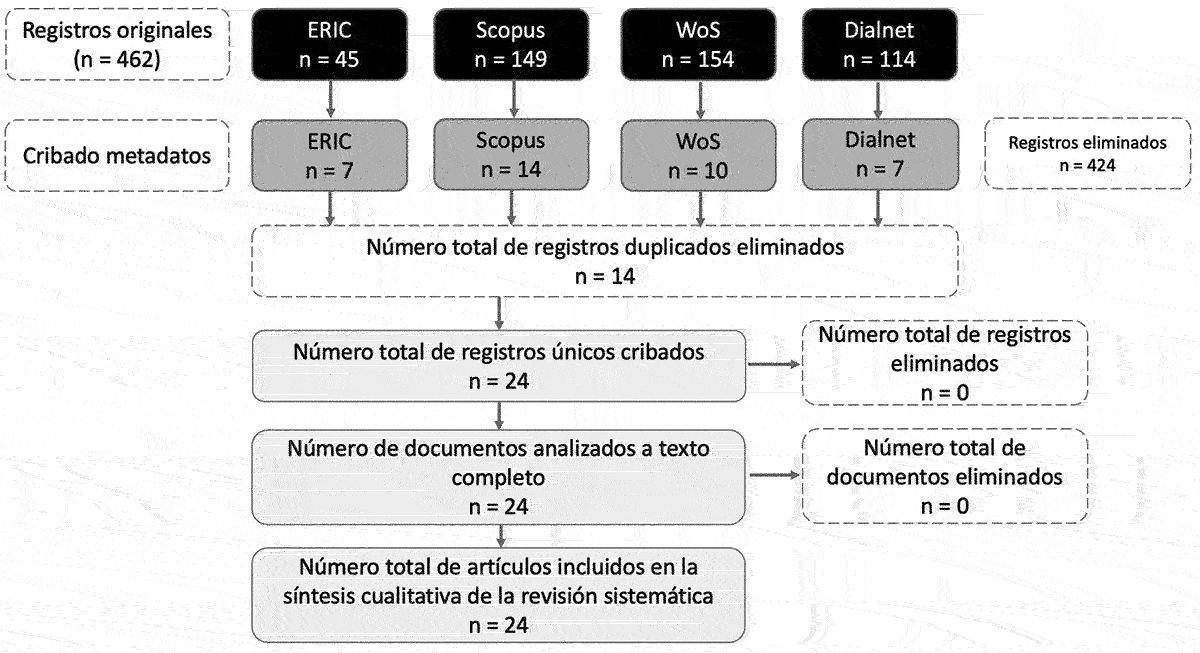
Muestra
Muestra analizada.
Los 24 documentos presentados corresponden a diferentes niveles educativos: educación infantil (2), educación primaria (3), educación secundaria (2), educación superior (10) y extraescolar (7); y a diferentes tipologías: artículos científicos (17), capítulos de libros (1) o contribuciones a congresos (6); y se produjeron según el siguiente flujo temporal (Figura 2). Distribución temporal de los documentos analizados.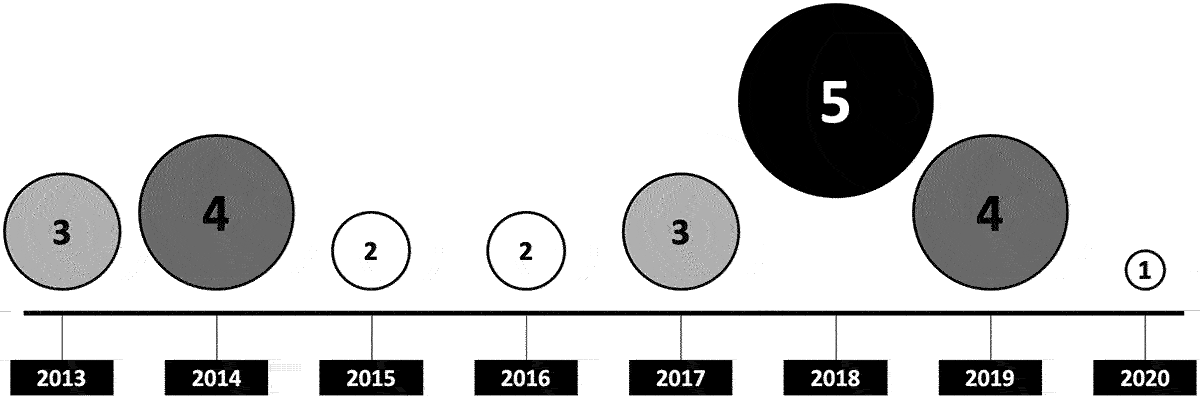
Resultados
PI1. ¿Qué se entiende por aprendizaje transmedia?
Quizá una de las formas de empezar este análisis sea partir de una de las últimas reflexiones al respecto, cuando Dickinson-Delaporte et al. (2020) asumen una de las dificultades de situarse conceptualmente en el ámbito educativo del transmedia: más allá del reconocimiento al marco conceptual de Jenkins, con su convergencia mediática y su cultura participativa, es tal la diversidad de formas de entender el transmedia en general como en su aplicación educativa. Y así, si estas autoras sugieren la existencia de múltiples caras transmediáticas (transmedia storytelling, branding, performance, ritual, activism o spectacle), en el ámbito del aprendizaje ocurriría lo mismo. Y de ahí, quizá, que uno de los primeros intentos conceptualizadores, Fleming (2013) haya sentado las bases de lo que después se viene recogiendo en la literatura posterior, pero solo de modo indirecto. En ese sentido, esta autora señala que el AT puede definirse como: the application of storytelling techniques combined with the use of multiple platforms to create an immersive learning landscape which enables multivarious entry and exit points for learning and teaching. It is the unifying concept of the learning environment that is important since that can become a landscape for learning that has few, if any, boundaries. (Fleming, 2013, p. 371)
Como decimos, más allá de alguna cita puntual y un reconocimiento general a los pilares que el trabajo de esta autora suponen para el joven ámbito de conocimiento, no es una definición que haya sido adoptada de modo general, pero sí que apunta a algunos de los elementos que podemos destacar en cualquiera de las obras posteriores: el posicionamiento socioconstructivista, la concreción en términos de aprendizaje de las ideas de navegación secuencial entre diferentes medios, el salto de los límites tradicionales del aprendizaje formal o la importancia de una narrativa que, al desarrollarse, permite la creación de un vasto panorama de aprendizaje (que liga más con el concepto de ecologías que de entornos o escenarios de aprendizaje; Pereira & Pedro, 2020). Sintetizado, es lo que se muestra en el siguiente esquema (Figura 3). Elementos del AT.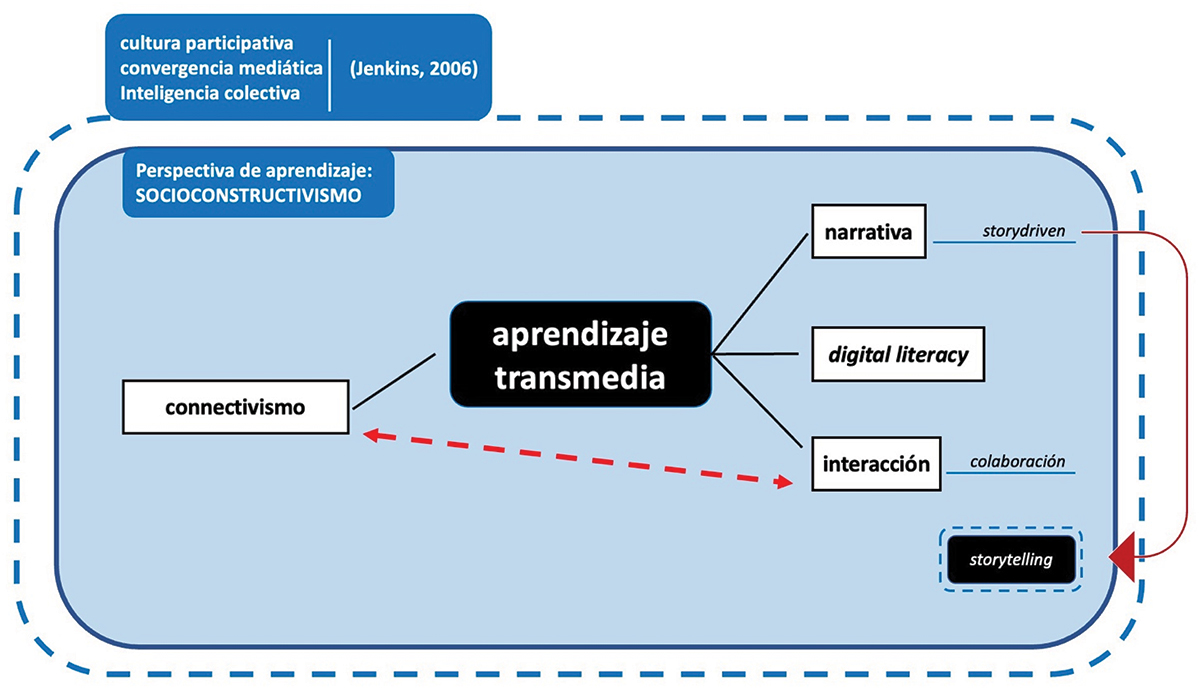
Sobre el paradigma de aprendizaje, algunos elementos que se señalan, más allá del posicionamiento socioconstructivista y bajo este paraguas, sitúan al/a la estudiante como centro (Amador, 2013; Davis, 2017; Dickinson-Delaporte et al., 2020; Wiklund-Engblom et al., 2013), e interpelan a usar elementos de la vida cotidiana que no solo hagan el aprendizaje más significativo (por su mayor potencial transferencia y por su relación directa con los conocimientos previos), sino que liguen de forma más directa con elementos de la vida cotidiana (Amador, 2013; Rodrigues & Bidarra, 2014), lo que debe tener un impacto directo en términos de engagement (una de las oportunidades que se sugieren comúnmente al abordar el AT; Chung, 2014; Raybourn, 2014).
En este abordaje socioconstructivista, sobresalen tres elementos, según lo que encontramos en los documentos consultados: el rol central de la narrativa como estrategia didáctica, el elemento tecnológico y la dimensión colectiva (interacción y comunicación, lo que nos lleva al conectivismo).
En primer lugar, el eje didáctico desde el que se organiza cualquier experiencia de aprendizaje transmedia es siempre una narrativa, que puede ser de ficción o de no ficción; por lo tanto, los proyectos están siempre impulsados por historias (Barreneche et al., 2018; Chung, 2014). Desde una perspectiva motivacional, se destaca el poder de estas narrativas (que se convierten en un reto) para involucrar a los estudiantes (si la narrativa los motiva, naturalmente se sentirán obligados a desarrollarla y compartirla, y así aprenderán; Chung, 2014). Y también es común señalar que son flexibles desde la perspectiva del profesor (se pueden definir diferentes caminos inicialmente, para satisfacer diferentes necesidades) y maleables desde la perspectiva del alumno (se pueden desarrollar según sus propios intereses; Ellis et al., 2018; Fleming, 2013; Gutu, 2019; Raybourn, 2017). También es prometedor que las narrativas puedan ser interminables a priori, ya que esto ofrece infinitas posibilidades de desarrollo y también de aprendizaje (Rodrigues & Bidarra, 2015). La narrativa tiene un papel clave en el desarrollo de toda experiencia de aprendizaje transmedia; narrativas que deben estar basadas en elementos de la vida cotidiana, que permitan el compromiso y una alta transferencia de todo lo aprendido (Chung, 2014; Raybourn, 2014; Rodrigues & Bidarra, 2014).
En cuanto a la tecnología, es flexible y líquida. No hay tecnologías ni medios predeterminados (tampoco los recursos, ni el orden o la secuencia en que aparecen estas tecnologías). La narrativa puede ser transmediada con lo que esté disponible en cada contexto; por lo tanto, no hay contexto en el que no pueda ocurrir la transmedialidad y los alumnos pueden transmediar fuera de los límites de la escuela como institución (límites espaciales y temporales; Davis, 2017; Ellis et al., 2018; Fleming, 2013; Gutu, 2019). El AT es una concreción directa de las infinitas posibilidades derivadas tanto del espectacular desarrollo tecnológico como del entorno de la cultura participativa/inteligencia colectiva y de la convergencia mediática. En este sentido, es fácil pensar que el AT es un paso más en el discurso de la alfabetización digital y que bebe directamente de ella (Barreneche et al., 2018; Pereira & Pedro, 2020), ya que ofrece un contexto cultural y crítico en el que se deben movilizar estas competencias cuando cada uno intenta actuar como ciudadano (si bien esto supone para el docente un reto muy importante y bastante difícil de implementar). También va más allá del discurso de la multimedialidad en la medida en que la alternancia entre lo analógico y lo digital, así como la superposición entre lo diferentemente digital, son naturales; y, con ello, también se vuelve natural ir más allá de los muros de la institución escolar en sentido estricto (Davis, 2017; Ellis et al., 2018; Fleming, 2013; Gutu, 2019; Raybourn, 2014). Esta alternancia es libre, con pocos límites de tiempo, espacio, orden y canales, ‘si es que los hay’, como hemos visto en la definición de Fleming (2013) con la que hemos empezado.
En relación con esto, el aprendizaje transmedia obliga a movilizar y desarrollar alfabetizaciones digitales de amplio espectro (es lo que señalábamos al principio al hablar de la transliteración, como un paso más allá de la habitual competencia digital y la educación mediática; Barreneche et al., 2018; Pereira & Pedro, 2020).
Otro elemento importante es la dimensión colectiva y colaborativa del aprendizaje transmedia (aprendemos en red, colaboramos), en relación con las ideas de Jenkins (2006) sobre la cultura participativa y la inteligencia colectiva. El elemento comunitario, de hecho, es destacado por diferentes autores en relación con el enfoque conectivista (Campalans, 2015; McCarthy et al., 2018; Valdés et al., 2016). Al aprender a través de la colaboración y de la participación, nacen comunidades de creación (y de aprendizaje; Raybourn, 2017; Rodrigues & Bidarra, 2015) y se desarrollan auténticos proyectos comunitarios. Es aquí donde es pertinente hablar, en muchos casos, de transautoría (Rodrigues & Bidarra, 2015, 2019).
En este sentido, es importante destacar que, más allá de la búsqueda directa de interacción o colaboración, el aprendizaje transmediático deviene comunitario de forma esencial, de modo que se cifra en torno a la construcción de comunidades de aprendizaje, virtuales o presenciales (Campalans, 2015; Rodrigues & Bidarra, 2015) de tal modo que la inteligencia colectiva sea el principal estímulo para aprender (Barreneche et al., 2018) y un agente principal de dinamización en los procesos de aprendizaje también en el ámbito formal, especialmente en el diseño y en la gestión de ecosistemas y entornos de aprendizaje (Raybourn, 2017; Raybourn et al., 2018). En ese sentido, y también como veíamos en la definición inicial, los lazos del AT con el conectivismo se añaden a los socioconstructivistas (Campalans, 2015; Rodrigues & Bidarra, 2019) y se concretan en muchos procesos de transmedialidad compartida, y de transautoría (Rodrigues & Bidarra, 2015) o de asunción compartida de identidades alternativas al servicio del aprendizaje (Raybourn, 2014, 2017).
Más allá de esos elementos, ya por sí importantes, quedan dos cuestiones que no ligan tanto con el concepto como con el contexto. El primero tiene que ver con el posible salto de los muros de la institución escolar o del aprendizaje formal, si se quiere. En ese sentido, del mismo modo que ocurría con el protagonismo de la narrativa, también encontramos un consenso sobre las potencialidades del transmedia a este respecto (Barreneche et al., 2018; Chung, 2014; Rodrigues & Bidarra, 2015). En ese sentido, podemos analizar dos de los mundos en que se producen estas aportaciones de la literatura como ejemplo de ello: por un lado, Fleming (2013) sitúa su transmedia play (una forma de concretar el aprendizaje transmediático) en el ámbito de la acción de las bibliotecas escolares (no en el sentido español, sino más amplio, como bibliotecas que trabajan en un contexto geográfico y educativo en el que sirven a diferentes escuelas), justo con el propósito de permitir un trasvase entre los aprendizajes formales dentro de la escuela y los informales, que responden a los intereses de los/as niños/as; por el otro, el desencadenante de los trabajos iniciales de Raybourn (2014), al servicio del desarrollo de serious games para un aprendizaje más inmersivo en la formación militar. Incluso, en las propuestas más ligadas a planteamientos más formales, siempre existe esa voluntad de ir más allá de las aulas (Valdés et al., 2016) aplicando las diferentes lógicas transmediáticas existentes (Dickinson-Delaporte et al., 2020) para superar las limitaciones de la institucionalización de los aprendizajes formales (en todos los niveles).
Finalmente, la segunda cuestión contextual que apuntábamos tiene que ver con la concreción didáctica del AT, pues no se trata tanto aquí de ver cómo se produce el aprendizaje en contextos de cultura participativa (en el sentido pedagógico), por interesante que sea, sino de poderlo aplicar de modo consciente en el diseño de experiencias de aprendizaje. En ese sentido, es lógico recuperar el storytelling como estrategia didáctica. Si bien decíamos antes que no todo el AT es storytelling (aunque sí storydriven), es lógico deducir que llevar a las personas que aprenden a desarrollar una historia puede ser una forma de plantear la situación de aprendizaje desde el punto de vista didáctico. Y todo ello con el objetivo de estimular a las personas que aprenden en múltiples formas (haciendo, viendo, escuchando, compartiendo, colaborando, reflexionando, etc.; Wiklund-Engblom et al., 2013), ofreciéndoles múltiples canales que les permitan el uso simultáneo o secuencial de diferentes perspectivas (Valdés et al., 2016). En definitiva, una concreción didáctica que se inspire por cuatro principios (McCarthy et al., 2018): (1) una narrativa rica y variada; (2) actividades y retos cuya resolución conlleve la colaboración; (3) elementos de gamificación; y (4) conexiones entre el aprendizaje formal e informal.
PI2. ¿Qué oportunidades brinda la integración de la narrativa transmedia en los procesos de enseñanza-aprendizaje?
La integración del transmedia en los procesos de enseñanza-aprendizaje presenta oportunidades tanto para el alumnado como para el profesorado. Desde la perspectiva del alumnado, la narrativa transmedia, si está bien planteada, incluye contenido atractivo e integra adecuadamente la narrativa, suele tener una repercusión positiva en la motivación de los estudiantes (Fleming, 2013; McCarthy et al., 2018). Este hecho, tal como indican McCarthy et al. (2018), puede acabar derivando en un mayor interés por el contenido académico por parte de los estudiantes.
De la misma forma, la ubicuidad que caracteriza de manera intrínseca este tipo de prácticas transmediáticas que utilizan la tecnología también puede ejercer una influencia directa en el interés por la materia que muestran los estudiantes (Fleming, 2013). Esto se debe, en parte, a que se amplían los contextos de aprendizaje fuera de los límites temporales y espaciales característicos de la educación formal, lo que permite al docente trabajar junto con los estudiantes a lo largo de la semana de manera continua y con independencia del momento de clase presencial (Dickinson-Delaporte et al., 2020).
Ir más allá de las horas lectivas permite que los estudiantes contribuyan con aportaciones adicionales a las que realizarían en el aula, es decir, se produce una expansión del ecosistema de aprendizaje como resultado de llevar el proceso de E-A más allá de los límites tradicionales de las instituciones educativas (McCarthy et al., 2018; Rodrigues & Bidarra, 2014). Como gran parte del proceso de aprendizaje se desarrolla fuera del centro educativo, se propicia que se compartan experiencias cercanas a la cotidianidad que promueven una mayor inmersión de los aprendizajes en la vida diaria de los estudiantes (Rodrigues & Bidarra, 2014). La creación de tales conexiones entre contenido curricular y vida cotidiana suscita una mayor implicación personal y, a menudo, provoca emociones en los estudiantes, lo que potencia una mejor asimilación de los contenidos (Dickinson-Delaporte et al., 2020).
Por otro lado, combinar la cotidianidad con el currículo por medio de la tecnología también facilita la integración de pedagogías centradas en el alumno en los procesos de E-A formales (Rodrigues & Bidarra, 2014). Esto, en parte, se debe a que la interactividad mediada por el uso de las tecnologías permite personalizar el proceso de aprendizaje para dar respuesta tanto a las necesidades individuales de los estudiantes como a las colectivas del grupo clase (Bernal, 2017). Asimismo, si un proceso de E-A transmediático incluye tecnologías adaptativas, más propias de los videojuegos, se puede llegar a ajustar el nivel en función de las necesidades de los estudiantes (McCarthy et al., 2018). Este tipo de aprendizaje con tecnología puede permitir un aprendizaje personalizado que se basa en los datos obtenidos (Raybourn et al., 2019).
Para que estos procesos de E-A más individualizados sean exitosos es interesante también ofrecer una gran cantidad de contenido. Ampliar el abanico tanto en posibilidades de participación de los estudiantes y de las familias, como indican Paulsen y Rueter (2014), como en formatos y canales, ayuda a toda la comunidad educativa a evitar la frustración de los estudiantes, quienes reciben la información de manera previa y en varios formatos, y fomenta el engagement de los estudiantes y de las familias (Dickinson-Delaporte et al., 2020; Paulsen & Rueter, 2014).
Es evidente que, para participar en un proceso de aprendizaje de dichas características, disponer de ciertas habilidades digitales resulta imprescindible; con todo, ni es preciso un repertorio concreto de destrezas tecnológicas (cada uno puede encontrar su propio camino transmediático), ni la heterogeneidad del grupo es un problema. En ese sentido, según Dickinson-Delaporte et al. (2020), quienes tienen una competencia digital mayor actúan de agentes motivadores para los menos experimentados, con lo que se promueve la colaboración. Además, si se gestionan correctamente, tanto con la interrelación como con el contenido personalizado se pueden crear contextos de E-A más eficientes (Crespo-Pereira & Legerén-Lago, 2018).
No obstante, para que se produzcan interacciones provechosas y enriquecedoras entre el alumnado es importante velar por mantener una conciencia-inteligencia colectiva, es decir, por lograr relaciones dinámicas y participativas que reafirmen los lazos sociales entre los intervinientes (Bernal, 2017). Por ello, Raybourn (2014) va más allá y apunta que, además de promover la colaboración y la interacción, hay que rastrear la interacción para conocer los datos que esta genera, pues pueden ser útiles para la adaptación de los contenidos y el proceso de aprendizaje a lo largo de la vida del estudiante.
Si los aspectos más colaborativos y tecnológicos del transmedia tienen un rol fundamental y se centra la atención en (el desarrollo de) la narrativa, resulta evidente que estos procesos de E-A contribuyen a mejorar las habilidades comunicativas de los estudiantes (no solo las tecnológicas). Dichas mejoras están relacionadas tanto con la capacidad de expresión como con la interpretación del contenido del discurso (Bernal, 2017). Esto va estrechamente ligado al hecho de que la narrativa transmedia suele implicar compartir y conocer puntos de vista variados en torno a un mismo concepto, lo que implica un mayor grado de reflexión (Raybourn et al., 2019).
Tal como apunta Fleming (2013), el objetivo final de las estrategias transmediáticas integradas en los procesos de E-A es detectar los intereses de los estudiantes con la finalidad de poder guiar y acompañar a los aprendices teniendo en cuenta sus inquietudes para poder animarlos a seguir con su proceso de aprendizaje. La misma autora subraya que este tipo de actuaciones no solamente tiene implicaciones en el alumnado, sino que también las tiene en el profesorado, quienes se pueden sentir motivados por profundizar también en los contenidos que imparten. De este modo, los docentes pueden resultar también beneficiarios de este tipo de prácticas educativas.
Al hilo de esta idea, Barreneche et al. (2018) consideran que las prácticas transmediáticas inciden directamente en el profesorado, pues deben abundar en aspectos que les permiten comprender con más profundidad la realidad de los jóvenes, es decir, implican un esfuerzo de actualización constante. Por ello, la integración del transmedia en los procesos de E-A puede llegar a suponer un cambio de hábitos tanto para aprendices como para docentes, que deben aplicar modelos de aprendizaje y pedagogías diferentes (centrados en el estudiante), ya que, para que una experiencia de tales características funcione, hay que plantear narrativas elaboradas que aborden los planes de estudio de un modo interactivo y fluido (Fleming, 2013).
Es evidente, pues, después de todo lo presentado, que las estrategias transmedia no pueden ser vistas de manera única. Son prácticas poliédricas que permiten su adaptación a las necesidades del contexto y que, sobre todo, son complementarias a la escolarización presencial que se imparte en horario lectivo en los centros educativos (Davis, 2017). Tal como indican McCarthy et al. (2018), resolver problemas y crear experiencias más allá del tiempo estipulado en el aula permite desarrollar habilidades y adquirir conocimientos que de otro modo requerirían de más recursos y más tiempo.
En esta línea, se puede considerar que una de las principales oportunidades o potencialidades de la narrativa transmedia es su versatilidad (en la medida en que no es una receta o método cerrado, férreo), que permite combinar la teoría con la práctica, el trabajo individual con el colaborativo, los entornos virtuales con los presenciales y las actividades libres con las dirigidas (Valdés et al., 2016) y todo ello en muy diversos contextos y niveles educativos. Esta infinidad de posibilidades supone una mayor facilidad para encaminar el proceso de E-A hacia perspectivas constructivistas y conectivistas que buscan que el conocimiento curricular se asimile y se construya haciéndolo desplegarse por los diferentes medios (Fleming, 2013).
En cualquier caso, está claro que este tipo de estrategias permiten acercarse mejor a los jóvenes — quienes valoran positivamente este tipo de acciones — y a sus procesos ‘naturales’ de E-A, lo que facilita el objetivo de dar respuesta a sus necesidades individuales y colectivas, si se atiende al contiendo que crean, consumen, comparten, producen y, en definitiva, aprenden (Bernal, 2017; Gutu, 2019).
PI3. ¿Qué retos plantea la integración del transmedia en los procesos de enseñanza-aprendizaje?
Al contrario de lo que podría pensarse al hablar de una experiencia de aprendizaje con un elemento tecnológico a priori importante, el primer reto al que debe enfrentarse un profesor que quiera integrar la narración transmedia en el aula no tiene que ver ni con la tecnología ni con la decisión sobre la mejor estrategia de seguimiento, sino la motivación de los alumnos. No es exclusivo de este tipo de experiencias, por supuesto; pero sí es muy relevante desde un enfoque constructivista partir de ella (y un presupuesto común en varios de los textos analizados), ya que el alumno es quien desarrolla la narrativa en parte por su cuenta. Si los estudiantes, ya de raíz, no comprenden la importancia del curso o estudio, será difícil que muestren interés por ninguna práctica formativa (Bernal, 2017). Por ello, el profesorado debe tener en cuenta y detectar antes de que empiece cualquier proceso las posibles lagunas que puedan presentar los estudiantes (Rodrigues & Bidarra, 2019).
Una vez se supera este primer reto, si la experiencia está bien planteada, el alumnado puede sentir tal nivel de interés que llegue a superar el tiempo que deberían dedicar a la actividad. Este hecho no se puede considerar positivo, dado que no se observan diferencias de aprendizaje significativas entre aquellos que invierten más tiempo que el necesario y aquellos que se ciñen al tiempo establecido (Paulsen & Rueter, 2014). En este sentido, para realizar este tipo de actividades se debe proporcionar a los estudiantes suficiente tiempo para que puedan implicarse y llegar a adoptar un papel activo en el proceso. De no ser así, será difícil que se llegue a ese punto en el que se piensa de un modo crítico y se construye conocimiento de un modo colaborativo (Rodrigues & Bidarra, 2019). No obstante, para conseguir esta interacción entre los estudiantes se requiere de una buena planificación y de una disponibilidad de tiempo que permitan al docente guiar bien el proceso de colaboración y de consumo de contenido (Dickinson-Delaporte et al., 2020).
Elaborar una buena narrativa transmedia es todo un desafío si se quiere hacer minuciosamente. Esto se debe a que, primeramente, hay que detectar las posibilidades de cada medida que se quiere aplicar y determinar cómo se va a integrar. A continuación, hay que proceder con una cuidadosa definición: la narrativa, los personajes, las interacciones que se van a producir y el espacio en el que se sitúa la trama, entre otros. En este sentido, y teniendo en cuenta la dificultad de crear la propia historia para que forme parte de un proceso de E-A, es imprescindible tener en cuenta que hay que conseguir que esta integre la dimensión de aprendizaje, es decir, hay que lograr que la narrativa encaje con los contenidos y con las habilidades por desarrollar (Rodrigues & Bidarra, 2015). Además, las estrategias más complejas requieren de un mayor número de recursos (programas especializados, grabación de contenidos, monitorización de las interacciones … ; Dickinson-Delaporte et al., 2020).
Con lo expuesto hasta el momento se pone de manifiesto que la integración de la narrativa transmedia en los procesos de aprendizaje es una oportunidad para utilizar metodologías centradas en el estudiante y también para que los docentes amplíen sus conocimientos. Aun así, para ello se requiere en numerosas ocasiones de apoyo y de estímulos que respalden a los docentes en su proceso de integración de las tecnologías digitales y la narrativa transmedia en sus aulas (Fleming, 2013). Esto, tal como apuntan Valdés et al. (2016), puede ser difícil en el caso de que el profesorado presente resistencias y miedos debidos a contextos conservadores que pueden dificultar el cambio.
Discusión y conclusiones
Como se ha comentado a lo largo del artículo, el aprendizaje transmedia ha surgido en los últimos años tanto en el ámbito de la cultura como en el de la educación. Según el planteamiento de Jenkins, para que una práctica sea transmediática debe tener tres elementos clave (1) cultura participativa; (2) convergencia mediática; y (3) inteligencia colectiva. Partiendo de esta idea y teniendo en cuenta el interés que despiertan las experiencias educativas transmediáticas, esta revisión sistemática ha analizado un total de 24 documentos. La selección de estos documentos se ha realizado siguiendo los criterios PRISMA, ya que inicialmente había 38 documentos. Así, del análisis mediante NVivo 12 de los 24 artículos y según los resultados obtenidos, se pueden extraer las siguientes conclusiones.
Como primera conclusión, deberemos aceptar que, aun con un tronco común, es importante la disparidad de aproximaciones didácticas que podríamos englobar dentro de lo que se viene denominando AT. Además, pese a la novedad que puede implicar la concurrencia de los elementos definitorios que hemos ido abordando, difícilmente podremos aceptar que se trate de una nueva concepción del aprendizaje, de una nueva pedagogía; más bien diríamos, pues, que estamos ante un paraguas didáctico que puede orientar el diseño de experiencias de aprendizaje a partir de la articulación de elementos que, ahora sí, provienen de una concepción diferente de los fenómenos culturales. Así, como decíamos, podríamos aproximarnos al AT partiendo de tres marcos referenciales: las ideas de cultura participativa y convergencia mediática (Jenkins, 2006), los pilares del socioconstructivismo (Biggs, 1996) y los del conectivismo de Siemens (2004, 2006). Y, a partir de ahí, podemos plantear situaciones de aprendizaje movidas por la necesidad de que el sujeto desarrolle una historia (Dickinson-Delaporte et al., 2020; Wiklund-Engblom et al., 2013), con los recursos que tenga a mano y considere (analógicos y digitales; Pereira & Pedro, 2020; Raybourn, 2014, 2017) y en un contexto comunitario, en que la colaboración no será una decisión sino una necesidad (Ellis et al., 2018; Fleming, 2013). No son pocos elementos, sin duda; tampoco son poco importantes; tampoco son completamente nuevos en el ámbito digital pedagógico, debemos decirlo también. Pero difícilmente podremos ir más allá en este punto, a tenor de lo que vemos en la literatura y de lo que se recoge gráficamente en la Figura 3. Y es justo reconocer, al hilo de lo que se muestra en esta representación gráfica, que la combinación de estos elementos, y la confluencia de tecnología, el transmedia y una potente narrativa, conforman una propuesta didáctica potencialmente muy interesante y poco común (también demasiado amplia, de hecho).
Las ramificaciones de estas ideas, eso sí, son largas y variadas: conexiones con el enactivismo (Campalans, 2015), elementos lúdicos (Barreneche et al., 2018), vinculación con el aprendizaje de lenguas extranjeras (Rodrigues & Bidarra, 2015, 2019). Por ello, además de la dificultad de concebir que realmente estamos hablando de un aprendizaje transmediático en el sentido pedagógico, también tenemos dificultad incluso para concretar de forma ortodoxa una única aproximación didáctica a esta nueva forma de aprender. A todo ello, al mismo tiempo como oportunidad y como limitación, se añade la amplia diversidad de contextos en que estas experiencias transmediáticas se producen: dentro de la escuela, pero también fuera de ella (con relación directa o indirecta con lo que pasa en el aula), con diferentes agentes implicados (la persona que aprende en el centro siempre, y habitualmente también sus docentes acompañándoles, pero las familias, educadores del ámbito informal), niveles educativos amplios (desde la educación infantil a los estudios universitarios o la formación militar profesional). Es, por tanto, una realidad muy permeable y en construcción, que comparte un tronco común (convergencia mediática, colaboración, narrativa), pero que adopta en gran medida la forma del contexto que la recibe (Amador, 2013).
En resumen, cuando hablamos de aprendizaje transmedia, estamos considerando que algunos elementos que Jenkins (2006) señaló desde una perspectiva cultural pueden ser utilizados conscientemente con fines de enseñanza/aprendizaje. Es decir, que los procesos participativos en los que se moviliza la inteligencia colectiva para alcanzar un producto (o meta) cultural común producen aprendizaje, permiten aprender; y que pueden ser utilizados por los educadores para la definición de itinerarios de aprendizaje y el diseño de experiencias de aprendizaje, que pueden entenderse como aprendizaje transmedia: la secuencia inicial de una narrativa, atractiva para los estudiantes, debe ser desarrollada por ellos con su interacción y utilizando los medios digitales (no solo) de su elección, y con amplias oportunidades para tener sus propias experiencias singulares al mismo tiempo que comparten parte de ellas con el resto de la comunidad. Es decir, la cultura, la tecnología y esta idea de inteligencia compartida no son nuevas en el aprendizaje transmedia, pues ya se destacaban en la conceptualización de Jenkins sobre el transmedia (cultura participativa, convergencia mediática e inteligencia colectiva, en sus propias palabras); pero ahora estos tres elementos se fijan y utilizan con fines de aprendizaje concretos, y es alguien distinto del alumno (profesores, educadores) quien decide y diseña cómo deben articularse (al menos en una fase inicial) para ofrecer experiencias de aprendizaje atractivas. Quizás esa sea la idea clave del AT, aunque en este momento es difícil ir más allá en el desarrollo didáctico de lo que hemos encontrado, debido a la disparidad de las experiencias relacionadas.
A efectos prácticos, las oportunidades del AT nacen justamente de su capacidad para concretar principios pedagógicos fáciles de aceptar pero difíciles de articular (constructivismo, conectivismo) en propuestas que resulten motivadoras para las personas que aprenden (engagement), personalizables y comunitarias (precisamente porque la narrativa admite capas, derivaciones, puntos de encuentro sucesivos), armónicos con el contexto digital que vivimos (pero a un tiempo lowtech y compatibles con el mundo analógico, del que no es necesario huir). Y, finalmente, propuestas que permiten saltar, si se quiere, los límites del aprendizaje formal (en el sentido amplio) y de las instituciones educativas (en concreto) y ligar con el mundo cotidiano de las personas que aprenden (punto este importantísimo, pues da vida y oportunidades reales al AT que conectan directamente con el aprendizaje personal del individuo).
Los retos, sin embargo, están a la altura de estas oportunidades, en la medida en que el concepto, aun después de esta clarificación, es líquido, y los avances son más teóricos que prácticos; las experiencias y sus logros son más incidentales que generales o sistemáticos; y, como consecuencia de todo ello, lo que conocemos sobre el transmedia es más apriorístico que basado en la evidencia.
A partir de aquí, por un lado, nos dejamos seducir por esa idea de pensar las estrategias de aprendizaje de modo más flexible y comunitario, a la vez personal. Y, por lo que hemos encontrado con estas experiencias, podemos ser bastante optimistas en cuanto a las posibilidades de utilizar (planificar, diseñar) experiencias de aprendizaje transmedia. De hecho, desde una perspectiva puramente escolar, la cultura participativa y la convergencia mediática de Jenkins (2006) nos invitan a saltar las paredes y los tiempos de las aulas, a crear comunidades de aprendizaje reales (esto es, formadas por personas que aprenden donde conviven, en el espacio presencial y en el virtual, como continuum), que impulsan sus propias historias (las narrativas), con los recursos de que disponen y con los que incorporan por el camino, con sus pares; y que aprenden en ese proceso. Pero, por otro lado, especialmente por difuso, no dejemos de reconocer la complejidad, especialmente cuando saltamos de las competencias transversales (comunicativa, digital, etc.) a las específicas, y cuando subimos de nivel educativo. Los proyectos Inanimate Alice (Fleming, 2013) y Curious George and the Odd Squad (McCarthy et al., 2018) o los que se recogen en Paulsen y Rueter (2014), no dejan de ser iniciativas en las que el core es la parte fundamental del aprendizaje (son expe-riencias en educación infantil o primeros años de la primaria); y, en el otro extremo, las propuestas concretas de Raybourn (2014, 2017), por estimulantes que resulten (y casi exóticas) implican un nivel tal de sofisticación tecnológica que difícilmente pueden generalizarse, al menos en la educación obligatoria.
Por ello, quizá, uno de los grandes retos sea dar el salto desde la evidencia de Scolari (2014, 2018) de que las prácticas transmediáticas de los jóvenes les propician aprendizajes muy positivos, a una nueva realidad en la que esas posibilidades puedan capitalizarse y aprovecharse, para mejorar la experiencia educativa (y los aprendizajes), especialmente en el contexto escolar.
