






Abstract
The mechanical properties of thermoplastic HDPE composites filled with CF and CNT were studied. Coupling agent surface-treated CF-filled HDPE composites increased their tensile strength and impact strength, which is further increased with the addition of CNT. Coupling agent was proved to play an important role in the improvement of the interfacial adhesion of the CF/HDPE composite. SEM showed that CNT coating-treated CF/HDPE composites show better dispersion of the filler into the matrix.
Keywords
Introduction
Excellent mechanical and thermal properties make carbon fibre (CF)-reinforced polymer composites become an ideal structural material in the automotive and aerospace industries [1-3]. Carbon fibre (CF) is a promising lightweight material because of its high specific tensile properties and carbonaceous microstructure. There are a number of existing functionalisation methods are studied to address different application requirements of functionalising carbon fibres [4-7].
HDPE is an inexpensive commodity polymer, but its use in some engineering applications may depend on improving its properties by crosslinking [8, 9]. Radiation on the molecules of a polymer, particular for HDPE, is often used for the modification of its properties, as it promotes a process involving simultaneously crosslinking and scission of the material polymeric chains, leading to greater degrees of compatibility and stabilisation. They are lighter, tougher, stiffer, more sustainable and can be produced in high volumes. These advantages result in a wide range of applications, i.e. structural members in aerospace, automotive and other industries. Nowadays, the introduction of a variety of materials into the composites has been tried and with the development of nanotechnology, the introduction of nanomaterials such as nano-silica and carbon nanotubes (CNTs) has become a hot spot for researchers [10, 11]. CNTs, tube-shaped allotropes of carbon-like rolled graphenes, are potentially very advantageous for nano-strengthening of the cement matrix because of their ultra-high aspect ratio (length-to-diameter ratio), ultra-large surface area and outstanding mechanical properties [12, 13].
In this study, we investigated the microstructure and mechanical properties of carbon fibre composites by fibre surface treatments with CNT coating treatment. Corresponding changes in surface chemical composition of CF fibres were analysed by an X-ray photoelectron spectroscopy (XPS).
Experimental
Materials and specimens
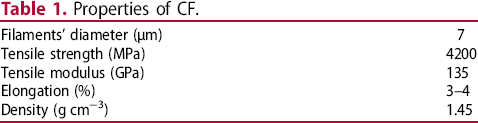
Properties of CF.
Properties of CF.
Fibre surface treatment
Carbon nanotube electrophoretic deposition on carbon fibre was used. CF is immersed in a coupling agent solution of 0.03 wt-% sodium dodecylbenzene sulphonate at 90°C. CNT was stirred in the coupling agent solution with a weight ratio of 1:100.
Composite preparation
Composites with CNT were extruded under the same condition that was used to prepare blends of HDPE with CF. The materials were extruded and palletised. The extruded materials were compression moulded into standard tensile, flexural and Izod impact specimens. The operating temperature was 220°C and the materials were preheated for 10 min and compressed for 10 min, and underwent cooling process at room temperature for 5 min before removed from the mould.
Mechanical test
The tensile, flexural and impact tests were carried out on a universal testing machine (CMT5254 Shenzhensans Testing Machine Co., Ltd, China) at the constant temperature (20°C) and the extension rate was set as 5 mm min−1. For each sample, several dumbbell-shaped specimens were taken and averaged to determine the mechanical properties of the blends.
Results and discussion
Tensile properties
The tensile strength of CF-reinforced HDPE composites with and without surface treatment at different carbon fibre loading is shown in Figure 1. It can be seen in Figure 1 that the presence of CF has considerably increased the tensile strength of the HDPE matrix with and without CNT. It is also noticeable that composite was always stronger with CNT than without CNT. This shows that CF has effectively reinforced and rendered its good mechanical properties to the matrix materials. This indicates that TiO2 improves interfacial adhesion, yielding a greater strength.
Variation of tensile strength at different fibre loading.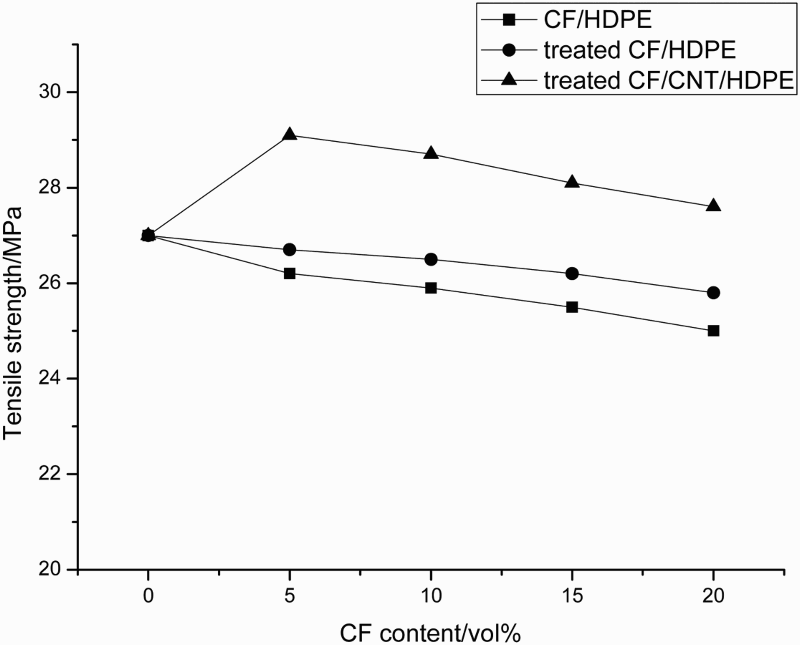
Figure 2 shows the variation of the Young's modulus at different fibre loading. The Young's modulus increased with fibre loading as shown in the studies of other researchers. The composites fabricated from CNT-coated CF showed 69% higher tensile strength as compared to composites made of neat-CF. The enhanced tensile properties are likely to be the overall effect of CF surface coating by CNT.
Variation of Young's modulus at different fibre loading.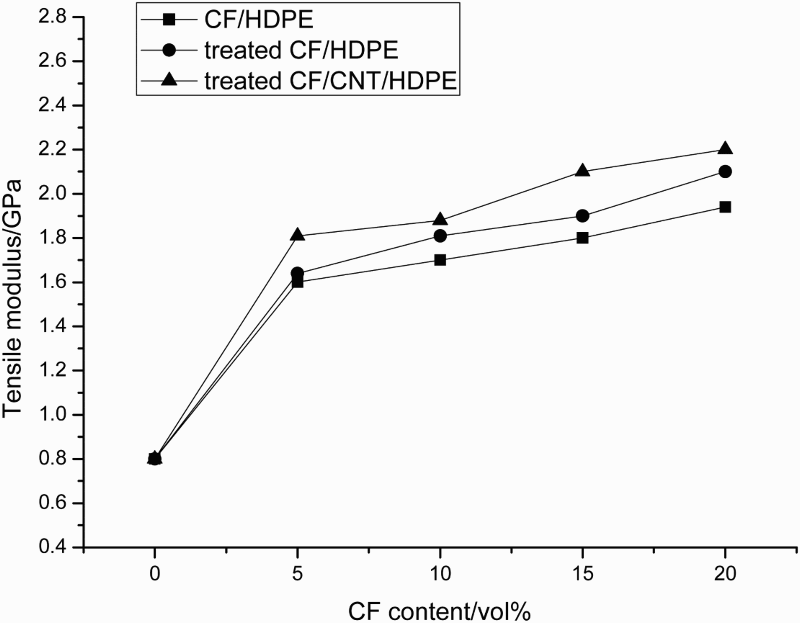
Impact strength results
Variation of the charpy impact strength with fibre loading for both raw and treated CF composites and CNT-filled composites is shown in Figure 3. The impact strength increased first and then decreased for 15–20% fibre-loaded composites. Incorporation of the CNT with short carbon fibres increases the work of fracture of CNT/HDPE composite, indicating that the composite reinforced by short carbon fibre can also absorb much energy to avoid the catastrophic fracture behaviour probably due to the friction between fibres and HDPE matrix during fibre pulling-out.
Variation of impact strength at different fibre loading.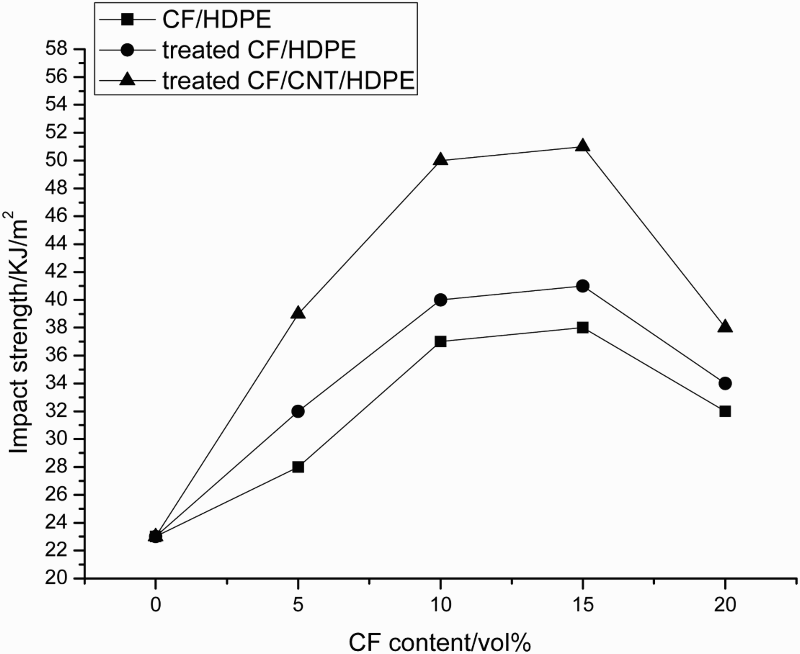
Previous studies on fibres have reported that the enhancement in stiffness is dependent on several factors, including the fibre aspect ratio, fibre modulus and fibre content. The presence of CF fibre into HDPE has increased the tensile modulus by about 70% as compared to unreinforced HDPE.
From the trend presented in Figure 4, it had been indicated that adding a small amount of CNT into polymer-based materials could potentially enhance their strength with the CNT content less than 3 wt-%. However, it was also reasonable to believe that it should have a necessary limit since the physical properties between these nano-structural materials and matrix were different. By analysing the relevant scientific materials, we could draw a conclusion that the time required for solidification was also longer as well as the surface of the sample was relatively soft compared with other samples with lower CNT contents. The addition of CNT improved only the hardness, for the CNT has no change of other factors with the increase of content.
Tensile strength of CF/CNT/HDPE composite.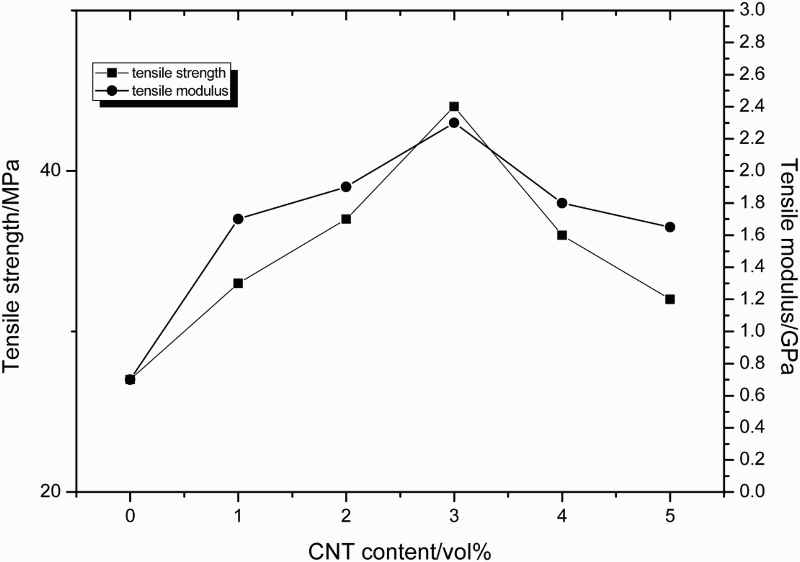
SEM morphology
The morphology of the fracture surface shows the phase information, reflecting the reasons that the mechanical properties of the composites fabricated under different conditions are different. The tensile fracture surface morphologies of untreated and treated CF/HDPE composites prepared with 15 vol.-% CF are shown in Figure 5. The SEM images of the untreated CF/HDPE composites show a number of pull-out traces of fibre with smooth surfaces and micro-voids as well as agglomeration of the fibre in the HDPE matrix (image a). Few resin is left on the surfaces of fibres, and some cavities appear between the fibres and matrix resin, reflecting that CF is easily pulled out of the matrix owing to its poor interfacial adhesion with HDPE matrix. These features suggest weak interfacial bonding between the filler and the matrix. On the other hand, treated CF/HDPE composites show better dispersion of the filler into the matrix, which results in better interfacial adhesion between the filler and the matrix. As clearly seen in the micrograph (image (b)), both fibre pull-out traces and the agglomeration of CF in the matrix have substantially reduced in the treated CF/HDPE composite, suggesting that interfacial bonding between the treated filler and the matrix is much more favourable compared to that of the untreated one. A larger amount of fibres are buried and covered by HDPE matrix as shown in Figure. 5(b); besides, fibres tend to break rather than being pulled out of the HDPE resins; and the pulled out fibres are surrounded by a large amount of the matrix resins. The outcome of the better interfacial bonding between the filler and the matrix is reflected in the improvement of the mechanical properties of the treated CF/HDPE composites.
Fracture surface morphologies of untreated and treated CF/HDPE composites prepared with 15 vol.-% CF.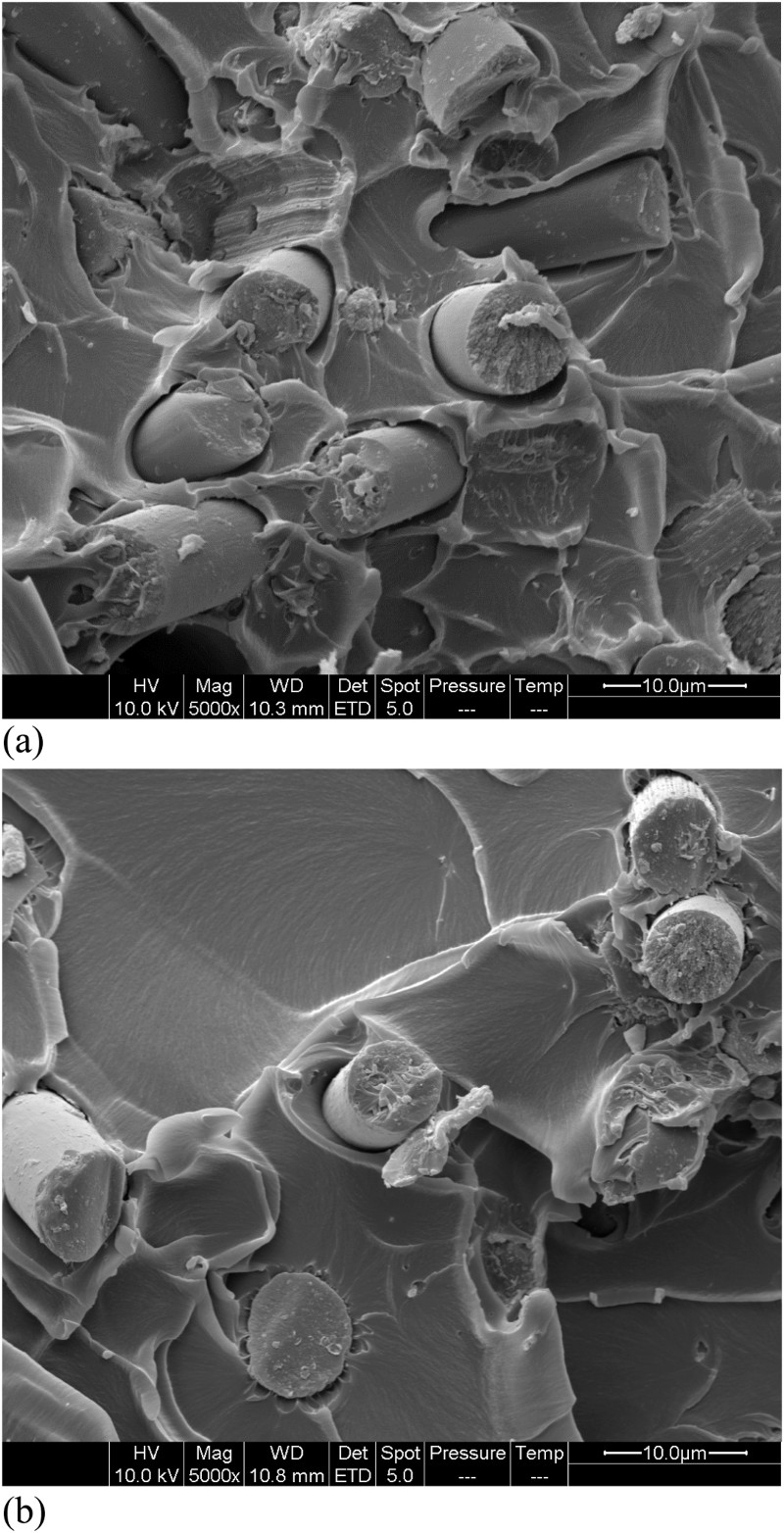
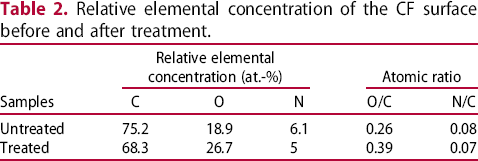
Relative elemental concentration of the CF surface before and after treatment.
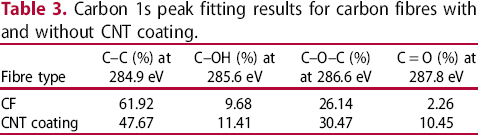
Carbon 1s peak fitting results for carbon fibres with and without CNT coating.
Conclusions
Coupling agent surface-treated CF-filled HDPE composites increased their tensile strength, flexural strength and impact strength, which is further increased with the addition of CNT. In this study, coupling agent was proved to play an important role in the improvement of the interfacial adhesion of the CF/HDPE composite. The XPS results indicated that the coupling agent treatment could make carbon fibre have a chemical interaction with the HDPE, and then the interfacial adhesion of the composite was improved. SEM images indicated that effective interfacial adhesion leads to the improvement of the impact properties of the CNT-deposited CF/HDPE composites.
Footnotes
Disclosure statement
No potential conflict of interest was reported by the author.