







Abstract
This study examined the influences of alkali concentration on the interfacial characteristics of bamboo–polyester. Pull-out tests were carried out using a newly designed jig to minimise the fibre breakage during clamping. Bamboo bundles were embedded at 3, 5, 7 and 10 mm and alkali concentrations ranged from 0, 1, 3, 5 to 7 wt-%. The attenuated total reflectance-Fourier transform infrared spectroscopy spectra revealed hemicelluloses was observed at ∼1030 cm−1. The pull-out results showed that interfacial characteristics were not influenced by the embedded length. Furthermore, the highest apparent interfacial shear strength was attained at 3 wt-% concentration, with approximately three times higher compared to the untreated one. A comparison with data from the literature showed that both untreated and treated bamboo/polyester composites have the weakest interfacial bonding. Scanning electron micrographs revealed that alkali treatment has resulted in interface enhancement through chemical modification, mechanical interlocking and frictional contact.
Keywords
Introduction
In recent decades, natural fibres are getting more attention as reinforcements for polymer composites due to their advantages of being low weight, low cost and environmentally friendly (renewable, recyclable and biodegradable) [1]. However, the fibre/matrix interface is generally weak due to the incompatibility between hydrophilic fibre and hydrophobic matrix, leading to early debonding of the fibre upon loading [2]. Consequently, the debonded fibres are not able to carry the load and this would lead to the premature failure of the composites. Hence, it is important to study the interfacial adhesion and to enhance the natural fibres for overall improvement of the composites.
The study on interfacial adhesion of natural fibres in different types of polymers has been carried out by many researchers. Some publications include bamboo [3-6], basalt [7], cotton [8], flax [8-16], hemp [7, 8, 17, 18], henequen [1, 2, 19], jute [5, 20, 21], kenaf [15, 20], lyocell [15, 22], pineapple leaves [23], ramie [22], sisal [24, 25] and wheat straw pulp [26]. Among the listed works, it was found that although alkalisation is a common method to improve interfacial properties, researchers generally fixed one to three alkali concentrations and the optimised concentration for bamboo bundle embedded in unsaturated polyester was not yet reported as well.
In this regard, this study focused on the investigation of alkali concentration on the interfacial shear strength of bamboo bundle reinforced polyester composite. The interfacial characteristics of untreated and treated bamboo bundles were evaluated and compared. Through this study, a new fibre pull-out jig was developed and the optimum alkali concentration for bamboo/polyester composite system was suggested.
Materials and methods
Materials
The resin used in this study was unsaturated polyester (Reservol P 9509) supplied by Jiashan Anserly Glass Fibre Co. Ltd. Malaysia. Bamboo stems were purchased from a local household shop in Sarawak, Malaysia.
Bamboo bundles extraction
All bamboo bundles were carefully extracted from the outer layer of the bamboo stem using a sharp pen knife. To ensure the consistency in the properties of the bundles, only bundles from the same bunch were chosen. They were known as ‘bundles’ instead of ‘fibres’ because manual extraction did not produce a single fibre, but a fibre bundle composed of many elementary fibres. The average diameter of the untreated bamboo bundle was 0.9 mm. This will be verified later in the section of morphology study using the scanning electron micrographs.
Bamboo bundles treatment
Extracted bamboo bundles were soaked in sodium hydroxide (NaOH) solution at 1, 3, 5 and 7 wt-%, respectively, at room temperature for 1 h. The duration of immersion was chosen with reference to the literature [1, 2]. The bundles were then washed with distilled water for several times and then left to dry under the sun. Subsequently, the dried bamboo bundles were cut into approximately 50 mm length.
Specimens preparation
First, the inner surfaces of U-shape aluminium moulds with a size of 12.7 × 12.7 × 50.0 mm3 were pre-greased with release agent. Then, square rubbers with the same size as the mould were inserted in each mould to control the embedded length. One selected bamboo bundle was then inserted into the central hole of the rubbers. After the mould was prepared, the unsaturated polyester was mixed with 2 vol.-% of methyl ethyl ketone peroxide which acted as catalyst and stirred gently. Next, the mixture was poured into the moulds. All specimens were left to cure at room temperature for 24 h.
Pull-out test
All tests were conducted using a universal testing machine at 1 mm min−1. Figure 1 shows the schematic diagram of the pull-out specimen and how it was loaded on the testing machine using the customised jig. The advantage of the jig is that none of the fibre bundle end was necessary to be clamped, thus avoided the initial fibre bundle failure due to stress concentration at the clamping region. This would improve the number of successful pulled out specimens. The free gauge length was always fixed at 5 mm. The fixed end was consistently fixed at 20 mm, which was at least twice of the embedded length. This ensured that the debonding always occurred at the loading end. The number of specimens tested for each series is listed in Appendix. For treated fibre bundles, the repeatability of the results was comparatively better compared with the untreated ones, and hence less number of tested specimens were tested. At each NaOH percentage, the number of specimens was 104, 18, 13, 15 and 7 for alkali concentration of 0, 1, 3, 5 and 7 wt-%, respectively. From the literature, it was also found that the number of specimens for each series used to study the interfacial shear strength of natural fibre reinforced polymer composites could be as low as 3–5 specimens [6, 11, 18]. However, it is worth to note that for natural fibres, it is usually sensible to test a larger number of specimens to enable a statistical evaluation and for the results to be displayed as histograms.
Schematic diagram of the pull-out specimen and the loading condition.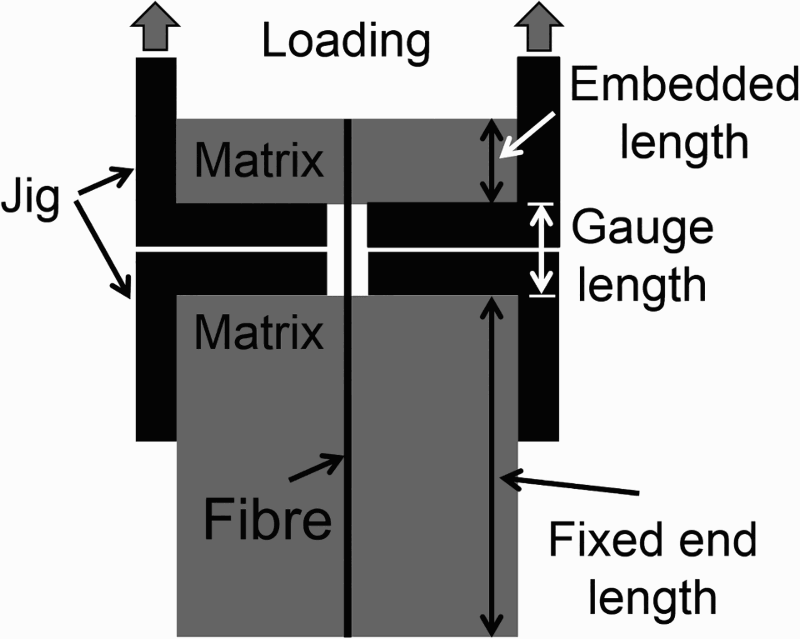
Fourier transform infrared spectroscopy
Attenuated total reflectance-Fourier transform infrared spectroscopy (ATR-FTIR) was performed to investigate the characteristic functional groups of the untreated bamboo fibre and to compare the changes of the functional groups in the treated fibres. The ATR-FTIR was conducted using the Perkin-Elmer Frontier FTIR Spectrometer (Waltham, MA, U.S.A.). The spectra were recorded at room temperature with a resolution of 4 cm−1 in the range of 4000–600 cm−1.
Morphology analysis
The fibre bundle and matrix surfaces were gold sputtered using auto fine coater (JEOL JFC-1600, Japan) before the morphology of the surfaces was studied under Scanning Electron Microscope (JEOL-JSM 840, Japan).
Results and discussion
Fourier transform infrared spectroscopy
Figure 2 compares the ATR-FTIR spectra of untreated and treated bamboo bundles. All spectra were baseline corrected and normalised with respect to the first peak at ∼3339 cm−1. This was because comparison of absorbance was usually done for wavelength below ∼1800 cm−1 [2, 4, 9]. Similar to the observation by Kim et al. [4], a significant band which implied the existence of hemicelluloses was observed at ∼1030 cm−1.
ATR-FTIR spectral patterns of untreated and treated bamboo bundles.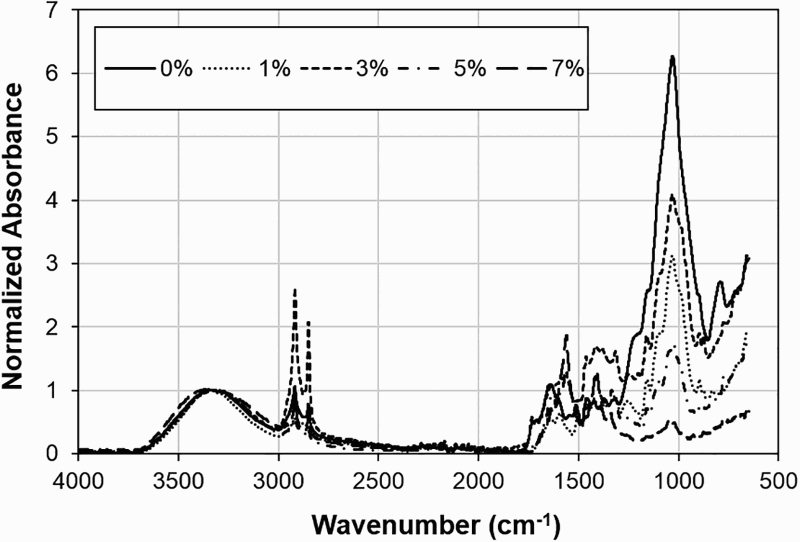
Force-displacement graphs
Figure 3 illustrates the force-displacement responses at various embedded lengths and alkali concentrations. All curves referred to the average curve of each series. All graphs showed that upon loading, the force increased linearly until peak load was attained. After that, interfacial crack was initiated and debonding was observed. This was accompanied by a sudden load drop, which corresponded to the release in the accumulated elastic energy. Upon further loading, the bamboo bundle slided along the matrix and the force decreased gradually. This implied the existence of the frictional force. When the bamboo bundle was totally pulled out, the force reduced to zero. Similar observation was also reported by other researchers through pull-out and microbond tests [2, 6, 12-16, 22, 23]. It is worth to mention that the success rate of the pull-out tests using the new customised jig was at least 90% of the total tests.
Force-displacement graphs of pull-out specimens at embedded lengths of (a) 3 mm, (b) 5 mm, (c) 7 mm and (d) 10 mm.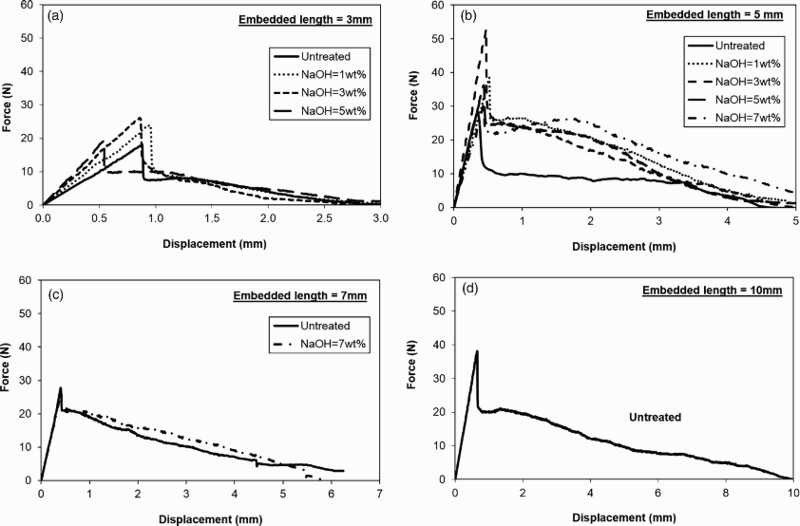
Apparent interfacial shear strength
Conventionally, the apparent or debond shear strength, τd is calculated using Kelly–Tyson equation [27], which is written as:

In Equation (1), df is the bamboo bundle diameter, le is the embedded length and Fd is the debonding load. The average bamboo bundle diameter was 0.9 and 0.6 mm for untreated and treated bundle, respectively, which will be displayed and discussed later using the scanning electron micrographs. This model assumes that the interfacial shear stress is uniform throughout the bonded region, the cross-section of the fibre is circular and uniform along the length, and the lateral contraction due to Poisson's shrinkage is neglected. However, these conditions are generally not fulfilled. Hence, the calculated τd is an approximated value and is regarded as apparent interfacial shear strength [15, 27].
Figure 4 displays the variation of the debond shear strength (Equation (1)) with the alkali concentrations at different embedded lengths. Results suggested that the debond shear strength was influenced by the percentage of NaOH and seemed to be independent of the embedded length. Constant debond shear strength at various embedded lengths implied ductile interface debonding characteristic. [13] This behaviour was also found in untreated hemp/PLA composite [18] and flax/low-density polyethylene composite [13]. In addition, Figure 4 depicts that there was no specific trend of the debond shear strength variation with the alkali concentration. The optimum interfacial bonding was achieved at 3 wt-%, which was approximately three times higher compared to the untreated fibre. The decrement after that was believed to be due to chemical degradation of the fibre surface through excessive delignification [9, 28]. Kim et al. [4] described that the region between ∼1600 and 1400 cm−1 depicted the presence of lignin. As could be observed in Figure 5, for untreated, 1 and 3 wt-% treated fibres, there was similarity in the spectra. However, for 5 and 7 wt-% treated fibres, certain differences were noticed. For example, there were two peaks observed, which were circled in the figure. Nevertheless, in overall, alkalisation has improved the interfacial bonding of bamboo/polyester composite.
Debond shear strength as a function of the alkali concentrations at various embedded lengths. ATR-FTIR spectral patterns between ∼1650 and 1300 cm−1.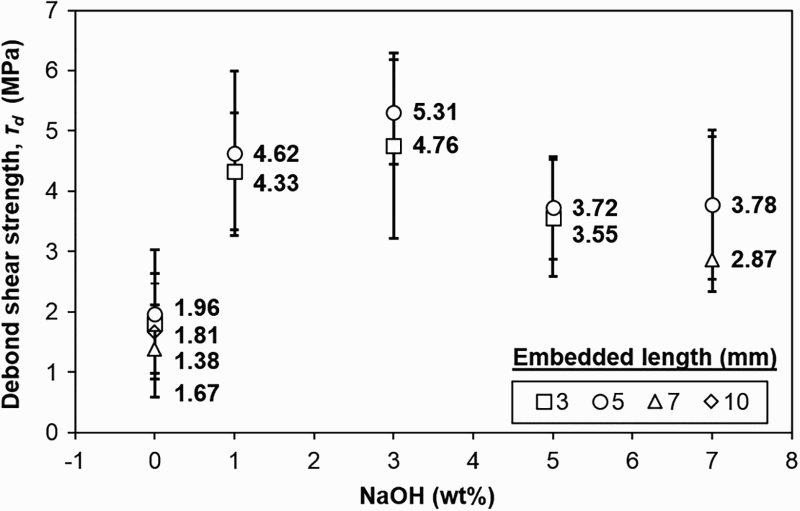
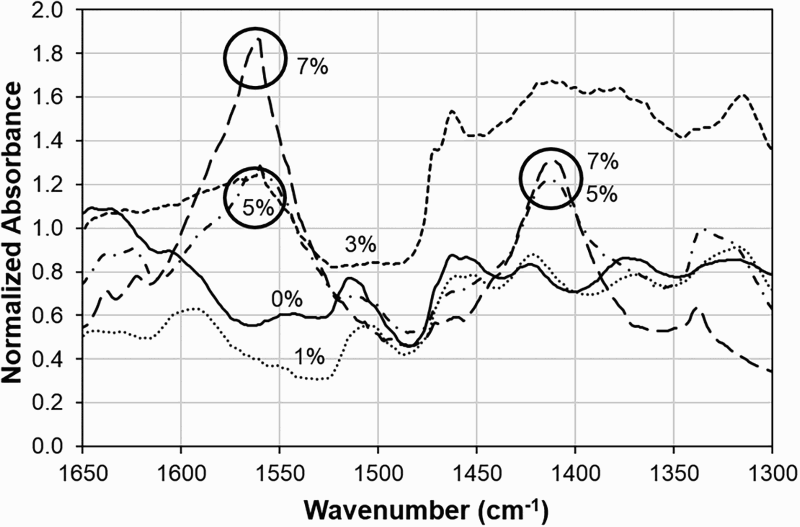
The increment in the debond shear strength due to alkalisation was believed to be attributed to the improvement in the compatibility between hydrophilic bamboo bundle and hydrophobic polyester matrix [17]. As described in the following equation, alkalisation has removed the hydrogen bonding in the network structure of the fibre [29, 30].

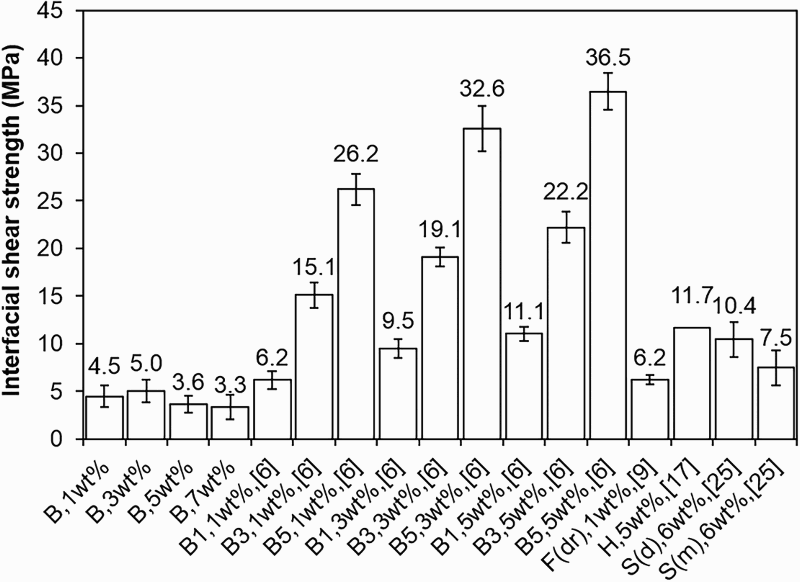
When the results from this study were compared with other natural fibres reinforced in the same matrix (UP) tested using the pull-out test, it was found that the ultimate interfacial shear strength (IFSS) obtained from this study was the lowest. This included both untreated (Figure 6) and treated bundles (Figure 7). However, as the testing conditions were not exactly the same, it should be noted that this comparison was for qualitative rather than quantitative comparison.
Comparison of IFSS of untreated natural fibres in polyester. The first alphabet refers to the type of fibre (B-bamboo, where B1, B3 and B5 indicate the embedded length of 1, 3 and 5 mm, respectively, F-flax, F(dr)-dew-retted flax, F(D)-Duralin flax, H-hemp, Hq-henequen, S-sisal, where S(d) and S(m) means that the IFSS was measured using density and microscopy method, respectively. The second alphabet indicates the test method (P-pull-out, F-fragmentation, M-microbond, whereas the number after that is the crosshead speed. Comparison of IFSS of alkali treated natural fibres in polyester. The number indicated before the reference refers to the weight percentage of sodium hydroxide. For other testing conditions, please refer to Figure 6.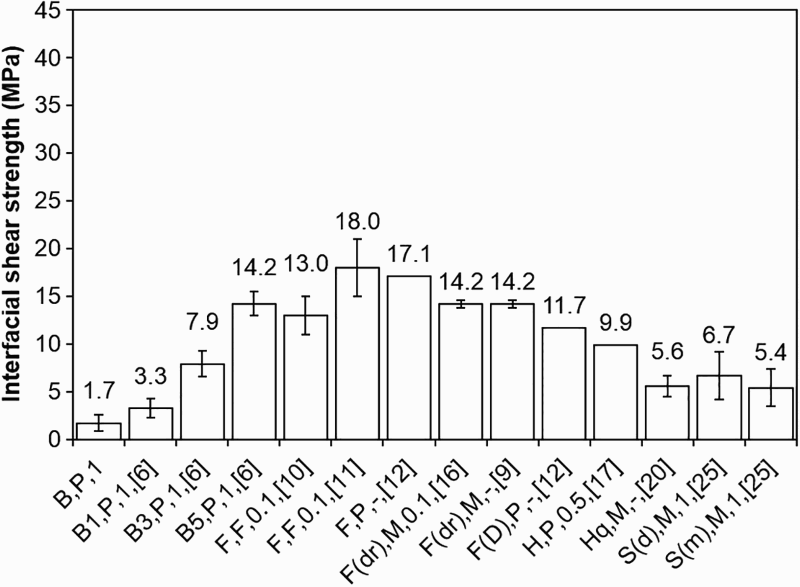
Morphology study
The morphology study was done by comparing the untreated and treated bundles at 7 wt-%. The highest concentration was chosen instead of other concentrations because it was intended to observe the possible surface impurities due to high alkali concentration in addition to the surface modification. Figure 8 displays the cross-section of untreated and 7 wt-% NaOH treated bundles embedded in the polyester. It could be seen from both figures that the bamboo bundle used in this study was a fibre bundle formed by many elementary fibres. This was also observed in [6]. According to Wong et al. [14], the single fibres were bonded together by waxes and other impurities. In addition, Figure 8(a,b) showed that the cross-section of the fibre bundle could be approximated as circular, even though it was not exactly true. This approximation was also adopted elsewhere [6, 16]. Based on the micrographs, the average bundle diameters were approximately 0.9 and 0.6 mm for untreated and treated fibres, respectively. However, it should be noted that the measurement of the bundle size through micrographs has generally overestimated the diameter of the bundle due to the porosity of the bundle, as observed in reference [6] as well. Furthermore, both untreated and treated fibres were found to be perfectly bonded to the matrix. The matrix surface was uneven because the top surface was left opened during curing process to accommodate a slight extrusion of the fibre. Otherwise, the elementary fibres would be covered by the matrix and could not be visualised from the micrograph.
Scanning electron micrographs of the cross-sectional area of (a) untreated and (b) 7 wt-% NaOH treated bamboo bundles reinforced in polyester resin.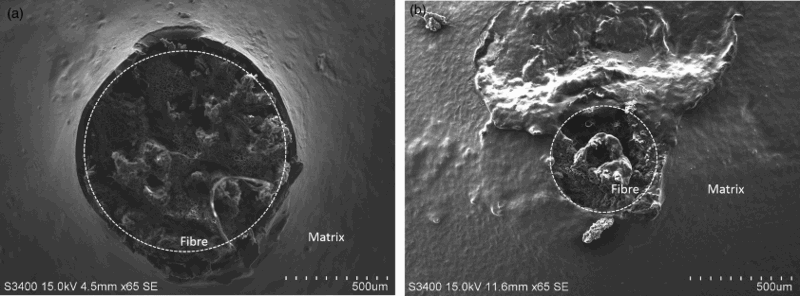
Figure 9 shows the fibre surfaces of the untreated and treated fibres. From Figure 9(a), untreated elementary fibres were not strongly bonded, where the separation and partial breakage of single fibres along the bundle direction could be observed. Besides, as depicted in Figure 9(b), alkali treatment has removed some low molecular weight compounds such as hemicelluloses, lignin, waxes, pectin and surface impurities on the untreated bundle surface [2, 6, 19]. It has been reported that hemicelluloses contain groups that absorb in the carbonyl region and could be dissolved in alkaline solutions [19]. As a result, the morphology and chemical composition of the treated surface was changed, where there was more exposed cellulose for better bonding [2, 19]. Generally, the treated fibre surface was cleaner but with more imperfections, where there were some tiny defects, surface damage, cleavage, crevices and creases [2, 19, 32]. This has increased the contact surface for better frictional contact and mechanical interlocking, which enhanced the fibre/matrix interpenetration [32]. However, at 7 wt-%, alkalisation could have induced damage on the bundle surface due to excessive delignification that led to the deterioration in the interfacial shear strength [9, 28, 32]. In addition, the lateral cohesion of the bundle has been improved, where no fibre splitting was observed.
Scanning electron micrographs of unbonded bundle region of (a) untreated and (b) 7 wt-% NaOH treated bundles.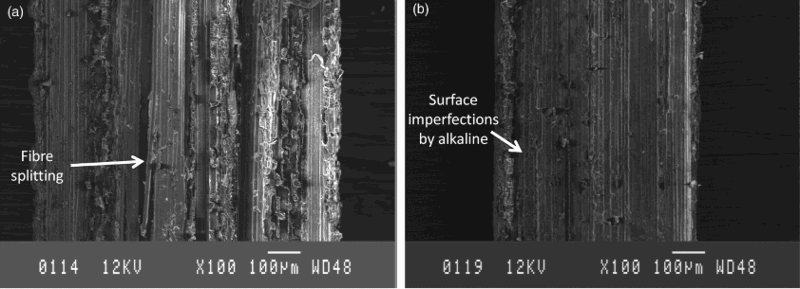
Figure 10 shows the scanning electron micrographs of the debonded bundle surfaces. It could be observed from Figure 10(a) that there were very minimal matrix fragments attached on the bundle surface, which was the primary cell wall of the bundle. Some fibre splitting was also observed. This indicated poor bundle/matrix and fibre/fibre bonding. Compared to Figure 9(a), there was not much change in the bundle topography before and after debonding. From Figure 10(b), there was obviously less fibre splitting observed on the treated bundle, however, more fibrils were observed. This means that even though alkalisation has improved the lateral cohesion of the bundle, the improvement in the bonding between the bundle/matrix has dominated over the fibre/fibre bonding [12]. In addition, matrix attachment was also noticed, believed to be attributed by surface quality and surface roughness improvement after treatment. According to Stamboulis et al. [13], matrix attachment indicated mechanical interlocking between fibre and matrix. This contributed to the friction force during pull-out, which corresponded to the portion of the curve after peak load was attained. Hence, it could be deduced that alkali treatment improved the interface bonding quality, which subsequently enhanced the interfacial bonding of the bundle/matrix system [14].
Scanning electron micrographs of debonded bundle surfaces of (a) untreated and (b) 7 wt-% NaOH treated bundles.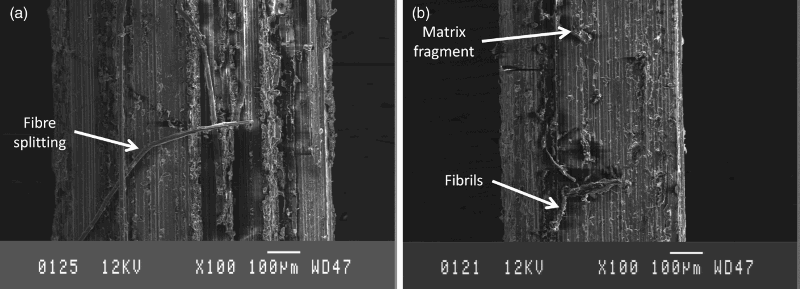
Significant bundle end damage was noticed in Figure 11(a), which signified comparatively large energy dissipation at bundle end. Less end damage was observed in treated bundle, as indicated in Figure 11(b).
Scanning electron micrographs of debonded bundle ends of (a) untreated and (b) 7 wt-% NaOH treated bundles.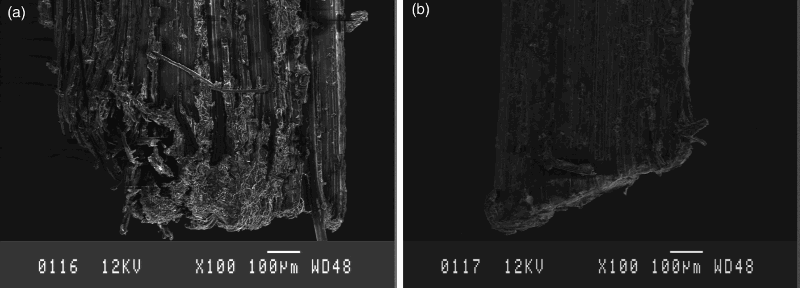
Figure 12(a) shows the debonded matrix surface, where the trace of fibre sliding was observed, but no fibre was found to attach on the matrix. This signified comparatively weak interfacial bonding behaviour in the bundle/matrix system. As for the treated bundle, the matrix surface displayed in Figure 12(b) showed significant fibre attachment and matrix shear cusps, which implied better bonding and energy dissipation. Traces of primary cell wall implied adhesion among the single fibres in the bundle was weaker than the interface [12]. Separation of single fibres in alkali treated bamboo fibre was also observed [6].
Scanning electron micrographs of debonded matrix surfaces of (a) untreated and (b) 7 wt-% NaOH treated bundles.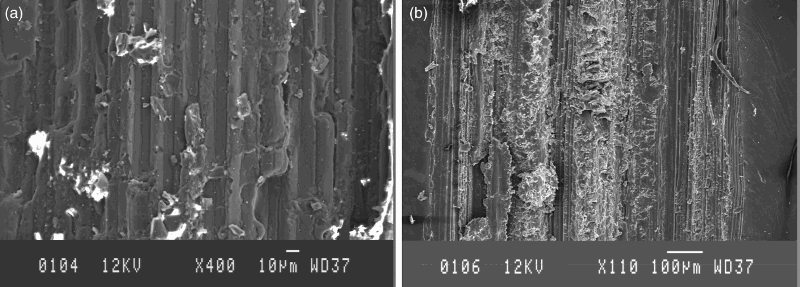
Conclusions
In this study, a customised jig for fibre bundle pull-out test was designed and fabricated. The jig has been implemented in the characterisation of the influences of alkali concentration on the interfacial characteristics of bamboo bundles in unsaturated polyester. The ATR-FTIR spectra provided information of hemicellulose, lignin and waxes removal, and water absorption reduction upon alkali treatment. Besides, results showed that the optimised alkali concentration was found at 3 wt-%, with approximately threefold increase in the apparent interfacial shear strength compared to the untreated system. Through scanning electron micrographs, it was found that the improvement was contributed by the surface modification through alkalisation, which in turn enhanced the interface bonding through chemical modification, mechanical interlocking and frictional contact. However, comparison with other types of natural fibre from the literature revealed that the bamboo bundle used in this study has low interfacial shear strength. Further works could be conducted to improve the interfacial characteristics. Some possible solutions that could be considered include different fibre extraction methods (steam explosion, alkali extraction and chemical extraction) and fibre treatment methods (combination of alkalisation with bleaching, acetylation, silanation and sodium suphite).
