







Abstract
Modified multi-walled carbon nanotubes (MWCNTs) were prepared from commercially purchased MWCNTs with different chemical reactions. Nanocomposites were synthesised by the solvent casting method. The effects of functional groups, filling ratios and surfactants on thermal properties of nanocomposites were investigated. The structural, thermal and morphological properties of MWCNT and nanocomposites were investigated using Fourier transform infrared spectrophotometer, Brunauer–Emmett–Teller surface area measuring device, thermogravimetric analysis, differential scanning calorimetry and scanning electron microscopy. The novel increases in the thermal properties of poly(butylmethacrylate) (PBMA) were observed by adding MWCNT samples into a PBMA matrix. T g values of nanocomposites were higher than those of PBMA films. The data obtained from the thermograms of nanocomposites at different heating rates were analysed with Kissinger, FWO and Friedman equations. The activation energies of the nanocomposites were higher than those of PBMA films.
Introduction
In recent years, polymeric nanocomposites have achieved great importance in engineering and biotechnology applications as they generally exhibit higher thermal and mechanical properties than polymers. These properties depend not only on the individual properties of the components that make up the nanocomposite, but also on the interactions among the components, morphology and interfacial interactions [1, 2]. Poly(butylmethacrylate) (PBMA), with its chemical structure, s given in Figure 1, is a polymer frequently used in coatings and bone cement, biomedical materials, such as controlled release drug delivery systems [3, 4]. However, due to its low glass transition temperature and relatively poor mechanical properties, PBMA is seldom used alone [3, 5]. Therefore, PBMA can be used as a polymer matrix in nanocomposite synthesis with different fillers. The main difficulty in improving the thermal and mechanical properties of polymers arises from the irregular nature of the components and the compatibility between polymers and fillers. Thus, the nanocomposites, containing polymers, and fillers, containing functional groups, have attracted much attention. Such nanocomposites exhibit new properties as they change the mechanical, thermal, optical, etc. properties of polymers [2]. In the literature, different nano-sized filler materials, such as clays, oxides, metals, are used in nanocomposite synthesis to improve the thermal, mechanical, optical, etc., of polymers [6-12]. However, because some of these materials are toxic and expensive and are not distributed homogeneously in the polymer matrix, they are used in a very limited way in nanocomposite synthesis.
Chemical structure of PBMA.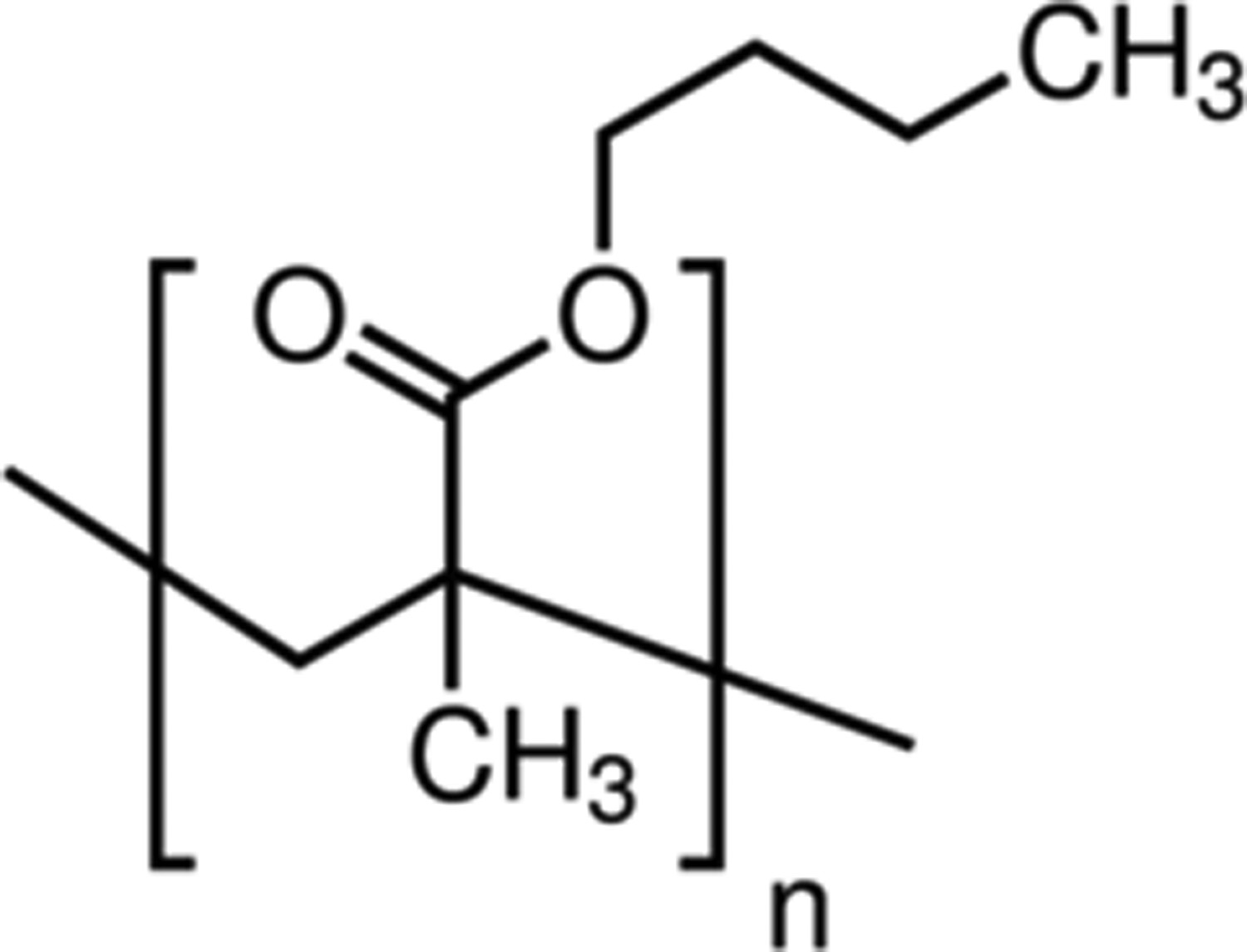
An alternative filler to these materials and recently widely used in nanocomposite synthesis is carbon nanotubes (CNT). Since their discovery by Iijima in 1991 [13], they have been the main centre of research in engineering and science fields due to their physical and chemical properties [14]. CNTs have potentially unique mechanical and thermal properties, with wide application areas in electronics, polymer chemistry, computer, aerospace and other industries. These different properties make CNTs an excellent reinforcement material in the polymer matrix [15]. CNTs are tube forms of carbon, rounded to the cylindrical shape of graphite sheets [16]. Since these structure do not have any functional groups and electrical and van der Waals interactions between them, they are generally not distributed homogeneously in the polymer matrix. Therefore, the CNT surface must be modified to increase the interaction between polymers and CNsT. The modification of multi-walled carbon nanotubes (MWCNTs) with hydroxyl groups, carboxylic acid groups and amine-containing organosilane compounds can alter the surface properties and increase the hydrophilic properties of MWCNTs [15-18]. As a result, the homogeneous distribution of MWCNTs in the polymer matrix can significantly change the properties of the obtained nanocomposites.
In the literature, the nanocomposites of PBMA have been synthesised with different fillers and the expected improvements in the thermal properties of PBMA are not yet at the desired level. For example, Han et al. synthesised transparent flexible ZnO/MWCNTs/PBMA ternary nanocomposite films with in situ bulk polymerisation and found that the tensile strength of the ZnO/MWCNTs/poly-n-butyl methacrylate ternary film was enhanced by 42% [19]. Suhailath et al. investigated the flame, thermal and electrical properties of poly(n-butyl methacrylate)/titanium dioxide nanocomposites prepared with various concentrations of titanium dioxide (TiO2) nanoparticles by the in situ free radical polymerisation method. DSC and TGA studies showed that the glass transition temperature and thermal stability of the nanocomposites increased with the increase in the concentration of nanoparticles [2]. Yang and Hu studied the rheological properties of poly(n-butyl methacrylate)/montmorillonite composites. Moreover, the studies on the thermal stability of polymers are very important due to the increasing demand for materials with high-resistant temperature properties [3]. The analysis of the kinetic parameters is also important in understanding solid-state reactions that could occur during the decomposition processes [20]. To the best of our knowledge, there are no studies in the literature on the nanocomposite synthesis of PBMA with MWCNT. The aims of this study are to synthesise the nanocomposites of PBMA polymers with low thermal properties with MWCNT and modified MWCNTs by the solvent casting method; to characterise with Brunauer–Emmett–Teller (BET), Fourier transform infrared (FTIR) spectroscopy-Attenuated total reflectance (FTIR-ATR), thermogravimetric analysis (DTA/TG), differential scanning calorimetry (DSC) and scanning electron microscopy (SEM) devices; and to perform non-isothermal kinetic analysis of nanocomposites. The novelties of this study are to prepare multi-walled carbon nanotube samples with different functional groups, to change the surface properties of MWCNT, to investigate the effects of functional groups, filler ratio and sodium dodecyl sulphate (SDS) surfactant on the thermal stability of nanocomposites, and to examine the thermal degradation kinetics of nanocomposites with the highest degradation temperature.
Materials and method
Materials
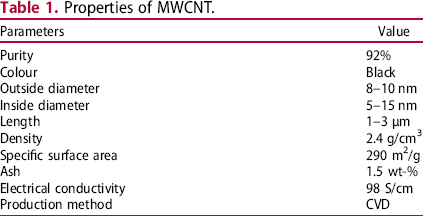
Properties of MWCNT.
Methods
Hydroxylation of MWCNT
The modification of MWCNT was done by Fenton oxidation. 1 g MWCNT and 0.3 M 90 mL FeCl2·4H2O were placed in a flask and kept in an ultrasonic bath for 1 h. The mixture was placed on a magnetic stirrer and 300 mL 30% H2O2 was added slowly into the mixture, stirred for 12 h at room temperature, and filtered with a vacuum filtration apparatus. The filtrate was washed with 5% HCl and dried in an oven at 80°C for 24 h. The resulting MWCNT was MWCNT-OH [21, 22]. The hydroxylation reaction scheme of the carbon nanotube is given in Figure 2.
The modification reaction schema of MWCNT.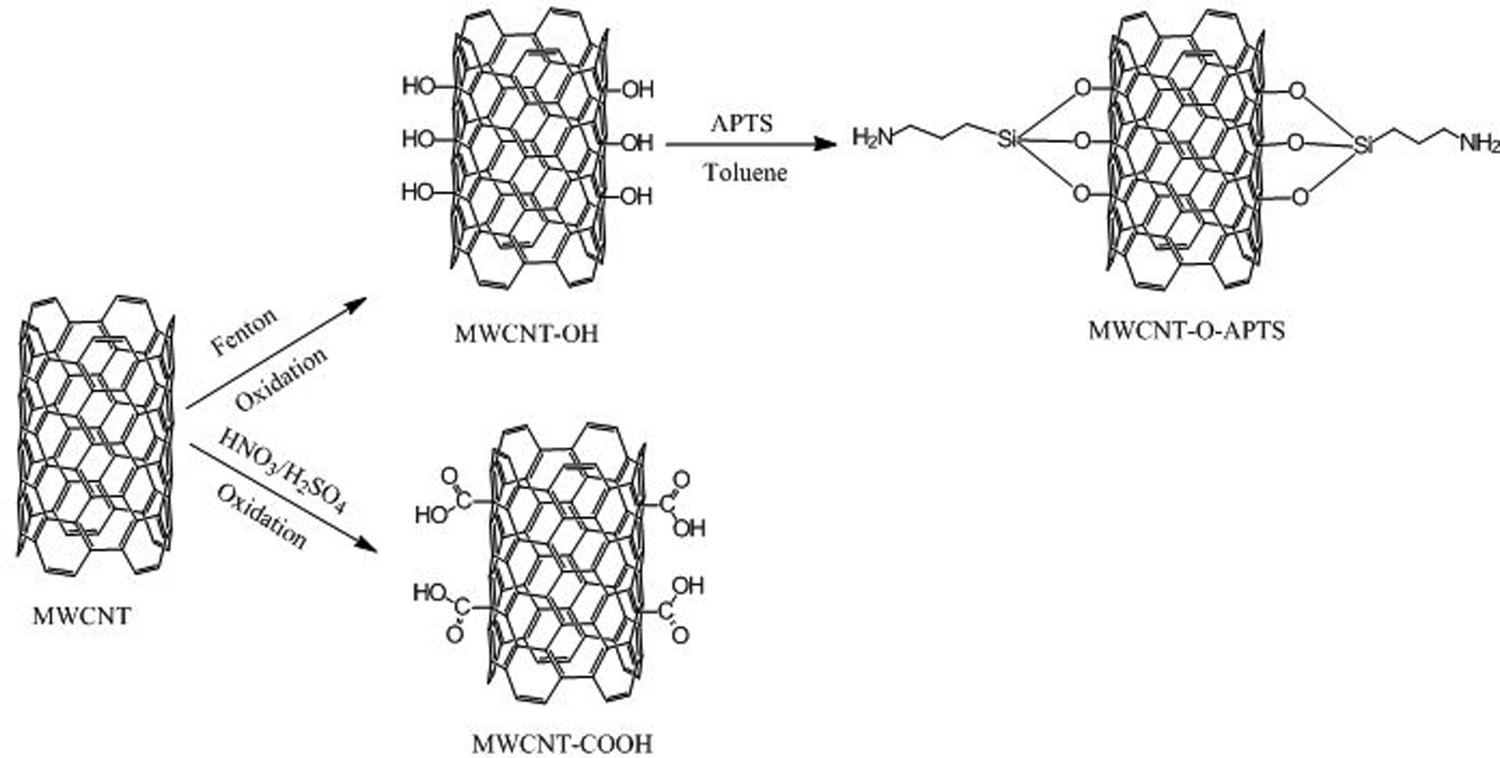
Carboxylation of MWCNT
The oxidation of p-MWCNT was accomplished by adding 0.5 g of MWCNT and 20 mL of concentrated H2SO4/HNO3 (3:1 ratio) solution to the reaction flask. The prepared suspension was kept in an ultrasonic bath for 3 h. After sonication, the solution was diluted with distilled water (5:1 ratio) and filtered, and then the reaction mixture was washed with 500 mL distilled water. When the pH of the carbon nanotube dispersion was equal to that of the distilled water (∼7), the carbon nanotube was considered acid-free. The carbon nanotube was dried under a vacuum in an oven overnight and labelled MWCNT-COOH [16]. The reaction scheme of the oxidised carbon nanotube is given in Figure 2.
Synthesis of MWCNT-O-APTS
2 mL of 3-aminopropyltriethoxysilane (APTS), 50 mL of toluene and 1 g of MWCNT-OH were placed in a reaction flask, and the mixture was kept in an ultrasonic bath for 30 min. The mixture was stirred under reflux on a magnetic stirrer for 24 h at 80°C and filtered with a vacuum filtration apparatus. The filtrate was washed three times with toluene, methanol and acetone and dried in an oven at 80°C for 24 h. The resulting MWCNT was named MWCNT-O-APTS [16]. The reaction scheme of MWCNT-OH with APTS is given in Figure 2.
Synthesis of PBMA/MWCNT or PBMA/modified MWCNT nanocomposites
PBMA/MWCNT and PBMA/modified MWCNT nanocomposite films were prepared by the solvent casting method. THF was used as a solvent in nanocomposite synthesis. For the preparation of nanocomposites, MWCNT and modified MWCNTs were used in 0.25, 0.5 and 1 wt-%. These fillers were kept in a homogeniser for 10 min in a 50 mL of solvent and then in an ultrasonic bath for 2 h. Meanwhile, PBMA in 50 mL of solvent was mixed with a shaker for 2 h to ensure complete dissolution of the polymer. At the end of 2 h, the dispersion of MWCNT or modified MWCNTs and polymer solution were brought together and held in an ultrasonic bath for 2 h. To remove THF, the solution was poured in a Teflon Petri dish and dried in an oven at 30°C for 48 h. Thus, nanocomposite was synthesised in a film form [15].
Characterisation
BET Analysis
BET surface areas of MWCNT and modified MWCNT samples were measured with a Nova2200e instrument (Quantachrome Instruments). Before the measurements, the samples were degassed at 100°C for 4 h.
FTIR-ATR analysis
FTIR spectra of PBMA, MWCNT samples and their nanocomposites were performed in the range from 4000 to 650 cm−1 in the transmission mode using an ASCO FTIR-4700 spectrometer.
Scanning electron microscopy
A TESCAN brand scanning electron microscope was used to investigate the morphological properties of nanocomposites. For the SEM analysis, MWCNT and modified MWCNT samples were prepared by spraying on a carbon band. PBMA/MWCNT and PBMA/modified MWCNT nanocomposites were prepared by suspension in an ultrasonic bath in THF. These suspensions were then dropped on the copper tape and kept in an oven at 40°C to remove the solvent. SEM images of the samples were taken by applying a magnification ratio of 10 kx, 10 mm WD and 30 Kv voltage.
Thermalgravimetry
The thermal stability of the samples was performed using a SII TG/DTA6300 device under the nitrogen atmosphere from room temperature up to 500°C at a heating rate of 10°C per min.
Differential scanning calorimetry
The glass transition temperatures (T g) of the nanocomposite materials were measured by a PerkinElmer DSC 4000. Analyses were carried out under the nitrogen atmosphere at a heating rate of 10°C per min in the temperature range of 25–400°C.
Thermal kinetic analysis
The thermogravimetric analysis to measure and record the sample mass change with temperature over the course of the pyrolysis reaction was done with an SII TG/DTA6300 device. Samples were heated from room temperature to 500°C under the nitrogen atmosphere at heating rates of 5, 10, 15 and 30°C per min. Nitrogen was used as an inert purge gas. The experiments were carried out two or three times with acceptable reproducibility and the data represent the mean values of results.
Results and discussion
BET analysis
BET surface area is an important parameter in the adsorption and modification of adsorbent surfaces. In this study, BET surface areas of MWCNT and modified MWCNT samples were measured separately. BET surface areas of MWCNT, MWCNT-OH, MWCNT-COOH and MWCNT-O-APTS samples were determined as 290, 203, 510 and 112 m2/g, respectively. From these results, it is seen that the surface areas of CNT decrease with modification except for MWCNT-COOH. The reason for this decrease may be the structural defects in the structure of the carbon nanotube with modification and the blocking of the pores of the carbon nanotube [23].
FTIR-ATR analysis of nanocomposites
FTIR is a useful analysis tool using mid-infrared radiation in the wavenumber range of 4000–650 cm−1. In this study, FTIR-ATR was used to determine the chemical interactions of PMMA, MWCNT, modified MWCNTs and their nanocomposites qualitatively. In the FTIR spectra of CNT and modified MWCNTs, the band of the C = C double bond of the aromatic ring was observed in the wavenumber range of 1600–1450 cm−1 and the band of the carbonyl group in the wavenumber range of 1760–1690 cm−1 (Figure not shown). Figure 3(a) shows the FTIR spectrum of pure PBMA, where it is possible to show the intense absorption peaks at 2957 and 2873 cm−1, corresponding to the CH stretching vibration of the CH3 group and CH bending vibration of the CH2 group [24]. The absorptions in 1464 and 1239 cm−1 are attributed to the C–O stretching vibration. The strong spectral band at 1721cm−1 is the C = O stretching of the ester group from methacrylate [19]. FTIR spectra of PBMA/MWCNT nanocomposites have been given in Figure 3(a). Since MWCNTs do not contain functional groups, there are no very obvious vibrations in FTIR spectrum. Only the C–O stretching vibration of PBMA at 1464 cm−1 shifts to 1457 cm−1. Similar peak shifts were observed in nanocomposites of PBMA with modified MWCNTs. Figure 3(b,c) illustrates the FTIR spectrum of PBMA/MWCNT-OH and PBMA/MWCNT-COOH nanocomposites. The hydroxyl peak of MWCNT-OH appears at 3442 cm−1. The C–H stretching vibration peak at 2957 cm−1, the C–O stretching vibration peak at 1464 cm−1 and the C = O peak of the ester group at 1721cm−1 in nanocomposites shifted to 2953, 1459 and 1723cm−1, respectively. In the case of nanocomposite, the appearance of the hydroxyl band of MWCNT-OH and the shifts in other bands indicate that significant interactions have occurred between PBMA and MWCNT-OH. Figure 3(d) shows the PBMA/MWCNT-O-APTS nanocomposites. In the spectrum, the other prominent peaks except for the hydroxyl peak of PBMA/MWCNT-OH and PBMA/MWCNT-COOH nanocomposites show similar band shifts. This is proof of the interaction between PBMA and MWCNT-O-APTS. The new peaks or shifting of peaks in the FTIR spectrum arise from hydrogen bonds between groups, such as hydrogen, hydroxyl, carbonyl, in the structure of CNT and groups such as hydrogen and carbonyl in the structure of PBMA, from the strong adhesion of CNT with the carbonyl group of PBMA or both [2, 15]. This type of intermolecular interaction was observed in the pioneering works of Lipatov et al. and Suhailath et al. [2, 25]. Thus, from the FTIR spectra, it was confirmed that CNT were successfully dispersed within the macromolecular chain of PBMA.
FTIR-ATR spectra of a. PBMA/MWCNT, b. PBMA/MWCNT-OH, c. PBMA/MWCNT-COOH and d. PBMA/MWCNT-O-APTS nanocomposites.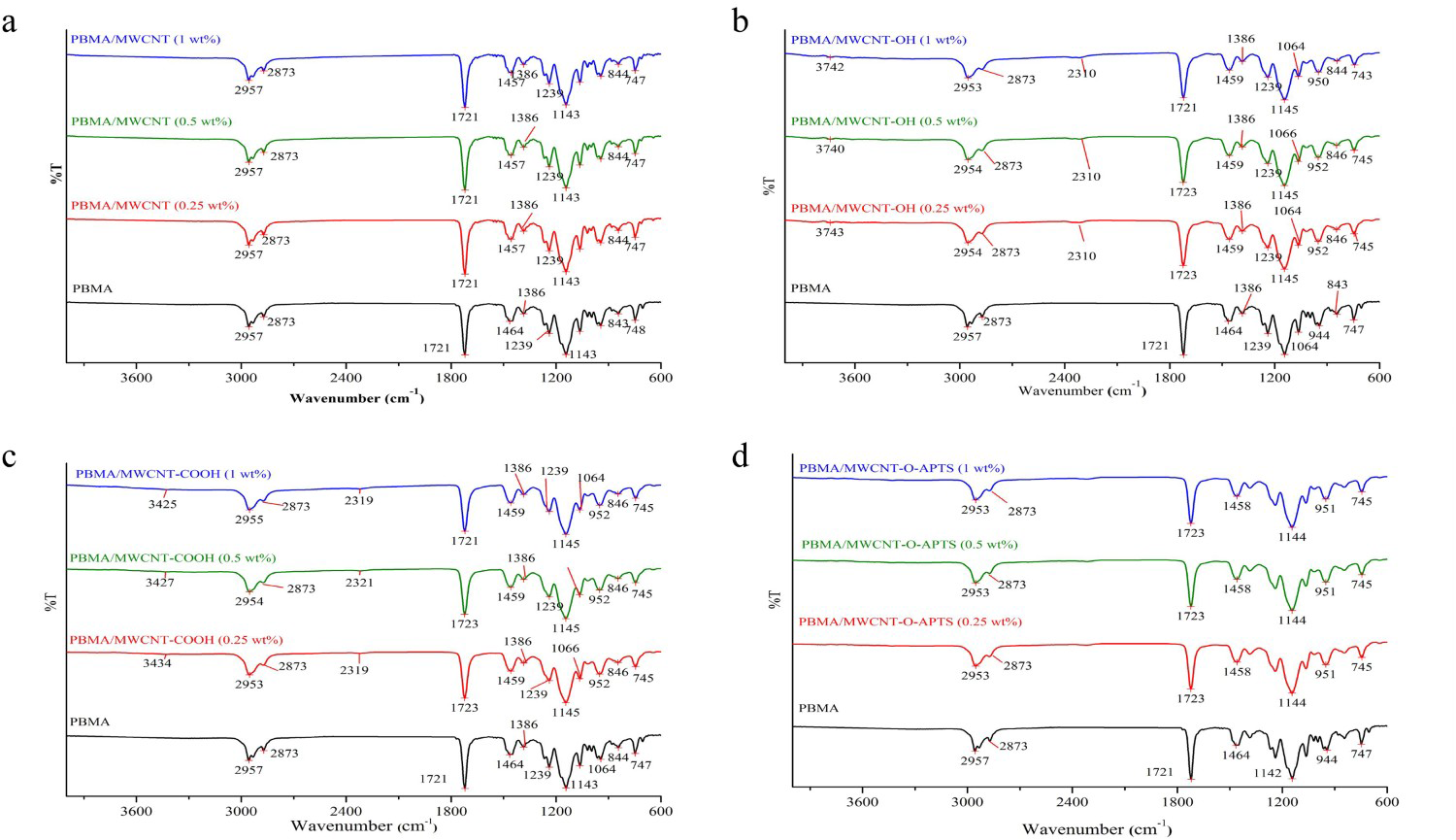
SEM
SEM images of MWCNTs, PBMA/MWCNT (1 wt-%), PBMA/MWCNT-OH (1 wt-%), PBMA/MWCNT-COOH (0.5 wt-%) and PBMA/MWCNT-O-APTS (1 wt-%) nanocomposites are illustrated in Figure 4. Figure 4(a) shows that the pure MWCNT has an entangled ivy structure, strongly intermingled. In this case, a regular alignment of MWCNTs is not possible. And also the SEM images of modified MWCNTs are less complex as shown in Figure 4(b–d). This is explained by the effect of the functional groups added to the structures, as well as the reduction of aggregation and the shortening of the nanotubes [26, 27]. MWCNT, MWCNT-OH and MWCNT-COOH samples are uniformly dispersed in the polymer matrix, but MWCNT-O-APTS sample tends to agglomerate by coming together in the polymer matrix. This uniform morphology is due to the strong interfacial interaction between the carbon nanotube and the ester segment of the polymer.
SEM images of (a) MWCNT, (b) MWCNT-OH, (c) MWCNT-COOH, (d) MWCNT-O-APTS, (e) PBMA/MWCNT (1 wt-%), (f) PBMA/MWCNT-OH (1 wt-%), (g) PBMA/MWCNT-COOH (0.5 wt-%) and (h) PBMA/MWCNT-O-APTS (1 wt-%).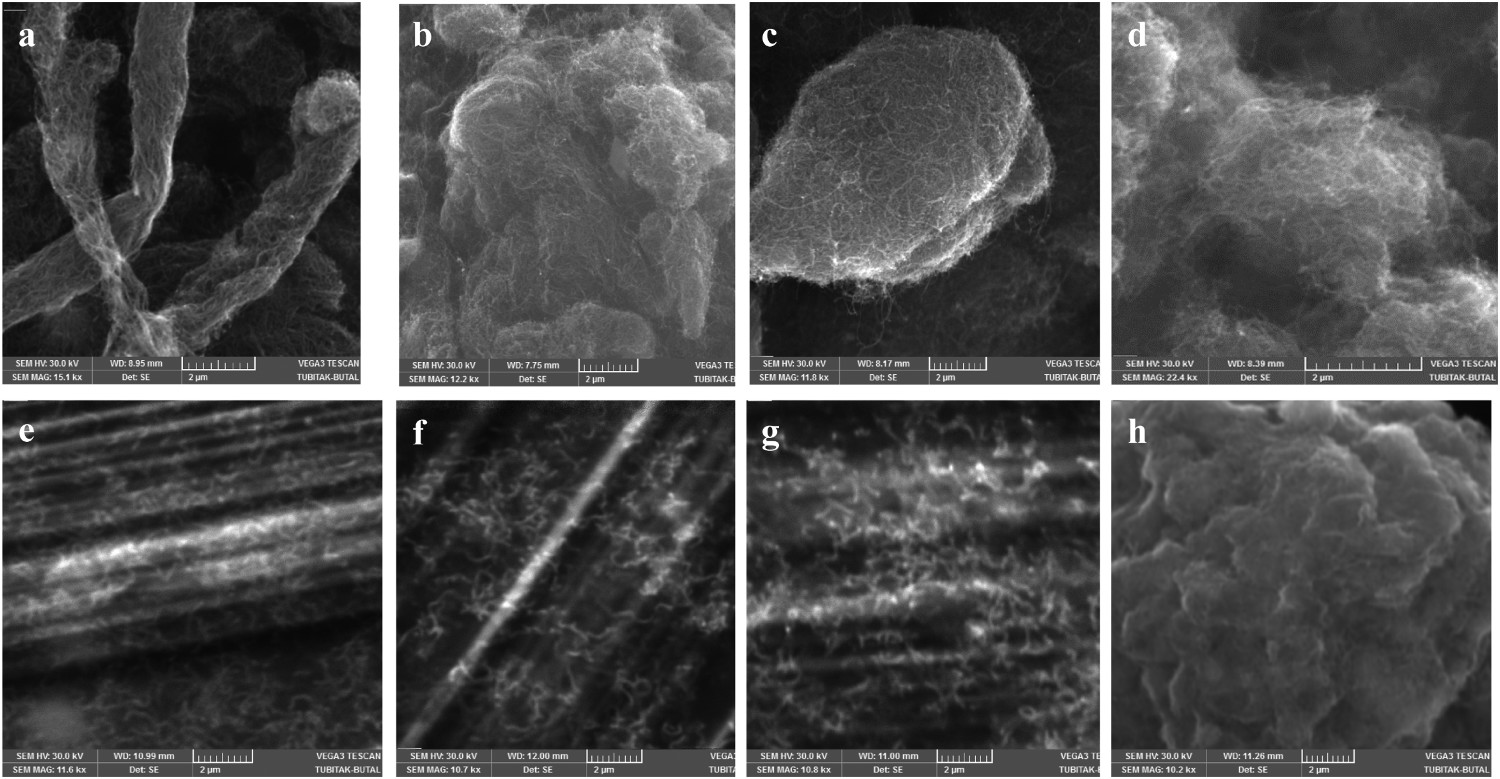
Thermal stability
Thermogravimetric analysis provides information about the degradation steps of polymers and nanocomposites, temperatures at which maximum mass loss occurs, and temperatures at which different mass losses of materials occur [16]. T x, T max and residue amounts calculated from TG thermograms are given in Table 2. As shown in Figure 5, the thermal degradation of PBMA occurs in one step. Since PBMA degrades in one step, it loses most of its mass around 314°C. The thermal decomposition of PBMA and its nanocomposites is associated with the scission of the C–C bond β to the vinyl group and attributed to the decomposition of the remaining methoxy carbonyl side groups [2, 28]. When MWCNT and modified MWCNTs are added to the PBMA matrix, significant increases occur in the decomposition temperature of the polymer. Thermal degradation temperatures of PBMA/MWCNT (1 wt-%), PBMA/MWCNT-OH (1 wt-%), PBMA/MWCNT-COOH (0.5 wt-%) and PBMA/MWCNT-O-APTS (1 wt-%) nanocomposites compared to the PBMA film increased by 50, 56, 41 and 56°C, respectively. Decomposition temperatures of nanocomposites have shifted to higher temperatures than those of the pure PBMA film. This may be due to the homogeneous distribution of MWCNT and modified MWCNT samples in the PBMA matrix, increasing interactions between PBMA and fillers, and the higher thermal stability of MWCNT and modified MWCNT samples [15]. In the literature, Suhailath et al. measured that the maximum decomposition temperature of PBMA, as synthesised by the radical polymerisation method, was 316°C and that the decomposition temperature of PBMA in PBMA/TiO2 nanocomposite increased by 20°C [2]. The residual amount of nanocomposites increases in proportion to the amount of MWCNT in the nanocomposites. Among nanocomposites, PBMA/MWCNT-COOH (1 wt-%) has the highest residue amount, and PBMA/MWCNT-O-APTS (0.25 wt-%) nanocomposite has the lowest residue amount. The increase in thermal stability and the remainder of the degradation product for PBMA/MWCNT and PBMA/modified MWCNT nanocomposites are significantly enhanced with the addition of MWCNT samples, suggesting that the polymer nanocomposite is more stable than the pure PBMA sample [2]. Again, as seen from Table 2, T 5, T 10, T 30, T 50 and T 80 temperatures of PBMA/MWCNT (1 wt-%), PBMA/MWCNT-OH (1 wt-%), PBMA/MWCNT-COOH (0.5 wt-%) and PBMA/MWCNT-O-APTS (1 wt-%) nanocomposites were calculated as 37.6, 23.6, 43.5 and 43.5°C; 33.8, 23.3, 41.6 and 44.1°C; 48.9, 47, 50.2, 58°C; 51.8, 53.8, 59.4 and 66.1°C; and 53.2, 60.9, 45.9 and 53.4°C, respectively. The reason why the temperatures at which 5 per cent mass loss occurs do not show a regular change may be due to the moisture or solvents remaining in the structure of the samples. The highest increase in T x temperatures was determined as 66.1°C for the T 50 temperature of PBMA/MWCNT-O-APTS (1 wt-%) nanocomposite.
TG thermograms of (a) PBMA/MWCNT (1 wt-%), (b) PBMA/MWCNT-OH (1 wt-%), (c) PBMA/MWCNT-COOH (0.5 wt-%) and (d) PBMA/MWCNT-O-APTS (1 wt-%). Data obtained from TG, d[TG] and DSC thermograms of PBMA, PBMA/MWCNT and PBMA/modified MWCNT nanocomposites.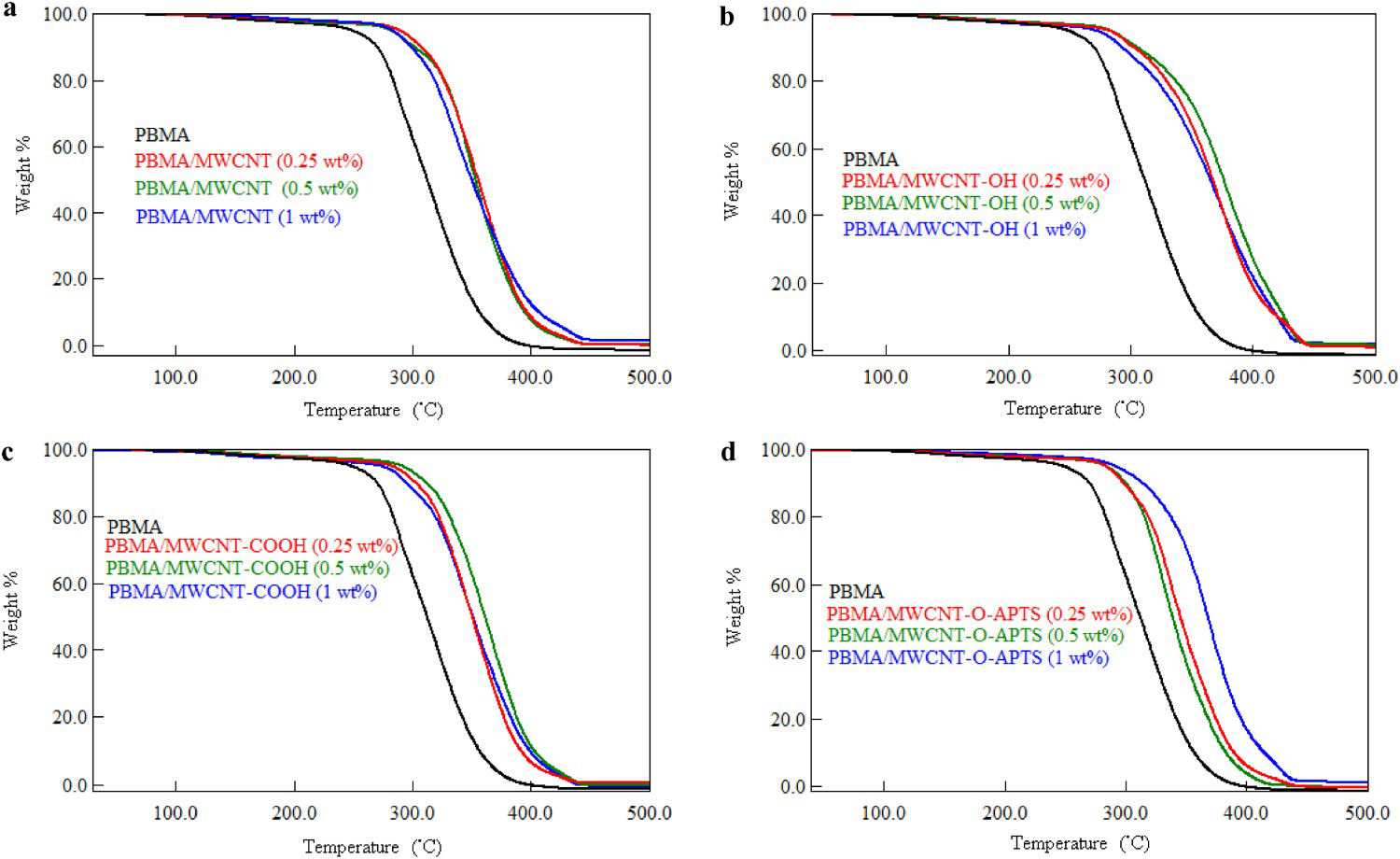
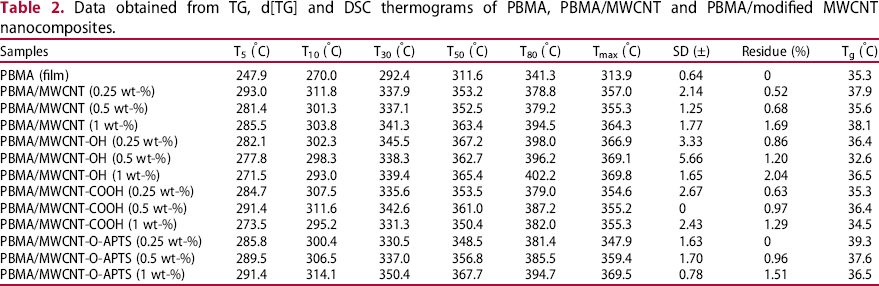
The glass transition (T g) temperatures of PBMA nanocomposites with various loadings of MWCNT and modified MWCNT samples are given in Table 2. The glass transition temperature of PBMA film prepared in THF was 35.3°C. This value is in agreement with the literature [2]. MWCNT and modified MWCNT samples added to the PBMA matrix increased the glass transition temperature of the polymer, but this increase did not proportionately increase with the increasing filler amount. The temperatures at which 5 percent mass loss occurs do not show a regular change. This may be due to moisture or solvents remaining in the structure of the samples. However, the glass transition temperature of the nanocomposite synthesised with MWCNT-O-APTS is higher. This may be because the amine group at the end of the carbon chain in the structure of the carbon nanotube interacts more easily with the functional group of PBMA. These results are consistent with the trends in glass transition temperatures obtained from the DSC analysis of composite materials obtained by adding MMT into the PBMA matrix in the literature. In general, it has been concluded that THF changes the thermal property of PBMA. Yang and Hu) determined that the glass transition temperature of PBMA, as synthesised from the monomer, was 33.1°C [3], and Castillo-Ortega et al. measured it as 39°C [29]. Many researchers suggest that the addition of functional fillers into the polymer matrix creates a strong interfacial interaction between the polymer chain and functional filler surfaces. This interaction affects the glass transition temperature of the polymer matrix [30]. The strong interaction of MWCNT and modified MWCNTs with PBMA leads to a close contact with the polymer region, increasing T g values. Therefore, it can be concluded that the thermal properties, such as glass transition, depend on the concentration of MWCNT and modified MWCNT samples.
Thermal degradation kinetics
The thermal degradation behaviour of a polymer or nanocomposite is generally studied depending on the degree of degradation or partial mass loss [31]. In this study, the kinetic analysis of nanocomposites with the highest decomposition temperature was performed. Thermal kinetic analysis of PBMA/MWCNT and PBMA/modified MWCNT nanocomposites prepared in THF was performed at four different heating rates: 5, 10, 20 and 30°C per min. Figure 6 illustrates TG thermograms of PBMA, PBMA/MWCNT (1 wt-%), PBMA/MWCNT-OH (1 wt), PBMA/MWCNT-COOH (0.5 wt-%) and PBMA/MWCNT-O-APTS (1 wt-%) samples at different heating rates. Thermograms of PBMA and its nanocomposites behave similarly. This may be because nanocomposites have the same pyrolysis behaviour due to similar chemical bonds in their structure [31]. Analysis shows that when the heating rate increases, the maximum decomposition temperatures shift to the right, i.e. to higher temperatures. Several equations to indicate kinetic parameters of the degradation of polymeric materials are known. In this study, Kissinger, Flynn–Wall–Ozawa (FWO) and Friedman equations were used to analyse the kinetic data obtained at different heating rates. These multiple heating rate methods were used to calculate the parameters of degradation kinetics, such as activation energy (E a) and so on [15].
TG thermograms of (a) PBMA, (b) PBMA/MWCNT (1 wt-%), (c) PBMA/MWCNT-OH (1 wt-%), (d) PBMA/MWCNT-COOH (0.5 wt-%) and (e) PBMA/MWCNT-O-APTS (1 wt-%).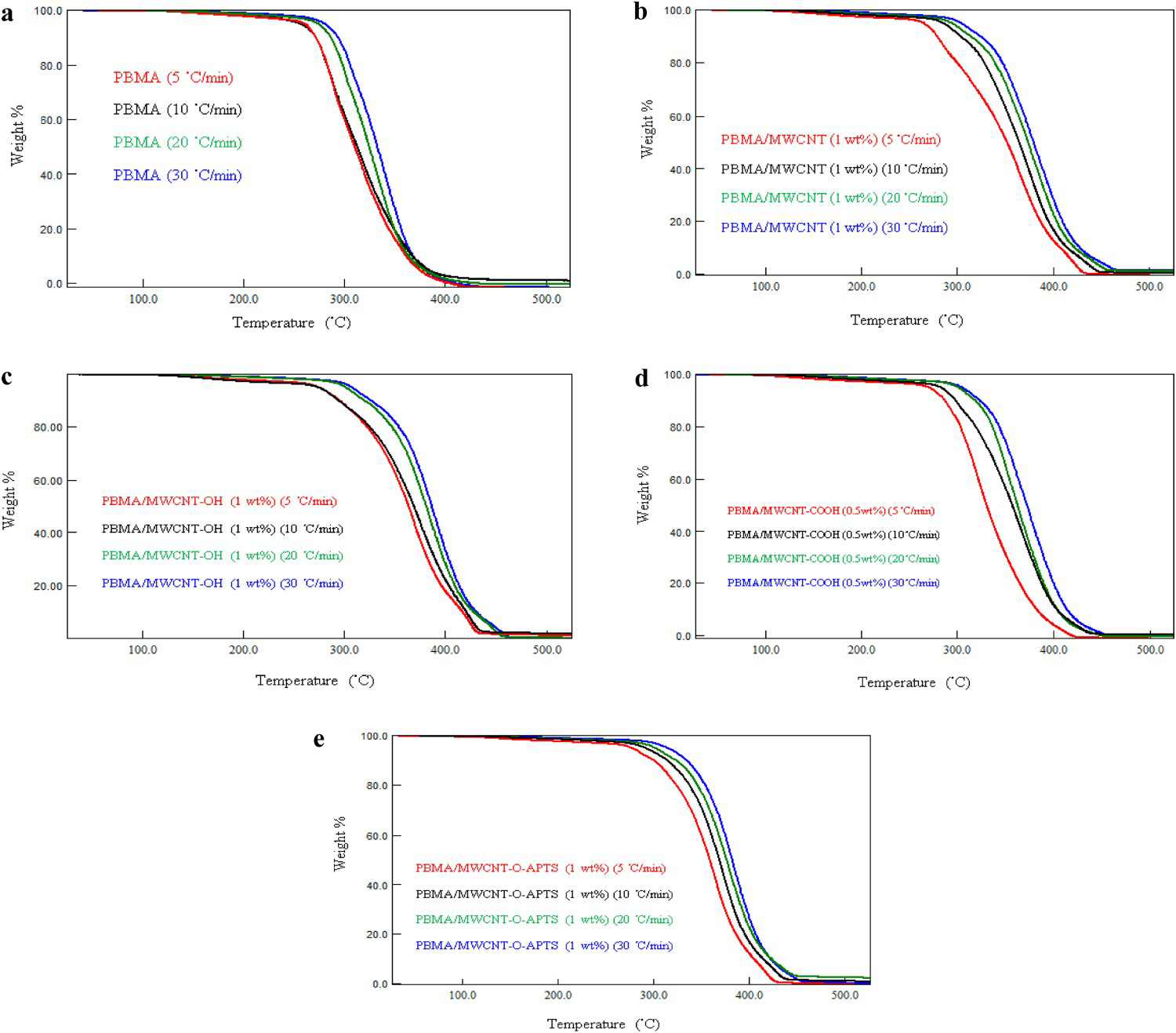
Kissinger equation can be given as follows:

 versus
 , E a value can be calculated from the slope [12, 16].
FWO equation can be given as follows:

 versus 1/T max should have a linear relationship at the degree of conversion. The activation energy, Ea, can be calculated by the slope of any conversions [32].
Friedmann equation can be given by the following equation

Kinetic analysis of PBMA and some of its nanocomposites.

Conclusions
First, MWCNT samples were modified with different functional groups to investigate the effects of the modification on the thermal properties of PBMA/MWCNT nanocomposites. Then, PBMA/MWCNT and PBMA/modified MWCNT nanocomposites prepared according to the solvent casting method were characterised by BET, FTIR-ATR, SEM, TG/DTA and DSC devices. FTIR-ATR proved the existence of MWCNT and modified MWCNT in the polymer matrix and showed that there are important interactions between the filler and the polymer matrix. According to the TG and d[TG] thermograms, PBMA and their nanocomposites degraded in one step. All nanocomposites had higher thermal stability than PBMA film. The addition of MWCNT samples into the PBMA matrix improved the T g values of PBMA. The thermal degradation data of PBMA/MWCNT and PBMA/modified MWCNT nanocomposites were compatible with Kissinger, FWO and Friedman equations and activation energies, calculated with three equations increased in the nanocomposite state. From SEM images, it was determined that all nanocomposites except PBMA/MWCNT-O-APTS were homogeneously distributed in the PBMA matrix. As a result, MWCNT and modified MWCNT samples produced novel increases in the thermal properties of PBMA.
Footnotes
Disclosure statement
No potential conflict of interest was reported by the author(s).