







Abstract
The influence of electropolishing at different conditions on the electrochemical behaviour of 316L stainless steel (316L SS) in simulated body fluid (SBF) was investigated. Accordingly, 316L SS samples were electropolished in several electropolishing baths of H3PO4 and H2SO4 at 2-6 applied volts and 50-110°C for different time intervals. The corrosion behaviour then was studied by means of potentiodynamic polarisation technique and electrochemical impedance spectroscopy in SBF at 37°C. The surface morphology was also investigated by scanning electron microscopy. The results proved that the treated samples had better corrosion resistance than nonpolished one. The highest corrosion resistance was observed for the treated sample at 5 V and 90°C in 10:90 ratio of acidic electrolyte (H3PO4:H2SO4) for 15 min. Moreover, the corrosion resistances of anodically treated samples were found to be dependent greatly on applied volt, bath temperature, polishing time and phosphoric to sulphuric acids ratio.
Introduction
Biomaterials are substances used for manufacturing medical devices, which are extensively required in repair, replacement or augmentation of diseased or damaged parts of the musculoskeletal system to serve for a long time with minimal failure [1–3]. The demand of implantation process growth consequently as the global population and aging increase [4–6]. These devices subjected to interact with biological systems. Ceramics, polymers, metals and alloys are selectively used in orthopaedics [7,8]. Regardless the fact that polymers and ceramics are predominate in many medical applications, metallic implants are still popular because of their mechanical properties and their ease of production by traditional procedures [9–11].
The implanted alloys are frequently fabricated mainly from one of the three types of materials: stainless steels, cobalt-chromium based alloys and titanium and its alloys [10,12,13]. These materials are unlikely to degrade by body fluid due to their passive and inert oxide layer formed on their surfaces [3,14,15]. The main requirements for a biomaterial are the achievement of biocompatibility and corrosion resistance property. In several countries, 316L SS type is familiar as temporary implant due to its availability, practical cost, good mechanical properties, ease of welding and fabrication compared to cobalt-chromium alloys and titanium and its alloys [16–18]. Moreover, 316L SS possesses reasonable corrosion and fatigue resistance, adequate biocompatibility, tensile strength and appropriate density for load-bearing purposes [19–21]. These properties are making the material an attractive surgical-implant.
Corrosion is one of the main processes affecting the life and the task of implants made of metals and alloys [22–24]. It causes a release of metallic ions into surrounding tissue leading possibly to the loss of the implant or health problems [16,25,26]. Therefore, the metallic material must survive in the body environment and should not degrade to a point where it cannot serve in the body as expected [2,3,7,8]. No metallic material is totally resistant to corrosion or ion release within living tissues. Nevertheless, it is required to keep the metal ion release to a minimum by using of corrosion-resistant materials and/or enhancing its surfaces [8,12,15,25,27].
On contrast to the other commonly employed metallic implanted materials; 316L stainless steel type is highly susceptible to corrosion attack. It corrodes in the human body environment and releases iron, chromium and nickel ions [28–30]. These ions are found to be allergens and carcinogens [4,7]. Hence the extensive release of ions from the implant can produce unfavourable biological reactions leading to damage of implants causing the early removal of the device [13,14,24,26]. To reduce this problem, increasing of corrosion resistance of metal is essential [4,31,32].
Depending on the biological opinion, the surface is the main vital part of the implants since it has a direct contact with human tissue and is responsible for acceptance or rejection of the implant [10,33,34]. Anodic treatment (electropolishing process) of the surface is regarded as one of the prospective means broadly applied for refinement of the metallic surfaces [35–37]. It offers the main benefits of producing a microscopically smooth, passive and anticorrosive surface of metals and alloys when achieved with an appropriate electrolytic bath. This method will remove the deformed layer and improve surface roughness [38–40]. In addition, it forms a thin passive film (∼few nanometrs) on the surface of the metal that giving rise to an increase of the corrosion resistance [41–43].
The main objective of this study was focused on the surface treatment of 316L SS in different electrochemical baths. Then, the corrosion behaviour and protective efficiency of the treated samples were investigated in simulated body fluid (SBF) at 37°C using potentiodynamic polarisation and electrochemical impedance spectroscopy (EIS) techniques.
Experimental
Materials
All chemicals are of the analytical grades and have been used without further purification. Phosphoric acid (85%, Riedel-deHaen, Germany) and sulphuric acid (97%, Merck, Germany) were used as an electrolyte for electropolishing baths. SBF were prepared using sodium chloride (99%, Universal Laboratories PVT, LTD, India), sodium hydrogen carbonate (99%, Fluka, Germany), potassium chloride (99%, Merck, Germany), potassium hydrogen phosphate (99.5%, Winlab, United Kingdom), magnesium chloride Hydrate (99%, Q. Biogene, North America), Calcium chloride (99%, Adwic, Egypt), sodium sulphate anhydrous (99%, Sisco Research Laboratories, India) and Tris-base (99.9% Fluka, Germany) and the pH was adjusted by hydrochloric acid (37%, Fluka, Germany). The chemicals were dissolved in bidistilled water.
Anodic treatment (electropolishing)
Chemical composition of 316L stainless steel substrate.

Electrochemical measurements
Potentiodynamic polarisation is a valuable technique to identify the anodic behaviour of a material when exposed to a certain environment [45–47]. The applied potential on the electrode is varied at a selected scan rate through the electrolyte [48–50], the resultant current can be used for measuring the corrosion resistance of the material [51–53].
For potentiodynamic polarisation, the sample was kept in the electrolyte solution at open circuit potential to attain steady state prior to the measurements. Then the potential was applied from −250 to 250 mV at a scan rate of 0.5 mV s−1. A Potentiostat/Galvanostat (model PGZ 301, Voltalab, Radiometer Analytical – France) fitted with a frequency response analyzer (FRA) impedance module and controlled using VoltaMaster software Version 4.0 was used for both potentiodynamic polarisation and electrochemical impedance investigations. From the obtained and tabulated data, the electrochemical parameters, corrosion rates and protection efficiencies were determined.
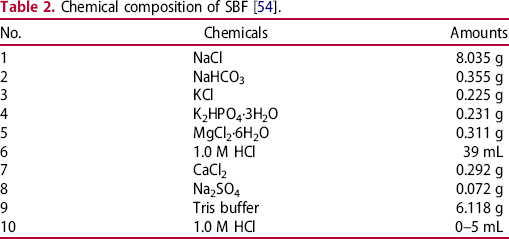
A conventional three-electrodes cell was used for the measurements. A saturated calomel electrode (SCE, 241 mV vs. SHE) was employed as a reference electrode, platinum wire acts as a counter electrode and treated 316L SS samples as working electrode. A SBF was freshly prepared according to Kokubo et al. [54] and its chemical composition was listed in Table 2. The electrochemical investigations were carried out for the test specimens in 150 mL at 37 ± 0.2°C. The experimental setup for the electrochemical measurements is shown in Figure 1.
Schematic presentation of electrochemical measurements setup (adopted Ref. [25]). Chemical composition of SBF [54].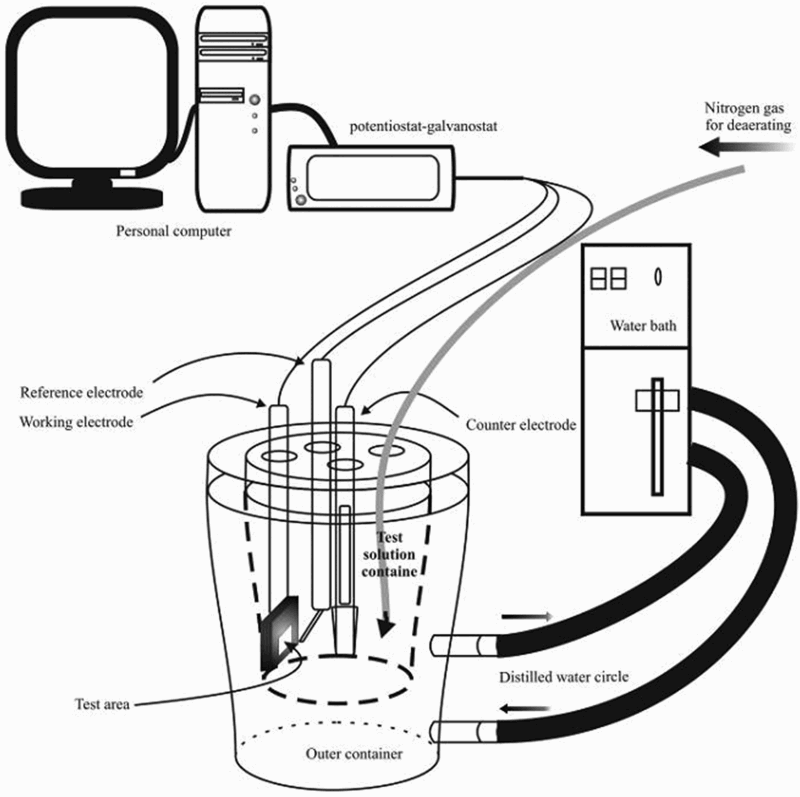
EIS is a valuable and convenient method that yields information on changes of rate and mechanism of corrosion. It is considered as one of the most important technique to evaluate the electrochemical behaviour of passive film and protective coat [55,56]. The EIS data was represented by Nyquist plot where the frequency decreased from left to right; although, the frequency range is not shown on the Nyquist graph. A straight line parallel to the y-axis refers to zero corrosion whereas a semicircle shape represents a corroded surface. The diameter of the semicircle is a measure of the corrosion rate, since a large diameter indicates the decrease in the corrosion rate and vice versa [57–59]. Equivalent circuits are usually employed to give an explanation about EIS results [60–62]. Impedance spectra were acquired at the open circuit potential in the frequency range of 10 KHz to 10 mHz with a 10 mV amplitude generated by the FRA.
For the purpose of result reproducibility, all electrochemical measurements were performed in triplicate.
Surface characterisation
The surface morphologies of the non-polished specimen and electropolished one with optimum conditions (at 5 V and 90°C for 15 min in 90:10 phosphoric acid: sulphuric acid) before and after corrosion tests were investigated with a (JSM-6360LA, JEOL, Japan) SEM equipped with an Energy-dispersive X-ray spectroscopy.
Results and discussion
In order to characterise the features of the surface of 316L SS, the electrochemical measurements were performed in SBF. In general, the electrochemical tests result in useful information about the kinetics of the electrochemical processes (e.g. corrosion rate) and able to predict the stability of the oxide films formed on the surface at the early stage of corrosion attack.
Electropolishing bath
Effect of electrolyte
Electropolishing of stainless steels for different applications is mostly performed in a mixture containing concentrated phosphoric and sulphuric acids [63,64]. It was found that the solution of phosphoric acid that containing sulphuric acid provided a better surface finishing than phosphoric acid individually [40,63]. In order to evaluate the effect of the electrolyte composition on 316L SS electropolished in different ratios of phosphoric and sulphuric acids at 5 V and 90°C for 15 min, potentiodynamic polarisation technique was performed. Representative polarisation curves (Tafel plots) for electropolished electrodes compared with none electropolished one in SBF at 37 ± 0.2°C were presented in Figure 2. The curves exhibited some differences in corrosion behaviour for analysed samples. The corrosion potential of the non-polished specimen is quite negative (−285 mV), while the corrosion potentials of the modified alloys were shifted to more positive values (at around 180 mV). In addition, the corrosion current densities of the modified specimens are lower compared to the unmodified one. These observations indicate signify remarkable higher corrosion resistances and lower corrosion rates on the modified specimens [65,66]. The well-known electrochemical parameters such as corrosion potential (E corr), corrosion current (i corr) and polarisation resistance (R p), were determined from Tafel segment of the particular potentiodynamic curves and listed in Table 3. The more positive shift of the potential, the lower i corr and the higher corrosion resistance results in lower corrosion rate [30,65]. The corrosion rates and the values of βa and βc (anodic and cathodic Tafel slopes, respectively) were also listed in Table 3. Additionally, the protection efficiency η (%) of the anodically treated specimens can be calculated from the following equation and listed in Table 3 [67]:
Potentiodynamic polarisation curves in SBF solution at 37°C with a scan rate of 0.5 mV s−1 for non-polished and electropolished 316L stainless steel specimens at 5 V and 90°C for 5 min in a solution of H3PO4 and H2SO4 with different acidic ratios. Electrochemical parameters in SBF solution of bare and electropolished 316L stainless steel specimens for 15 min at 5 V and 90°C in a solution containing different H3PO4 and H2SO4 ratios.
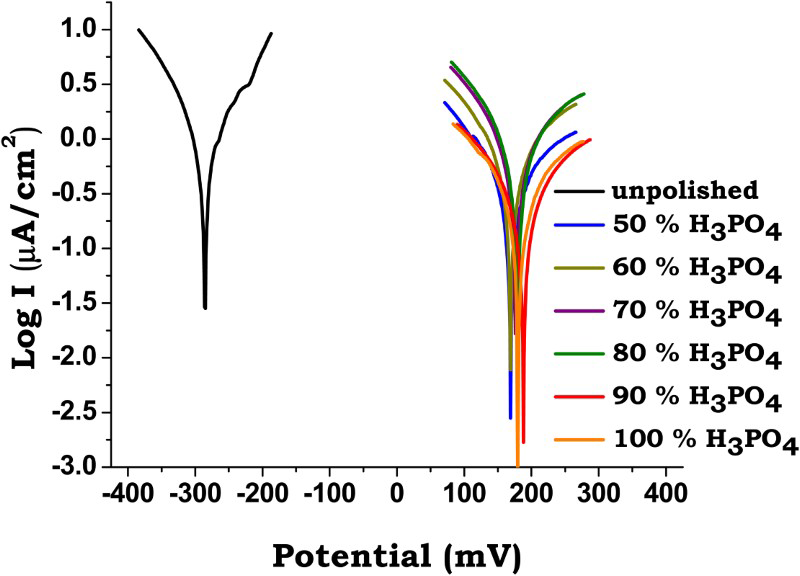

Based on the previous results which were supported by visual examination (non-homogenous surface) the anodic treatment in the acidic mixture with equal amounts of both acids (50:50) led to lower corrosion resistance and partially polished substrate surface. On the other hand, the anodic treatment in a ratio of 90:10 (H3PO4:H2SO4) showed a mirror-like surface and exhibited the highest corrosion resistance as shown in the tabulated data. This proved the passive film formation and hence the dependence of its corrosion resistivity on the electrolyte composition [36,40,70].
Moreover, the effect of acid ratio was also investigated using EIS. Figure 3 illustrates the Nyquist plots that performed in SBF for untreated and anodically treated electrodes in different acidic electrolyte mixtures at 5 V and 90°C for 15 min. All specimens display similar impedance features and exhibit incomplete semicircle in the high-frequency region accompanied by a straight line in the low-frequency region. This kind of behaviour indicates that the charge transfer reactions are active followed by a region of a mass transfer or a diffusion reaction [71–73]. As shown in the figure, the obtained semicircles of the electropolished electrodes have larger diameters than that of the untreated one. This indicated that corrosion resistance of the alloy was improved notably by electropolishing in the acidic electrolyte mixtures. This probably is due to the presence of a thin oxide film formed on the electrode surface that created after electropolishing process [38,43,68].
Nyquist plots in SBF solution at 37°C for unmodified and electropolished 316L stainless steel samples for 15 min at 5 V and 90°C in a solution containing H3PO4 and H2SO4 with different acidic ratios.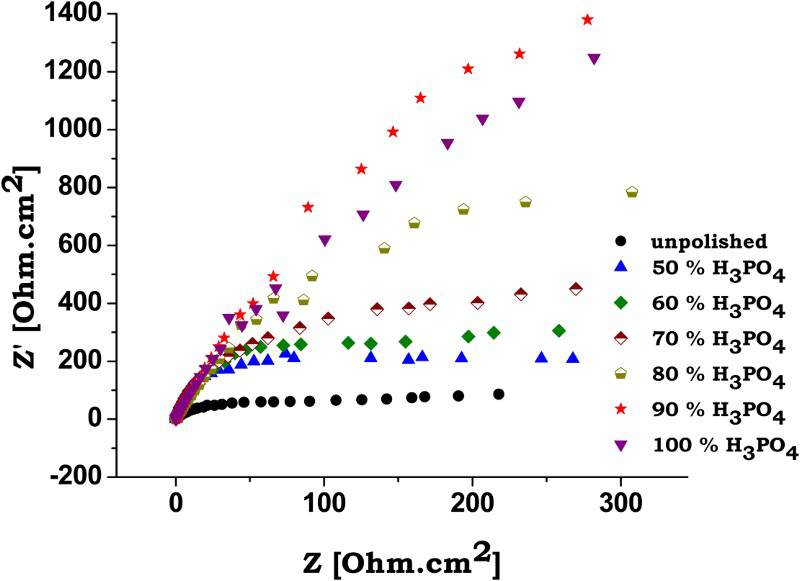
The semicircles pointed out that the most significant increase in the polarisation resistance was achieved after modification in the acidic mixture with a ratio of 90:10 (H3PO4:H2SO4). The Nyquist plots data well coincide with the results obtained by polarisation curves presented in Figure 2.
A modified Randles equivalent circuit (Figure 4) is proposed to represent the behaviour of all the samples under the EIS test. The circuit consists of solution (SBF) resistance (R s) in series with a couple of polarisation resistance (R p) and capacitance of the oxide film (C dl). The equivalent circuit includes also Warburg impedance (W) which indicate the diffusion part [70,74,75].
Modified Randles circuit: equivalent circuit indicating a mixed kinetic and diffusion control that proposed to express the electrochemical impedance measurements.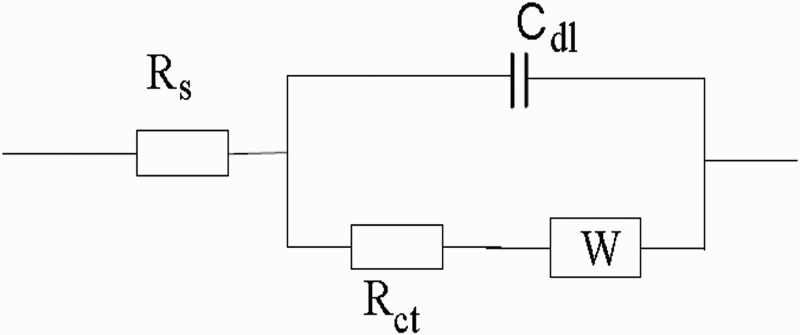
Effect of potential
The corrosion behaviour of the anodically treated 316L SS electrode in 100 mL acidic electrolyte consists of (H3PO4:H2SO4; 90:10) for 15 min at 90°C and different applied potential values (2, 3, 4, 5 and 6 V) were tested with potentiodynamic polarisation and EIS techniques.
Figure 5 illustrates the behaviour of untreated and electropolished samples which performed in SBF solution using potentiodynamic polarisation in the potential range from +250 mV to −250 mV at a scan rate of 0.5 mV s−1. As shown in Figure 5 and Table 4 the corrosion potential of all modified electrodes are shifted to more positive values compared to unmodified one. Furthermore, the corrosion current densities of the modified specimens are lower than that of the unmodified alloy. These indicate low corrosion rates of the modified specimens [23,27,30,68,76].
Potentiodynamic polarisation curves in SBF solution at 37°C with a scan rate of 0.5 mV s−1 for non-polished and electropolished 316L stainless steel specimens in a solution of H3PO4:H2SO4 (90:10) for 15 min at 90°C and different potential values. Electrochemical parameters in SBF of bare and electropolished 316L stainless steel specimens for 15 min at 90°C and different potential values in the acidic electrolyte (90:10).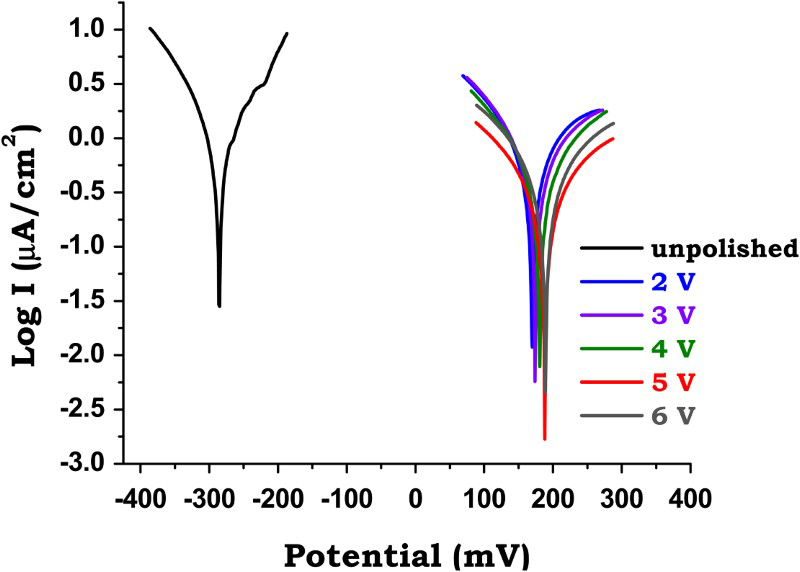

Moreover, it has been seen visually by the naked eye that; electropolishing process at 2 V was not enough to brighten the surface while; surface brightness was increased with increasing the applied potential. Table 4 demonstrates that higher corrosion resistance and lower corrosion rate are achieved when the electrode is anodically treated at 5 V. However, when electropolishing carried out at 6 V a lower corrosion resistance is recognised although the surface remained lustre. This decrease of the corrosion resistance is attributed to an increase of the oxide imperfection on the electrode surface [42,77,78].
The effect of different applied potentials on the electropolishing of 316L SS specimens in SBF was investigated by EIS as shown in Figure 6. The results of all polished samples led to semicircles with larger diameters than non-polished one. Largest diameter was recognised in the case of electropolishing process performed at 5 V. The proposed equivalent circuit (Figure 4) is also believed to represent these results. The results of impedance measurement further confirmed the main conclusions elucidated from the polarisation curves (Figure 5).
Nyquist plots in SBF solution at 37°C for unmodified and electropolished 316L stainless steel samples in a solution of H3PO4:H2SO4 (90:10) for 15 min at 90°C and different potential values.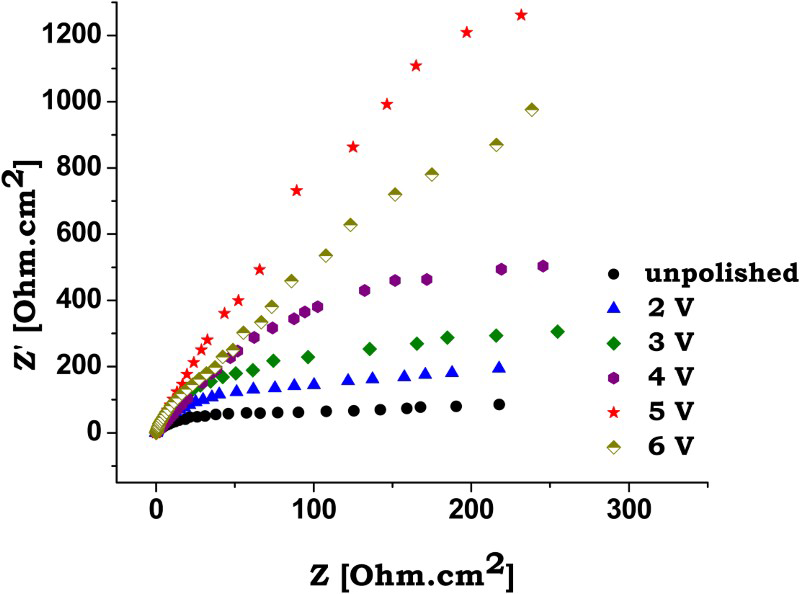
Effect of bath temperature
For a further understanding of the effect of one more parameter on the electrochemical behaviour of the 316L SS, the surface was electropolished at different temperature values. Figure 7 demonstrates the polarisation curves of the unmodified specimen in the SBF with modified ones at a potential value of 5 V and various temperature values (50, 70, 90 and 110°C) for 15 min in the acidic electrolyte (90:10). The figure shows that more positive corrosion potentials and lower corrosion current densities are obtained for modified electrodes compared to the unmodified one. Therefore, it can be deduced that the temperature of the electropolishing bath significantly affects the passive formed film on the electrode surface.
Potentiodynamic polarisation curves in SBF solution at 37°C with a scan rate of 0.5 mV s−1 for non-polished and electropolished 316L stainless steel specimens in a solution of H3PO4:H2SO4 (90:10) at a potential value of 5 V for 15 min and different temperature values.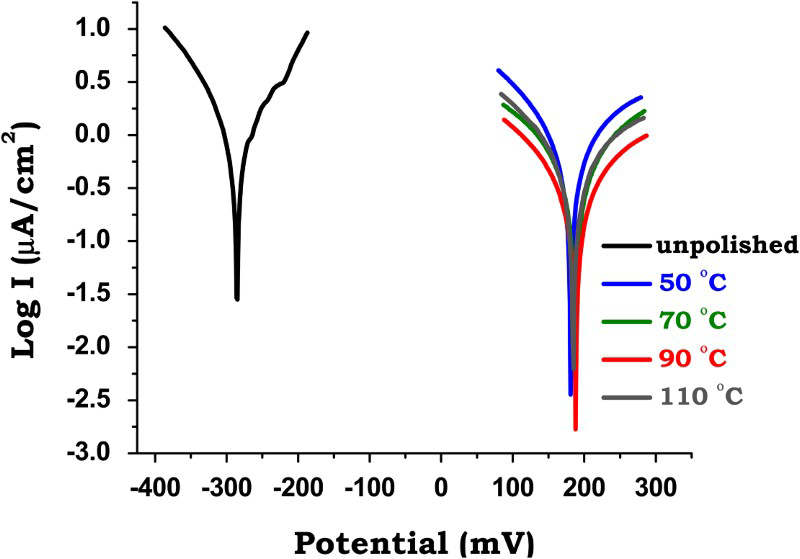
Electrochemical parameters in SBF of bare and electropolished 316L stainless steel specimens for 15 min at 5 V and different temperature values in the acidic electrolyte (90:10).

The electrochemical impedance spectra were also carried out in SBF for the untreated and anodically treated substrates at 5 V and several temperature values (50, 70, 90 and 110°C) for 15 min in the acidic electrolyte as shown in Figure 8. Dissimilar semicircle diameters can be seen in the plot indicating different corrosion resistances. The smaller semicircle of the untreated substrate indicated the surface attack by the existent ions in the electrolyte [31]. The diameters of the semicircles of the treated substrates are larger than the untreated one indicating a lower corrosion rate. Moreover, the lowest corrosion rate was achieved at a bath temperature of 90°C which agreed with the results obtained from the polarisation measurements (Figure 7). These results could be expressed by the equivalent circuit (Figure 4) as well.
Nyquist plots in SBF solution at 37°C of unmodified and electropolished 316L stainless steel samples in a solution of H3PO4:H2SO4 (90:10) for 15 min at a potential of 5 V and different temperature values.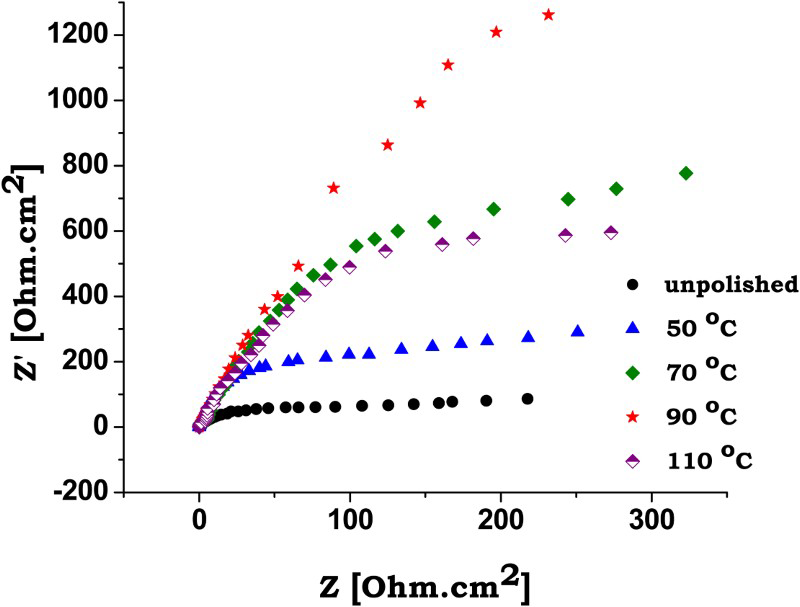
Effect of electropolishing time
Another factor is the bath time which might affect the corrosion behaviour of 316L SS electrode. Figure 9 illustrates the polarisation curves in SBF solution of untreated and treated 316L SS samples at 5 V and 90°C for different time intervals (5, 10, 15 and 20 min) in the acidic electrolyte (90:10). The electrochemical parameters of the time effect are listed in Table 6.
Potentiodynamic polarisation curves in SBF solution at 37°C with a scan rate of 0.5 mV s−1 for non-polished and electropolished 316L stainless steel specimens in a solution of H3PO4:H2SO4 (90:10) at a potential value of 5 V and temperature equals 90°C for different time intervals. Electrochemical parameters in SBF of bare and electropolished 316L stainless steel specimens at 5 V and 90°C for different time intervals in the acidic electrolyte (90:10).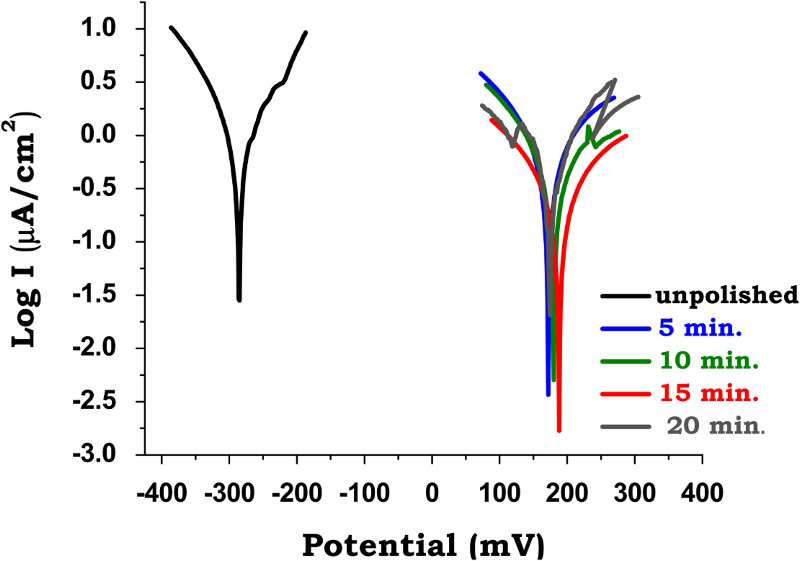

It is clear that a lower corrosion current was recorded for the electropolished specimen at 15 min results in lower electrochemical activity of the surfaces [79]. The results also revealed that the corrosion potential are shifted to more positive values and the corrosion resistances of the samples are increased as the electropolishing time increased in the range of 5-15 min. Then the resistance was decreased again for the treated sample at 20 min. Hence, the corrosion rate followed the same sequence displaying the effect of electropolishing time on the formed thin film on the surface [35,37,80].
The effect of electropolishing time was also investigated by EIS (Figure 10). It was evident that all the treated samples exhibited similar behaviours in SBF with larger semicircle than that of the bare electrode. Additionally, it is clear that the sample treated at 15 min offered larger semicircle and correspondingly higher impedance value demonstrating higher corrosion resistance. This behaviour proved that the passive film on the surface is protective by nature. The same equivalent circuit in Figure 4 was considered for this examination. These results are in consisting with the polarisation data given in Figure 9.
Nyquist plots in SBF solution at 37°C for unmodified and electropolished 316L stainless steel samples in a solution of H3PO4:H2SO4 (90:10) for 15 min at 5 V, 90°C and different interval time values.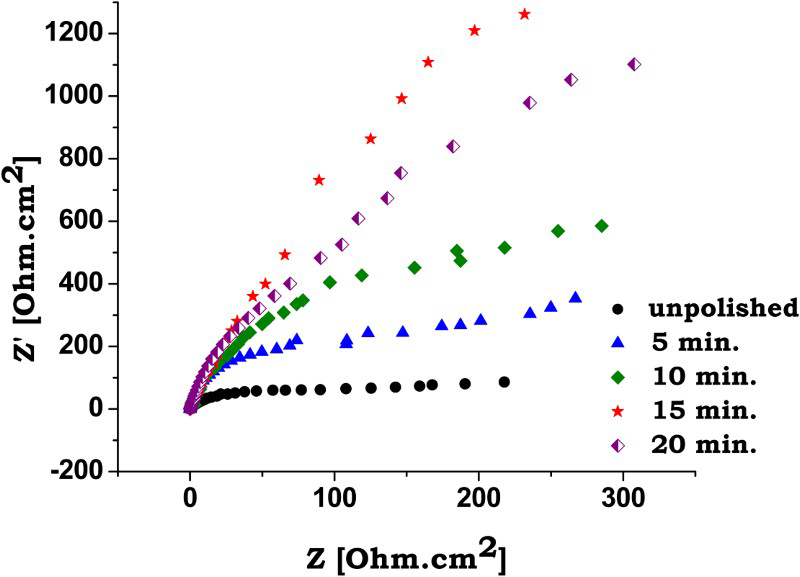
Part of these results was reported elsewhere by Hassan and Abdelghany [81].
Surface characterisation using SEM
In order to examine the surface morphology, a higher corrosion resistance specimen was selected and compared with the bare electrode. Figure 11 shows the topography of the non-polished 316L stainless steel electrode and the electropolished one at optimum bath conditions before and after potentiodynamic polarisation. The optimum bath conditions are 90:10 of H3PO4:H2SO4 at 5 V and 90°C for 15 min. Different surface morphologies were observed in each case. The surface of the blank sample shows a rough surface with an arboreal structure (Figure 11(A)) while the treated sample shows a smoother surface (Figure 11(B)). The visual observation by naked eye could also support the SEM investigation. When the two samples subjected to the corrosive SBF solution, no significant change was observed on the surface of the treated sample after polarisation (Figure 11(D)) while, the untreated sample (Figure 11(C)) shows some scratches on the surface. These indicate that the thin layer formed film protects the specimen surface [82]. This was also proved from the negative shift of the corrosion potential and the lower corrosion rate obtained from the potentiodynamic polarisation curves. Thus a high susceptibility to corrosion reaction, in the case of the bare electrode was also confirmed compared to the treated sample due to the formation of a protective passive film on the surface [83].
SEM morphologies (A) of a bare 316L stainless steel, (B) of 316L SS after electropolishing in a solution containing H3PO4: H2SO4 (90:10) at 90°C under potential of 5.0 V for 15 min (optimum conditions), (C) of bare electrode after polarisation in SBF and (D) of electropolished electrode at optimum conditions after polarisation in SBF.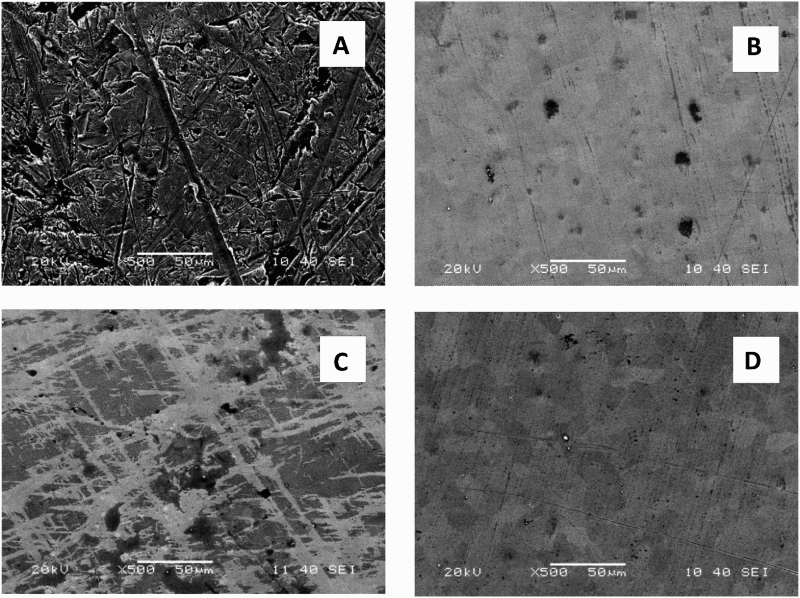
Conclusions
316L stainless steel electrode samples were electropolished in the electrochemical acidic bath at different parameters. The corrosion rates were tested in SBF solution using potentiodynamic polarisation. The samples were also characterised using EIS. The morphologies of the surfaces were investigated by scanning electron microscopy.
The following conclusions were drawn:
From the potentiodynamic polarisation curves, it is obvious that the corrosion potential for electropolished samples was shifted to less negative values that indicate low corrosion rates. The EIS shows a high semicircle for the electropolished samples which means high corrosion resistance. The surface examination using scanning electron microscopy proved that a smooth surface is obtained as a result of electropolishing. The higher protective efficiency in SBF solution is nearly 80%. The optimum conditions for the electropolished samples were found to be 5 V and 90°C for 15 min in 90:10 acidic ratio of H3PO4:H2SO4. The modified surface of 316L SS alloy is a promising material for biomedical applications. Further investigations are in progress.
Footnotes
Acknowledgements
Authors are appreciating help and advice of Professor Dr Alaa El-din Abdel-Halim Farag (A. A. M. Farag) Materials Sciences, Physics Department, Faculty of Education, Ain Shams University, Cairo, Egypt and Professor Dr Hala El-Adawi, Medical biotechnology Dept., Genetic Engineering and Biotechnology Institute, City of Scientific Research and Technological Applications, Alexandria, Egypt.
Disclosure statement
No potential conflict of interest was reported by the authors .
