







Abstract
The steel/soil interface on cathodically protected pipeline steel has been investigated using electrochemical polarisation measurements and electrochemical impedance spectroscopy, to add more insights into the electrochemical processes occurring at the interface. A critical electrode potential (CEP) was found that divides the steel corrosion reaction kinetics into two regions. When the electrode potential is below this critical value, the steel surface has a large impedance value, indicating much slower corrosion kinetics than when the electrode potential is more positive than the CEP value. This critical value is found to be related to pitting potential determined by potentiodynamic polarisation measurements. The CEP could be affected by the CP condition and environmental, including the CP potential and the soil moisture content. At a more negative CP potential, the CEP was found to be nobler; while at the same CP potential but in the soil with a higher moisture content, the CEP became more negative. The impact of the CP potential and soil moisture level on the CEP value is explained by local soil pH effects on steel passivity.
Introduction
To mitigate external steel pipeline corrosion, on-shore underground pipelines are typically protected by thick organic coatings and cathodic protection (CP) systems. [1,2] CP has a long and positive track-record of extending the service life of buried steel pipelines around the world. The traditionally accepted working principle for CP is that CP reduces corrosion rate by counteracting the corrosion driving force using a cathodic protection potential, typically within the −850 to −1200 mV range (vs. Copper-Copper Sulphate reference electrode (CSE)) [3 -5]. Recently passivation of steel surfaces in a CP-induced high pH environment has been considered as a critical mechanism for cathodically protecting buried pipelines [6,7]. Although the corrosion rate of a buried pipeline at these ‘safe’ CP potentials should decrease to an acceptable level, in practice locally insufficient CP remains a major issue and it may lead to incomplete protection of a buried pipeline [8]. One major cause of locally insufficient CP is the presence of stray currents [9 -11]. Stray currents can originate from sources external to the pipeline, e.g. neighbouring pipelines, urban rail transit traction, and some natural sources such as telluric currents [12]. When the ionic currents travel in the soil, they would deviate from their intended path if they find a less resistive parallel route such as a buried steel pipeline. When an underground pipeline picks up stray currents, an excursion of the interfacial CP potential would occur [13,14]. At the locations where stray currents enter the pipeline, the potential of the pipe will shift in a negative direction and this is generally not a major concern for cathodic protection, although sometimes this over-protection could, in extreme cases, produce accelerated coating delamination [13]. The most concerning locations are where stray currents leave the pipeline because here the potential of the pipe would be shifted in the positive direction in the form of anodic transients. Such anodic transients could in some cases result in insufficient cathodic protection, or even cause the anodic polarisation of the pipeline [15,16]. In the cases where anodic transients lead to corrosion, the attack is usually localised [17,18]. The localised nature of the attack and possible high corrosion rates make stray currents one of the ‘worst case scenarios’ for pipeline corrosion [19].
So, the question arises, at which point the anodic transients induced by stray currents become harmful for the integrity of the pipeline? Over the past few decades, efforts have been made to quantify the effect of stray current interferences on the corrosion behaviour of underground pipelines, much laboratory and field information [7,16,17,20,21] has been collected. However, insight into the metal/soil interface during the anodic transient is lacking. A mechanistic understanding of these interfacial electrochemical processes can be a benefit for developing proper CP criteria and assessment methods for stray current affected pipeline systems. Towards this goal, this study simulated the potential shifts of a pipe during anodic transients using potentiostatic polarisation tests. Electrochemical measurements were conducted, with the attempt to understand the electrochemical processes occurring at the interface between steel electrodes and soil under the simulated anodic transients, and the impact of influencing factors such as CP potential and the water content in the soil.
Experimental procedures
Materials
Type 1035 carbon steel (UNS no. G10350) square samples with 50 mm sides were cut from a 3-mm thick sheet and cold mounted in epoxy resin. The surfaces were grinded using SiC papers to a 240-mesh finish under running tap water, rinsed thoroughly using Milli-Q water, and rapidly dried in a hot air flow. The surface was then coated with a high build epoxy pipeline coating (HBE-95) leaving a 24.5 mm by 24.5 mm square bare metal area to simulate a coating defect on a steel pipe.
The sand used for experiments was commercially available washed sand. A ‘sandy soil’ was prepared by mixing a solution of 0.5 M NaCl with a known weight of pre-dried washed sand. Two types of sandy soils were prepared for this study. The Water Holding Capacities (WHC) of these two soils were 40% and 60%. Additional Milli-Q water was added to the sandy soil with 40% WHC to increase the water content to 60% WHC, while maintaining the amount of Cl−· ions constant.
Electrochemical Tests
Electrochemical tests were performed using a three-electrode electrochemical cell of custom design which was described elsewhere [20]. The cell consists of a box of sandy soil as an electrolyte (weight: 5 kg, pH = 7), a titanium (Ti) mesh counter electrode (CE), and a silver/silver chloride/ saturated potassium chloride reference electrode (RE). In this study, although all potentials were measured against a silver/silver chloride/saturated potassium chloride reference electrode, the results are presented with respect to the copper/saturated copper sulfate (CSE) scale, which is the typical reference electrode used in the pipeline industry. To eliminate the IR drops between the RE and the steel working electrode (WE), a Lugging capillary was used. The capillary tip was placed 5 mm in front of the WE surface. The electrochemical measurements were performed using a Bio-logic VMP 3 multichannel potentiostat.
Before each set of experiments, CP was applied to the steel electrode for 24 hours to simulate the interfacial conditions around a coating defect in a CP protected steel pipeline. One set of experiments consisted in performing this 24 hours CP induction at different potentials, immediately followed by potentiodynamic polarisation tests at a scan rate of 0.1667 mV/s, sweeping from the CP potentials to+1000 mV (vs. Ag/AgCl/Sat.KCl). Another set of experiments involved the simulation of the anodic potential shift produced during anodic transients by potentiostatic polarisation tests. During these tests, an anodic ‘step change’ signal was applied to the steel electrode after 24 hours CP induction at −950 mV. The effects of four different anodic ‘step change’ signals shifting potential from the prior CP potential to 150, 250, 350 and 450 mV were investigated. Finally, electrochemical impedance spectroscopy (EIS) measurements were also performed after the 24 hours CP preconditioning at −950 mV and during each of the potentiostatic polarisation tests. EIS data was collected over a frequency range from 50 KHz to 50 mHz, with eight points per decade using a sinusoidal potential perturbation of 10 mV around the open circuit potential.
The pH of the soil was tested by placing pH indicator paper in contact with the soil and then removing it after a minute.
Results and discussion
Behaviour of preconditioned steel surface under anodic transients
At the first stage of the test programme, the electrochemical characteristics of the interface between steel and the soil were studied in a quasistatic condition to establish a reference frame for the subsequent potentiostatic polarisation tests. Preconditioning CP was applied to the steel electrode in 40% WHC soil at −950 mV for 24 hours to simulate the interfacial conditions around a coating defect in a CP protected steel pipeline. This was immediately followed by potentiodynamic polarisation tests. When the steel potential was shifted anodically in potentiostatic polarisation measurements, the preconditioned steel surface presented a passive characteristic behaviour. As shown in Figure 1, within the potential range between −100 and 250 mV potential, the current was small and almost independent of potential, suggesting passivity. When the potential was greater than 250 mV, the current fluctuated considerably, possibly indicating the breakdown of the surface passivity.
Potentiodynamic polarisation curve obtained from the steel electrode immediately after CP preconditioning in 40% WHC soil at −950 mV for 24 hours.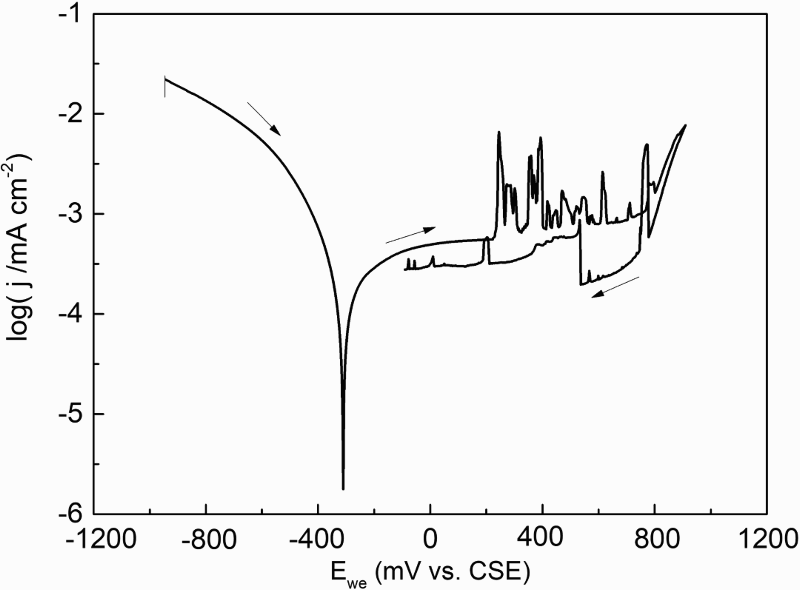
To investigate the interfacial electrochemical processes occurring during the anodic transients, we simulated the positive potential shifts of a pipe during the anodic transients in a simple and well-controlled way. In the experiments, the potential change of pipe during an anodic transient was simulated by using potentiostatic polarisation test that shifted the steel potential from CP potential to a nobler potential than CP potential. Based on the potentiodynamic polarisation curve in Figure 1, the potentials of 150, 250, 350 and 450 mV were chosen to simulate the potential change of pipeline steel during anodic transients. The variation of current density over time during these simulated anodic transients are shown in Figure 2.
The variation of current density over time in the potentiostatic polarisation tests with four different anodic potentials (150, 250, 350, and 450 mV vs. CSE) after 24 hours CP preconditioning in 40% WHC soil.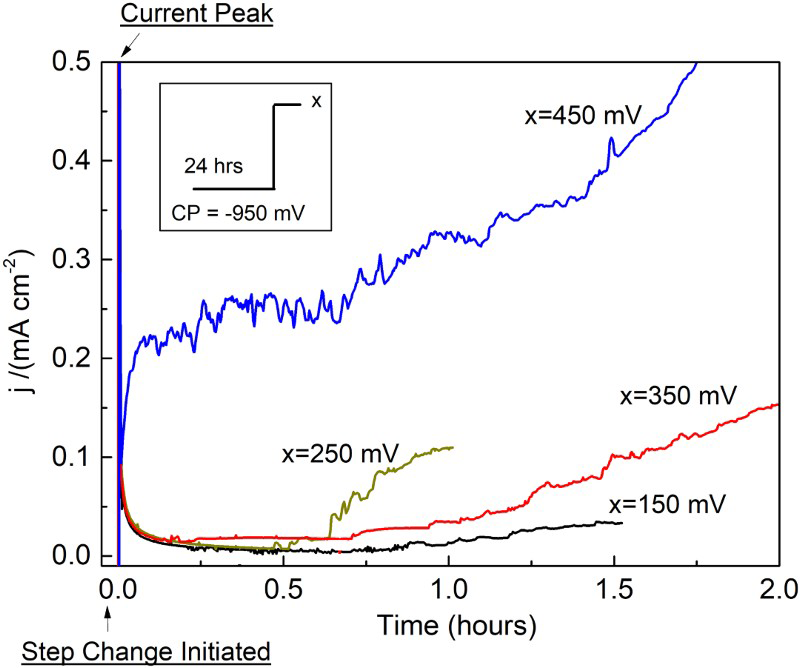
Two completely different behaviours can be found in Figure 2 for current densities in the cases where steel potential value was below or above 350 mV. When the steel potential was shifted to 150, 250 and 350 mV, the current density dropped to a negligible value after a short initial spike; while for the 450 mV case, the current density remained high. This observation suggests the existence of a critical potential value between 350 and 450 mV, at which immediate breakdown of the passive film occurs and corrosion is initiated.
In Figure 2, at the beginning of the anodic transients, a current density peak was observed in all cases. The appearance of this peak is believed to be contributed by two processes: (a) the discharge process of the double layer capacitor at the interface of steel and soil, and (b) chemical reactions occurring on the steel surface. When the steel was cathodically polarised for 24 hours, the double layer capacitor would have been at a certain dynamic equilibrium state. At the onset of an anodic transient, the double layer capacitor was forced to rapidly adopt another equilibrium state. The transition between these two equilibrium states is achieved by the flow of a certain amount of charges that is registered as an anodic current peak [22]. Meanwhile, the faradic currents due to the chemical reactions occurring on the steel surface would also contribute to the overall current density peak. One of the chemical reactions is the steel dissolution, driven by the anodic overpotential suddenly imposed over it [22]. This anodic dissolution could be an active dissolution, such as in the case where a potential of 450 mV was imposed; or could be related to the formation/thickening of a protective passive layer, such as in the case where a potential of 150 mV was imposed. Another possible chemical reaction contributing to this initial anodic current density peak could be the oxidation of the hydrogen that has generated and diffused into the steel during the CP preconditioning stage.
Followed by the current density peak, the current density dropped sharply, as shown in Figure 2. For the cases where the steel potential was shifted to 150, 250 and 350 mV, the current density initially dropped to negligible values within approximately 10 minutes. After a period of negligible low current density values, an increase in anodic current density was found for these three cases. The incubation time for the increase of anodic current density depended on the anodic potential applied. The higher the steel potential, the shorter the incubation time. For the case where the steel potential was shifted to 450 mV, the current density behaved differently. After the initial current density increased, it did not decrease and instead remained at increasingly high anodic values for the rest of the test. This suggests the existence of a critical electrode potential (CEP) that divides the steel corrosion reaction kinetics into two regions.
One reason for the current drop could be due to that the double layer capacitor researched to the equilibrium state that resulted in the disappearance of the capacitive currents. Besides, a previous study has monitored the in-situ current density distribution by using a multi-electrode array, and suggested that the initial reduction in current density could also be related to the passivation of the surface [17]. With the anodic transient progressed, the current density dropped continuously, gradually, and slightly, in the cases where the steel potential was shifted to 150, 250 and 350 mV. This could be due to two factors. One of the factors is related to the pH decrease around the steel electrode. The pH of the soil adjacent to the steel electrode surface was measured during the anodic transient process when the steel potential was shifted to 150 mV. pH decreased from a pH value of 11 (measured 1 minute after the potential transient) to a pH value of 10 (measured 1 hour after the potential transient). Another factor is the formation and growth of the passive layer with time (suggested by the results presented in Figure 3(b)). As the passive layer grows and the surface layer resistance increases, a lower anodic current density is expected even with the same steel potential.
Typical Nyquist plots of electrochemical impedance spectroscopy obtained at different stages of the transients. (a) Spectroscopy obtained immediately after the 24 hours cathodic protection preconditioning period at −950 mV; (b) spectroscopy obtained after the 10 and 30 minutes anodic transients to a potential of 150 mV; (c) spectroscopy obtained after the 10 minutes anodic transients to potentials of 150, 350, and 450 mV.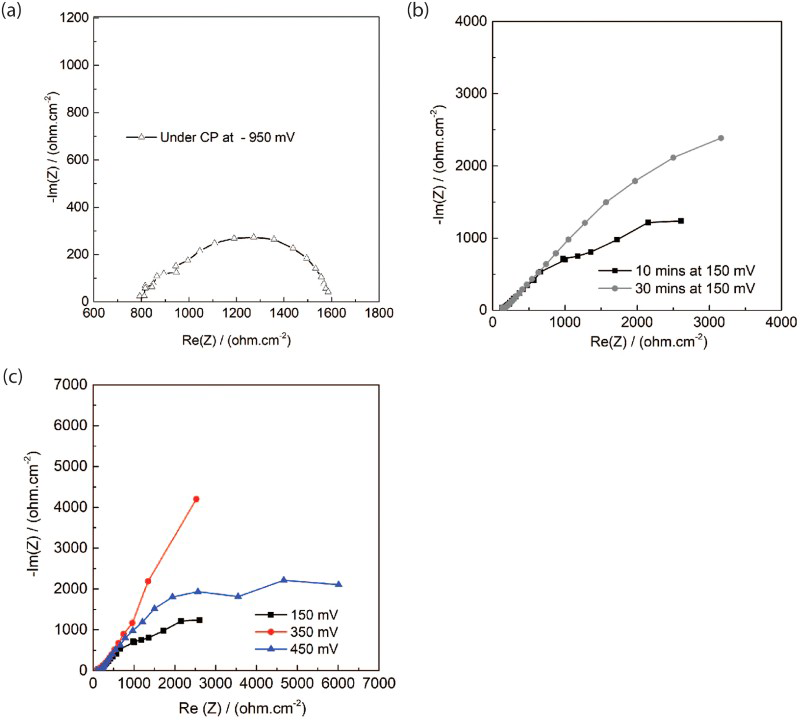
The existence of a passive film on the steel surface under CP has been discussed previously [6,7]. Although the passive film has not been observed physically and requires future research, all electrochemical evidences pointed to the existence of such film. This is also supported by the impedance results in Figure 3. EIS measurements were performed just after cathodic protection preconditioning and after several stages of the simulated anodic transients and shown in Figure 3. When comparing the impedance spectroscopy under CP (Figure 3(a)) against the spectroscopy obtained at 150 mV (Figure 3 (b)), the significantly larger impedance value at 150 mV indicates an increase of the sum of surface film and charge transfer resistance, which is in agreement with the passivation hypothesis. When contrasting the EIS plots obtained at 350 and 450 mV (Figure 3(c)), the lower impedance value at 450 mV suggests a decrease in the sum of the surface film and charge transfer resistances, which echoes the observation in Figure 2. This suggests that when the electrode potential is below the CEP, the steel surface has a large impedance value, indicating much slower corrosion kinetics than when the electrode potential is more positive than the CEP value.
With the extension of the anodic transient at 150 mV, the size of impedance spectroscopy continued to increase (Figure 3(b)). Figure 3(c) compares the Nyquist plots after 10 minutes of anodic transients at different steel potentials. Although all cases showed a significant increase in the size of impedance spectroscopy, compared with the impedance spectroscopy obtained after the CP preconditioning (Figure 3(a)); the rate of increase does not show a monotonic relationship with the steel potential during the anodic transients. In fact, the impedance spectroscopy was smaller at 150 mV, inter-medium at 450 mV, and larger at 350 mV. The Nyquist plots are characteristic of an interface where the formation of a surface film and charge transfer are two dominant processes [23].
It should be noted that although several factors discussed above could contribute to the anodic current density trends shown in Figure 2, the relative contribution of each factor is not clear at this stage.
After the initial anodic current density peak, current densities remained relatively low for certain period and then increased suddenly. For instance, for the 150 mV anodic excursion (Figure 2), the current density started to increase suddenly approximately after 40 minutes the onset of the transient. The increase of current densities suggested that corrosion was taking place on steel. Based on the observation in Figure 2, the length of the corrosion incubation time is found to be affected by the steel potential. Figure 2 shows that during the anodic transient, the higher the steel potential, the shorter the corrosion incubation time. The length of the incubation time for corrosion can be associated with the gradual pH decrease in the soil adjacent to the steel surface and to the diffusion of Cl– ions that were repelled by the steel during the CP preconditioning stage [17]. As the steel potential became nobler, the pH decrease and the Cl– flux towards the steel surface became greater due to the higher electrical field. Therefore, the surface film of the steel was more sensitive to corrosion. Eventually, when the steel potential reached a certain high value, the surface film failed to provide passivation and corrosion occurred immediately at the onset of the anodic transient (450 mV case in Figure 2).
The effects of soil conditions on the behaviour of preconditioned steel surface
In order to further understand the effect of major influence factors on the interfacial processes, potentiodynamic polarisation measurements have been conducted under different prior CP potential and in different soil moisture contents. Both factors are expected to affect the critical potential values because they have a great influence on the soil pH and the transportation of ions (ca. Cl–). The effect of these two factors on the system were investigated by potentiodynamic polarisation. Because although the pitting and critical potential values do not necessarily coincide, the general trend presented by both potentials would be similar. In fact, for any given system, critical potential values are expected to be nobler than the respective pitting potential.
Figure 4 compares the potentiodynamic polarisation curves obtained after 24 hours prior cathodic protection at different CP potentials. When the CP potentials were −750 and −850 mV, the curves are very similar. The critical pitting potentials were at approximately −100 mV. When the more negative CP potentials of −950 and −1100 mV were applied, the pitting potential increased dramatically to approximately 250 mV for −950 mV CP potential and 400 mV for −1100 mV CP potential. The corrosion potentials were observed to shift towards the negative direction while the critical pitting potential reached to a nobler value. This can be explained by the different cathodic reactions taking place across the range of CP potentials tested. When the CP potential was −750 and −850 mV, the controlling cathodic reaction was oxygen reduction reaction, the kinetics of which are controlled by the concentration of O2 in the soil. However, when the CP potential was −950 and −1100 mV, the water reduction reaction contribution became increasingly more significant and its kinetics is not controlled by diffusion [24]. Therefore, the reduction of the CP potential from an oxygen reduction reaction region to water reduction reaction region would result in a significantly larger amount of OH− ions, a dramatic increase in pH around the steel, and thereby a reduction of corrosion potential, and significant increase of pitting potential/ critical anodic potential.
Potentiodynamic polarisation curves after 24 hours cathodic protection at different Cathodic Protection potentials in 40% WHC soil.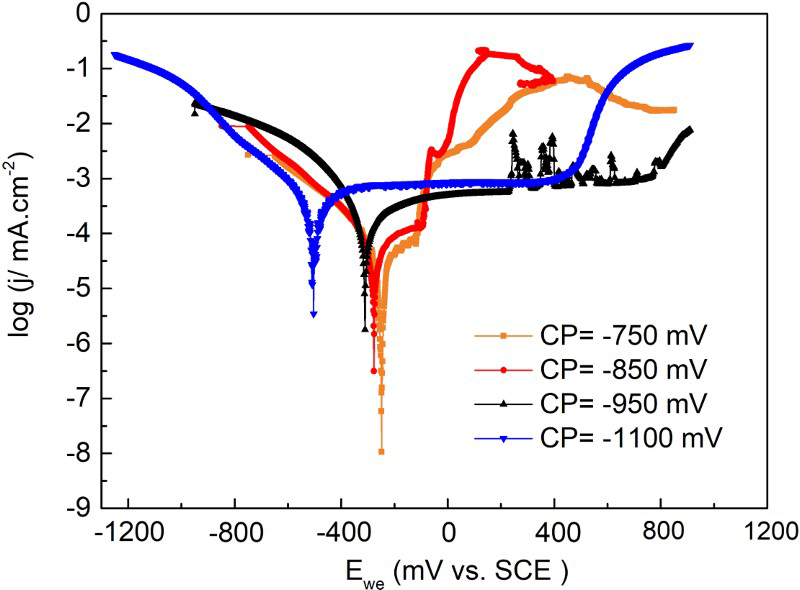
Figure 5(a) compares the current density during the 24 hours CP preconditioning in the soils with 40% and 60% WHC, (b) compares the potentiodynamic polarisation curves after 24 h CP at −950 mV in these two soils. In Figure 5(a), during the 24 hours CP preconditioning period, the CP current density in the 60% WHC soil condition was higher than it in the 40% WHC soil condition, which is consistent with the literature [25 -28]. The PP curves in Figure 5(b) show that there was no obvious difference in the corrosion potential for steels in these two types of soils; however, the WHC of soil could significantly affect the critical pitting potential. It is also found that the critical pitting potential became nobler when the WHC was increased from 40% to 60%.
(a) Variation of current density during 24 h cathodic protection at –950 mV in two soils with different moisture content (60 WHC and 40 WHC); (b) potentiodynamic polarisation curves obtained after 24 h cathodic protection at −950 mV in these two soils.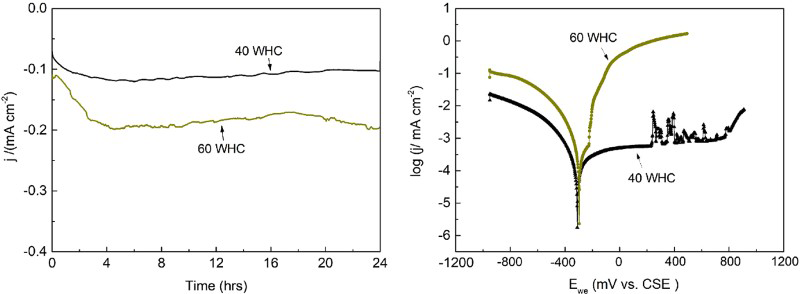
In this study, a 40% WHC soil and a 60% WHC soil were contrasted to study the effect of soil moisture content on the pitting potential. Because according to the literature [26 -29], the current density value at the CP preconditioning stage is closely related to the WHC of the soil, presenting a peak at 60% WHC. In the range between 0% WHC to 60% WHC, a higher WHC increases the amount of solution filling the pores between soil particles, which can result in the increase in the length of the metal/soil/solution triple interphase; thereby increasing water content in this range leads to the increase of current density. Indeed, the current density during the preconditioning CP stage in 60% WHC soil was higher than in 40% WHC soil (Figure 5(a)), which thereby is believed to be due to the increased wet surface area.
Interestingly, Figure 5(b) shows that the pitting potential in 60% WHC soil was significantly lower than in 40% WHC soil, suggesting that the critical potential decreases with the increase of the soil moisture within 60% WHC range. This could be explained by the influence of the soil water content on the path tortuosity and the flow rate of Cl−· and OH−· ions in the soil. The increase of WHC in soil could reduce the path tortuosity, and accelerate the transport of OH− and Cl−· during the anodic transient. Therefore, although the amount of OH – generation was greater in the soil with 60% WHC, the steel surface became more sensitive to the corrosion in the soil with higher WHC.
These results suggest that the CEP could be affected by the CP condition and environmental, including the CP potential and the soil moisture content. At a more negative CP potential, the CEP was found to be nobler; while at the same CP potential but in the soil with a higher moisture content, the CEP became more negative.
Analysis of the behaviour of preconditioned steel surface under anodic transients
Figure 6 is a schematic of Evan's Diagram for assisting the analysis of the behaviour of preconditioned steel surface under anodic transients. In this figure, the dashed lines representing the anodic reaction at two different times during the anodic transient are only a generic representation. The net current density which is the current density measured on Figure 2 is the difference between the anodic and cathodic curves at each time. As shown in Figure 6, with the anodic transient continues and the passive film grows, the current density of anodic reaction at the passive plateau decreases from (i a1) to (i a2), the net current density thereby decreases. On the other hand, the pH decreases during the anodic transient results in the change in the oxygen reduction cathodic curve. Since the dominant cathodic reaction of oxygen reduction is not necessarily limited by diffusion at the potentials used for anodic transients, this shift in equilibrium potential is expected to produce a cathodic current density increase (from (i c1) to (i c2)) at the fix anodic potentials used during the transients. This further reduces the net current density. Therefore, these factors would result in a net anodic current density that peaks at the onset of the anodic transient and then gradually decreases.
Schematic of Evan's Diagram of steel after experiencing different times of anodic transient at 150 mV. t1 represents an earlier time than t2.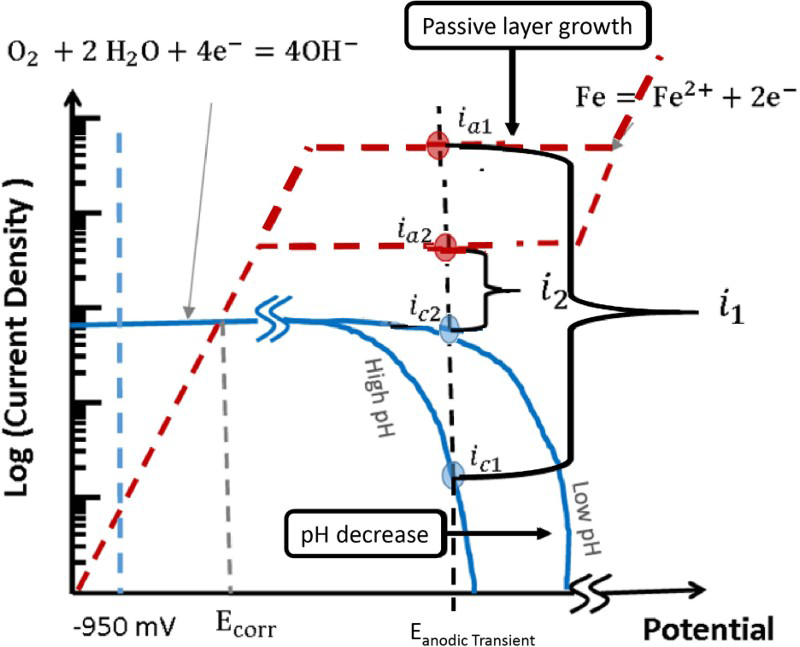
Based on the results presented in this paper and the analysis described above, we believe that low amplitude and short-term anodic transient loss is less likely to threaten the integrity of steel pipelines installed in proper soil. Only when the potential of pipe is shifted over a higher potential value, which is above CEP, corrosion could occur at the onset of anodic transients. The results presented in this study suggest that short and low amplitude anodic transient loss below the critical potential would not produce significant corrosion; the critical potential value is highly dependent on CP potential and the surrounding soil conditions. Therefore, careful consideration and continuous monitoring of these parameters are crucial to diagnose the corrosion risk and tolerance threshold for the anodic transients at any pipeline location.
Conclusions
(1) Electrochemical processes occurring at the interface of steel and soil during the anodic transient were investigated using electrochemical techniques, and detailed interpretation about the currents evolution during the simulated anodic transient has been discussed.
(2) It was found that when a CP preconditioned steel electrode is subjected to an anodic transient, there is a critical steel electrode potential, above which corrosion damage to the steel is immediate. However, if the potential maintained below this value, the surface is initially passivated producing a delay between the onset of the anodic transient and the start of corrosion.
(3) The CP potential and the surrounding soil moisture content can significantly affect this critical potential value.
