







Abstract
Non-stoichiometric oxynitride with a composition of EuTaO1.75N1.25 was synthesized in <10 min through urea route combined with modified pressureless spark plasma sintering apparatus. The electronic properties of EuTaO1.75N1.25 was investigated by first-principles calculations. X-ray powder diffraction revealed that EuTaO1.75N1.25 crystallized with the cubic perovskite-type structure, S.G.
 , and a lattice constant of a = 4.0283(7) Å. Thermogravimetric studies revealed that EuTaO1.75 N1.25 decomposed at around 345 under the oxygen atmosphere, giving a final product of decomposition as EuTaO4 and Eu5Ta4O15 oxides. Magnetic susceptibility measurements indicated EuTaO1.75 N1.25‘s paramagnetic behavior with an estimated T
c
=9.9 K. The saturation moment of 6.82 μB which is smaller than 7 μB expected for Eu2+ can be due to the existence of Eu3+. The extremely low value obtained for remanence and coercive field agrees to the isotropic character of the 8S7/2 ground state associated to the Eu2+.
, and a lattice constant of a = 4.0283(7) Å. Thermogravimetric studies revealed that EuTaO1.75 N1.25 decomposed at around 345 under the oxygen atmosphere, giving a final product of decomposition as EuTaO4 and Eu5Ta4O15 oxides. Magnetic susceptibility measurements indicated EuTaO1.75 N1.25‘s paramagnetic behavior with an estimated T
c
=9.9 K. The saturation moment of 6.82 μB which is smaller than 7 μB expected for Eu2+ can be due to the existence of Eu3+. The extremely low value obtained for remanence and coercive field agrees to the isotropic character of the 8S7/2 ground state associated to the Eu2+.
Keywords
Introduction
Perovskite oxynitrides ABO3−xN x (A = rare earth, alkaline earth or alkali metal; B = transitional metal; 0 < x < 3) have shown novel electric properties [1], high permittivity [2,3], magnetic properties [4], and photocatalytic activity [5]. They commonly crystallize in cubic structure with distortions. The substitution of oxygen ions by nitrogen ions strongly alters the properties of perovskites [6]. Many perovskite oxynitrides can be fabricated by calcinating the mixtures of regents or oxide precursors in ammonia gas flow at high temperature [7]. Novel approaches for low-cost, low-temperature, and/or time-saving preparation of the perovskite oxynitrides were reported [8].
Europium tantalum oxynitride compounds have been particularly investigated. Pastrana et al. [9] reported magnetic properties of the perovskite EuWO1.58N1.42 phase. Yang et al. [10] found the excellent flexibility of the electron and giant magnetoresistance effects in EuWO1+xN2−x, while changing the ratio of anions can adjust Eu and W oxidation states and hole/electron doping.
In this study, we focused on the non-stoichiometric oxynitride EuTaO1.75N1.25. Band structural of EuTaO1.75N1.25 were calculated by first-principles calculations. A urea route together with pressureless spark plasma sintering equipment was adopted for rapid synthesis. The non-stoichiometric oxynitride with a formula of EuTaO1.75N1.25 was obtained. The magnetic properties of EuTaO1.75N1.25 were investigated.
Experimental
The density functional theory (DFT) calculations were performed using the Vienna ab-initio simulation package (VASP). The projector-augmented wave (PAW) method was used to represent the core-valence interaction. The plane wave energy cut-off was set to 500 eV. The generalised gradient approximation (GGA) with the Perdew–Burke–Ernzerhof (PBE) exchange–correlation functional were used in our calculations. The first Brillion zone k-point sampling utilises the Monkhorst–Pack scheme with an automated mesh determined by 20 times of the reciprocal lattice vectors. The energy and force criterion for convergence of the electron density are set at 10–5 eV and 0.02 eV Å−1, respectively.
Powders of Eu2O3 and Ta2O5 with urea were mixed with anhydrous ethanol. Then the mixture was dried in an oven and well ground. The dry regent was calcined in a nitrogen atmosphere using a modified pressureless SPS equipment (SPS-3.20 mk II, Sumitomo Coal Mining, Tokyo, Japan). The temperature was raised to 600°C over 3 min, then to 1100°C at 300°C min−1 and kept for 1 min. The products were collected after the furnace was cooled to room temperature. First-principles calculations were performed by using the Vienna Ab initio Simulation Package (VASP) to investigate the electronic properties of EuTaO1.75N1.25.
The O/N content was determined by a combustion analyser (LECO TC500, LECO Corp., USA). The phase composition was determined by X-ray diffraction (XRD, D8 Advance, Brucker/Axs Corp., Germany), collecting data at 0.02° steps over the 2θ range of 5-110° with a counting time of 1.0 s per step. Rietveld refinement was done with the Full-prof program package. Morphology of the product was observed with scanning electron microscope (SEM, Tescan MIRA3, Tescan Ltd., Czech Republic) and transmission electron microscopy (TEM, Tecnai G2 F20 S-TWIN 200 kV, FEI Corp., USA). Thermal stability was tested on a thermogravimetric and differential scanning calorimetry (TG-DSC, DSC204F1, Netzsch, Germany) in an oxygen flow. Magnetic susceptibility was measured by a Quantum Design XL-SQUID magnetometer over 2–300 K at 0.1 T. Magnetisation at different temperatures were measured in the magnetic field range of −6 to 6 T.
Results and discussion
The calculated DOS (Density of States) and band structure of EuTaO1.75N1.25 was shown in Figure 1. The results revealed a split in spin polarisation of EuTaO1.75N1.25, which was caused by electronic of Eu−4f. The Energy level of spin-lower electronic was obviously higher than that of spin-upper electronic, which indicated that spin-lower state may be unstable. Also, the number of electronic calculated in two cases were 22 (spin upper) and 16 (spin lower), respectively. Therefore, the result of spin-upper state was more convincible. In spin-upper state (Figure 1(c)), the calculated band gap of EuTaO1.75N1.25 was 1.21 eV, which was significantly lower than that of EuTaO4 (3.66 eV) [11]. The bottom of the conduction band (CBM) at G point and the top of the valence band (CVM) at G point indicated a direct bandgap for EuTaO1.75N1.25 oxynitride.
The DOS and band structure for EuTaO1.75N1.25, (b) and (c) showed spin-lower and spin-upper states of band structure of EuTaO1.75N1.25, respectively.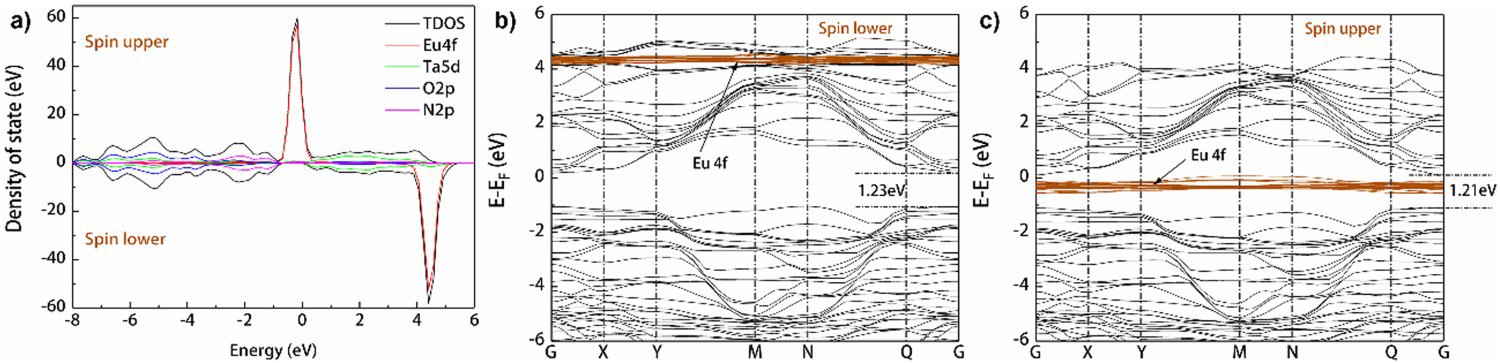
Figure 2 showed the Rietveld refinement results of the XRD pattern with randomly distributed O and N. More details were listed in Table 1. The oxynitride crystallized in a cubic structure with a space group
Refined XRD pattern for EuTaO1.75N1.25. The inset showed cubic crystal structure of EuTaO1.75N1.25. Rietveld refinement results including unit-cell parameters, atomic coordinates, and main interatomic distances for EuTaO1.75N1.25. . Compared with considering Eu3+ (1.06 Å, CN:8), the experimental bond distance (2.848 Å) for Eu−(O|N) is closer to the sum of the ionic radii of Eu2+ (1.25 Å, CN:8) and O2− (1.38 Å, CN:4)/N3− (1.46 Å, CN:4). Octahedral tilting was identified using the method by Barnes et al. [12]. The ionic radii were obtained according to Shannon Previtt [13] cationic radii in oxides. Based on the space groups originated from cis- and trans- anion ordering and octahedral tilting in the mixed anion perovskites proposed by Porter et al. [14], it was deduced that there was no anion ordering. The anion composition of the synthesised oxynitride was determined by hot gas extraction. The results showed that the anion content of nitrogen and oxygen was 4.41 and 7.01 wt.% respectively, which indicated a chemical formula of EuTaO1.75N1.25. The non-stoichiometric O/N ratio can be induced by the presence of oxygen vacancies.
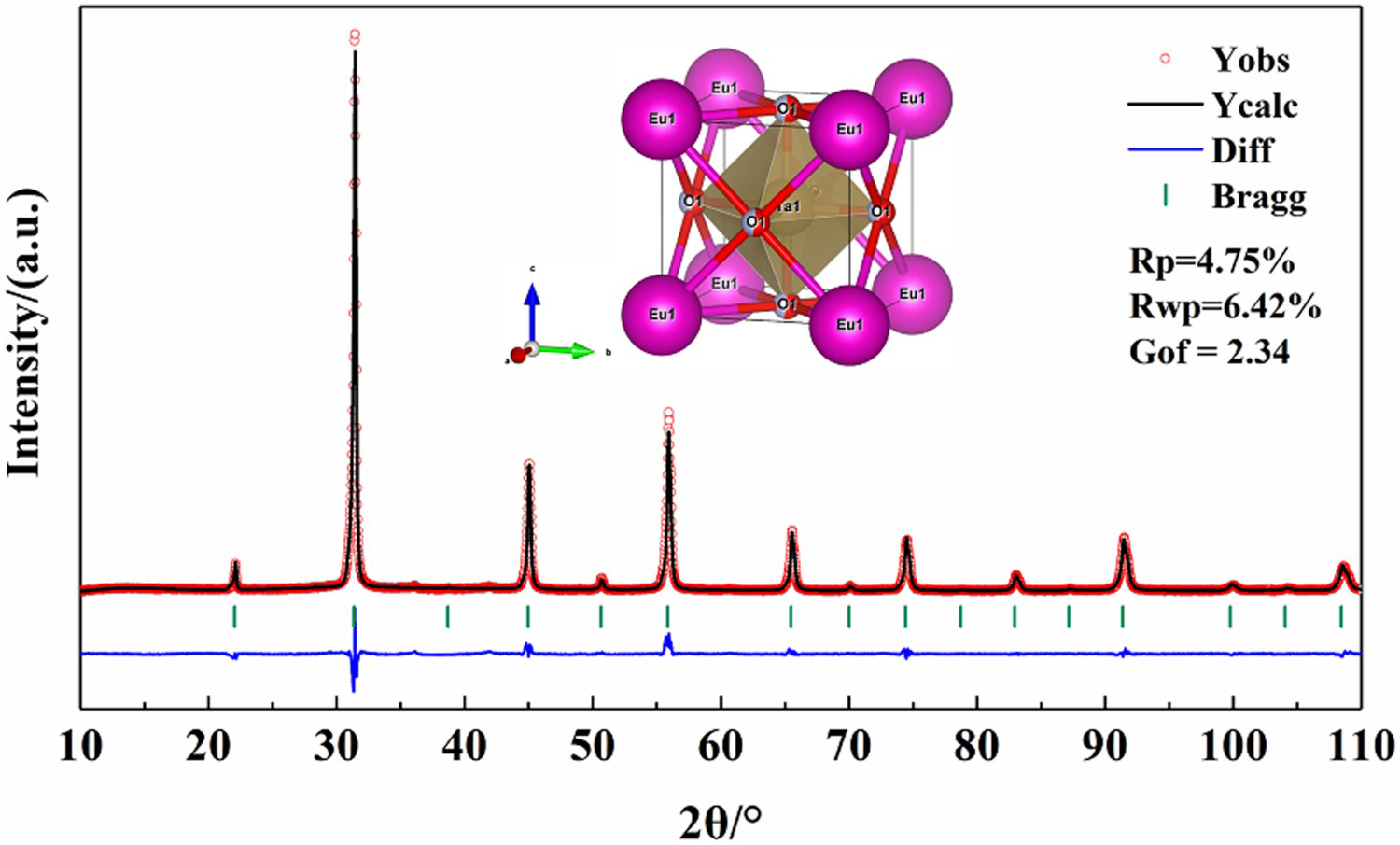
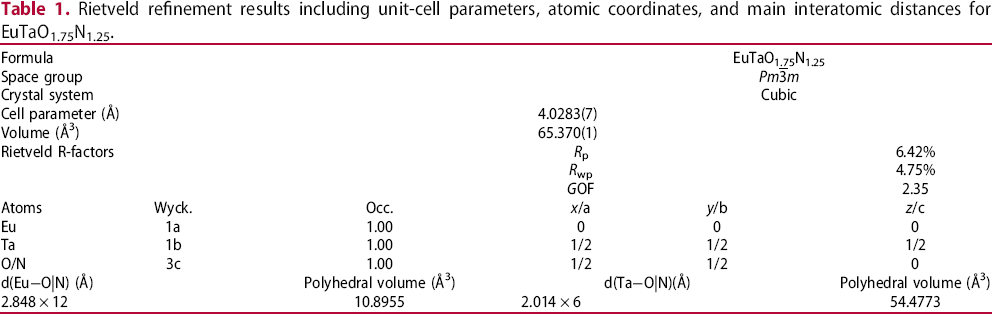
Figure 3(a) showed the results of thermogravimetric study. The decomposition of the oxynitride can be divided into three steps. A slight weight fluctuation occurred during the first step (<345°C) was mainly due to the removal of the physical and chemical combination of moisture. At 345–515°C, the mass increased significantly by 6.4 wt-%. The DSC curve reflected the heat release process which can be attributed to the total oxidation of EuTaO1.75N1.25. The difference (1.51 wt-%) between the experimental weight gain and the theoretical value (4.89 wt-%) can be due to the oxygen vacancy, which was very close to the weight loss of oxygen (1.39 wt-%). In the last step (>515°C), the sample showed a gradual weight loss in a two-step exothermal process. One possible explanation is the dissociation and kinetics of the oxide at high temperatures were controlled by temperature. Another is the removal of N2 suggested by Rachel et al. [15] and Gendre et al. [16] The results showed that EuTaO1.75N1.25 was stable in the air below 345°C.
(a) TG-DSC curves for EuTaO1.75N1.25 in air and (b) XRD patterns for EuTaO1.75N1.25 after oxidised in air at 500/1000°C.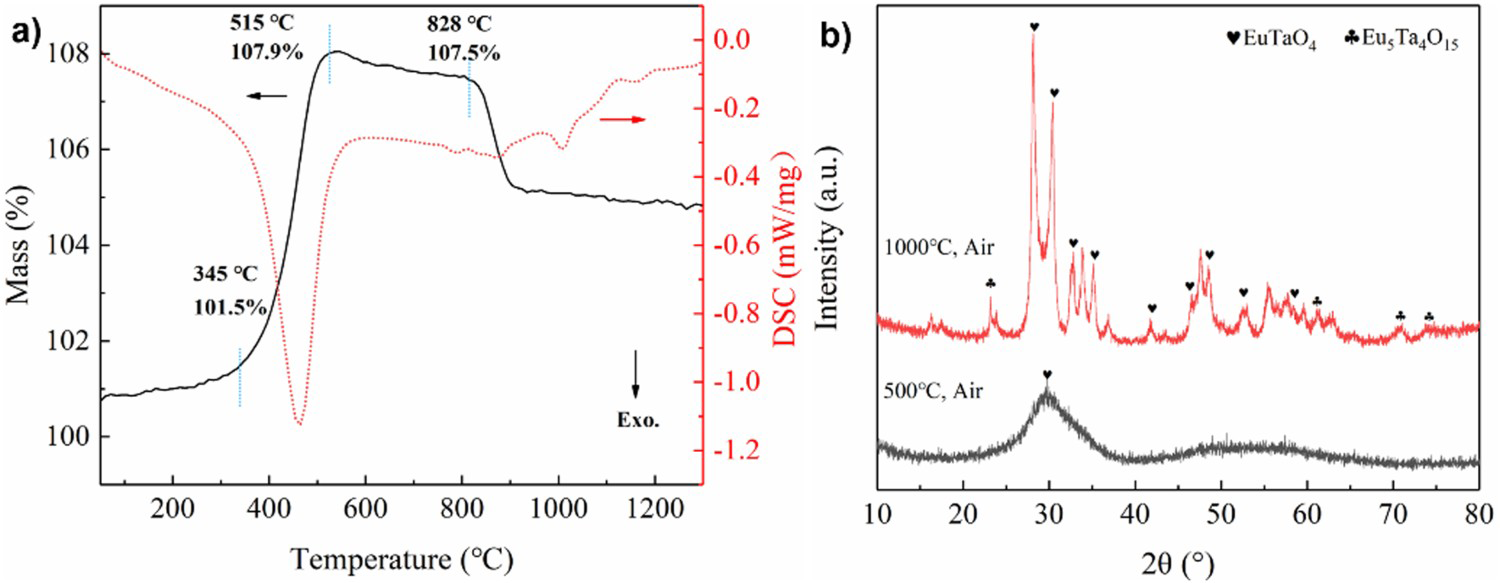
The composition of oxidised EuTaO1.75N1.25 was determined by X-ray diffraction as shown in Figure 3(b). Amorphous EuTaO4 was obtained after EuTaO1.75N1.25 oxidised in air at 500°C for 2 h. However, when heated in air at 1000°C for 2 h, EuTaO1.75N1.25 transformed to europium oxide containing crystal EuTaO4 and a handful of Eu5Ta4O15. As a result, the decomposition of EuTaO1.75N1.25 produced intermediate products as amorphous EuTaO4 and final products as crystal EuTaO4 and a handful of Eu5Ta4O15.
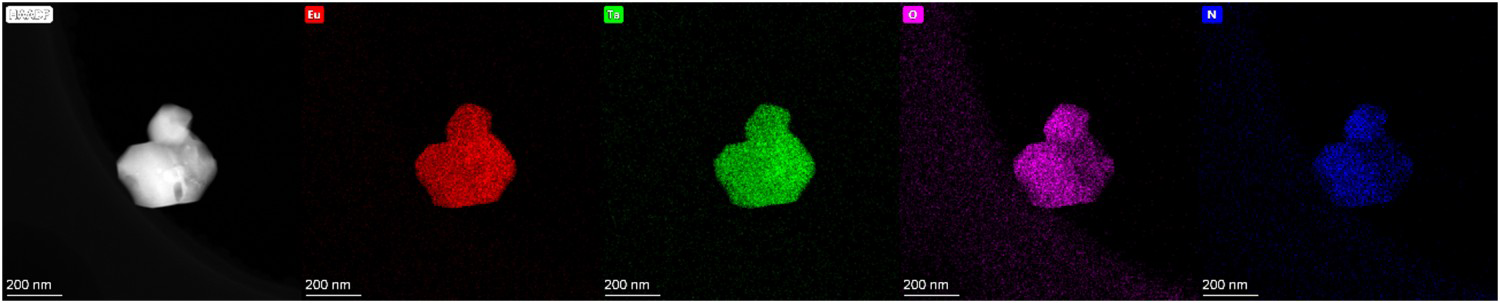
SEM and TEM images were illustrated in Figure 4. The SEM image displayed regular cubic grains with a size of 50–200 nm. The ED pattern was indexed as (100) plane. Considering that anion ordering would lower the symmetry of crystal structure, there is no evidence of ordering between the oxygen and nitrogen atoms. Figure 5 showed the EDS mapping of Eu/Ta/O/N elements obtained in HAADF-STEM mode. It can be seen that these elements were homogenously distributed in the crystals, which indicated a good homogeneity from the microscopic perspective.
SEM and TEM images for EuTaO1.75N1.25. The inset in TEM image shows the electronic diffraction pattern of the selected area. STEM-EDS elemental maps for EuTaO1.75N1.25. The size of the studied crystal is <500 nm. It can be obviously seen that the Eu/Ta/O/N elements were homogeneously distributed.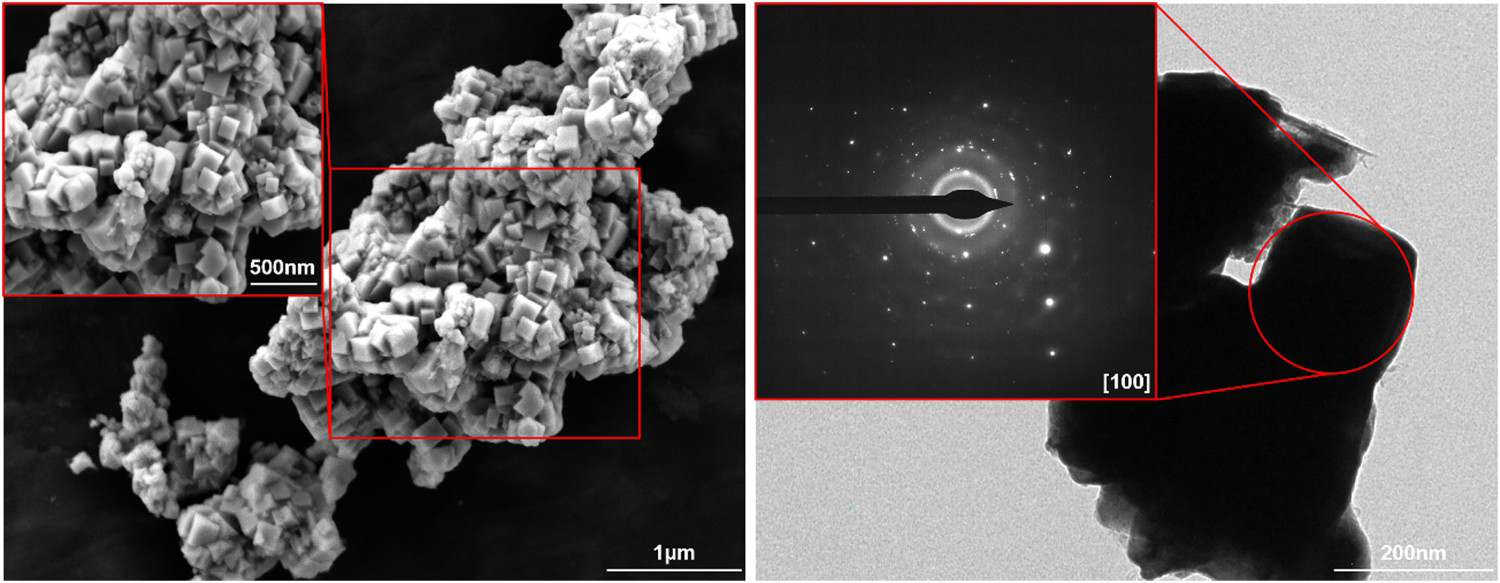
The magnetic properties of EuTaO1.75N1.25 were investigated. Figure 6(a) showed the temperature dependence of the magnetic susceptibility. In the temperature range of 30–300 K, the magnetic susceptibility conformed to a Curie–Weiss law: χ = 7.75/T−3.32. The effective magnetic moment is 7.82 μB. The value of the positive Weiss constant was 3.32 K, and the deviation of magnetic susceptibility below 10 K can be ascribed to the beginning of ferromagnetic behaviour, which was confirmed by the irreversibility found in the zero-field cooling (ZFC) susceptibility measurements. The estimated Curie temperature (Tc) was 9.9 K. In most of the trivalent cations R3+ (R = lanthanide), the crystal field effects leading to deviations are banned with 8S7/2 ground term. Therefore, the deviations from the Curie–Weiss behaviour observed at low temperatures were caused by the beginning of magnetic cooperative interactions [17]. Figure 6(b) showed the field dependence of the magnetisation at different temperatures. The oxynitride performed a typical ferromagnetic behaviour below 15 K and a paramagnetic behaviour over 30 K. The saturated moment was 6.82 μB at 6 T. The effective magnetic moment (7.82 μB) and saturated moment (6.82 μB) are both smaller than the theoretical value (7.94 μB and 7 μB) of the Eu2+ cation. This phenomenon can be attributed to the existence of Eu3+ confirmed by the non-stoichiometric O/N ratio. The ferromagnetic behaviour of the Eu2+ was revealed by the hysteresis loop at 2 K depicted in Figure 6(c). The Eu2+ cation behaved as a soft magnetic cation because of the isotropic character of its 8S7/2 ground state without anisotropic effect. The remanence and the coercive field were too low to be detected due to isotropic character.
(a) ZFC variation of the magnetic susceptibility for EuTaO1.75N1.25. The inset shows the reciprocal susceptibility vs. T; (b) Field dependence of the magnetisation for EuTaO1.75N1.25 at different temperatures; (c) Hysteresis for EuTaO1.75N1.25 at 2 K.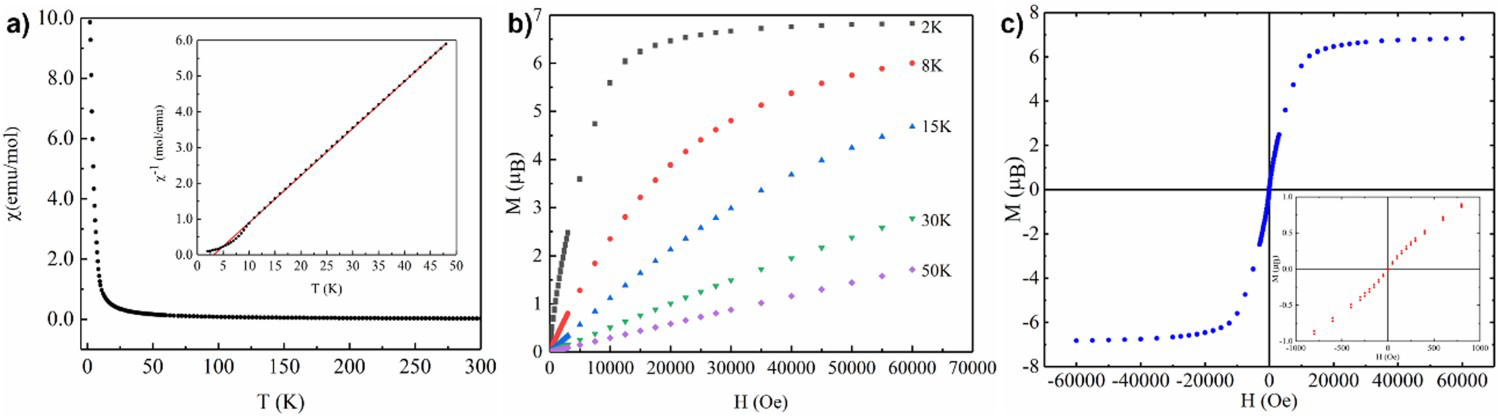
Conclusions
EuTaO1.75N1.25 can be rapidly synthesised within 10 min. First-principles calculations revealed a split in spin polarisation of EuTaO1.75N1.25. EuTaO1.75N1.25 possessed randomly distributed O/N in the anionic sublattice, and it decomposed at around 345°C in the oxygen atmosphere. A ferromagnetic behaviour with Tc = 9.9 K and a saturation moment of 6.82 μB was detected for EuTaO1.75N1.25.
Footnotes
Acknowledgement
This work was supported by the National Natural Science Foundation of China (Grant No. 51702361).
Disclosure statement
No potential conflict of interest was reported by the author(s).