






Abstract
Pinus wallichiana and Dalbergia sissoo wood is widely used in the construction and furniture industry in Pakistan. However, directional variability of physical properties, which can be important for wood-based industry, remains poorly documented. In both wood types, water and moisture uptake, water contact angle, and compressional strength varied significantly along the three directions. Water and moisture uptake was found significantly higher in tangential direction while water contact angle, and compressional strength was found the highest along the longitudinal direction in both wood types. Furthermore, thermal conductivity and diffusivity were found the highest along longitudinal direction however, specific heat capacity was found the highest in radial direction. Based on the results it can be concluded that although, dimensional variability was more pronounced in Dalbergia sissoo wood however, studies on site-specific variations in physical properties need further investigations for better recommendations.
Keywords
Introduction
Wood having 3-D biopolymer composites composed of cellulose, hemicellulose, and lignin along with some inorganics (Rowell 2005). Cellulose as well as hemicellulose are the key wood components in addition to minor sugar polymers such as starch and pectin (Kutz 2012). The presence of phenolic components and the deposition of waste materials regulates the anisotropic behaviour of wood (Guyot et al. 2013). As a metabolically active part, sapwood is responsible for conducting water and nutrients from roots to leaves (Bamber 1985). Upon death, substances in parenchyma cells in the sapwood transform into heartwood (Hillis 1987). The proportion of sapwood and heartwood may vary in trees owing to age, species, and biotic and abiotic factors (Hazenberg and Yang 1991). Studies have shown that owing to high porosity, sapwood is more water or moisture-absorbent as compared to heartwood thus, readily cracks upon drying whereas, the presence of biochemical in the heartwood decreases porosity, moisture or water absorption and prevents cracking of wood (Sandberg 2008). Wood has been categorized into two types based on its structural differences: softwood (gymnosperms) and hardwood (angiosperms). Softwood has a simple structure as wood is mainly composed of tracheid that makes up the major conductive and mechanical structure. Hardwood has a more complex structure wood is made up of vessels of various sizes which are responsible for water conduction and mechanical strength (Wiedenhoeft and Miller 2005).
Wood properties differ across three directions i.e. radial (R), tangential (T), and longitudinal (L) which makes this material quite unique. The L axis is along the direction of the grain and the R and T axis are across the direction of the grain. (Ethington and Hilbrand 1966). Studies have demonstrated that both softwood and hardwood are stronger along the L axis as compared to R and T axis. Previously, Suleiman et al. (1999) evidenced the anisotropic properties of birch hardwood and demonstrated higher strength, thermal conductivity, and diffusivity along the grain direction. Steinhagen (1977) showed a greater thermal conductivity in the longitudinal direction than in the tangential direction. Similarly, Çavuş et al. (2019) explored the thermal properties of different wood species from Turkey and found a linear relation between wood density and thermal conductivity. Faouel et al. (2012) used the transient hot bridge method and analysed the anisotropic behaviour of three wood species (ash, mahogany, and iroko) and demonstrated a higher thermal conductivity in the longitudinal direction.
Himalayan white pine (Pinus wallichiana) and hardwood North Indian Rosewood (Dalbergia sissoo) are the common tree species of South Asia. The timber of both species is extensively used in countries like Pakistan, India, Sri Lanka, and Bangladesh in the furniture and construction industry i.e. for making doors, windows, poles, beams, and shuttering. Despite being widely used, properties of Pinus wallichiana and Dalbergia sissoo wood such as water/moisture sorption, water contact angle, thermal conductivity, thermal diffusivity, specific heat capacity, and compressional strength remains poorly documented. Therefore, the objective of this research was to study the directional dependence of various physical properties like water/moisture sorption, water contact angle, thermal conductivity/diffusivity, specific heat capacity and compressional strength of Pinus wallichiana and Dalbergia sissoo. Documenting these wood properties can be very important in determining the stability and strength of these two wood types and will be useful to the industries for improving the processing, fabrication and finishing of their end products.
Materials and methods
Wood specimens
Wood specimens of Pinus wallichiana and Dalbergia sissoo (Supplementary Figure 1) were purchased from the Faisalabad timber market and samples of defined dimensions were prepared. Trees age and origin was considered while selecting wood for sample preparation. Wood samples of both species were of the same densities and were free from all kinds of defects, such as cracks, knots, and biological infections. The mean wood density was 470 ± 10 kg/m3 for Pinus wallichiana and 740 ± 10 kg/m3 for Dalbergia sissoo. Thirty-six wood samples of size 50 × 25 × 15 mm3 and, ten samples of size 30 × 30 × 30 mm3 were prepared per species. Wood samples of size 50 × 25 × 15 mm3 were used for moisture, water absorption and compression strength measurements and, samples of size 30 × 30 × 30 mm3 were used for measuring the thermal properties. Before all kinds of measurements, samples were oven dried for 18 h at 103°C.
Water/moisture absorption tests
Twenty wood samples (50 × 25 × 15 mm3) per species were used to measure water and moisture absorption. To measure water and moisture uptake in a particular direction e.g. radial, tangential, and longitudinal, the other two directions were completely sealed using plastic tape (Scotch™ tape).
Water absorption was measured on ten pre-weighted wood samples per species that were submerged in distilled water for 1, 2, 4, 6, 23, 38, 45, 72, and 96 h to determine the water uptake of wood samples. After each immersion period, specimens were removed, paper dried, and weighed to estimate water uptake.
Moisture absorption was determined using sealed glass desiccators containing a saturated solution of KNO3 to regulate a relative humidity of 95% at 20°C. Beforehand, 10 wood samples per species were oven dried and placed in the glass desiccators for 1, 2, 4, 7, 8, 14, 15, 16, 18, 20, 22, 32, and 40 days to measure the moisture uptake of wood samples. The weight of the samples was measured continuously at different time intervals.
The gain of weight (ΔW) after each interval was calculated as ΔW = ((Wt – Wt = 0)/Wt = 0) × 100. Where Wt = 0 and Wt are the weight of wood samples at the beginning and at the end of specific time intervals, respectively.
Measurement of water contact angle
Six wood samples per species were used to measure the water contact angle in each direction (radial, tangential, and longitudinal). A 2 μL water droplet was dispensed on the wood surface with a piston-driven air displacement pipet. Images of water droplets were captured by Nikon D90 digital camera. Contact angles were determined by examining droplet images with the software FTA32 Version 2.0. The camera was adjusted to give three images per second for advancing and receding contact angles. Add and remove volume method was used for examining advancing and receding contact angles.
Measurement of compression strength
Ten replicates per species were used to measure compressional strength in each radial, tangential, and longitudinal direction Compression strength was measured using a Universal Testing Machine (WDS-50 model, China) that had an applied force capacity of 50 kN. All the measurements were made at 20°C for all three (longitudinal, tangential, and radial) orientations. Before compression strength measurements, samples were oven dried (18 h, 103°C) to ensure minimal moisture contents in the wood samples.
Measurement of thermal properties
Ten replicates per species were used to measure thermal properties in each radial, tangential, and longitudinal direction. Thermal conductivity, thermal diffusivity, and specific heat capacity were measured with the help of the Transient Plane Source (TPS) technique employing a transient thermal analyzer (The Hot Disc TPS S 500 model, Sweden) as described by (Suleiman et al. 1999; Gustavsson et al. 2000; Lagüela et al. 2015). To measure water and moisture uptake in a particular direction, for example, radial, tangential, and longitudinal, the other two directions were completely sealed using plastic tape (Scotch™ tape). All the measurements were made at 20°C. Before thermal measurements, samples were oven dried (18 h, 103°C) to ensure minimal moisture contents in the wood samples.
Statistical analysis
The data of each species was tested using one-way ANOVA for dimension effect (D-effect). All tests were taken significant at P < .05 and, means were compared using Tukey's HSD. All tests were done in Statistica 12.5, Maisons-Alfort, France.
Results and discussion
Dimensional variation in water/moisture uptake
In this study water and moisture uptake in various wood directions differed significantly in the wood samples of Pinus wallichiana (P < .001) and Dalbergia sissoo (P < .001; Figure 1(a, b)). Results showed that in both wood types, water and moisture uptake was the highest in tangential direction as compared to radial or longitudinal directions. In both the species, water uptake was quicker at the beginning (first 6 h), that slowed down considerably between 6–45 h and was almost negligible between 45–95 h of immersion (Figure 1(a)). Similarly, moisture uptake in both wood types also followed a similar pattern. It was quick at the beginning (first eight days), slowed down between 8–22 days, and was almost negligible between 22–40 days of exposure (Figure 1(b)). studies have demonstrated that wood is a porous and hygroscopic material and because of its hydrophilic components wood has profound tendency to absorb water/moisture when in contact with water or exposed to moist air (Kollmann and Côté 1984). Similar results have been reported previously in softwood (Pinus spp.) and hardwood (Dalbergia and Acer spp.) where the rate of water absorption was highest during the first 5–6 h of immersion that decreased thereafter (Weigenand et al. 2007; Khazaei 2008; Tripathi and Bhoru 2014; Sunny et al. 2019). Furthermore, in this study, both species showed less water absorption in the longitudinal direction as compared to tangential and radial directions. These results are in accordance with the previous studies on hard wood species where maximum absorption has been observed in the tangential direction (Priadi et al. 2019). Such directional variability in water/moisture absorption in hard wood species can be attributed to less porosity and more compact microstructure along the longitudinal direction as described by Mantanis and Young (1997). Other studies have demonstrated that wood density plays a vital role in determining the water or moisture absorption ability of the wood. In general, the species having high wood density show low moisture absorption (Bowyer et al. 2003). Along with interspecific variability in wood density and porosity, studies have shown that differences in wood density are also influenced by environmental factors. Sunny et al. (2019) compared Dalbergia sissoo wood coming from ten different sites and reported that variation in moisture contents was directly related to specific gravity. In this study, although Dalbergia wood was found anisotropic than Pinus, but further studies are required to document the site-specific variations in both the species.
Water (a) and moisture (b) absorption of Pinus wallichiana (S) and Dalbergia sissoo (H) wood in longitudinal (L), tangential (T) and radial (R) direction.
Dimensional variation in water contact angle (WCA)
In this study, mean water contact angle WCA in both species varied significantly across the longitudinal, tangential, and radial directions (Pinus wallichiana, P < .001 and Dalbergia sissoo, P < .001). Mean WCA in both species was the highest in longitudinal direction followed by the tangential and radial direction, respectively (Figure 2). WCA measurements are taken as an indicator of wood wettability; if the contact angle is less than 90°, the wood is considered hydrophilic (Williams 2005). Our results on WCA fall within the range of previous studies on hardwood species where WCA of 62.2° and 68.2° has been reported for sugar maple and Aspen, respectively (Mantanis and Young 1997). In softwood tree species, a WCA of 47° has been reported under control conditions that decreased to 30° under heat treatment at 230°C in Pinus radiata (Fu et al. 2019). The lower wettability observed in Dalbergia as compared to Pinus can be related to a lower proportion of hydrophilic components such as hemicellulose. Furthermore, Young (1976) reported that the interspecific differences in wood extractive influence the wettability and thus, the water contact angle in various tree species. Since Pinus is a softwood tree species with a higher proportion of wood extractive, the observed low water contact angle might be owing to the higher proportion of extractive blocking the cell opening thus, preventing the penetration of the droplet as reported by Kajita and Skaar (1992). Other studies like Chehreh and Farahani (2015) reported that increase in water contact angle with increase in nano-copper oxide retentions. Therefore, further studies are required to check the effects of various chemicals on WCA and the improvement of weathering resistance of both wood types.
Water contact angle measurements of Pinus wallichiana and Dalbergia sissoo wood in longitudinal (L), tangential (T) and radial (R) orientations.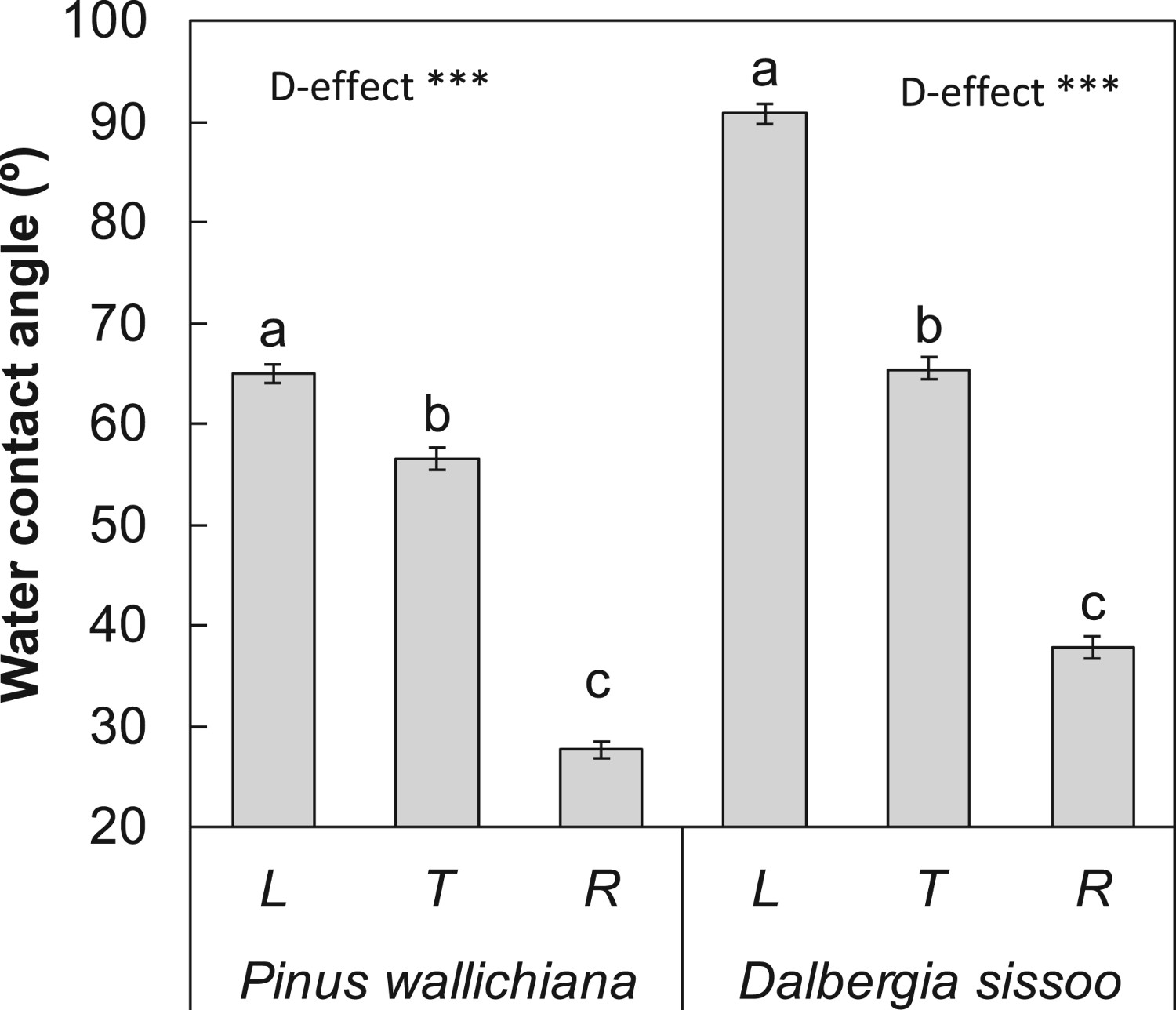
Dimensional variation in compressional strength
In this study, the mean compressional strength of Pinus wallichiana and Dalbergia sissoo wood differed significantly along the longitudinal, tangential, and radial directions (P < .001 and P < .001, respectively; Figure 3). Studies have shown that the compressional strength of wood is directly proportional to the wood density (Bello and Jimoh 2018). High compressional strength is a very desirable characteristic while selecting wood for the construction industry. Generally, wood possesses very strong compressional strength parallel to grain because the wood cells act as tiny columns or tubes bonded together, giving, and receiving support from neighbouring cells (Tsoumis 1991). In this study, higher compressional strength observed in longitudinal direction as compared to tangential, and radial in both Dalbergia and Pinus wood can be owing to the higher strong compressional strength parallel to grain. These results are in line with the previous studies where a higher wood density Acacia wood showed higher compressional strength both parallel and perpendicular to the grain as compared to Dalbergia and Eucalyptus species (Awan et al. 2012). In this study, the compressional strength of the hardwood was three times greater in longitudinal and tangential direction as compared to softwood indicating that hardwood is more compact and better integrated than softwood. However, both kinds of wood offered minimal compressional strengths in the radial direction owing to the specific arrangement of cells, higher porosity, and lesser density (Horáček et al. 2018).
Compression strength in Pinus wallichiana and Dalbergia sissoo wood along the longitudinal (L), tangential (T) and radial (R) orientations.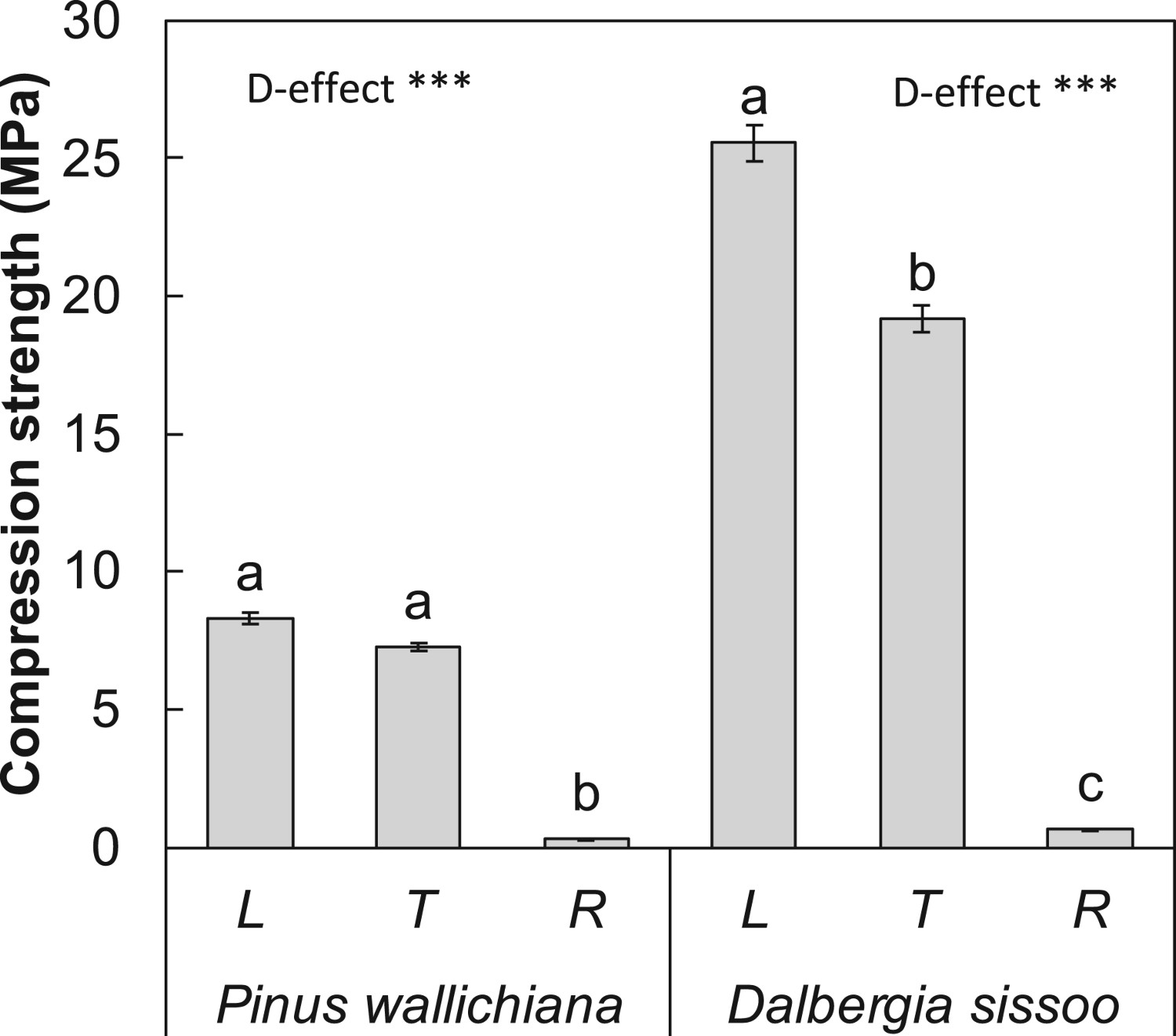
Dimensional variation in thermal properties
In both Pinus wallichiana and Dalbergia sissoo wood, thermal conductivity thermal diffusivity and specific heat capacity varied significantly along the three dimensions (P < .001, P < .001 and P < .001, respectively; Figure 4(a, b, c)). Overall, the thermal conductivity of falls within a range of previously reported values in five softwood and five hardwood tree species (Yu et al. 2011). Furthermore, in this study, thermal conductivity and thermal diffusivity were the highest in the longitudinal direction (Pinus wallichiana, 0.23 W/mK and 0.36 mm2/s; Dalbergia sissoo, 0.33 W/mK and 0.265 mm2/s, respectively) and followed by the tangential and radial direction, respectively. Our results are in line with the previous studies where higher thermal conductivity has also been evidenced along the longitudinal plane as compared to a tangential and radial plane in Oaks, Spruce, and Larch (Lagüela et al. 2015). Furthermore, the values of thermal conductivity found in this study also fall within the reported range in soft and hard wood tree species (1.5–2.8 W/mK; Yu et al. 2011). In this study, the values of thermal diffusivity were found lower than the values previously reported by Steinhagen (1977). Studies have shown that the thermal diffusivity of wood is directly linked to moisture contents at a given temperature. In our study, wood samples were dried at 103°C as compared to the green wood used by Steinhagen (1977). Similarly, Suleiman et al. (1999) have demonstrated a positive correlation between thermal diffusivity and wood temperature and an increase in wood temperature decreases the wood moisture contents. Both Pinus wallichiana and Dalbergia sissoo showed a significantly higher specific heat capacity in radial direction (1.3 and 2.3 MJ/m3 K, respectively; Figure 4(c)). Thermal properties like conductivity, diffusivity, and specific heat capacity of wood are desirable for determining the energy performance of wood or wood-based material (TenWolde et al. 1988). Previous studies have demonstrated that the direction variation of the thermal properties of wood is owing to the variation in the wood density and porosity which is high in the longitudinal direction followed by tangential and radial direction, respectively (Rice and Shepard 2004). Generally, at the same moisture level and temperature, the thermal conductivity of wood increases in accordance with the increase in wood density (denser wood, more conductance). Furthermore, thermal diffusivity is desirable to determine the thermal perturbation of a given species and can give an insight into the dynamics behind the conduction mechanism in the wood (Steinhagen 1977). Since variations in thermal properties are directly linked to wood density, therefore, further studies are required to investigate site-specific variations of thermal properties in wood coming from various sites.
Thermal conductivity (a), thermal diffusivity (b) and specific heat capacity (c) of Pinus wallichiana and Dalbergia sissoo wood in longitudinal (L), tangential (T) and radial (R) orientations.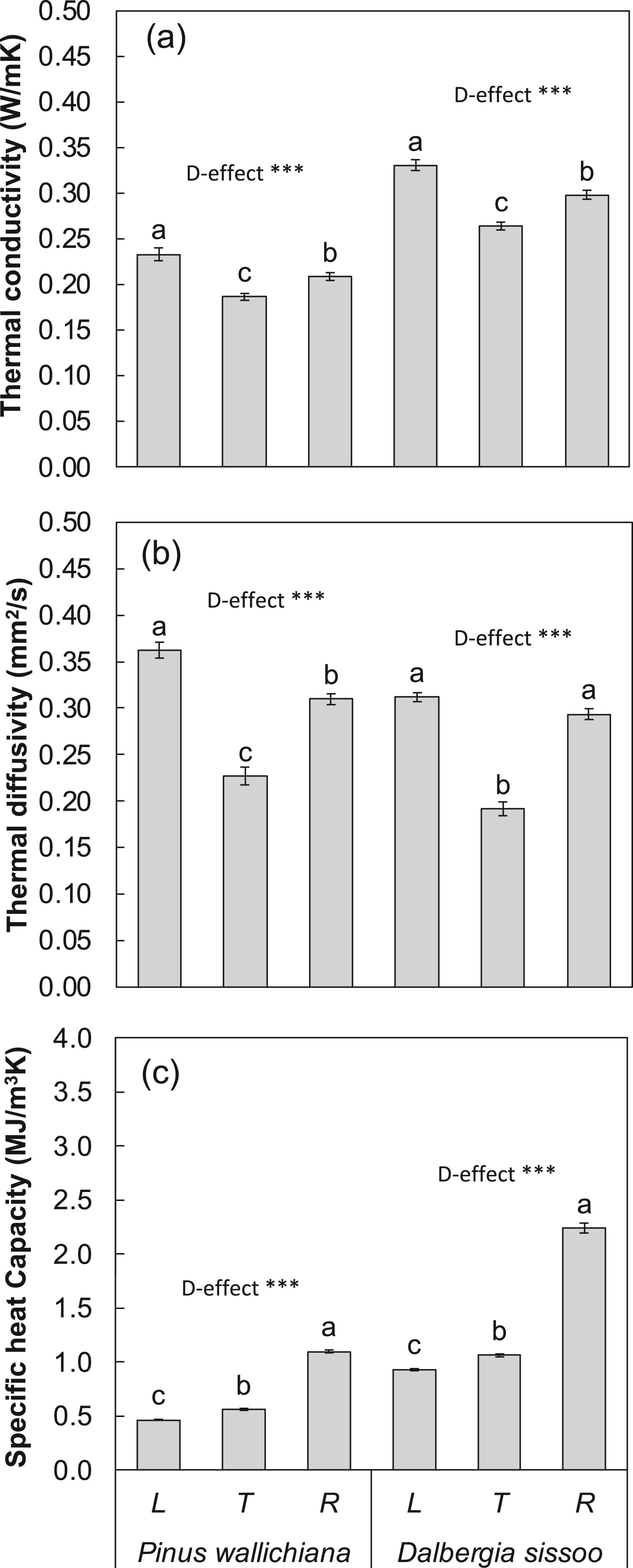
Conclusions
A spectrum of tested physical properties as well as compressional strength for both Pinus wallichiana and Dalbergia sissoo showed a strong orientation dependence. In a particular orientation, response to any physical property is highly influenced by cell arrangements, compactness, porosity as well as wood density. Irrespective of hardwood or softwood, along the longitudinal orientation, wood exhibited the least water and moisture absorption, low hydrophilicity, and highest compressional strength in contrast to tangential and radial orientations. Property variations are more pronounced for Dalbergia sissoo (hardwood) than for Pinus wallichiana (softwood) in all three tested orientations implying that hardwood is more anisotropic owing to complex wood structure. However, further investigations are required to evidence site-specific variations in these wood properties.
Footnotes
Acknowledgements
The authors are highly thankful to Pakistan Agricultural Research Council (PARC) for financially supporting this research under project number ALP-062.
Disclosure statement
No potential conflict of interest was reported by the author(s).