







Abstract
Experimental measurements have been made of the compositions of slag, matte and tridymite phases in chemical equilibrium in the Cu-Fe-O-S-Si system at 1300°C, p(SO2) = 0.25 atm and selected oxygen partial pressures. The high temperature equilibration experiments were conducted using silica substrates under controlled CO-CO2-SO2-Ar gas atmospheres. The resulting phases obtained from the equilibrations were retained at room temperature through rapid quenching of the samples. The condensed phase compositions from the equilibrium experiments were measured by Electron Probe X-ray Microanalysis (EPMA). The data obtained in the present study, combined with those from previous studies, have enabled the liquidus slag temperature to be accurately described as a function of Fe/SiO2 ratio at p(SO2) = 0.25 atm for temperatures between 1200 and 1300oC and mattes containing from ∼44 to ∼ 78 wt pct Cu.
Introduction
Further knowledge of the phase relations in the Cu-Fe-O-S-Si system is required to assist in the optimisation of the pyrometallurgical processing of copper. The Cu-Fe-O-S-Si system at copper smelting, converting, and refining conditions has been investigated by previous researchers (Korakas 1964; Kuxmann and Bor 1965; Geveci and Rosenqvist 1973; Nagamori 1974; Tavera and Davenport 1979; Kaiura et al. 1980; Jalkanen 1981; Yazawa et al. 1983; Shimpo et al. 1986; Tavera and Bedolla 1990; Li and Rankin 1994; Takeda 1997a, 1997b; Font et al. 1998; Henao and Jak 2013; Sun et al. 2013; Fallah-Mehrjardi et al. 2017a, 2017b, 2017c). Although the system has been extensively studied, there are no comprehensive systematic investigations of changes to the compositions of the phases present in the Cu-Fe-O-S-Si system as a function of temperature in carefully controlled gas atmospheres.
In the present study, experimental measurements have been undertaken of the compositions of slag-matte-tridymite phases in equilibrium at 1300°C, p(SO2) = 0.25 atm and selected oxygen partial pressures. The new data at 1300°C, together with previous experimental data at 1200°C and 1250°C (Fallah-Mehrjardi et al. 2017b, 2017c), can be used to evaluate the influence of temperature and matte grade on the phase equilibria in this system. The information can also be used to create reliable thermodynamic databases describing these copper-containing systems.
Experimental technique and microanalysis of phases
An experimental technique reported previously by the authors (Fallah-Mehrjardi et al. 2017a, 2017b, 2017c) has been used to determine gas-slag-matte-tridymite equilibria in the system under a controlled temperature and gas atmosphere. The experimental technique is based on an approach developed by (Jak et al. 1995; Jak 2012), which involves the equilibration of a sample supported on a substrate made of primary phase solid at controlled conditions, preservation of the equilibrium condensed phases formed at high temperature by rapid quenching to room temperature, chemical analysis of the condensed phase compositions by microanalysis techniques, and verification of equilibrium attainment. The equilibrium attainment was verified using a 4-points test approach (Jak 2012), which assesses: (1) the equilibration process as a function of time; (2) the homogeneity of the final phases as a function of location; (3) the influence of direction of approach towards the equilibrium condition; and (4) the systematic analysis and identification of the elementary reactions/processes occurring during the equilibration process and those affecting the achievement of equilibria, which are specific to the system under investigation.
The starting materials used for the experiments were mixtures of high purity powders of FeO (99.8 wt pct purity, supplied by Sigma-Aldrich Co., St Louis, US), SiO2 (99.5 wt pct purity), Cu2S (99.5 wt pct purity) and FeS (99.9 wt pct purity) powders (supplied by Alfa Aesar, Heysham, England). Each sample (approximately 0.2 g) was supported on a pure silica glass plate substrate (approx. Length 20 mm, width 10 mm, thickness 1 mm).
High temperature equilibrations of the mixtures on the silica substrates were undertaken in a vertical alumina reaction tube. A calibrated, alumina-shielded Pt/Pt-Rh 13% thermocouple was placed immediately adjacent to, but not touching, the sample to monitor the actual sample temperature. The thermocouple was calibrated against a standard thermocouple (supplied by the National Measurement Institute of Australia, NSW, Australia). The accuracy of the temperature measurement is estimated to be within 5 K. Flowing mixtures of gases (CO in Ar >99.9% purity), CO2 (99.995% purity) and SO2 (99.9% purity), supplied by Coregas Pty Ltd, Yennora, Australia), were introduced to the reaction tube to control the atmosphere surrounding the sample. The proportions of the gases to achieve partial pressures of oxygen between 10−7.9 and 10−7.1 atm at a fixed temperature 1300°C and a fixed p(SO2) = 0.25 atm were determined using the FactSage 7.0 thermodynamic software (Bale et al. 2016).
After equilibration for a designated time, the equilibrium phases formed at high temperature were preserved by rapid quenching into cold water. The samples were then dried, mounted in resin. Polished cross-sections were prepared with an automated polishing machine (TegraPol-31, Struers, Denmark).
The surfaces of the samples were coated with carbon using a QT150TES coating machine (Quorum Technologies, UK). The microstructures and compositions of the samples were examined and measured by Electron Probe X-ray Microanalysis (EPMA) – JEOL JXA 8200L (Japan Electron Optics Ltd., Tokyo, Japan). The EPMA was used to measure the chemical compositions of the condensed phases in the samples. An acceleration voltage of 15 kV and 15 nA probe current were used. The take-off area of the EPMA analysis was varied between 0 and 50 μm (depending on the size and heterogeneity of the phases) to obtain representative compositions of the condensed phases (Fallah-Mehrjardi et al. (2017a)). Several standards were used for the EPMA calibration they included (i) CuFeS2 (chalcopyrite) for Cu and Fe in matte, and S in matte, slag and tridymite; (ii) SiO2 (quartz) for silica in slag and tridymite; (iii) Fe2O3 (hematite) for iron oxide in slag and tridymite; and (iv) Cu2O (cuprite) for copper oxide in slag and tridymite (from the Charles M. Taylor EPMA set of standard materials and pure Cu2O supplied by Structure Probe, Inc., West Chester, USA). A Duncumb-Philibert ZAF correction procedure was applied to the EPMA analyses. Only the concentrations of the metal cations and sulfur in the phases were measured with EPMA in the present study without information on their oxidation states; all the measured concentrations of Cu, Fe, S and Si in the liquid and solid oxides from EPMA analysis were recalculated to Cu2O, FeO, S and SiO2, respectively, for presentation purposes. Oxygen concentrations in mattes were not measured with EPMA in the present study; the analyses of the mattes were normalised with respect to Cu, Fe and S species present.
The thermodynamic predictions provided in the paper have been undertaken using the FactSage thermochemical software and associated thermochemical databases (Jak et al. 1997; Decterov and Pelton 1999; Jak et al. 2000; Decterov et al. 2004).
Experimental results and discussion
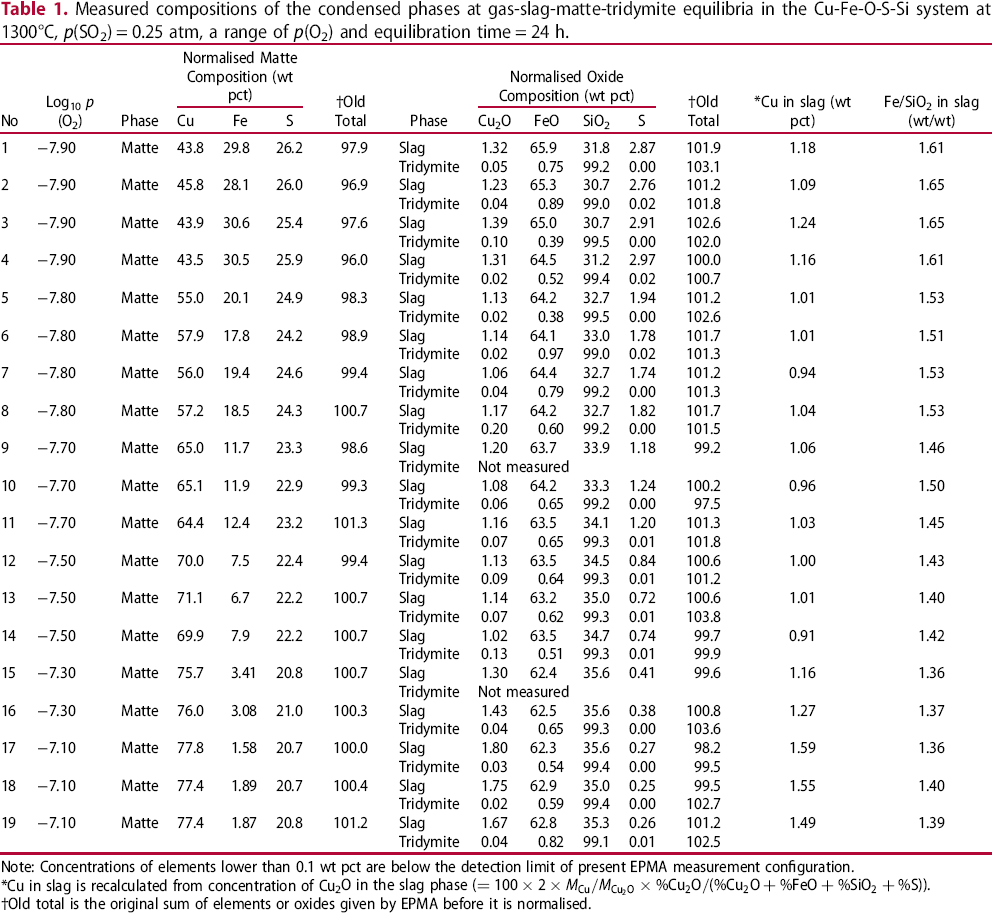
Figure 1 shows a microstructure typical of samples from equilibration experiments at 1300°C, p(SO2) = 0.25 atm, and fixed oxygen partial pressures p(O2) between 10−7.9 until 10−7.1 atm taken with a backscattered electron detector within the EPMA. The condensed phases present in the rapidly quenched samples are matte and slag, which were liquid at the equilibration temperature, and solid tridymite. The EPMA measured compositions of the condensed phases are summarised in Table 1.
A back-scattered electron micrograph showing the microstructure of a sample containing slag, matte, and tridymite phases from equilibration at 1300°C, p(SO2) = 0.25 atm, the phase assemblage is typical of that observed for p(O2) between 10−7.9 and 10−7.1 atm. Measured compositions of the condensed phases at gas-slag-matte-tridymite equilibria in the Cu-Fe-O-S-Si system at 1300°C, p(SO2) = 0.25 atm, a range of p(O2) and equilibration time = 24 h. Note: Concentrations of elements lower than 0.1 wt pct are below the detection limit of present EPMA measurement configuration. *Cu in slag is recalculated from concentration of Cu2O in the slag phase
†Old total is the original sum of elements or oxides given by EPMA before it is normalised.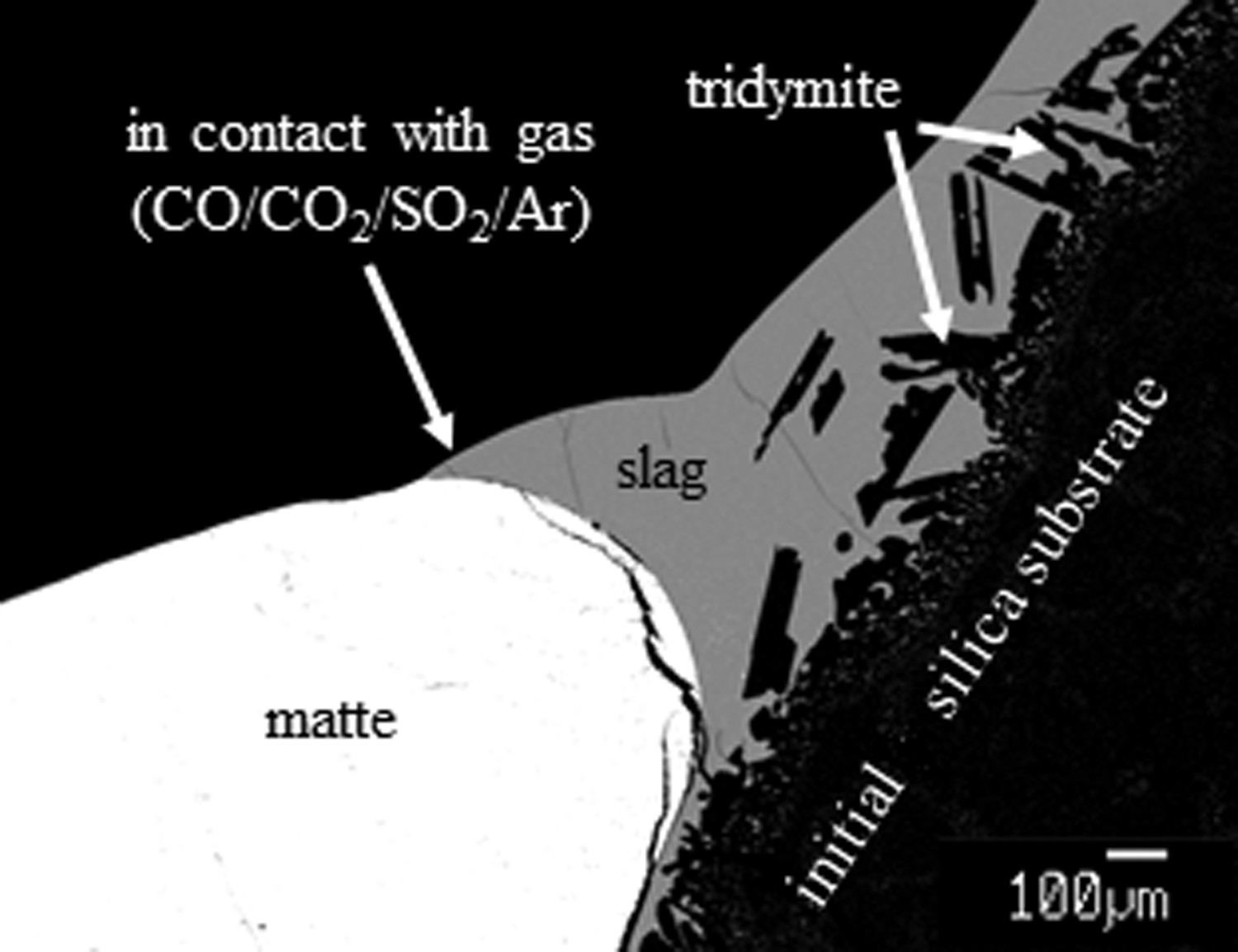
 .
.
To enable systematic analysis of the experimental results, the measured compositions of phases are represented in set of seven graphs shown in Figure 2. The graphs, given as a function of Cu in matte (100·Cu/[Cu+Fe+S]), show:
The oxygen partial pressures as log10[p(O2)] corresponding to the gas/matte equilibria of the system; The sulfur concentrations in the mattes
The estimated oxygen concentrations in the mattes
The FeO concentrations in the slags
The sulfur concentrations in the slags
The dissolved Cu concentrations in the slags
FactSage predicted Fe3+/FeTotal ratios in the slags. Graphs describing the gas-slag-matte-tridymite equilibria in the Cu-Fe-O-S-Si system at 1200°C, 1250°C, and 1300°C, and fixed p(SO2) = 0.25 atm as a function of concentration of Cu in matte: (a) Corresponding oxygen partial pressures of the system (log10 p(O2)); (b) Concentrations of S in matte; (c) Concentrations of O in matte; (d) Concentrations of FeO in slag; (e) Concentrations of S in slag; (f) Concentrations of chemically dissolved Cu in slag; and (g) the ratio of ferric iron to total iron in slag. Previous experimental data are taken from (Fallah-Mehrjardi et al. 2017b, 2017c). Predicted lines were calculated with FactSage.
All graphs contain the present experimental results at p(SO2) = 0.25 atm and predicted values.
 ;
;



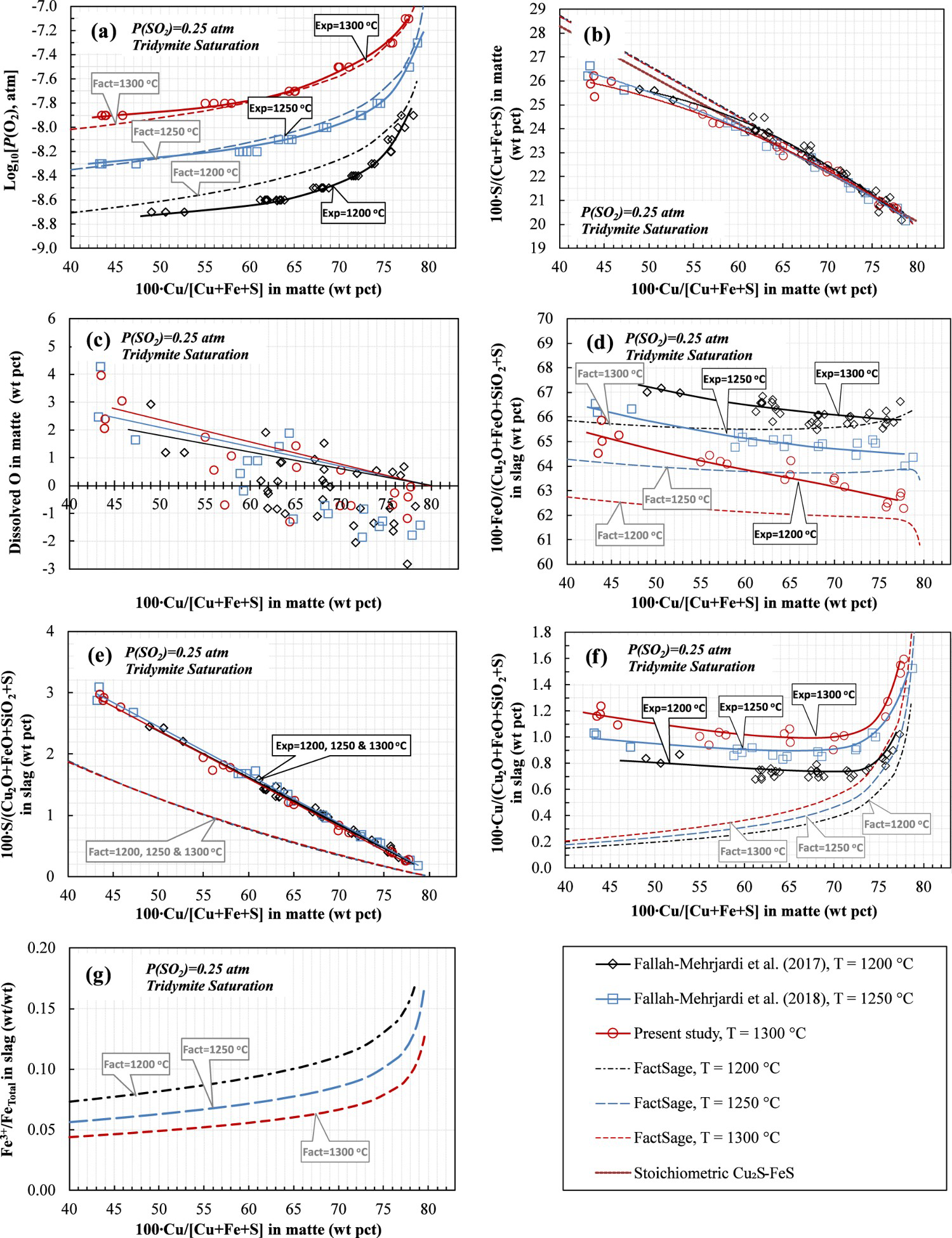
Figure 2(a) shows the relationship between log10[p(O2)] and %Cu in matte for the new data at 1300°C and previous data at 1200°C and 1250°C (Fallah-Mehrjardi et al. 2017b, 2017c). It can be seen from the figure that at all temperatures the concentration of Cu in the matte consistently increases with the increase in the p(O2) of the system. For a given %Cu in matte, the corresponding p(O2) increases with increasing temperature. For example, 60 wt pct Cu in matte at 1200, 1250 and 1300°C corresponds to p(O2) = 10−8.65, 10−8.2, and 10−7.8 atm, respectively. The experimental trends are in agreement with the predicted trends, although the predicted values at 1200°C differ from the experimental data obtained in the previous study (Fallah-Mehrjardi et al. 2017c). The p(O2) at equilibrium with a given matte grade is lower than predicted by approximately 0.2 log units.
The relationship between the S concentration in matte and the Cu concentration in matte at selected temperatures is presented in Figure 2(b). In the matte phase, the S concentration does not change with temperature and decreases with increasing Cu concentration in matte. The experimental S concentrations in matte are lower than the Cu2S-FeS stoichiometric line when Cu in matte is below 60 wt pct. At low Cu in matte, the predicted S concentrations in matte are higher than the experimental S concentrations in matte; these differences may be attributed to the missing O component in the liquid matte model.
Figure 2(c) presents the estimated oxygen (O) in matte as a function of %Cu in matte. The concentration of O in matte in the system is estimated from the difference between 100 and the sum of Cu, Fe, and S in matte from EPMA measurements (see Old Total in Table 1). For a given temperature, the estimated O in matte becomes lower as Cu in matte increases.
The concentrations of FeO in the liquid slag in equilibrium with tridymite as a function of %Cu in matte at different temperatures are plotted in Figure 2(d). It can be seen that, at a fixed temperature, relatively small decreases in FeO the slag concentration take place with increasing Cu in matte. For example, at 1300°C, the FeO concentration in the slag decreases by less than 3 wt pct with increasing Cu concentration in matte from 45 to 77 wt pct. The influence of temperature on the FeO concentration in the liquid slag is also small. For every 50°C increase in temperature, the FeO concentration in the slag in equilibrium with tridymite decreases by less than 2 wt pct. The predictions underestimate the FeO concentration in the liquids for all matte compositions up to 77 wt pct Cu in matte. The discrepancies between the experimental and predicted values are significant at low %Cu in matte, as shown in Figure 2(d).
The concentration of dissolved sulfur in slag is not sensitive to changes in temperature, as demonstrated in Figure 2(e). At all temperatures, the concentration of S in the liquid slag becomes lower as %Cu in matte increases. The %S in slag decreases from 3.1–0.2 wt pct with increasing Cu in matte from 43.3–78.7 wt pct. The predicted S concentrations in the liquid slag are systematically lower than the experimental S concentrations under the conditions investigated in the present study.
It was suggested (Richardson and Withers 1950) that the dissolution of S in liquid slag takes place through the following reaction,
Sulfur capacity, CS in liquid slag as a function of the concentration Cu in matte at gas-slag-matte-tridymite equilibria in the Cu-Fe-O-S-Si system at 1200°C, 1250°C, and 1300°C, and fixed p(SO2) = 0.25 atm. Previous experimental data are taken from (Fallah-Mehrjardi et al. 2017b, 2017c). Predicted lines are calculated using FactSage.
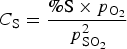
 is the experimentally measured concentration of S in the liquid slag (Table 1) and p(O2) and p(S2) are, respectively, the oxygen and sulfur partial pressures in the gas. The p(S2) is calculated from the reaction:

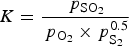
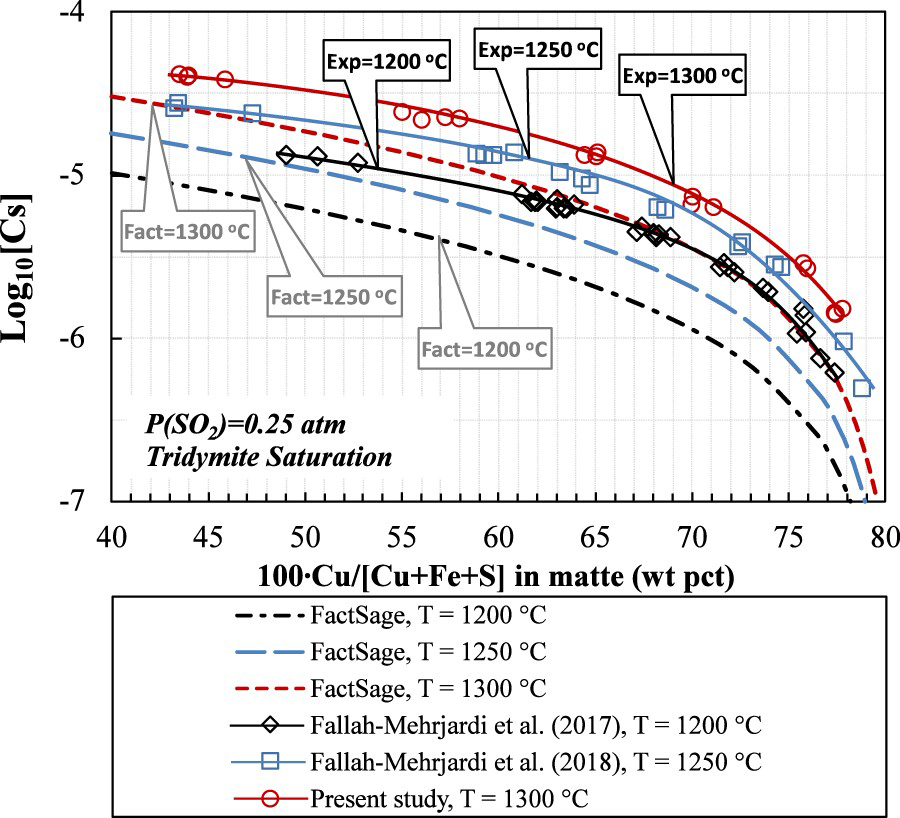
Figure 4(a) shows the measured S in slag as a function %Cu in matte at 1300°C obtained in the present study and previous data by Henao and Jak (2013), Kaiura et al. (1980), Tavera and Davenport (1979) and Yazawa et al. (1983). Most of the previous experimental data have noticeable scatter. The experimental result reported by Yazawa et al. (1983) shows decreasing S concentration in slag with increasing %Cu in matte; this trend is in agreement with that observed in the present study.
Comparison of data from the present and previous studies for the gas-slag-matte-tridymite equilibria in the Cu-Fe-O-S-Si system at 1300°C and fixed p(SO2) as a function of %Cu in matte, (a) %S in slag; and (b) %Cu in slag. Previous experimental data are taken from (Tavera and Davenport 1979; Kaiura et al. 1980; Yazawa et al. 1983; Henao and Jak 2013). The predicted lines were calculated using FactSage.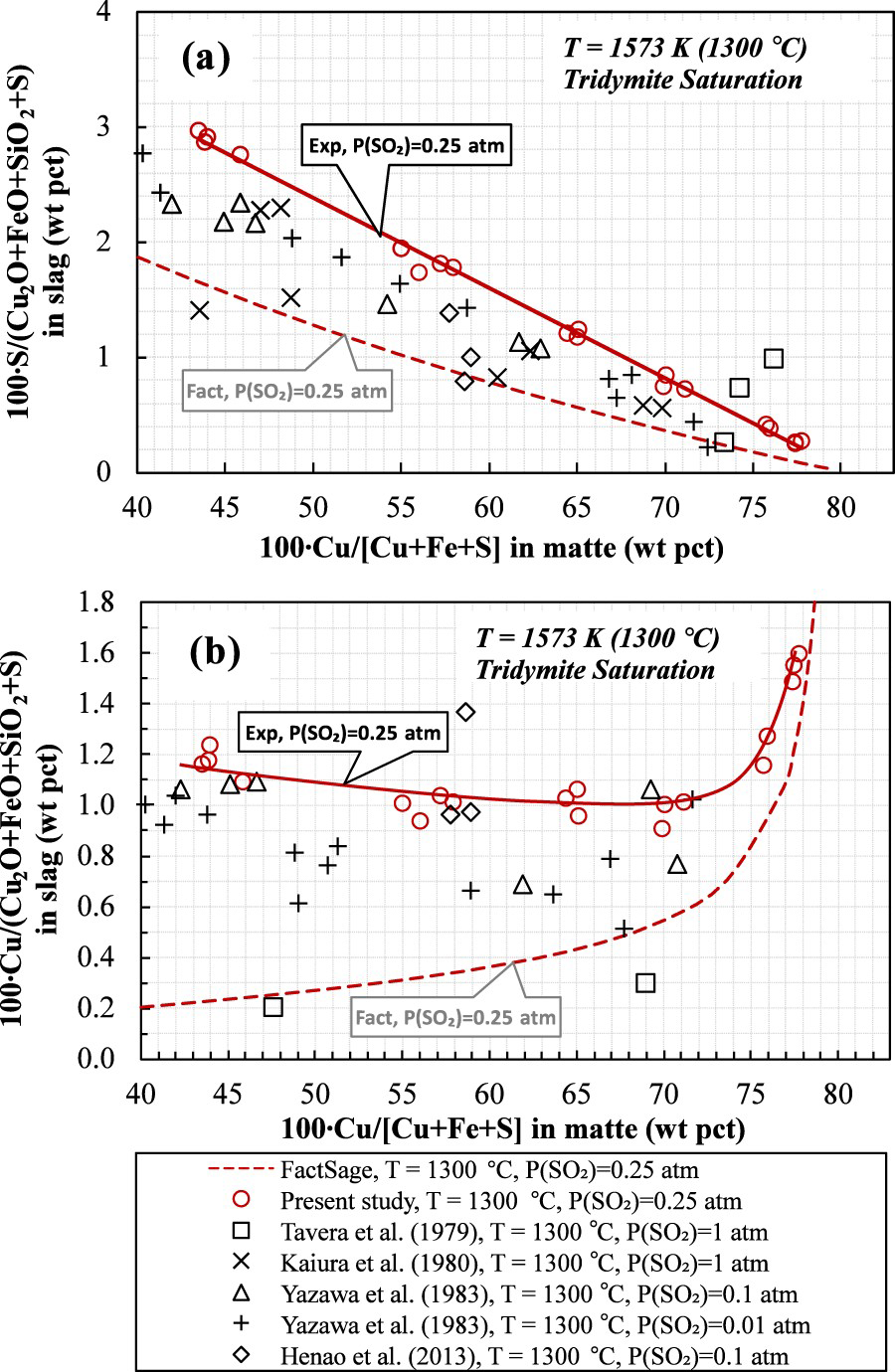
Figure 2(f) shows the chemically dissolved copper (%Cu) in liquid slag as a function of %Cu in matte at different temperatures. In the studies undertaken by the authors, the concentrations of dissolved copper in slag decrease with increasing matte grade at low matte grades but increase rapidly with increasing matte grade at high matte grades. The minima in dissolved copper concentrations depend on the temperature of the system. At 1200°C, the lowest concentrations of Cu in the slag has been found to be 0.72 wt pct Cu at approximately 72 wt pct Cu in matte; at 1300°C this value is 1.0 wt pct Cu at approximately 68 wt pct Cu in matte. The figure also shows that at fixed %Cu in matte the increase in temperature results in the increase in the concentration of chemically dissolved Cu in slag. For example, at 73 wt pct Cu in matte, increasing the temperature from 1200°C to 1300°C raises the concentration of Cu in liquid slag by approximately 0.3 wt pct. The predictions underestimate the dissolved Cu in liquid slag at all temperatures.
Figure 4(b) summarises the experimentally measured %Cu in slag from the gas-slag-matte-tridymite equilibria in the Cu-Fe-O-S-Si system at 1300°C from the present and previous studies by Henao and Jak (2013), Kaiura et al. (1980), Tavera and Davenport (1979) and Yazawa et al. (1983). The figure shows the high scatter of the measured %Cu in liquid slag measured by previous researchers and demonstrates the precise measurements of %Cu in slag obtained by the microanalysis technique used in the present study.
There are no data on the oxidation states of iron obtained in the present study. Figure 2(g) shows the FactSage-predicted Fe3+/Fe total ratio. The figure shows that the Fe3+/Fe total ratio increases with increasing %Cu in matte and decreasing temperature.
The Fe/SiO2 weight ratio in the bulk slag is one of the key process parameters used in the control of pyrometallurgical copper production processes. The ratio is used to monitor and limit the SiO2 flux addition. The limit for flux addition corresponds to the maximum solubility of tridymite in the slag, which is determined by the liquidus composition in the tridymite primary phase field.
Figure 5 shows the Fe/SiO2 ratio at the liquidus composition of slag in equilibrium with tridymite solid at 1200°C, 1250°C, and 1300°C. The ratio of Fe/SiO2 in the slag in equilibrium with tridymite decreases with increasing %Cu in matte at a given temperature. For example, at 1200°C, the Fe/SiO2 ratio in the slag in equilibrium with tridymite decreases from approximately 1.80–1.55 (wt/wt) with increasing Cu in matte from 50 to 77 wt pct. The Fe/SiO2 ratio at the liquidus of the slag in equilibrium with tridymite also decreases with increasing temperature at a given %Cu in matte. For example, increasing temperature from 1200°C to 1300°C at 70 wt pct Cu in matte leads to a decrease of the Fe/SiO2 ratio in the slag in equilibrium with tridymite by 0.2 (wt/wt). This indicates that the silica flux addition requirement to maintain silica saturation increases with increasing %Cu in matte and increasing temperature.
Fe/SiO2 ratio in liquid slag as a function of concentration of Cu in matte at the gas-slag-matte-tridymite equilibria in the Cu-Fe-O-S-Si system at 1200°C, 1250°C, and 1300°C, and fixed p(SO2) = 0.25 atm. Previous experimental data are taken from (Fallah-Mehrjardi et al. 2017b, 2017c). Predicted lines were calculated using FactSage.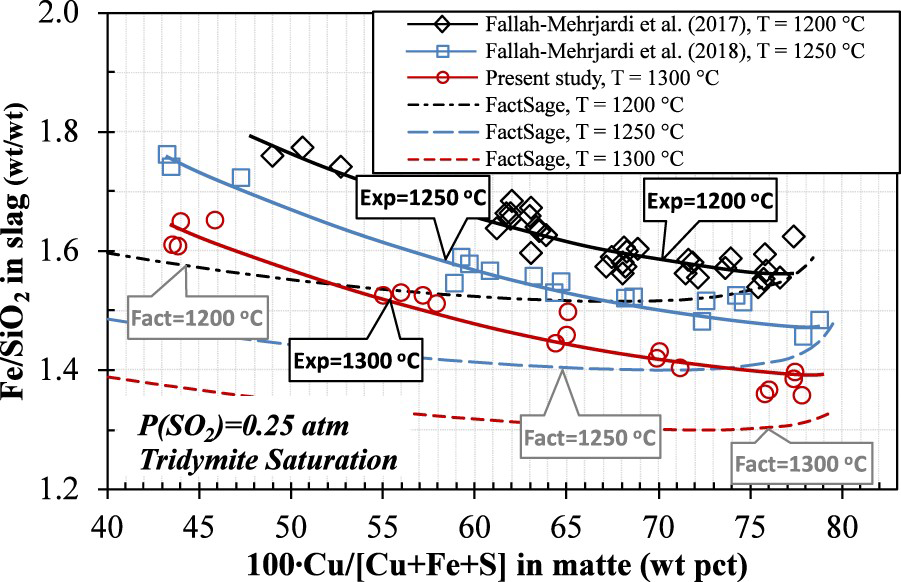
A graph showing the Fe/SiO2 ratio at the liquidus as a function of temperature, which combines the results from the present and previous investigations on the gas-slag-matte-tridymite (Fallah-Mehrjardi et al. 2017b, 2017c) and the gas-slag-matte-spinel equilibria (Hidayat et al. 2018, 2020), is given in Figure 6. The figure shows that the range of compositions at which the slag is fully liquid at a given temperature is limited by the primary phase fields and stabilities of solid spinel and tridymite. It can be seen that the composition of the tridymite liquidus is significantly less sensitive to changes in temperature compared to the spinel liquidus. Also, the composition of the tridymite liquidus is significantly less sensitive to changes in matte grade compared to the spinel liquidus. The copper grade of the matte is an indication of the degree of oxidation of the system; a higher matte grade corresponds to a higher effective oxygen partial pressure.
The liquidus temperature as a function of Fe/SiO2 ratio at the gas-slag-matte-tridymite and gas-slag-matte-spinel equilibria in the Cu-Fe-O-S-Si system at fixed p(SO2) = 0.25 atm and in mattes containing 50, 60, and 70 wt pct.Cu. Previous experimental data are taken from (Fallah-Mehrjardi et al. 2017b, 2017c; Hidayat et al. 2018, 2020)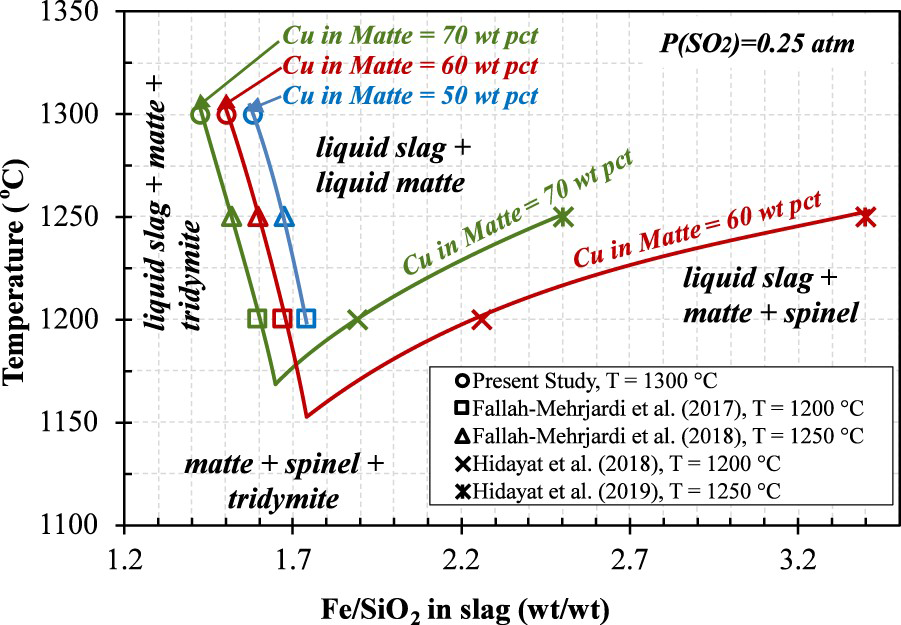
It can be seen that the experimental results obtained from the present study can be used directly to assess the effect of temperature on the process parameters of the pyrometallurgical processing of copper. The experimental results are also of importance for the development and improvement of a reliable thermodynamic databases for copper-containing systems.
Summary
An experimental investigation of the gas-slag-matte-tridymite equilibria in the Cu-Fe-O-S-Si system at 1300°C, p(SO2) = 0.25 atm and a range of selected oxygen partial pressures has been undertaken. Measurements have been made of the concentrations of Cu, Fe and S in matte and Cu Fe, S and Si in slag. This has enabled the concentrations of dissolved copper in slag to be determined as a function of matte grade and temperature. The data have also been used to construct diagrams of the liquidus temperatures as a function of Fe/SiO2 ratio for the Cu-Fe-O-S-Si system between 1200°C to 1300°C at p(SO2) = 0.25 atm in the tridymite and spinel primary phase fields; this form of representation serves a useful guide to fluxing with silica in industrial copper smelting practice.
Footnotes
Acknowledgments
The authors would like to thank the Australian Research Council Linkage program, Anglo American Platinum, Altonorte Glencore, Atlantic Copper, Aurubis, BHP Billiton Olympic Dam Operation, Boliden, Glencore Technologies, Kazzinc Glencore, PASAR Glencore, Outotec Oy (Espoo), Penoles, Rio Tinto Kennecott and Umicore for the financial support for this research. The authors would like to thank Mr Ryan Wright and Dr Denis Shishin for review and assistance in preparation of the manuscript. The authors acknowledge the support of the staff at the Centre for Microscopy and Microanalysis at the University of Queensland.
Disclosure statement
The authors declare that there are no conflicts of interest exist that could potentially influence or bias the submitted work.