







Abstract
Phase equilibria studies have been experimentally carried out in the ZnO–‘FeO’–Al2O3–CaO–SiO2–MgO system in equilibrium with metallic iron using high temperature equilibration, quenching and electron probe X-ray microanalysis techniques. Wüstite (Fe, Zn)O and spinel (Fe, Zn)O⋅(Al, Fe)2O3 are the major phases in the composition range investigated. The effects of Al2O3 and CaO/SiO2 ratio on the stabilities of the wüstite and spinel phases and the liquidus temperatures have been systematically investigated in the composition range relevant to lead and zinc blast furnace slags. Partitioning of ZnO has been determined between liquid and solid phases. Applications of the results to the prediction of liquidus temperature and proportion of the solid phase are discussed for lead and zinc blast furnace slags.
Introduction
ZnO, ‘FeO’, CaO, SiO2, Al2O3 and MgO are major components of the slags used in zinc blast furnaces (imperial smelting furnace, ISF) and lead blast furnaces. They are introduced into the slag through concentrates, secondary feed materials, fluxes, coal ash and dissolved refractories. Previously the phase diagrams in the systems ‘FeO’–CaO–SiO2 and ‘FeO’–CaO–SiO2–Al2O3 in equilibrium with metallic iron have been used to describe the phase equilibrium and liquidus temperatures of zinc and lead blast furnace slags (Richards, 1981). It is described in these systems that the compositions of the industrial slags are located in the wüstite (‘FeO’) primary phase field (Richards, 1981). However, analyses of the zinc-containing industrial slags show (Zhao, 1999; Lenz and Lee, 1984; Gammon et al., 1993; Yazawa and Kikuta, 1995) that spinel [(Fe2+, Mg, Zn)O⋅(A1, Fe3+)2O3] is the primary phase, which indicates that phase diagrams of the systems ‘FeO’–CaO–SiO2 and ‘FeO’–CaO–SiO2–Al2O3 do not accurately characterise the phase equilibria of zinc and lead blast furnace slags and cannot be directly applied to industrial operations.
Accurate experimental determination of the liquidus and the phase relations in zinc-containing slag systems under reducing conditions is difficult because of the high zinc vapour pressures and rapidly changing bulk compositions of the condensed phases. These hurdles have been largely overcome with new research methodologies and techniques developed by the author (Jak et al., 1997, 2002a, 2002b), that have been applied to the system ZnO–‘FeO’–CaO–SiO2 in equilibrium with metallic iron. The results have been presented in the form of pseudo-ternary sections ZnO–‘FeO’–(CaO+SiO2) with fixed CaO/SiO2 weight ratios of 0·33, 0·71, 0·93 and 1·2. Wüstite [(Fe, Zn)O], zincite [(Zn, Fe)O], olivine [(Fe, Ca)2SiO4], willemite [(Zn, Fe)2SiO4] and melilite [Ca2(Zn, Fe)2Si2O7] are the major primary phases reported in the composition ranges investigated. The experimental research has now been extended into the ZnO–‘FeO’–CaO–SiO2–Al2O3–MgO system in equilibrium with metallic iron to accurately characterise the complex zinc-containing slags.
The experimental techniques used in this study have been described in detail in a previous paper (Zhao et al., 2004). Essentially this involves the preparation and premelting of iron-free master slags from ZnO–CaO–SiO2–Al2O3–MgO mixtures. These master slags were ground to powder and mixed with metallic iron powder. The final mixture containing metallic iron was equilibrated in an iron metal foil in an ultra high purity N2 gas atmosphere after which the sample was rapidly quenched into cool water. On cooling, the liquid silicate present at the equilibration temperature is converted to a homogeneous glass and the solids present at temperature are retained without change in composition.
The quenched samples were mounted in resin and polished for analysis. Optical microscopy was first employed to identify the phases present in the sample. The compositions of these phases were then measured using a JEOL-8800L electron probe X-ray microanalyser (EPMA) with wavelength dispersive spectrometers (WDS). An accelerating voltage of 15 kV and a probe current of 15 nA were used. The Duncumb–Philibert ZAF correction procedure supplied with JEOL-8800L was applied. The standards used for analysis were from Charles M. Taylor Co. (Stanford, CA, USA): Al2O3 for Al, Fe2O3 for Fe, CaSiO3 for Ca and Si, MgO for Mg, and from Micro-Analysis Consultants Ltd (Cambridge, UK): ZnO for Zn. The average accuracy of the EPMA measurements was estimated to be within 1 wt-% of element concentration.
Only the metal cation contents in the samples were measured by EPMA; the oxygen content was calculated according to the assumed oxidation states of the metals. Since all of the slag samples were in equilibrium with metallic iron, all iron in the slag is calculated as ‘FeO’ for the purposes of the calculations.
Results and discussions
Experimentally determined phase diagrams are presented in form of pseudo-ternary sections ZnO–‘FeO’–(Al2O3+CaO+SiO2) with fixed CaO/SiO2 and (CaO+SiO2)/Al2O3 weight ratios. For the MgO-containing system the results are projected on the above pseudo-ternary section at fixed MgO concentration. Figure 1 shows 1553 K isotherms (the thin lines) for MgO-free and MgO-containing slags. The thick lines in the figure show the boundaries between the wüstite and spinel primary phase fields. It can be seen from the figure that wüstite (Fe, Zn)O and spinel (Fe, Zn)O⋅(Al, Fe)2O3 are the major primary phases present in the composition range investigated. In the wüstite primary phase field, the liquidus temperatures are principally dependent on the (ZnO+‘FeO’)/(Al2O3+CaO+SiO2) ratio. In the spinel primary phase field, the liquidus temperatures are principally dependent on the ZnO concentration.
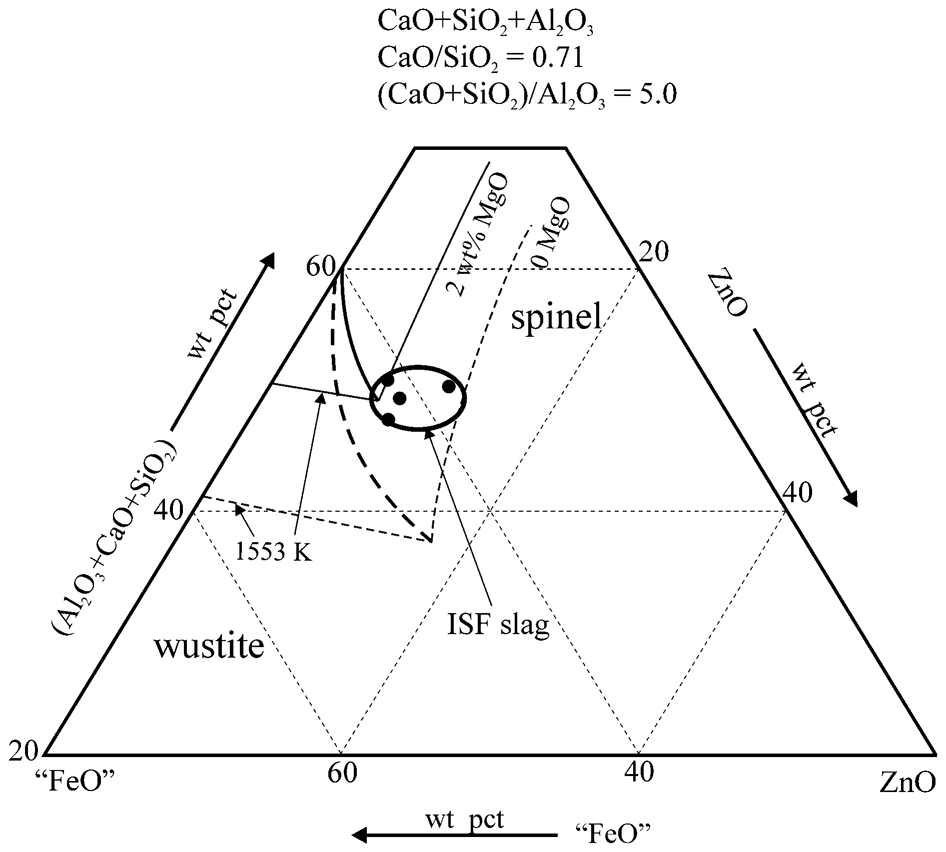
Experimentally determined 1553 K isotherms with 0 and 2 wt-% MgO projected onto the pseudo-ternary section ZnO–‘FeO’–(Al2O3+CaO+SiO2) with CaO/SiO2 = 0·71 and (CaO+SiO2)/Al2O3 = 5·0 in equilibrium with metallic iron
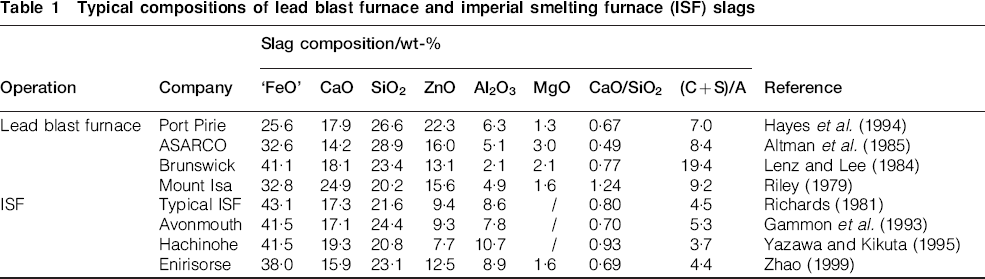
Table 1 shows some typical compositions of lead blast furnace and ISF slags normalised to 100%. All iron in the slag is calculated as FeO. In some slags, the MgO was not reported as a major component. It can be seen from Fig. 1 that 2 wt-% MgO can significantly increase liquidus temperatures in both wüstite and spinel primary phase fields. It can be seen from Table 1 that lead blast furnace slags cited have relatively low Al2O3 concentrations, and the CaO/SiO2 and (CaO+SiO2)/Al2O3 weight ratios in the slags vary over a wide range. In addition to the major components shown in Table 1, 4–5 wt-% MnO is also present in the Port Pirie lead blast furnace slag (Hayes et al., 1994; Manson and Segnit, 1956). Imperial smelting furnace slags have relatively high Al2O3 concentration and the (CaO+SiO2)/Al2O3 weight ratios in the slags are close to 5·0. It can be seen from Fig. 1 that all ISF slags are located in the spinel primary phase field. The liquidus temperatures of the MgO-free ISF slags are below 1553 K and in contrast, the liquidus temperatures of the MgO-containing ISF slags are above 1553 K.
Typical compositions of lead blast furnace and imperial smelting furnace (ISF) slags
Primary phases and liquidus temperatures in different systems
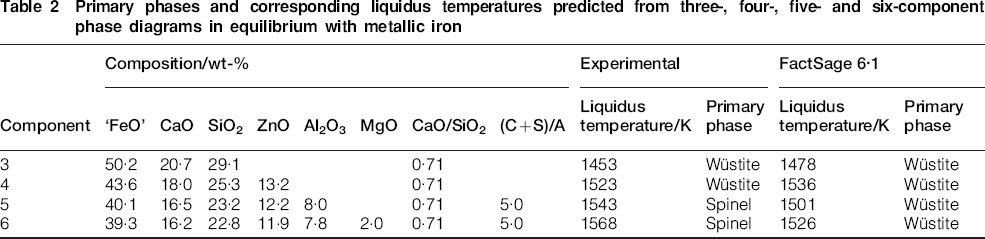
Phase diagram in the ‘FeO’–CaO–SiO2 system in equilibrium with metallic iron was initially used to predict the primary phases and liquidus temperatures of zinc and lead blast furnace slags (Richards, 1981). Phase diagrams in the zinc-containing systems ZnO–‘FeO’–CaO–SiO2 (Jak et al., 1997; Jak et al., 2002a; Jak et al., 2002b), ZnO–‘FeO’–CaO–SiO2–Al2O3 and ZnO–‘FeO’–CaO–SiO2–Al2O3–MgO have now been experimentally determined to characterise these complex slags. Table 2 shows the primary phases and corresponding liquidus temperatures of a typical zinc blast furnace slag predicted from three-, four-, five and six-component phase diagrams, respectively. For comparison, the predictions by FactSage 6·1 (Bale et al., 2002) are also given in the table. It can be seen that if six-component phase diagram is used, the slag is located in the spinel primary phase field with a liquidus temperature of 1568 K. If MgO is removed and the rest of the five components are normalised to 100%, the slag is still within the spinel primary phase field but the liquidus temperature is 25 K lower than that predicted from the six-component phase diagram. If only ‘FeO’–CaO–SiO2 phase diagram (Muan and Osborn, 1965) is used, it can be seen from Table 2 that the predicted primary phase is wüstite and the liquidus temperature is only 1453 K, which is 115 K lower than that predicted from six-component phase diagram. This example shows that more accurate phase equilibria information can be obtained from the phase diagram involving more elements. It can also be seen that in three- and four-component systems the predictions from FactSage 6·1 are close to the experimental results. However, in five- and six-component systems the predictions from FactSage 6·1 are significantly different from the experimental results.
Primary phases and corresponding liquidus temperatures predicted from three-, four-, five- and six-component phase diagrams in equilibrium with metallic iron
Effects of Al2O3 concentration and CaO/SiO2 ratio
It has been shown (Zhao et al., 2004) that with increasing Al2O3 concentration, i.e. decreasing (CaO+SiO2)/Al2O3 weight ratio, the size of the spinel primary phase field significantly expands and the size of the wüstite primary phase field decreases, and the equilibrium between wüstite and spinel moves to higher ‘FeO’ concentrations. This is clearly shown in Fig. 2, where the thick lines show the boundaries between different primary phase fields and the thin lines show the 1523 K isotherms. It can be seen that four primary phase fields are present in the composition range investigated in the section with the (CaO+SiO2)/Al2O3 ratio of 7·0, these are wüstite (Fe, Zn)O, zincite (Zn, Fe)O, spinel (Fe, Zn)O⋅(Al, Fe)2O3 and melilite Ca2(Fe, Zn)(Al, Si)2O7. At lower (CaO+SiO2)/Al2O3 ratio, i.e. higher Al2O3 concentrations, only two primary phase fields wüstite and spinel are present. The boundary line between the wüstite and spinel primary phase fields is moved towards higher ‘FeO’ concentrations with decreasing (CaO+SiO2)/Al2O3 ratio. The liquidus temperatures decrease slightly in the wüstite primary phase field but increase significantly in the spinel primary phase field with decreasing (CaO+SiO2)/Al2O3 ratio. The fully liquid composition range at 1523 K is significantly decreased with decreasing the (CaO+SiO2)/Al2O3 ratio.
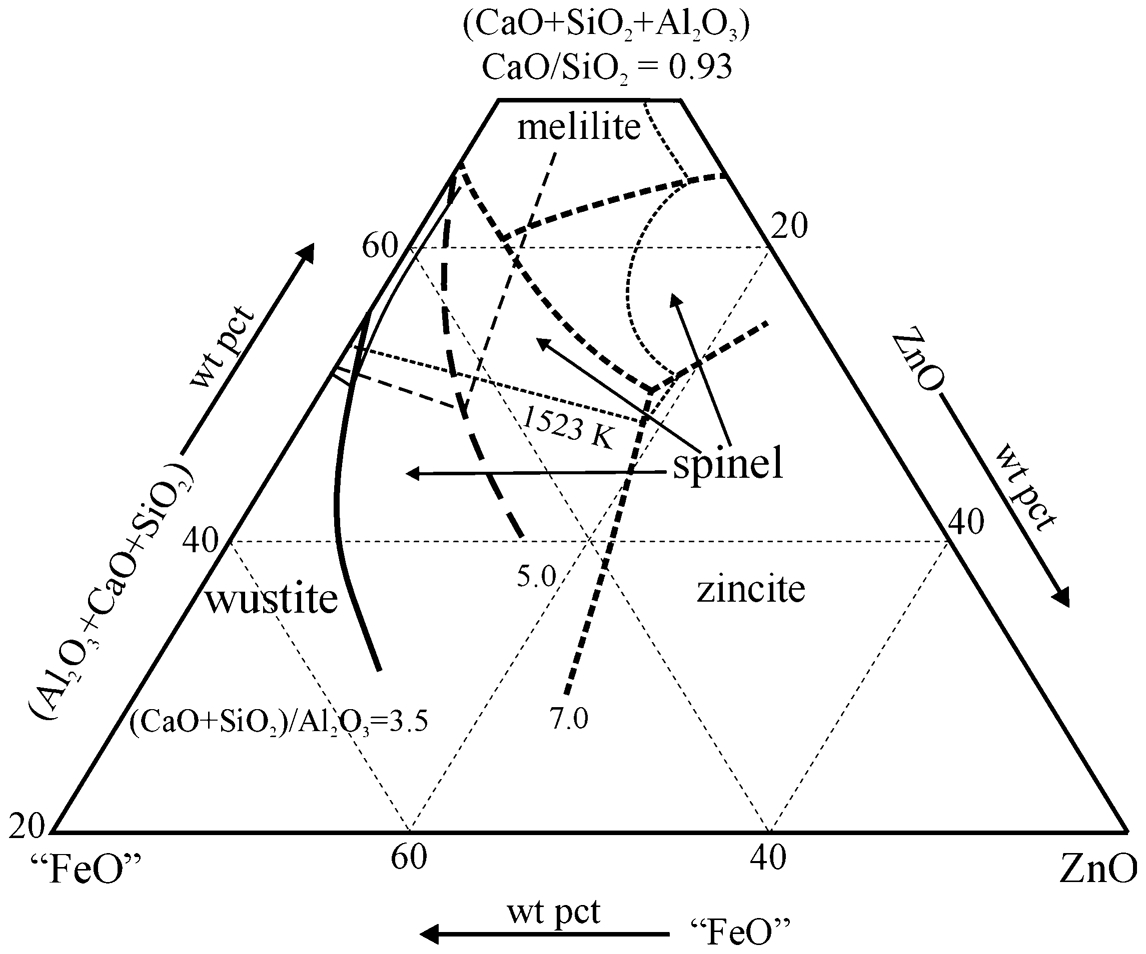
Effect of (CaO+SiO2)/Al2O3 ratio on liquidus temperature and the relative sizes of the wüstite and spinel primary phase fields in equilibrium with metallic iron, CaO/SiO2 = 0·93 in liquid in the ZnO–‘FeO’–CaO–SiO2–Al2O3 system
Figure 3 shows liquidus temperatures in spinel primary phase field as a function of Al2O3 concentration in the liquid at fixed 40 wt-% ‘FeO’ and 5 wt-% ZnO, and fixed CaO/SiO2 ratios of 0·55 and 0·71, respectively. It can be seen that the liquidus temperatures in the spinel primary phase field increase by 25–30 K with 1 wt-% increase of Al2O3 in the liquid. At a given Al2O3 concentration the spinel liquidus temperatures increase slightly with increasing CaO/SiO2 ratio.
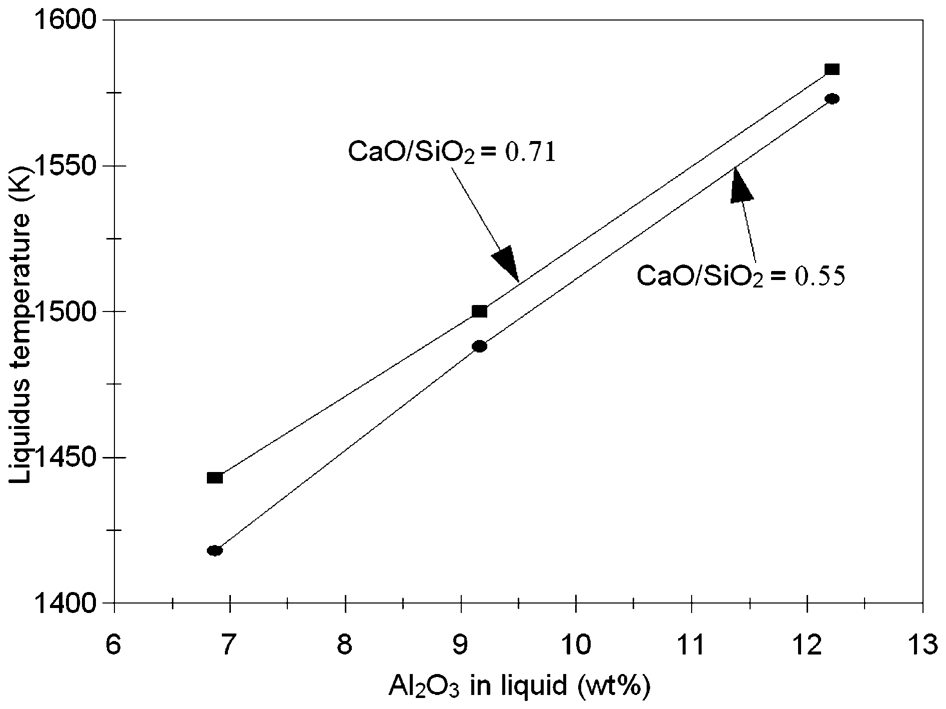
Effect of Al2O3 concentration in liquid on the spinel liquidus temperature at fixed 40 wt-% ‘FeO’ and 5 wt-% ZnO in equilibrium with metallic iron in the ZnO–‘FeO’–CaO–SiO2–Al2O3 system
Figure 4 shows the phase boundaries between the wüstite and spinel primary phase fields and 1553 K isotherms for pseudo-ternary sections having the same (CaO+SiO2)/Al2O3 ratio of 5·0. It can be seen that, at a given (CaO+SiO2)/Al2O3 ratio, increase of the CaO/SiO2 ratio stabilises the wüstite phase and moves the boundary towards lower ‘FeO’ concentrations. For example, at the (CaO+SiO2)/Al2O3 ratio of 5·0 and 10 wt-% ZnO, the wüstite phase is stable below 50 wt-% ‘FeO’ when the CaO/SiO2 ratio is 0·55 in the slag. However, if the CaO/SiO2 ratio in the slag is increased to 0·93, the wüstite phase is still stable at ‘FeO’ concentration as low as 43 wt-%. It can be seen that increase of the CaO/SiO2 ratio from 0·55 to 0·93 does not have significant effect on the liquidus temperature in the spinel primary phase field but significantly increases the liquidus temperature in the wüstite primary phase field. As a result, the fully liquid area at 1553 K is significantly reduced in the wüstite primary phase field with the increase of the CaO/SiO2 ratio from 0·55 to 0·93.
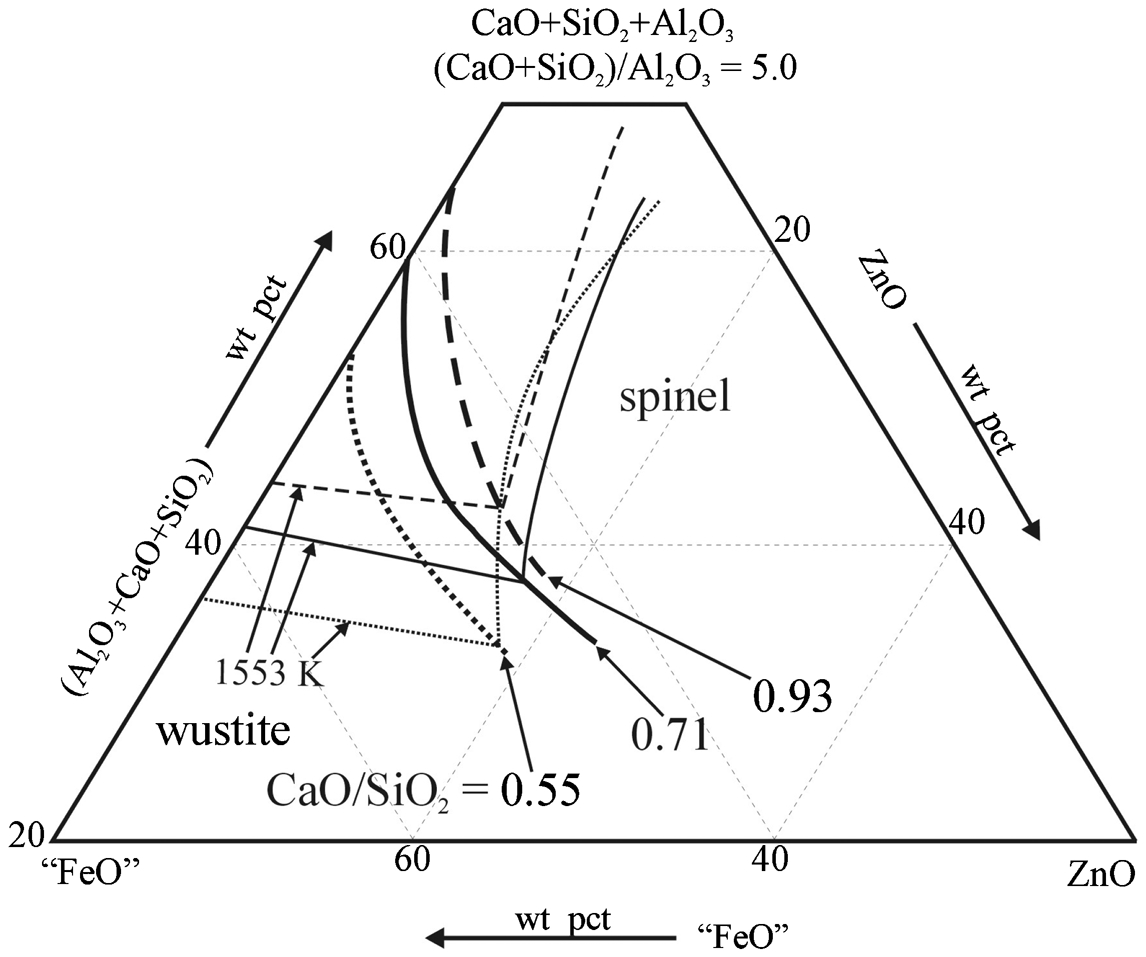
Effect of CaO/SiO2 ratio on liquidus temperature and the relative sizes of the wüstite and spinel primary phase fields in equilibrium with metallic iron, (CaO+SiO2)/Al2O3 = 5·0 in the ZnO–‘FeO’–CaO–SiO2–Al2O3 system
Figure 5 shows liquidus temperatures in the wüstite primary phase field as a function of CaO/SiO2 ratio in the liquid at fixed ‘FeO’/(CaO+SiO2) ratio of 1·22 and (CaO+SiO2)/Al2O3 ratios of 7·0 and 5·0, respectively, for ZnO-free slags. The results from the ‘FeO’–CaO–SiO2 system (Muan and Osborn, 1965), i.e. 0% Al2O3, are also given in the figure for comparison. It can be seen that the liquidus temperatures in the wüstite primary phase field increase significantly with increasing the CaO/SiO2 ratio. At a given CaO/SiO2 ratio, the wüstite liquidus temperatures decrease with increasing Al2O3 concentration [decreasing (CaO+SiO2)/Al2O3 ratio].
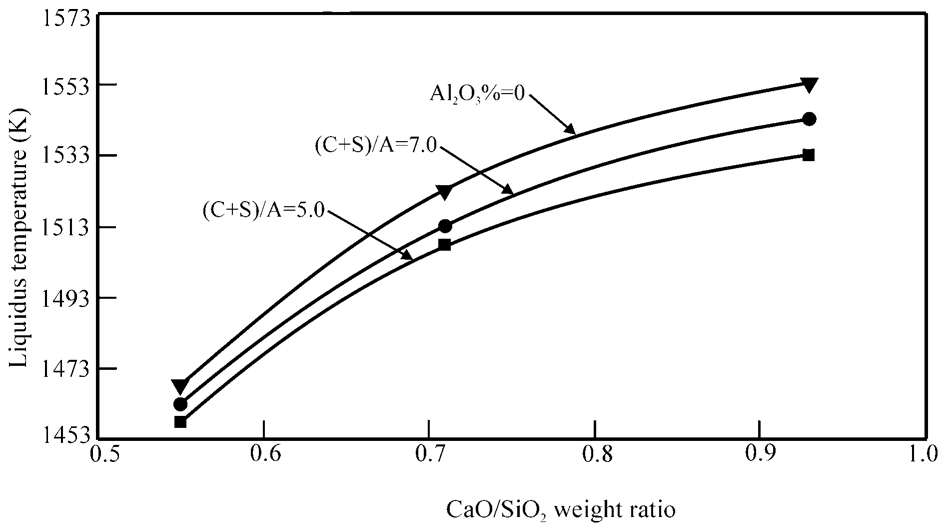
Effect of the CaO/SiO2 ratio on wüstite liquidus temperatures at fixed ‘FeO’/(CaO+SiO2) ratio of 1·22 in equilibrium with metallic iron in the ‘FeO’–CaO–SiO2–Al2O3 system
Solid/liquid equilibria
With the quenching and EPMA techniques used in the present study, the compositions of all phases present at equilibrium including liquid and solids can be accurately measured. EPMA measurements show that ‘FeO’ and ZnO are the major components in the wüstite phase, and ‘FeO’, ZnO and Al2O3 are the major components in the spinel phase. The partitioning of ZnO between liquid and wüstite, and between liquid and spinel are shown in Figs. 6 and 7, respectively.
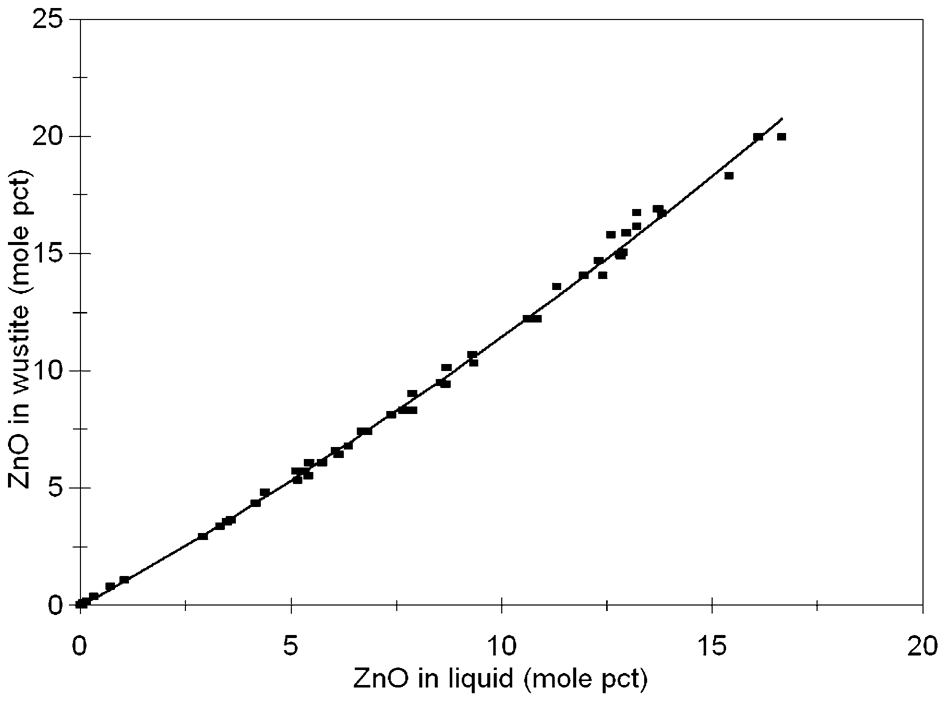
Distribution of ZnO between the liquid and wüstite phases for temperatures between 1383 and 1553 K in equilibrium with metallic iron, CaO/SiO2 = 0·62–0·75, (CaO+SiO2)/Al2O3 = 6·3–9·5 in the ZnO–‘FeO’–CaO–SiO2–Al2O3 system
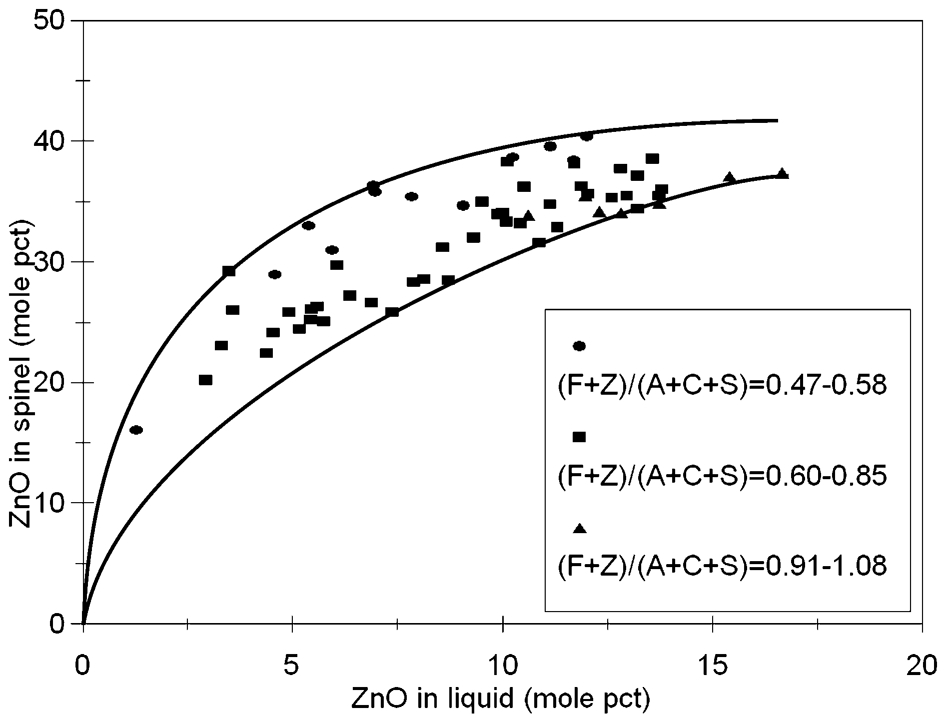
Distribution of ZnO between liquid and spinel for temperatures between 1383 and 1523 K in equilibrium with metallic iron, CaO/SiO2 = 0·62–0·76 and (CaO+SiO2)/Al2O3 = 6·1–9·8 in the ZnO–‘FeO’–CaO–SiO2–Al2O3 system
The solid symbols in Fig. 6 are experimental points in the temperature range between 1383 and 1553 K in the ZnO–‘FeO’–Al2O3–CaO–SiO2 system. The CaO/SiO2 weight ratios in the liquid are in the range of 0·62 to 0·75 and the (CaO+SiO2)/Al2O3 weight ratios in the liquid are in the range of 6·3 to 9·5. The line through these points is one of ‘best fit’. The correlation between ZnO concentrations in wüstite (y) and ZnO concentrations in liquid (x) can be represented by the following equation (all concentrations in mole percentage)

Electron probe X-ray microanalyser measurements of the spinel phase show that it is a solid solution (Fe2+, Zn)O⋅(A1, Fe3+)2O3, with end members of hercynite (FeAl2O4) and gahnite (ZnAl2O4) with small amount of magnetite (Fe3O4). The Al2O3 concentration in the spinel phase is between 45·8 and 50·3 mol.-% at temperature between 1383 and 1523 K. The partitioning of ZnO between spinel and the corresponding liquid is presented in Fig. 7. It can be seen that ZnO concentration in spinel phase is much higher than that in the liquid phase. The partition ratios between spinel and liquid are typically in the range of 2 at high zinc concentrations to 6 at low-zinc concentrations in the liquid. Temperature does not appear to have a significant effect on the partition ratio. It can be seen from the figure that an increase in the (‘FeO’+ZnO)/(Al2O3+CaO+SiO2) mole ratio appears to decrease the ZnO concentration in the spinel phase.
Proportion of solid phases in slag
The viscosity of the slag containing solid phases can be expressed by the Einstein equation (Einstein, 1906)

The formation of the wüstite and spinel phases leads to increased slag viscosity and increased tendency for blockage during slag tapping. The precipitation of wüstite and spinel solid phases in the slag increases the apparent viscosity in two ways. First, EPMA measurements show that SiO2 is not present in the wüstite and spinel solid phases. Formation of wüstite and spinel phases selectively removes ZnO, ‘FeO’ and Al2O3 from the liquid phase and increases the SiO2 concentration of the remaining liquid, therefore increases viscosity of the liquid [μ0 in equation (2)]. Second, it can be seen from equation (2) that the viscosity of the slag is strongly dependent on the proportion of the solid phases present at temperature. It is therefore important to predict the proportion of the solid phases for a given slag composition at given temperatures.
Electron probe X-ray microanalyser measurements show that wüstite is a solid solution of ‘FeO’ and ZnO and it is located in the pseudo-ternary section ZnO–‘FeO’–(Al2O3+CaO+SiO2) regardless of the CaO/SiO2 and (CaO+SiO2)/Al2O3 ratios. When the wüstite precipitates out of the liquid of a given Al2O3/CaO/SiO2 ratio, these ratios in the remaining liquid phase do not change. Therefore both the solid and the liquid compositions stay in the plane of the section. The wüstite primary phase field therefore can be treated as true ternary phase diagram. The proportion of the wüstite phase can be directly obtained from the pseudo-ternary diagram according to the lever rule.
In the other hand, the spinel phase contains ZnO, ‘FeO’ and Al2O3 and it does not lie on the same pseudo-ternary section as the liquid. The lever rule cannot be applied to predict the proportion of the spinel phase directly. However, using the experimental data determined in the present study it is possible to estimate the proportion of the solid phases including spinel. Considering a slag P, having initial composition of 40 wt-% ‘FeO’, 10 wt-% ZnO and 50 wt-% (Al2O3+CaO+SiO2) with CaO/SiO2 = 0·71 and (CaO+SiO2)/Al2O3 = 3·5. It was found that this slag is located in the spinel primary phase field and the liquidus temperature is estimated to be 1593 K from the phase diagram determined (Zhao et al., 2004). If this slag is allowed to cool, spinel will first crystallise. Electron probe X-ray microanalyser measurements show that the Al2O3 concentration in the spinel is approximately 55 wt-%. If spinel is precipitated out of the liquid, the (CaO+SiO2)/Al2O3 ratio in the liquid will increase and the CaO/SiO2 ratio will stay constant. Assuming at certain temperature x% spinel is precipitated from the slag P so that the (CaO+SiO2)/Al2O3 ratio of the liquid is changed from 3·5 to 5·0; the composition of the new liquid phase and proportion of the spinel precipitated can be obtained by mass balance. Using the same approach as above, the liquid composition, proportion of the spinel and liquidus temperature can be obtained for (CaO+SiO2)/Al2O3 = 7·0. At a certain temperature wüstite will co-precipitate with the spinel and the proportion of the solid phases will include both wüstite and spinel. Figure 8 shows proportions of solid phases estimated from the experimental data and those predicted from FactSage 6·1. It can be seen that the proportion of the solid increases slowly with decreasing temperature if only wüstite is present. However, the proportion of the solid increases rapidly with decreasing temperature when the spinel starts to form. It can be seen from Fig. 8 that the liquidus temperature of slag P is 1593 K. The proportion of the solid is approximately 10 wt-% at 1493 K but increases to approximately 30 wt-% at 1443 K. FactSage 6·1 predicts similar trend but with relatively lower liquidus temperature and proportion of the solid phases. Besides providing a useful trend analysis, one of the advantages of using model predictions is that it also enables the sub-liquidus equilibria to be explored. In the example given above from the liquidus information alone it would not be possible to predict the co-precipitation once the liquid composition leaves the pseudo-ternary section.
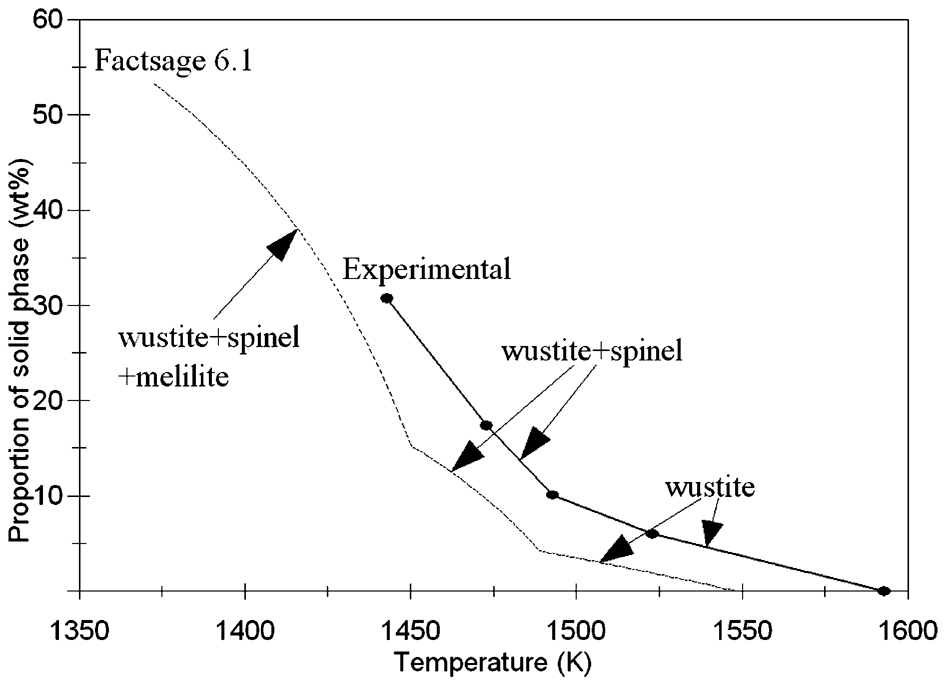
Proportions of solid phases as a function of temperature for a slag with 10·0 wt-% ZnO, 40·0 wt-% ‘FeO’, 16·2 wt-% CaO, 22·7 wt-% SiO2 and 11·1 wt-% Al2O3, estimated from the experimentally determined phase diagram (Zhao et al., 2004) and comparison with FactSage predictions
Industrial implications
Experimentally determined phase equilibria data on the multicomponent slag systems relevant to lead blast furnaces and ISP operations have provided important new information on these systems. These data provide more accurate descriptions of slag behaviour than previously obtained using the ‘FeO’–CaO–SiO2 system approximations.
Primary phases
It has been shown that in systems containing ZnO, MgO and Al2O3, the spinel primary phase can form even at low oxygen partial pressures represented by metallic iron saturation. The extent of the spinel primary phase field increases with increasing MgO and Al2O3 concentrations.
Electron probe X-ray microanalyser measurements show that ZnO concentration in wüstite is slightly lower, and in spinel phase is much higher, than that in the liquid phase. Formation of the spinel phase will result in significant partitioning of zinc to the spinel phase in the slag.
Liquidus temperature
Knowledge of the primary phase field assists in identifying the trends in the liquidus surfaces with changing bulk composition of the slags. The liquidus temperature data on wüstite primary phase field increase with increasing (ZnO+‘FeO’)/(Al2O3+CaO+SiO2) and CaO/SiO2 ratios. The liquidus temperatures in spinel primary phase field increase with increasing ZnO and Al2O3 concentrations. In addition, it has been shown in Table 2 that over 100 K difference of liquidus temperature can be predicted by using three-component phase diagram and six-component phase diagram. The closer the number of the components to the real slag, the more accurate liquidus temperature can be predicted.
Proportion of solid phases
It has been shown that using appropriate pseudo-ternary sections of the ZnO–‘FeO’–CaO–SiO2–Al2O3 system it is possible to estimate the proportions of the solid phases present at temperatures below the liquidus in the wüstite and spinel primary phase fields. Formation of suitable solid phases can help in the protection of the hearth refractory. However, the presence of extensive solid phase can also significantly increase the viscosity of the slag and cause operational difficulties such as in slag tapping. In practice the slags having greater than 20 wt-% solids are known to have significantly greater viscosities than fully liquid slags.
Conclusion
Phase equilibria and liquidus temperature in the ZnO–‘FeO’–CaO–SiO2–Al2O3–MgO system in equilibrium with metallic iron have been experimentally determined for wide range of compositions. Primary phase and liquidus temperature of the industrial slags can be more accurately predicted with the multicomponent phase diagram. Wüstite and spinel are the major primary phases in the composition range related to zinc and lead blast furnace slags. The liquidus temperatures in wüstite primary phase field increase with increasing (ZnO+‘FeO’)/(Al2O3+CaO+SiO2) and CaO/SiO2 ratios. The liquidus temperatures in spinel primary phase field increase with increasing ZnO and Al2O3 concentrations. Extensive wüstite (Fe2+, Zn)O and spinel (Fe2+, Mg, Zn)O⋅(A1, Fe3+)2O3 solid solutions are formed and the ZnO concentrations in the spinel phase are significantly higher than in the corresponding liquid phase. Estimation of solid fraction in the slag using the experimental data is demonstrated.
Footnotes
Acknowledgement
The authors wish to thank the Australian Research Council (ARC-SPIRT scheme), ISP Ltd, Britannia Zinc Ltd, Enivisorse SA, Pasminco Sulphide, Rio Tinto Technical Services, MHD GmbH, Metaleurop and Hachinohe Smelting Co. Ltd for providing the financial support to enable this research to be carried out, and providing scholarship support.
Part of this work was presented at Lead-Zinc 2010, Vancouver, Canada, 2010.