







Abstract
The possibility of using Icelandic basalt for production of continuous fibres with presently known technology was investigated. One hundred and forty-five samples were taken based on selected field and petrographical criteria and further geochemically analysed. Additional sample discrimination using the geochemical results indicates that it may be difficult to find a suitable basalt for such production. However, minor modification to the composition of three samples is adequate to make them suitable. The viscosity of one specimen was further measured and found to be within the known limits for production of continuous fibres. It, therefore, seems possible that selected samples from the collection are suitable for production of continuous basalt fibres.
Introduction
Basalt is the most common rock on the surface of the planet and is the dominant component of oceanic crust, as well as of many mid-oceanic islands, including Hawaii and Iceland (e.g. Klein and Philpotts 2015). Utilisation of basalt has been developed for several industrial applications such as in the building industry and highway engineering (e.g. Morozov et al. 2001; Singha 2012; Pisciotta et al. 2014). Basalt has also been used in casting processes to make tiles and slabs for architectural applications, and cast basalt tubes have been used in industrial applications because of its high abrasion resistance. The concept of using molten rock to form fibres dates from the 1920s and the production of basalt rock wool is a well-known industrial product. However, serious research work to develop continuous basalt fibres (CBF) began in the 1960s, principally undertaken in former Soviet countries and the U.S.A. (Ross 2006).
In many ways, the properties of basalt fibres resemble those of glass fibres, but basalt fibres have the advantage of being useful at higher temperatures than glass fibres (e.g. Morozov et al. 2001; Cerny et al. 2007) and are more stable in strongly alkaline liquids (e.g. Scheffler et al. 2009). Production of CBF is a relatively young industry with many of the leading manufacturing companies being less than 20 years old and showing rapid technological advance. The current market is steadily developing as production becomes more economic and CBF becomes more widely tested and recognised.
Although basalt deposits in the world are abundant, only a small number contain basalt suitable for production of CBF (e.g. Singha 2012; Tatarintseva et al. 2012b). This is because the composition and petrology of the basalt must be of a narrow range to be suitable for the presently known technology. A particular constraint is the requirement to optimise the viscosity of fibre production which reflects the basalt's composition.
Recently a NordMin program was set up by the Nordic Council of Ministers, with the purpose of creating a Nordic Network of Expertise for a Sustainable Mining and Mineral Industry. The GREENBAS project was funded within the NordMin program with a focus on gaining knowledge on relevant properties of basalt in Iceland suitable for production of high quality CBF. Participants were Innovation Center Iceland (ICI), Iceland GeoSurvey (ISOR), Reykjavik University (RU) and Íslenskur Jarðefnaiðnaður (JEI) in Iceland, SINTEF in Norway and VTT in Finland.
In this paper, we focus on the sampling process, the criteria used to classify samples and the main results.
Petrology of Icelandic basalt and sampling criteria in field
Iceland sits astride the Mid-Atlantic Ridge and is underlain by an anomalous mantle plume. Over 90% of the rocks erupted and intruded is of basaltic composition, with about 2% intermediate and 8% silicic rocks, the latter two occurring within central volcanic complexes. Figure 1 is a geological map of Iceland, showing the volcanic rift zones and then progressively older rock formations with increasing distance from the rift zones.
Geological map of Iceland showing the four main geological zones. Circles show sample locations and sample id.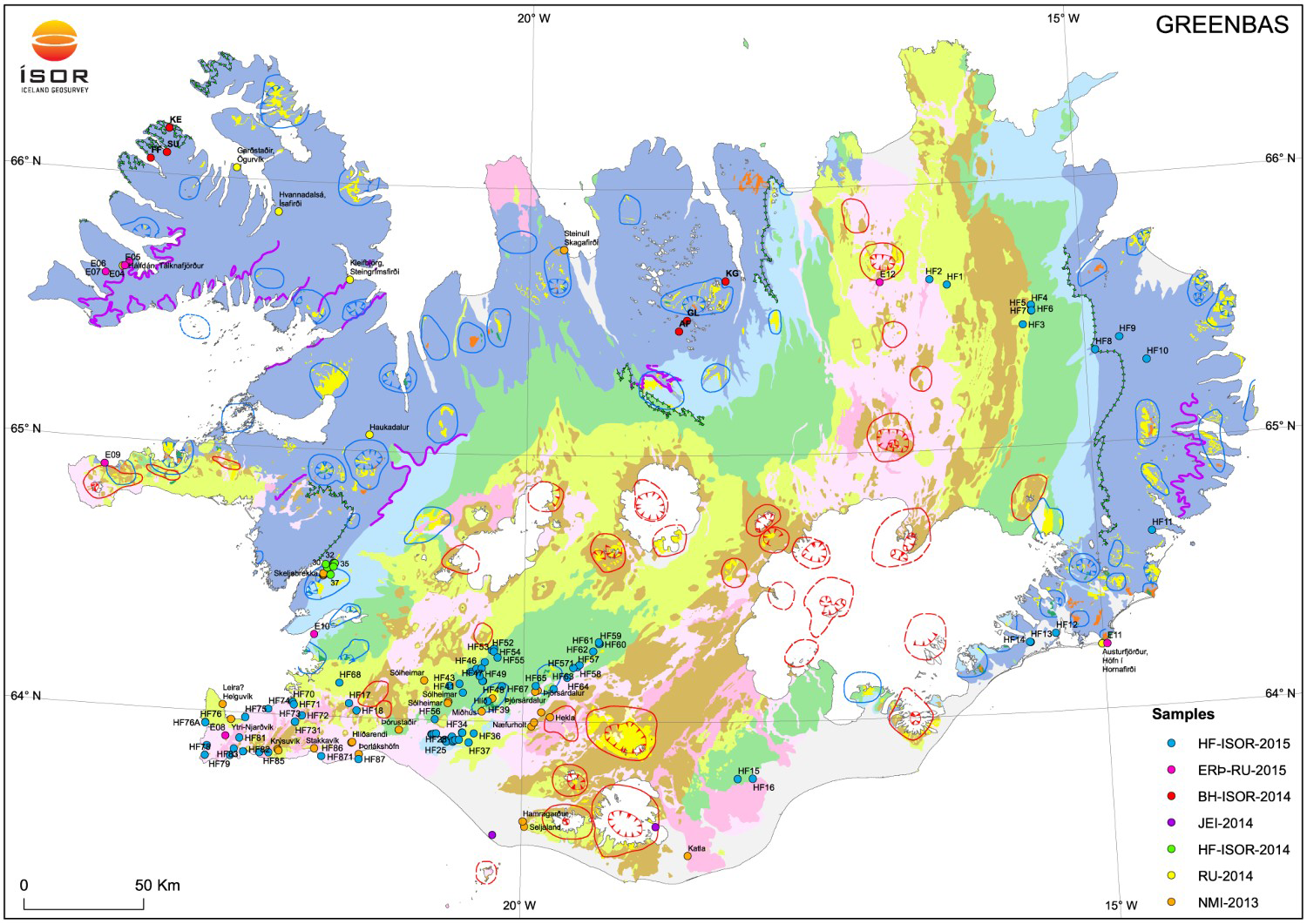
The island's rocks are mostly tholeiitic basalts, together with less common alkali basalts. Most surface rocks are fresh or have been subject to zeolite alteration.
Sampling criteria were established prior to fieldwork based on a survey of the literature and discussions with colleagues (Stekloplastic, Moscow. Boris Gromkov, personal communication 2014, Lipex GmbH, Germany. Toni Schneider, Gert Lichtblau. Personal communication, 2015). They were as follows: (1) Lava flows and possibly intrusions (if accessible). (2) Aphyric rock. Porphyritic nature is considered to affect the fibre forming process and properties of the fibres. (3) Finely crystalline rock. In general, the crystal size becomes smaller as rocks become more evolved. Thus, olivine tholeiite has coarser crystals than quartz tholeiites. Andesites have the smallest grain size. All of these were sampled. (4) Non-vesicular rock. The reason for this criterion was not clear except from the standpoint that these could contain undesirable mineral fillings where rocks had undergone hydrothermal alteration. This constraint was abandoned on the grounds that samples were largely taken from fresh rocks with no secondary mineral fillings. (5) No hydrothermal alteration. This criterion was mostly adhered to. (6) Accessibility. This is economically very important, and the guideline was set to a 500 m maximum distance from the nearest road. (7) Sufficient volume. A rough volume estimate was done at each location and only sampled if sufficiently large. (8) Environmentally acceptable location. This criterion may have the largest error margin, as any location outside an existing quarry may be subject to environmental review. Sample selection takes place at locations where the environmental impact is considered to be minimal. (9) Chemical composition. This criterion is the most important one. We used an extensive ISOR data base on basalts (Hooper et al. 2014), first of all to evaluate the probability of finding samples of the appropriate composition and to guide the fieldwork. The evaluation indicated that several locations hosted rocks of appropriate composition. However, this data base does not take the above criteria into account, which reduces it to an indication only of compositional probability. The compositional ranges of individual chemical components are given in the following section.
Geochemical selection criteria for production of CBF
Chemical composition and mineral content of basalt vary considerably. For applications such as tiles, stone castings or staple fibres, basalt with a wide range of properties can be used. However, for production of CBF, the requirements become much more stringent and only a narrow range of compositions can be used (e.g. Singha 2012; Tatarintseva et al. 2012b; Vasileva et al. 2014). With such strict requirements for composition and mineral content, the list of possible basalt mines in the world becomes very short (Singha 2012; Tatarintseva et al. 2012b). Today, major manufacturers of CBF are known to use raw material from mines in western Ukraine and Georgia consisting of andesitic basalts with SiO2 content more than 50 wt-% (Morozov et al. 2001; Novitskii and Efremov 2013). In the search for possible basalt mines in Iceland, a method with a set of criteria was defined and applied. The limits of basalt properties published in the literature and used here are based on experience gained from production of CBF. These limits should not be applied slavishly but used as general guidelines. The ultimate test of applicability of a sample must also be based on measurements of viscosity, crystallisation and related properties.
Chemical composition
The first step was to define limits of composition for all major oxides. The ‘window’ of oxide content used in selecting basalt for production of CBF varies between sources (e.g. Johannesson et al. 2016). In this project, it was decided to use the limits given by Lipex GmbH (Lipex GmbH, Germany. Toni Schneider, Gert Lichtblau. Personal communication, 2015). In weight % of main oxides, these are 45–60% SiO2, 12–19% Al2O3, 5–15% FeO/Fe2O3, 6–12% CaO, 3–7% MgO and 0.1–2% TiO2.
Acidity modulus
A parameter that has frequently been used in the selection process is the acidity modulus Ma defined by
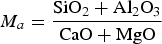
Signs for oxides denote weight % of oxides. Ma denotes the ratio of acidic to basic oxides. The optimal chemical composition for production of CBF is considered to be one that gives an acidity modulus in the range 3–6 (e.g. Tatarintseva and Khodakova 2010, Tatarintseva et al. 2012a).
Viscosity modulus
Another parameter that can be used in the selection process is the viscosity modulus Mv defined by

Sampling of Icelandic basalt
Having established a window for composition as well as acidity and viscosity moduli, an extensive database at ISOR (Hooper et al. 2014) was used to evaluate the probability of finding suitable rocks, as described in the section ‘Petrology of Icelandic basalt and sampling criteria in field’. Samples were then collected, and the following steps taken:
analysis of chemical composition; evaluation of acidity modulus (Ma) and viscosity modulus (Mv). Ideally, the acidity modulus should be in the interval 3–6 and the viscosity modulus in the interval 2–3; for selected samples, measurement of viscosity, melting temperatures, crystallisation, electrical resistivity and other relevant properties (e.g. loss of ignition, degassing, etc.).
Steps 1 and 2 were taken in the GREENBAS project and viscosity was measured for one sample. The 145 samples were collected during four summers from 2013 to 2016 (for a detailed account of the project, including locations of all sampling sites, see Johannesson et al. 2016). Oxide content of all samples was measured with a simultaneous ICP-OES instrument (SPECTRO-CIROS) at the Institute of Earth Sciences, University of Iceland. After each field trip, all relevant aspects were evaluated, and a decision was then taken on location of the next field trip. As the work progressed it became clear that samples of evolved composition such as andesite, which contained more than 50 wt-% SiO2, were most likely to meet all constraints (e.g. Novitskii and Efremov 2013).
Results
Figure 2(a, b) shows results for six main oxides as a function of specimen number for all 145 specimens.
(a) Measured content of SiO2 (filled circles), Al2O3 (circles), CaO (triangles) and MgO (crosses) as a function of specimen number for 145 specimens. The horizontal lines show upper and lower limits for SiO2. The diamonds furthest to the right in the picture show values for a reference sample from Ukraine. (b) Measured content of FeO/Fe2O3 (filled circles) and TiO2 (triangles) as a function of specimen number for 145 specimens. Horizontal lines show upper limits for both oxides. The diamonds furthest to the right in the series show values for a reference sample from Ukraine.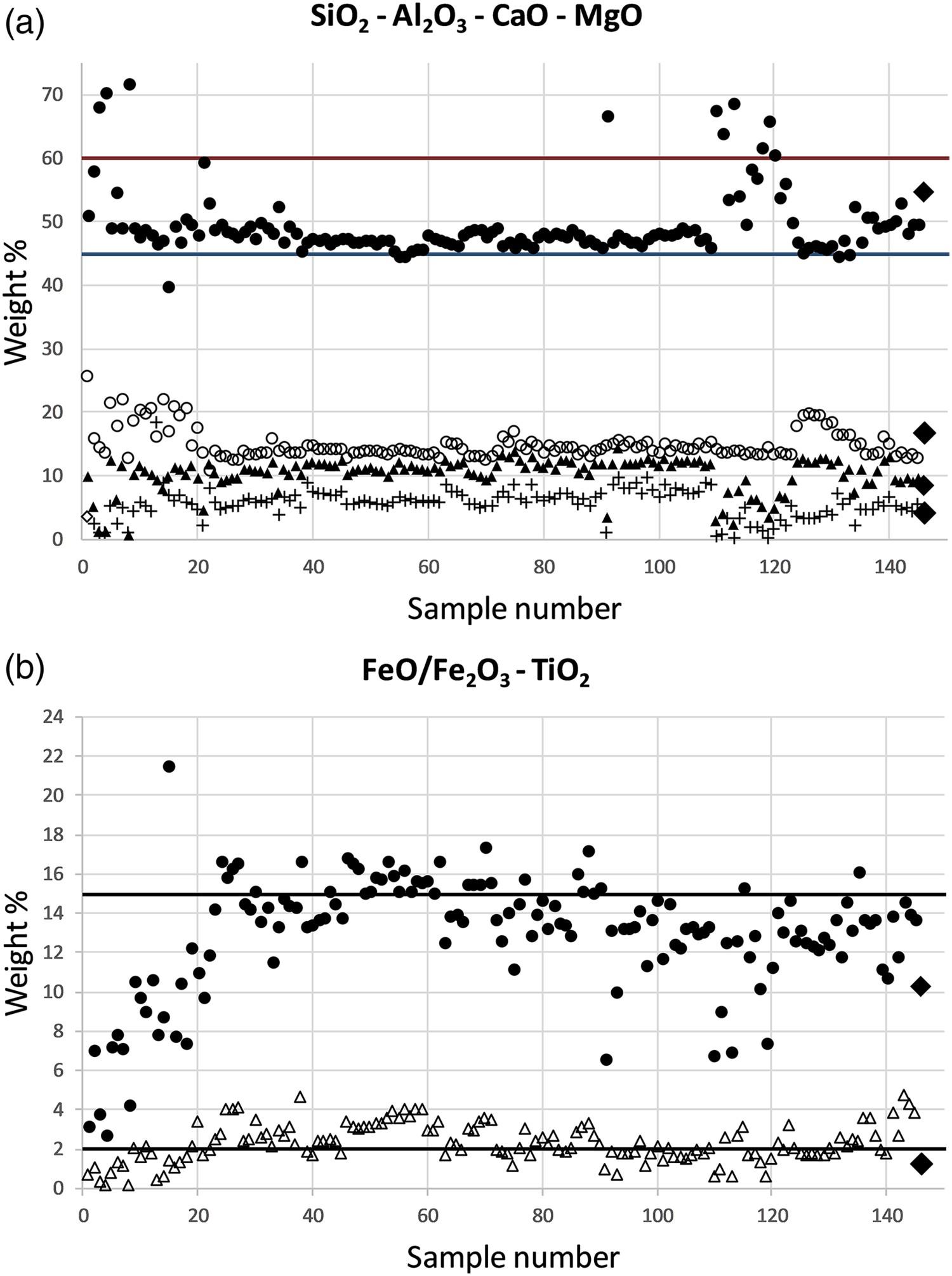
The top series in Figure 2(a) shows that, for most specimens, the SiO2 content is close to the lower limit, with values between 45 and 50 wt-%. This is reflected in the acidity modulus in Figure 3(a) where values are at or just above the lower limit of 3 for most specimens. Figure 2(b) shows that the proportions of iron oxides and titanium oxide are considerable, with many specimens being close to or above the upper limit.
(a) Acidity modulus Ma as a function of specimen number for all 145 specimens. Horizontal lines show upper and lower limits. Diamond furthest to the right shows the value for a reference sample from Ukraine. (b) Viscosity modulus Mv as a function of specimen number for all 145 specimens. Horizontal lines show upper and lower limits. Diamond furthest to the right shows value for a reference sample from Ukraine.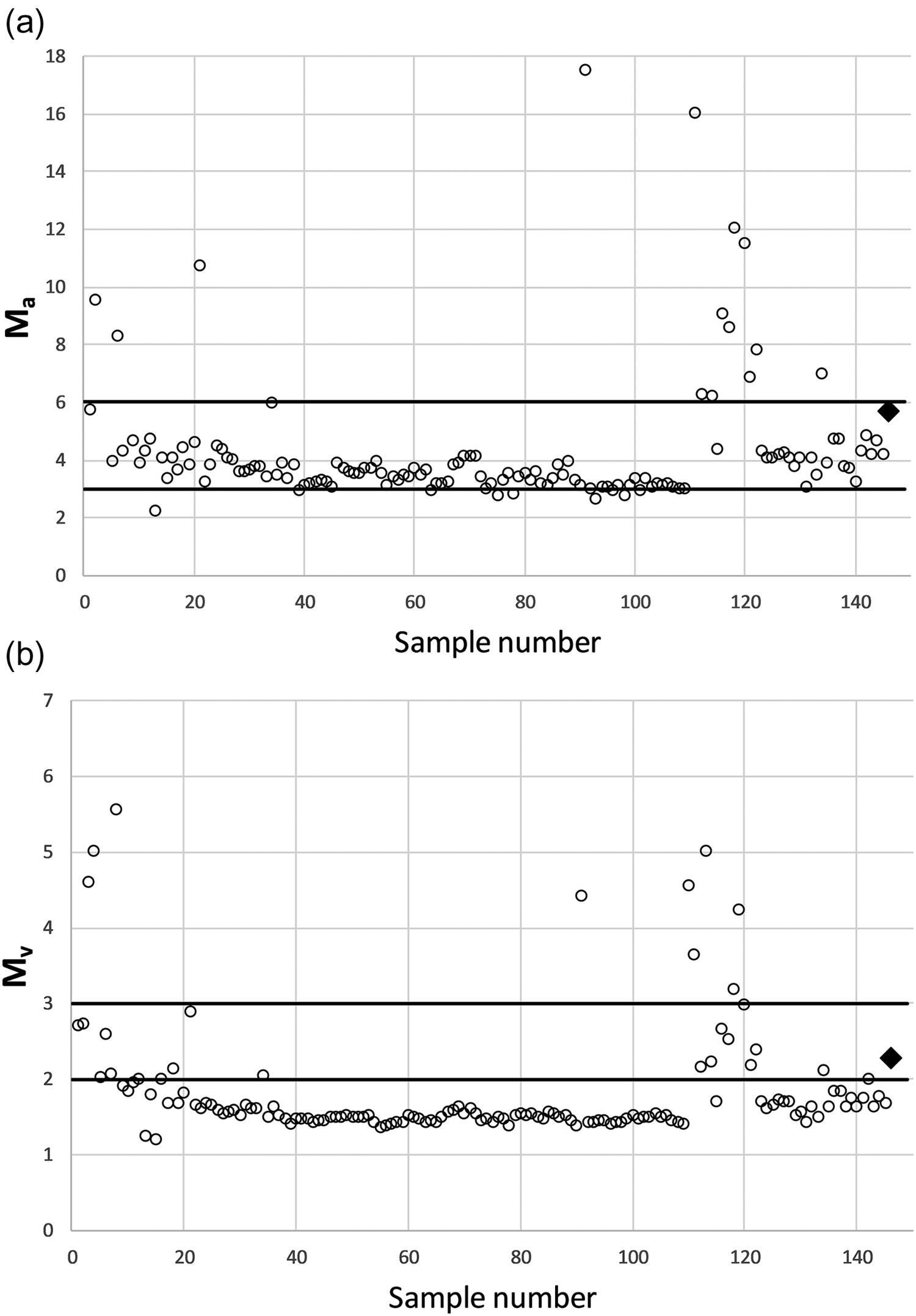
Figure 3(b) shows that the viscosity modulus for most of the specimens lies below the lower limit, with about dozen specimens lying within the limits.
Oxide content (wt-%) and acidity and viscosity moduli for three samples selected for further consideration.
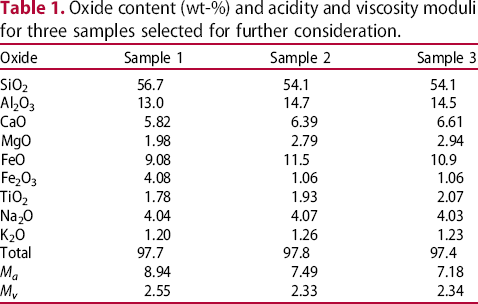
The acidity modulus is above the upper limit for all three specimens, but the viscosity modulus is within limits. Further steps were not taken in the GREENBAS project. To illustrate what steps could be taken next, a straightforward way to reduce the acidity modulus would be to add burnt lime, which is mostly CaO. Figure 4(a, b) shows the acidity and viscosity moduli of the three samples in Table 1 before (columns 1, 2 and 3) and after (columns 4, 5 and 6) addition of 5 wt-% CaO. With this addition of CaO, the acidity modulus is within limits and the viscosity modulus is close to the lower limit. These basalt samples would, therefore, become more suitable for CBF production.
(a) Acidity modulus (Ma). (b) Viscosity modulus (Mv). Columns 1, 2 and 3 show the acidity and viscosity moduli for the three specimens in Table 1. Columns 4, 5 and 6 show the acidity and viscosity moduli after addition of 5% burnt lime (CaO).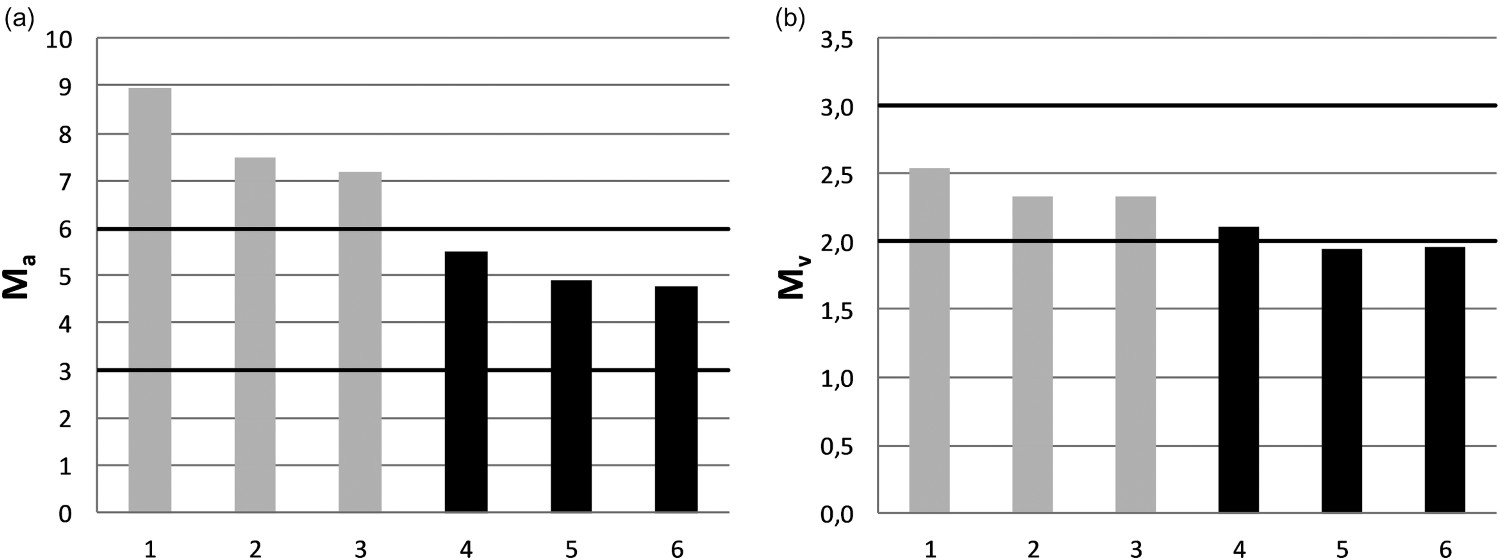
Viscosity measurements
One of the most important properties of basalt that determines its suitability for manufacturing continuous fibres is the viscosity, η (units of Pa s). Basaltic melts can form continuous fibres in a viscosity range of 10–30 Pa s (e.g. Dzhigiris et al. 1983; Tatarintseva and Khodakova 2012; Tatarintseva et al. 2012b). This range of viscosity is typically in the temperature range 1380–1440°C (Tatarintseva and Khodakova 2012). Basalt contains titanium, magnesium and calcium oxides and a high content of iron oxides. If the melting process takes place in atmospheric air, as is usually the case in CBF production, oxidation leads to formation of crystallites of e.g. magnetite. This increases viscosity of the melt and can adversely affect stability of the fibre forming process as well as properties of the fibres. In addition, oxidation leads to increase in Fe2O3 content and decrease in FeO content. This also increases viscosity of the melt (e.g. Sörensen et al. 2005; Ivanitskii et al. 2011; Singha 2012; Tatarintseva and Khodakova 2012; Tatarintseva et al. 2012b; Gutnikov et al. 2013; Perevozchikova et al. 2014; Vasileva et al. 2014; Manylov et al. 2015; Pisciotta et al. 2015). The effect of scale should also be kept in mind. Viscosity measurement of a small quantity of basalt in a crucible may not scale up to viscosity of basalt in a plant size CBF production. With these considerations in mind, a preliminary experiment was done to measure the viscosity of sample 1 (Table 1) in atmospheric air with an FRS 1600 Furnace Rheometer System from (Anton Paar 2015). The results are shown in Figure 5. The two horizontal lines (10 and 30 Pa s) show lower and upper limits for production of continuous fibres. The two vertical lines (1380 and 1400°C) show the temperature limits used at Stekloplastic in drawing of fibres with basalt from Ukraine (Stekloplastic, Moscow. Boris Gromkov, personal communication 2014). Figure 5 shows that, based on this measurement, this basalt sample appears to be suitable for continuous fibre drawing. Figure 5 also shows the calculation of viscosity with a formula from Giordano et al. (2008) (squares). Water content is an adjustable parameter in the model. The water content of the sample was not measured and the curve in Figure 5 was calculated with water content of 0.64 wt-%. The calculated curve corresponds closely with the measured curve except at the lowest temperature.
Viscosity measurements on sample 1 (circles). Calculated viscosity is also shown (squares) (Giordano et al. 2008). Horizontal and vertical lines show upper and lower limits for production of CBF.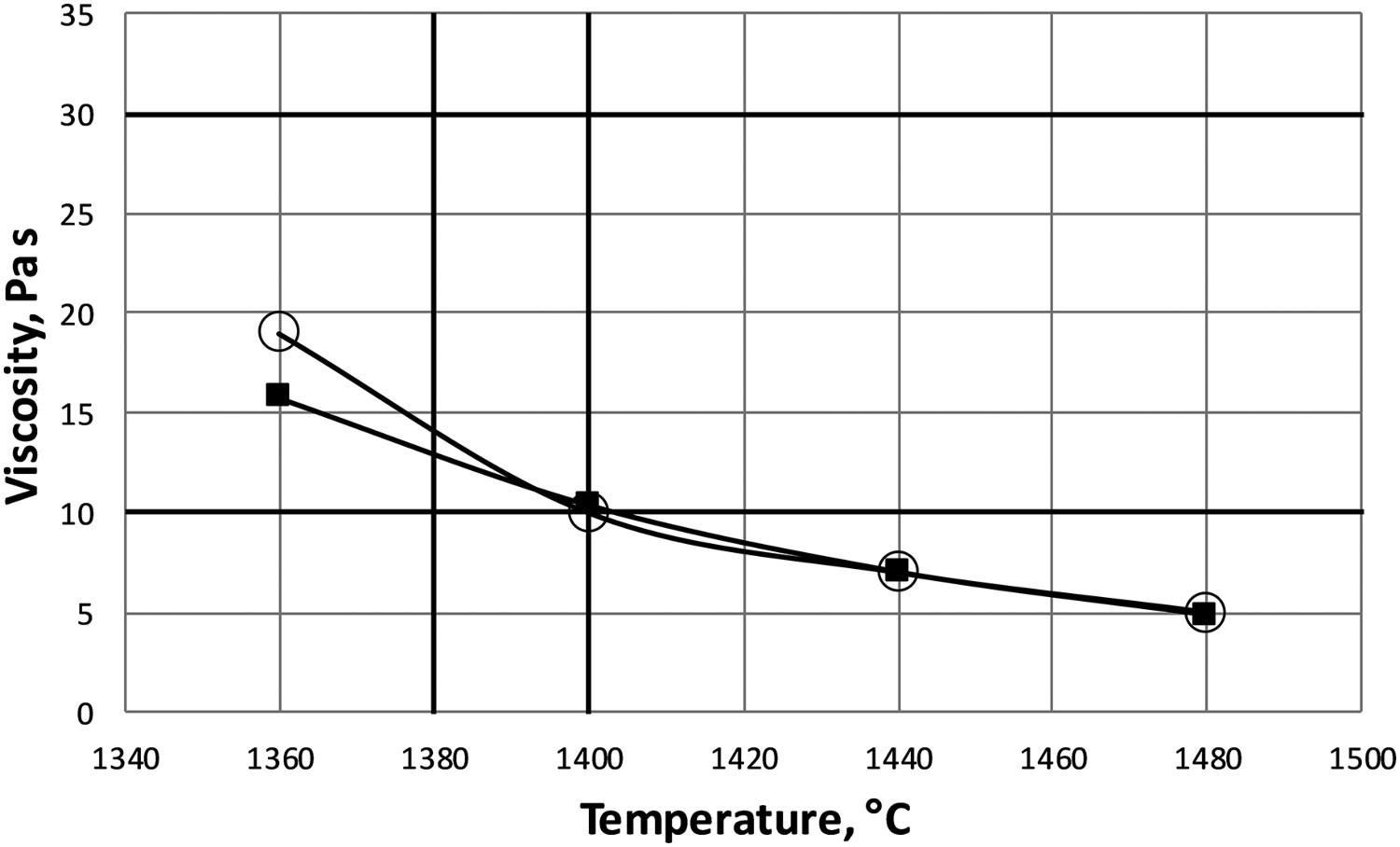
Conclusions
An investigation was done to find out if Icelandic basalt is suitable for production of continuous fibres. Samples were collected at 145 locations in Iceland and oxide composition measured. Criteria for composition, acidity and viscosity moduli were used to classify the samples. No sample was found that fulfilled all criteria. Three of the most promising samples were selected for further consideration. It was shown that a minor addition of calcium oxide would be enough to bring all parameters within limits. Viscosity of one sample was measured in atmospheric air. Keeping in mind limitations of a small-scale viscosity measurement in air, it can be concluded that within the temperature range normally used in fibre production, viscosity of the sample was found to be within limits used in fibre production.
Footnotes
Disclosure statement
No potential conflict of interest was reported by the authors.