







Abstract
This paper represents a geological review of the Lapland Granulite Belt (LGB). Description of the general geological framework of the LGB complex is coupled with reviews of the geochronological data, metamorphism, mineral endowment and concludes with a discussion of the geotectonic models. It is shown that the belt was formed in the Neoarchean (2703 ± 9 Ma using the U-Pb method) and consists of two compositionally different units. The lower member with dominating amphibolites is interpreted as metamorphosed volcanics, while the upper member is mainly composed of metamorphosed sandstones. It is noted that the composition and structure of the LGB complex are broadly consistent with typical Phanerozoic island-arc complexes. An interpretation of the LGB complex as a Neoarchean island-arc system is proposed. It is consistent with existing geodynamic interpretations of the adjacent terrains and, in general, fits the global geodynamic model of the supracrustal Archean complexes in the Baltic Shield.
Keywords
Introduction
Precambrian granulite complexes that experienced deep metamorphic conditions are characterised by specific and unique features. Precambrian granulites, besides the presence of charnoсkites, enderbites and other high-grade metamorphic rocks, include a broad distribution of the anorthosite intrusions coupled with reverse metamorphic zoning commonly observed at the granulite belts. These enigmatic characteristics of granulites are of particular interest to Precambrian geologists with a specific focus on their petrogenetic and geodynamic features that are significantly obscured by metamorphism.
One of the best-studied granulite terrains is the Lapland Granulite Belt (LGB), which is located in the north-eastern part of the Baltic Shield, Arctic zone, which can be traced for a distance of approximately 400 km from the Caledonian front in Norway, through Finnish Lapland to the coast of the White Sea in Russia (Figure 1). The Lapland granulites are diverse with compositions ranging from mafic to felsic. The belt was intermittently studied by the current authors for over 40 years with a focus on elucidating the geodynamic setting for the granulite succession, a topic that remains the subject of intense debate in the scientific community. This contribution summarises the results of the authors’ past research and reviews alternative interpretations of the belt's petrogenesis and geodynamic settings. The authors postulate these studies are vital for recognising the existence of plate tectonics during the Archean. This contribution commonly refers to the primary origin of the rocks therefore prefix ‘meta-’ (indicating metamorphism) is omitted for conciseness.
(a, b) Generalised geological map of the Lapland Granulite Belt with lithostratigraphic correlation of supracrustal sequences and showing the main mineral deposits. Based on (Kozlov et al. 1993; Kozlov 1995a, 1995b; Lokhov et al. 2006). Detailed study areas: I – Tana River, II – Vuotso village, III – Jaurujoki River; IV – Salniye Tundra, V – Kandalaksha Tundra, VI – Kolvitsa Tundra. The numbers denote the mineral deposits: 1 – Zasteid and Zasteid-2 Cu-Ni deposits, 2 – Lovnozersky (Lovno) Cu-Ni deposit, 3 – chromite occurrences at the Mt. Pados, 4 – Ti-magnetite occurrences in the Kolvitsa Tundra area.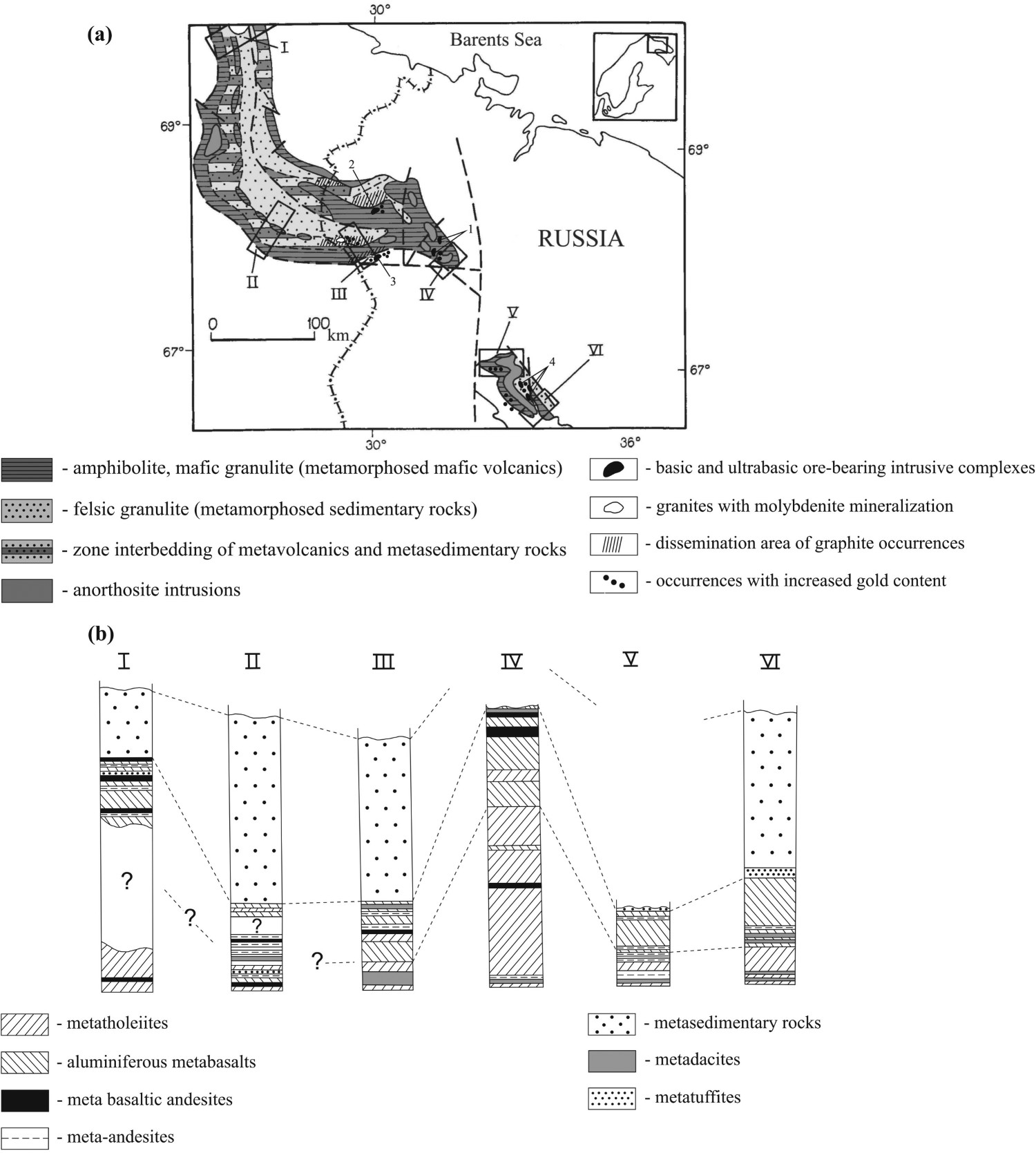
Past studies of the LGB complex geology and geotectonic interpretations
The compositional diversity of the Lapland granulites and their relevance for the geodynamic synthesis of the LGB complex is a subject of continuous debate. Researchers studying the LGB complex have addressed this issue from different angles, including petrogenetic studies and geochemical systematics of the volcano-sedimentary successions (Kozlov et al. 1995a, 1995b), reconstruction of the belt's magmatism (Pozhilenko et al. 2002), and analysis of the regional metamorphism (Glebovitsky 1993). The history of the LGB studies can be subdivided into several main stages.
Discussion of the LGB origin was commenced in the 1930–1950s, when two alternative concepts emerged, including the volcano-sedimentary model proposed by P. Eskola (Eskola 1952) and the intrusive origin of the LGB advocated by A. A. Polkanov (Polkanov 1935).
In the 1960s, studies were largely focused on the tectonic features of the belt, which was interpreted by some authors (Zhdanov 1966) as an upthrusted slab of lower crustal blocks.
This interpretation was challenged by Belyaev (1971), who considered the entire LGB complex as a single and deeply metamorphosed volcano-sedimentary succession that also includes felsic and mafic granulites, their underlying anorthosites, gneisses and amphibolites.
Priyatkina and Sharkov (1979) define the garnet-bearing amphibolites and their associated gneisses as supracrustal rocks, while anorthosites and mafic granulites were interpreted as intrusive rocks.
Vinogradov et al. (1980) suggest correlating felsic granulites with Archean gneisses of the Kola and Belomorian complexes, and consider garnet-bearing amphibolites as a separate unit, not related to the LGB complex. The granulites were interpreted as a product of a paleorift (Vinogradov et al. 1980) and later they suggest a rift origin for the Tana belt. Their proposed litho-stratigraphic model, however, fails to explain the gradational contacts between the mafic granulites and garnet-bearing amphibolites (Kozlov 1995a, 1995b).
Marker (1985) suggests that the LGB granulites and their underlying units represent separate nappes. The granulites were assigned to the Lapland nappe, but not include the rocks metamorphosed to amphibolite facies and defined as the Korva Tundra nappe. According to Marker (1985), the felsic granulites represent a deeply metamorphosed sedimentary succession distributed alongside the Pechenga greenstone belt. Volcanism of the Pechenga belt is characterised by geochemical signatures indicating a rift origin (Smolkin 1992).
In the early 1990s, new geophysical data became available for the LGB area that supports a nappe tectonics model. The revised model considers the LGB complex as intercalated nappes of the different origin, as represented by felsic and mafic granulites, which were upthrust onto the anorthosite bodies and amphibolites (Mints 1973; Bogdanova et al. 1992; Bibikova et al. 1993; Terekhov and Levitsky 1993; Miller and Milkevich 1995; Terekhov 2007; Cagnard et al. 2011).
Kozlov et al. (1995a, 1995b) undertook a detailed geochemical analysis of the granulites that revealed their volcano-sedimentary origin. The revised model (Kozlov 1995a; 1995b) represents the LGB complex as a composite package of tectonically superimposed Precambrian supracrustal sequences exhibiting modern island-arc affinities. The LGB complex, according to these studies, includes gneisses, felsic and mafic granulites and amphibolites. Compositional zoning of the granulites can be explained by different protolith compositions.
Regional geological context
The LGB complex consists of two main units. The basal mafic unit is represented by gneiss-amphibolites, which are discordantly overlain by granulites representing the upper acid unit (Figure 1) (Kozlov et al. 1995a, 1995b). Their contact is marked by anorthosite bodies (Belyaev 1971; Vinogradov et al. 1980; Kozlov et al. 1995a, 1995b), which also records an isograd between amphibolite and granulite facies (Priyatkina and Sharkov 1979). The authors would like to emphasise that the geological map shown in Figure 1 is schematic. This image shows the patterns of the belt structure noted in this article more clearly. Variants of a detailed geological map were published earlier (Kozlov and Ivanov 1991; Kozlov et al. 1995; Kozlov 1995b).
The composition of granulites spans a wide range from essentially felsic to intermediate and mafic, with variation observed along the strike of the belt. The belt is subdivided into two major domains based on the granulite composition. The western domain is dominated by felsic granulites and is distributed through Norway and Finland. Mafic rocks are relatively rare in this area and clustered mainly along the south-western border of the LGB, which also hosts tectonically emplaced anorthosite bodies, such as the Vaskojoki anorthosite complex (Marker 1985; Kozlov 1995a, 1995b). The mafic unit of the western LGB domain is metamorphosed to amphibolite facies and some researchers (Eskola 1952; Barbey et al. 1980; Hörmann et al. 1980; Marker 1985) defined it as separate complex known as the Tana (Tanaelv) belt. The eastern domain, encompassing the granulites distributed mainly in the Russian part of the LGB, exhibits more abundant mafic rocks and anorthosites and relatively less felsic material. The varying composition of the granulites is reflected in lithostratigraphic sections of the belt that systematically change from the north-west to south-east (Figure 1).
Geochronology
The age of the LGB complex was dated using different methods that produced controversial results. In 1995, the volcanic rocks of the Salny Tundra metamorphosed to granulite facies were dated using the Rb-Sr method and yielded 2700 ± 44 Ma (n = 3, MSWD = 0.8) (Kozlov 1995a, 1995b). Similar Rb-Sr results, 2690 ± 33 Ma (n = 5, MSWD = 1) were obtained for LGB rocks metamorphosed to amphibolite and granulite facies conditions (Kozlov et al. 1995).
These results were verbally questioned by some researchers because of the mobility of Rb-Sr isotopes during metamorphism, particularly at metamorphic conditions exceeding 600°C (Faure 1986; Levsky et al. 2009). Given limitations of the Rb-Sr method, the age of the LGB complex was determined using U-Pb dating of zircons from gneisses exposed at the Jaurioki river area (Figure 1). The U-Pb age of these gneisses, interpreted as metamorphosed dacites and andesite-dacites (Kozlov et al. 1995a, 1995b), is 2703 ± 9 Ma (n = 3, MSWD = 1.3), which strongly supports the Neoarchean origin (Kozlov 1995a, 1995b).
The result validity was facilitated by exclusively dating well-preserved and transparent zircon crystals exhibiting elongated euhedral to subhedral shapes and distinct finely zoned textures. Zircon crystals containing any inclusions were discarded (Kozlov 1995a, 1995b). The dated zircons are characterised by coefficient Ke in a range of 1.5–2.0, which is indicative of zircons generated in felsic volcanic rocks (Kozlov 1995a, 1995b). A similar Neoarchean age of 2799 ± 4 Ma for the LGB complex was obtained by U-Pb dating of zircons from Garnet-Orthopyroxene-Clinopyroxene-Hornblende crystalline schists of basic composition sampled from the Kandalaksha area (Korikovsky et al. 2014)
Significantly younger age of the LGB complex, 2473 ± 3 Ma, MSWD = 0.95, was obtained by U-Pb dating of zircons from the rocks exposed in the Mount Okatiev area of the Kandalaksha Tundra (Figure 1) (Balagansky et al. 1998). These rocks were interpreted by Balagansky et al. (1998) as metamorphosed andesites hosted in the lower unit of the LGB complex. Anorthosites intruding the LGB complex and marking the compositional and metamorphic boundary between the mafic and felsic granulites were dated using U-Pb techniques that yielded 2450 ± 10 Ma (Mitrofanov et al. 1993).
Regional metamorphism
The LGB nature remains intensely debated, with particular emphasis to the relationship between the amphibolite facies rocks and granulites. Some authors divide terrains metamorphosed in the amphibolite facies from the LGB complex and refer these rocks to a separate belt commonly referred to as Tana or Tanaelv (Eskola 1952; Barbey et al. 1980; Hörmann et al. 1980; Marker 1985), whereas other researchers (Kozlov et al. 1998) consider them as a part of the LGB complex.
The basal unit rocks vary from almandine amphibolite to granulite facies, while structural patterns remain consistent throughout this package. The typical paragenesis of amphibolite facies rocks is Green Hornblende – Plagioclase–Garnet–Clinopyroxene indicating formation at 720°С and 8 kbar pressure (Figure 2) (Kozlov et al. 1998). Temperature and pressure are observed to gradually increase when approaching contact with granulite facies rocks. The two facies are separated by a transitional zone that is the main host for mafic-ultramafic rocks and anorthosites. Metamorphic conditions in the transitional zone increase to 860°С and 11–12 kbar (Kozlov et al. 1998) evidenced in an eclogite-like appearance of the mafic rocks. Here, a typical paragenesis of the rocks is Garnet–Clinopyroxene–Brown and green Hornblende–Plagioclase. The transitional unit also exhibits evidence of the tectonic displacement and local intense deformation (Drugova et al. 1972; Gaál et al. 1989). The presence of hornblende, a hydrous silicate, in the granulite facies metamorphic rocks suggests discrete zones of permeability, likely along the tectonic surfaces that facilitated transportation and storage of hydrothermal solutions.
(a) Generalised geological map of the eastern Lapland Granulite Belt (Kozlov et al. 1993, 1998); (b) lithostratigraphic sections with estimated PT parameters of regional metamorphism (Kozlov et al. 1998). Detailed study areas: N. Finland (I), Jaurujoki River (II) and Salniye Tundras (III). P-T parameters of metamorphism were estimated using the TPF computer program (P. N. Kopylov, unpublished data) applied to the database of A. A. Grafchikov and A.N. Konilov (unpublished data). The program uses garnet-clinopyroxene and garnet-clinopyroxene-plagioclase-quartz geothermometers and geobarometers techniques.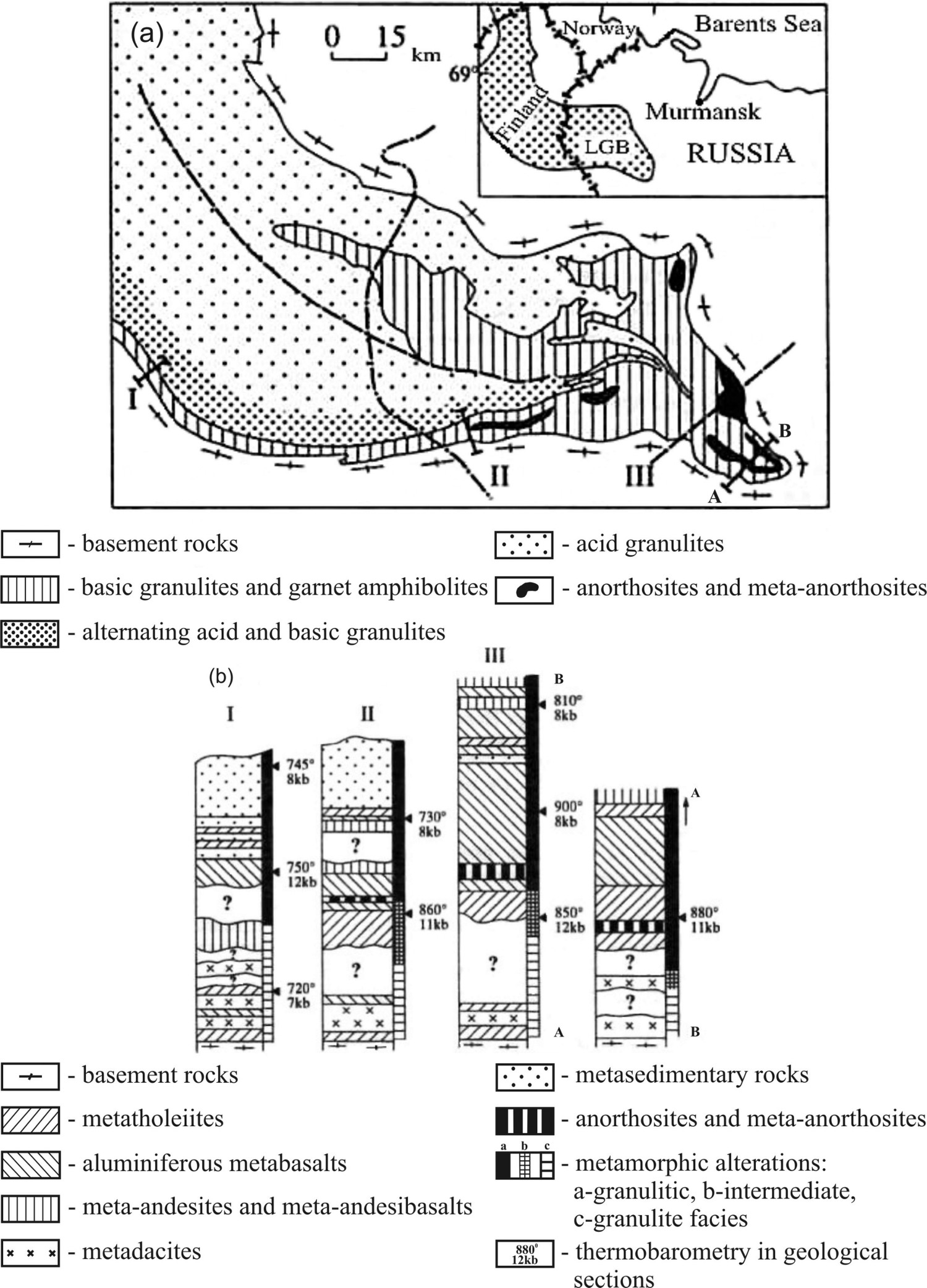
Mafic granulites are the most abundant in the Salny Tundra area (Figures 1 and 2) and represented by a high-grade metamorphic paragenesis including Orthopyroxene–Clinopyroxene–Plagioclase–Brown Hornblende. This characteristic paragenesis dominates in the central part of the belt and is replaced by Garnet–Clinopyroxene –Plagioclase–Quartz paragenesis along the tectonic faults and belt margins where the lower-grade assemblage is most abundant. All parageneses were interpreted as syn-kinematic with the ductile deformation. Fine banding textures in the granulites and the distribution of clinopyroxene in pressure shadows of the garnet and orthopyroxene porphyroblasts support this interpretation (Ramsay and Huber 1987). The paragenesis in the central part of the mafic granulite suggests metamorphic conditions (Figure 2) were 800−900°С and 8 kbar and reached 11–12 kbar along the contact with the transitional zone.
The comparison of the metamorphic facies distribution along the belt (Kozlov et al. 1998) shows that the highest pressure estimates are associated with rocks in the transitional zone, with metamorphic pressures gradually decreasing towards the southern contact of the LGB. The lowest pressure zones are determined to be in the middle part of the belt, although local increases are associated with thrust surfaces.
The comparison of the geological sections, using the reconstructed primary (pre-metamorphic) nature of the rocks, has revealed their considerable similarities (Figures 1 and 2). Notably, the reconstructed stratigraphic succession is consistent and observed in different parts of the LGB independent of the intensity of tectonic processes and metamorphism of the rocks. The best example of this stratigraphic relationships can be seen at the Salny Tundra area (section b-III in Figure 2(b)), where this pattern is observed in different limbs of the Salny Tundra syncline.
Results of the geochemical reconstructions concur with detailed petrological studies of the amphibolite and granulite facies rocks (Glebovitsky 1993; Kozlov et al. 1998) that have shown close petrogenetic signatures. In general, the geochemical and chemo-stratigraphic data do not support separating the amphibolite and granulite facies rocks into different belts. An alternative interpretation proposed by Glebovitsky (1993) suggests that the reverse metamorphic zoning, with amphibolite facies rocks at the base of the complex and granulite facies at the top, could be formed by a post-subduction transformant of the island-arc complexes stage.
Metallogeny
The LGB complex is well endowed with mineral deposits and occurrences of different commodities and mineralisation types. However, the main endowments of the belt, including Ni–Cu and Fe–Ti mineralisation, are mainly associated with Proterozoic intrusive complexes related to magmatic reactivation of the LGB area (Mitrofanov et al. 1993; Serov et al. 2020). A general metallogenic framework of the belt was extensively reported in publications (Kozlov et al. 1995a, 1995b, 1993; Kozlov 1995a, 1995b; Pozhilenko et al. 2002; Serov et al. 2020) and is briefly summarised here.
The Lovno intrusive complex is host to significant Ni–Cu sulphide mineralisation and is located in the central segment of the LGB close to the border of Russia and Finland (Figure 1). This intrusive complex is Paleoproterozoic and characterised by differentiated mafic-ultramafic intrusions comprising norite, gabbro and peridotite. The structure of the Lovno intrusion and composition of the rocks are much similar to the Monchegorsk intrusive complex that also hosts large Ni–Cu sulphide deposits (Gorbunov et al. 1985; Kozlov et al. 1988; Pozhilenko et al. 2002). Other occurrences of the Ni–Cu sulphide mineralisation are significantly smaller and hosted in discontinuous lenses of disseminated sulphides within discrete and small mafic and ultramafic intrusives scattered throughout the belt (Pozhilenko et al. 2002).
A dunite-harzburgite intrusion located in the Mount Pados area (Figure 1) hosts high-grade disseminated chromite mineralisation (Pozhilenko et al. 2002; Mamontov and Dokuchaeva 2005). Laterally restricted lenses and pods of chromite mineralisation are distributed along the shear zones cutting the dunite-harzburgite intrusive. The age of the intrusion is 2485 ± 77 Ma, according to Sm-Nd isochron dating (Serov et al. 2020).
The Kolvitsa titanium-magnetite deposit is associated with discrete bodies of ultramafic rocks distributed in the vicinity of the Kolvitsa anorthosite intrusive complex (Figure 1). The intrusions are hosted by mafic granulites that are abundant in this part of the belt (Kozlov 1995a, 1995b). While the age of these intrusions has been not isotopically constrained, preliminary unpublished results of U-Pb dating (T. Bayanova, personal communication) yield 1836 ± 16 Ma, suggesting the Paleoproterozoic origin. This age concurs with geological evidence, including structural settings of the intrusions and relatively a less altered appearance compared to the host sequence, suggesting their late emplacement postdating the peak of granulite metamorphism.
The LGB is also host to molybdenite mineralisation. One of the best-studied examples is the Jaurioki molybdenite prospect associated with subvolcanic granite intruding the Lapland granulites (Figure 1) (State Geological Map of Russian Federation 2000). The age of granites was determined by the potassium-argon method on muscovite at 1720–1760 Ma. A combined Pb-Pb Pb207/Pb206 isochron diagram for 11 samples of monazites and zircons from these granites and granitoids of the Litsa-Araguba complex yields an age at 1840 ± 50 Ma (Vinogradov and Vinogradova 1987; Kupriyanova and Kuvshinova 2007; Sorokhtin et al. 2020).
Molybdenite occurs as irregularly distributed and disseminated mineralisation with stringers in hydrothermal quartz-muscovite-fluorite veins which are commonly found along margins of explosive breccia pipes hosted by greisens and high-temperature metasomatic albitites (State Geological Map of Russian Federation 2000).
Felsic granulites of the LGB complex that are interpreted as metamorphosed sedimentary rocks (Kozlov 1995a, 1995b) host graphite mineralisation that, while known for decades (Ivliev 1977), was essentially left unexplored and poorly studied. Lokhov et al. (2006) associates the graphite mineralisation to metasomatic processes associated with two major tectono-magmatic episodes dated at 1910 ± 12 and 1792 ± 6 Ma (U-Pb method).
The belt is also considered prospective for gold with several occurrences (Figure 1) discovered in the early 1990s during reconnaissance geochemical sampling (Kozlov et al. 1993). The gold-enriched rocks are spatially associated with the transition from granulite to amphibolite facies and the largest gold anomalies are confined to the contact between basalts and felsic to intermediate volcanics (Kozlov et al. 1993).
Discussion
The debate regarding the tectonic setting of the LGB complex commonly centres on several questions: (1) interpretation of the binary structure of the belt; (2) nature of the relationship between the felsic and mafic granulites; (3) the age of the felsic and mafic granulites and (4) the age and role of tectonic processes and metamorphism in generating the structural and compositional complexities of the belt.
Litho-stratigraphic subdivisions of the LGB complex
Detailed geochemical studies (Kozlov 1988, 1995a, 1995b) revealed the binary structure of the belt, indicating two compositionally different units separated by faults. The lower unit consists of rocks originally interpreted as tholeiitic basalts, andesites, dacites, aluminous basalts and basaltic andesites. The upper unit's interpreted protolith is sedimentary rocks dominated by graywackes and less common arkoses intercalated with pelitic to semi-pelitic shales and volcaniclastic rocks. Systematic studies at different parts of the LGB have shown that litho-stratigraphic relationships are consistently repeated throughout the belt (Kozlov 1995a, 1995b). Notably, the binary structure identified in the different sections of the belt is independent of deformation intensity and degree of metamorphism. This is presented on the sections of Salny Tundra (B-III in Figure 2(b)), displaying two units on different limbs of the Salny Tundra synform.
The diverse deformation history of the belt prevents direct correlation of the interpreted volcanic and sedimentary rocks thus limiting correlation to the larger litho-stratigraphic volumes at scales as presented on the generalised cross-sections (Figure 1). The binary structure is important because it holds a key line of evidence for justifying the interpretation of a volcano-sedimentary origin of the belt. Other models have been proposed. In particular, the concept of randomly juxtaposed tectonic nappes of different compositions is suggested by Marker (1985). The other concept suggests a purely metamorphic origin for the litho-stratigraphic differentiation of the LGB complex (Zhdanov 1966). Both models fail to adequately explain how the binary structure of the belt is consistently repeated throughout its length. Despite intense deformation and high-grade metamorphism of the rocks, it is more likely that evidence of the binary structure is retained in some well-preserved primary features. The litho-stratigraphic correlation along the belt accords well with the interpretation of the mafic volcanics of the LGB basement as a separate litho-stratigraphic unit which was tectonically displaced and includes differently metamorphosed rocks representing a volcanogenic-sedimentary succession origin (Kozlov et al. 1995a, 1995b). This reasoning allows less metamorphosed mafic rocks to be used for petro-genetic reconstruction of the entire belt.
The distribution of regional metamorphism, including the granulite facies isograd that intersects the anorthosite intrusions and zoned distribution of metamorphic pressure across the basal unit of LGB, indicates the regional metamorphism peak that postdates emplacement of anorthosite intrusions into LGB. This observation jointly with the presented litho-stratigraphic correlations indicates that the subdivision of amphibolite facies rocks into a separate geotectonic unit proposed by some researchers (Barbey et al. 1980; Hörmann et al. 1980; Marker 1985) within the LGB complex is unsustainable.
Age
Two substantially different ages have been proposed for the LGB complex: Proterozoic (Huhma and Meriläinen 1977; Barbey et al. 1984; Gaál et al. 1989; Bibikova et al. 1993; Balagansky 2002) and Archean (Priyatkina and Sharkov 1979; Vinogradov et al. 1980; Krylova 1983; Kozlov 1995a; Mints et al. 1996; Vrevsky et al. 2000). Support for a Proterozoic age is further complicated by suggestions made by some workers (Gusev et al. 2010) that the granulites are older than the Proterozoic gabbro-anorthosite complexes intruding the belt. Debates regarding the LGB age are centred on representativity of the samples taken for U-Pb dating of zircons, and doubts were raised regarding both groups of the data, that produced Archean and Proterozoic dates.
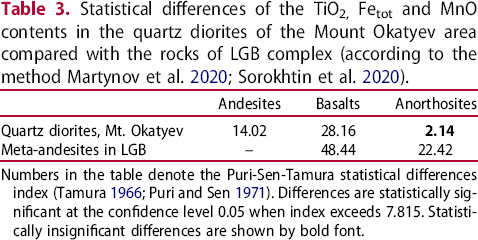
Representativeness of the samples that return an Archean age (Kozlov 1995a, 1995b) is debated and some researchers suggested, albeit verbally, that the samples could have been taken from the tectonic lenses representing the Archean basement of the LGB complex. These concerns are largely caused by the location of the Ya-30 samples that were taken close to the contact of the granulite belt with the Archean basement. The contact is poorly defined in this area, which is lacking detailed mapping due to the scarcity of the outcrops. In order to resolve this issue, biotite-gneisses of the Archean basement were sampled and compared with representative rocks of the LGB complex. Two sets of data, including the whole rock oxides and trace elements, were processed and compared statistically using the multivariate discriminant analysis technique (Kim et al. 1989). The estimated discriminant index ‘D’ for Archean basement was D = 1069.3 while for volcanic rocks of the LGB complex D = 915.5. The threshold value for discriminating the two statistical sets of the data D = 956.8 representing (Table 1). Sample Ya-30 returned D = 943.2, indicating that the sample is distinctly characterised by geochemical affinities related to the LGB volcanics. Besides the statistical indicators, the LGB rocks have notably lower chromium and vanadium content than the Archean basement rocks proximal to the Ya-30 sampling site (Kozlov 1995a, 1995b). The composition of the Ya-30 sample corresponds to rocks typical of the LGB complex significantly differs from the Archean gneisses underlying the LGB complex. The validity of the Neoarchean age of the LGB rocks has been recently confirmed by U-Pb dating of zircons collected from the basic composition crystalline schists located in the eastern part of the belt (Korikovsky et al. 2014). The Proterozoic age model is based on a single study (Balagansky et al. 1998). Using U-Pb dating of zircons, the Proterozoic age was obtained for gneisses of intermediate composition in the eastern part of the LGB in the Kandalaksha Tundra (Figure 1) (Balagansky et al. 1998). These rocks were interpreted as metamorphosed andesites of the LGB complex and according to U-Pb dating of zircons, they are 2473 ± 3 Ma old. The gneisses intercalate with amphibolites of the LGB complex and this relationship was the rationale for assigning them to the lower unit of the belt (Balagansky et al. 1998). This evidence alone is insufficient for conclusive litho-stratigraphic classification of the sampled rocks. It is widely known and documented (Kozlov 1995a, 1995b; Balagansky et al. 1998) that the LGB complex in this area was intruded by the Kandalaksha anorthosite sill and therefore the sampled rocks may be felsic differentiates of the intrusion of these anorthosites. Unfortunately, the composition of the sample is not available in the work by Balagansky et al. (1998), therefore, the representativity of the samples cannot be confirmed by this paper. Authors of the current work have tried to fill the gap and studied the debated rocks, which they defined as quartz diorite (unpublished data). The rocks sampled for the current work were taken from different parts of the belt and compared with the LGB andesites. Results in Table 2 show that the composition of the quartz diorite is constant across the belt and notably different to the LGB andesites in Ti, Fe and Mn contents (Table 2). The composition of these rocks was also compared with the anorthosites (Table 2) and coupled with statistical analysis of the data (Table 3). The comparative analysis has shown that quartz diorites are markedly different from andesites and other common lithologies of the LGB litho-stratigraphic succession (Table 3). It was also noted that rocks of intermediate composition are relatively rare for the LGB belt and therefore their abundance in the Mount Okatyev area suggests an origin not related to that of the LGB volcano-sedimentary succession. In general, the interpretation of the disputed intermediate rocks as intrusive bodies comagmatic with anorthosite sills seems more plausible and accords with the distinctive geochemical signatures of these rocks and their geological settings. D = 7.37 SiO2 + 111.65 TiO2 + 51.52 Al2O3 + 10.13 Fe2O3 + 5.06 FeO + 14.62 MnO + 19.32 MgO – 55.01 CaO – 60.53 Na2O – 10.82 K2O = 956.8. *Content variations.


Island-arc model
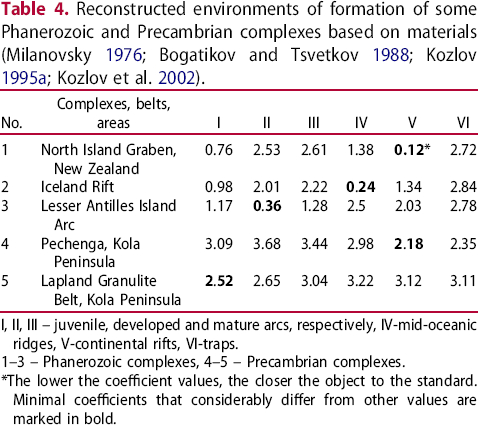
I, II, III – juvenile, developed and mature arcs, respectively, IV-mid-oceanic ridges, V-continental rifts, VI-traps.
1–3 – Phanerozoic complexes, 4–5 – Precambrian complexes.
*The lower the coefficient values, the closer the object to the standard. Minimal coefficients that considerably differ from other values are marked in bold.
Interpretation of the LGB complex as a Neoarchean island-arc also conforms well to the global geodynamic model of supracrustal Archean complexes and is consistent with the geodynamic interpretation of the adjacent terrains (Balagansky et al. 2015; Kozlov et al. 2018; Sorokhtin et al. 2020). It also explains the so-called reverse metamorphic zoning described above. An island-arc affinity of the LGB rocks can have practical implications for metallogenic analysis of terrains and geotectonic constraints for exploration models.
Noteworthy, geochemical signatures comparable with Phanerozoic island-arc complexes have been determined in the many other high-pressure granulite complexes in Eurasia (Kozlov 1995a, 1995b, Kozlov et al. 2013, 2017). It is important that many of the studied granulite belts have a binary structure similar to that of the LGB complex, with their base units composed of metavolcanics and also exhibit reverse metamorphic zoning. A detailed description of the geochemical and chemostratigraphic reconstruction of different granulite complexes is provided in Kozlov (1995a, 1995b).
The proposed interpretation of the LGB complex as a deeply metamorphosed Neoarchean island-arc system closely linked to another major geoscientific controversy, i.e. whether tectonics processes operated in Archean were similar to the modern plate-tectonics (Vearncombe 1991; Dobretsov et al. 2013; Barnes and Van Kranendonk 2014; Balagansky et al. 2015). Detailed study of this topic is beyond the scope of this paper. However, it can be noted that the studied Eurasian granulites (Kozlov 1995a, 1995b; Kozlov et al. 2013) include Paleo- to Neoarchean complexes, and they all have geochemical affinities with Phanerozoic island-arc complexes. The degree of geochemical similarities with Phanerozoic island-arcs varies and decreases in the older complexes. In general, a reliable interpretation of the granulite geotectonic nature could be made using conventional geochemical approaches to the younger complexes, not older than 3.0 Ga (Kozlov et al. 2013, 2017). This suggests that plate tectonic processes could begin at the earliest stages of the Earth's history, when they could act in parallel with plume-tectonic processes, which is also observed at later stages of the Earth's development (Dobretsov et al. 2013).
Conclusions
A review of geological and geochemical studies shows that the most plausible geological model of the LGB is a Neoarchean volcano-sedimentary succession formed in a setting resembling that of a Phanerozoic island-arc complex.
The LGB has a binary structure comprising two compositionally different units separated by faults. The lower unit consists of rocks interpreted as having a protolith of tholeiitic basalts intercalated with intermediate and felsic volcanic rocks. The upper unit is mainly composed of graywacke sedimentary rocks. Despite their intense deformation and high-grade metamorphism, some of their primary features were well preserved.
Some other tectonic models are reviewed, including a concept of the randomly juxtaposed tectonic nappes of the different compositions, but they fail to adequately explain the consistent binary structure of the belt throughout its length.
A granulite facies isograd intersects the Proterozoic anorthosite sill intruding the LGB sequence indicating that the peak of regional metamorphism postdates anorthosite magmatism.
Footnotes
The research has been carried out in the framework of the State Orders Nos. 0226-2019-0052 and 0149-2019-0005. The authors thank Dr. M. Lindsay, Dr. А. Vrevsky, Dr. J. Verncombe, Dr. M. Often and anonymous reviewer of the journal for thorough reviews, useful comments and recommendations that have helped to improve the paper. The authors are also grateful to T. Marchuk for drawing the diagrams and T. Miroshnichenko for help with the paper translation to English. The authors also express their sincere gratitude to Dr. M. Abzalov for valuable discussions and many useful comments.
Disclosure statement
No potential conflict of interest was reported by the author(s).