







Abstract
Background:
Many studies have suggested that the flavonoids from Rhus verniciflua Stokes
Patient and method:
We present here the case of a female patient (82 years old) with an adenocarcinoma of the stomach that was first diagnosed via an abdomen computed tomography (CT) scan and endoscopic biopsy. Any conventional therapy such as surgical resection was not performed because of her advanced age. She wanted to receive alternative care, and so she was exclusively treated with standardized
Course of therapy and results:
Daily therapy with 900 mg of orally administered RVS extract was initiated on September 25, 2006. Five (5) months later, the gastroscopy and abdomen CT scan showed a marked decrease in the polypoid mass at the mid body and a slight decrease in the flat elevated lesion at the prepyloric antrum, as compared to tumor sizes on the first gastroscopy and abdomen CT scan. She is alive and doing well at the present time (April 2009).
Conclusions:
We suggest that
Introduction
Rhus verniciflua Stokes (RVS) of the Anacardiaceae family has traditionally been used in East Asian countries for treating various stomach diseases, including tumor. 5 RVS acts against malignant tumors because of its property of breaking up blood stasis and purging hardness, as based on traditional medicine theory. 6 Many experimental studies have also reported that RVS has antiproliferative and apoptotic activities in human cancer cell lines, including gastric carcinoma. 7 –10 We report here on an elderly patient whose gastric cancer decreased in size when she took a standardized extract from RVS as her exclusive therapy.
Patient and Method
Patient
We describe here an 82-year-old female who had been diagnosed with gastric cancer via an abdominal computed tomography (CT) scan on September 2, 2006. The CT detected a gastric mass in the gastric antrum and the small gastrohepatic lymph nodes without metastasis to any other organs (Fig. 1A). She had been continuously taking antihypertensive medication for 10 years, and her past medical history included osteoarthritis and allergic rhinitis. Two (2) cases of gastric cancer in her family were reported. For further evaluation, a gastroscopy on October 9, 2006 revealed a polypoid gastric mass approximately 25 mm in diameter at the middle body portion of the lesser curvature and a flat elevated lesion 50 mm in diameter at the prepyloric antrum (Fig. 2A, B). The endoscopic biopsy confirmed well-differentiated adenocarcinoma with a mutation in p53 that showed high nuclear activity of more than 80% (Fig. 3A, B). Surgical removal was recommended, but this could not be done because of her advanced age and the concerns about the quality of life after gastrectomy.
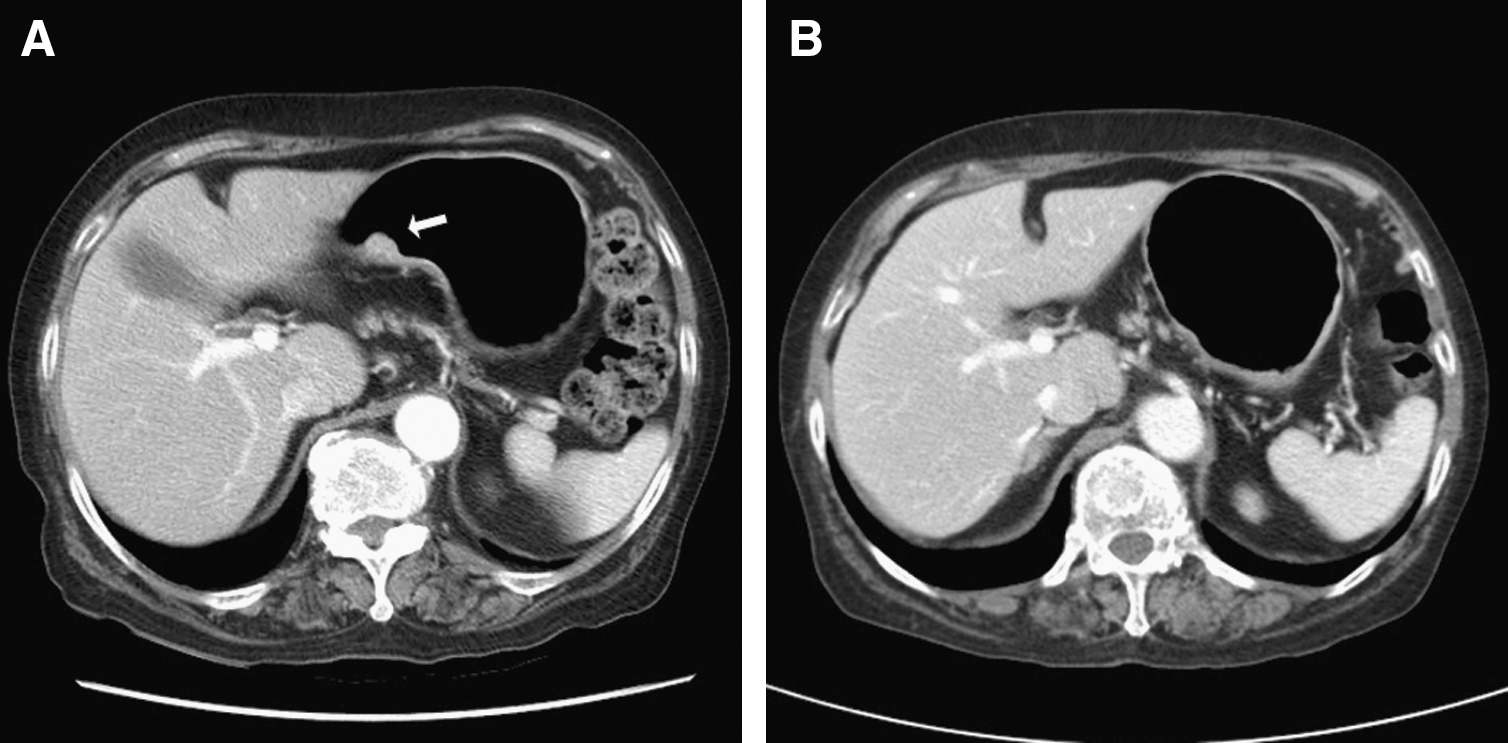
An abdominal computed tomography (CT) scan dated September 2, 2006 revealed a polypoid mass in the gastric antrum (
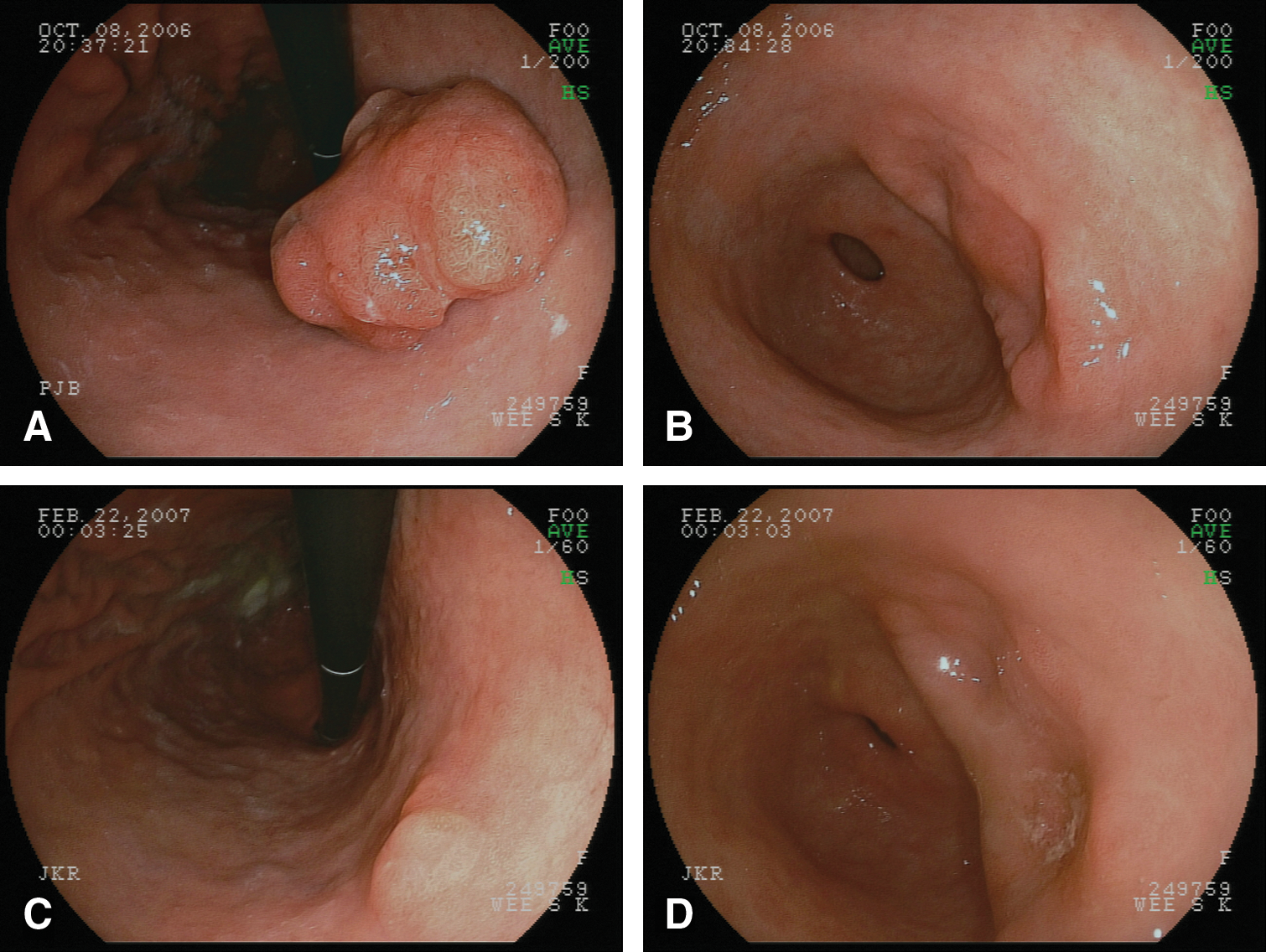
A gastroscopy dated October 9, 2006 revealed a polypoid mass that was approximately 25 mm in diameter at the middle body portion at the lesser curvature (
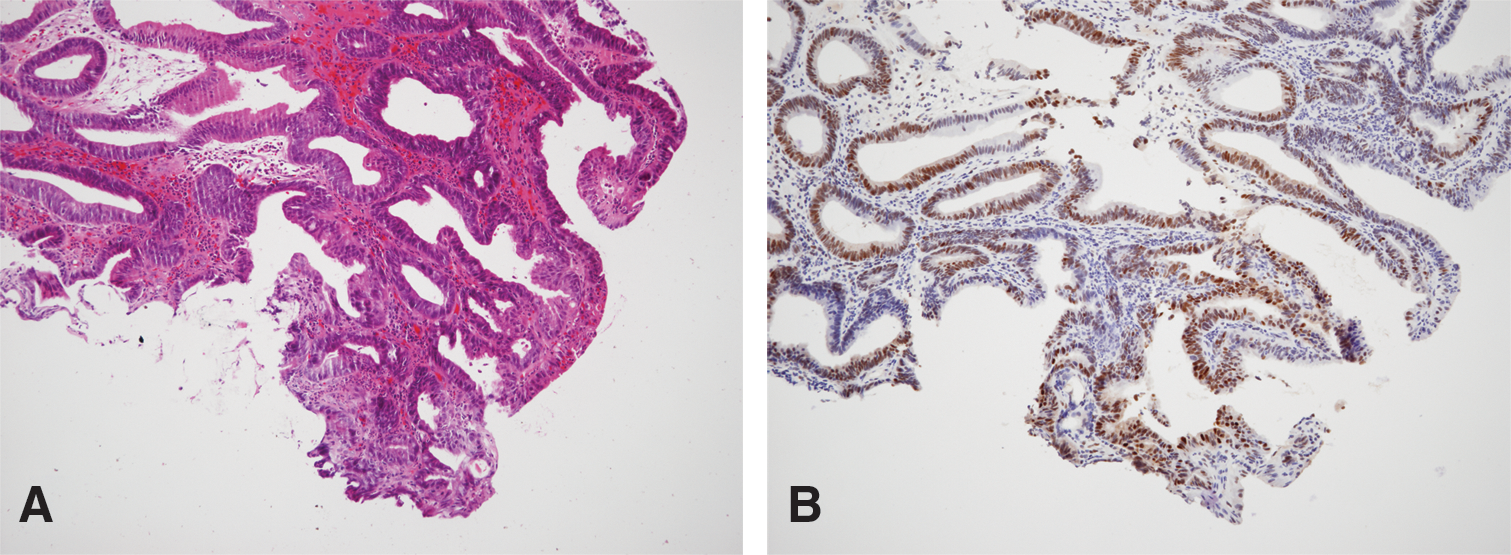
A gastric middle body biopsy specimen stained with hematoxylin and eosin showed well-differentiated adenocarcinoma (
Standardized extract of RVS
The clinical application of RVS has been limited because RVS, like poison ivy and many other plants of the Anacardiaceae family, causes contact dermatitis on sensitive individuals. 11 An allergenic component, urushiol, which is a mixture of several derivatives of catechol, should be removed from the RVS before RVS is used pharmaceutically. A standardized extract of urushiol-free RVS was manufactured according to the method disclosed by a Korean patent (no. 0504160).
Ten (10)-year-old RVS stalks and the bark, which were grown in Wonju, Republic of Korea, were processed to sawdust and then dried to less than 5% water content. They were roasted in an iron pot at 240°C for 50 minutes, and extracted with a 10-fold volume of water at 90°C–95°C for 6 hours. The extract was concentrated in a vacuum evaporator and then it was dried to a dark brown powder, then the final product was meshed through a screen. The yield of the final extract was 3.3% (wt/wt). The major compounds are flavonoids such as fustin and fisetin according to high performance liquid chromatography, while sulfuretin and butein were also detected as minor components. There is significant variation in the composition of the final product due to the presence of some deviation resulting from the age and harvest time of the trees, the growing areas, the parts to be harvested, etc. The quality of the RVS extract was tested and controlled according to the quality standards of the Korea Food & Drug Administration and our hospital's standards (fustin > 13.0%, fisetin > 2.0%, urushiol not detected).
Treatment course
Daily therapy with 900 mg of orally administered
Discussion
Gastric cancer in elderly patients has unique characteristics, including a high frequency of differentiated tumors, blood vessel invasion, and hematogenous recurrence. 2 Early gastric cancer generally progresses to the advanced stage with time, and it will usually lead to death from gastric cancer if left untreated. 12
In this case, an 82-year-old female patient with gastric cancer showed a markedly decreased size of her polypoid mass, from 25 mm in diameter to a bulging state, after treatment with RVS extract for 5 months. Although the stage could not be exactly determined without an endoscopic ultrasound scan, the tumor contracted and a good performance status was achieved with the oral administration of RVS extract. She received no other systemic treatments or chemotherapy before or after taking RVS extract. Therefore, it stands to reason that the reduction of the tumor size was indeed induced by RVS.
RVS has been experimentally reported to have selective growth inhibition and apoptosis-inducing effects. An ethanol extract of RVS in vitro was shown to induce apoptosis through the intrinsic pathway and G1 cell cycle arrest in human AGS gastric cancer cells, but not in normal cells. 8,13 A purified flavonoid fraction prepared from RVS was also observed to be capable of inducing apoptosis in human osteosarcoma cells by activating p53, which in turn causes mitochondrial stress leading to the release of apoptosis-inducing factor and endonuclease G into the nucleus. 14 The butein (3,4,2',4'-tetrahydroxychalone) component of the flavonoid fraction from RVS was previously shown to interfere with the interaction between fibroblasts and breast cancer cells in vitro. 15 The aqueous extract of urushiol-free RVS was demonstrated in vivo to suppress the tumor volume in a xenograft mouse model system that used A549 non-small-cell lung cancer cells and Lewis lung cancer cells via inhibiting the proliferation and migratory activity of vascular endothelial growth factor. 16 It was recently reported that an aqueous extract of urushiol-free RVS potentiated the cisplatin-induced antitumor activity in CT-26 murine colon carcinoma in vivo along with having antioxidant activity to reduce the cisplatin-induced cytotoxicity. 17
Therefore, we hope that this case would stimulate further investigation into the effectiveness and tolerability of RVS for the treatment of gastric tumors in clinical practice, though it should not be generalized for use in all cases. Follow-up monitoring and further clinical trials with a large population are required to investigate its efficacy and safety. We suggest that
Footnotes
Acknowledgments
We would like to thank our patient, who consented to having her case presented and published.
Disclosure Statement
No competing financial interests exist.