







Abstract
Objectives:
This study reports on the safety of the complementary and alternative medicine (CAM) practice of cupping in a patient undergoing concomitant therapy with bevacizumab for advanced non-small-cell lung cancer (NSCLC), and raises awareness of the need for improved communication between CAM practitioners and oncologists during the care of patients with cancer. The practice of cupping generates local hyperemia, disrupts superficial vasculature in the dermis, and leads to cutaneous lesions including circular erythema, edema, and subsequently ecchymosis. There are no data on the safety of cupping in patients being treated with bevacizumab.
Design:
This is a single-institution case report.
Settings/location:
The setting for this study was a tertiary-care academic medical center.
Conclusions:
A patient with advanced NSCLC received four cycles of carboplatin AUC 6, paclitaxel 200 mg/m2, and bevacizumab 15 mg/kg, and was continued on every-3-week maintenance bevacizumab 15 mg/kg. The patient underwent glass dry cupping during cycle six of maintenance bevacizumab treatment without overt cutaneous adverse events or bleeding. The patient did not realize he should have communicated his cupping plans or recent bevacizumab treatment with his providers.
Introduction
Sustained or altered angiogenesis is one of the hallmarks of cancer and commonly involves dysregulation of vascular endothelial growth factor. 4 Bevacizumab is a humanized monoclonal antibody that inhibits angiogenesis by blocking vascular endothelial growth factor A. 5 Since 2004, bevacizumab has been U.S. Food and Drug Administration–approved for use in metastatic colorectal cancer, glioblastoma, metastatic renal cell carcinoma, and nonsquamous non-small-cell lung cancer (NSCLC) in combination with standard cytotoxic therapy. Treatment with bevacizumab is known to cause the following: (1) Delayed or incomplete wound healing, 5 which has been reported in patients undergoing surgical procedures and has led to a box warning in the label of bevacizumab, stating it should be stopped at least 28 days before voluntary surgery; and (2) Increased risk of bleeding. Both fatal hemorrhages and superficial bleeding have been reported to occur 2–4 times more often in patients receiving bevacizumab than in controls. 5 Case reports have described spontaneous ecchymosis as an adverse event of bevacizumab. 6 To date, there are no data on the safety of cupping in patients being treated with bevacizumab. Herein, a patient is reported who successfully underwent the practice of cupping during bevacizumab treatment.
Case Presentation
A 62-year-old Taiwanese man with metastatic nonsquamous NSCLC completed four cycles of carboplatin AUC 6, paclitaxel 200 mg/m2, and bevacizumab 15 mg/kg, and was continued on every-3-week maintenance bevacizumab 15 mg/kg. On maintenance bevacizumab, he was found to have stable disease on serial computed tomography scanning. Baseline and serial laboratory assessments revealed normal prothrombin time, activated partial thromboplastin time, platelet count, and renal function. During a trip to his native Taiwan, 18 days after receiving cycle six of maintenance bevacizumab, he underwent 3 sessions of glass dry cupping lasting 15 minutes per target meridian on an every-other-day schedule. The patient did not realize he should have communicated his cupping plans or recent bevacizumab treatment with his treating physicians. He developed characteristic rounded skin ecchymoses at sites of cupping (Fig. 1A). On return, he was treated with cycle seven of maintenance bevacizumab as per his regular schedule. The ecchymoses started to resolve 7 days after his CAM treatment and had completely resolved 24 days after initial cupping (Fig. 1B). This is compatible with ecchymosis resolution in normal individuals. 7 The patient reported that he had received cupping treatments prior to his cancer diagnosis and that the time course of recovery of his skin lesions was similar to that experienced during therapy with bevacizumab.
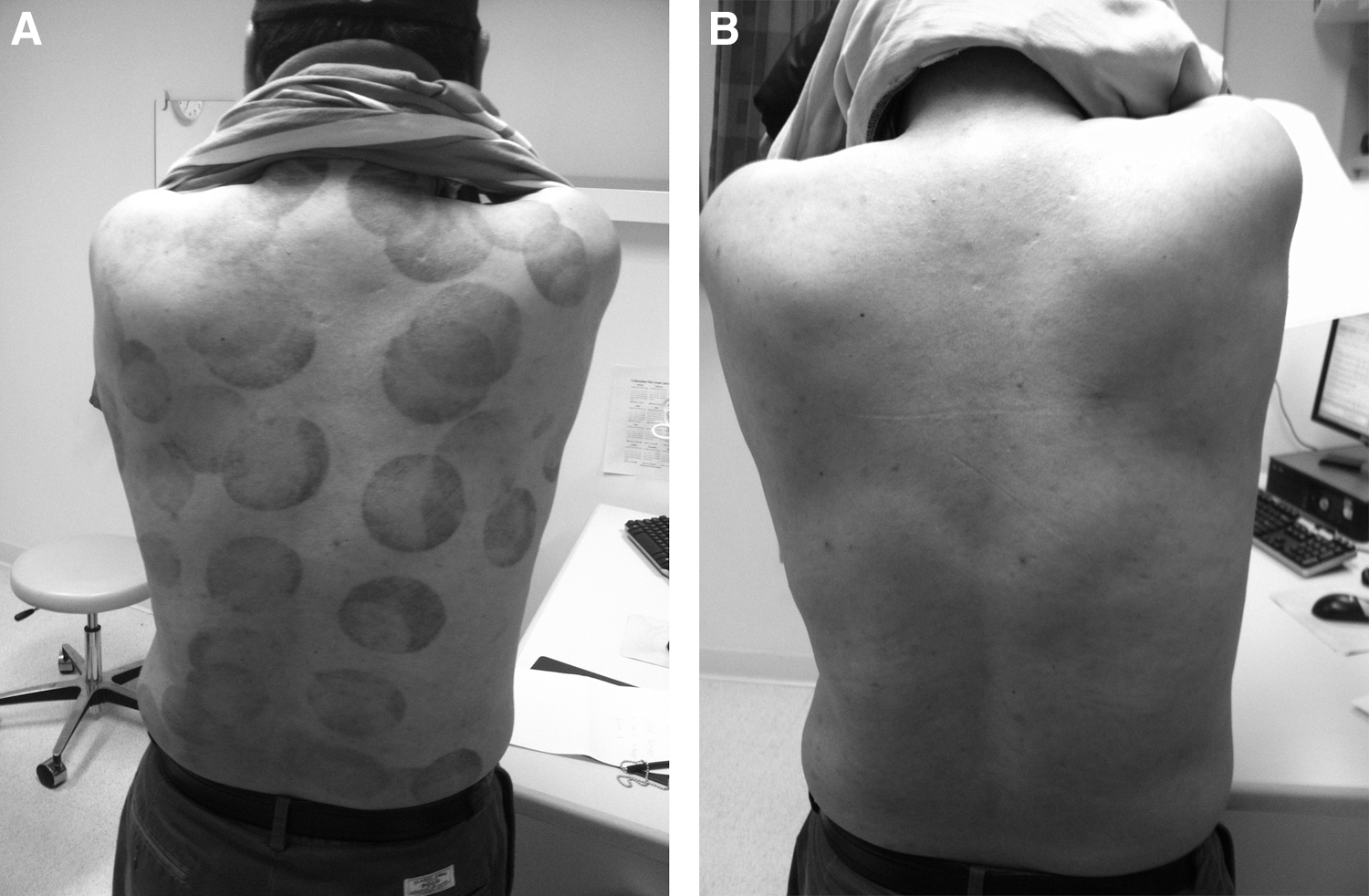
Cupping during treatment with bevacizumab.
Conclusions
This case demonstrates a lack of overt cutaneous adverse events of cupping in a patient despite undergoing treatment with an angiogenesis inhibitor, bevacizumab. To the authors' knowledge, this is the first published report on the safety of cupping during bevacizumab therapy. In this era of new targeted therapies and increasing CAM use, more open communication between CAM practitioners and practicing oncologists is encouraged to minimize potential adverse events. Our report suggests that further research on the role and safety of cupping during anticancer therapy is warranted.
Footnotes
Acknowledgments
All authors contributed equally to the preparation of this article. There is no grant support or funding for this work.
Disclosure Statement
No competing financial interests exist for any of the authors.