






Abstract

Back in 2003 when Konica bought Minolta, the merged company was expected to go toe-to-toe with Eastman Kodak and Fujifilm after a century of innovations in Japan that included the nation’s first brand-name camera (1903), and color film (1940). Instead, the combined company surprised the industry in 2006 by withdrawing from photography altogether.
More than a decade later, Konica Minolta aims to turn heads again.
A corporate giant focused on digital, optical and electronic technology, Konica Minolta last year bought Ambry Genetics for up to $1 billion ($800 million upfront, the rest in milestones), in a deal completed October 20, 2017. Six days later, Konica Minolta completed its purchase of Invicro, a contract researcher organization (CRO) that provides imaging services and software for biopharmas for research and clinical development.
The deals gave Konica Minolta a beachhead in precision medicine, a market projected to more-than-triple by 2026 to $141.70 billion up from $43.59 billion two years ago, according to BIS Research.
“Philips is the closest competitor that is focused on a digital pathology and precision medicine theme alongside of its imaging device business. They chose the road of pathology as opposed to genomics, where Konica Minolta will take a lead,” said Divyaa Ravishankar, industry principal, Transformational Health & Life Sciences with market research firm Frost & Sullivan.
Earlier this year, Konica Minolta established a global headquarters in the U.S. for its new Konica Minolta Precision Medicine division to be based in Alisa Viejo, CA at Ambry Genetics. And in July, the company named John E. Niederhuber, M.D., to chair its Scientific Advisory Board, a former director of the NIH’s National Cancer Institute, and current EVP and CEO of Inova Translational Medicine Institute, and recently named President and CEO of the Genomics and Bioinformatics Research Institute, a joint venture between Inova Health System and the University of Virginia.
Engaging Biopharma
Expanding in precision medicine, Konica Minolta says, will entail both organic growth and acquisitions focused first on greater engagement with biopharmas. The company already works with most pharma giants through its CRO Invicro, but expects to generate more biopharma business for Ambry, reviving an area from which the company retreated several years ago to focus on clinical testing.
Kenneth Bloom M.D., chief medical officer of Advanced Pathology and Genomic Services for Konica Minolta, said the company aims to meet the genomic need of biopharmas by showing them that its technologies can help de-risk their drug development, by identifying the right targets for new therapies through the company’s variety of technologies.
Kenneth Bloom M.D., CMO, Konica Minolta

“We’ve determined that pharma has a genomic need that we can fit,” said Bloom. “Most of that is along the germline space. But we’re starting to move out and look for somatic opportunities as well.”
Among the company’s goals in strengthening ties with pharma, he said, is to build a presence in companion diagnostics (CDx) by helping customers determine if a CDx is necessary for their drug candidates.
“Ambry was already working with pharma from the genomic side, Konica Minolta from the nanotechnology side, and Invicro predominantly from the radiology side,” Bloom, who is also CMO for Invicro and Ambry Genetics, told Clinical OMICs. “As a result of the companies coming together, this allows us to go to pharma with an agnostic biomarker strategy. We bring everything to the table from a science standpoint, so when we sit and talk to a pharma company, we don’t have a vested interest one way or another who wins. We get you the best solution for what your problem is. That’s very appealing to pharma.”
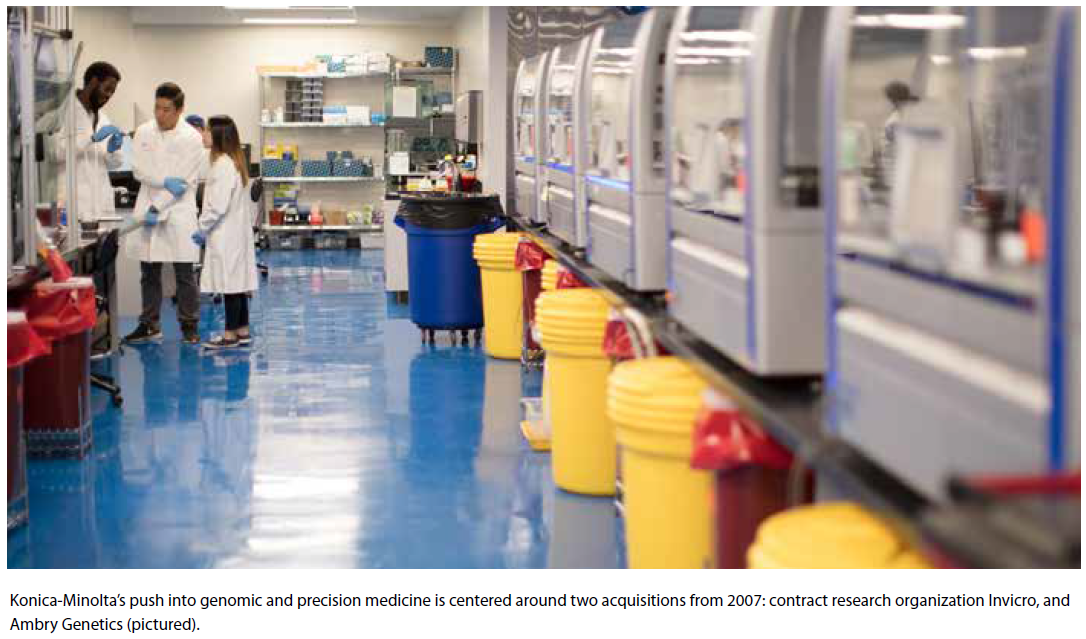
Konica-Minolta’s push into genomic and precision medicine is centered around two acquisitions from 2007: contract research organization Invicro, and Ambry Genetics (pictured).
Konica Minolta’s ability to integrate radiology, pathology, and genomic information, he said, will serve over time as a differentiator. Through Ambry, Konica Minolta offers genetic testing solutions for inherited and non-inherited diseases, as well as for numerous clinical specialties that include oncology, cardiology, pulmonology, neurology, and general genetics.
Pursuing Opportunities
Across all those areas, Konica Minolta said, it plans to pursue opportunities for new germline and somatic tests following a recent review of its testing menu. The company reasons that biopharmas focused on treating rare genetic disorders, or developing precision cancer treatments like PARP inhibitors, will want to access Ambry’s comprehensive testing to help them identify patients who may benefit from new therapies.
Through Boston-based Invicro, Konica Minolta offers pharmaceutical development support services from early-phase discovery through late-phase clinical trials to approximately 140 businesses, primarily biopharmas. It specializes in searching for and establishing central nervous system biomarkers for cancer and Alzheimer’s disease using its VivoQuant image data visualization and analysis software and iPACS data management platform. Since its founding 10 years ago, Invicro has evolved into a service provider specializing on quantitative imaging biomarker assays.
For most of its history, Invicro focused on discovery-phase imaging, but expanded into clinical-phase research in 2016 when it acquired Molecular Neurouimaging, along with additional acquisitions last year of Imanova and CORE Clinical.
“The combination of Konica Minolta’s robust precision medicine platform with Invicro’s strong track record with the world’s top 20 pharmaceutical and biotech companies, as well as leading research universities, will accelerate our mission by a couple of years to go beyond just the medical imaging and software sectors,” Invicro Co-Founder and CEO Jack Hoppin, Ph.D., said in the company’s annual Integrated Report 2018.
Konica Minolta also aims to engage biopharmas through its High-Sensitivity Tissue Testing (HSTT). The advanced immunostaining technology uses fluorescent nanoparticles to detect and quantify proteins linked to disease, with the goal of offering greater precision and accuracy than conventional immunostaining techniques. Initially applied in oncology, HSTT is designed to determine the exact cellular location and amount of specific proteins in cells, enabling early-stage, precise diagnosis and insights into a patient’s disease designed to inform research and clinicians’ treatment plans.
“We’re hoping that we’re going to be able to identify a broader group of patients that might benefit from current therapies, but more importantly, moving forward for pharma, that they’re going to look at this technology as being more robust,” Bloom said.
Perspective and Pathology
“The Konica Minolta precision medicine perspective is: We want to take care of people when they’re ill. And more importantly we want to keep people healthy,” Bloom added.
Keeping people healthy has been Ambry’s focus through its germline testing, while taking care of people when they’re ill has been the concern of Invicro via is research services that aid new drug development, to get drugs to market quicker. “What we want to do,” Bloom said, “is merge those two together.”
Konica Minolta also intends to build a pathology business whose operations can be aligned with Ambry’s genomics services. Pathology services are now being handled at labs in Japan as well as in Boston, but Konica Minolta plans to add that capability as well in Aliso Viejo. How soon that will occur has yet to be decided, Bloom said.
¥100 Billion Goal
Konica Minolta has publicly committed to growing its genomic or “bio-healthcare” business to at least ¥100 billion ($885.4 million) in revenue, and an operating profit of at least ¥20 billion ($177 million), by the 2021 fiscal year.
The company finished its 2017 fiscal year ending March 31, 2018, with bio-healthcare revenue of ¥9 billion ($79.7 million), and was more than halfway to equaling that in the first quarter of its current fiscal year (April–June 2018) with ¥5.9 billion ($52.2 million) in revenue.
For the current fiscal year ending March 31, 2019, Konica Minolta has projected ¥35 billion ($309.9 million) in bio-healthcare revenue, or about 3% of the ¥1.08 trillion (about $9.6 billion) in revenue forecast for the entire company.
“Konica Minolta is currently shifting business resources from its traditional businesses, which have involved developing and providing X-ray diagnostic equipment, ultrasound diagnostic systems, and medical IT solutions, to the field of precision medicine, where we can provide greater added value,” Kiyotaka Fujii, the president of Konica Minolta’s healthcare business, stated in the annual report.
A key driver of Konica Minolta’s precision medicine growth has been its desire to bring that medical approach to Japan. On October 1, the company launched a wholly owned subsidiary dedicated to marketing high-end precision medicine tools and diagnostic services in Japan. Konica Minolta Precision Medicine Japan will be led by president Ken Masuo, who has 30-plus years of pharmaceutical industry experience. It will be based in Tokyo with a launch team of 23 employees.
Konica Minolta
Among precision medicine efforts Konica Minolta has identified for Japan is creating a database of genetic data gleaned from its diagnostics, with the aim of contiributing to genetic analyses based on the characteristics of Japanese patients. The company also plans to work with genetic research organizations to help advance Japan’s national genome strategy.
While Ambry has given Konica Minolta know-how on securing reimbursement for tests from private payors in the United States, the company’s ability to apply that expertise in Japan faces a challenge.
“Like many other emerging markets, Japan is also increasingly a self-pay market,” Ravishankar said. “The cost of the tests as they are right now may not be affordable for this population. It will be interesting to see Konica Minolta’s pricing strategy as they wade through the tough waters of price sensitivity.”