







Abstract
The current study has investigated the prevalence of antimicrobial resistance (AMR) genes in cow and goat raw milk samples. The misuse of antibiotics in the livestock sector has already been reported to be a major factor contributing to AMR risk. For the study, milk samples were collected from five different farms, and metagenomic DNA was extracted. Then, PCR amplification was carried out using primers specific to 15 different AMR genes. From the results obtained, the prevalence of β-lactam resistance genes, particularly blaTEM (24%), along with other genes like blaZ (12%) and blaSHV (8%), were observed in addition to the transmissible mcr9 gene (12%) conferring resistance to colistin. These findings underscore the urgent need for monitoring AMR genes and regulating antibiotic use in dairy farming to safeguard public health, as it poses a potential risk with the consumption of unpasteurized milk.
Keywords
Introduction
With the increasing population worldwide, a pressing demand exists to supply safe and healthy food to society. Due to the nutrient richness of milk, it provides an ideal environment for the growth of microorganisms. Even though various approaches have already been taken to enhance the quality of unpasteurized milk, the microbiological risk is significant with the emerging antimicrobial resistance (AMR) concern. The common pathogens found in raw milk include Staphylococcus spp., Salmonella spp., and members of Enterobacteriaceae. The rapid dissemination of AMR among these pathogens significantly affects their therapeutic management. The major antibiotics used in dairy farms include β-lactam antibiotics, aminoglycosides, fluoroquinolones, and tetracyclines (Martinez JL, 2009). The AMR concern on the same can make foodborne pathogens cause serious life-threatening illnesses in humans (Arbab S et al., 2021). Hence, generating genomic data on AMR is crucial for raising awareness of the risks through food products such as those made from unpasteurized milk (Almansour AM et al, 2023). Here comes the relevance of PCR-based screening of antibiotic resistance genes from the metagenomic DNA of food samples like raw milk, as investigated in the current study.
Methodology
For the study (n = 50, containing 42 cows and 8 goats), milk samples were collected from the Alappuzha district, Kerala, India. Here, 25 mL of milk was collected per animal from five private farms from March to May 2024 in sterile 50 mL plastic containers (Magro S et al., 2023). The sampling from the udder was done after cleaning the teats with wet disposable towels, and the samples were further transported to the lab under frozen conditions to avoid microbial multiplication and also to prevent the introduction of contaminant microorganisms into them (Gupta and Brightwell, 2023). Metagenomic DNA was further isolated from all 50 samples and screened for the presence of 15 AMR genes (Supplementary Table S1) by PCR. The products obtained were further sequenced using the Sanger method, and reads were collected using Applied Biosystems Sequencing Analysis Software.
Results and Discussion
The metagenomic DNA-based approach used in the study helped to capture genetic information from the microbial community of milk and is a rapid method when compared to the traditional culture-based methods. Genes present in microbial strains could also be detected through the PCR, which further rules out the false negative results obtained in the routine phenotypic methods-based antibiotic sensitivity test (AST) screening (Ahmadi A et al., 2022). As antibiotic residues have previously been reported to be present in milk, the results of the current study suggest the potential link between the use of antibiotics in dairy settings and the evolution of AMR (Vercelli C et al., 2023). The quality of the extracted metagenomic DNA was confirmed by the PCR amplification of 16S rDNA (Fig. 1a), and the AMR gene-specific primers used for the metaDNA screening of milk were listed (Supplementary Table S1). A heatmap representing the distribution of various AMR genes used in the PCR screening was also listed (Supplementary Fig. S1). In the study, the confirmation of a specific PCR band as that of a specific AMR gene was further carried out by sequencing the randomly selected samples (Rekadwad BN et al., 2023). Among the AMR genes screened, blaTEM (1080 bp) was found to be the most prevalent (24%), followed by the gyrA (398 bp) gene among 22% of the samples, whose mutation can result in antimicrobial resistance (Fig. 1b, c, f, and g). The sequence data of gyrA were 97% identical to the gyrA gene (ARO:3003296) previously reported from Staphylococcus Aureus, and blaTEM was 96% identical to the blaTEM gene (ARO:3001029) from the mixed culture bacteria (Supplementary Table S2). The other β-lactamase coding genes, including the blaZ (377 bp) and blaSHV (870 bp), were present in 12 and 8% of the used samples (Fig. 1d and e). Here, the blaZ gene was 90% identical to the blaZ gene (ARO:3000621) of S. aureus, and the blaSHV gene was 67% identical to the blaSHV gene (ARO:3001079) from Klebsiella pneumoniae. Out of the six colistin-resistance genes (mcr1, mcr2, mcr3, mcr4, mcr5, and mcr9) screened, there was a 12% prevalence of the mcr9 (465 bp) gene (Fig. 1i). In the case of mcr9, it has previously been reported from broiler feces, which highlights the need for further monitoring of this variant from other veterinary sources (Sreekumaran S et al., 2024). The mcr9 sequence upon BLAST X analysis was found to have 100% similarity to the mcr9 gene (ARO:3004684) previously reported from Salmonella enterica (Supplementary Table S2). The prevalence of the mecA (533 bp) gene (8% distribution) (Fig. 1h) as observed was comparatively lower when compared to its 13% distribution reported previously for the mastitis-positive samples (Deepak SJ et al., 2023), and here the sequence data was found to be 100% identical to the mecA gene (ARO:3000617) previously reported from S. aureus (Supplementary Table S2). The identification of multiple clinically relevant genes among the selected samples indicates the emerging threat of raw milk as a medium for silent AMR dissemination. This also highlights the need for stringent monitoring and regulation of antibiotic use in dairy farming to control the evolution of resistant strains at the source itself. The spread of AMR genes through raw milk causes significant public health implications. This also indicates the need for deep research on understanding the evolution dynamics of AMR genes and to explore alternative ways to manage infections in dairy herds.
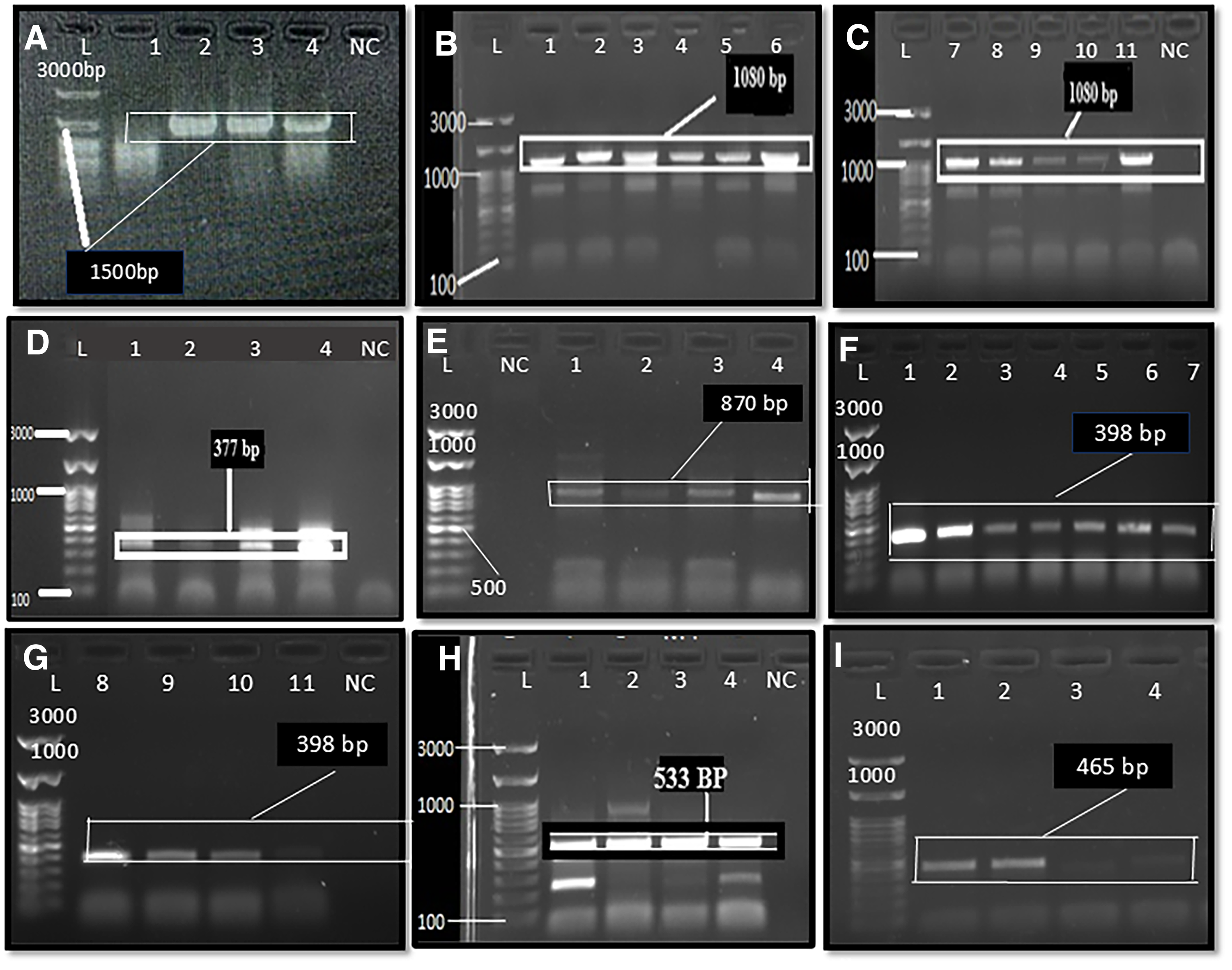
Agarose gel electrophoresis of PCR amplifications conducted in the study.
Authors’ Contributions
R.M.S., A.M., F.T.A., S.S., and R.E.K.: Conceptualization, Investigation. R.M.S., A.M., F.T.A., S.S., D.L., and R.E.K.: Methodology. R.M.S., A.M., S.S., and R.E.K.: Formal analysis and data curation. S.S., M.J., and R.E.K.: Supervision. R.M.S., A.M., and R.E.K.: Writing, review and editing.
Footnotes
Acknowledgments
The authors are highly thankful to the Kerala State Higher Education Council for the funding support received for the Kairali Gaveshana Puraskaram Research Project, awarded to Dr. Radhakrishnan E.K. The authors acknowledge their sincere thanks to the School of Biosciences, Mahatma Gandhi University, for the instrumental support.
Funding Information
This study was partially funded by the Kairali Gaveshana Puraskaram Research Project (Proc. No. KSHEC-A3/352/Kairali Research Award 2021/894/2023 dated 07.07.2023), Kerala State Higher Education Council, Kerala, India.
Ethical Approval
This is not applicable as this study does not involve human participants, cell lines, or antibodies.
Consent to Participate
This is not applicable because this study does not involve human participants.
Consent for Publication
This is not applicable because this study does not involve human participants.
Data Availability
All data generated or analyzed during this study are included in this article or as supplementary data.
Disclosure Statement
No competing financial interests exist.
Supplemental Material
Supplemental Material
Supplemental Material
References
Supplementary Material
Please find the following supplemental material available below.
For Open Access articles published under a Creative Commons License, all supplemental material carries the same license as the article it is associated with.
For non-Open Access articles published, all supplemental material carries a non-exclusive license, and permission requests for re-use of supplemental material or any part of supplemental material shall be sent directly to the copyright owner as specified in the copyright notice associated with the article.
