







Abstract
T here are now many different models of primary care operating within the UK. However, the traditional practice owned and run by GPs, almost always with the assistance of a practice manager, is still the most usual model of primary care provision. In some cases, the practice manager is also a stakeholder in the business, in others simply an employee. This section focuses on the management roles of the GPs within traditional style practices.
The GP curriculum and management for GPs
GP Curriculum statement 4.1 covers management in primary care. In particular, it requires GPs to
understand the role of team dynamics in the functioning of an organization describe strategies for effective communication within the practice organization describe the management structure of the practice, how decisions are made and how responsibilities are distributed critically appraise the organizational systems of the practice
In addition, the GP should be able to demonstrate that he or she
is aware of his or her own capabilities and values is aware of self—or has an understanding that his or her own attitudes and feelings are important determinants of how he or she manages and leads
Every practice is different and so the management roles of the GPs within the practice will differ considerably from practice to practice. Whatever management roles the GPs have within a practice, it is important that
Each individual's role, responsibilities and limits are clearly defined There are good lines of communication and reporting between those with management responsibilities
Management roles and responsibilities of GPs
In most practices, the management tasks are broken up, with the practice manager having day-to-day responsibility for every aspect of the smooth running of the practice, and GPs taking responsibility, in co-operation with the practice manager, for specific aspects of management (Fig. 1). For example, one partner may be responsible for training and education within the practice, another for prescribing, and another may be involved in staff relations.
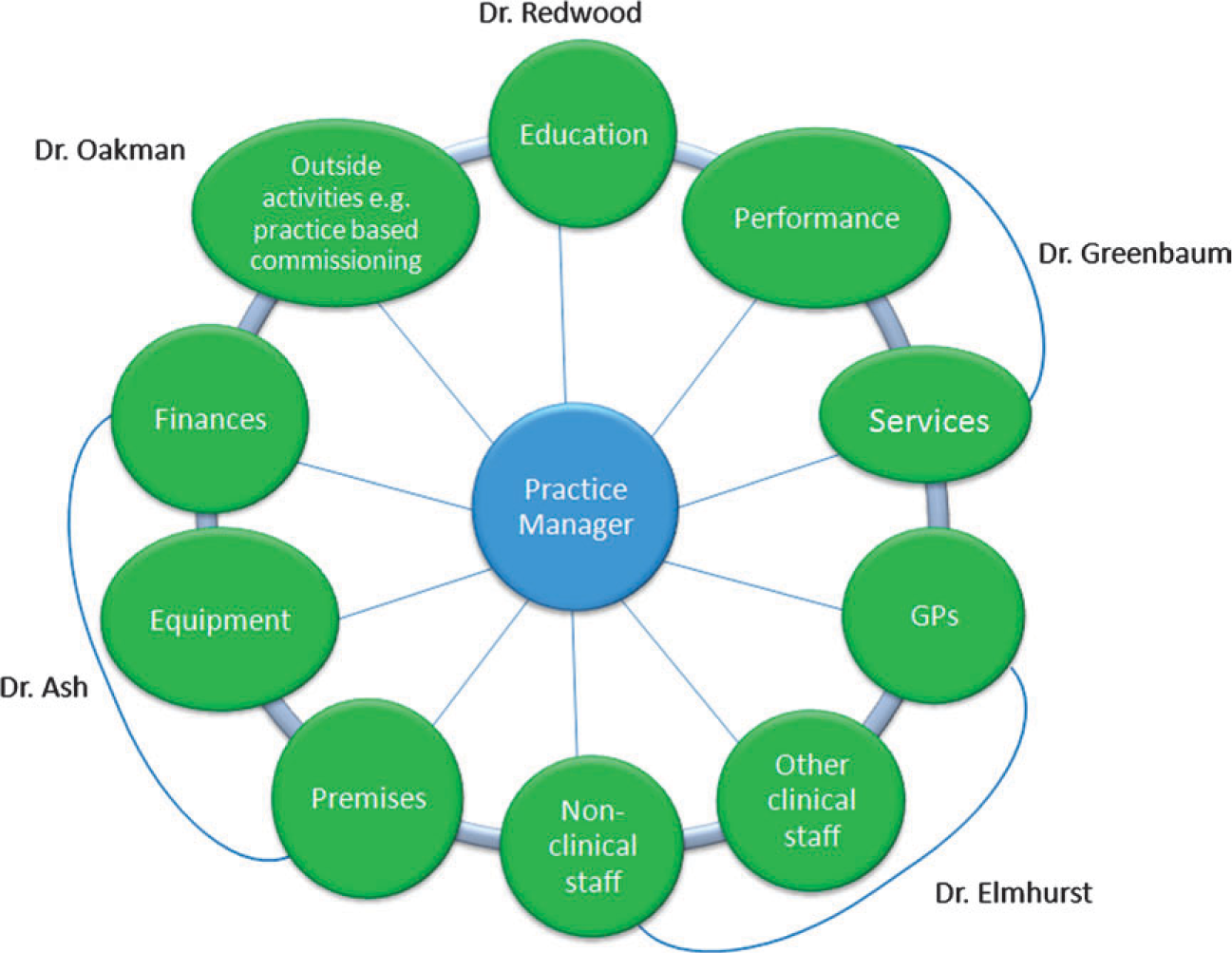
Division of management tasks in the Forrest practice between the practice manager and GPs.
In some practices, a GP takes responsibility for one part of the management of the practice and remains in that role permanently. In other practices, roles are rotated at regular intervals to ensure that all the partners involved with management have knowledge of every aspect of the practice. Ideally, when GPs or other team members take on a management responsibility, their strengths should be matched to the tasks that they are allocated, and it is important that the management needs of the practice are a consideration when recruiting new partners and staff expected to assume management responsibility.
The degree to which GPs take on management tasks varies considerably from practice to practice. Most GPs have very little formal management training. Some enjoy their management responsibilities, while others find them a chore. These factors will affect the management style of the GP, the degree to which a GP will develop that role and also the degree of autonomy that a practice manager is allowed when running a practice or even just specific aspects of a practice. For a practice manager, judging the level of involvement to have in any particular management task can be difficult, particularly if roles are rotated.
In almost every case, the practice manager supports the GP manager in his or her management role, whatever that is. The practice manager is the driver of the management activity within the practice who focuses on implementing the agreed action plans, to keep the practice moving in the intended direction. The practice manager is also the moderator of management activity, watching for external influences that might alter the best direction that the practice should take. This allows the GPs to get on with their clinical work with the knowledge that management tasks will continue regardless.
Example 1
The Forrest practice has five GP partners and is situated in a busy market town. Each partner has clearly defined areas of management responsibility but different partners have very different management styles.
Dr Oakman really enjoys the management side of the practice. She is the lead partner for practice-based commissioning. The practice manager and the other partners leave her to do that task with very little assistance. This usually works well, but there was a problem when she had a nasty accident and was away on sick leave for 4 months. No one else knew what was going on in this area of practice management, and several opportunities were lost as a result.
On the other hand, Dr Elmhurst hates anything to do with management. He is responsible for recruitment and staff relations. The practice manager constantly has to chivvy him to get tasks done and it is often easier to do tasks herself than to badger him to do them. He is happy for her to do that and shows no interest at all when anyone consults him on staffing issues. This has caused some discord in the practice at times, as some of the other partners do not feel that he is making an equal contribution to the management success of the practice.
Communication
Because the management tasks are usually broken up between the managing partners of a practice, it is vital that everyone in the management team has a common vision of how the practice should be run and is working towards shared goals. Depending on the size of the practice and relationship between the partners in the practice, this can be achieved in many ways. However, it is becoming more and more common for all those involved with the management of the practice to hold a strategy meeting at least annually to review their progress over the past year and formalize their goals for the future (Fig. 2).

Ensuring co-ordinated action of the practice management team.
Many practices produce a formal business plan as a result of that meeting. This ensures that everyone has agreed on the targets that they are working towards, and their individual roles and responsibilities, and helps keep everyone on track.
Once a business plan has been formulated, ongoing monitoring of progress is essential to
Ensure that everyone is following the business plan Co-ordinate the actions of the practice Provide flexibility to manage unforeseen events
Usually this monitoring takes the form of a weekly practice business meeting. All meetings should be minuted. When keeping records of such meetings, it is important to record who is responsible for any tasks allocated and a time frame for each task to be completed within.
Setting limits and boundaries
It is important for all those with management responsibilities, including practice managers, to have written agreements about when they need to involve the managing GPs in decision making. GPs with management responsibility should also be clear when they can take decisions alone and when they need to involve the whole partnership in decision making. Allowable financial expenditure might be an example. For instance, the practice manager might have permission to spend up to £250 on a certain area of practice activity without reference to the managing GP and £1000 with the permission of the GP with management responsibility for that area, but expenditure above that limit needs to be agreed with the whole partnership.
Management disputes
In any practice, there will be times when individual GPs will disagree on the right course of action or the practice manager will not agree with the GPs. Such disagreements can be a source of significant disharmony within the practice and even lead to partnership breakdown.
The way in which disagreements are dealt with varies from practice to practice, but it is important that there is a clearly defined way that practice management decisions are agreed upon. Different policies will suit different practices. It is important for the policy to be stated in the practice agreement. Commonly used policies include
Majority decision—this is probably the most frequently used method of decision making. However, factions commonly form in practices and majority decision making can result in decisions always going the way of the bigger or dominant faction. Veto—the decision cannot go through if one, or in some cases two, individual(s) vote against the proposal. This prevents individuals from being sidelined, but can stifle development, particularly in bigger practices.
Another common source of friction occurs when decisions are made in the absence of one of the managing GPs or the practice manager. For a large proportion of each year, one or more of those involved with the management of the practice will be away. The decision-making process of the practice cannot stop when the full management complement is not there, so there must be a policy in place to deal with decisions made at these times.
Again different policies will operate at different practices. Options include proxy voting, allowing decisions to go through where the majority decision is present whatever the vote of the absent manager, classifying decisions as minor or major, and allowing minor decisions to go through without everyone's opinion being known. Each has pros and cons.
Example 2
The weekly business meeting at the Forrest practice has become very heated. Dr Ash and Dr Oakman think that the practice should employ an additional salaried GP to make workload lighter. Dr Greenbaum and Dr Redwood do not want to invest any more money in staff salaries. Dr Elmhurst is on holiday.
Pat, the practice manager, steps in and points out that, as this is a major decision affecting income and expenditure of the practice, no decision can be made until Dr Elmhurst's opinion is known.
The following week, Dr Elmhurst is back. He has been lobbied by both factions and is already fed up with the argument about employing an extra salaried GP. He is approaching retirement and really does not care whether a new GP is employed or not as it will not really affect him. He abstains from voting leaving a split decision.
Pat consults the practice agreement which states that, in the case of major decisions, where a decision is split, a power of veto applies. She puts this to the meeting and Dr Greenbaum vetoes the proposal.
The relationship between the GPs and the practice manager
Being a practice manager is a very challenging role. Not only are you the manager of a small business but you must also manage the GPs who own the business—who are often also your employers. Those individuals know the practice well and often have strong views about how the practice should be run. On the other hand, they may have limited experience of how to run a business and it is in their interests that the business should be run well and at maximum profit. Successful practice managers are those who are respected by the managing GPs as the overall co-ordinators of management activity within the practice, and can tread the fine line between accommodating the wishes of the managing GPs and knowing when to exert their own authority.
Training in management
Training opportunities are available to equip GPs with management skills. Many deaneries offer management courses as part of GP training or as an extended training option. Management courses are also available within the commercial sector and many universities, colleges of higher education and business schools offer opportunities ranging from courses on specific aspects of management, to certificate, diploma and masters (MBA) courses in business administration. Often these courses are available as distance learning programmes.
Key points
In most traditional style practices, the GP partners have management responsibility for the running of the practice, usually with the assistance of a practice manager It is important to match an individuals’ strengths and weaknesses to the management tasks of the practice in order to run a successful business in which all partners contribute equally Each individual's role, responsibilities and limits should be defined, agreed and shared with the rest of the practice team Good communication channels are the key to effective working and decision making. A business plan that is reviewed on a regular basis is a useful tool to ensure that everyone is working effectively towards a common goal. Every practice should have an agreed procedure for decision making and dealing with management disputes