







Abstract
Approximately 15% of GP consultations in the UK are for a skin condition. In the general population, about 4.5% of people have a contact allergy to nickel and 1–3% to an ingredient in cosmetics. Studies suggest that skin disorders (29%) are the second most common cause of occupational disease after musculoskeletal conditions (57%).
The GP curriculum and contact dermatitis
General practitioners should be able to assess risk factors for skin diseases. They are well placed to promote skin well-being and should not underestimate the impact of skin problems on a patient's life.
GP curriculum statement 15.10 states that GPs should
Demonstrate a reasoned approach to diagnosis of skin symptoms using history,
examination, investigation and referral Advise patients appropriately on principles of protective care, occupational
health and hand care Empower patients to look after their own health and take responsibility for
managing their skin problem Understand the importance of occupational risk in aetiology of skin disease and
impact of skin problem on fitness to work Recognize how disfigurement and cosmetic skin changes can fundamentally affect
patient's confidence, mood and interpersonal relationships Appreciate the importance and psychological impact of skin problems on
patient's family, friends, dependants and employers Recognize the risk of under referral
Definition
Dermatitis is an inflammation of the skin. Eczema is a clinical syndrome which consists of itchy erythematous, papular and lichenified plaques in a roughly symmetrical distribution. All eczemas are dermatitis but not all dermatitis is eczema. Eczema can be endogenous or caused by an external agent in which case it is referred to as contact dermatitis (CD). Atopic eczema is an example of an endogenous type of dermatitis, while dermatitis caused by nickel is a CD.
Classification
There are two main types of CD: irritant and allergic CD (Table 1). Irritant CD (Fig. 2) is caused by direct skin contact with an irritant substance. It can potentially affect anyone and is usually limited to an area of skin that is in contact with the irritative substance. A single prolonged or multiple brief exposures to a strong irritant, for example bleach, solvents, abrasives and detergents, can cause acute dermatitis. Repetitive exposure to weaker irritants such as water, soaps, weak organic acids (plants), dust and powders can lead to a more chronic irritant type CD. Environmental factors like heat, cold, friction and dry air can worsen the effect of irritants on skin. A chain reaction of skin damage leading to inflammation and weakening of skin barrier function will further increase the skin's susceptibility to irritants (see Fig. 1).
Characteristic features of the two main types of contact dermatitis


Vicious cycle of irritant contact dermatitis.

Irritant hand dermatitis
Allergic CD (see Figs. 3 and 4) develops following sensitization to specific allergens. It involves a cell-mediated delayed hypersensitivity reaction (type IV) and can cause a new, or complicate a pre-existing, dermatitis. It can potentially spread beyond the area of direct contact; a systemic reaction can also develop on systemic administration of a drug or following a topical sensitizing event.

Allergic contact dermatitis on the face from rosin in make-up
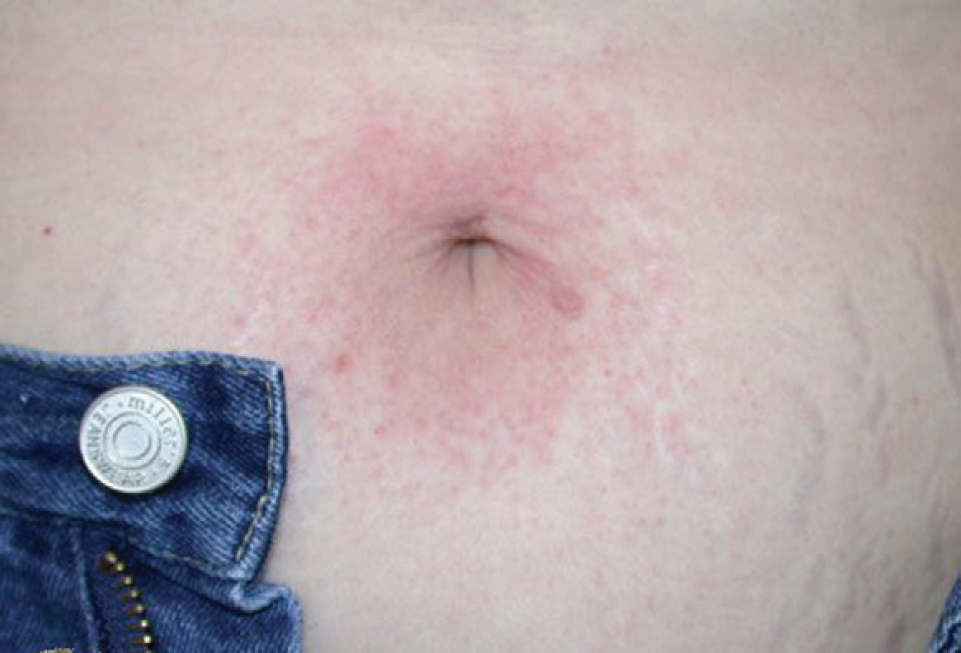
Allergic contact dermatitis from nickel in jean studs
Suspecting CD
Irritant CD is more common than allergic CD but both can also coexist. When suspecting CD and conducting a clinical assessment, it is important to take a detailed history and examine all the skin sites involved.
Factors to consider in the history
When taking a history, the symptom profile alone is not very helpful as it is essentially that of an underlying skin inflammation and is similar in both types of CD (Table 2).
Symptoms and signs found in contact dermatitis

You will need to ask about the initial site of appearance of dermatitis and search for a potential exposure source; you should also explore the timescale from the exposure to eruption and spread to other areas of the body. Allergic dermatitis involves both direct and more distant sites and develops over days and weeks. Irritant dermatitis is much more common on hands and may develop immediately or within a very short period of exposure.
It is also important to obtain a detailed drug history including current and past usage of both topical and oral medications in order to assess if there has been a prior sensitizing event. Enquire if there is a personal or family history of atopy, as individuals with a history of eczema, hay fever and asthma are more predisposed to allergic CD. You should also elicit if there is a past history of known sensitivity to any of the following such as drugs either topical or a systemic; inhalant allergens like cat dander, dog hair, dust or perfume; food allergy to prawn, nuts or shellfish and/or any allergic reaction to metals in ear rings, studs in clothing, cosmetic and toiletries or to rubber products in gloves and Elastoplasts.
Obtaining an occupational history is crucial (see Table 3—Occupations at high risk of contact dermatitis). Therefore, enquire about the patient's current job and its duration, previous jobs and previous skin reaction. Is there any improvement in skin when patient has been off work? Also find out about other hobbies and sporting activities; this is mainly to explore if there is excessive exposure to friction, humidity, water, etc.
Occupation with the highest risk (rate per 100 000 employed per year) using labour force survey data as the denominator and cases of contact dermatitis reported to the UK EPI-DERM Survey as the numerator

Examination findings
An examination of affected skin areas could reveal signs of both acute and chronic inflammatory change in the skin (Table 2). Paying attention to the distribution of the skin lesions is important as it can point towards the potential exposure source and underlying type of CD.
Direct irritants are more likely if only the hands are involved and especially in between the finger webs. Collar, belt and flexure areas are known to accumulate dust irritants. Lesions predominantly on the face, lips or eyelids can result from an environmental or cosmetic allergen and some lesions on the face, neck and back of hands also arise from exposure to vapour, photo allergens and jewellery use.
Confirming the diagnosis
The diagnosis of an irritant CD can only be made clinically by the history and finding an improvement with avoidance of the irritant. In contrast, allergic CD can usually be confirmed by patch testing for which referral to a specialized dermatology clinic is required.
Patch testing
Patch testing involves a controlled challenge with an antigen that a person may be sensitized against. (Fig. 5). It has a high sensitivity and specificity of 70% and 80%, respectively. The procedure involves a series of patches that contain small chambers (Finn chambers) being applied on the skin, commonly on the back or outer upper arm. These are filled with a standardized concentration of the potential allergens. The patches are removed after 48 hours and the clinician observes whether the skin has reacted to any of them; another reading is carried out after 96 hours to check for the development of any late reaction.

Patch test series
It is important to control any eczema on the back and elsewhere prior to patch testing. This minimizes false-positive results or an angry back syndrome developing (also called an excited skin syndrome) where a skin hyperirritability produces multiple false-positive results to a patch test series, as skin often behaves as a unified organ and may react to whatever is applied when it is in a reactive state. A number of allergens are available for testing. A standard battery includes all common substances which are additives to commodities of daily use like cosmetics, clothes, leather, etc. If suspected, it is also possible to apply additional batteries and some of the patient's own range of cosmetics and medicaments; however, strong irritants like powder detergents cannot be patch tested.
Differential diagnosis
CD can look similar in its physical appearance to atopic eczema, psoriasis or fungal skin infection. These may be differentiated from each other by their clinical presentation, histology, microscopy and culture and patch testing results.
Management
Hand care

The amount of topical steroid to apply is commonly measured by ‘fingertip units’ (FTU). One FTU is the amount of topical steroid that is squeezed from the very end of an adult index finger to the first crease on that finger. It is enough to treat an area of skin twice the size of the flat of an adult's hand with the fingers together. Oral steroids may also sometimes be required in cases of acute, severe and widespread dermatitis in order to control the condition. Prednisolone can usually be given as 30 mg once a day for about 10 days and stopped or alternatively tailed off over a period of a few weeks.
There is only limited evidence about the benefit of antihistamines on itchy skin symptoms. If a secondary skin infection develops, an antibiotic would generally be indicated. The standard approach would be to obtain a swab for culture and sensitivity and use an appropriate topical or oral antibiotic. Topical antibiotics are adequate if there is a localized or mild infected area of dermatitis; oral antibiotics would be preferred if infection is more severe or widespread and/or if the response to the topical antibiotic has been poor with signs of ongoing infection still present.
Steroid-resistant chronic or debilitating hand dermatitis should be referred to a dermatologist who can assess and consider second-line treatment options with local psoralene + ultraviolet A, azathioprine or cyclosporine. Recently, a new retinoid, alitretinoin, has also been launched.
However, as a GP, you do not have to make a judgement that CD has been caused by the patient's occupation alone. You could refer your patients to a dermatologist or a GP with special interest in occupational skin problems for further assessment and confirmation of this diagnosis.
Prognosis
The prognosis will depend on the type of CD and ease with which trigger avoidance can be achieved. Allergic and occupational dermatitis is less likely to be cured completely; up to 50% of patients may have regular flare of symptoms and a quarter permanent symptoms. A change of occupation, though required, may not always cure dermatitis completely. Patients can suffer significant psychological impact from the loss of normal use of their hands, disfigurement of skin and pain; it can also impact their social life and cause them to incur loss of earnings if they give up their chosen profession.
Key points
Skin changes look identical in both irritant and allergic dermatitis Endogenous eczema, irritant and allergic CD can coexist Patients with persistent eczematous eruptions should be referred for patch
testing to exclude an underlying contact allergy Certain occupations are associated with higher risk of CD Only long-term cure is to identify cause and avoid it CD can significantly affect a patient's quality of life, so wider issues
must be explored and support offered