







Abstract
Vaginal discharge is a common presenting symptom encountered in day-to-day practice. From the time of puberty, the vagina is colonized by lactobacilli and other bacteria. Commensal lactobacilli metabolize glycogen in the vaginal epithelium to produce lactic acid, maintaining an acidic environment in the vagina (pH less than 4.5) and providing defence against infection.
The GP curriculum and vaginal discharge
The GP curriculum statement on women's health (10.1) lists vaginal discharge as a key symptom within its knowledge base. GPs must be able to demonstrate that they can assess women presenting to the GP surgery with vaginal discharge and treat any causes found appropriately.
Curriculum statement 11 (Sexual health) requires GPs to be able to take a sexual history from a woman. It lists assessment of unusual or different vaginal discharge within its knowledge base, including taking of appropriate swabs to confirm diagnosis. Within the knowledge base, bacterial vaginosis, candidal vulvovaginitis, gonorrhoea and Trichomonas vaginalis infections are specifically listed as common and important conditions that GPs should be able to manage.
Vaginal discharge can be physiological or pathological (see Box 1). In women of reproductive age complaining of vaginal discharge, the most common cause is physiological, but infective and other causes should be excluded. Before puberty and after menopause the vaginal epithelium is thin, atrophic and has a higher pH, all of which predispose to infection.
Aetiology
Physiological discharge
A normal physiological discharge is white or clear and non-offensive. It consists of transudate from the vaginal walls, squames containing glycogen, polymorphs, lactobacilli, cervical mucus, residual menstrual fluid, and secretions from the greater and lesser vestibular glands.
Type and quantity of physiological discharge varies throughout life.
Newborn infants may have a small amount of vaginal discharge, sometimes mixed in with a little blood, due to high levels of circulating maternal oestrogen. This should disappear by two weeks of age. During the reproductive years, the fluctuating levels of oestrogen and progesterone throughout the menstrual cycle affect the quality and quantity of cervical mucus, which is perceived by women as a change in their vaginal discharge. Initially when oestrogen is low, the mucus is thick and sticky. As oestrogen levels rise, the mucus gets progressively clearer, wetter and more stretchy. After ovulation, there is an increase in the thickness and stickiness of the mucus once more. Around the menopause, the normal amount of vaginal discharge decreases as oestrogen levels fall.
Causes of vaginal discharge
Bacterial vaginosis Candida
Trichomonas vaginalis Chlamydia trachomatis Neisseria gonorrhoeae
Foreign bodies (e.g. tampons, condoms, ring pessary) Cervical polyps and ectopy Genital tract malignancy Fistulae Allergic reactions
Pathological discharge
Abnormal vaginal discharge is characterized by a change in colour, consistency, volume or odour of the discharge. It may be associated with symptoms such as itch, soreness, dysuria, pelvic pain or intermenstrual or post-coital bleeding.
Although abnormal vaginal discharge often prompts women to seek screening for sexually transmitted infections (STIs), vaginal discharge is poorly predictive of the presence of an STI.
Non-sexually transmitted infections
Bacterial vaginosis
Bacterial vaginosis (BV) is the most common cause of infective vaginal discharge. It is characterized by an overgrowth of anaerobic organisms that replace normal lactobacilli, leading to an increase in vaginal pH (greater than or equal to 4.5).
Gardnerella vaginalis is commonly found in women with BV, but the presence of Gardnerella alone is insufficient to constitute a diagnosis of BV. Other organisms associated with BV include Prevotella species, Mycoplasma hominis and Mobiluncus species.
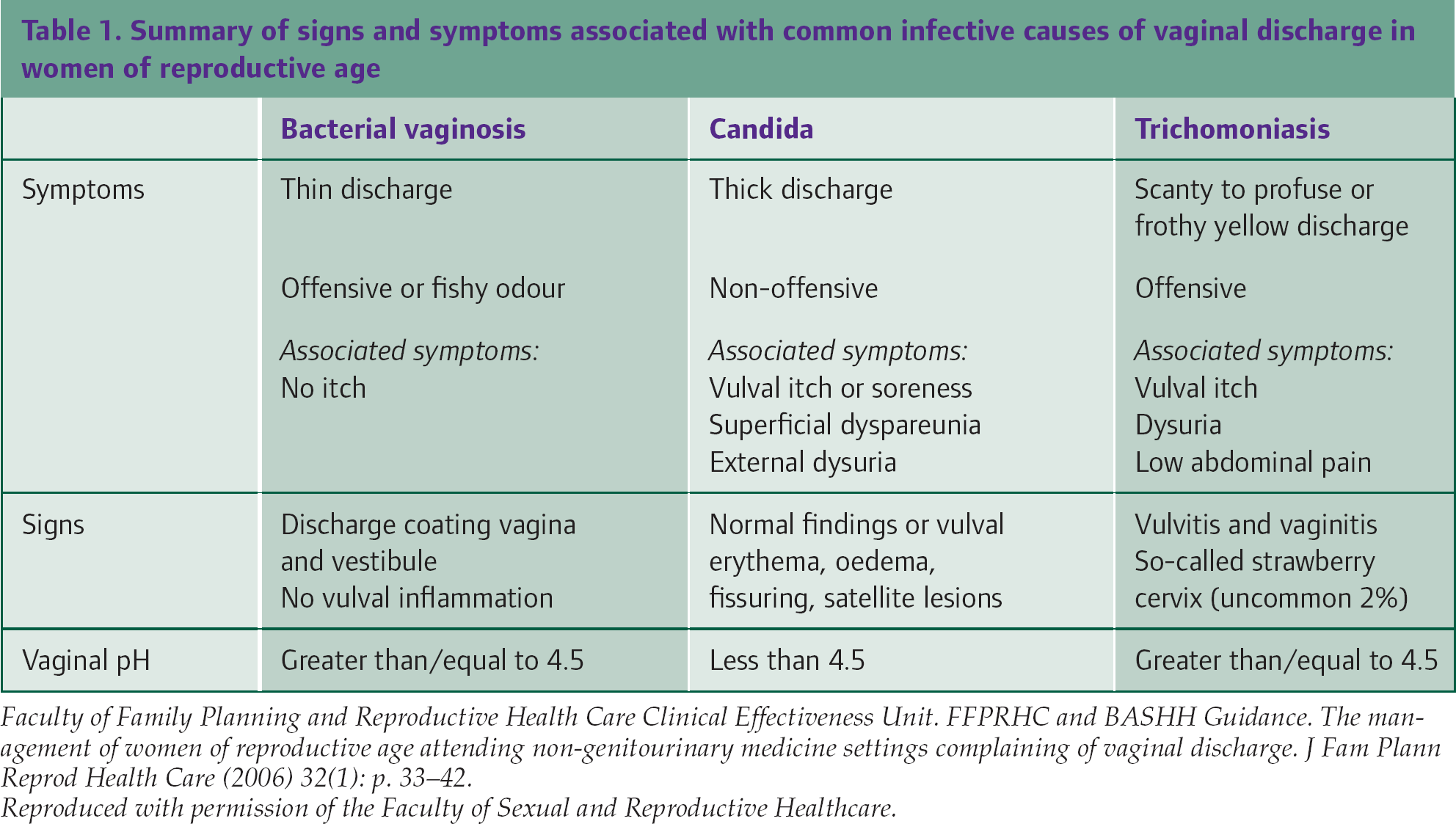
The discharge is thin and has a characteristic offensive or fishy odour (Table 1). ‘Clue cells’ are vaginal epithelial cells so heavily coated with bacteria that the border is obscured (Fig. 1). In clinical practice, BV is diagnosed using Amsel's criteria (Box 2).
Summary of signs and symptoms associated with common infective causes of vaginal discharge in women of reproductive age
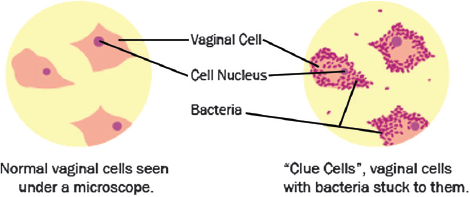
Clue cells.
BV can occur and remit spontaneously; it is associated with early age at first intercourse and a higher number of sexual partners. However, BV is not considered to be an STI.
The recommended treatment for BV is oral metronidazole [400-500 mg twice daily (bd) for 5–7 days, or as a single 2 g dose]. The single dose may improve compliance but may be less effective at 4 weeks follow-up. Alternative regimens include the following:
intravaginal metronidazole gel (0.75%), 5 g application nightly for 5 days intravaginal clindamycin cream (2%), 5 g application nightly for 7 days oral clindamycin 300 mg bd for 7 days or tinidazole 2 g as a single oral dose.
Criteria to diagnose BV
Amsel's criteria (three out of four must be present):
White discharge pH greater than 4.5 Fishy odour (with addition of potassium hydroxide to the discharge) Clue cells (vaginal epithelial cells surrounded by bacteria)
Note: Many research studies use Nugent or Hay/Ison criteria to diagnose BV. These are complex laboratory criteria based on the microscopic appearance of the discharge and cannot be applied in the GP surgery.
Women using combined hormonal contraception should be advised to use additional contraceptive protection (e.g. condoms) during the antibiotic course and for 7 days afterwards and to avoid alcohol when taking metronidazole. Routine testing and treatment of sexual partners is not recommended.
Genital thrush
Candida albicans is a vaginal commensal found in 10–20% of asymptomatic women. Acute vulvovaginal candidiasis (VVC), or genital thrush, is the second most common cause of infective vaginal discharge and is caused by an overgrowth of yeasts, usually C. albicans (80-95% of cases) or Candida glabrata (5%). Candidiasis occurs most commonly when the vagina is exposed to oestrogen, especially in women aged 20–30 years and in pregnancy. The lifetime incidence of VVC is 50–75%, and around 50% of women who have had an acute attack will have a further episode.
VVC is characterized by a thick, white, non-offensive discharge and may be associated with vulval itch or soreness, superficial dyspareunia or external dysuria. Diabetes mellitus, immunosuppression, antibiotics and corticosteroids treatment may precipitate VVC, but there is no good evidence that hormonal contraception increases the risk of VVC, nor is there evidence that tampons, sanitary towels or vaginal douching cause candidiasis. Candidiasis is not sexually transmitted.
Antifungal treatment can be given if VVC is suspected and there is low risk of STIs or while awaiting results when swabs have been taken. Give as a single 500-mg pessary, 200-mg nightly for 3 days or 100-mg nightly for 6 days. The efficacy of treatment depends on the total dose given, rather than duration. A single high dose is as effective as a divided dose given over several days and compliance may be improved. Women should be advised that latex condoms, diaphragms and cervical caps might be damaged by some topical antifungal treatments.
Sexually transmitted infections
Trichomonas vaginalis
Trichomonas vaginalis (TV) is a flagellated protozoan that causes vaginitis. It is characterized by a fishy-smelling vaginal discharge that may be associated with itching, soreness and dysuria (due to urethral infection). Punctate mucosal haemorrhages can occur on the cervix, giving the appearance of a ‘strawberry cervix’ (Fig. 2); however, this is only seen in 10% of cases. Diagnosis is confirmed with high vaginal swabs (HVS).

Strawberry cervix.
Although there is a spontaneous cure rate of 20–25% for TV, recommended treatment is oral metronidazole 400 mg bd for 5–7 days or as a single 2-g oral dose. Inform women that TV is an STI and initiate contact tracing, partner notification and treatment for all sexual partners that the woman has encountered in the previous 6 months.
Chlamydia trachomatis
Chlamydia trachomatis, the most common bacterial STI in the UK, is asymptomatic in 80% of women. However, women may present with vaginal discharge (due to cervicitis), abnormal bleeding (post-coital or intermenstrual), lower abdominal pain, dyspareunia or dysuria.
In the absence of treatment 10–14% of infected women develop pelvic inflammatory disease (PID). PID can result in tubal infertility, ectopic pregnancy and chronic pelvic pain. The risk of developing PID increases with each recurrence of Chlamydia trachomatis infection, as does the risk of reproductive sequelae. Chlamydia trachomatis can be detected using samples taken from the endocervix and vulva, or urine if a nucleic acid amplification technique is used. All patients diagnosed with chlamydia should be encouraged to have screening for other STIs.
The recommended treatment regimen for chlamydial infection is with doxycycline 100 mg bd for 7 days (contraindicated in pregnancy) or azithromycin 1 g orally given as a single dose. Alternative regimens include erythromycin 500 mg bd for 10–14 days or ofloxacin 200 mg bd or 400 mg once daily for 7 days.
Neisseria gonorrhoeae
Gonorrhoea is the second most common bacterial STI in the UK. Up to 50% of women with Neisseria gonorrhoeae infection will complain of vaginal discharge. The discharge is due to cervicitis rather than vaginitis. Neisseria gonorrhoeae may co-exist with other genital tract pathogens such as TV, candida and C. trachomatis. It infects the columnar cells of the endocervix and so an endocervical swab should be taken and sent to the laboratory for analysis if gonorrhoea is suspected. Microscopy of Gram-stained genital specimens allows direct visualization of N. gonorrhoeae as monomorphic gram-negative diplococci with polymorphonuclear leucocytes (Fig. 3).

Extracellular and intracellular Gonococci CDC/Joe Millar.
The recommended treatment for uncomplicated anogenital gonorrhoea is with ceftriaxone 250 mg intramuscularly (IM) as a single dose. Cefixime 400 mg oral as a single dose or spectinomycin 2 g IM as a single dose are alternatives.
Other causes of vaginal discharge
There are many other causes of vaginal discharge that should be considered. These include the following:
foreign bodies (e.g. retained tampons, condoms, vaginal sponges) cervical ectopy or polyps genital tract malignancy fistulae, and allergic reactions to lubricants, deodorants and disinfectants
Assessment of a woman presenting with vaginal discharge
When a woman presents with a vaginal discharge, it is important to find out what her concerns are. For example, she may be concerned that she has an STI or cancer, and these worries should be addressed accordingly. The assessment of a woman complaining of vaginal discharge is summarized in Fig. 4.
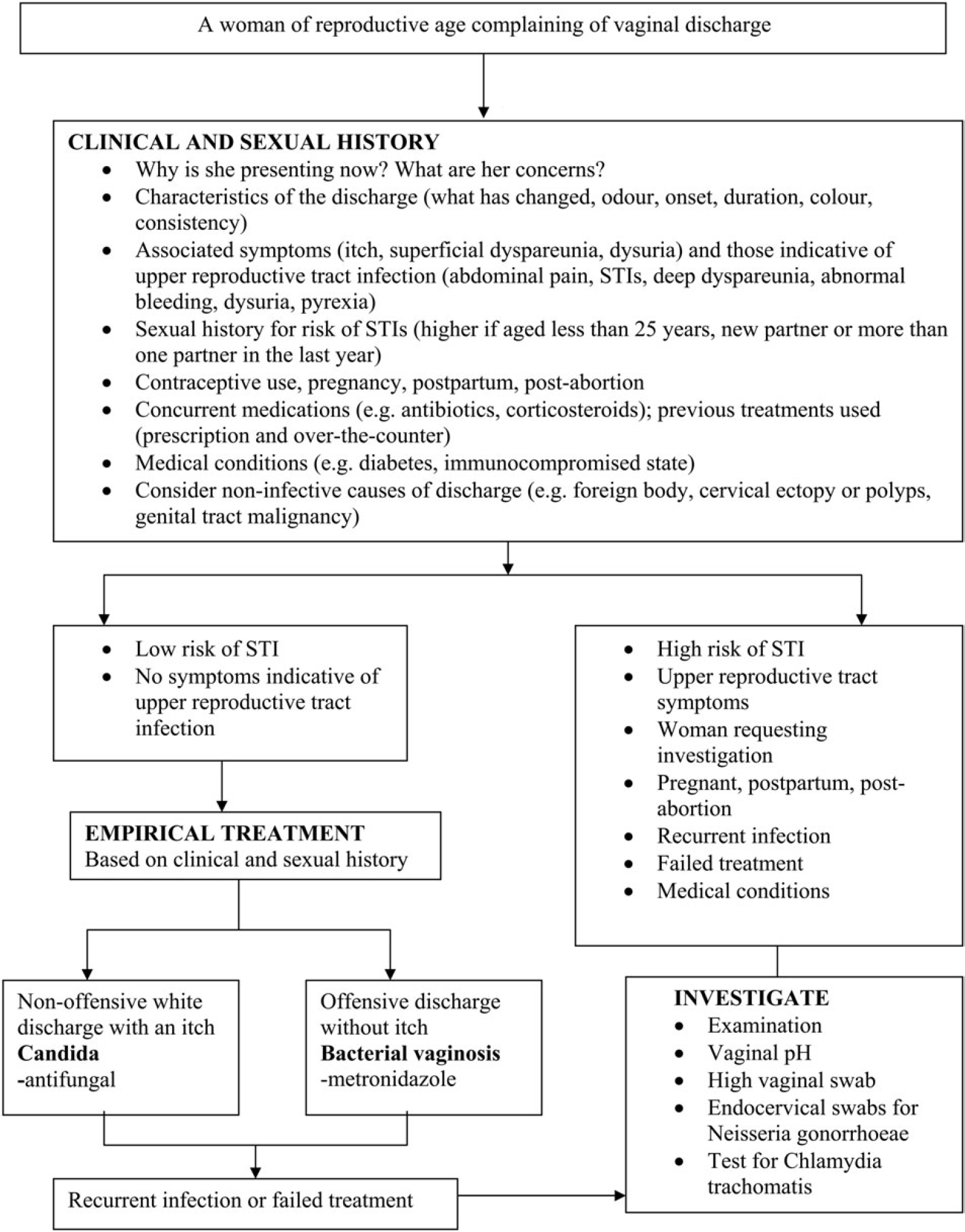
Flow chart for the assessment of women attending non-genito-urinary medicine settings complaining of vaginal discharge.
Take a full clinical and sexual history with a particular note on the nature of the discharge. Ask what has changed, and about onset and duration of symptoms. Enquire about the discharge—colour, odour and consistency—and its cyclicity in relation to the woman's menstrual cycle. Check if there are any associated symptoms, for example itch, superficial or deep dyspareunia, lower abdominal pain, dysuria, abnormal bleeding or pyrexia. Look for potential triggers of symptoms in the history, such as recent use of antibiotics or corticosteroids, recent unprotected intercourse and other medical conditions such as diabetes or immunocompromised states. Sexual history is vital to assess the risk of STIs. Women are at high risk of STIs if they are under the age of 25 years, have had a change in partner in the last year or have had more than one sexual partner in the last year.
In addition to the clinical and sexual history, physical examination and pH provide supporting information, which may help you to reach a diagnosis. However, a woman may be empirically treated at first presentation, based on her symptoms and without taking swabs, if she is at low risk for STIs and without symptoms indicative of upper reproductive tract infection. The presence of itch makes candida the likeliest cause and an antifungal treatment is most appropriate. An offensive odour makes BV the likeliest cause and metronidazole is then the treatment of choice.
Examination is required if the discharge
is recurrent or persists despite empiric treatment is blood stained is associated with abdominal pain, fever, deep dyspareunia or irregular bleeding, or occurs in a post-menopausal woman
Physical examination should include abdominal palpation for pain or tenderness; inspection of the vulva for obvious discharge or vulvitis; speculum examination to check the vaginal walls and cervix, to exclude the presence of foreign bodies and to examine the amount, consistency and colour of the discharge; and bimanual pelvic examination to assess the woman for adnexal and uterine tenderness and tenderness associated with movement of the cervix (cervical excitation).
During speculum examination, take a HVS for microscopy and culture and endocervical swabs for chlamydia and gonorrhoea.
If the swabs are not transported immediately to the laboratory, they should be stored at 4°C for no longer than 48 hours.
The presence of lower abdominal pain, cervical excitation and adnexal tenderness in association with abnormal vaginal discharge implies PID. It is vital to advise patients to avoid sexual intercourse until they and their partners have completed treatment if an STI is suspected.
Recurrent vaginal discharge
Psychosexual problems and depression may occur in women with recurrent vaginal discharge. In all cases,
potential underlying causes such as diabetes mellitus, immunosuppression, corticosteroid therapy or concurrent antibiotic use should be considered.
Recurrent BV
For women with recurrent BV, consider suppressive therapy with 5 g metronidazole intravaginal gel (0.75%) twice weekly for 4–6 months after an initial 10 day treatment, or 400 mg metronidazole orally bd for 3 days at the start and end of menstruation. Advise women to avoid use of douches, shower gels, antiseptic agents and shampoo in the bath. Acidifying gel may reduce relapse rates and maintain acidic vaginal pH at 1 month follow-up.
Recurrent VVC
For women with recurrent VVC (four or more episodes in 12 months) advise women to avoid douching, local irritants, perfumed products and tight-fitting synthetic clothing. Consider using an ‘induction and maintenance’ regimen for 6 months. Induction regimens involve daily use of vaginal imidazoles (usually clotrimazole) or oral fluconazole or itraconazole for 6–12 days. The maintenance regimen (half-dose) should comprise weekly treatments for 6 months duration (oral fluconazole 100 mg weekly, clotrimazole pessary 500 mg weekly or oral itraconazole 400 mg weekly). If further symptoms occur, induction and maintenance treatment may need to be restarted and continued for a longer period (12 months).
Recurrent TV
Recurrent TV is usually due to re-infection, but consideration should be given to the possibility of drug resistance.
Vaginal discharge in pre-pubertal girls
Vaginal discharge is the most common reason for referral of a pre-pubertal girl to a gynaecologist. Vaginal discharge in a young girl can cause parental anxiety. The vulval and vaginal skin in a pre-pubertal female is hypo-oestrogenic, thin and delicate with a neutral pH. The anus is anatomically very close to the vagina. These factors predispose to inflammation and infection. Non-specific bacterial vulvovaginitis is the most frequent cause; however, less common causes must be excluded (Box 3). In a young child an important cause of vaginal discharge may be an ectopic ureter. Sexual abuse should always be considered in girls with recurrent or persistent vaginal discharge. Vulval hygiene and the use of appropriate emollients form the cornerstone of successful management (Box 4).
Causes of vulvovaginitis with vaginal discharge in pre-pubertal girls
Group A beta-haemolytic Streptococcus Haemophilus influenzae Candida
Varicella Measles Rubella Diphtheria Shigella
Soap Bubble bath Playing in a sandpit Prolonged contact of urine and faeces with the skin Irritants; for example perfume, clothing dye Foreign bodies
Treatment of vulvovaginitis in a pre-pubertal girl
Ensure that the bottom is completely clean after defaecation Avoid constipation Wipe from front to back Avoid soaps and bubble baths Ensure that the vulval area is properly dry after bathing Ensure legs are wide apart when passing urine Avoid tight clothing, especially jeans Wear cotton underwear Do not wear underwear in bed Use gentle emollients and barrier creams
Vaginal discharge in pregnancy
The quality and quantity of vaginal discharge often changes during pregnancy with most women producing more discharge during pregnancy. It is important to distinguish between vaginal discharge and premature rupture of membranes during pregnancy, as the management is quite different.
BV in pregnancy
BV in pregnancy is associated with late miscarriage, preterm labour, premature rupture of membranes, low birth weight and post-partum endometritis. Routine screening during pregnancy is not currently recommended, but current guidelines support screening for women with a previous preterm birth (prior to 28 weeks gestation) or second-trimester miscarriage. If BV is identified as a cause of vaginal discharge in pregnancy, it should be treated. Treatment regimens include: Oral metronidazole 400mg twice daily for 5 days; metronidazole gel 5 g nightly for 5 nights; oral clindamycin 300 mg twice daily for 7 days; or clindamycin cream for 3 days.
VVC in pregnancy
VVC is common in pregnancy. Treatment is the same as for non-pregnant women but may need to be of longer duration (i.e. 7 days). Oral antifungals should be avoided in pregnancy because of potential teratogenicity.
TV in pregnancy
There is no indication for routine screening for TV in pregnancy. However, treatment with oral metronidazole (400 mg bd for 7 days) is indicated if TV is diagnosed. There is increasing evidence that TV may be associated with preterm delivery and low birth weight.
Chlamydia in pregnancy
The recommended regimen for treatment of chlamydia infection in pregnancy is erythromycin 500 mg four times a day for 7 days or erythromycin 500 mg twice a day for 14 days. Due to higher positive chlamydia tests after treatment in pregnancy, attributed to either less efficacious treatment regimen, non-compliance or re-infection, it is recommended that pregnant woman must have a test of cure 5 weeks after completing therapy (6 weeks later if given azithromycin).
Vaginal discharge following miscarriage or delivery
Patients presenting with vaginal discharge following miscarriage or delivery should be fully investigated and empirically treated while awaiting results of swabs. BV is associated with endometritis and PID following abortion, but retained products of conception should be considered in all women, particularly in the presence of a heavy growth of coliforms.
Vaginal discharge in post-menopausal women
After the menopause, atrophic vaginal changes may predispose women to infective vaginal discharge. Gynaecological malignancies and retained intrauterine contraceptive devices should also be considered as possible causes. Any women presenting with a post-menopausal bleed should be referred for further investigation to be seen within 2 weeks, for exclusion of endometrial cancer or other gynaecological malignancy.
Key points
Vaginal discharge is a common presenting symptom in the GP surgery Among women of reproductive age complaining of vaginal discharge, the most common cause is physiological, but infective and other causes should be excluded When taking swabs to establish a diagnosis, if there is a delay in transportation, vaginal swabs should be refrigerated at 4°C for no longer than 48 hours BV and vaginal candidiasis are the most common causes of infective vaginal discharge but neither is sexually transmitted Infections with Trichomonas vaginalis, C. trachomatis and N. gonorrhoeae are sexually transmitted. Contact tracing should be undertaken and partners treated to prevent re-infection Offer Chlamydia screening to all sexually active under-25-year olds