







Abstract
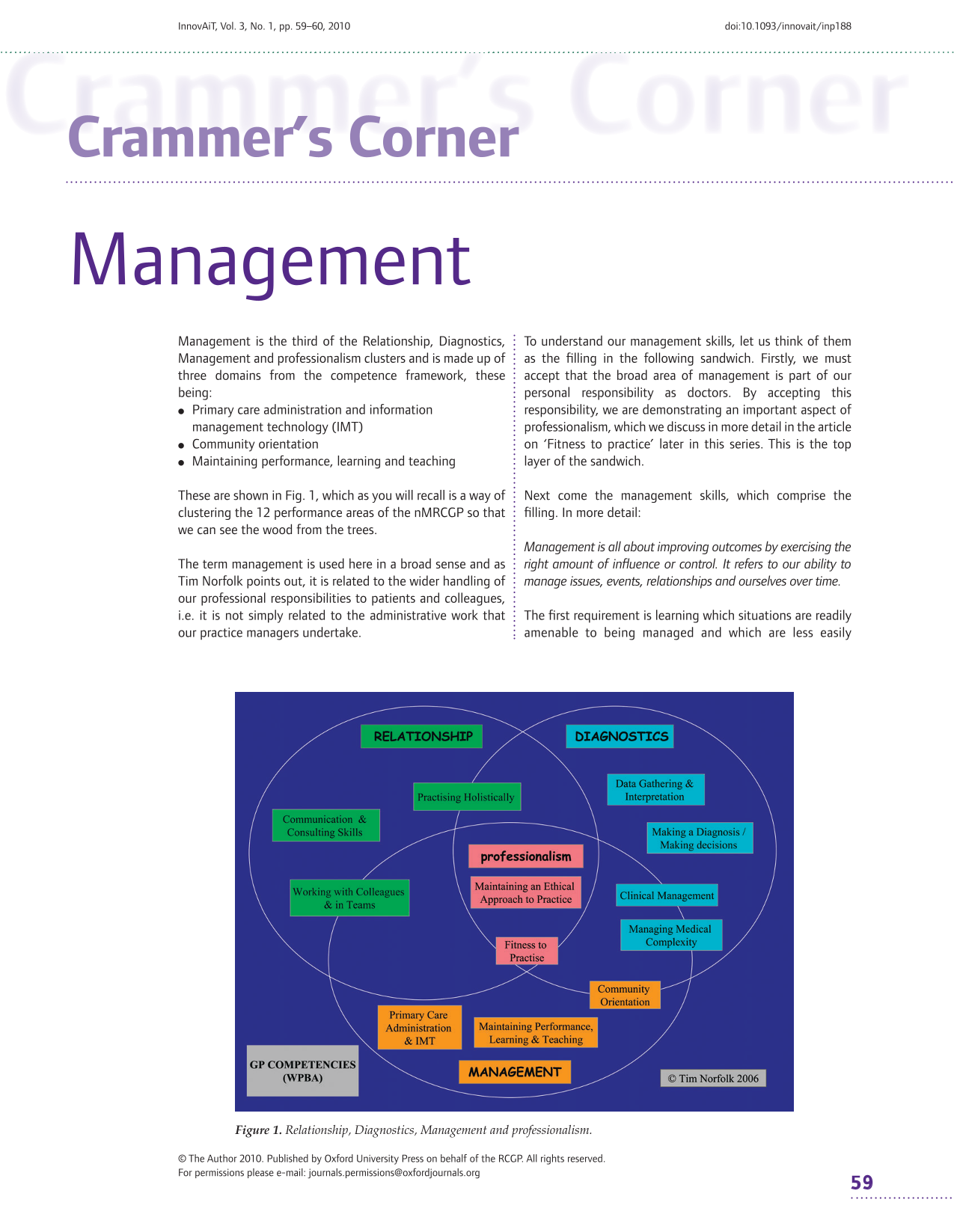
Management is the third of the Relationship, Diagnostics, Management and professionalism clusters and is made up of three domains from the competence framework, these being:
Primary care administration and information management technology (IMT) Community orientation Maintaining performance, learning and teaching
These are shown in Fig. 1, which as you will recall is a way of clustering the 12 performance areas of the nMRCGP so that we can see the wood from the trees.
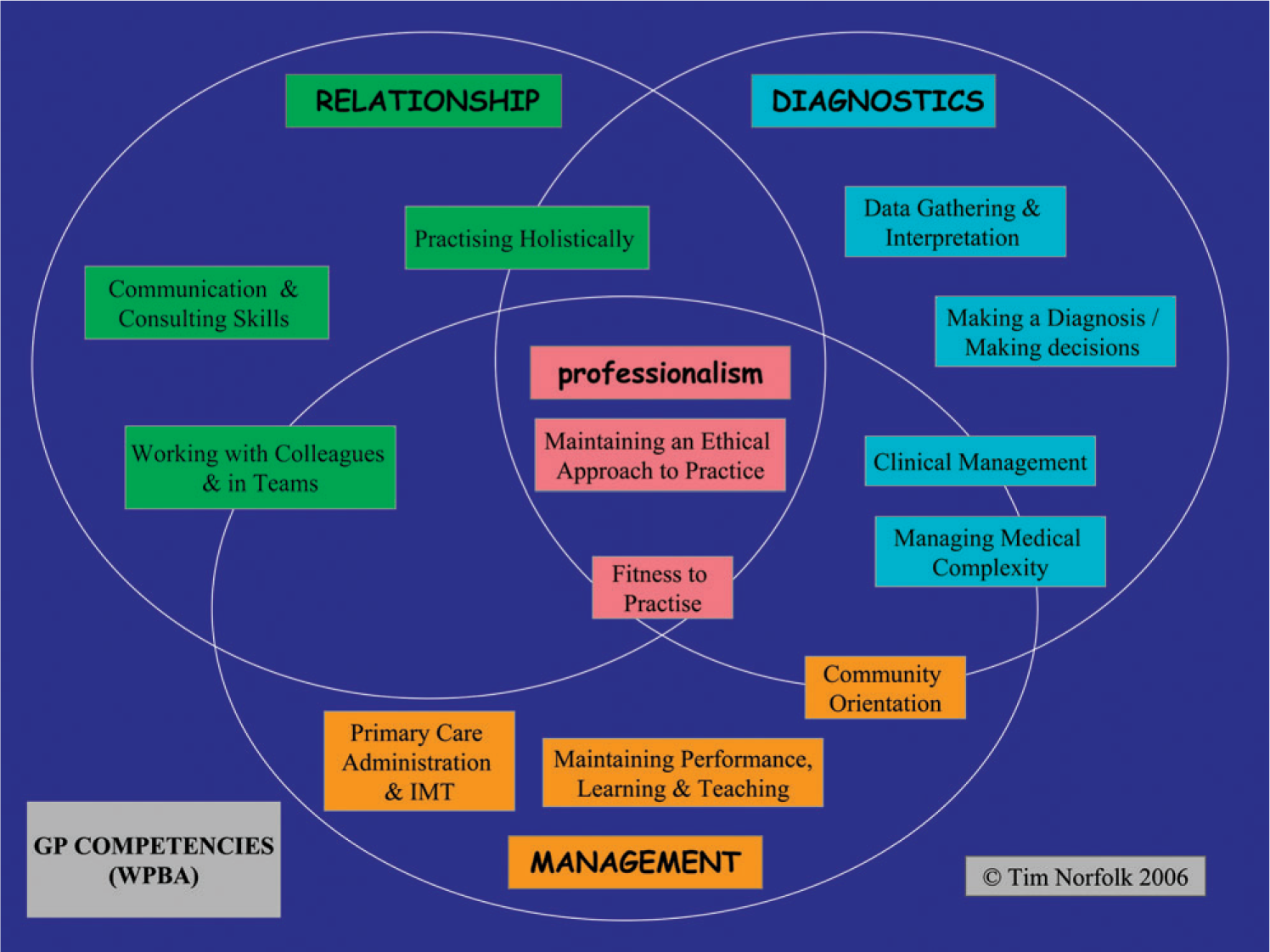
Relationship, Diagnostics, Management and professionalism
The term management is used here in a broad sense and as Tim Norfolk points out, it is related to the wider handling of our professional responsibilities to patients and colleagues, i.e. it is not simply related to the administrative work that our practice managers undertake.
To understand our management skills, let us think of them as the filling in the following sandwich. Firstly, we must accept that the broad area of management is part of our personal responsibility as doctors. By accepting this responsibility, we are demonstrating an important aspect of professionalism, which we discuss in more detail in the article on ‘Fitness to practice’ later in this series. This is the top layer of the sandwich.
Next come the management skills, which comprise the filling. In more detail:
Management is all about improving outcomes by exercising the right amount of influence or control. It refers to our ability to manage issues, events, relationships and ourselves over time.
The first requirement is learning which situations are readily amenable to being managed and which are less easily influenced. The spectrum is broad, for example, we might manage episodes such as the sequence of events in a consultation or ongoing situations such as our responsibilities as the leader of a project. We can also use management skills with relationships, for example, by planning to develop a relationship of trust with the patient through continuity of care or with colleagues through discussion on how to work together effectively. Importantly, management skills include the ability to continually keep track of situations and adjust to them. For example, we ‘manage’ ourselves by monitoring our performance and professional development and, more widely, by monitoring our mental and physical well-being.
By so doing, we take steps to work as effectively as we can and keep doing so throughout our careers. To be effective at management, we also need to learn that our influence has a narrow therapeutic range. Too little brings no benefit, whereas too much can be toxic to ourselves and the people around us!
The final layer of the sandwich is the realization that we and the situations we are involved with, such as the treatment of patients, are influenced by other people's attempts to manage. Just as we try to exercise some control in order to improve the outcomes, others around us do the same and part of our professionalism is to fit in with this to the appropriate degree. To give a clinical example, a colleague may suggest to the patient that if the symptoms did not improve, certain tests or a referral may be needed. We would certainly need to consider these thoughts and maybe ‘fit in’ with the colleague's plan.
Primary care administration and information management and technology
At first glance, this section might appear rather dull compared to the other performance areas as it does not seem to be directly related to patient care. We might even ask ‘What has “primary care administration’‘ to do with me and my training as a doctor?’ However, for modern GPs, the protocols and systems on which primary care is based are as essential to the care of patients as sound clinical skills. As doctors, we have a vital role in developing the systems that meet our needs.
This competency is about the appropriate use of primary care administration systems, effective record keeping and information technology for the benefit of patient care.
For licensing, we are not expected to have an in-depth knowledge of practice management but we should understand the basics of practice administration systems and, in particular, the role of the GP in applying, monitoring and improving this so that patient care is optimized and the practice, as a business, runs smoothly (and profitably!).
Computing skills on the other hand are as essential in modern practice as being able to write, and the curriculum requires us to have a level of skill equivalent to the European computer driving licence.
This performance area also includes the ability to keep good medical records, which is partly a matter of attitude and partly a skill.