







Abstract
This competence is about the management of the health and social care of the practice population and local community.
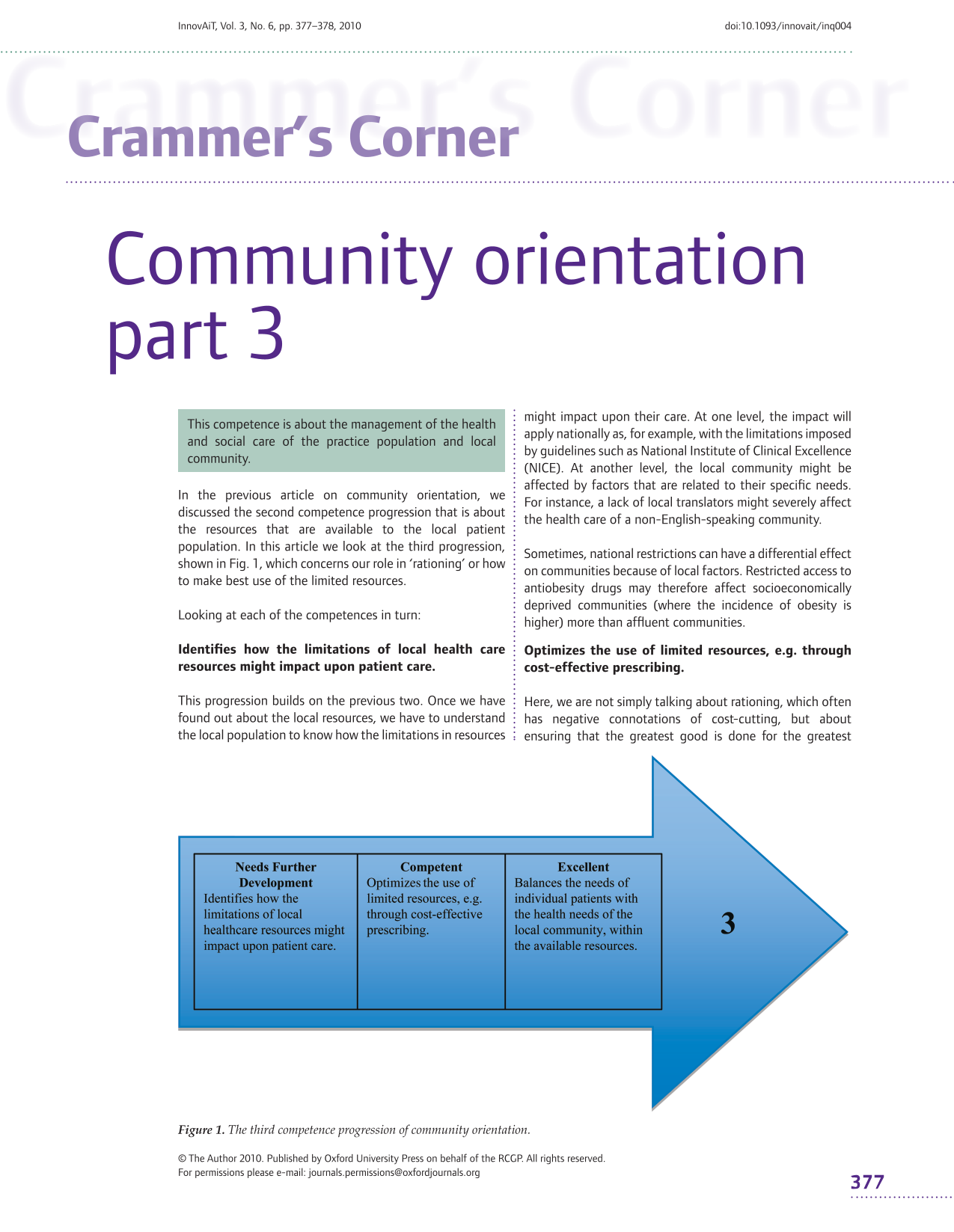
In the previous article on community orientation, we discussed the second competence progression that is about the resources that are available to the local patient population. In this article we look at the third progression, shown in Fig. 1, which concerns our role in ‘rationing’ or how to make best use of the limited resources.

The third competence progression of community orientation.
Looking at each of the competences in turn:
This progression builds on the previous two. Once we have found out about the local resources, we have to understand the local population to know how the limitations in resources might impact upon their care. At one level, the impact will apply nationally as, for example, with the limitations imposed by guidelines such as National Institute of Clinical Excellence (NICE). At another level, the local community might be affected by factors that are related to their specific needs. For instance, a lack of local translators might severely affect the health care of a non-English-speaking community.
Sometimes, national restrictions can have a differential effect on communities because of local factors. Restricted access to antiobesity drugs may therefore affect socioeconomically deprived communities (where the incidence of obesity is higher) more than affluent communities.
Here, we are not simply talking about rationing, which often has negative connotations of cost-cutting, but about ensuring that the greatest good is done for the greatest number of people (a utilitarian principle). Very often, making the best financial use of resources is not in conflict with producing the optimum management plan. For example, the curriculum teaches us to:
Recognize the place of simple therapy and expectant measures in cost-effective management, while ensuring that the patient's condition is adequately monitored
Prioritize referrals accurately so that people with minor conditions do not delay/compromise the care of those with more serious conditions
Avoid investigations or treatments that are unlikely to alter outcomes, so that the availability of these resources (e.g. imaging methods) is increased
Deal with situational crises and manipulative patients appropriately, without resorting to inappropriate investigation or referral
Discussion: identifying local limitations in resources
Find out from doctors and nurses in your practice about cutbacks in service and the impact that this had. For example, has the practice lost services that it used to provide, such as chiropody, physiotherapy, extended district nursing services? Have these been missed and if so by whom and why?
Beyond this, what services do local practitioners feel should be provided, but are not yet available? Again, what impact does this lack of service have on the local community? Do practitioners feel that this adverse impact is any worse locally than it would be nationally? If so, why? This question will help to gauge the relative importance of local factors.
Moving to locality level, try to find out what the priorities of the local commissioning body are. What limitations are they trying to rectify and why?
You can make a reflective note of your findings, which will be of interest to the practice and will be excellent evidence for your portfolio.
Tip: demonstrating the optimum use of resources
You could readily demonstrate cost-effective prescribing by showing that you prescribe generically and by recording situations in which you chose a more cost-effective drug or avoided a more costly formulation, such as a modified release drug where this was not necessary.
Now look at the four-numbered list of principles in the text. Try to produce evidence of these, particularly of the first three as the opportunity for these occurs frequently. Examples from the range of areas discussed in this box will be ample evidence for the portfolio.
The nub of this complex competence is understanding that we have responsibilities to individual patients and to wider communities. To demonstrate this competence, we must be able to explain and justify the decisions that we make by showing that we recognize the tensions and have a rational way of approaching them. Probably, the most important abilities that we need are to show sensitivity and awareness for the problems that rationing creates, particularly in the human dimension and to avoid prejudice and undue bias in trying to reach a compromise.
‘Resources’ should be widely interpreted. We are not just talking about finances, but about services, including our own time. Therefore, making optimal use means thinking about time spent with patients as well as investigations, referrals and prescribing costs.
Note that the curriculum points out that ‘balancing resources’ means that we must also plan to give some people more resources than others. Such people are often, by virtue of their condition, less able to speak up for their needs and in these situations, part of our role as doctors is to act as their advocate.
Finally, let us consider the patient whose demands seem to be inappropriate. Part of the balance that we have to consider is the one between giving the patient what they want and confronting the patient, with the risk of a timeconsuming complaint and damage to our emotional health. Time lost with complaints is an important loss of medical time that could be spent on patient care. On the other hand, not dealing with such an issue may simply store up problems for ourselves or colleagues in the future and is not fair to the majority of patients who do not shout for attention. In managing this, we have to remember that our health is also an important resource that is finite and should be used with care.
In the next and final articles on ‘Management’, we will consider how we manage ourselves well enough to maintain our performance.