







Abstract
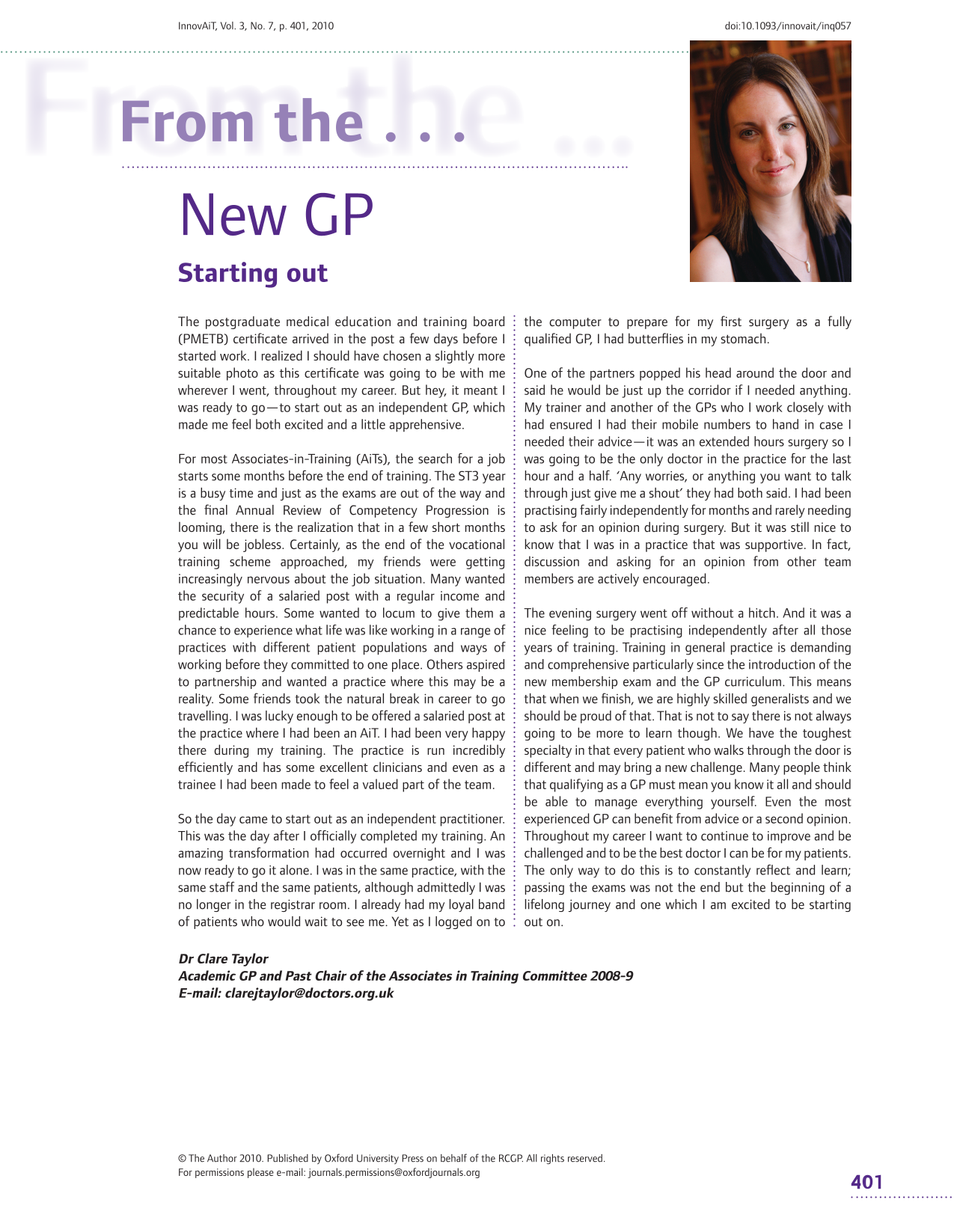

The postgraduate medical education and training board (PMETB) certificate arrived in the post a few days before I started work. I realized I should have chosen a slightly more suitable photo as this certificate was going to be with me wherever I went, throughout my career. But hey, it meant I was ready to go—to start out as an independent GP, which made me feel both excited and a little apprehensive.
For most Associates-in-Training (AiTs), the search for a job starts some months before the end of training. The ST3 year is a busy time and just as the exams are out of the way and the final Annual Review of Competency Progression is looming, there is the realization that in a few short months you will be jobless. Certainly, as the end of the vocational training scheme approached, my friends were getting increasingly nervous about the job situation. Many wanted the security of a salaried post with a regular income and predictable hours. Some wanted to locum to give them a chance to experience what life was like working in a range of practices with different patient populations and ways of working before they committed to one place. Others aspired to partnership and wanted a practice where this may be a reality. Some friends took the natural break in career to go travelling. I was lucky enough to be offered a salaried post at the practice where I had been an AiT. I had been very happy there during my training. The practice is run incredibly efficiently and has some excellent clinicians and even as a trainee I had been made to feel a valued part of the team.
So the day came to start out as an independent practitioner. This was the day after I officially completed my training. An amazing transformation had occurred overnight and I was now ready to go it alone. I was in the same practice, with the same staff and the same patients, although admittedly I was no longer in the registrar room. I already had my loyal band of patients who would wait to see me. Yet as I logged on to the computer to prepare for my first surgery as a fully qualified GP, I had butterflies in my stomach.
One of the partners popped his head around the door and said he would be just up the corridor if I needed anything. My trainer and another of the GPs who I work closely with had ensured I had their mobile numbers to hand in case I needed their advice—it was an extended hours surgery so I was going to be the only doctor in the practice for the last hour and a half. ‘Any worries, or anything you want to talk through just give me a shout’ they had both said. I had been practising fairly independently for months and rarely needing to ask for an opinion during surgery. But it was still nice to know that I was in a practice that was supportive. In fact, discussion and asking for an opinion from other team members are actively encouraged.
The evening surgery went off without a hitch. And it was a nice feeling to be practising independently after all those years of training. Training in general practice is demanding and comprehensive particularly since the introduction of the new membership exam and the GP curriculum. This means that when we finish, we are highly skilled generalists and we should be proud of that. That is not to say there is not always going to be more to learn though. We have the toughest specialty in that every patient who walks through the door is different and may bring a new challenge. Many people think that qualifying as a GP must mean you know it all and should be able to manage everything yourself. Even the most experienced GP can benefit from advice or a second opinion. Throughout my career I want to continue to improve and be challenged and to be the best doctor I can be for my patients. The only way to do this is to constantly reflect and learn; passing the exams was not the end but the beginning of a lifelong journey and one which I am excited to be starting out on.