







Abstract
Well, it's a paradox. Patients have been referred to me with all sorts of chronic pain which fail conventional treatment. I put on a new pair of glasses and see these patients in a different perspective, grab some needles and insert them at specified points on the body, twist them around for half an hour and the patients get better.
This is acupuncture, a major therapeutic modality of Traditional Chinese Medicine (TCM). Western science has yet to decipher its basis of action, but as a treatment for chronic pain it remains a useful alternative in general practice.
Classic patients
Case study 1
Mrs A, a widow in her late 80s, has advanced osteoarthritis of both knees against a background of multiple co-morbidities, making her ineligible for a knee replacement. She is taking maximum doses of her slow-released morphine and showed no improvement with repeated intra-articular hyaluronic acid and extra-articular steroid injections. She insists on her independence and sees her GP's advice of using a wheelchair as an insult.
Case study 2
Mr B is a successful accountant in his late 30s and suffers persistent back pain following a sprain 12 months ago. Pain ranges from 7/10 to 10/10 after prolonged standing or sitting, mainly felt in the lumbo-sacral area with no sciatic radiation. Repeated magnetic resonance imaging (MRI) scans have excluded herniated intervertebral discs. Oral non-steroidal medications have not helped and Mr B declines anything stronger than codeine for fear of addiction. Physiotherapy sessions have helped minimally. He does not believe in cognitive behaviour therapy for his pain.
Case study 3
Mr C is a car mechanic and has just turned 50 years. He was proud of his health until he developed pain and paraesthesia in the lateral three fingers of both hands that render him unable to hold a spanner, let alone his other usual chores. After being diagnosed with bilateral carpal tunnel syndrome, he has no relief with multiple steroids injections. He declined surgical decompression when he learnt of the low chance of success. He cannot tolerate oral analgesics as they ‘dope him out’ at work. Physiotherapy sessions have helped minimally and the prescribed wrist braces keeps him awake at night.
Patients A, B and C are classic patients among the many others who are referred to my acupuncture clinic. Their complaints have not been relieved by Western medicine and they are eager to seek alternatives that will help in whatever way possible. Such scenarios are often criticized by sceptics of complementary and alternative medicine as being a self-fulfilling prophecy; any benefit from acupuncture is nothing more than placebo. Instead of going into such an argument, I shall only describe the discipline of acupuncture as I know it and let the readers decide for themselves as to how relevant it may be to their patient groups in their daily practice.
History of acupuncture
Acupuncture is a treatment modality that originates from 5000 BC to 10 000 BC along the banks of the Yellow River of China. It involves insertion of sharpened objects into specific areas of the body to achieve a curative effect. The very first sharpened objects are carved out from animal bones or stone flints, and they can hardly be regarded as needles. It was not until the Zhou dynasty (1000 BC to 250 BC) when the art of metallurgy in China reached an acme to enable the production of the prototypes of filamentous needles for acupuncture. Today, needles are mostly made of stainless steel for strength and occasionally, for special reasons, pure copper or pure gold. The art of acupuncture was carried along with expeditions to Japan in 200 BC and Korea in 800 AD. Twice in the history of China, acupuncture was almost eradicated as an obsolete culture when the existing reigning body was overturned.
Theory of acupuncture
Acupuncture is based around the fundamental principles of TCM like Yin—Yang, Zhing—Fu, and Qi—Xue that were covered in the first article. In a healthy state, an incessant flow of Qi will propel the Xue through the 365 points of the 12 meridians without delay or obstruction, so that all Zhongs and Fus will interact with each other with the appropriate Yin—Yang dynamics as governed by the relationships of the Five Elements. Any deviation will lead to a disturbance of Qi and Xue flow within the meridians that then manifest as imbalance of the Zhong/Fu and overall illness. When certain strategic acupoints on the affected meridian are manipulated with needles, the flow of Qi is regulated along with Xue, and subsequently the Zhong/Fu functions are normalized to ensure health. Utilizing particular acupoints depends on the overall diagnosis. Despite two patients having the same symptoms, the prescription of acupoints often differs because of the patient's unique internal milieus. In a way, the practice of acupuncture is a very ancient form of personalized medical care.
Meridians, acupoints and de-qi
Meridians are designated routes through which Qi and Xue travel and circulate round every part of the body. Think of them as highways and Qi/Xue are the cars speeding along on them. Each meridian is linked to a Zhong, a Fu or the Sanjiao. The five Zhong meridians occupy the anterior aspect of the body while the six Fu meridians are located posteriorly. All meridians are linked up with each other in such a way that one meridian will end on the beginning of the other, so that Qi and Xue will advance through every part of the body in a big grand cycle. There are 12 major meridians covering the body similar to the 12 months in a calendar year, an example that TCM is founded upon the laws of nature. The meridians traverse the body in designated routes such that different anatomical sites will feature different combinations of meridians (see Figs. 1– 3). For full details of all the 12 meridian routes, readers are advised to consult standard acupuncture textbooks or online resources.

The head and neck featuring the gall bladder and Sanjiao meridians.

The abdomen showing the stomach, the kidney and the spleen meridians.

The foot features the kidney, the spleen, the liver and the gall bladder meridians.
Acupoints are specific points along the meridians through which manipulation with acupuncture needle will bring about regulation of the Qi and Xue and hence re-establishing the inner balance between the Zhongs/Fus and the overall dynamic homeostasis. One can think of them as relays or switches in an electrical grid. There are 365 main acupoints in the body as with 365 days in a calendar year.
De-qi refers to the unique needling sensation brought on by acupuncture. It has been described with various descriptive like ‘pressure’, ‘pushing feeling’ and ‘dull ache’. De-qi happens at variable lengths of time after the needle is inserted and is often hastened with twisting and manipulation of the needle. It may be localized, or it may travel along the meridian. It is regarded as the hallmark of an efficacious treatment. Recent functional magnetic resonance imaging (fMRI) studies by researchers from Harvard University (Hui et al., 2005, 2007) have shown various patterns of brain activity that are specific to the de-qi sensation, hence refuting criticisms that de-qi is nothing more than a figment of the imagination.
How does science explain acupuncture?
At time of writing, there remains no consensus as to the exact physiological mechanism underlying acupuncture. Neither the meridians nor the acupoints follow any Western anatomical system, structures or landmarks. Most, if not all, acupoints are located in areas that are unlikely to have life-threatening effects when penetrated by needles. From a mechanical standpoint, it has been hypothesized that the insertion and twisting of acupuncture needle distorts the connective tissues (Langevin et al., 2002) and stimulates the mechanoreceptors, sending off the first neural signals (Langevin et al., 2001). Subsequently, the micro-trauma induced around the needle leads to mast cell degranulation (Zhang et al., 2007) and release of pro-inflammatory mediators (i.e. TNF-α, interleukins and ATP) as macrophages are recruited. Paradoxically, these mediators are known to initiate nociception especially with the C-fibres (Ren and Torres, 2009) or enhance their transmission especially in the aetiology of chronic pain (Liu et al., 2007). Centrally, various receptors have been implicated for the actions of acupuncture, the main ones include the opioid (Zhang et al., 2004), the 5-HT (Chang et al., 2004), the monoamines (Zhu et al., 1997) and the glutamatergic receptors (Sun et al., 2004). Modern neuroimaging studies, in particular fMRI of the brain, reveal consistent activation patterns with acupuncture at points along meridians versus acupuncture at non-traditional random points (Li et al., 2008). Similarly, de-qi sensation in acupuncture is characterized by specific activation and deactivation fMRI patterns of the brain (Hui et al., 2007) that may also modulate its default mode network and the anti-correlated network (Bai et al., 2009; Hui et al., 2009). These neuroimaging studies have helped immensely in elucidating the possible mechanisms for the therapeutic actions of acupuncture.
How safe is acupuncture?
After all, a needle is a needle and it is not without risk when inserted into the human body. Three thousand years of clinical practice have percolated into a list of taboo sites where the acupuncture practitioner shall never place a needle: palpable pulses, eyeballs, genitalia, anus, lips, eyelids, precordium, a gravid abdomen and abscesses.
Having said, human anatomy, like that taught in medical school, is never included in the traditional curriculum of acupuncture. Practitioners occasionally go too deep with their needles resulting in foreseeable complications like a pneumothorax, bleeding, haematoma, organ puncture or nerve damage (most often the sciatic nerve). Other unforeseeable adverse effects include fainting, vomiting, cutaneous reaction and hypotension (Lao et al., 2003; Leung and Zhang, 2008; Leung et al., 2009). From one systemic review, 202 adverse incidents have been identified in 98 relevant papers from 22 countries over the last 35 years (Lao et al., 2003). Overall, acupuncture practice is still considered safe with trained hands.
What is the bedside evidence for the benefits of acupuncture?
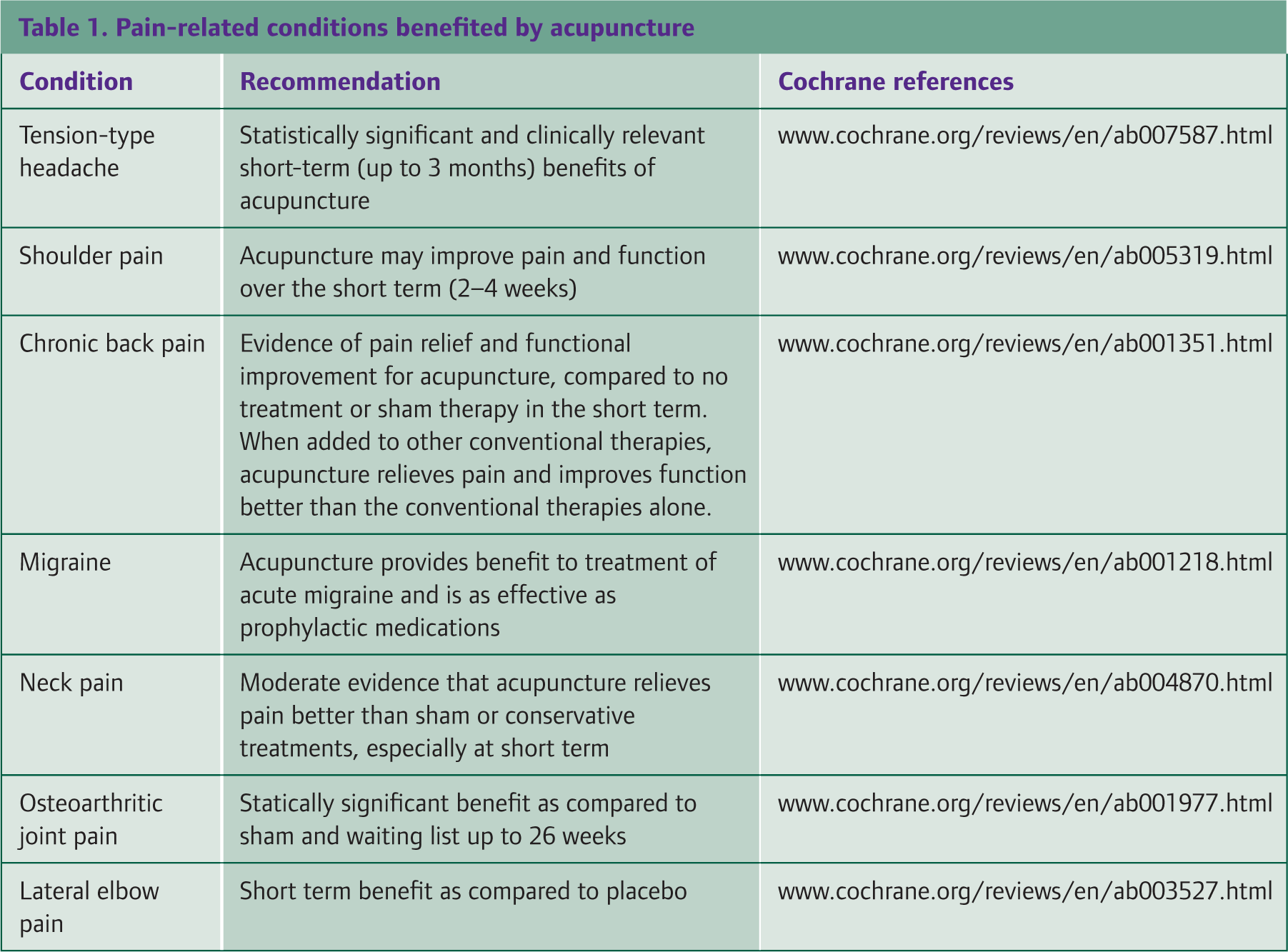
Cochrane Reviews provide evidenced-based recommendation for use of acupuncture for various conditions. A list of conditions for which acupuncture is considered to be beneficial has been tabulated for reference (Tables 1 and 2). A general caution in reviewing evidence-based data for acupuncture is that it is always difficult to standardize the prescription of acupoints and the duration of treatment due to the personalized nature of treatment. More often than not, the clinical trials included are either statistically underpowered or flawed in methodology.
Pain-related conditions benefited by acupuncture
Non-pain-related conditions benefited by acupuncture

Regulation of practice of acupuncture in UK
The Acupuncture Working Group by the Department of Health (DOH) reported that in 2003, there were about 7500 acupuncture practitioners in UK. Two-thirds of them belong to the two major self-regulated professional bodies (British Acupuncture Council and the British Medical Acupuncture Society; the other third do not belong to any professional body). The same report proposed the formation of a register for all acupuncture practitioners to regulate standards of practice while preserving the diversity of training backgrounds present in the profession. In June 2006, the DOH Steering Group for the Statutory Regulation of Acupuncture, Herbal Medicine and Traditional Chinese Medicine Practitioners was established to prepare the ground for regulating practitioners. In May 2008, the same steering group urged statutory regulation of all such practitioners under the auspice of a bigger collective, preferably through the existing regulatory body instead of formation of new statutory councils. At the time of writing, the profession of acupuncture is still voluntarily regulated by the institutions as shown in Table 3.
List of voluntary self-regulated organizations for acupuncture

How can a GP learn acupuncture in the UK
There are many institutions or Universities in the UK offering diplomas/degree courses in acupuncture; however, the standard of education is not monitored by the UK Government due to lack of statutory regulation. Having said, there is the British Acupuncture Accreditation Board (BAAB) which is a corporation working closely with the British Acupuncture Council to review the standards of available acupuncture courses and provide formal accreditation. As of 2008, there are nine institutions in the UK that meet the accreditation of BAAB, as summarized in Table 4.
List of institutions in UK offering BAAB accredited courses in acupuncture

How can it fit in my practice?
I have been practising acupuncture in parallel with my general practice for almost a decade and it is undoubtedly a major impetus for my journey of life-long learning. So often I accrue a pearl of practical wisdom—or phronesis as Plato coined it—as I adapt my thinking and skills that leads to a successful treatment. The joy will be beyond description. For trainees who share my belief and passion in acupuncture, they are strongly encouraged to pursue structured courses and achieve certified status to practice acupuncture for patients who may need it. For the rest of trainees, they should be cognizant of the possible therapeutic effects of acupuncture and stay open-minded enough to refer patients in need to properly trained hands. Last but not least, I believe that the present gold standards for evidence-based practice (i.e. double-blind randomized control trial) may not be an appropriate ruler to measure the true efficacy of acupuncture (and TCM as a whole) due to the multiple dynamic variables involved compared to the reductionistic constructs of Western medicine that prevail. I started out practising acupuncture according to the Cochrane and Bandolier guidelines; yet over the years, my phronesis has rapidly expanded to enable me to practise beyond such confines to bring about a significantly larger number of cures. I guess, in General Practice, we all do a similar thing everyday.