







Abstract
This competence is about the doctor's awareness of when his/her own performance, conduct or health or that of others might put patients at risk and the action taken to protect patients.
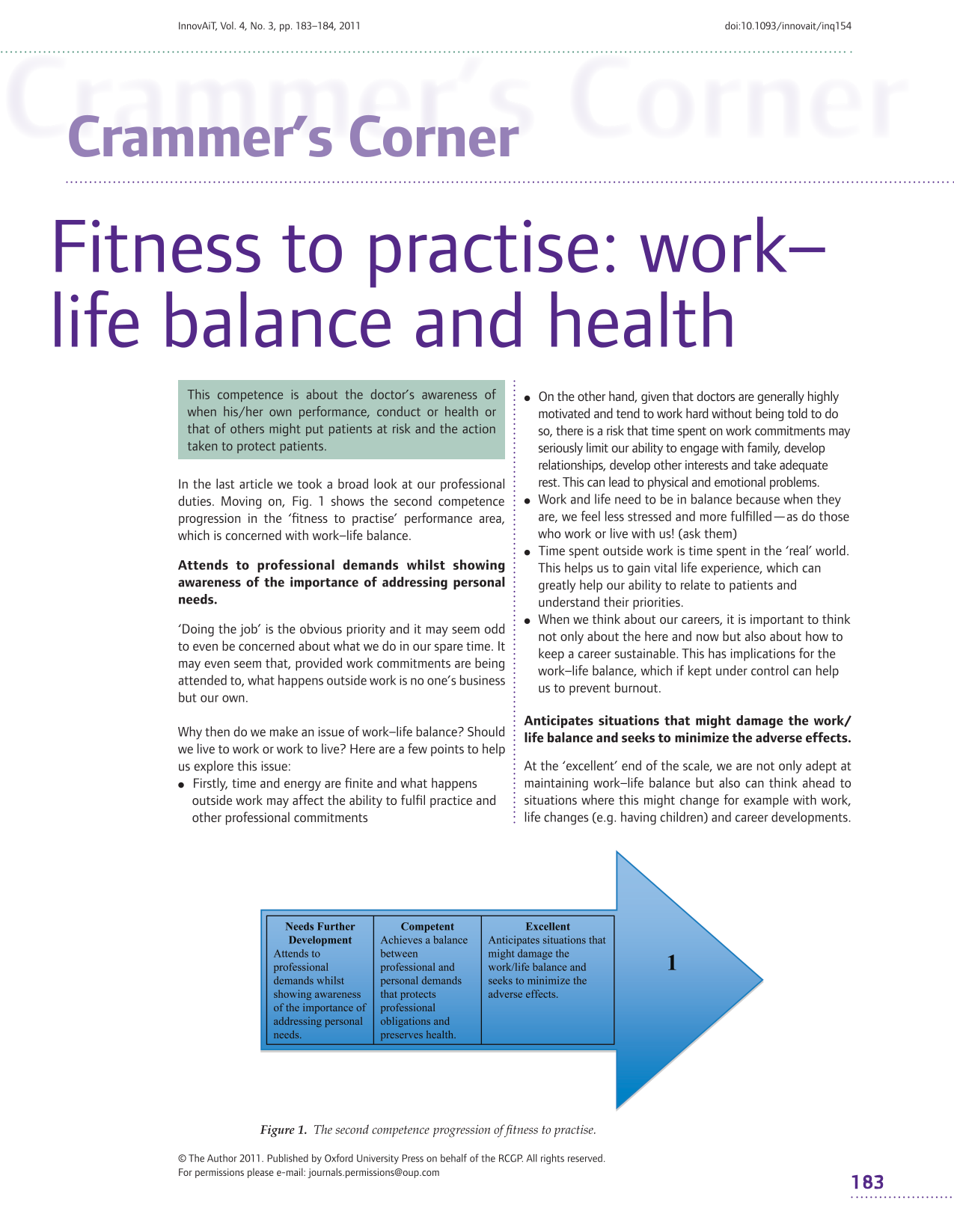
In the last article we took a broad look at our professional duties. Moving on, Fig. 1 shows the second competence progression in the ‘fitness to practise’ performance area, which is concerned with work—life balance.

The second competence progression of fitness to practise.
‘Doing the job’ is the obvious priority and it may seem odd to even be concerned about what we do in our spare time. It may even seem that, provided work commitments are being attended to, what happens outside work is no one's business but our own.
Why then do we make an issue of work—life balance? Should we live to work or work to live? Here are a few points to help us explore this issue:
Firstly, time and energy are finite and what happens outside work may affect the ability to fulfil practice and other professional commitments
On the other hand, given that doctors are generally highly motivated and tend to work hard without being told to do so, there is a risk that time spent on work commitments may seriously limit our ability to engage with family, develop relationships, develop other interests and take adequate rest. This can lead to physical and emotional problems.
Work and life need to be in balance because when they are, we feel less stressed and more fulfilled—as do those who work or live with us! (ask them)
Time spent outside work is time spent in the ‘real’ world. This helps us to gain vital life experience, which can greatly help our ability to relate to patients and understand their priorities.
When we think about our careers, it is important to think not only about the here and now but also about how to keep a career sustainable. This has implications for the work—life balance, which if kept under control can help us to prevent burnout.
At the ‘excellent’ end of the scale, we are not only adept at maintaining work—life balance but also can think ahead to situations where this might change for example with work, life changes (e.g. having children) and career developments.
In the third competence progression (Fig. 2), we consider our personal health and the health of those we are responsible for in the organization.

The third competence progression of fitness to practise.
Attends to physical or mental illness or habit that might interfere seriously with the competent delivery of patient care.
Our health matters because there is little point in achieving competence if our work becomes unsustainable because of health issues.
Being doctors does not make us immune to ill health. We are prone to the same range of diseases as the general population and would be expected to deal with these in a similar manner to other patients. This is much easier said than done. Doctors tend to feel they know better, a significant percentage self-medicate and the culture of medicine is fairly intolerant to taking time off work.
The three most common disorders from which GPs suffer are depression, anxiety and alcoholism, i.e. this does not just happen to other people, it happens to us!
Surveys suggest that in descending order of frequency, the main stressors are
Emergency calls during surgery hours
Time pressure
Working after a sleepless night
Dealing with problematic patients
Worrying about patient complaints
Interruption of family life (particularly for female doctors)
Unrealistically high expectations by others of the doctor's role
Partner on holiday
Older GPs are more stressed by contract demands compared to younger doctors, but younger doctors are more stressed by unrealistic patient demands.
What are the signs and symptoms of stress to look out for? It is as relevant to look for these in ourselves as in others.
Lack of concentration, increased errors and adverse significant events
Poor timekeeping
Poor productivity
Difficulty in comprehending new procedures, increased tendency to make mistakes and resisting change
Lack of motivation or cooperation along with irritability, aggressiveness, withdrawal behaviour and resentment
Proactive in taking steps to maintain personal health.
Here are some practical suggestions. Please think about them.
Register with the GP before you need their help. This way you can get the benefit of modern preventative medicine.
Work and life: control the workload, create appropriate boundaries and try to live a healthy life. Have a life! Keep the work—life balance under review. Learn stress management techniques including taking exercise. Make sure that your work continues to have meaning for you. This way you can maintain your motivation over the years.
Consulting: improve the ‘feel good’ of the environment that you spend so much time in. For example, look at ergonomics, decoration, personal items and mementos.
Learn to manage your time better, such as not being late for work, avoiding non-urgent consultations and eruptions in surgery
Promotes an organizational culture in which the health of its members is valued and supported.
There is an implicit onus on us and other healthcare workers to set a good example by living healthy lifestyles. Doctors who achieve this high-level ability seek to make health an issue for the team, for example, by encouraging personal health promotion and by looking at ways in which health could be influenced by the conditions at work.